


 Скачать презентацию Management Information Systems 10 e Raymond Mc Leod Jr
8029ad2c2e40fa8e3273ae31407d401f.ppt
- Количество слайдов: 25
 Management Information Systems, 10/e Raymond Mc. Leod Jr. and George P. Schell © 2007 by Prentice Hall Management Information Systems, 10/e Raymond Mc. Leod and George Schell 1
 Part I: Essential Concepts Chapter 1 Introduction to Information Systems © 2007 by Prentice Hall Management Information Systems, 10/e Raymond Mc. Leod and George Schell 2
 Introduction to Computer Architecture ► Hardware-processor, keyboard, monitor, mouse, printer, etc. ► Software-application, operating, etc. ► Used to support managerial decision making. © 2007 by Prentice Hall Management Information Systems, 10/e Raymond Mc. Leod and George Schell 3
 Introduction to Computer Architecture (Cont’d) ► Modem-hardware device that modulates ﻳﻨﻈﻢ the digital signals from a computer into analog signals (telephone system), and vice versa. ► Direct communication standards § Between computers is much faster. ► Wireless networks © 2007 by Prentice Hall Management Information Systems, 10/e Raymond Mc. Leod and George Schell 4
 The Evolution in Computer Applications systems are virtual systems that enable management to control the operations of the physical system of the firm. ► Physical system-tangible resources such as materials, personnel, machines, and money. ► Virtual system-information resources that are used to represent the physical system. ► Information © 2007 by Prentice Hall Management Information Systems, 10/e Raymond Mc. Leod and George Schell 5
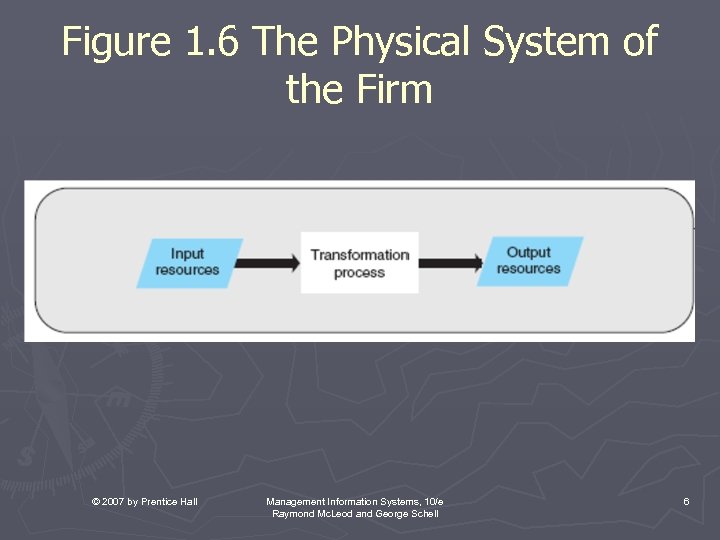 Figure 1. 6 The Physical System of the Firm © 2007 by Prentice Hall Management Information Systems, 10/e Raymond Mc. Leod and George Schell 6
 The Evolution of Computer Applications (Cont’d) ► Open system is a firm’s physical system that interacts with its environment by means of physical resource flows. ► Closed system is one that does not communicate with its environment. © 2007 by Prentice Hall Management Information Systems, 10/e Raymond Mc. Leod and George Schell 7
 Transaction Processing Systems ► Data-facts and figures that are generally unusable due to their large volume and unrefined nature. ► Information-processed data that is meaningful; tells users something. ► Transaction Processing System (TPS) processes data that reflects the activities of the firm. © 2007 by Prentice Hall Management Information Systems, 10/e Raymond Mc. Leod and George Schell 8
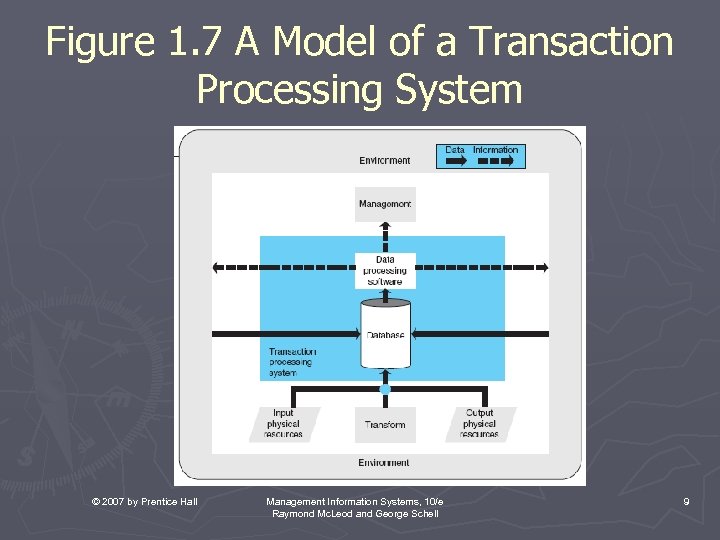 Figure 1. 7 A Model of a Transaction Processing System © 2007 by Prentice Hall Management Information Systems, 10/e Raymond Mc. Leod and George Schell 9
 Management Information Systems ► Management Information System (MIS) is a computer-based system that makes information available to users with similar needs. § Report-writing software produces both periodic and special reports. § Mathematical models produces information as a simulation of the firm’s operations. © 2007 by Prentice Hall Management Information Systems, 10/e Raymond Mc. Leod and George Schell 10
 Management Information Systems (Cont’d) ► Information provided by MIS describes the firm or one of its major systems. § What has happened in the past. § What is happening now. § What is likely to happen in the future. ► Interorganizational information system (IOS)–is formed when a firm interacts with others, such as suppliers. © 2007 by Prentice Hall Management Information Systems, 10/e Raymond Mc. Leod and George Schell 11
 Virtual Office Systems ► Office automation-use of electronics to facilitate communication. ► Personal productivity systems-use technology to self-manage clerical tasks such as calendars, address books, etc. ► Virtual office-performing office activities independent of a particular physical location. © 2007 by Prentice Hall Management Information Systems, 10/e Raymond Mc. Leod and George Schell 12
 Decision Support Systems ► Decision Support System (DSS)–assists management in solving a problem. ► Groupware–group-oriented software. ► Group decision support system (GDSS) combines groupware and the DSS. ► Artificial intelligence (AI)–the science of providing computers with human intelligence. © 2007 by Prentice Hall Management Information Systems, 10/e Raymond Mc. Leod and George Schell 13
 Enterprise Resource Planning Systems ► Enterprise Resource Planning System (ERP) is a computer-based system that enables the management of all of the firm’s resources on an organization-wide basis. § Y 2 K complaint § SAP–ERP Provider © 2007 by Prentice Hall Management Information Systems, 10/e Raymond Mc. Leod and George Schell 14
 Information System Users ► First users were clerical users on TPSs. ► MISs added problem-solvers as users. ► Managerial Levels § Strategic planning level § Management control level § Operational control level © 2007 by Prentice Hall Management Information Systems, 10/e Raymond Mc. Leod and George Schell 15
 Managerial Functions ►Henri Fayol was the first to describe the four managerial functions when he was the CEO of a large mining company in the later 1800’s. ►Fayol noted managers at all levels, operating in a for profit or not for profit organization, must perform each of the functions of: Planning, organizing, leading, controlling. © 2007 by Prentice Hall Management Information Systems, 10/e Raymond Mc. Leod and George Schell 16
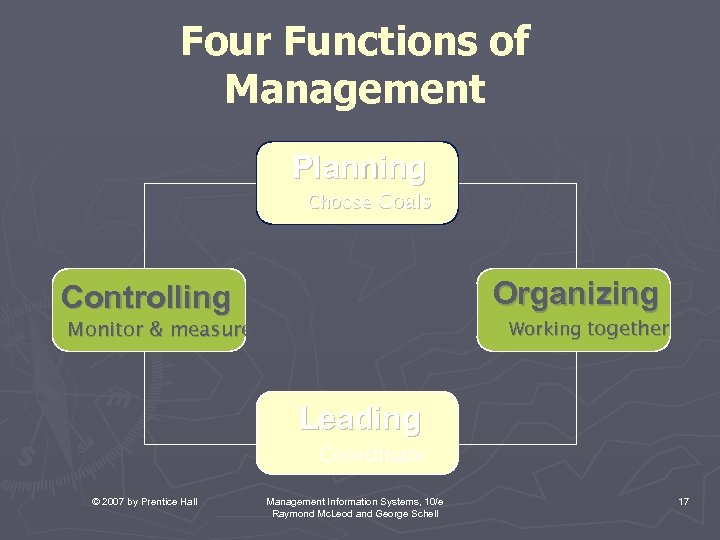 Four Functions of Management Planning Choose Goals Organizing Controlling Working together Monitor & measure Leading Coordinate © 2007 by Prentice Hall Management Information Systems, 10/e Raymond Mc. Leod and George Schell 17
 Planning is the process used by managers to identify and select appropriate goals and courses of action for an organization. 3 steps to good planning : 1. Which goals should be pursued? 2. How should the goal be attained? 3. How should resources be allocated? § The planning function determines how effective and efficient the organization is and determines the strategy of the organization. © 2007 by Prentice Hall Management Information Systems, 10/e Raymond Mc. Leod and George Schell 18
 Organizing ► In organizing, managers create the structure of working relationships between organizational members that best allows them to work together and achieve goals. ► Managers will group people into departments according to the tasks performed. § Managers will also lay out lines of authority and responsibility for members. ► An organizational structure is the outcome of organizing. This structure coordinates and motivates employees so that they work together to achieve goals. © 2007 by Prentice Hall Management Information Systems, 10/e Raymond Mc. Leod and George Schell 19
 Leading ► In leading, managers determine direction, state a clear vision for employees to follow, and help employees understand the role they play in attaining goals. ► Leadership involves a manager using power, influence, vision, persuasion, and communication skills. ► The outcome of the leading function is a high level of motivation and commitment from employees to the organization. © 2007 by Prentice Hall Management Information Systems, 10/e Raymond Mc. Leod and George Schell 20
 Controlling ► In controlling, managers evaluate how well the organization is achieving its goals and takes corrective action to improve performance. ► Managers will monitor individuals, departments, and the organization to determine if desired performance has been reached. § Managers will also take action to increase performance as required. ► The outcome of the controlling function is the accurate measurement of performance and regulation of efficiency and effectiveness. © 2007 by Prentice Hall Management Information Systems, 10/e Raymond Mc. Leod and George Schell 21
 Management Levels ► Organizations often have 3 levels of managers: First-line Managers: responsible for day-to-day operation. They supervise the people performing the activities required to make the good or service. Middle Managers: Supervise first-line managers. They are also responsible to find the best way to use departmental resources to achieve goals. Top Managers: Responsible for the performance of all departments and have cross-departmental responsibility. They establish organizational goals and monitor middle managers. © 2007 by Prentice Hall Management Information Systems, 10/e Raymond Mc. Leod and George Schell 22
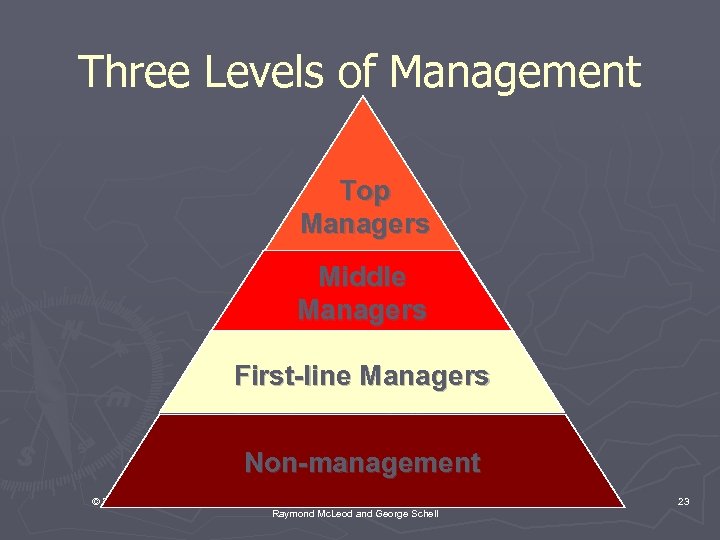 Three Levels of Management Top Managers Middle Managers First-line Managers Non-management © 2007 by Prentice Hall Management Information Systems, 10/e Raymond Mc. Leod and George Schell 23
 Problem Solving and Decision Making ► Problem– condition or event that is harmful or potentially harmful to a firm or that is beneficial or potentially beneficial. ► Solution–outcome of the problem-solving activity. ► Decision–a particular selected course of action. © 2007 by Prentice Hall Management Information Systems, 10/e Raymond Mc. Leod and George Schell 24
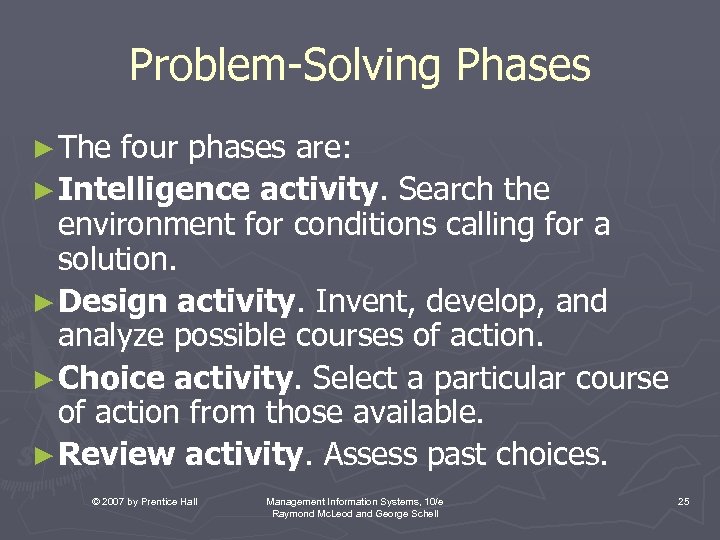 Problem-Solving Phases ► The four phases are: ► Intelligence activity. Search the environment for conditions calling for a solution. ► Design activity. Invent, develop, and analyze possible courses of action. ► Choice activity. Select a particular course of action from those available. ► Review activity. Assess past choices. © 2007 by Prentice Hall Management Information Systems, 10/e Raymond Mc. Leod and George Schell 25