 Скачать презентацию Management Control EMBA 5403 Fall 2010 Mugan
98d8cdf98fbb6a1bb85aa92de92f0913.ppt
- Количество слайдов: 45



Management Control EMBA 5403 Fall 2010 Mugan
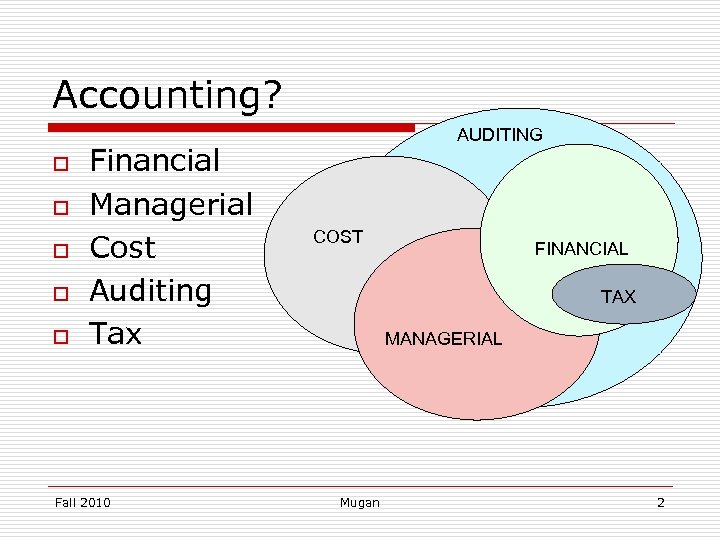
Accounting? o o o Financial Managerial Cost Auditing Tax Fall 2010 AUDITING COST FINANCIAL TAX MANAGERIAL Mugan 2
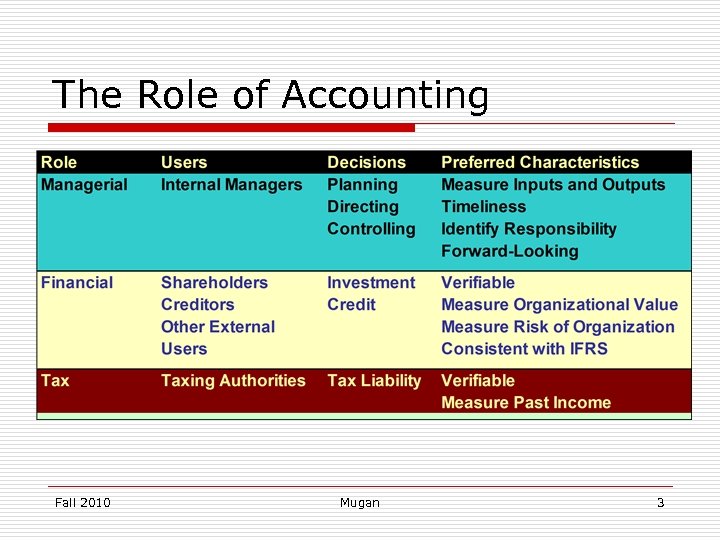
The Role of Accounting Fall 2010 Mugan 3
Application of Managerial Accounting o Applies to all types of business n o Applies to all forms of business organizations – n o Service, Merchandising, and Manufacturing Proprietorships, Partnerships, and Corporations Applies to not-for-profit as well as profit-oriented companies Fall 2010 Mugan 4
Accounting and Accountability o o Process of identifying, measuring, and communicating economic information to permit informed judgements and decisions by the users of the information (American Accounting Association, 1966) Stewardship function: usually owners and managers are separate n o Increase shareholders’ wealth Financial Accounting Fall 2010 Mugan 5
Differences and Similarities o o o Both deal with the same accounting data Both managerial and financial accounting deal with economic events of a business Both require that economic events be quantified and communicated to interested parties n Financial – external o Managerial- internal n n Fall 2010 Determining unit cost - managerial accounting, Reporting Cost of Goods Sold -financial accounting Mugan 6
Managerial or Management Accounting o Industrial Revolution – more complex production process n Cost became important n Cost accounting (forerunner of managerial accounting) o Cost of an object – product, segment, division n n 20 th century – multinationals, and large companies o o o First book 1897 – Garcke and Fell – Factory Accounting Performance evaluation Budgeting Management accounting term used after Second World War Fall 2010 Mugan 7
Management or Managerial Accounting o Assist managerial decisions n o Provide timely and accurate information to control costs and to measure and improve productivity; and devise improved production process Accurate costs important for n n n Fall 2010 Pricing decisions New product Response to rival products Mugan 8
Main activities o Planning- strategic and operational n o Implementing/Directing n o budgeting Generate, analyze and report relevant information Controlling n n n Fall 2010 Actual vs budget comparison Analysis and interpretation Feedback Mugan 9
Managerial Accounting o Process of n n n n Fall 2010 Identifying Measuring Analyzing Interpreting Communicating information in pursuit of a company’s goals Managerial accountants – business partners/consultants in companies Provides information to managers Mugan 10
Technology and Managerial Accounting o o o New techniques created new roles for management accountants New technologies demanded new control techniques Emerging service organizations Teams with people from production, marketing, engineering, etc. More flexible approaches to effective cost controls Fall 2010 Mugan 11
Managerial Accounting Objectives o o o Provide information for planning and decision making – be a part of it Assist managers in daily control of operations Motivate the managers and other employees towards the company goals-goal congruence Performance measurement of managers Strategic planning – determine competitive position and long-run success of the company Fall 2010 Mugan 12
Characteristics o o o Internal – manager oriented Future looking – planning Involves estimates More timely and relevant data necessary Adaptive to changing business environment Cross-functional – brings together production, marketing, managerial accountants and other key personnel Fall 2010 Mugan 13
Planning o Objectives should be inline with the overall objective of increasing shareholders’ wealth n Fall 2010 E. g. increase sales by 10% in Central Anatolia – objective Mugan 14
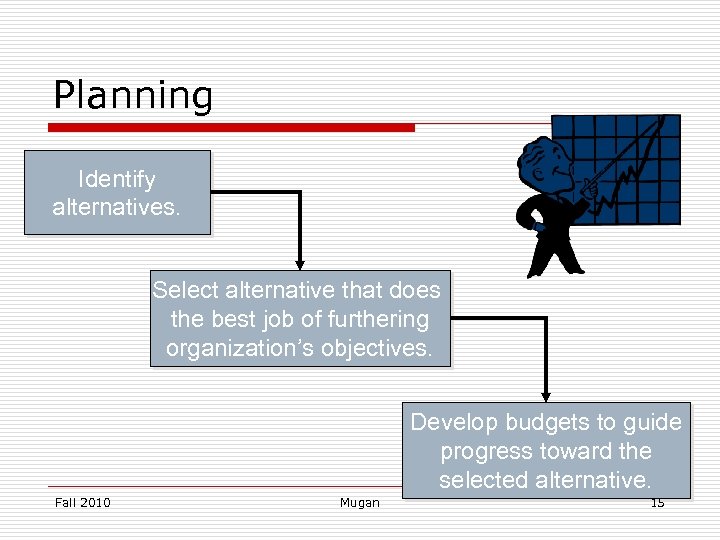
Planning Identify alternatives. Select alternative that does the best job of furthering organization’s objectives. Develop budgets to guide progress toward the selected alternative. Fall 2010 Mugan 15
Directing o Coordinate diverse activities and human resources o Implement planned objectives o Provide incentives to motivate employees o Hire and train employees including executives, managers, and supervisors o Produce smooth-running operation Fall 2010 Mugan 16
Controlling o o o o o Process of keeping activities on track Determine whether goals are met Decide changes needed to get back on track May use an informal or formal system of evaluations Employee job assignments Routine problem solving Conflict resolution Effective communications Decision making is not a separate management function, but the outcome of the exercise of good judgment in planning, directing, and controlling. Feedback in the form of performance reports that compare actual results with the budget are an essential part of the control function Fall 2010 Mugan 17
Management Control o o o Assure that resources are obtained and used effectively and efficiently in the accomplishment of the organization’s objective Has financial and non financial performance measurement Concerned with the implementation of strategies and n Fall 2010 Task control Mugan 18
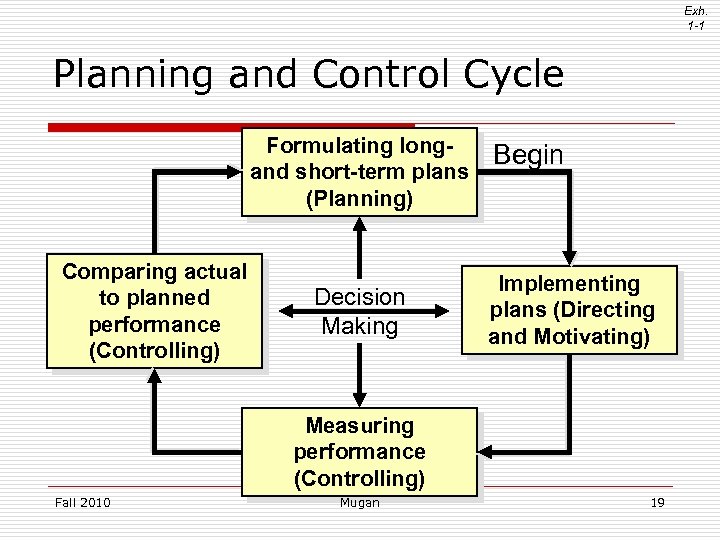
Exh. 1 -1 Planning and Control Cycle Formulating longand short-term plans (Planning) Comparing actual to planned performance (Controlling) Decision Making Begin Implementing plans (Directing and Motivating) Measuring performance (Controlling) Fall 2010 Mugan 19
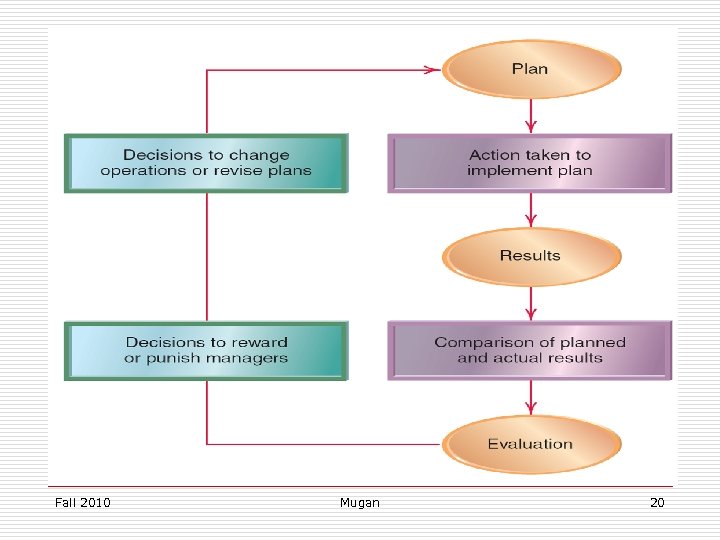
Fall 2010 Mugan 20
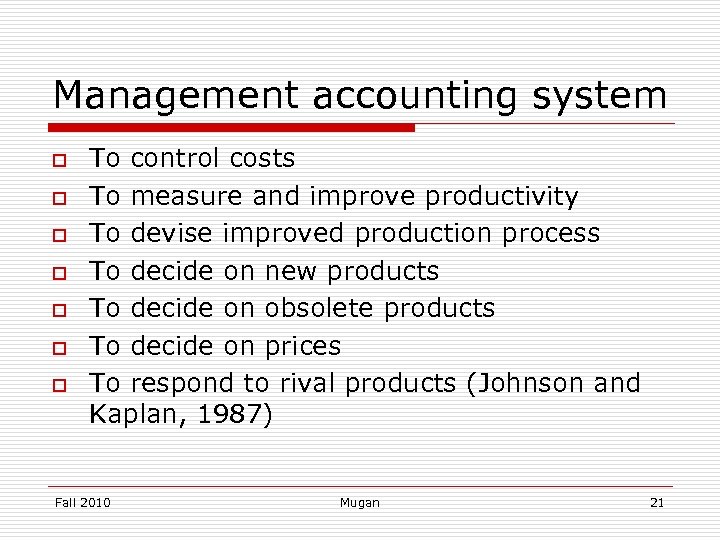
Management accounting system o o o o To control costs To measure and improve productivity To devise improved production process To decide on new products To decide on obsolete products To decide on prices To respond to rival products (Johnson and Kaplan, 1987) Fall 2010 Mugan 21
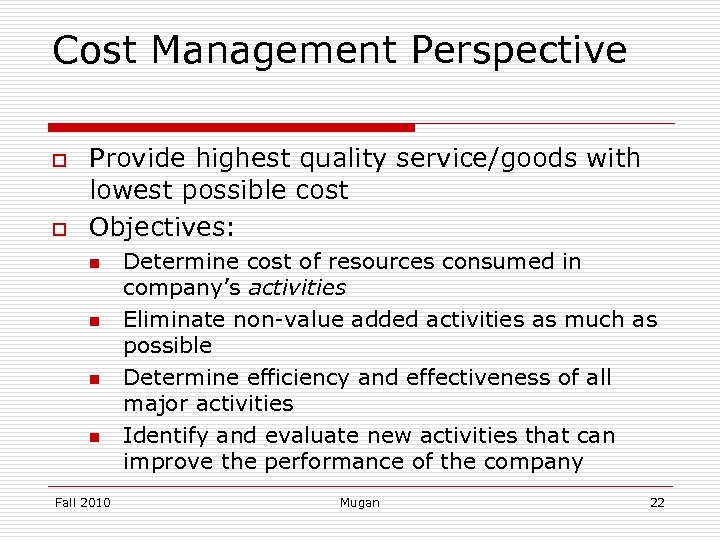
Cost Management Perspective o o Provide highest quality service/goods with lowest possible cost Objectives: n n Fall 2010 Determine cost of resources consumed in company’s activities Eliminate non-value added activities as much as possible Determine efficiency and effectiveness of all major activities Identify and evaluate new activities that can improve the performance of the company Mugan 22
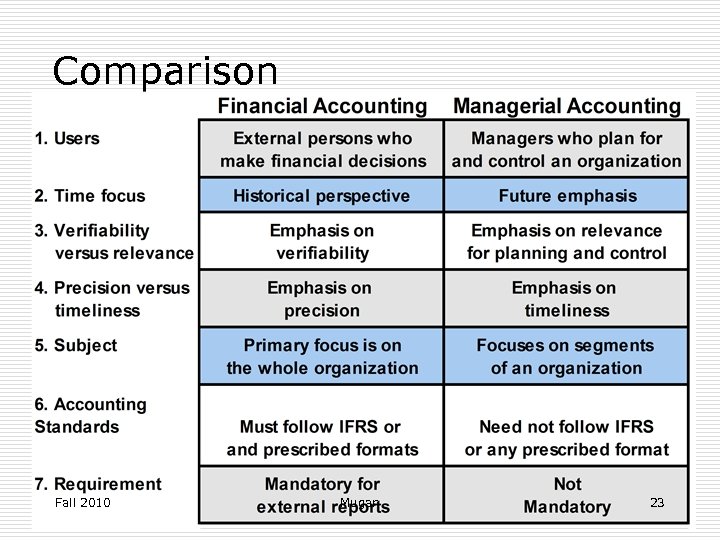
Comparison Fall 2010 Mugan 23
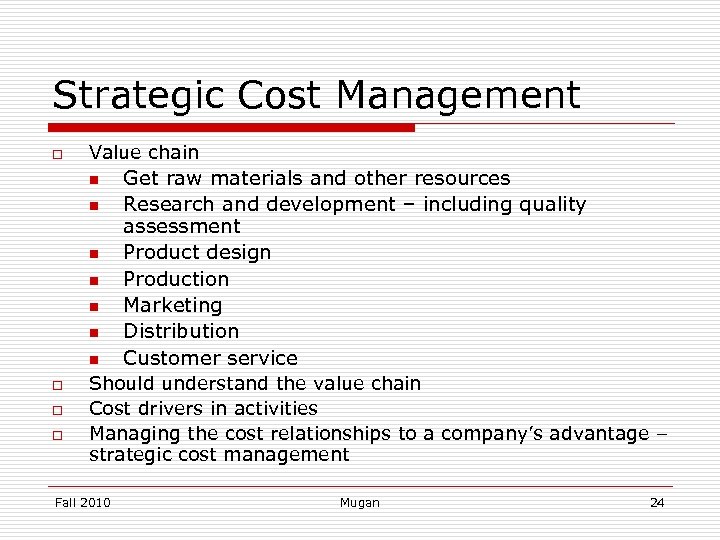
Strategic Cost Management o Value chain n n n o o o Get raw materials and other resources Research and development – including quality assessment Product design Production Marketing Distribution Customer service Should understand the value chain Cost drivers in activities Managing the cost relationships to a company’s advantage – strategic cost management Fall 2010 Mugan 24
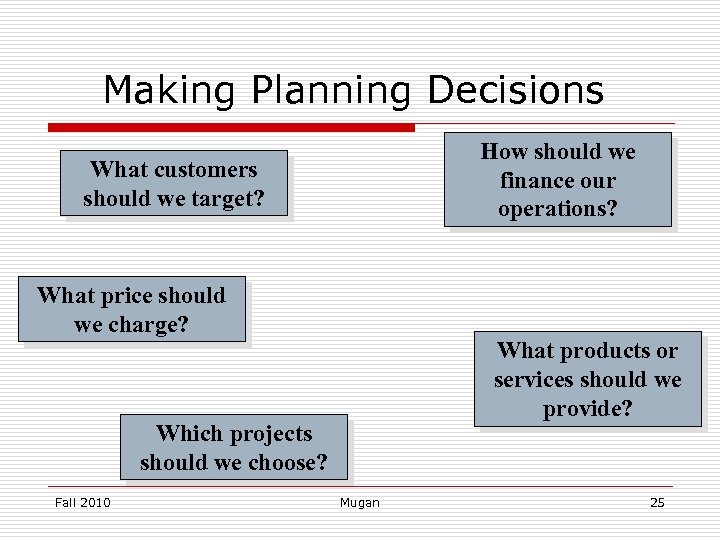
Making Planning Decisions How should we finance our operations? What customers should we target? What price should we charge? What products or services should we provide? Which projects should we choose? Fall 2010 Mugan 25
Cost – Benefit Analysis o o o Cost- using resources to achieve a benefit Benefits- aspects of a decision that help the organization Analysis: the process of analyzing alternative decisions to determine which decision has the greatest benefit relative to its cost Fall 2010 Mugan 26
Discussion Question o o A finance professor and a marketing professor were recently comparing notes on their perceptions of corporations. The finance professor claimed that the goal of a corporation should be to maximize the value to the shareholders. The marketing professor claimed that the goal of a corporation should be to satisfy customers. What are the similarities and differences in these goals? Zimmerman, 2003; p. 24 Fall 2010 Mugan 27
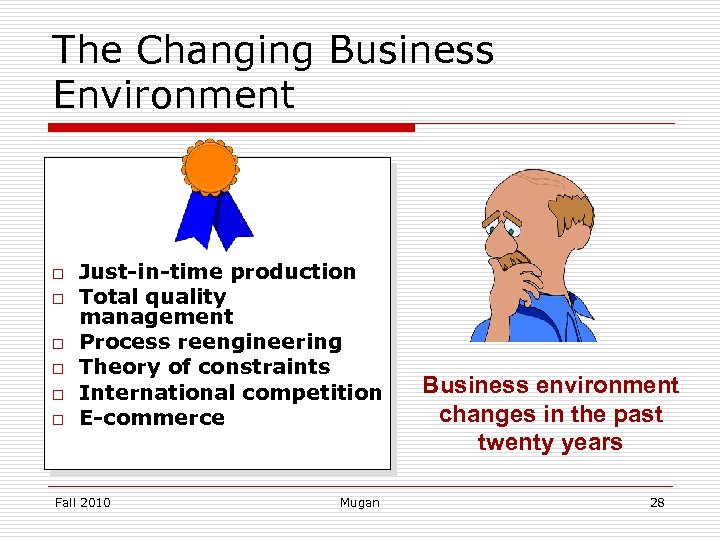
The Changing Business Environment o o o Just-in-time production Total quality management Process reengineering Theory of constraints International competition E-commerce Fall 2010 Mugan Business environment changes in the past twenty years 28
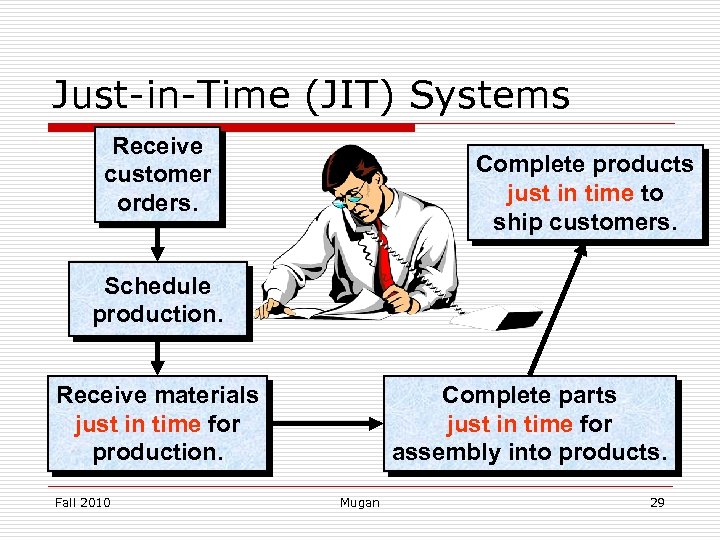
Just-in-Time (JIT) Systems Receive customer orders. Complete products just in time to ship customers. Schedule production. Complete parts just in time for assembly into products. Receive materials just in time for production. Fall 2010 Mugan 29
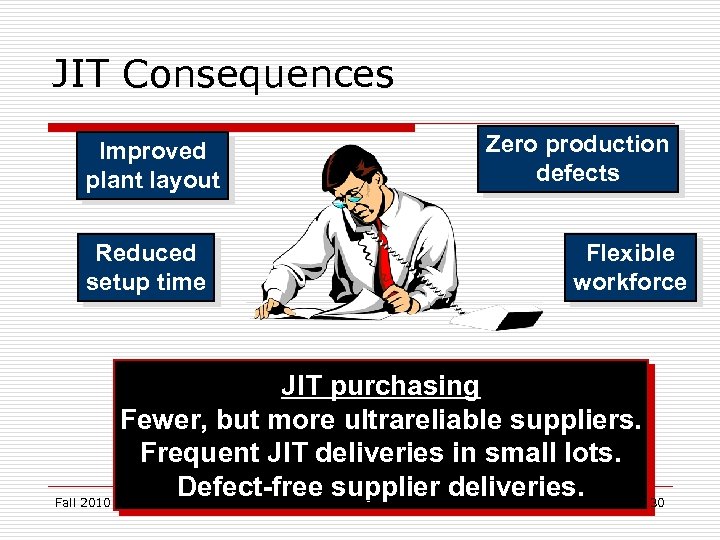
JIT Consequences Improved plant layout Reduced setup time Fall 2010 Zero production defects Flexible workforce JIT purchasing Fewer, but more ultrareliable suppliers. Frequent JIT deliveries in small lots. Defect-free supplier deliveries. Mugan 30
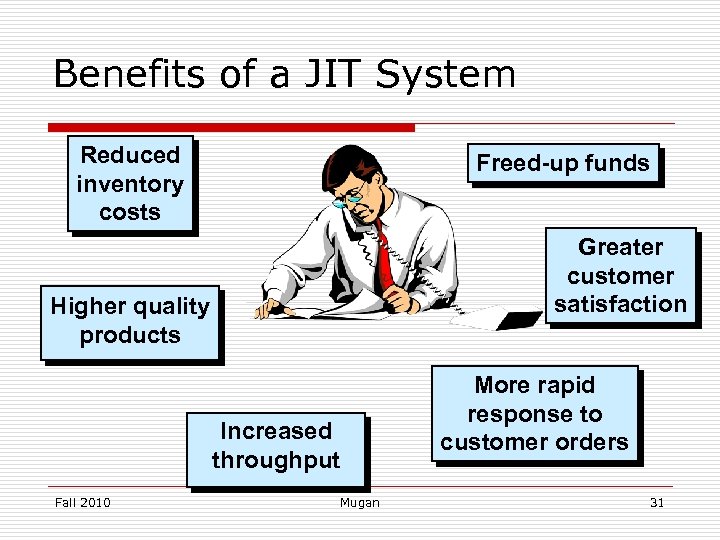
Benefits of a JIT System Reduced inventory costs Freed-up funds Greater customer satisfaction Higher quality products Increased throughput Fall 2010 Mugan More rapid response to customer orders 31
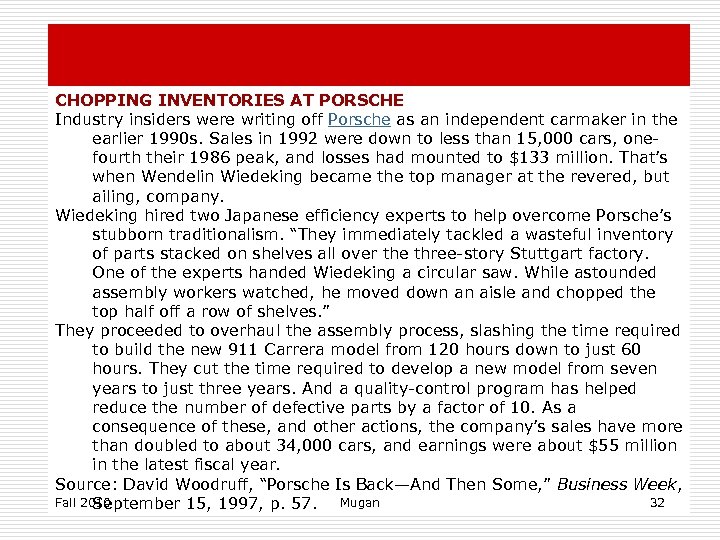
CHOPPING INVENTORIES AT PORSCHE Industry insiders were writing off Porsche as an independent carmaker in the earlier 1990 s. Sales in 1992 were down to less than 15, 000 cars, onefourth their 1986 peak, and losses had mounted to $133 million. That’s when Wendelin Wiedeking became the top manager at the revered, but ailing, company. Wiedeking hired two Japanese efficiency experts to help overcome Porsche’s stubborn traditionalism. “They immediately tackled a wasteful inventory of parts stacked on shelves all over the three-story Stuttgart factory. One of the experts handed Wiedeking a circular saw. While astounded assembly workers watched, he moved down an aisle and chopped the top half off a row of shelves. ” They proceeded to overhaul the assembly process, slashing the time required to build the new 911 Carrera model from 120 hours down to just 60 hours. They cut the time required to develop a new model from seven years to just three years. And a quality-control program has helped reduce the number of defective parts by a factor of 10. As a consequence of these, and other actions, the company’s sales have more than doubled to about 34, 000 cars, and earnings were about $55 million in the latest fiscal year. Source: David Woodruff, “Porsche Is Back—And Then Some, ” Business Week, Fall 2010 32 September 15, 1997, p. 57. Mugan
Disadvantage: Just-In-Time (JIT) systems have many advantages, but they are vulnerable to unexpected disruptions in supply. A production line can quickly come to a halt if essential parts are unavailable. Toyota, the developer of JIT, found this out the hard way. One Saturday, a fire at Aisin Seiki Company’s plant in Aichi Prefecture stopped the delivery of all brake parts to Toyota. By Tuesday, Toyota had to close down all of its Japanese assembly lines. By the time the supply of brake parts had been restored, Toyota had lost an estimated $15 billion in sales. Source: “Toyota to Recalibrate ‘Just-in-Time, ’” International Herald Tribune, February 8, 1997, p. 9. Fall 2010 Mugan 33
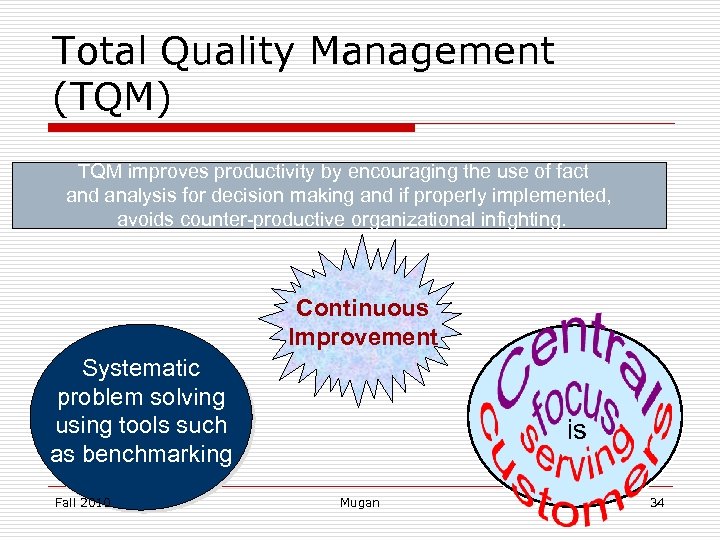
Total Quality Management (TQM) TQM improves productivity by encouraging the use of fact and analysis for decision making and if properly implemented, avoids counter-productive organizational infighting. Continuous Improvement Systematic problem solving using tools such as benchmarking Fall 2010 is Mugan 34
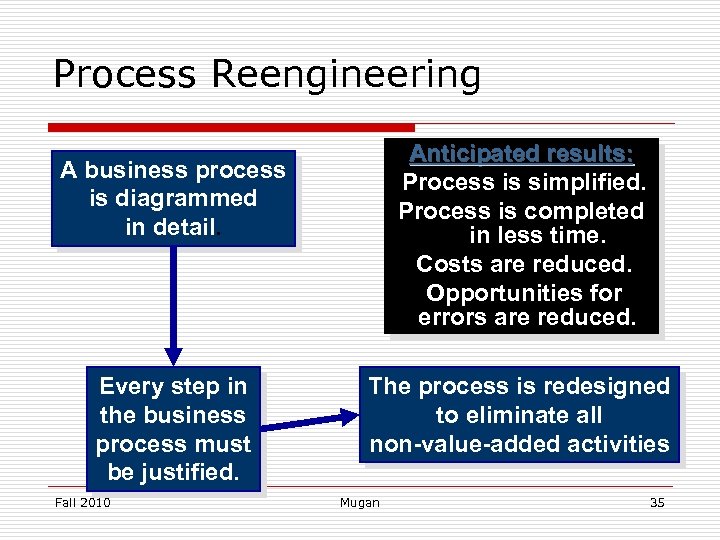
Process Reengineering Anticipated results: Process is simplified. Process is completed in less time. Costs are reduced. Opportunities for errors are reduced. A business process is diagrammed in detail. Every step in the business process must be justified. Fall 2010 The process is redesigned to eliminate all non-value-added activities Mugan 35
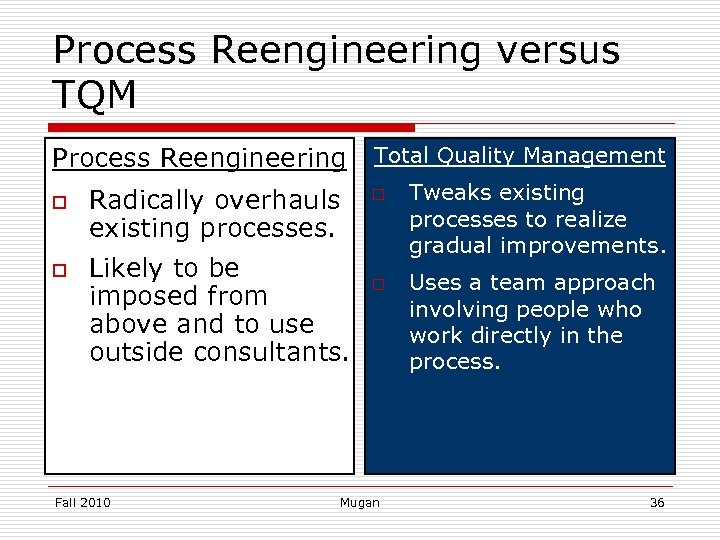
Process Reengineering versus TQM Process Reengineering o o Radically overhauls existing processes. Likely to be imposed from above and to use outside consultants. Fall 2010 Total Quality Management o o Mugan Tweaks existing processes to realize gradual improvements. Uses a team approach involving people who work directly in the process. 36
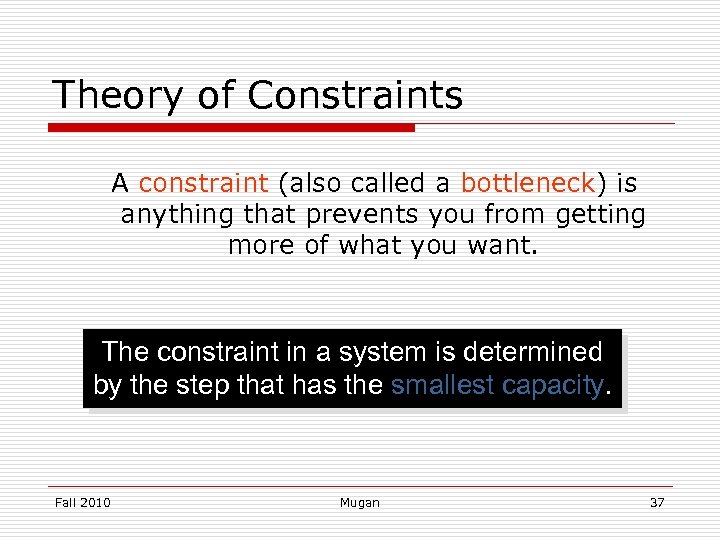
Theory of Constraints A constraint (also called a bottleneck) is anything that prevents you from getting more of what you want. The constraint in a system is determined by the step that has the smallest capacity. Fall 2010 Mugan 37
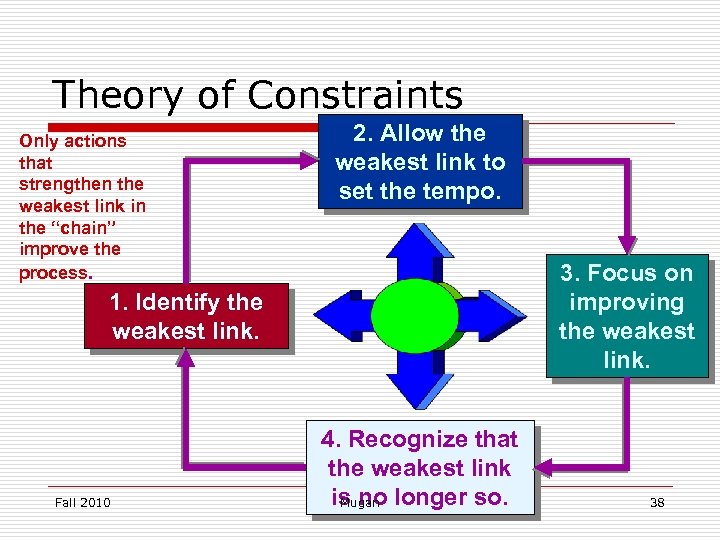
Theory of Constraints Only actions that strengthen the weakest link in the “chain” improve the process. 2. Allow the weakest link to set the tempo. 3. Focus on improving the weakest link. 1. Identify the weakest link. Fall 2010 4. Recognize that the weakest link is no longer so. Mugan 38
THE CONSTRAINT IS THE KEY The Lessines plant of Baxter International makes medical products such as sterile bags. Management of the plant is acutely aware of the necessity to actively manage its constraints. For example, when materials are a constraint, management may go to a secondary vendor and purchase materials at a higher cost than normal. When a machine is the constraint, a weekend shift is often added on the machine. If a particular machine is chronically the constraint and management has exhausted the possibilities of using it more effectively, then additional capacity is purchased. For example, when the constraint was the plastic extruding machines, a new extruding machine was ordered. However, even before the machine arrived, management had determined that the constraint would shift to the blenders once the new extruding capacity was added. Therefore, a new blender was already being planned. By thinking ahead and focusing on the constraints, management is able to increase the plant’s real capacity at the lowest possible cost. Source: Eric Noreen, Debra Smith, and James Mackey, Theory of Constraints and Its Implications for Management Accounting (Montvale, NJ: The IMA Foundation for Applied Research, Inc. ), p. 67. Fall 2010 Mugan 39
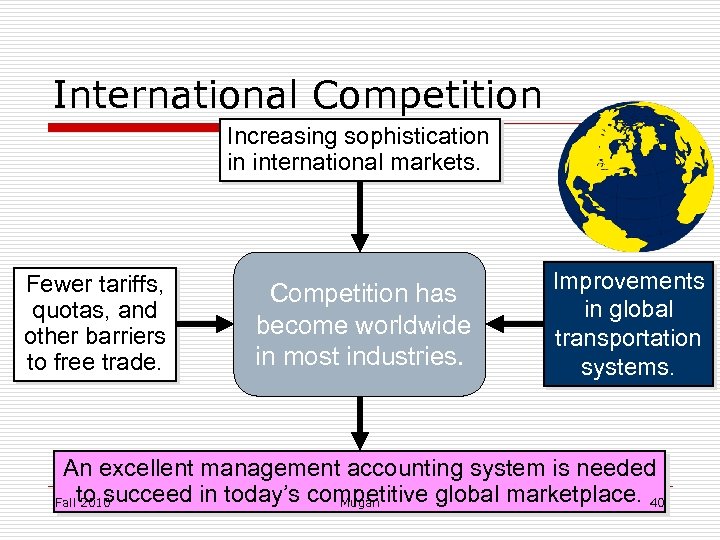
International Competition Increasing sophistication in international markets. Fewer tariffs, quotas, and other barriers to free trade. Competition has become worldwide in most industries. Improvements in global transportation systems. An excellent management accounting system is needed to succeed in today’s competitive global marketplace. 40 Fall 2010 Mugan
GLOBAL FORCES Traditionally, management accounting practices have differed significantly from one country to another. For example, Spain, Italy, and Greece have relied on less formal management accounting systems than other European countries. According to Professor Norman B. Macintosh, “In Greece and Italy the predominance of close-knit, private, family firms motivated by secrecy, tax avoidance, and largesse for family members along with lack of market competition (price fixing? ) mitigated the development of management accounting and control systems. Spain also followed this pattern and relied more on personal relationships and oral inquisitions than on hard data for control. ” At the same time, other Western European countries such as Germany, France, and the Netherlands developed relatively sophisticated formal management accounting systems emphasizing efficient operations. In the case of France, these were codified in law. In England, management accounting practice was influenced by economists, who emphasized the use of accounting data in decision making. The Nordic countries tended to import management accounting ideas from both Germany and England. A number of factors have been acting in recent years to make management accounting practices more similar within Europe and around the world. These forces include: intensified global competition, which makes it more difficult to continue sloppy practices; standardized information system software sold throughout the world by vendors such as SAP, People. Soft, Oracle, and Baan; the increasing significance and authority of multinational corporations; the global consultancy industry; the diffusion of information throughout academia; and the global use of market-leading textbooks. Sources: Markus Granlund and Kari Lukka, “It’s a Small World of Management Accounting Practices, ” Journal of Management Accounting Research 10, 1998, pp. 153– 171; and Norman B. Macintosh, “Management Accounting in Europe: A View from Canada, ” Management Accounting Research 9, 1998, pp. 495– 500. Fall 2010 Mugan 41
E-Commerce In recent years, many dot. com businesses failed that might have benefited from the application of managerial accounting tools: n Cost concepts n Cost estimation n Cost-volume-profit n Activity-based costing n Budgeting n Decision-making n Capital budgeting Fall 2010 Mugan 42
Code of Conduct for Management Accountants The Institute of Management Accountant’s (IMA) Standards of Ethical Conduct for Practitioners of Management Accounting and Financial Management have two major parts offering guidelines for: Ethical behavior. Resolution for an ethical conflict. Fall 2010 Mugan 43
Codes of Conduct on the International Level The Guidelines on Ethics for Professional Accountants, issued by the International Federation of Accountants (IFAC), govern the activities of professional accountants worldwide. In addition to competence, objectivity, independence, and confidentiality, the IFAC’s code deals with the accountant’s ethical responsibilities in: Taxes Fees and commissions Advertising and solicitation Handling of monies Fall 2010 Mugan Cross-border activities. 44
o Accounting for Managers: Interpreting Accounting Information for Decision-Making By: Paul M. Collier Price: $58. 50 Format: Adobe Reader PDF e. Books Requirements: Free Adobe Reader & Digital Editions (More Details) Restrictions: No printing, No copy and paste (More Details) Platforms: Windows Vista / XP / 2000, Mac OS X+, Palm OS (More Details) Features: Advanced navigation, search, bookmarks, and multiple viewing options. Fall 2010 Mugan 45
Скачать презентацию Management Control EMBA 5403 Fall 2010 Mugan
98d8cdf98fbb6a1bb85aa92de92f0913.ppt