


 Скачать презентацию Management and Development of Suppliers 1 Outline
c3db48449ed5a2ce45d2a10e4f595243.ppt
- Количество слайдов: 31
 Management and Development of Suppliers 1
 Outline è management and development of suppliers è rationalization and optimization of the supply base è development of suppliers è industrial practices è Mc. Donald’s suppliers è influences of manufacturing philosophy on purchasing è è JIT and Keiretsu Nissan’s rescue è Carlos Ghosn è Nissan’s Keiretsu
 Management and Development of Suppliers 3
 Management and Development of Suppliers è monitoring performance è to identify poor performing è to provide chance to improve è to provide a basis for future purchasing decisions è maintaining relationship è developing capabilities è activities by a buyer to improve the capabilities of suppliers to meet the buyer’s short- and long-term goals 4
 Supplier Measurement Decisions è what to measure è quantitative vs. qualitative variables è delivery, quality, cost reduction, service levels è measurement and reporting frequency è reports to both buyer and supplier è real-time information in problems, troubleshooting, and expediting è daily, monthly or quarterly summary, and annual face- to-face meeting 5
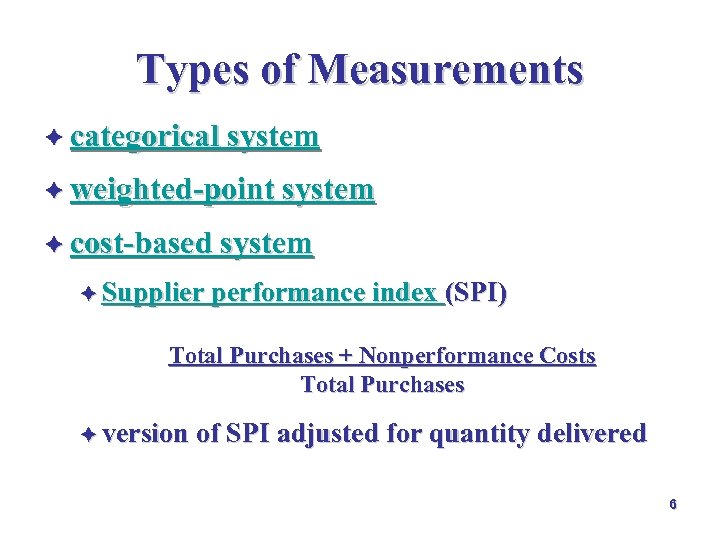 Types of Measurements è categorical system è weighted-point system è cost-based system è Supplier performance index (SPI) Total Purchases + Nonperformance Costs Total Purchases è version of SPI adjusted for quantity delivered 6
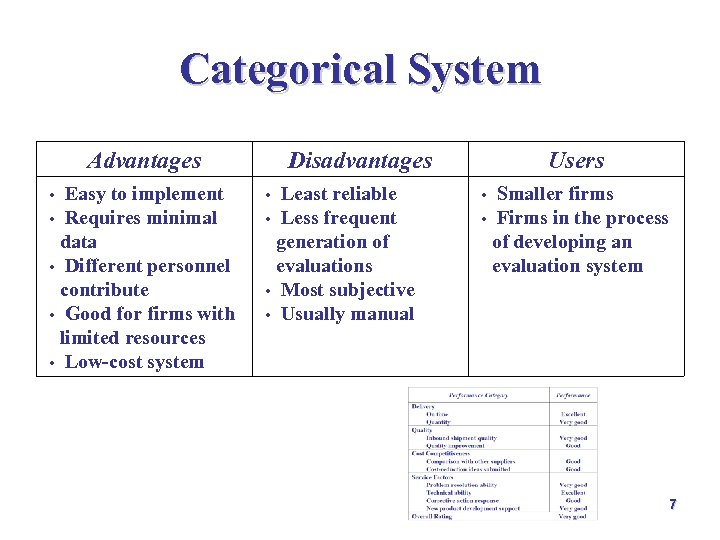 Categorical System Advantages Easy to implement • Requires minimal data • Different personnel contribute • Good for firms with limited resources • Low-cost system • Disadvantages Least reliable • Less frequent generation of evaluations • Most subjective • Usually manual • Users Smaller firms • Firms in the process of developing an evaluation system • 7
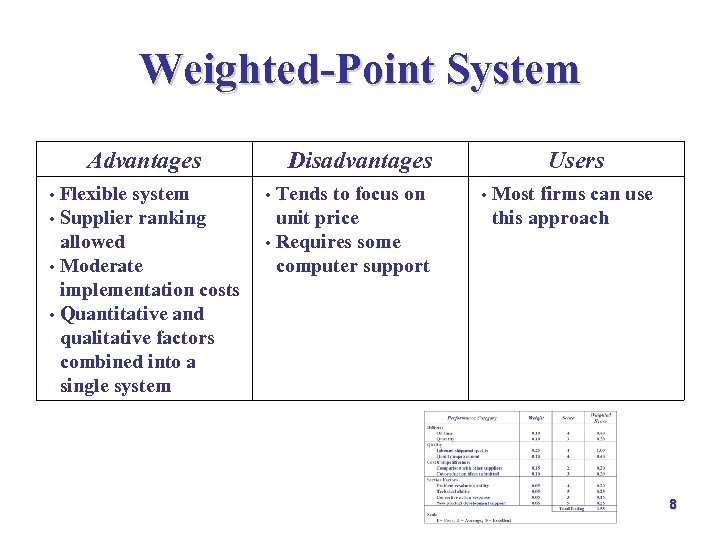 Weighted-Point System Advantages Flexible system • Supplier ranking allowed • Moderate implementation costs • Quantitative and qualitative factors combined into a single system • Disadvantages Tends to focus on unit price • Requires some computer support • Users • Most firms can use this approach 8
 Cost-Based System Advantages Total cost approach • Specific areas of supplier nonperformance identified • Objective supplier ranking • Greatest potential for long-range improvement • Disadvantages Cost accounting system required • Most complex • Implementation costs are high • Computer resources required • Users Larger firms • Firms with a large supply base • 9
 Rationalization and Optimization of the Supply Base 10
 General Trend: Reduction of Number of Suppliers è Dell è è more than 140 suppliers in early days and about 40 in 1999 Mc. Donald in US è è è hamburger suppliers: from 170 in early days to 5 in late 80’s potato chips: from 175 in early days to basically 1 in late 80’s reason: best trade off in maximizing value and minimizing risk è manage and develop with suppliers that can grow with the company 11
 Rationalization and Optimization è a continuous process to determine the number and quality of suppliers in the supply base è usually a decrease and occasionally an increase in number of suppliers è rationalization: how many and which suppliers to keep è optimization: analysis the supply base for keeping the most capable suppliers 12
 Phases and Activities è developing systems to evaluate suppliers è evaluating suppliers è keeping excellent and significant suppliers è replacing mediocre suppliers with better ones è initiating supplier development activities to improve performance è globally searching for world-class suppliers 13
 What are the Advantages? è US operations of Mc. Donald è hamburger suppliers: from 170 in early days down to 5 in late 80’s è potato chips: from 175 in early days to mostly 1 in late 80’s 14
 Advantages è buying from world-class suppliers è è è closer relationships with fewer, better performing suppliers fewer quality and delivery problems leading-edge technologies opportunities to collaborate use of full-service suppliers è remaining suppliers generally larger in size with more capabilities è è accessing to supplier’s engineering, R&D, design, testing, production, service, and tooling capabilities fuller range of value-adding services outsourcing integrated items reduction of supply base risk è qualified suppliers with more consistent quality 15
 Advantages è lower supply base administrative costs è è lower total product cost è è è greater information sharing joint problem-solving fewer problem-related interactions with suppliers lower variability in quality and delivery greater production volumes spread among fewer suppliers supplier’s fixed costs spread out over greater volumes incentive for supplier process improvement economies of scale and scope ability to pursue complex supply management strategies è è supplier development early supplier design involvement just-in-time sourcing development of cost-based pricing agreements 16
 What are the Disadvantages? è US operations of Mc. Donald è hamburger suppliers: from 170 in early days down to 5 in late 80’s è potato chips: from 175 in early days to mostly 1 in late 80’s 17
 Possible Risks è supplier dependency è è absence of competition è è è less motivation for suppliers to control cost and to improve continuously deterioration in performance because of complacent hard to switch equitable contracts to maintain the relationship supply disruption è è putting all eggs in one basket loss of continuous flow of materials overaggressive supply reduction è è è inadequate supplier capacity if demand increases missing qualified suppliers effort to find new replacement suppliers 18
 Formal Approaches è twenty-eighty rule è Pareto principle è “improve or else” rule è need to improve quickly è triage approach è categorization of existing suppliers è competency staircase approach è series of performance milestones 19
 Development of Suppliers 20
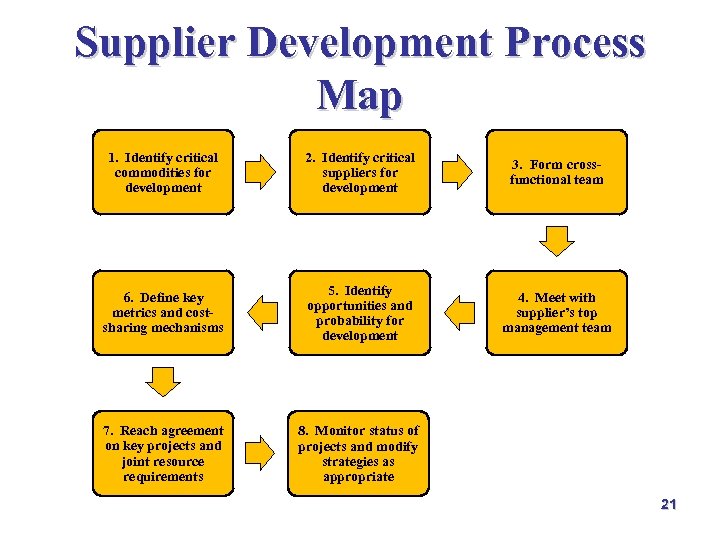 Supplier Development Process Map 1. Identify critical commodities for development 2. Identify critical suppliers for development 3. Form crossfunctional team 6. Define key metrics and costsharing mechanisms 5. Identify opportunities and probability for development 4. Meet with supplier’s top management team 7. Reach agreement on key projects and joint resource requirements 8. Monitor status of projects and modify strategies as appropriate 21
 Industrial Practice Product Development by Suppliers of Mc. Donald 22
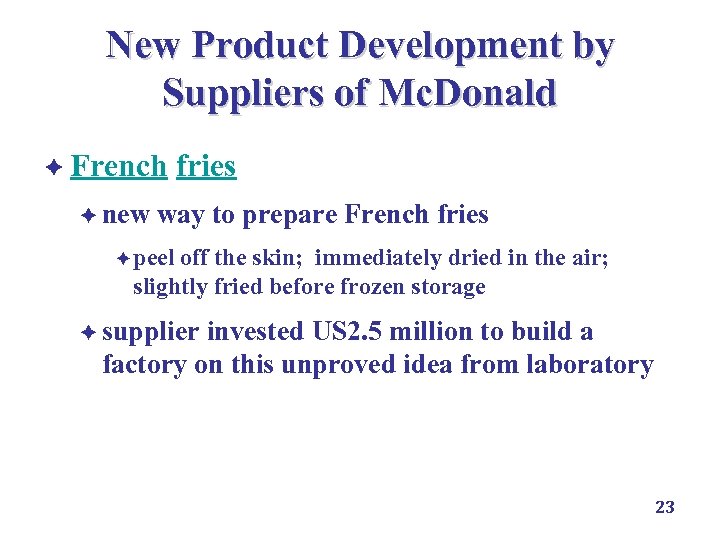 New Product Development by Suppliers of Mc. Donald è French è new fries way to prepare French fries è peel off the skin; immediately dried in the air; slightly fried before frozen storage è supplier invested US 2. 5 million to build a factory on this unproved idea from laboratory 23
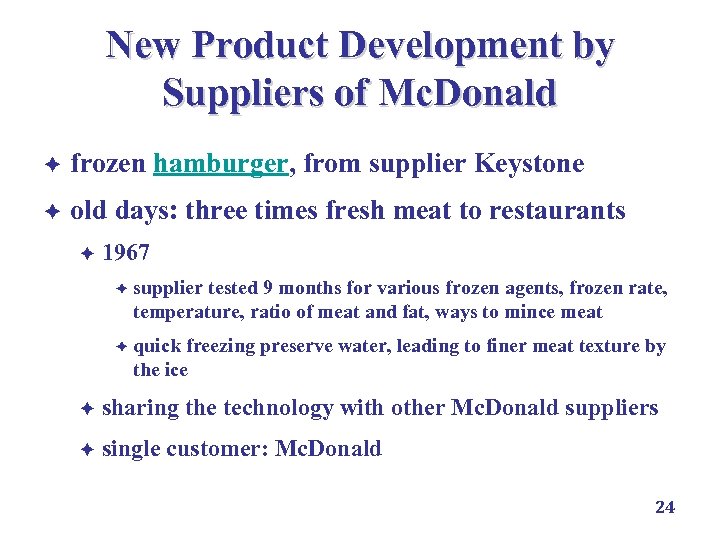 New Product Development by Suppliers of Mc. Donald è frozen hamburger, from supplier Keystone è old days: three times fresh meat to restaurants è 1967 è supplier tested 9 months for various frozen agents, frozen rate, temperature, ratio of meat and fat, ways to mince meat è quick freezing preserve water, leading to finer meat texture by the ice è sharing the technology with other Mc. Donald suppliers è single customer: Mc. Donald 24
 New Product Development by Suppliers of Mc. Donald è Mc. Nuggets è new product idea from Mc. Donald è Keystone to get meat from chicken è Keystone spent US$13 million to build automated factory for chicken meat processing based on the successful pilot test before the formal approval è sharing the technology with Tyson Food 25
 Questions è Why were suppliers of Mc. Donald willing to è develop products for Mc. Donald, often without any guarantee on partnership? è share their technology and methodology with other suppliers of Mc. Donald? 26
 Effect of Operations and Culture on Supply Management Japanese Influences in Manufacturing Processes 27
 Japanese Influences in Purchasing è necessary to understand Japanese philosophy and practices in manufacturing è from 70’s Japanese ideas being the mainstream è manufacturing: material intense with many purchasing and procurement activities 28
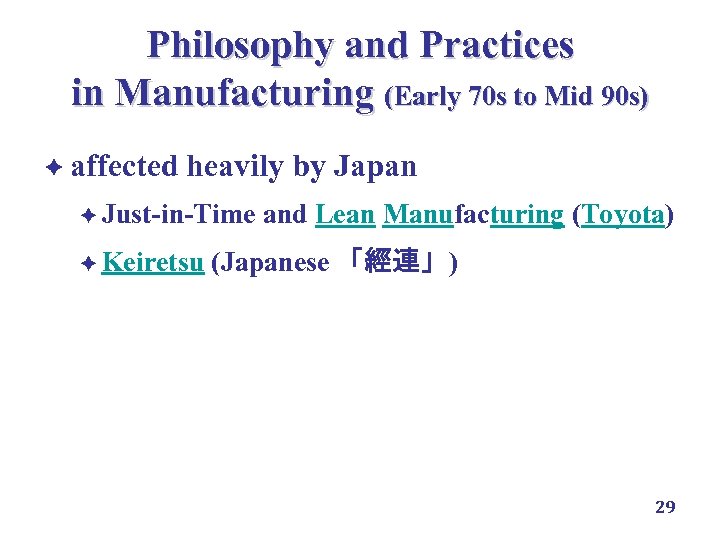 Philosophy and Practices in Manufacturing (Early 70 s to Mid 90 s) è affected heavily by Japan è Just-in-Time è Keiretsu and Lean Manufacturing (Toyota) (Japanese 「經連」) 29
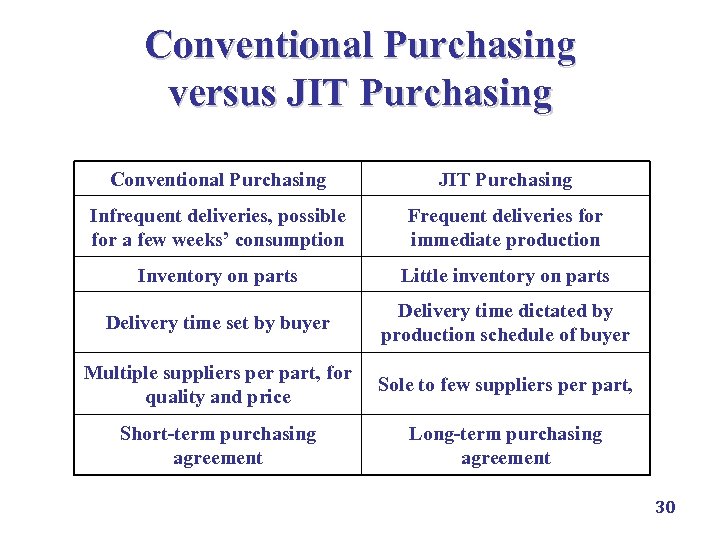 Conventional Purchasing versus JIT Purchasing Conventional Purchasing JIT Purchasing Infrequent deliveries, possible for a few weeks’ consumption Frequent deliveries for immediate production Inventory on parts Little inventory on parts Delivery time set by buyer Delivery time dictated by production schedule of buyer Multiple suppliers per part, for quality and price Sole to few suppliers per part, Short-term purchasing agreement Long-term purchasing agreement 30
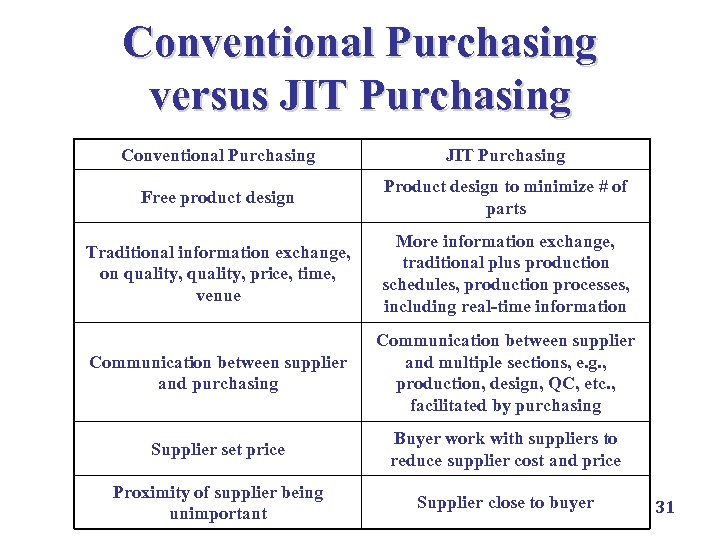 Conventional Purchasing versus JIT Purchasing Conventional Purchasing JIT Purchasing Free product design Product design to minimize # of parts Traditional information exchange, on quality, price, time, venue More information exchange, traditional plus production schedules, production processes, including real-time information Communication between supplier and purchasing Communication between supplier and multiple sections, e. g. , production, design, QC, etc. , facilitated by purchasing Supplier set price Buyer work with suppliers to reduce supplier cost and price Proximity of supplier being unimportant Supplier close to buyer 31