 Скачать презентацию Management Accounting The Cornerstone for Business Decisions Short-Run
a5ed71e4fc892e18cf482a4c1a874491.ppt
- Количество слайдов: 33



Management Accounting: The Cornerstone for Business Decisions Short-Run Decision Making; Relevant Costing and Inventory Management Copyright © 2006 by South-Western, a division of Thomson Learning. All rights reserved.
Learning Objectives 1. Describe the short-run decision-making model and explain how cost behavior affects the information used to make decisions. 2. Apply relevant costing and decisionmaking concepts in a variety of business situations. 3. Choose the optimal product mix when faced with one constrained resource.
Learning Objectives 4. Explain the impact of cost on pricing decisions. 5. Discuss inventory management under the economic order quantity and JIT models.
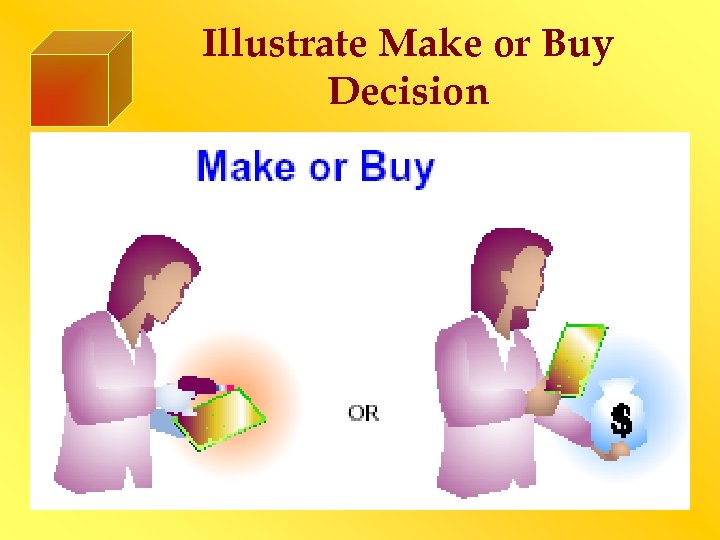
Illustrate Make or Buy Decision
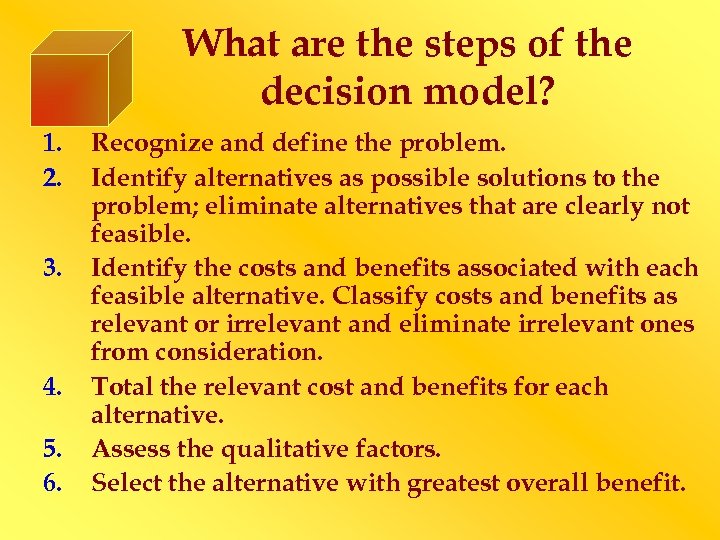
What are the steps of the decision model? 1. 2. 3. 4. 5. 6. Recognize and define the problem. Identify alternatives as possible solutions to the problem; eliminate alternatives that are clearly not feasible. Identify the costs and benefits associated with each feasible alternative. Classify costs and benefits as relevant or irrelevant and eliminate irrelevant ones from consideration. Total the relevant cost and benefits for each alternative. Assess the qualitative factors. Select the alternative with greatest overall benefit.
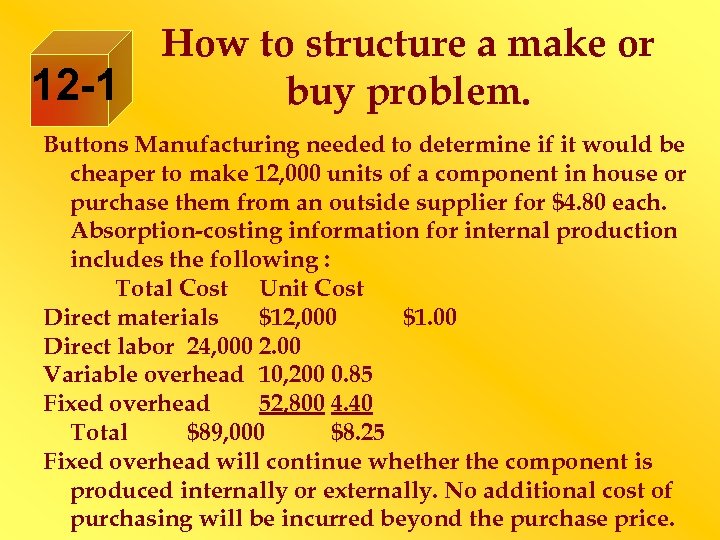
12 -1 How to structure a make or buy problem. Buttons Manufacturing needed to determine if it would be cheaper to make 12, 000 units of a component in house or purchase them from an outside supplier for $4. 80 each. Absorption-costing information for internal production includes the following : Total Cost Unit Cost Direct materials $12, 000 $1. 00 Direct labor 24, 000 2. 00 Variable overhead 10, 200 0. 85 Fixed overhead 52, 800 4. 40 Total $89, 000 $8. 25 Fixed overhead will continue whether the component is produced internally or externally. No additional cost of purchasing will be incurred beyond the purchase price.
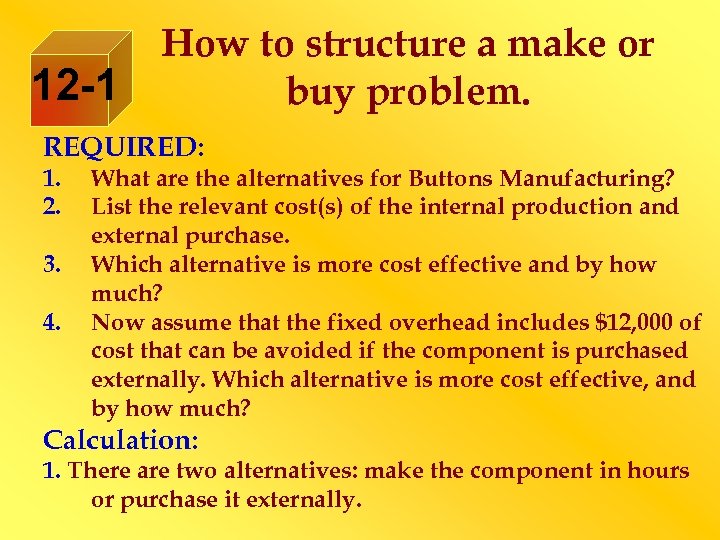
12 -1 How to structure a make or buy problem. REQUIRED: 1. 2. 3. 4. What are the alternatives for Buttons Manufacturing? List the relevant cost(s) of the internal production and external purchase. Which alternative is more cost effective and by how much? Now assume that the fixed overhead includes $12, 000 of cost that can be avoided if the component is purchased externally. Which alternative is more cost effective, and by how much? Calculation: 1. There are two alternatives: make the component in hours or purchase it externally.
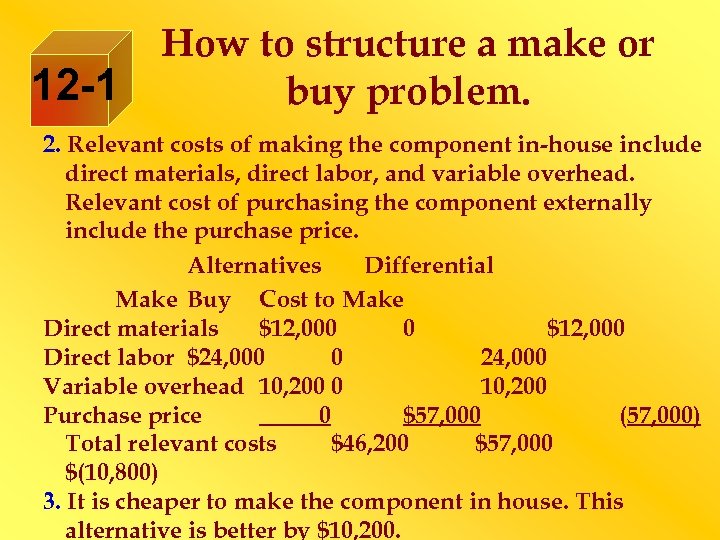
12 -1 How to structure a make or buy problem. 2. Relevant costs of making the component in-house include direct materials, direct labor, and variable overhead. Relevant cost of purchasing the component externally include the purchase price. Alternatives Differential Make Buy Cost to Make Direct materials $12, 000 0 $12, 000 Direct labor $24, 000 0 24, 000 Variable overhead 10, 200 0 10, 200 Purchase price 0 $57, 000 (57, 000) Total relevant costs $46, 200 $57, 000 $(10, 800) 3. It is cheaper to make the component in house. This alternative is better by $10, 200.
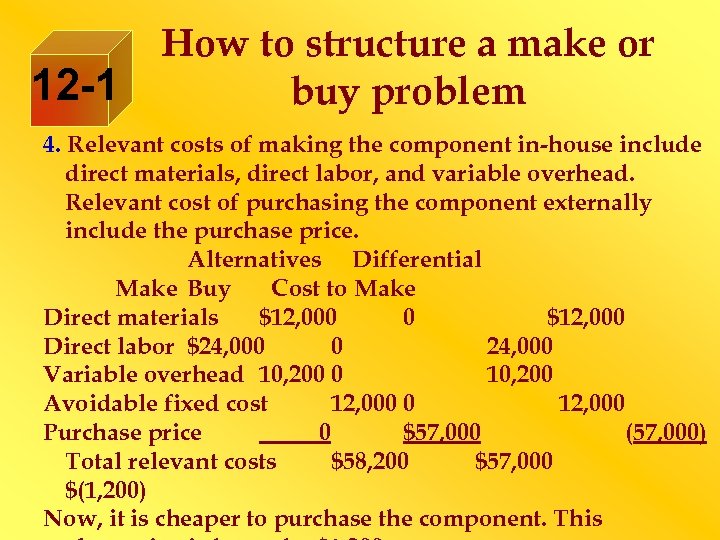
12 -1 How to structure a make or buy problem 4. Relevant costs of making the component in-house include direct materials, direct labor, and variable overhead. Relevant cost of purchasing the component externally include the purchase price. Alternatives Differential Make Buy Cost to Make Direct materials $12, 000 0 $12, 000 Direct labor $24, 000 0 24, 000 Variable overhead 10, 200 0 10, 200 Avoidable fixed cost 12, 000 0 12, 000 Purchase price 0 $57, 000 (57, 000) Total relevant costs $58, 200 $57, 000 $(1, 200) Now, it is cheaper to purchase the component. This
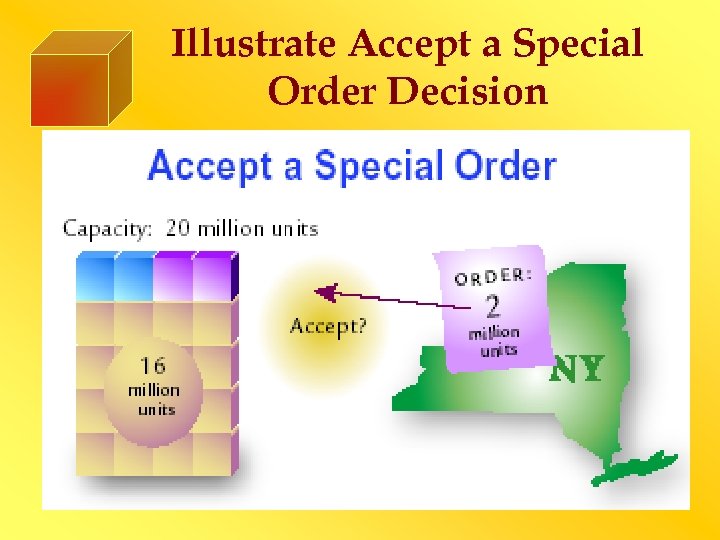
Illustrate Accept a Special Order Decision
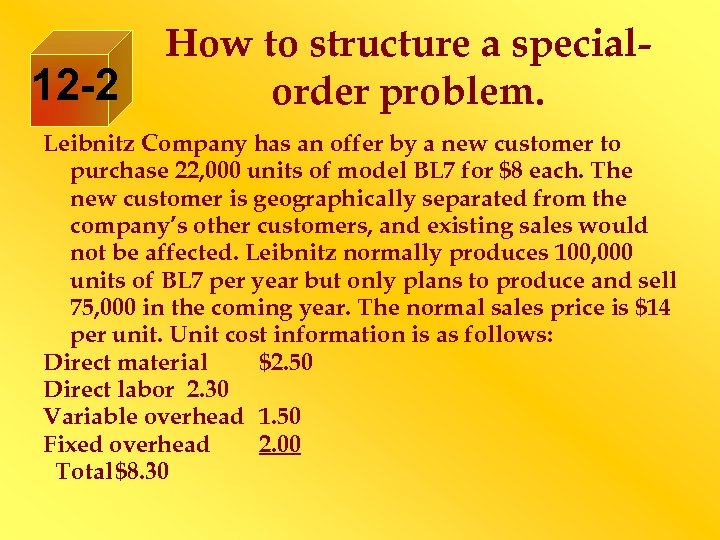
12 -2 How to structure a specialorder problem. Leibnitz Company has an offer by a new customer to purchase 22, 000 units of model BL 7 for $8 each. The new customer is geographically separated from the company’s other customers, and existing sales would not be affected. Leibnitz normally produces 100, 000 units of BL 7 per year but only plans to produce and sell 75, 000 in the coming year. The normal sales price is $14 per unit. Unit cost information is as follows: Direct material $2. 50 Direct labor 2. 30 Variable overhead 1. 50 Fixed overhead 2. 00 Total $8. 30
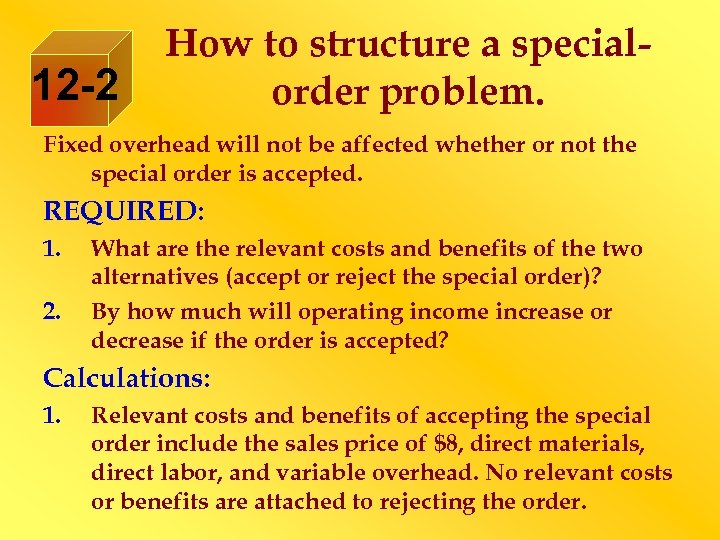
12 -2 How to structure a specialorder problem. Fixed overhead will not be affected whether or not the special order is accepted. REQUIRED: 1. 2. What are the relevant costs and benefits of the two alternatives (accept or reject the special order)? By how much will operating income increase or decrease if the order is accepted? Calculations: 1. Relevant costs and benefits of accepting the special order include the sales price of $8, direct materials, direct labor, and variable overhead. No relevant costs or benefits are attached to rejecting the order.
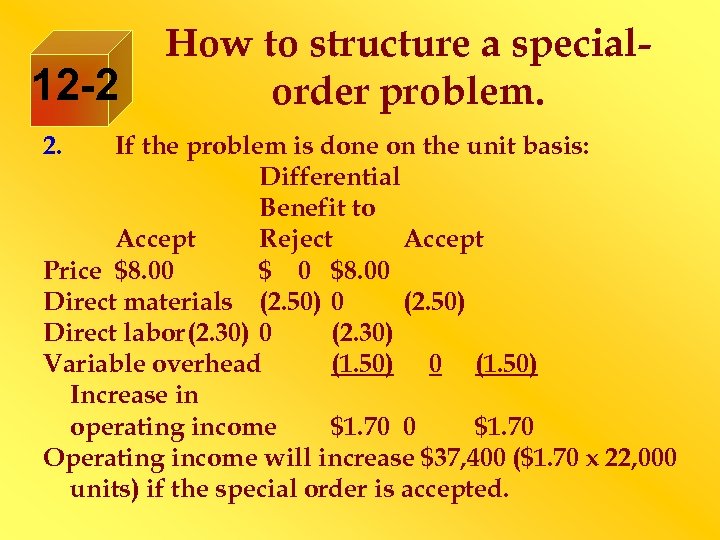
12 -2 2. How to structure a specialorder problem. If the problem is done on the unit basis: Differential Benefit to Accept Reject Accept Price $8. 00 $ 0 $8. 00 Direct materials (2. 50) 0 (2. 50) Direct labor(2. 30) 0 (2. 30) Variable overhead (1. 50) 0 (1. 50) Increase in operating income $1. 70 0 $1. 70 Operating income will increase $37, 400 ($1. 70 x 22, 000 units) if the special order is accepted.
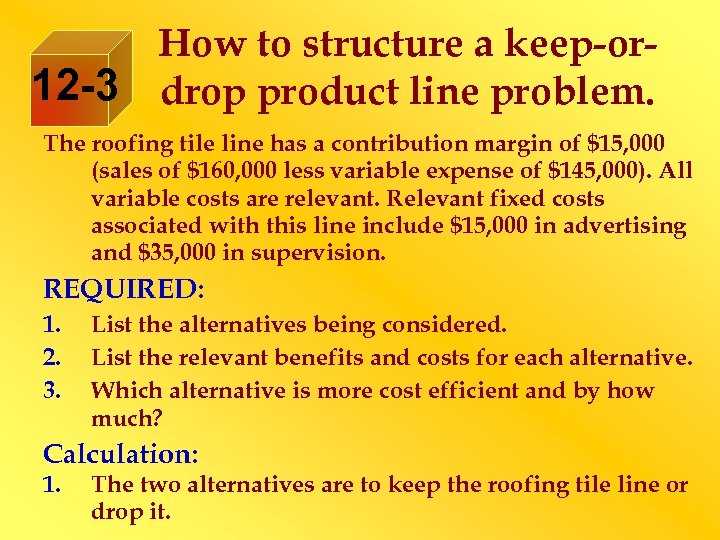
How to structure a keep-or 12 -3 drop product line problem. The roofing tile line has a contribution margin of $15, 000 (sales of $160, 000 less variable expense of $145, 000). All variable costs are relevant. Relevant fixed costs associated with this line include $15, 000 in advertising and $35, 000 in supervision. REQUIRED: 1. 2. 3. List the alternatives being considered. List the relevant benefits and costs for each alternative. Which alternative is more cost efficient and by how much? Calculation: 1. The two alternatives are to keep the roofing tile line or drop it.
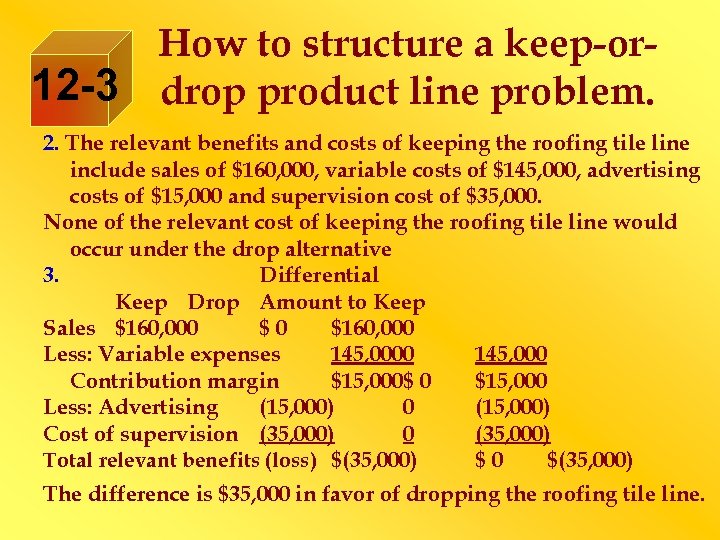
How to structure a keep-or 12 -3 drop product line problem. 2. The relevant benefits and costs of keeping the roofing tile line include sales of $160, 000, variable costs of $145, 000, advertising costs of $15, 000 and supervision cost of $35, 000. None of the relevant cost of keeping the roofing tile line would occur under the drop alternative 3. Differential Keep Drop Amount to Keep Sales $160, 000 $0 $160, 000 Less: Variable expenses 145, 0000 145, 000 Contribution margin $15, 000$ 0 $15, 000 Less: Advertising (15, 000) 0 (15, 000) Cost of supervision (35, 000) 0 (35, 000) Total relevant benefits (loss) $(35, 000) $0 $(35, 000) The difference is $35, 000 in favor of dropping the roofing tile line.
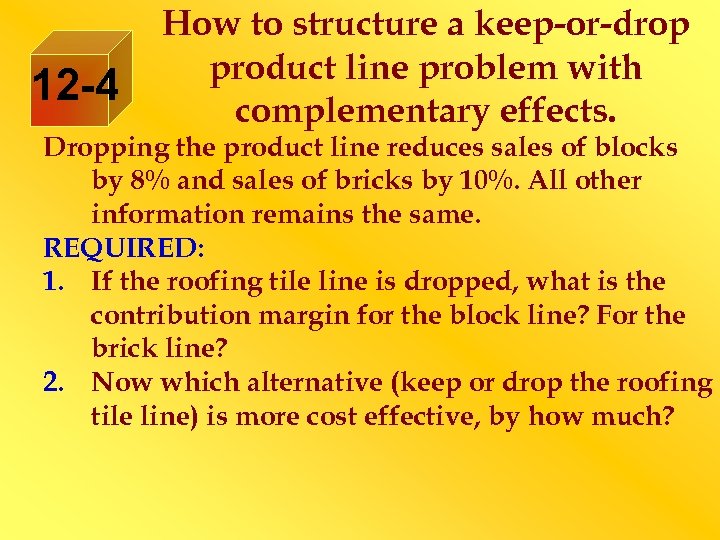
12 -4 How to structure a keep-or-drop product line problem with complementary effects. Dropping the product line reduces sales of blocks by 8% and sales of bricks by 10%. All other information remains the same. REQUIRED: 1. If the roofing tile line is dropped, what is the contribution margin for the block line? For the brick line? 2. Now which alternative (keep or drop the roofing tile line) is more cost effective, by how much?
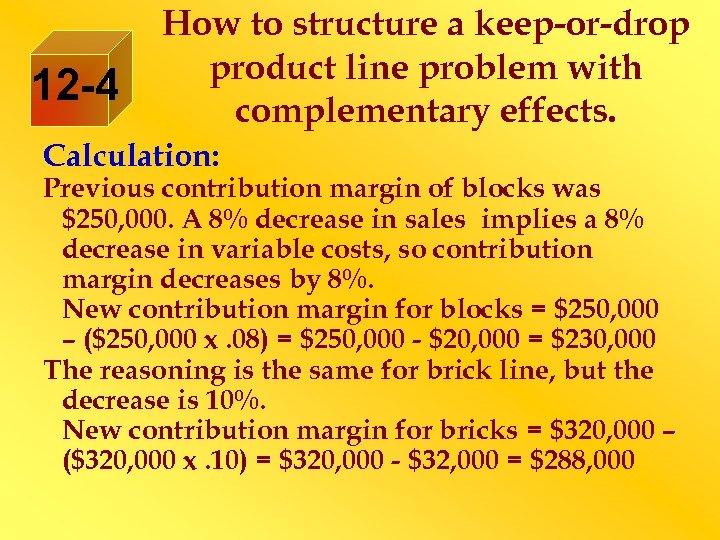
12 -4 How to structure a keep-or-drop product line problem with complementary effects. Calculation: Previous contribution margin of blocks was $250, 000. A 8% decrease in sales implies a 8% decrease in variable costs, so contribution margin decreases by 8%. New contribution margin for blocks = $250, 000 – ($250, 000 x. 08) = $250, 000 - $20, 000 = $230, 000 The reasoning is the same for brick line, but the decrease is 10%. New contribution margin for bricks = $320, 000 – ($320, 000 x. 10) = $320, 000 - $32, 000 = $288, 000
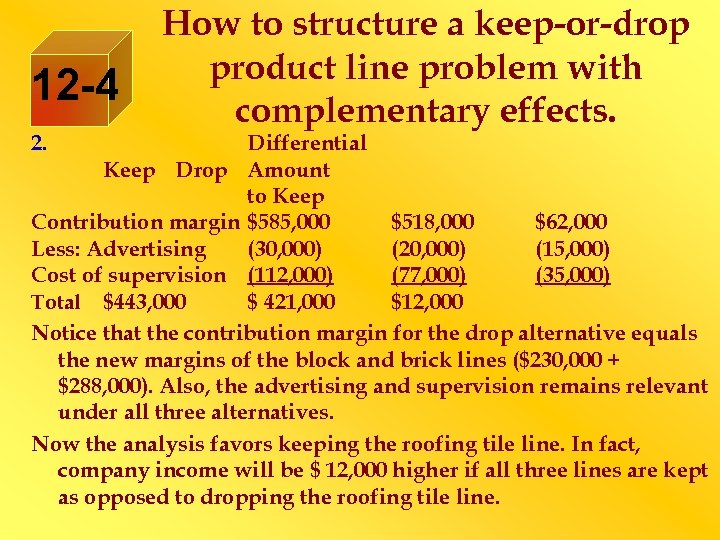
12 -4 2. How to structure a keep-or-drop product line problem with complementary effects. Differential Keep Drop Amount to Keep Contribution margin $585, 000 $518, 000 $62, 000 Less: Advertising (30, 000) (20, 000) (15, 000) Cost of supervision (112, 000) (77, 000) (35, 000) Total $443, 000 $ 421, 000 $12, 000 Notice that the contribution margin for the drop alternative equals the new margins of the block and brick lines ($230, 000 + $288, 000). Also, the advertising and supervision remains relevant under all three alternatives. Now the analysis favors keeping the roofing tile line. In fact, company income will be $ 12, 000 higher if all three lines are kept as opposed to dropping the roofing tile line.
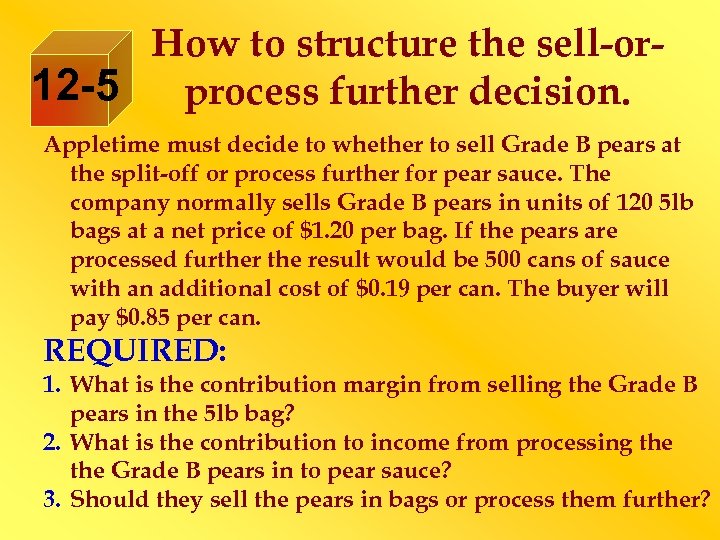
How to structure the sell-or 12 -5 process further decision. Appletime must decide to whether to sell Grade B pears at the split-off or process further for pear sauce. The company normally sells Grade B pears in units of 120 5 lb bags at a net price of $1. 20 per bag. If the pears are processed further the result would be 500 cans of sauce with an additional cost of $0. 19 per can. The buyer will pay $0. 85 per can. REQUIRED: 1. What is the contribution margin from selling the Grade B pears in the 5 lb bag? 2. What is the contribution to income from processing the Grade B pears in to pear sauce? 3. Should they sell the pears in bags or process them further?
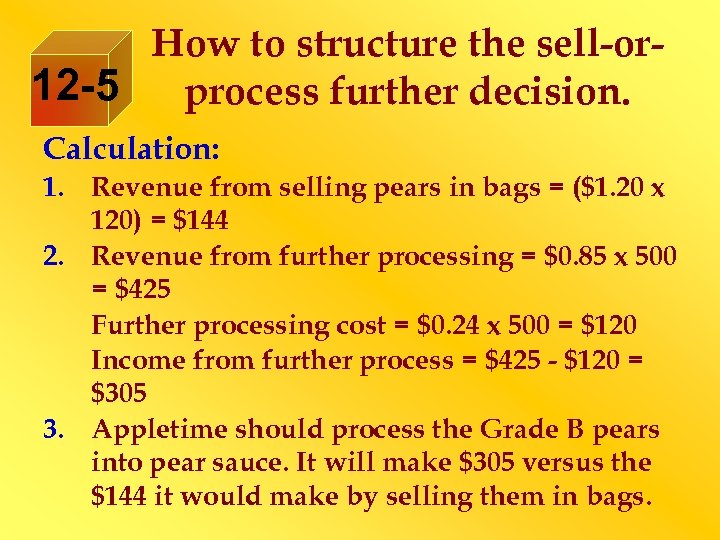
How to structure the sell-or 12 -5 process further decision. Calculation: 1. Revenue from selling pears in bags = ($1. 20 x 120) = $144 2. Revenue from further processing = $0. 85 x 500 = $425 Further processing cost = $0. 24 x 500 = $120 Income from further process = $425 - $120 = $305 3. Appletime should process the Grade B pears into pear sauce. It will make $305 versus the $144 it would make by selling them in bags.
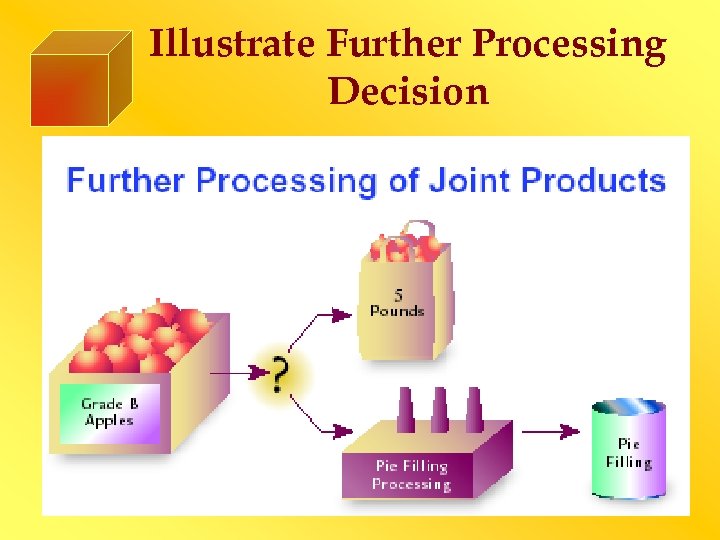
Illustrate Further Processing Decision
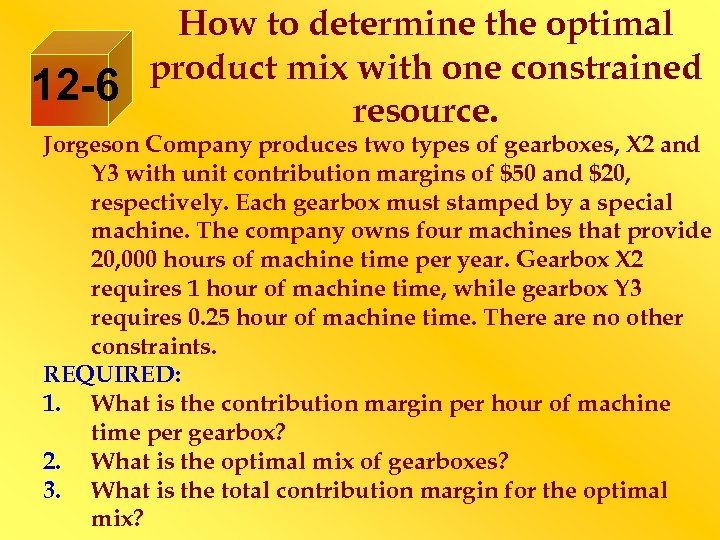
12 -6 How to determine the optimal product mix with one constrained resource. Jorgeson Company produces two types of gearboxes, X 2 and Y 3 with unit contribution margins of $50 and $20, respectively. Each gearbox must stamped by a special machine. The company owns four machines that provide 20, 000 hours of machine time per year. Gearbox X 2 requires 1 hour of machine time, while gearbox Y 3 requires 0. 25 hour of machine time. There are no other constraints. REQUIRED: 1. What is the contribution margin per hour of machine time per gearbox? 2. What is the optimal mix of gearboxes? 3. What is the total contribution margin for the optimal mix?
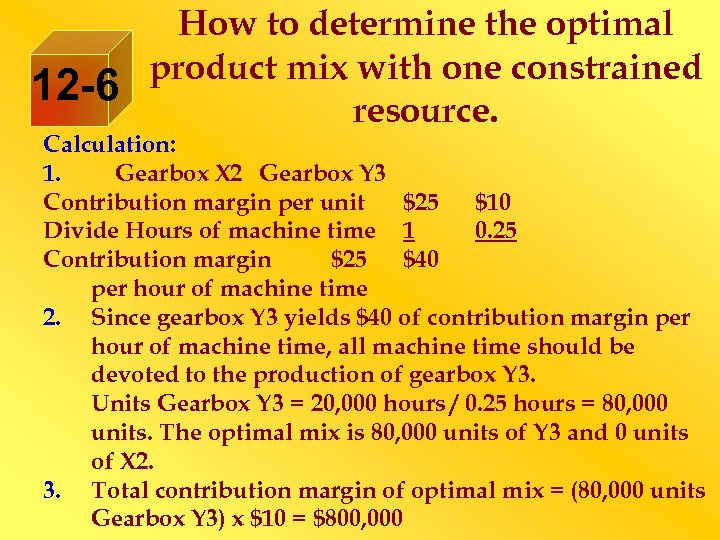
12 -6 How to determine the optimal product mix with one constrained resource. Calculation: 1. Gearbox X 2 Gearbox Y 3 Contribution margin per unit $25 $10 Divide Hours of machine time 1 0. 25 Contribution margin $25 $40 per hour of machine time 2. Since gearbox Y 3 yields $40 of contribution margin per hour of machine time, all machine time should be devoted to the production of gearbox Y 3. Units Gearbox Y 3 = 20, 000 hours / 0. 25 hours = 80, 000 units. The optimal mix is 80, 000 units of Y 3 and 0 units of X 2. 3. Total contribution margin of optimal mix = (80, 000 units Gearbox Y 3) x $10 = $800, 000
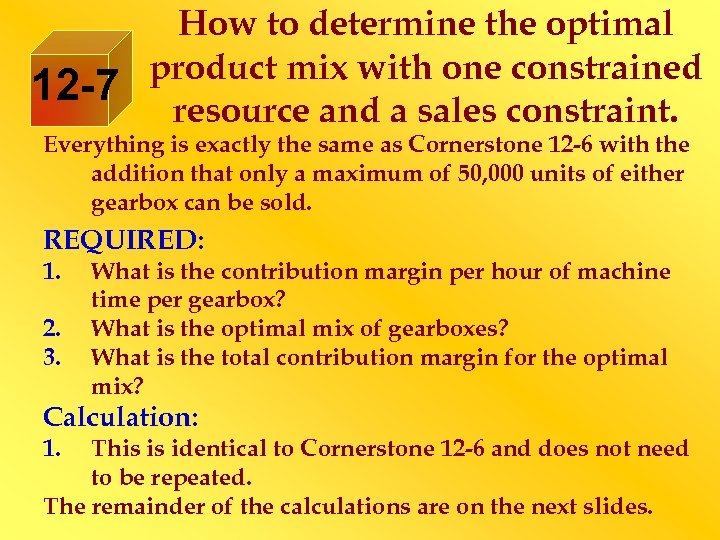
12 -7 How to determine the optimal product mix with one constrained resource and a sales constraint. Everything is exactly the same as Cornerstone 12 -6 with the addition that only a maximum of 50, 000 units of either gearbox can be sold. REQUIRED: 1. 2. 3. What is the contribution margin per hour of machine time per gearbox? What is the optimal mix of gearboxes? What is the total contribution margin for the optimal mix? Calculation: 1. This is identical to Cornerstone 12 -6 and does not need to be repeated. The remainder of the calculations are on the next slides.
12 -7 2. How to determine the optimal product mix with one constrained resource and a sales constraint. Since Gearbox Y 3 yields $40 of contribution margin per hour of machine time, the first priority is to produce all of Gearbox Y 3 that the market will take. Machine time required to for maximum amount of Gearbox Y 3 = 60, 000 x 0. 25 = 15, 000 Remaining machine time for Gearbox X 2 = 20, 000 – 15, 000 = 5, 000 hours Units of Gearbox X 2 to be produced in 5, 000 hours = 5, 000 / 1 = 5, 000 units Now the optimal mix is 60, 000 units of Gearbox Y 3 and 5, 000 of Gearbox X 2. This will precisely exhaust the machine time available.
12 -7 How to determine the optimal product mix with one constrained resource and a sales constraint. 3. Total contribution margin of optimal mix = [(60, 000 units Gearbox Y 3) x $10 + (5, 000 units Gearbox X 2) x $25] = $725, 000
12 -8 How to calculate price by applying a markup percentage to cost. Elvin Company assembles and installs computers to customer specifications. Elvin had decided to price its jobs at the cost of direct materials and direct labor plus 20%. The job for a local middle school included the following costs: Direct materials $150, 000 Direct labor 10, 000 REQUIRED: Calculate the price charged by Elvin Company to the middle school. Calculation: Price = Cost + Markup Percentage x Cost = $160, 000 + ($160, 000 x 20%) = $160, 000 + $32, 000 = $192, 000
12 -9 How to calculate a target cost. Digitime’s new pocket watch plus PDA has a target price $175. Management requires a 20% profit on new products. REQUIRED: 1. 2. Calculate the amount of desired profits. Calculate the target cost. Calculation: 1. 2. Desired profit = 0. 20 x Target price = 0. 20 x $175 = $35 Target cost = Target price – Desired profit = $175 - $35 = $140
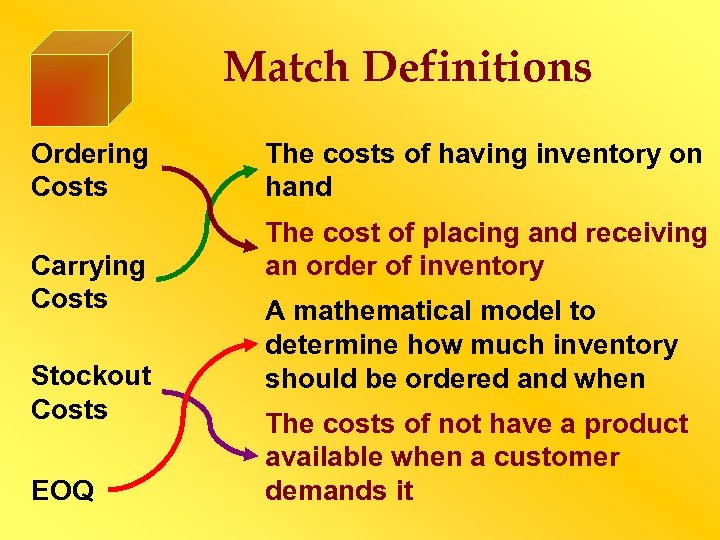
Match Definitions Ordering Costs Carrying Costs Stockout Costs EOQ The costs of having inventory on hand The cost of placing and receiving an order of inventory A mathematical model to determine how much inventory should be ordered and when The costs of not have a product available when a customer demands it
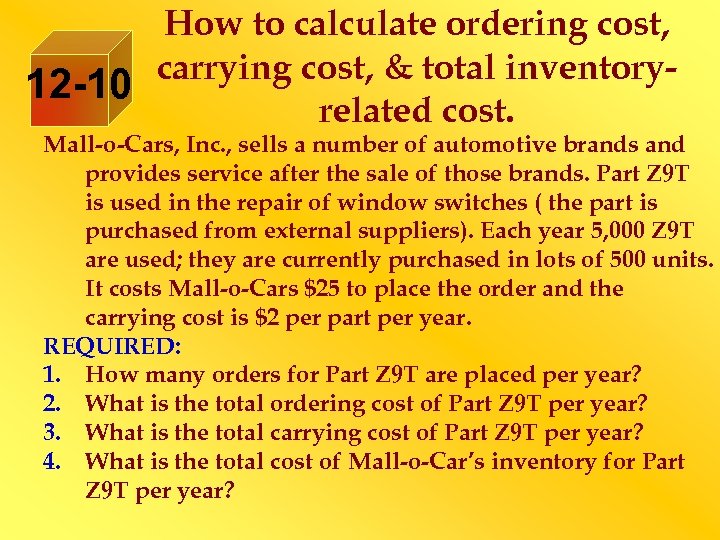
How to calculate ordering cost, carrying cost, & total inventory 12 -10 related cost. Mall-o-Cars, Inc. , sells a number of automotive brands and provides service after the sale of those brands. Part Z 9 T is used in the repair of window switches ( the part is purchased from external suppliers). Each year 5, 000 Z 9 T are used; they are currently purchased in lots of 500 units. It costs Mall-o-Cars $25 to place the order and the carrying cost is $2 per part per year. REQUIRED: 1. How many orders for Part Z 9 T are placed per year? 2. What is the total ordering cost of Part Z 9 T per year? 3. What is the total carrying cost of Part Z 9 T per year? 4. What is the total cost of Mall-o-Car’s inventory for Part Z 9 T per year?
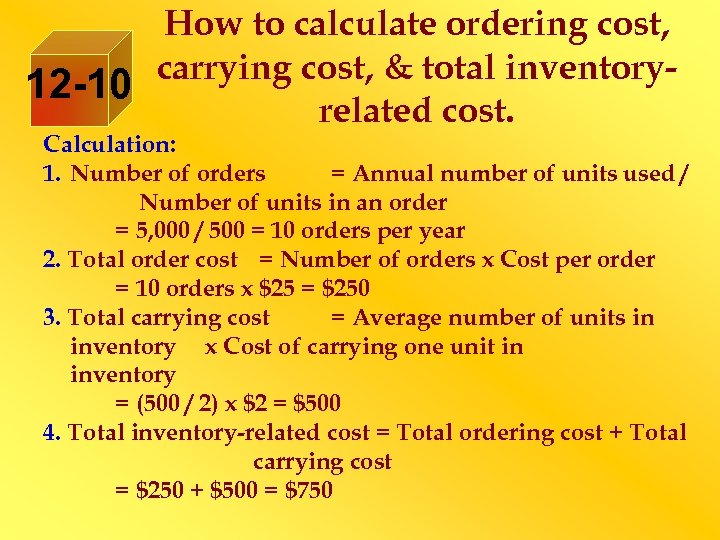
How to calculate ordering cost, carrying cost, & total inventory 12 -10 related cost. Calculation: 1. Number of orders = Annual number of units used / Number of units in an order = 5, 000 / 500 = 10 orders per year 2. Total order cost = Number of orders x Cost per order = 10 orders x $25 = $250 3. Total carrying cost = Average number of units in inventory x Cost of carrying one unit in inventory = (500 / 2) x $2 = $500 4. Total inventory-related cost = Total ordering cost + Total carrying cost = $250 + $500 = $750
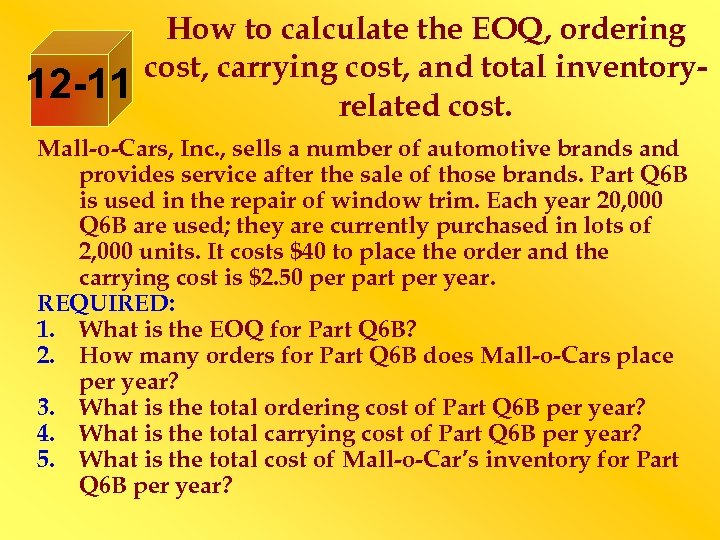
12 -11 How to calculate the EOQ, ordering cost, carrying cost, and total inventoryrelated cost. Mall-o-Cars, Inc. , sells a number of automotive brands and provides service after the sale of those brands. Part Q 6 B is used in the repair of window trim. Each year 20, 000 Q 6 B are used; they are currently purchased in lots of 2, 000 units. It costs $40 to place the order and the carrying cost is $2. 50 per part per year. REQUIRED: 1. What is the EOQ for Part Q 6 B? 2. How many orders for Part Q 6 B does Mall-o-Cars place per year? 3. What is the total ordering cost of Part Q 6 B per year? 4. What is the total carrying cost of Part Q 6 B per year? 5. What is the total cost of Mall-o-Car’s inventory for Part Q 6 B per year?
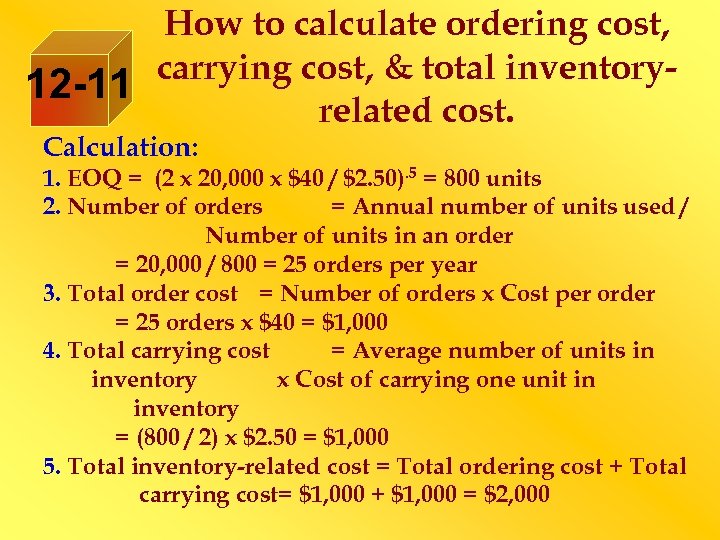
How to calculate ordering cost, carrying cost, & total inventory 12 -11 related cost. Calculation: 1. EOQ = (2 x 20, 000 x $40 / $2. 50). 5 = 800 units 2. Number of orders = Annual number of units used / Number of units in an order = 20, 000 / 800 = 25 orders per year 3. Total order cost = Number of orders x Cost per order = 25 orders x $40 = $1, 000 4. Total carrying cost = Average number of units in inventory x Cost of carrying one unit in inventory = (800 / 2) x $2. 50 = $1, 000 5. Total inventory-related cost = Total ordering cost + Total carrying cost= $1, 000 + $1, 000 = $2, 000
Скачать презентацию Management Accounting The Cornerstone for Business Decisions Short-Run
a5ed71e4fc892e18cf482a4c1a874491.ppt