


 Скачать презентацию Management accounting F 2 A Y Sokolov LOGO
2012_Upravlencheskii_uchet_F2_A-B-C.pptx
- Количество слайдов: 107
 Management accounting (F 2) A. Y. Sokolov LOGO
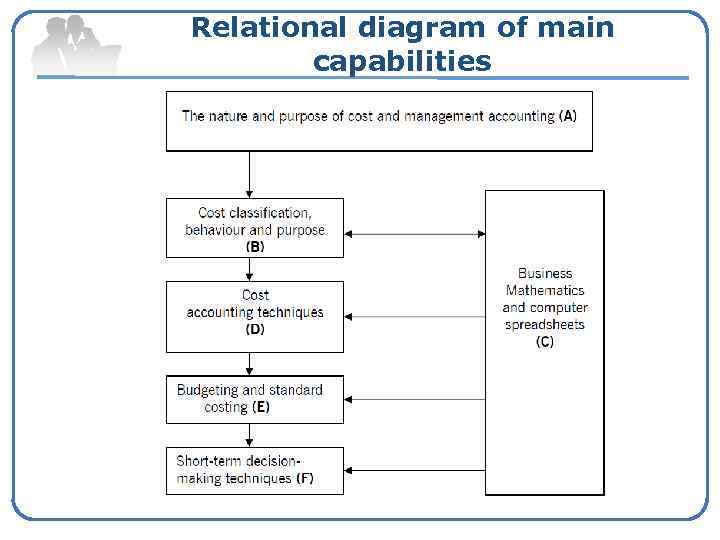 Relational diagram of main capabilities
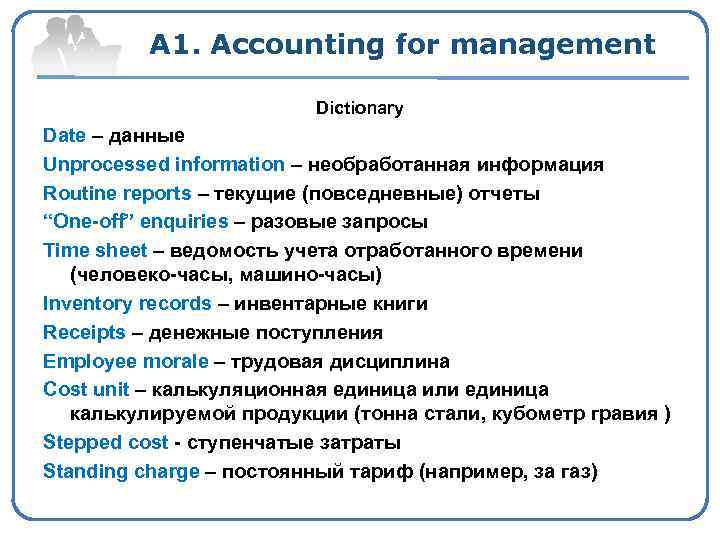 A 1. Accounting for management Dictionary Date – данные Unprocessed information – необработанная информация Routine reports – текущие (повседневные) отчеты “One-off” enquiries – разовые запросы Time sheet – ведомость учета отработанного времени (человеко-часы, машино-часы) Inventory records – инвентарные книги Receipts – денежные поступления Employee morale – трудовая дисциплина Cost unit – калькуляционная единица или единица калькулируемой продукции (тонна стали, кубометр гравия ) Stepped cost - ступенчатые затраты Standing charge – постоянный тариф (например, за газ)
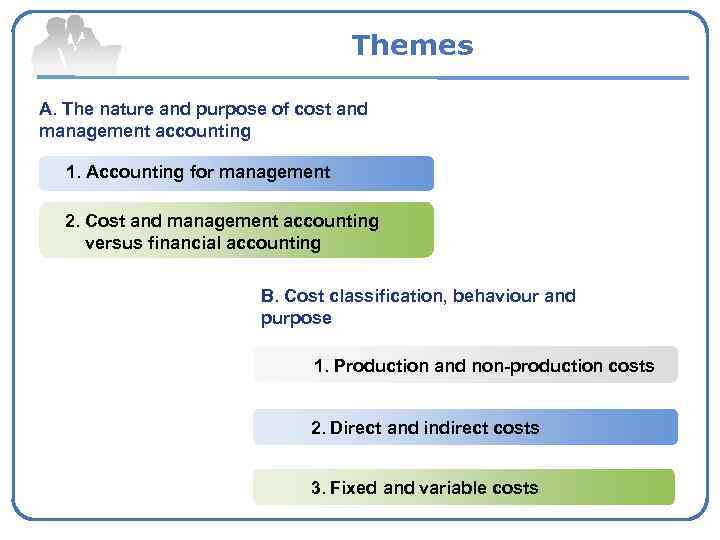 Themes A. The nature and purpose of cost and management accounting 1. Accounting for management 2. Cost and management accounting versus financial accounting B. Cost classification, behaviour and purpose 1. Production and non-production costs 2. Direct and indirect costs 3. Fixed and variable costs
 A 1. Accounting for management Purposes of the accounting § to provide a record of the financial value of business transaction and reduce the risks of fraud § to assist with the management of the financial affairs of an entity § to provide information – mainly information of a financial nature
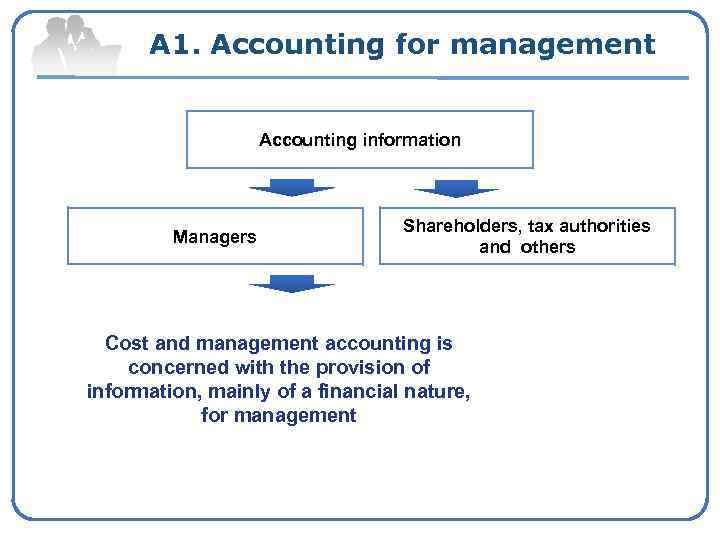 A 1. Accounting for management Accounting information Managers Shareholders, tax authorities and others Cost and management accounting is concerned with the provision of information, mainly of a financial nature, for management
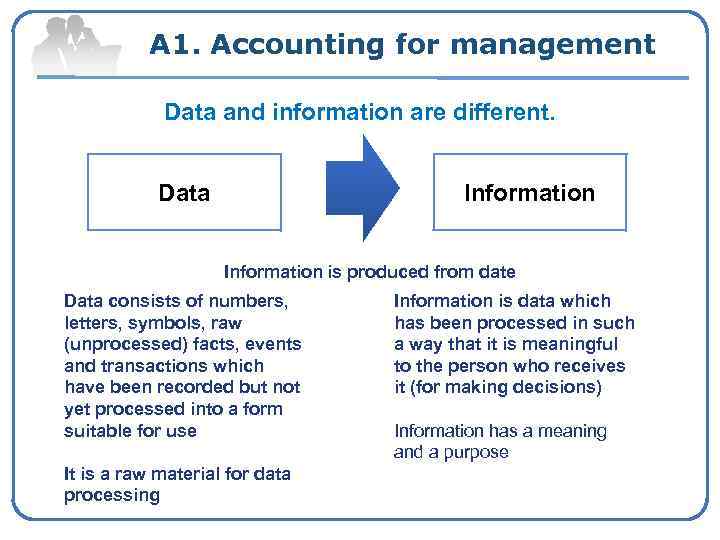 A 1. Accounting for management Data and information are different. Data Information is produced from date Data consists of numbers, letters, symbols, raw (unprocessed) facts, events and transactions which have been recorded but not yet processed into a form suitable for use It is a raw material for data processing Information is data which has been processed in such a way that it is meaningful to the person who receives it (for making decisions) Information has a meaning and a purpose
 A 1. Accounting for management Forms of the information (processed data) § Routine reports § Specially-prepared reports § Answers to “one-off” enquiries that are input to a computer system
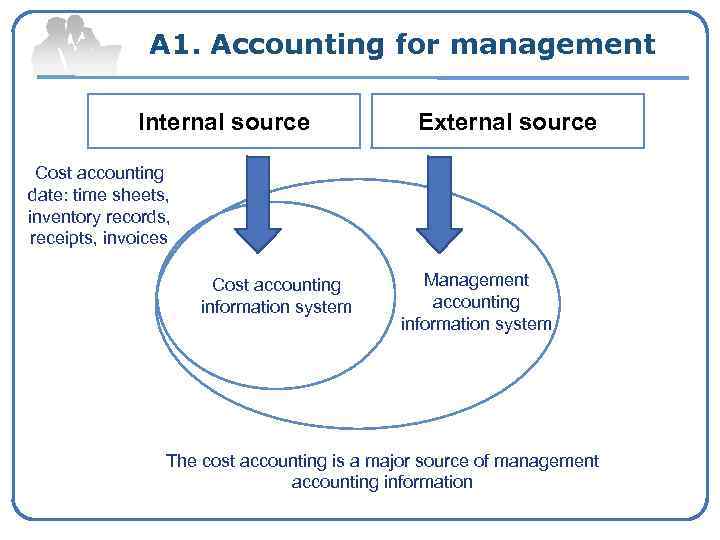 A 1. Accounting for management Internal source External source Cost accounting date: time sheets, inventory records, receipts, invoices Cost accounting information system Management accounting information system The cost accounting is a major source of management accounting information
 A 1. Accounting for management Explanation Completeness An information user should have all the information he needs to do his job Communication – Management information should be communicated to the proper (right) person Volume - There are physical and mental limitations to what a person can read, absorb and understand properly before taking action. Timing - Information which is not available until after a decision is made will be useful only for comparisons and longer-term control
 A 1. Accounting for management Explanation Accuracy and reliable – Information should be as accurate ore reliable as it needs to be for its purposes Channel of communication – The channel of communication might be the company's in-house journal, a national or local newspaper, a professional magazine. Cost - The value must exceed its cost.
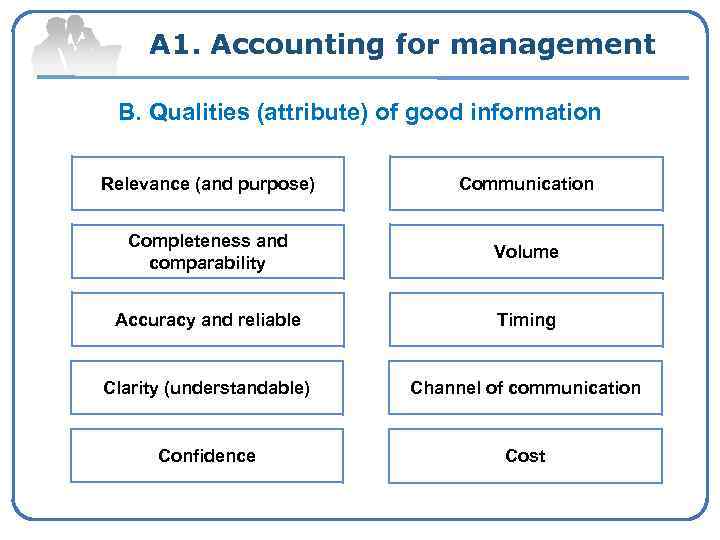 A 1. Accounting for management B. Qualities (attribute) of good information Relevance (and purpose) Communication Completeness and comparability Volume Accuracy and reliable Timing Clarity (understandable) Channel of communication Confidence Cost
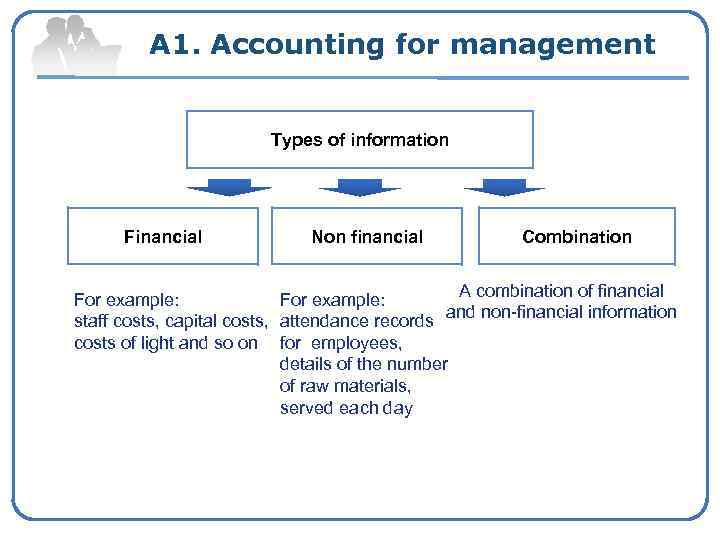 A 1. Accounting for management Types of information Financial Non financial Combination A combination of financial For example: staff costs, capital costs, attendance records and non-financial information costs of light and so on for employees, details of the number of raw materials, served each day
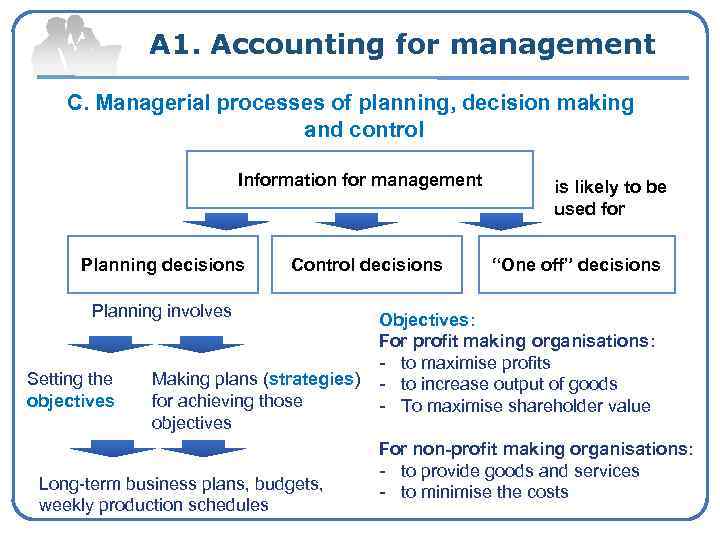 A 1. Accounting for management C. Managerial processes of planning, decision making and control Information for management Planning decisions Control decisions Planning involves Setting the objectives Making plans (strategies) for achieving those objectives Long-term business plans, budgets, weekly production schedules is likely to be used for “One off” decisions Objectives: For profit making organisations: - to maximise profits - to increase output of goods - To maximise shareholder value For non-profit making organisations: - to provide goods and services - to minimise the costs
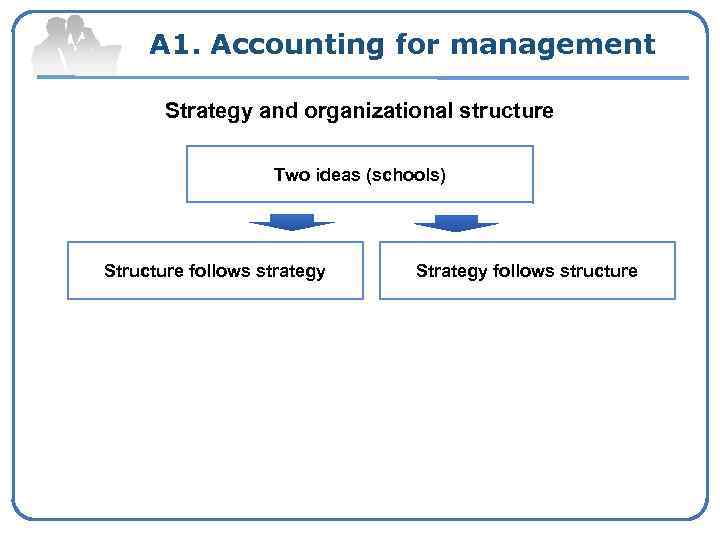 A 1. Accounting for management Strategy and organizational structure Two ideas (schools) Structure follows strategy Strategy follows structure
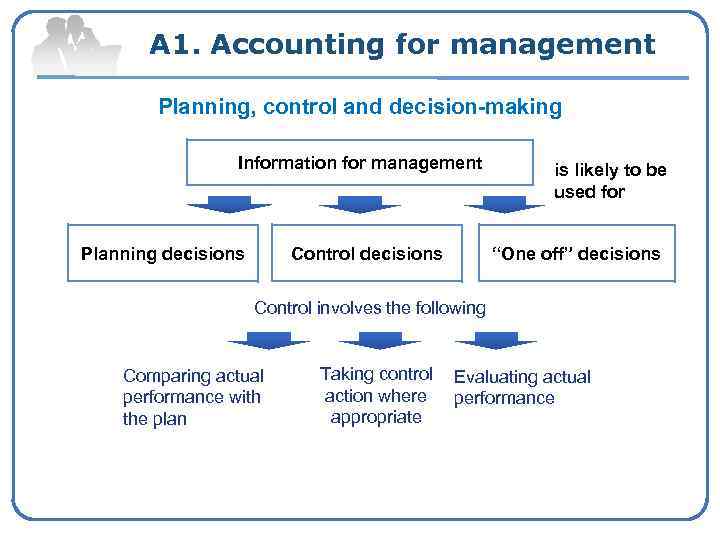 A 1. Accounting for management Planning, control and decision-making Information for management Planning decisions Control decisions is likely to be used for “One off” decisions Control involves the following Comparing actual performance with the plan Taking control action where appropriate Evaluating actual performance
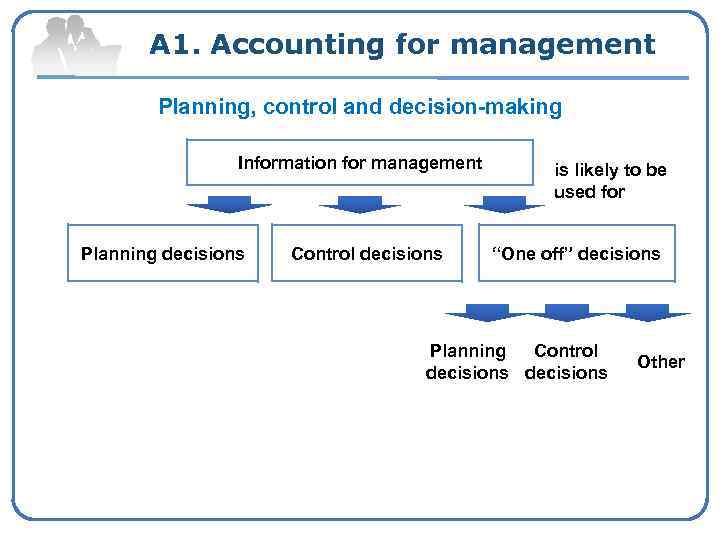 A 1. Accounting for management Planning, control and decision-making Information for management Planning decisions Control decisions is likely to be used for “One off” decisions Planning Control decisions Other
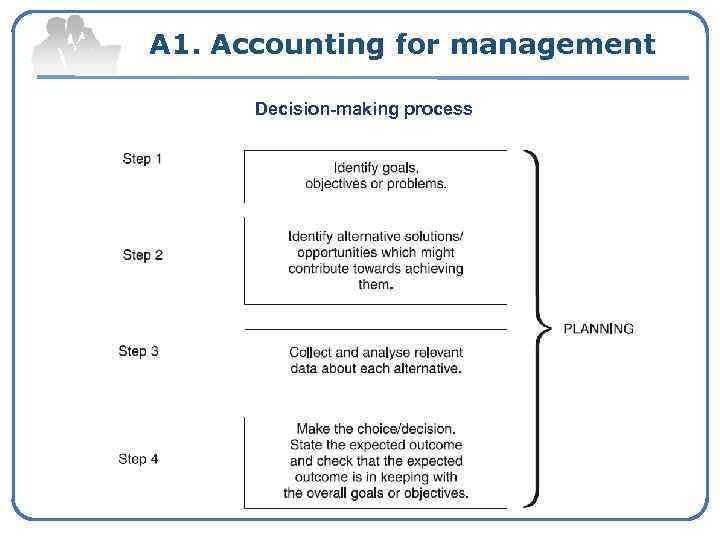 A 1. Accounting for management Decision-making process
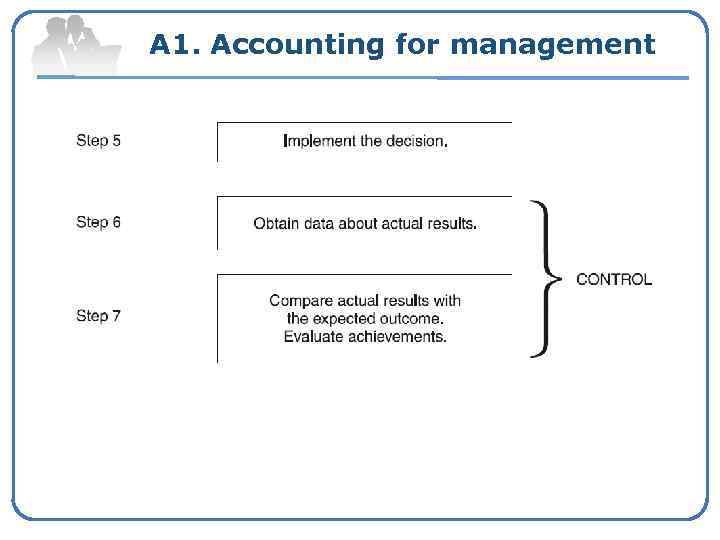 A 1. Accounting for management
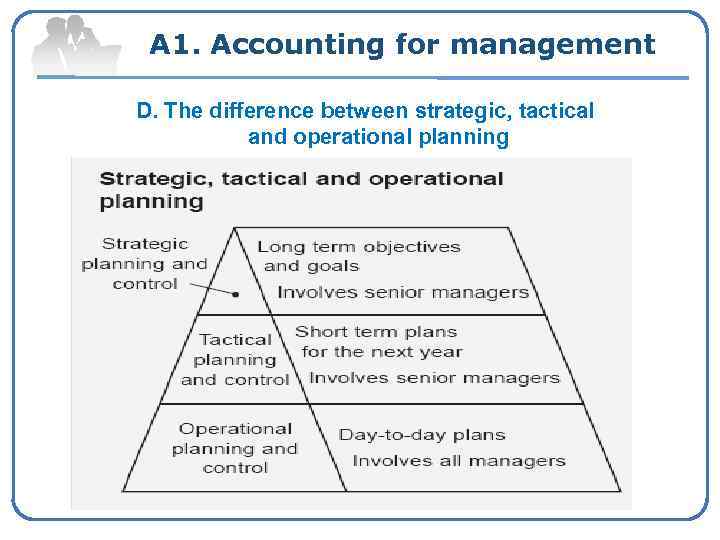 A 1. Accounting for management D. The difference between strategic, tactical and operational planning
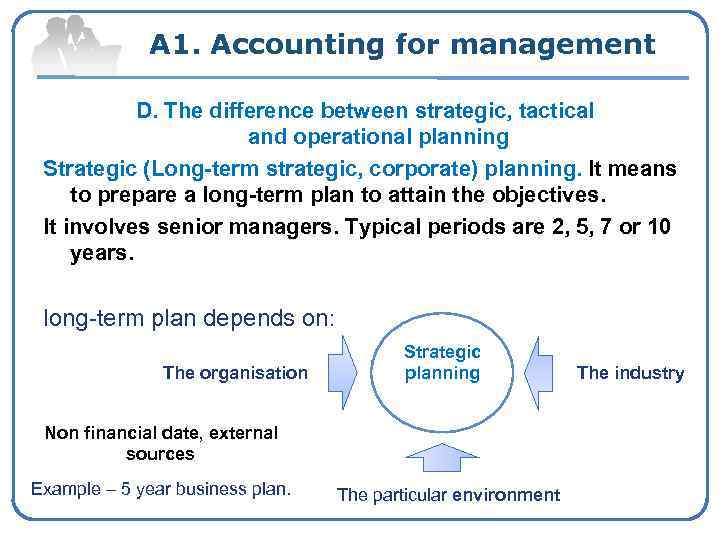 A 1. Accounting for management D. The difference between strategic, tactical and operational planning Strategic (Long-term strategic, corporate) planning. It means to prepare a long-term plan to attain the objectives. It involves senior managers. Typical periods are 2, 5, 7 or 10 years. long-term plan depends on: The organisation Strategic planning Non financial date, external sources Example – 5 year business plan. The particular environment The industry
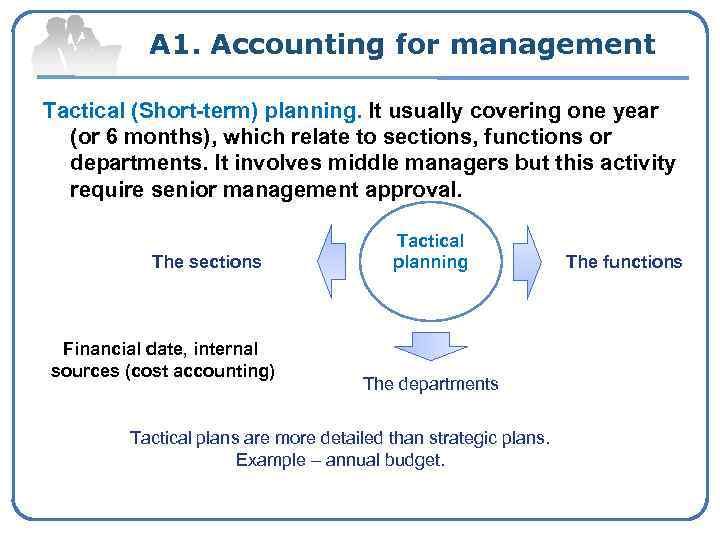 A 1. Accounting for management Tactical (Short-term) planning. It usually covering one year (or 6 months), which relate to sections, functions or departments. It involves middle managers but this activity require senior management approval. The sections Financial date, internal sources (cost accounting) Tactical planning The departments Tactical plans are more detailed than strategic plans. Example – annual budget. The functions
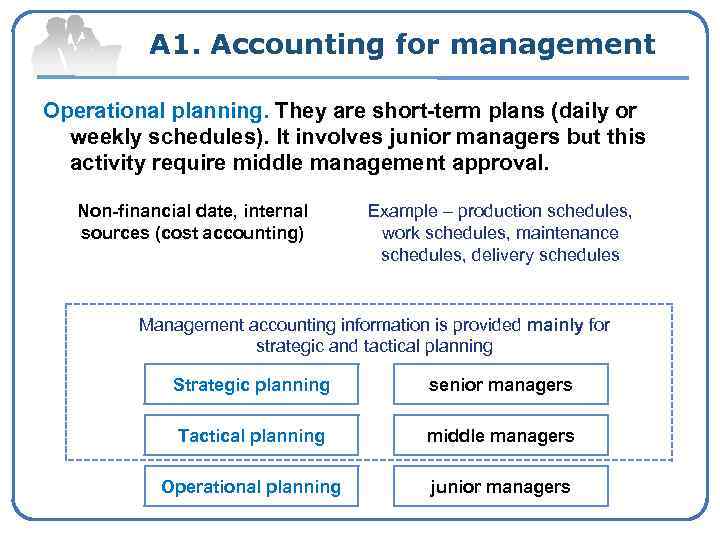 A 1. Accounting for management Operational planning. They are short-term plans (daily or weekly schedules). It involves junior managers but this activity require middle management approval. Non-financial date, internal sources (cost accounting) Example – production schedules, work schedules, maintenance schedules, delivery schedules Management accounting information is provided mainly for strategic and tactical planning Strategic planning senior managers Tactical planning middle managers Operational planning junior managers
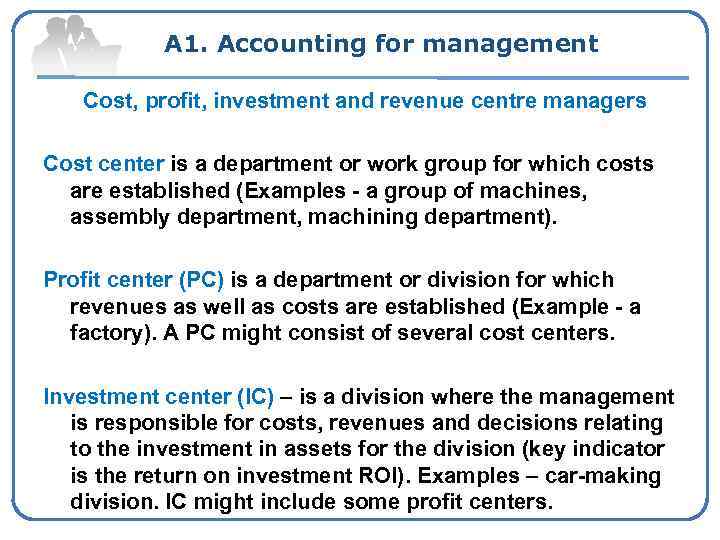 A 1. Accounting for management Cost, profit, investment and revenue centre managers Cost center is a department or work group for which costs are established (Examples - a group of machines, assembly department, machining department). Profit center (PC) is a department or division for which revenues as well as costs are established (Example - a factory). A PC might consist of several cost centers. Investment center (IC) – is a division where the management is responsible for costs, revenues and decisions relating to the investment in assets for the division (key indicator is the return on investment ROI). Examples – car-making division. IC might include some profit centers.
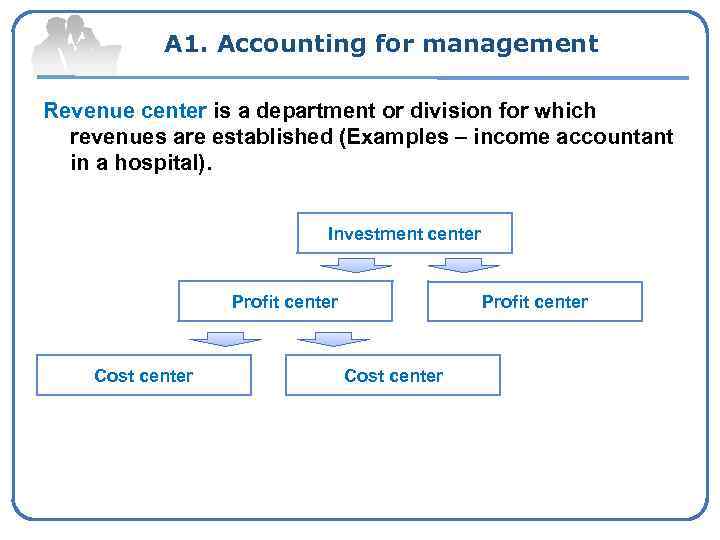 A 1. Accounting for management Revenue center is a department or division for which revenues are established (Examples – income accountant in a hospital). Investment center Profit center Cost center
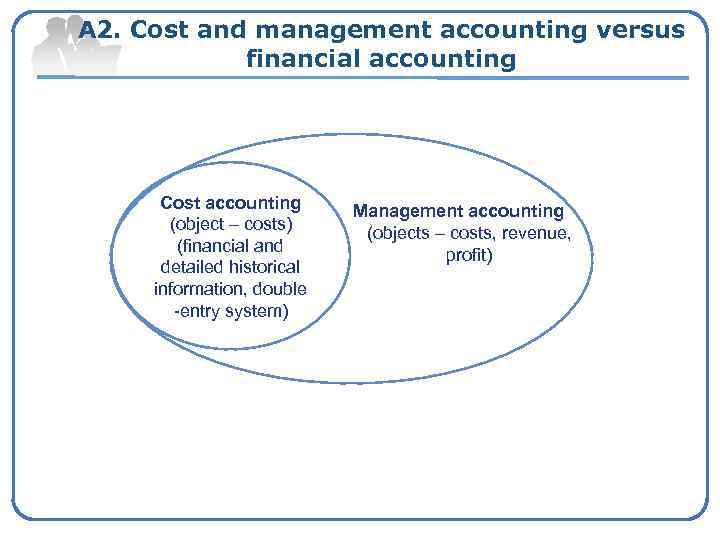 A 2. Cost and management accounting versus financial accounting Cost accounting (object – costs) (financial and detailed historical information, double -entry system) Management accounting (objects – costs, revenue, profit)
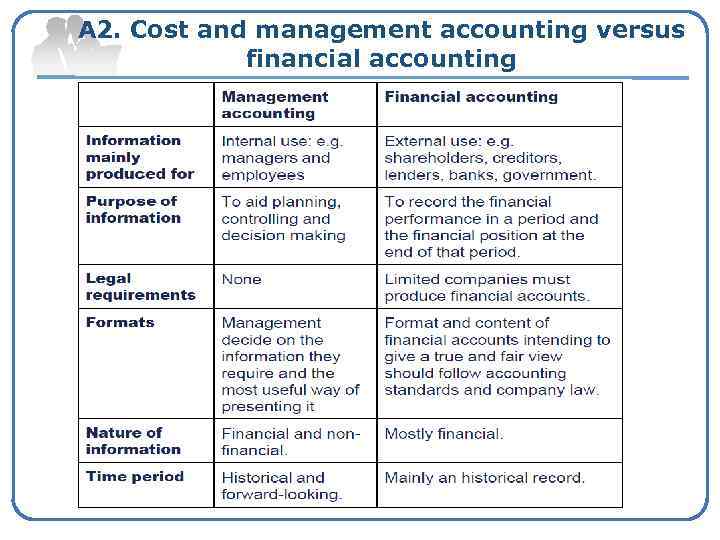 A 2. Cost and management accounting versus financial accounting
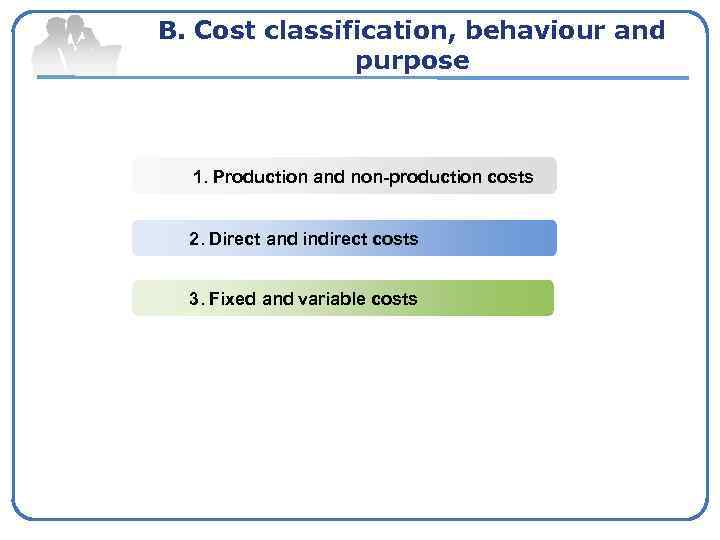 B. Cost classification, behaviour and purpose 1. Production and non-production costs 2. Direct and indirect costs 3. Fixed and variable costs
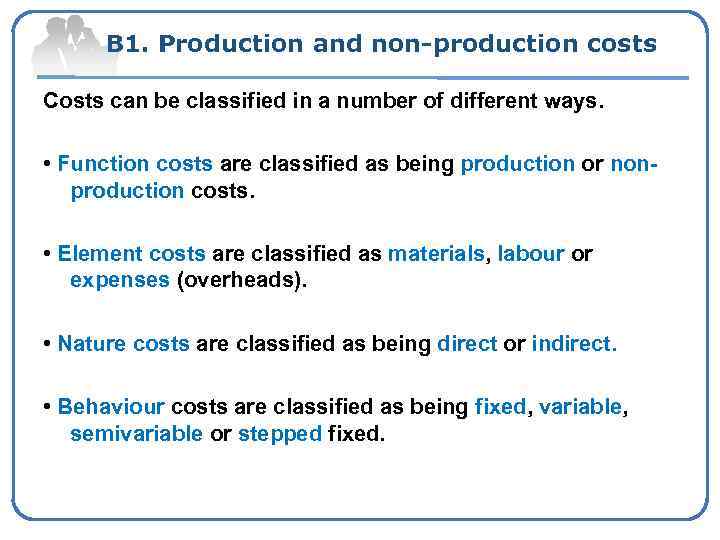 B 1. Production and non-production costs Costs can be classified in a number of different ways. • Function costs are classified as being production or nonproduction costs. • Element costs are classified as materials, labour or expenses (overheads). • Nature costs are classified as being direct or indirect. • Behaviour costs are classified as being fixed, variable, semivariable or stepped fixed.
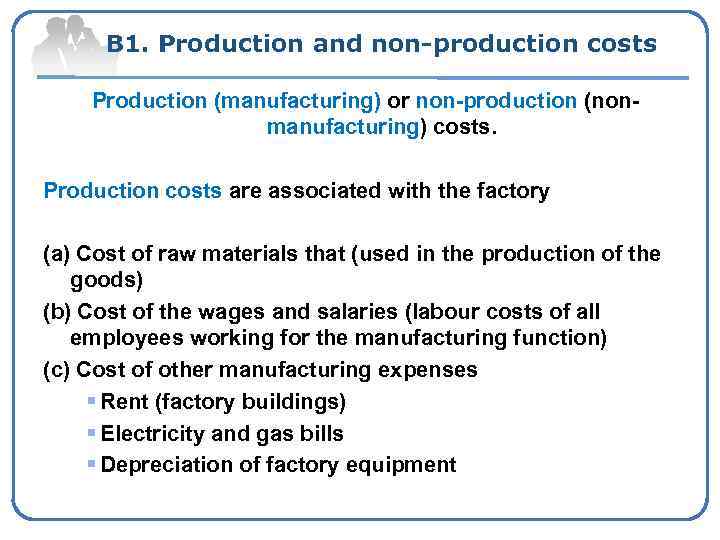 B 1. Production and non-production costs Production (manufacturing) or non-production (nonmanufacturing) costs. Production costs are associated with the factory (a) Cost of raw materials that (used in the production of the goods) (b) Cost of the wages and salaries (labour costs of all employees working for the manufacturing function) (c) Cost of other manufacturing expenses § Rent (factory buildings) § Electricity and gas bills § Depreciation of factory equipment
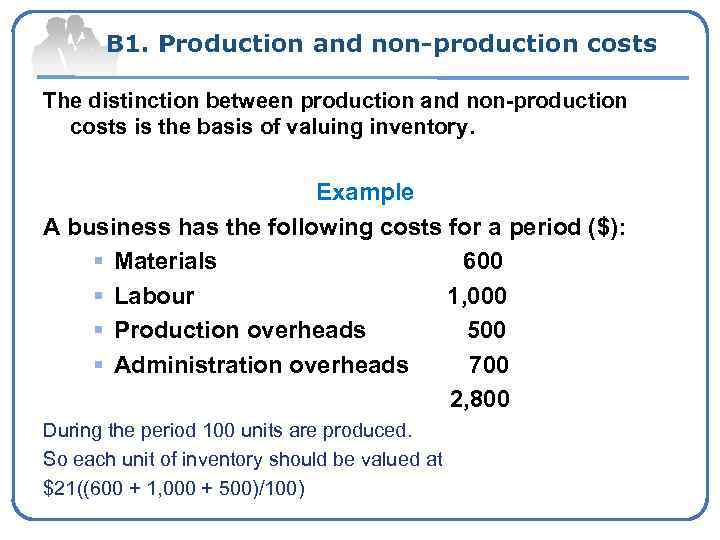 B 1. Production and non-production costs The distinction between production and non-production costs is the basis of valuing inventory. Example A business has the following costs for a period ($): § Materials 600 § Labour 1, 000 § Production overheads 500 § Administration overheads 700 2, 800 During the period 100 units are produced. So each unit of inventory should be valued at $21((600 + 1, 000 + 500)/100)
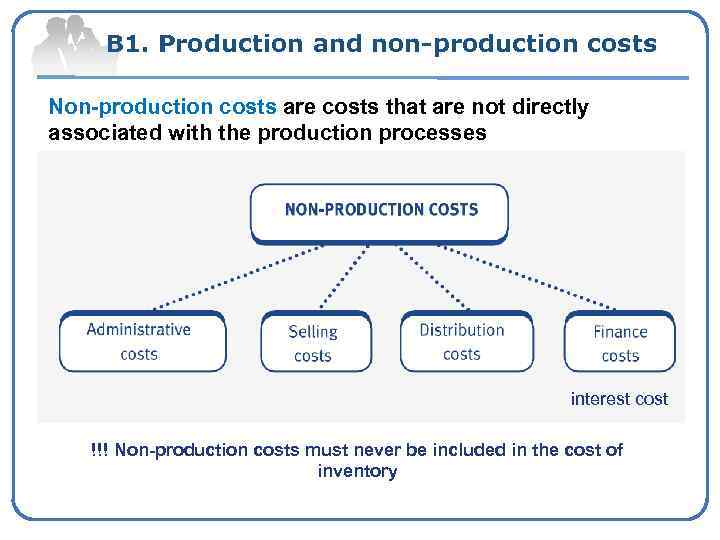 B 1. Production and non-production costs Non-production costs are costs that are not directly associated with the production processes interest cost !!! Non-production costs must never be included in the cost of inventory
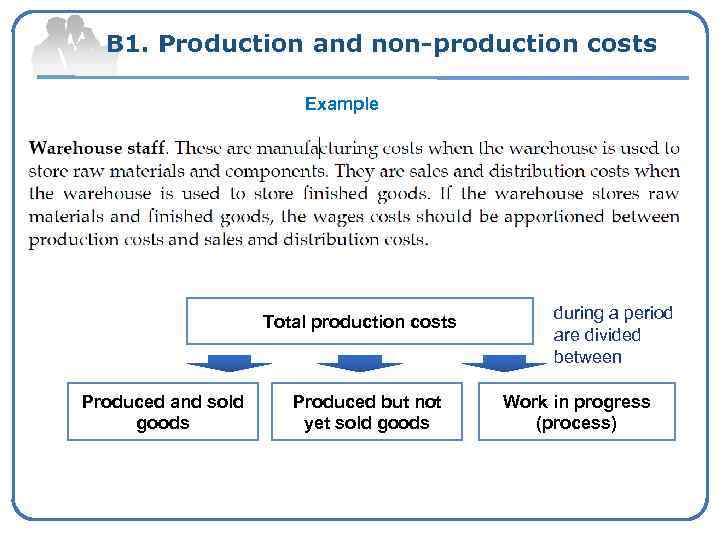 B 1. Production and non-production costs Example Total production costs Produced and sold goods Produced but not yet sold goods during a period are divided between Work in progress (process)
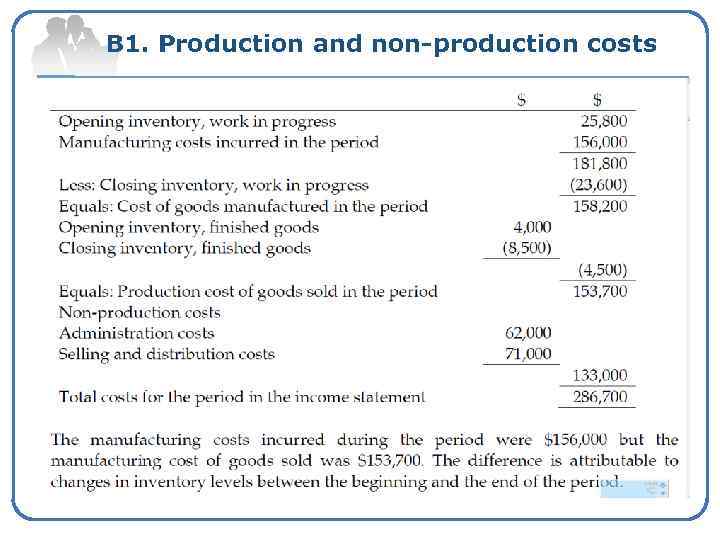 B 1. Production and non-production costs
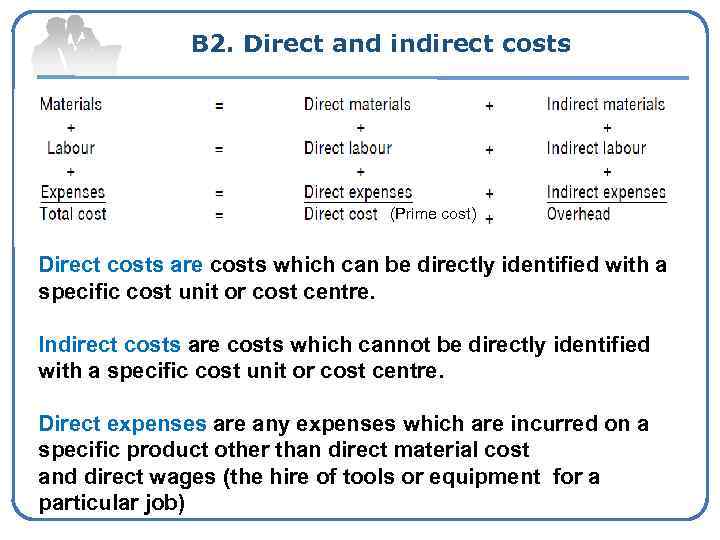 B 2. Direct and indirect costs (Prime cost) Direct costs are costs which can be directly identified with a specific cost unit or cost centre. Indirect costs are costs which cannot be directly identified with a specific cost unit or cost centre. Direct expenses are any expenses which are incurred on a specific product other than direct material cost and direct wages (the hire of tools or equipment for a particular job)
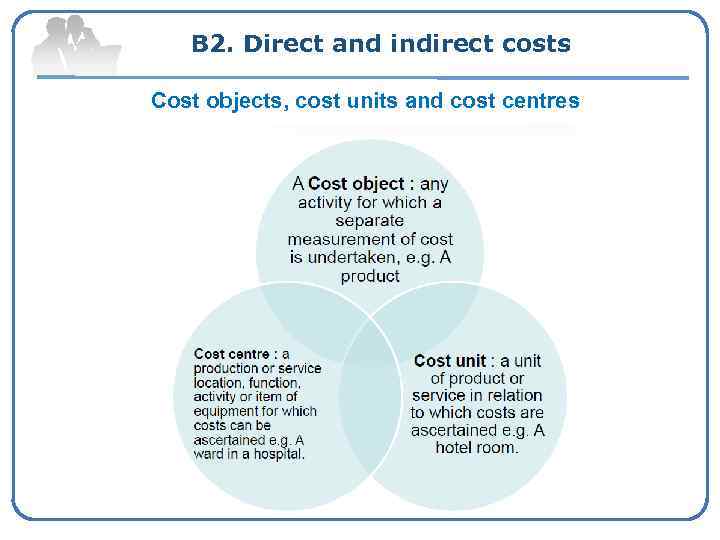 B 2. Direct and indirect costs Cost objects, cost units and cost centres
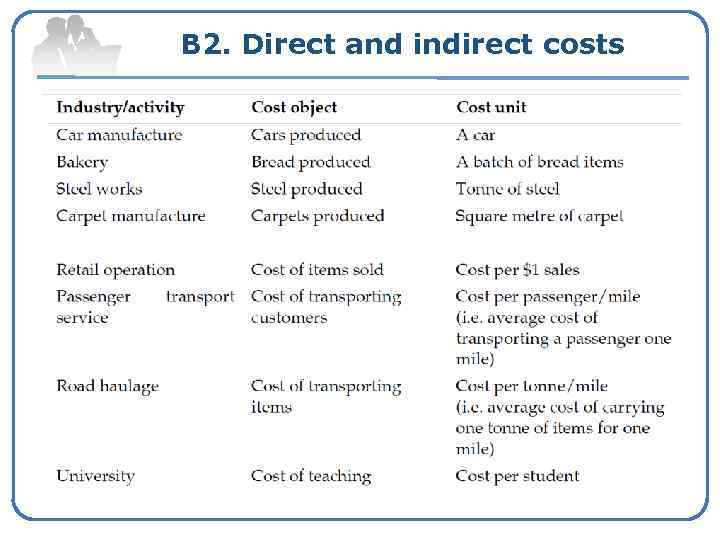
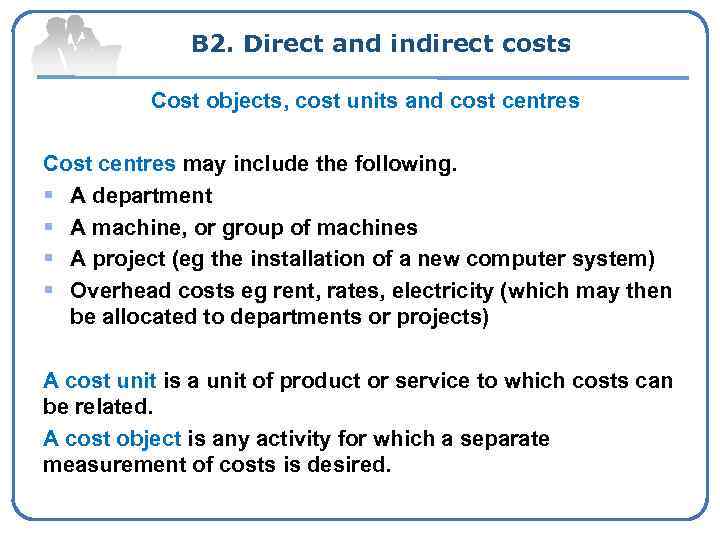 B 2. Direct and indirect costs Cost objects, cost units and cost centres Cost centres may include the following. § A department § A machine, or group of machines § A project (eg the installation of a new computer system) § Overhead costs eg rent, rates, electricity (which may then be allocated to departments or projects) A cost unit is a unit of product or service to which costs can be related. A cost object is any activity for which a separate measurement of costs is desired.
 B 2. Direct and indirect costs
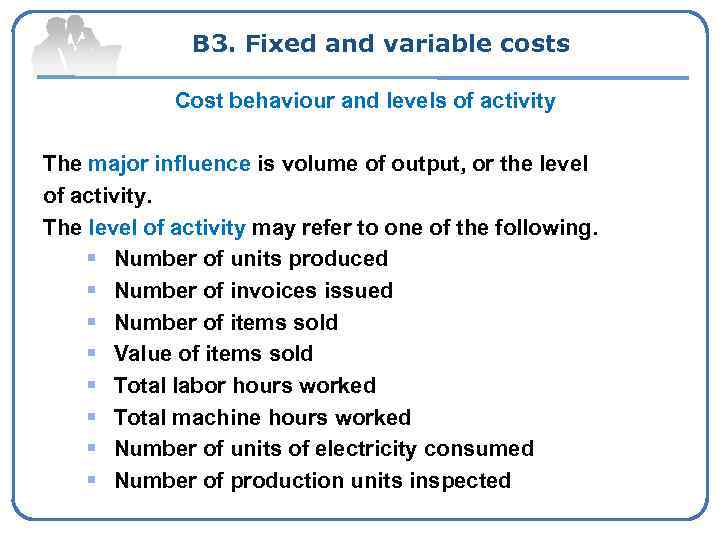 B 3. Fixed and variable costs Cost behaviour and levels of activity The major influence is volume of output, or the level of activity. The level of activity may refer to one of the following. § Number of units produced § Number of invoices issued § Number of items sold § Value of items sold § Total labor hours worked § Total machine hours worked § Number of units of electricity consumed § Number of production units inspected
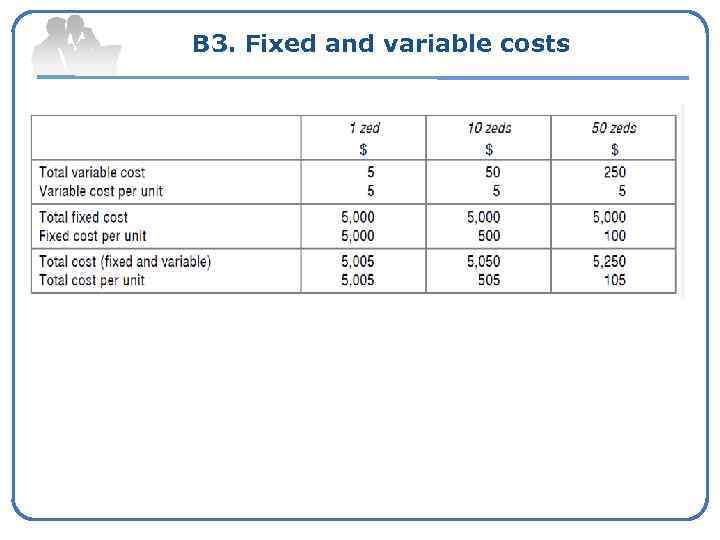
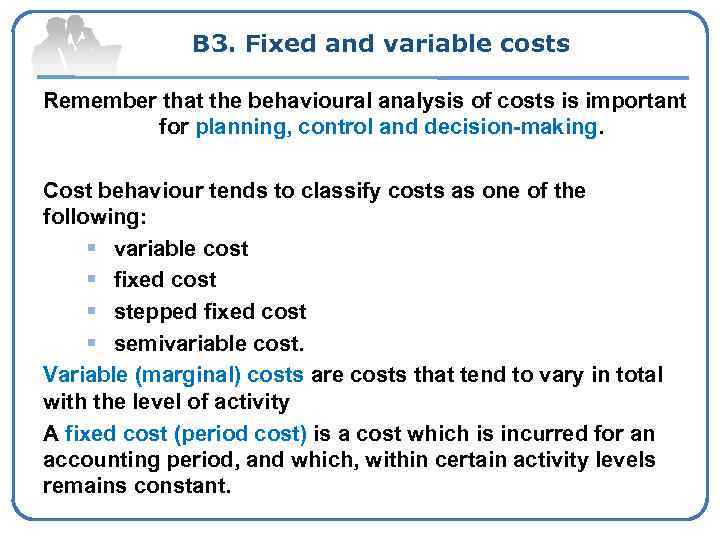 B 3. Fixed and variable costs Remember that the behavioural analysis of costs is important for planning, control and decision-making. Cost behaviour tends to classify costs as one of the following: § variable cost § fixed cost § stepped fixed cost § semivariable cost. Variable (marginal) costs are costs that tend to vary in total with the level of activity A fixed cost (period cost) is a cost which is incurred for an accounting period, and which, within certain activity levels remains constant.
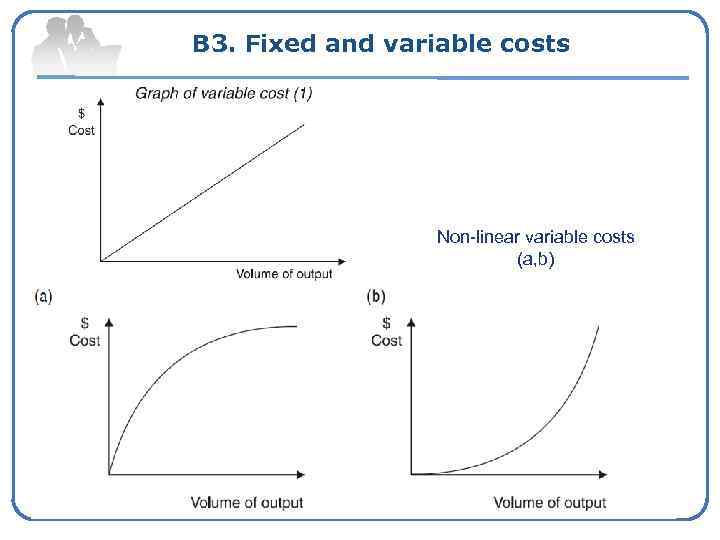 B 3. Fixed and variable costs Non-linear variable costs (a, b)
 B 3. Fixed and variable costs
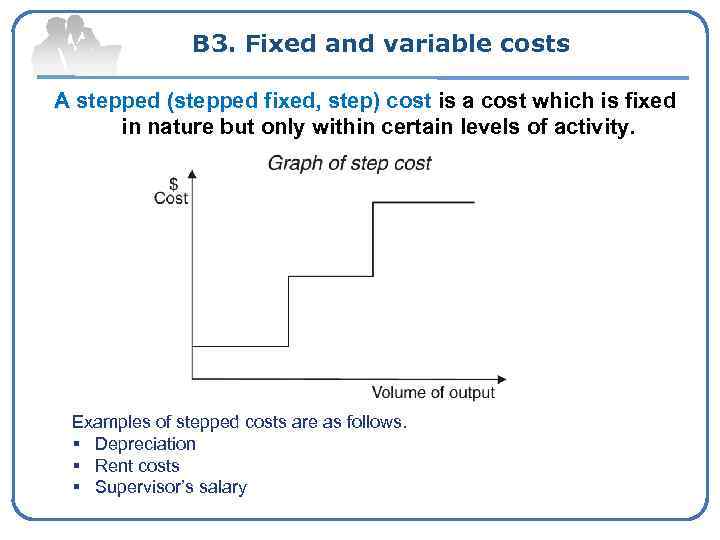 B 3. Fixed and variable costs A stepped (stepped fixed, step) cost is a cost which is fixed in nature but only within certain levels of activity. Examples of stepped costs are as follows. § Depreciation § Rent costs § Supervisor’s salary
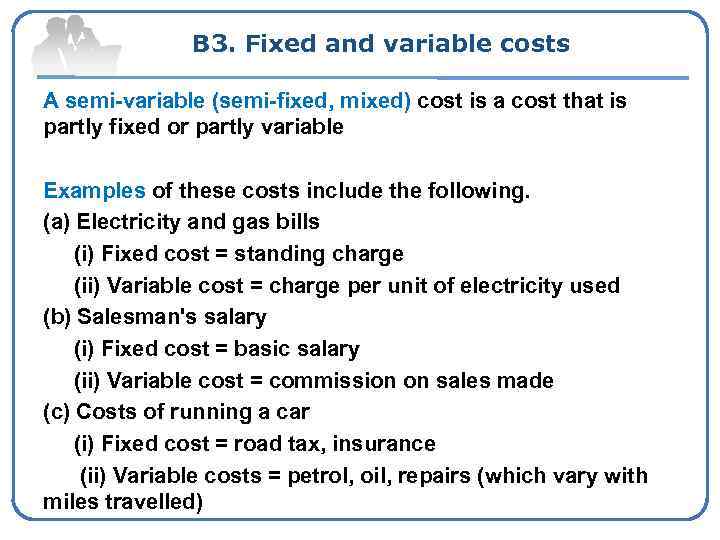 B 3. Fixed and variable costs A semi-variable (semi-fixed, mixed) cost is a cost that is partly fixed or partly variable Examples of these costs include the following. (a) Electricity and gas bills (i) Fixed cost = standing charge (ii) Variable cost = charge per unit of electricity used (b) Salesman's salary (i) Fixed cost = basic salary (ii) Variable cost = commission on sales made (c) Costs of running a car (i) Fixed cost = road tax, insurance (ii) Variable costs = petrol, oil, repairs (which vary with miles travelled)
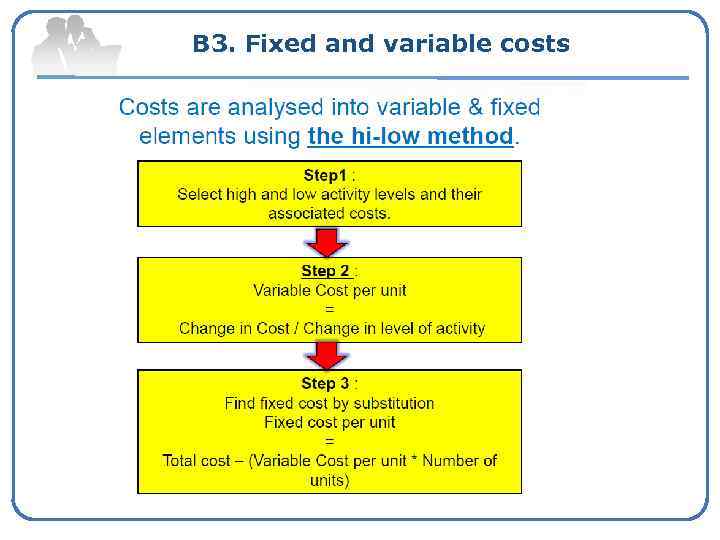 B 3. Fixed and variable costs Analysing costs
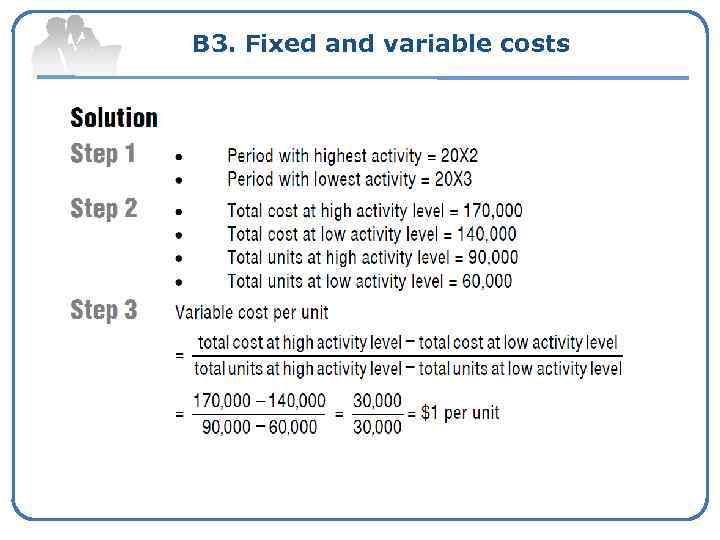
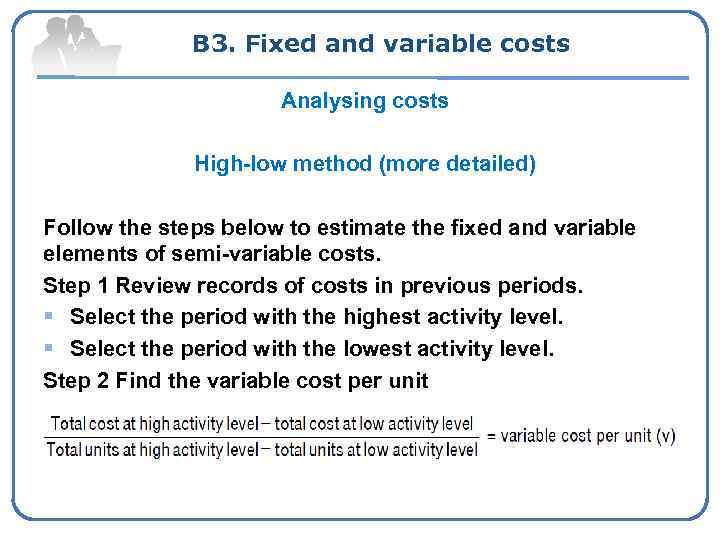 B 3. Fixed and variable costs Analysing costs High-low method (more detailed) Follow the steps below to estimate the fixed and variable elements of semi-variable costs. Step 1 Review records of costs in previous periods. § Select the period with the highest activity level. § Select the period with the lowest activity level. Step 2 Find the variable cost per unit
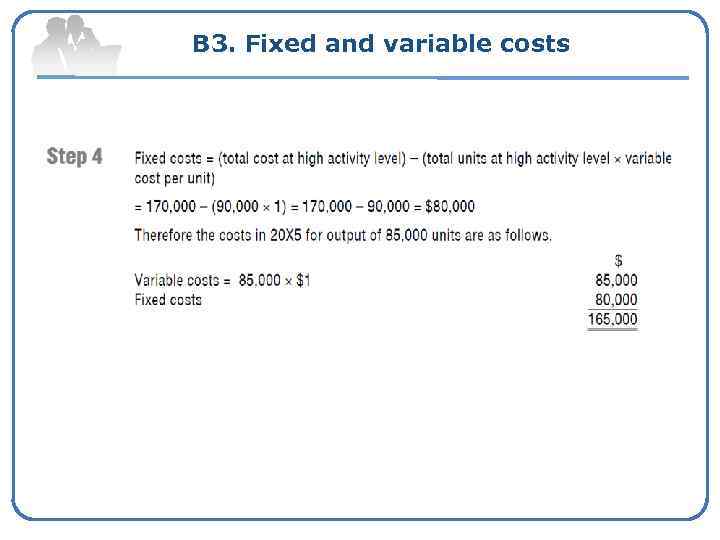
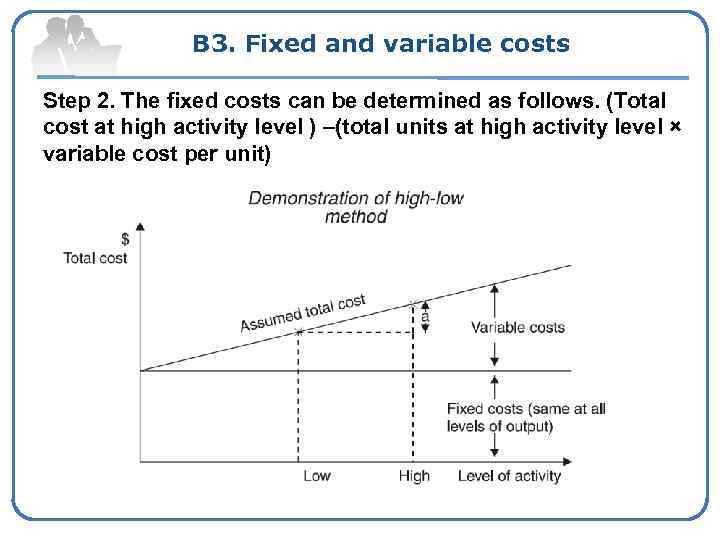 B 3. Fixed and variable costs Step 2. The fixed costs can be determined as follows. (Total cost at high activity level ) –(total units at high activity level × variable cost per unit)
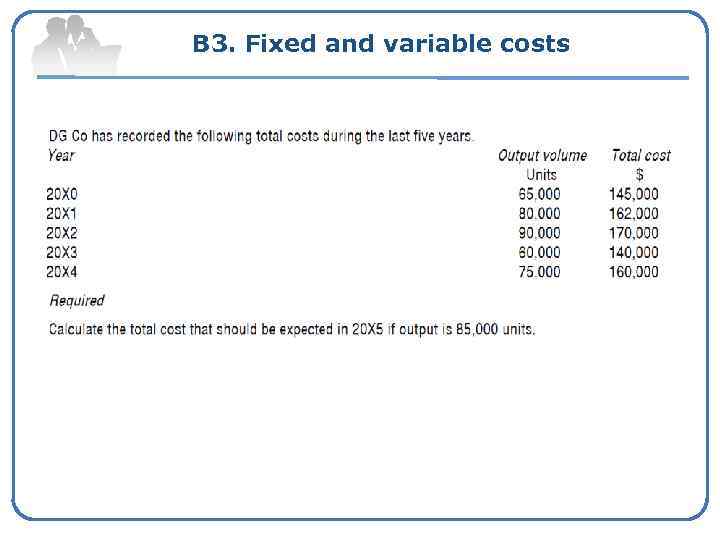 B 3. Fixed and variable costs
 B 3. Fixed and variable costs
 B 3. Fixed and variable costs
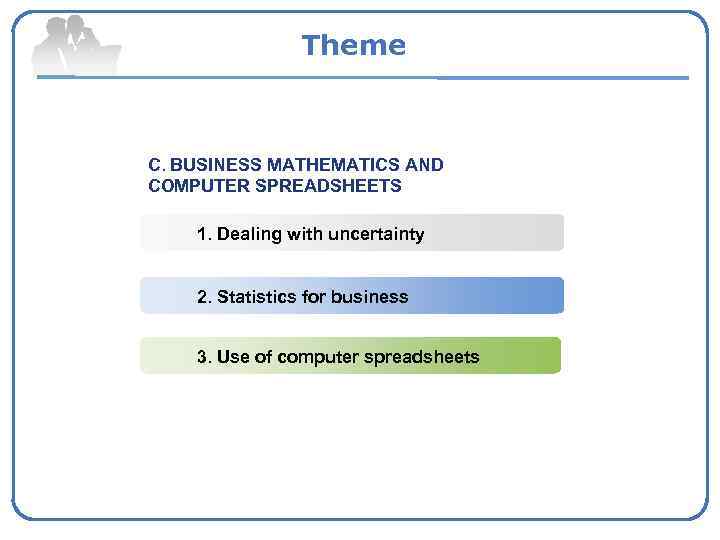 Theme C. BUSINESS MATHEMATICS AND COMPUTER SPREADSHEETS 1. Dealing with uncertainty 2. Statistics for business 3. Use of computer spreadsheets
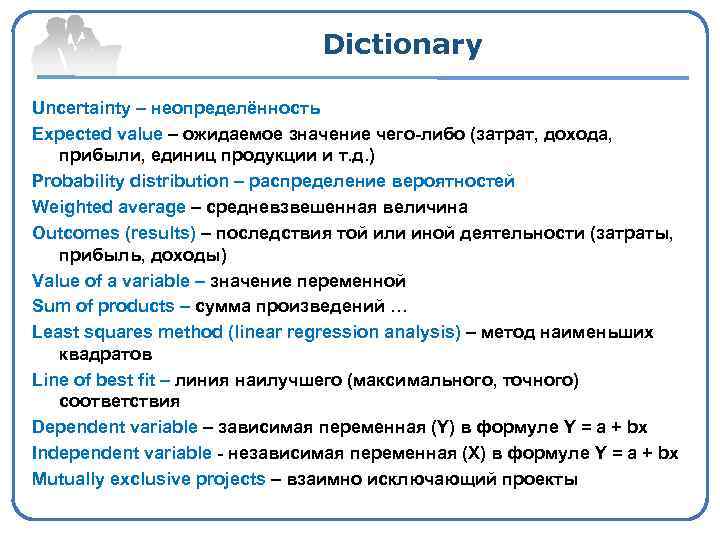 Dictionary Uncertainty – неопределённость Expected value – ожидаемое значение чего-либо (затрат, дохода, прибыли, единиц продукции и т. д. ) Probability distribution – распределение вероятностей Weighted average – средневзвешенная величина Outcomes (results) – последствия той или иной деятельности (затраты, прибыль, доходы) Value of a variable – значение переменной Sum of products – сумма произведений … Least squares method (linear regression analysis) – метод наименьших квадратов Line of best fit – линия наилучшего (максимального, точного) соответствия Dependent variable – зависимая переменная (Y) в формуле Y = a + bx Independent variable - независимая переменная (X) в формуле Y = a + bx Mutually exclusive projects – взаимно исключающий проекты
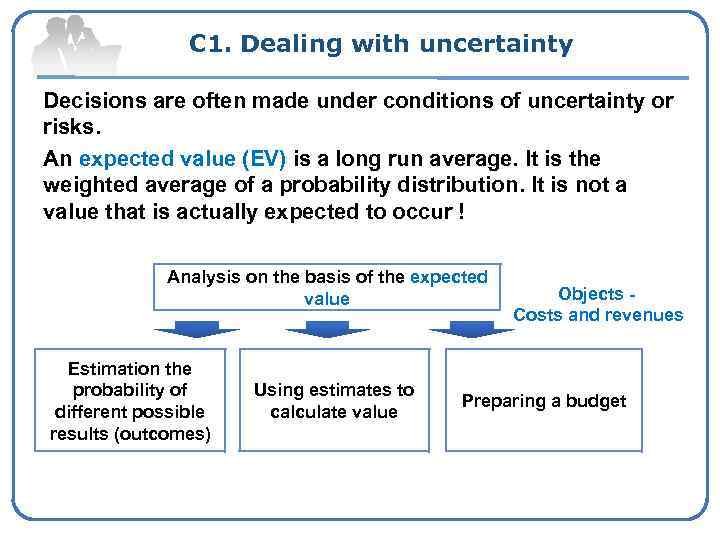 C 1. Dealing with uncertainty Decisions are often made under conditions of uncertainty or risks. An expected value (EV) is a long run average. It is the weighted average of a probability distribution. It is not a value that is actually expected to occur ! Analysis on the basis of the expected value Estimation the probability of different possible results (outcomes) Using estimates to calculate value Objects Costs and revenues Preparing a budget
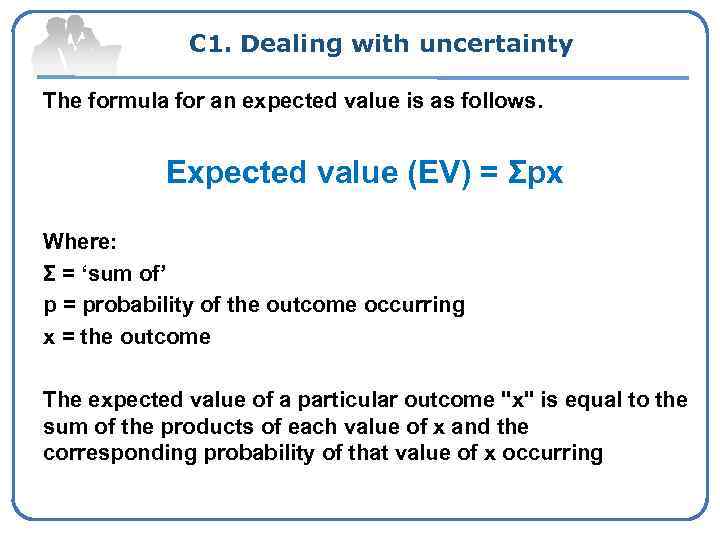 C 1. Dealing with uncertainty The formula for an expected value is as follows. Expected value (EV) = Σpx Where: Σ = ‘sum of’ p = probability of the outcome occurring x = the outcome The expected value of a particular outcome "x" is equal to the sum of the products of each value of x and the corresponding probability of that value of x occurring
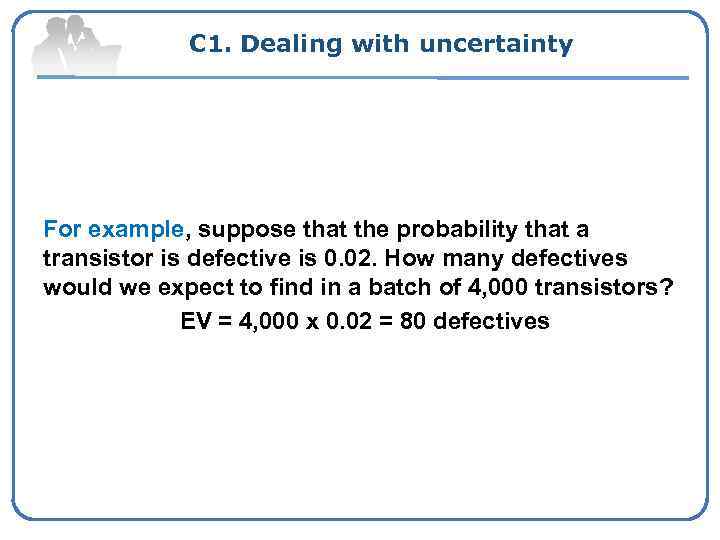 C 1. Dealing with uncertainty For example, suppose that the probability that a transistor is defective is 0. 02. How many defectives would we expect to find in a batch of 4, 000 transistors? EV = 4, 000 x 0. 02 = 80 defectives
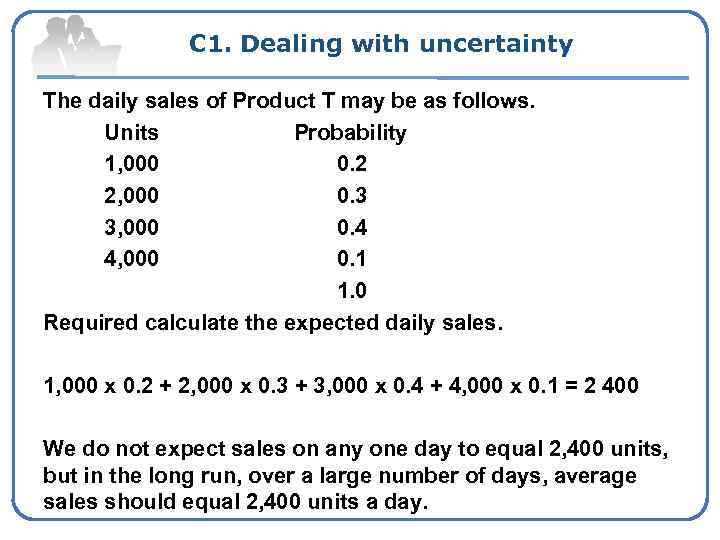 C 1. Dealing with uncertainty The daily sales of Product T may be as follows. Units Probability 1, 000 0. 2 2, 000 0. 3 3, 000 0. 4 4, 000 0. 1 1. 0 Required calculate the expected daily sales. 1, 000 x 0. 2 + 2, 000 x 0. 3 + 3, 000 x 0. 4 + 4, 000 x 0. 1 = 2 400 We do not expect sales on any one day to equal 2, 400 units, but in the long run, over a large number of days, average sales should equal 2, 400 units a day.
 C 1. Dealing with uncertainty Probability and expectation should be seen as an aid to decision-making. Probabilities are based on an analysis of past data. It is assumed that the past is a good indicator of the future.
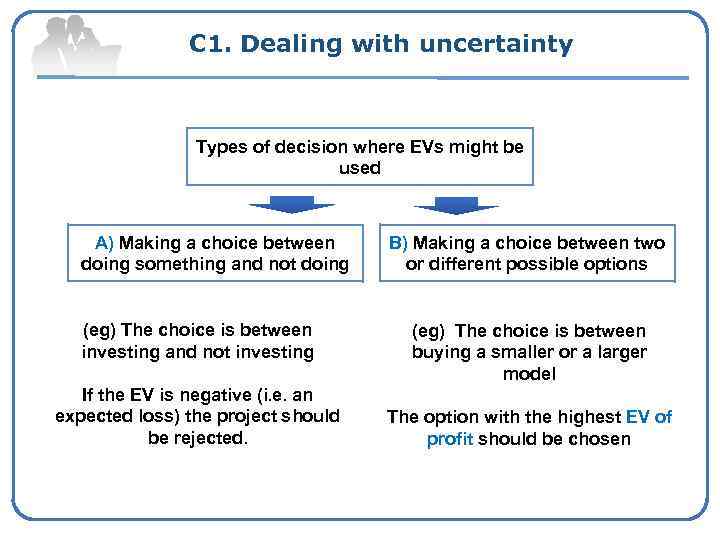 C 1. Dealing with uncertainty Types of decision where EVs might be used A) Making a choice between doing something and not doing (eg) The choice is between investing and not investing If the EV is negative (i. e. an expected loss) the project should be rejected. B) Making a choice between two or different possible options (eg) The choice is between buying a smaller or a larger model The option with the highest EV of profit should be chosen
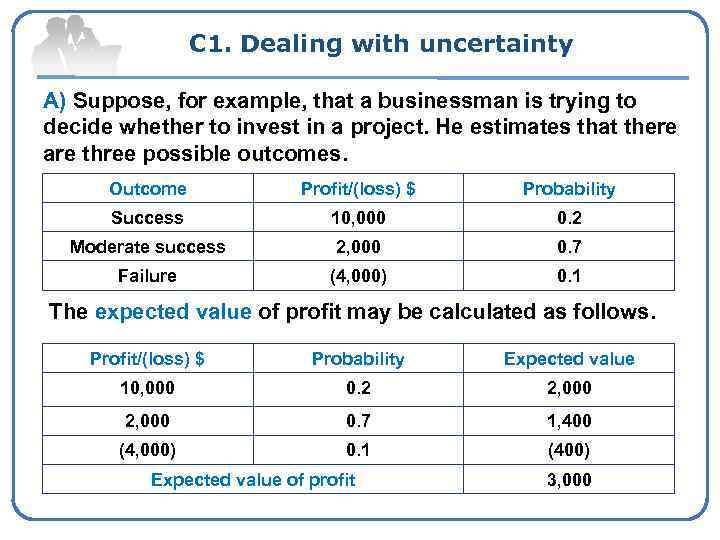 C 1. Dealing with uncertainty A) Suppose, for example, that a businessman is trying to decide whether to invest in a project. He estimates that there are three possible outcomes. Outcome Profit/(loss) $ Probability Success 10, 000 0. 2 Moderate success 2, 000 0. 7 Failure (4, 000) 0. 1 The expected value of profit may be calculated as follows. Profit/(loss) $ Probability Expected value 10, 000 0. 2 2, 000 0. 7 1, 400 (4, 000) 0. 1 (400) Expected value of profit 3, 000
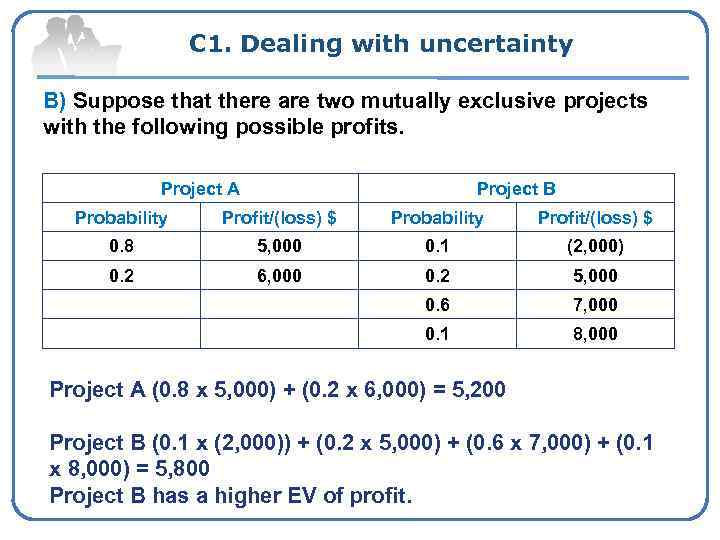 C 1. Dealing with uncertainty B) Suppose that there are two mutually exclusive projects with the following possible profits. Project A Project B Probability Profit/(loss) $ 0. 8 5, 000 0. 1 (2, 000) 0. 2 6, 000 0. 2 5, 000 0. 6 7, 000 0. 1 8, 000 Project A (0. 8 x 5, 000) + (0. 2 x 6, 000) = 5, 200 Project B (0. 1 x (2, 000)) + (0. 2 x 5, 000) + (0. 6 x 7, 000) + (0. 1 x 8, 000) = 5, 800 Project B has a higher EV of profit.
 C 1. Dealing with uncertainty Limitations of the expected value technique § Probabilities used in expected value calculations are usually based on past data and are therefore likely to be estimates. They may therefore be unreliable or inaccurate. § Expected values are not always suitable for making one-off decisions. This is because expected values are long-term averages § Expected values do not consider the attitudes to risk of the people involved in the decision-making process. They do not, therefore, take into account all of the factors involved in the decision.
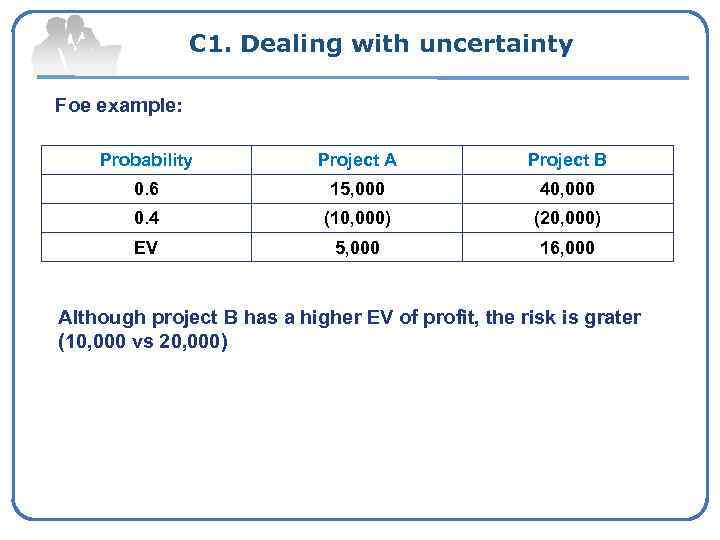 C 1. Dealing with uncertainty Foe example: Probability Project A Project B 0. 6 15, 000 40, 000 0. 4 (10, 000) (20, 000) EV 5, 000 16, 000 Although project B has a higher EV of profit, the risk is grater (10, 000 vs 20, 000)
 C 2. Statistics for business Regression analysis (linear regression), like the high/low method, can be used to predict the linear relationship between two variables (the linear function y = a + bx). Linear regression analysis is one technique for estimating a line of best fit. Once an equation for a line of best fit has been determined, forecasts can be made
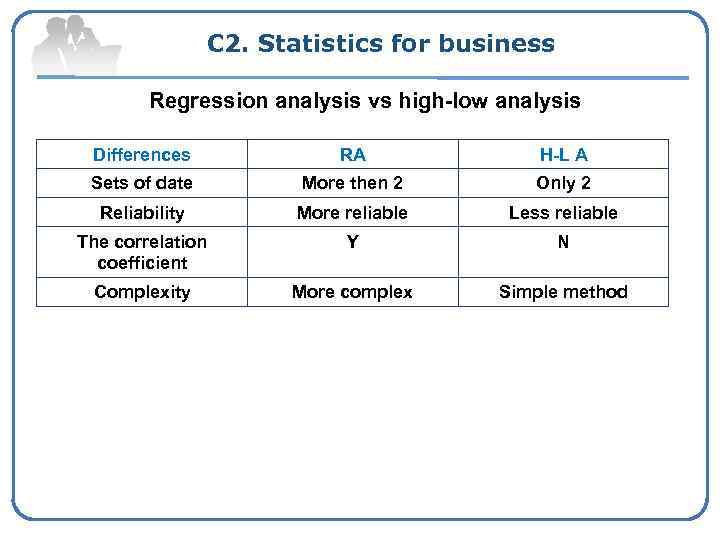 C 2. Statistics for business Regression analysis vs high-low analysis Differences RA H-L A Sets of date More then 2 Only 2 Reliability More reliable Less reliable The correlation coefficient Y N Complexity More complex Simple method
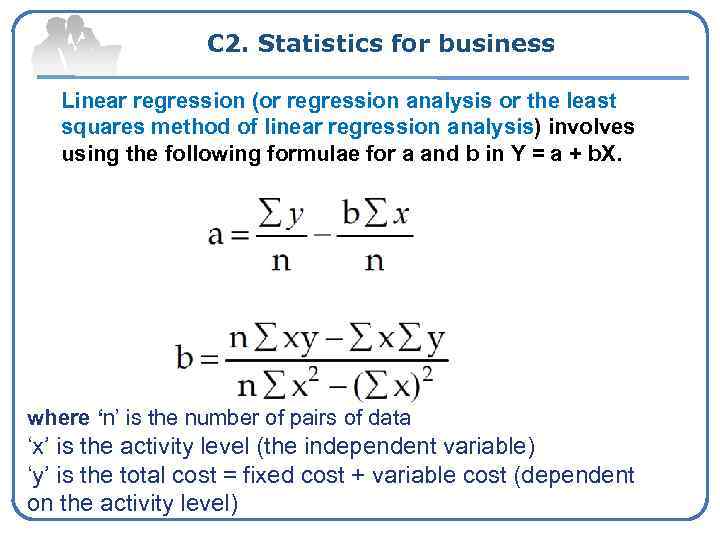 C 2. Statistics for business Linear regression (or regression analysis or the least squares method of linear regression analysis) involves using the following formulae for a and b in Y = a + b. X. where ‘n’ is the number of pairs of data ‘x’ is the activity level (the independent variable) ‘y’ is the total cost = fixed cost + variable cost (dependent on the activity level)
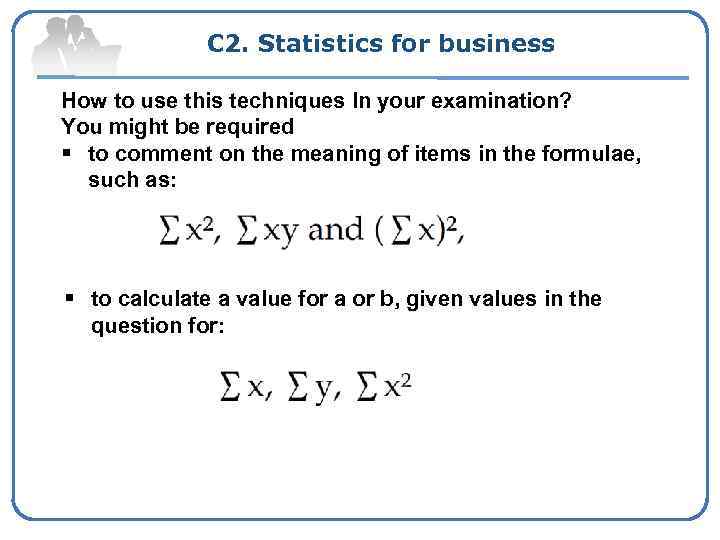 C 2. Statistics for business How to use this techniques In your examination? You might be required § to comment on the meaning of items in the formulae, such as: § to calculate a value for a or b, given values in the question for:
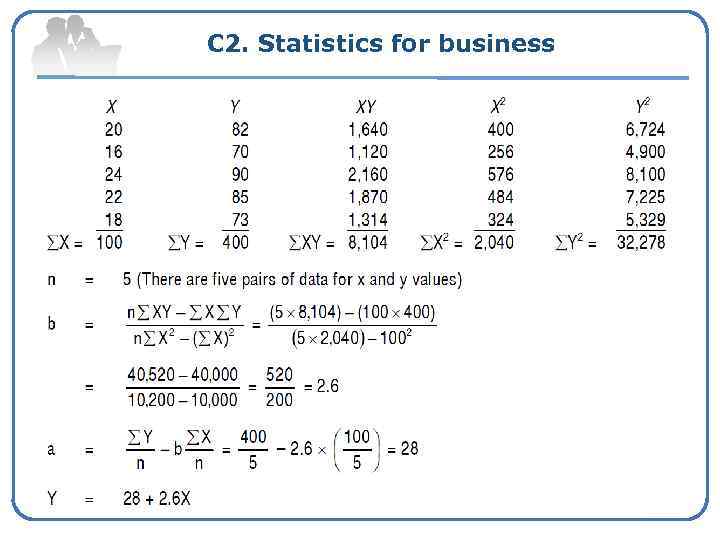
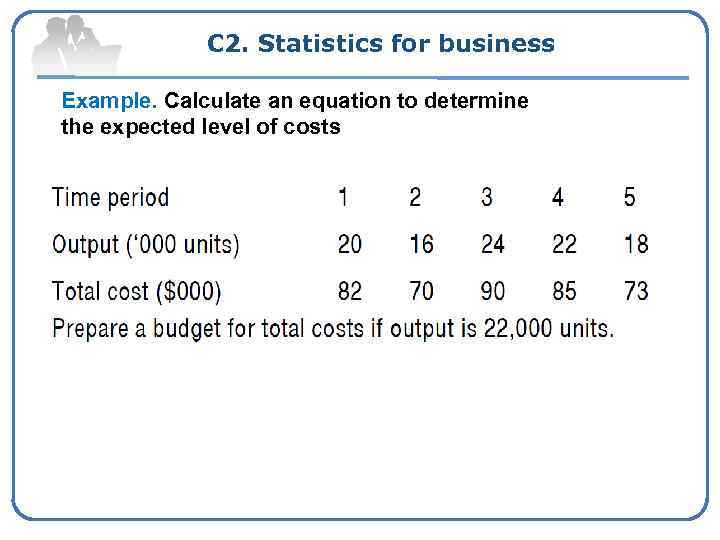 C 2. Statistics for business Example. Calculate an equation to determine the expected level of costs
 C 2. Statistics for business
 C 2. Statistics for business If the output is 22, 000 units, we would expect costs to be 28 + 2. 6 x 22 = 85. 2 = $85, 200. The activity level might be any of the following: § Units of output each week § Direct labour hours each week § Machine hours operated each week Which activity is the best one to choose as “X”? To answer to this question you should know about the coefficient of correlation. Correlation measures the strength of the relationship between two variables.
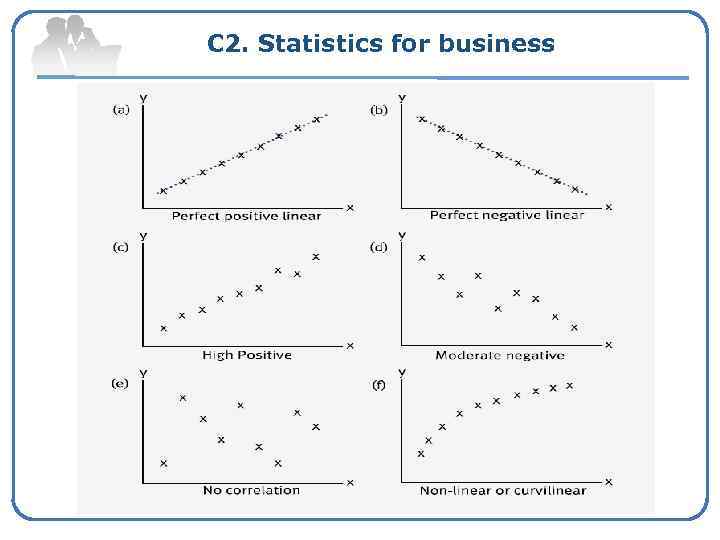
 C 2. Statistics for business One way of measuring ‘how correlated’ two variables are is by drawing a graph. Variables may be either perfectly correlated (a linear relationship exists between the two variables), partially correlated or uncorrelated. Positive correlation means that low (high) values of one variable are associated with low (high) values of the other. Negative correlation means that low values of one variable are associated with high values of the other, and high values of one variable with low values of the other.
 C 2. Statistics for business
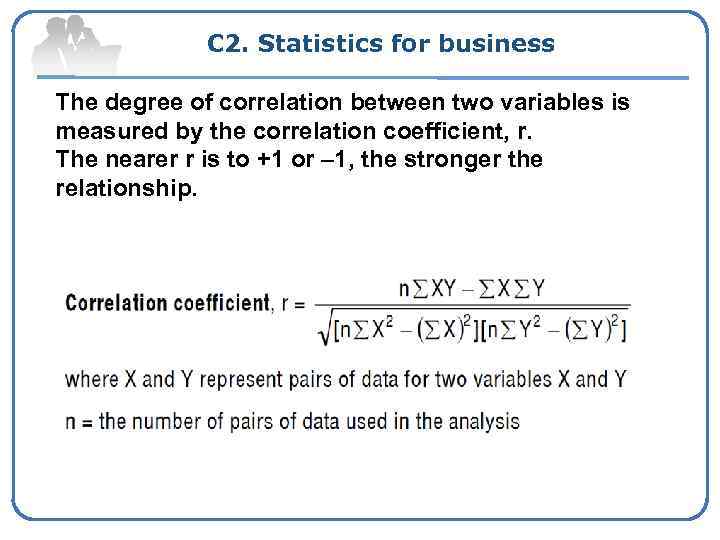 C 2. Statistics for business The degree of correlation between two variables is measured by the correlation coefficient, r. The nearer r is to +1 or – 1, the stronger the relationship.
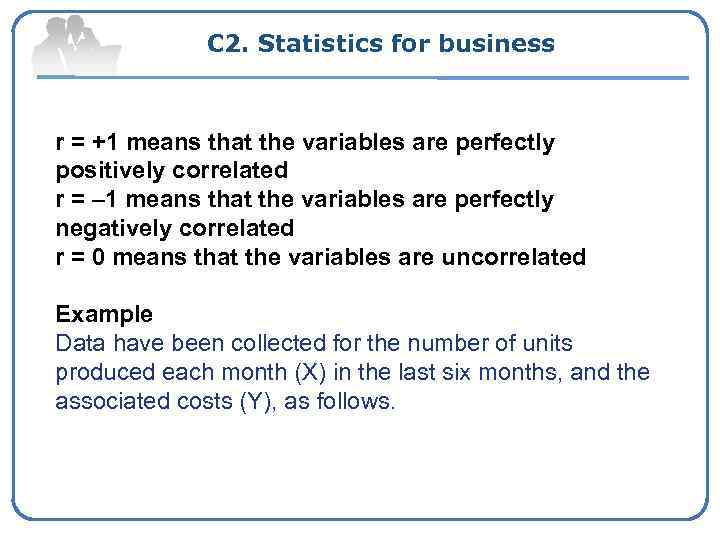 C 2. Statistics for business r = +1 means that the variables are perfectly positively correlated r = – 1 means that the variables are perfectly negatively correlated r = 0 means that the variables are uncorrelated Example Data have been collected for the number of units produced each month (X) in the last six months, and the associated costs (Y), as follows.
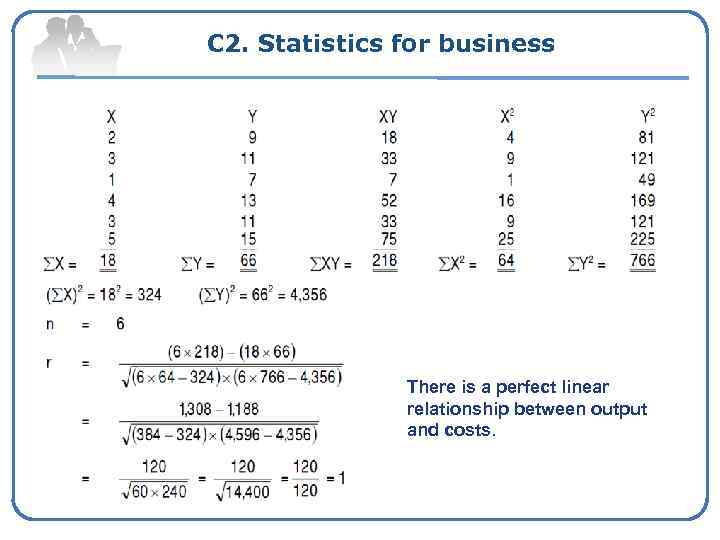 C 2. Statistics for business There is a perfect linear relationship between output and costs.
 C 2. Statistics for business Coefficient of determination The coefficient of determination is the square of the correlation coefficient The coefficient of determination is a measure of how much of the variation in the dependent variable is ‘explained’ by the variation of the independent variable For example, if r = 0. 98, r 2 = 0. 96 or 96%. This means that 96% of the variation in the dependent variable (y) is explained by variations in the independent variable (x). The other 8% of variations in total costs can be explained by other factors
 С 3. Use of computer spreadsheets What is a spreadsheet? A spreadsheet is an electronic piece of paper divided into rows and columns. The intersection of a row and a column is known as a cell. Spreadsheets can be used for a wide range of tasks. Some common applications of spreadsheets are: § Management accounts § Revenue analysis and comparison § Cash flow analysis and forecasting § Cost analysis and comparison § Reconciliations § Budgets and forecasts
 С 3. Use of computer spreadsheets The contents of any cell can be one of the following. (a) Text. A text cell usually contains words. Numbers that do not represent numeric values for calculation purposes (eg a Part Number) (b) Values. A value is a number that can be used in a calculation. (c) Formulae. A formula refers to other cells in the spreadsheet, and performs some sort of computation with them.
 С 3. Use of computer spreadsheets Advantages of spreadsheets § § Excel is easy to learn and to use Spreadsheets make the calculation and manipulation of data easier and quicker § They enable the analysis, reporting and sharing of financial information § They enable ‘what-if’ analysis to be performed very quickly
 С 3. Use of computer spreadsheets Disadvantages of spreadsheets § A spreadsheet is only as good as its original design, garbage in = garbage out! § Formulae are hidden from sight so the underlying logic of a set of calculations may not be obvious § A spreadsheet presentation may make reports appear infallible § Research shows that a high proportion of large models contain critical errors § A database may be more suitable to use with large volumes of data
 D. COST ACCOUNTING TECHNIQUES 1. Accounting for materials 2. Accounting for labour 3. Accounting for overheads 4. Marginal and absorption costing 5. Job and batch costing 6. Process costing 7. Service/operation costing
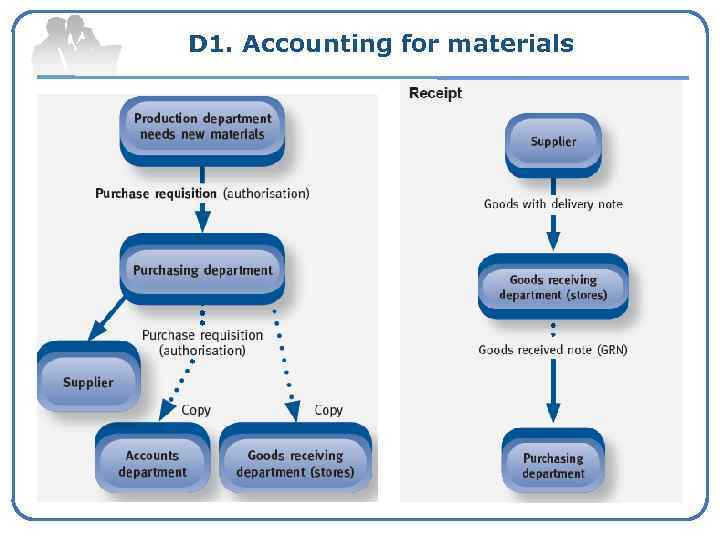
![Dictionary purchase requisition – требование [наряд] на закупку (документ, содержащий требование о покупке товаров,](https://present5.com/presentation/18925754_133503239/image-81.jpg "Dictionary purchase requisition – требование [наряд] на закупку (документ, содержащий требование о покупке товаров,") Dictionary purchase requisition – требование [наряд] на закупку (документ, содержащий требование о покупке товаров, необходимых для данного подразделения фирмы; направляется сотрудником данного подразделения в отдел закупок организации) purchase order - форма документа, используемого покупателем при покупке (чего-либо) или заказе и который затем, по заполнении, дается или высылается продавцу в качестве заказа delivery note – накладная на поставку товара goods received note - извещение о получении товара (документ, составленный компанией-получателем товара и подтверждающий получение товара) perpetual inventory - непрерывная [постоянная] инвентаризация (запасы учитываются в денежном и натуральном выражении ежедневно на протяжении отчетного периода, а не на конец периода) bin card – карточка складского учета inventory ledger - книга [регистр] (складского) учета запасов (ведется в бухгалтерии)
Dictionary purchase requisition – требование [наряд] на закупку (документ, содержащий требование о покупке товаров, необходимых для данного подразделения фирмы; направляется сотрудником данного подразделения в отдел закупок организации) purchase order - форма документа, используемого покупателем при покупке (чего-либо) или заказе и который затем, по заполнении, дается или высылается продавцу в качестве заказа delivery note – накладная на поставку товара goods received note - извещение о получении товара (документ, составленный компанией-получателем товара и подтверждающий получение товара) perpetual inventory - непрерывная [постоянная] инвентаризация (запасы учитываются в денежном и натуральном выражении ежедневно на протяжении отчетного периода, а не на конец периода) bin card – карточка складского учета inventory ledger - книга [регистр] (складского) учета запасов (ведется в бухгалтерии)
 Dictionary material requisition (note)– требование на отпуск материалов Discrepancy – расхождение, несоответствие между данными учета и реальными запасами материалов inventory records - инвентарные описи income statement = profit and loss statement Holding costs - издержки владения (затраты, связанные с владением каким-л. активом (напр. Недвижимостью, материалами и т. п. ) interest on capital - проценты на капитал economic order quantity - наиболее экономичный/оптимальный размер заказа place orders – размещение заказов Stocktaking – инвентаризация Obsolete inventories are those items which have become out-of-date and are no longer required Obsolescence and Deterioration – старение (моральный износ) и порча (повреждение)) mark-up – наценка
![Dictionary reorder level – уровень [точка] заказа, уровень повторного заказа (уровень запасов, при котором](https://present5.com/presentation/18925754_133503239/image-83.jpg "Dictionary reorder level – уровень [точка] заказа, уровень повторного заказа (уровень запасов, при котором") Dictionary reorder level – уровень [точка] заказа, уровень повторного заказа (уровень запасов, при котором необходимо произвести их пополнение) bulk discount оптовая скидка payroll department – отдел труда и зарплаты shift premium надбавка за работу во второй или третьей смене labour turnover текучесть рабочей силы Productivity – производительность (продуктивность) работы Productivity ratio (Efficiency ratio) коэффициент эффективности (выраженное в процентах отношение нормативного (стандартного) количества трудо-часов, отведенного на выполнение данной работы, к фактическому количеству отработанных часов; характеризует результативность деятельности) payroll record ведомость заработной платы Time sheet - лист учета [ведомость] отработанного времени (форма, на которой записывается количество трудо- или машино-часов, затраченных на выполнение определенных операций; используется для расчета затрат по определенным операциям или проектам)
Dictionary reorder level – уровень [точка] заказа, уровень повторного заказа (уровень запасов, при котором необходимо произвести их пополнение) bulk discount оптовая скидка payroll department – отдел труда и зарплаты shift premium надбавка за работу во второй или третьей смене labour turnover текучесть рабочей силы Productivity – производительность (продуктивность) работы Productivity ratio (Efficiency ratio) коэффициент эффективности (выраженное в процентах отношение нормативного (стандартного) количества трудо-часов, отведенного на выполнение данной работы, к фактическому количеству отработанных часов; характеризует результативность деятельности) payroll record ведомость заработной платы Time sheet - лист учета [ведомость] отработанного времени (форма, на которой записывается количество трудо- или машино-часов, затраченных на выполнение определенных операций; используется для расчета затрат по определенным операциям или проектам)
 Dictionary Rates (overheads) – коммунальные платежи book value остаточная (балансовая) стоимость losses and gains – потери и прирост прибыли в производстве normal loss нормальные потери (потери в ходе производственного процесса, связанные с отходами, утечками, усушкой, браком и т. п. , размер которых может быть оценен на основе прошлого опыта), т. е. это может быть естественная убыль Evaporation -испарение abnormal gain чрезмерная [сверхнормативная] прибыль (возникшая в результате того, что фактический доход превысил ожидавшийся (напр. , изза роста рыночных цен) или того, что фактические затраты оказались меньше ожидавшихся) scrap value - отходы, имеющие стоимость, например, стоимость лома batch costing - партионное калькулирование (метод расчета затрат, при котором объектом калькулирования является партия однородных изделий (т. е. рассчитывается стоимость партии продукции)) engineering component industry – предприятия по производству комплектующих для машин и оборудования (машиностроение) net realizable value 1) NRV , чистая возможная цена реализации (разность между ожидаемой ценой реализации за вычетом предполагаемых затрат, связанных с реализацией)
![Dictionary estimated cost расчетные [предполагаемые] затраты Rectification costs – затраты на исправление брака, дефектов,](https://present5.com/presentation/18925754_133503239/image-85.jpg "Dictionary estimated cost расчетные [предполагаемые] затраты Rectification costs – затраты на исправление брака, дефектов,") Dictionary estimated cost расчетные [предполагаемые] затраты Rectification costs – затраты на исправление брака, дефектов, недостатков в работе A batch is a group of similar articles which maintains its identity during one or more stages of production and is treated as a cost unit.
Dictionary estimated cost расчетные [предполагаемые] затраты Rectification costs – затраты на исправление брака, дефектов, недостатков в работе A batch is a group of similar articles which maintains its identity during one or more stages of production and is treated as a cost unit.
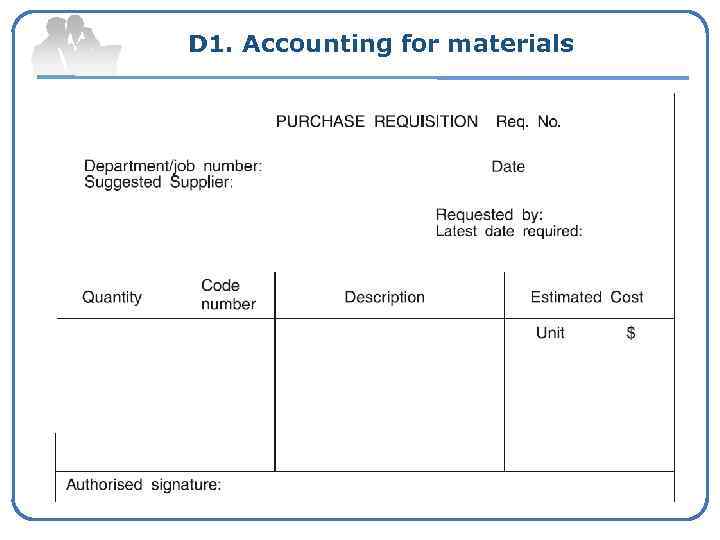
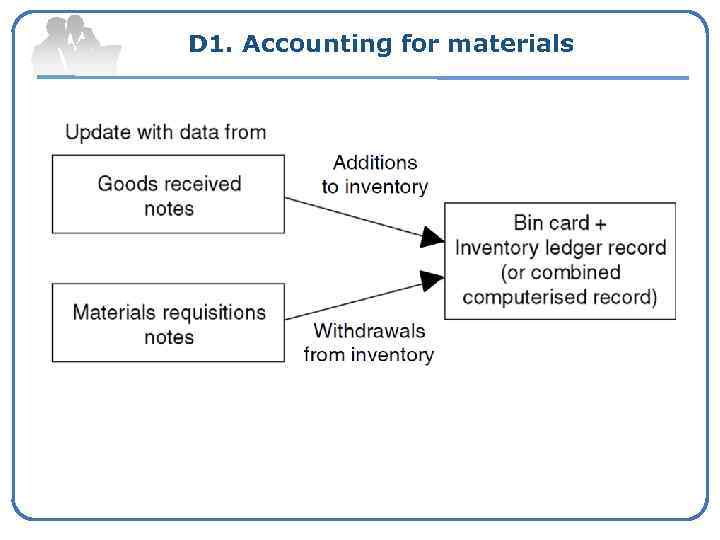
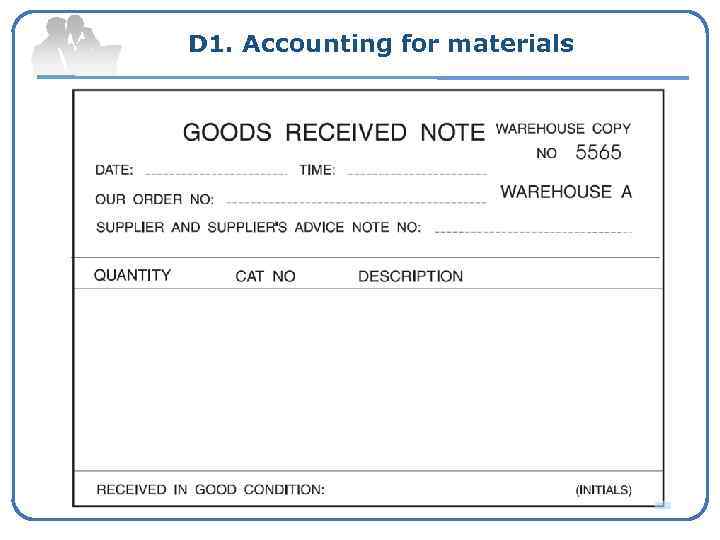
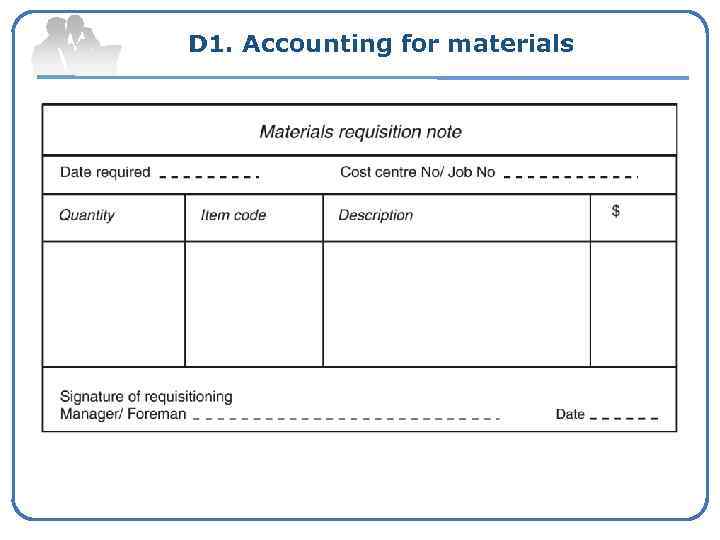
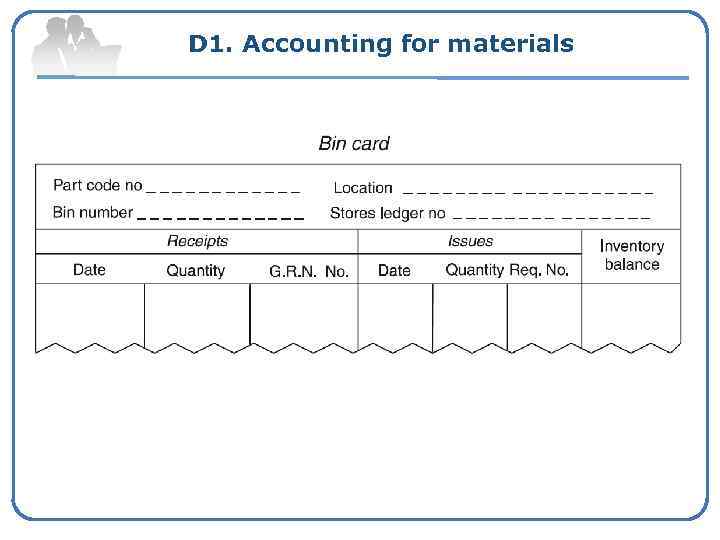
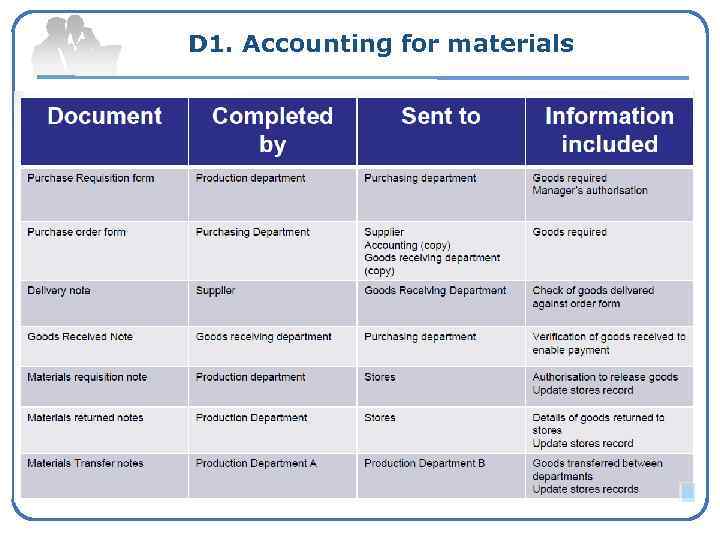
 D 1. Accounting for materials The procedures for ordering, purchasing and receiving materials are as follows. • ordering • purchasing • receiving • issuing • storing and stocktaking.
 D 1. Accounting for materials
 D 1. Accounting for materials
 D 1. Accounting for materials
 D 1. Accounting for materials
 D 1. Accounting for materials
 D 1. Accounting for materials
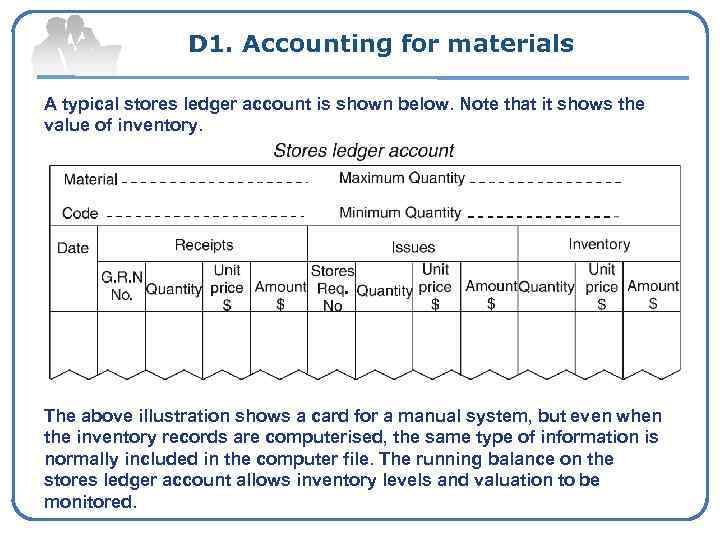 D 1. Accounting for materials A typical stores ledger account is shown below. Note that it shows the value of inventory. The above illustration shows a card for a manual system, but even when the inventory records are computerised, the same type of information is normally included in the computer file. The running balance on the stores ledger account allows inventory levels and valuation to be monitored.
 D 1. Accounting for materials
 D 1. Accounting for materials
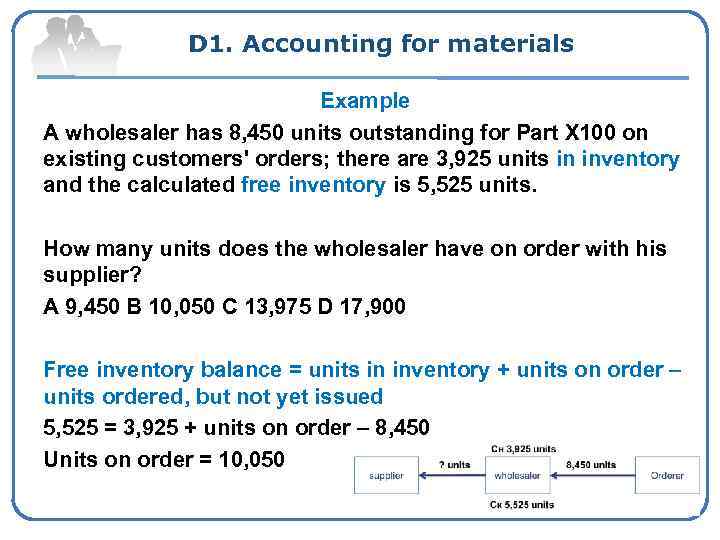 D 1. Accounting for materials Example A wholesaler has 8, 450 units outstanding for Part X 100 on existing customers' orders; there are 3, 925 units in inventory and the calculated free inventory is 5, 525 units. How many units does the wholesaler have on order with his supplier? A 9, 450 B 10, 050 C 13, 975 D 17, 900 Free inventory balance = units in inventory + units on order – units ordered, but not yet issued 5, 525 = 3, 925 + units on order – 8, 450 Units on order = 10, 050
 D 1. Accounting for materials There are three main inventory valuation methods: – FIFO – LIFO – Weighted average cost. Holding costs Costs associated with holding inventory are known as holding costs. – interest on capital tied up in inventory (VC) – cost of storage space (rental cost, wages and salaries of stores staff) (FC) – cost of losses through holding inventory: obsolescence, deterioration) – cost of insurance (FC).
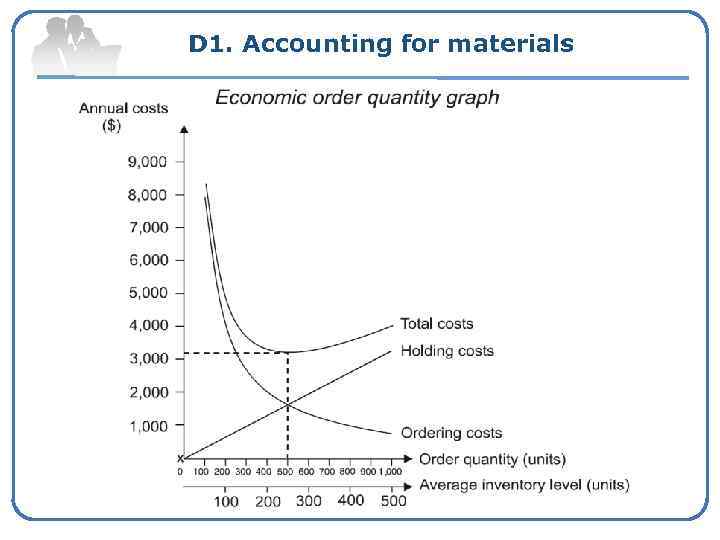
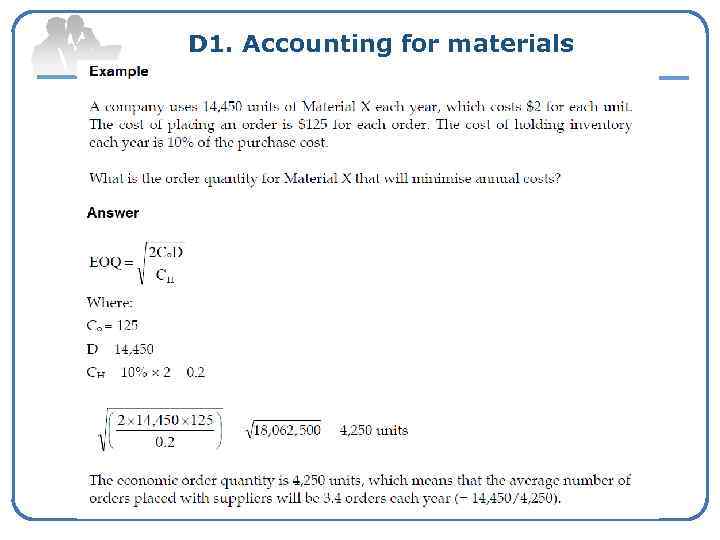
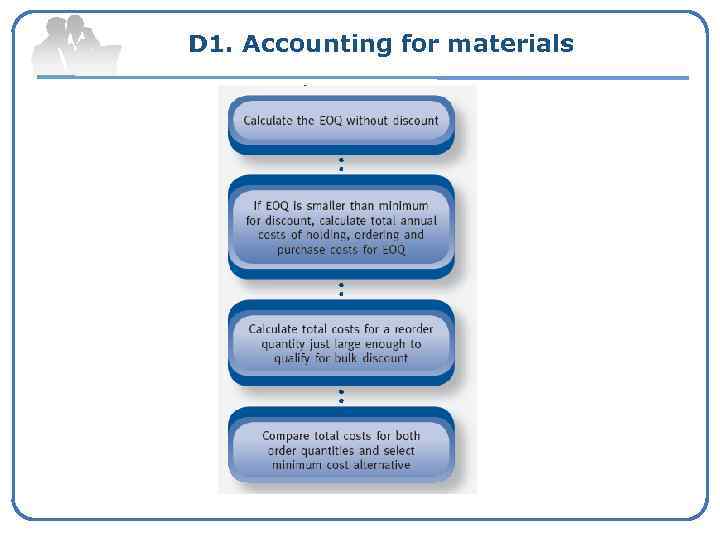
 D 1. Accounting for materials Ordering costs (сosts of obtaining inventory) The costs associated with placing (making) orders are known as ordering costs and include the cost of telephone calls, delivery costs (transport costs), costs of checking the inventory after delivery The economic order quantity (EOQ) The EOQ is the order quantity which minimises inventory costs. The EOQ is found at the point where total costs (holding + ordering) are at a minimum.
 D 1. Accounting for materials
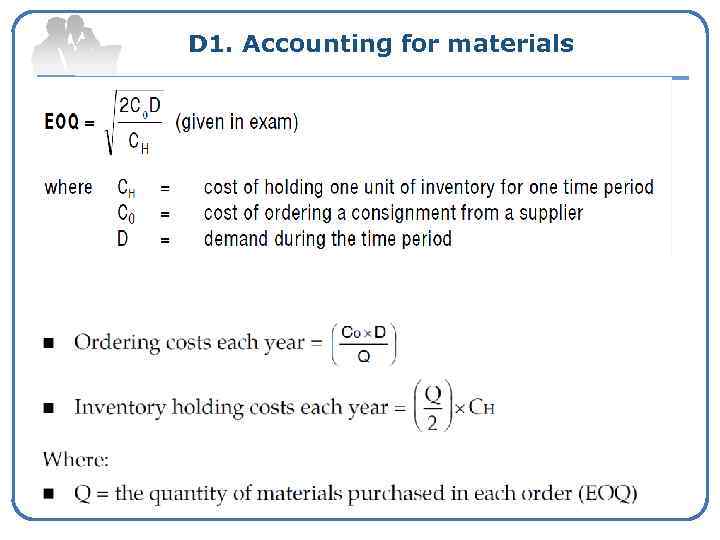
 D 1. Accounting for materials There a number of important assumptions and formulae related to the EOQ that you should note. • Average inventory held is equal to half of the EOQ = EOQ/2. • The number of orders in a year = Expected annual demand/EOQ. • Total annual holding cost = Average inventory (EOQ/2) x holding cost per unit of inventory. • Total annual ordering cost = Number of orders x cost of placing an order.
 D 1. Accounting for materials
 D 1. Accounting for materials
 D 1. Accounting for materials
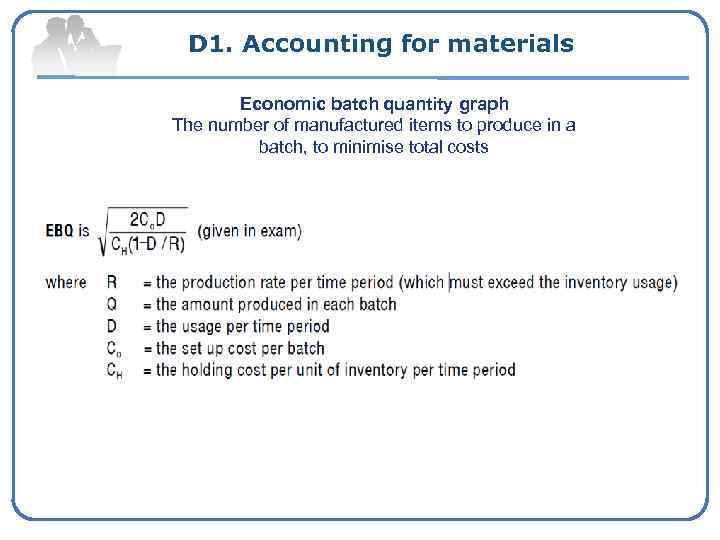 D 1. Accounting for materials Economic batch quantity graph The number of manufactured items to produce in a batch, to minimise total costs
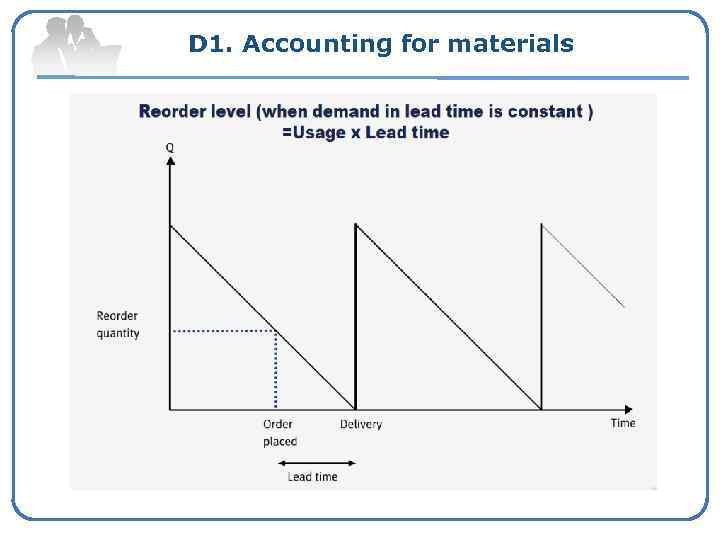
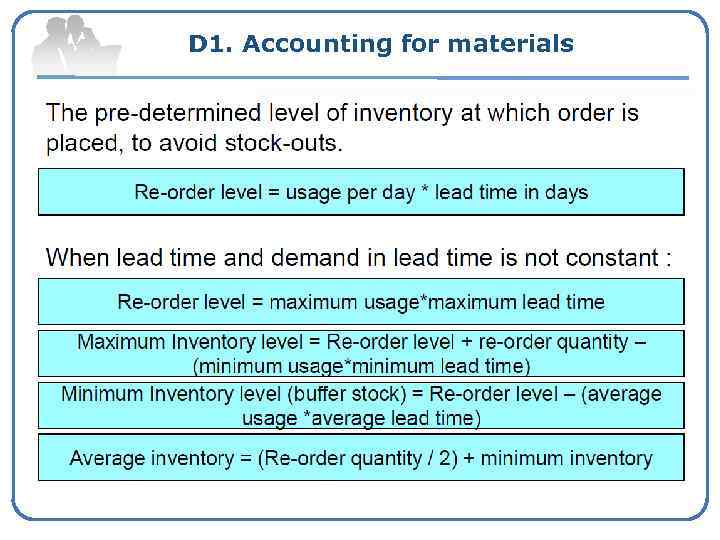
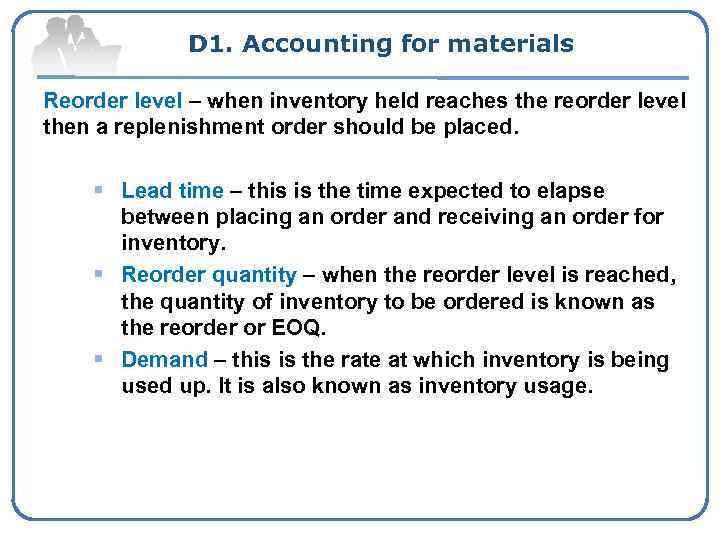 D 1. Accounting for materials Reorder level – when inventory held reaches the reorder level then a replenishment order should be placed. § Lead time – this is the time expected to elapse between placing an order and receiving an order for inventory. § Reorder quantity – when the reorder level is reached, the quantity of inventory to be ordered is known as the reorder or EOQ. § Demand – this is the rate at which inventory is being used up. It is also known as inventory usage.
 D 1. Accounting for materials
 D 1. Accounting for materials