

Man and Why do we establish schools and

Man and
Why do we establish schools and pay for them? Is the fundamental purpose of education the training of obedient citizens of a totalitarian state, or is it the development of free men in a democracy? Shall the church or the state dominate the schools? What shall we teach in our schools?
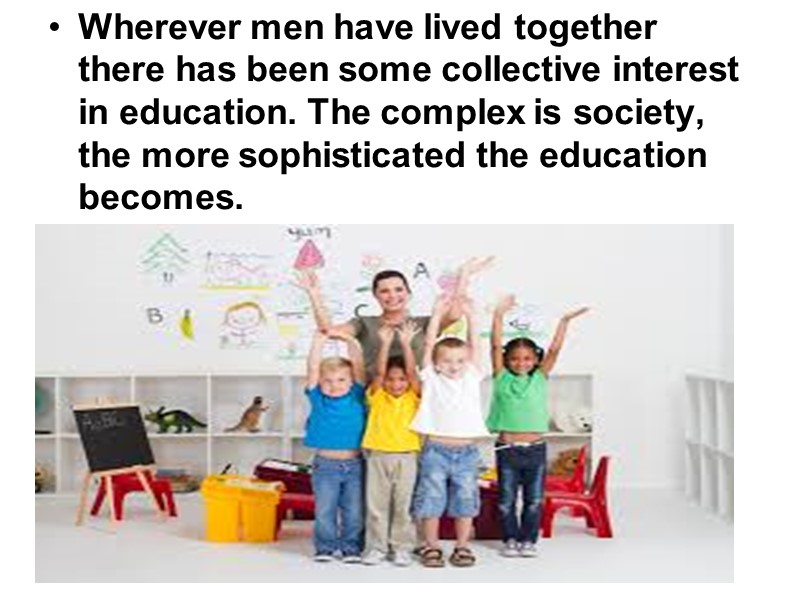
Wherever men have lived together there has been some collective interest in education. The complex is society, the more sophisticated the education becomes.
In the early periods of human existence, the education was rather primitive. The meagre record that we have suggests this. Tribe, den, his close relatives – that was the ambience through which the child was imbuing his education. It was something picked up rather than learnt in earnest.

To fish and hunt, to prepare his food, to fight the enemies, and to take care of his simple and elementary needs – that was the core of his educational interest. Survival was the prime goal.
Once traditions, customs, and group lore became more sophisticated, the older took it on their shoulders to cultivate the knowledge of the young. Age of puberty came to be the most crucial time for a child, when, under the accompaniment of special initiation rites the young man underwent the tests imposed upon him. If he was a success, he/she was told the most cherished secrets of the group and rendered a full-member of the society.
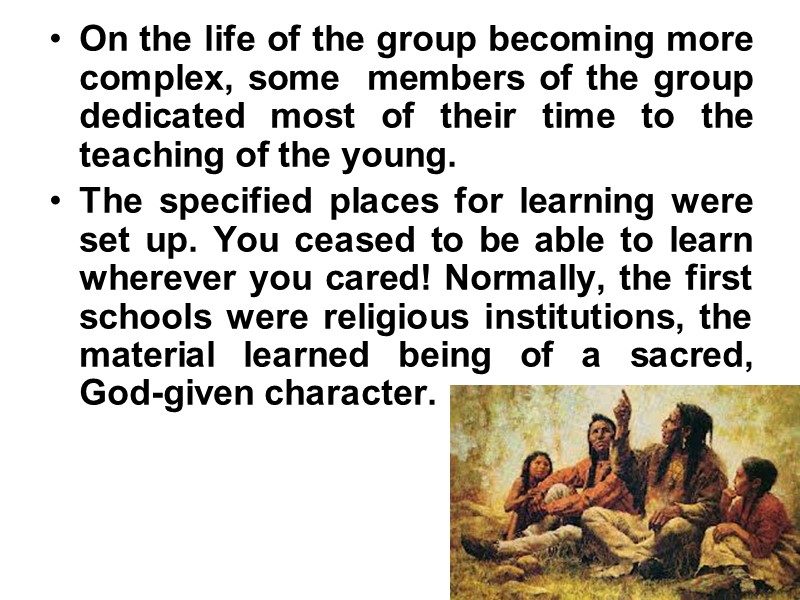
On the life of the group becoming more complex, some members of the group dedicated most of their time to the teaching of the young. The specified places for learning were set up. You ceased to be able to learn wherever you cared! Normally, the first schools were religious institutions, the material learned being of a sacred, God-given character.
Worshipping of the gods and compliance with customs were so closely interwoven that education was religious by default. The teacher should be religiously sanctioned to teach. The synagogue was primarily a place of religious worship; the teachers there were the “rabbis”.
Philosophers wanted to know what should be taught to the young and how it should be taught. The purpose of education, the methods, what should be taught – all these became their subject matter. If we believe something to be true, how can other be instructed so as to believe it to be true? Actually, education is the way the others can be got to accept some philosophy as true.
The Greeks - the Sophists were individualists. Man should be trained to pursuit self-interest at all times and advance himself at all cost. Everything at the time was about the workings of public opinion, so the Sophists paid the utmost attention to the oratory. To win the public case – that’s their goal.
The young men were taught to mount logical arguments which could not be broken down; Thence, these arguments should have been delivered with a persuasive voice and accompanied with strong personal traits such as to win the hearers.
This necessitated knowledge of logic, mastery of the laws and customs of the Athenians, a familiarity with the literature of the past generations so as to be capable to use instance from it, great practice in speaking and careful training of the voice, and a thorough mastery of the language of the people so that it might be used with ease.
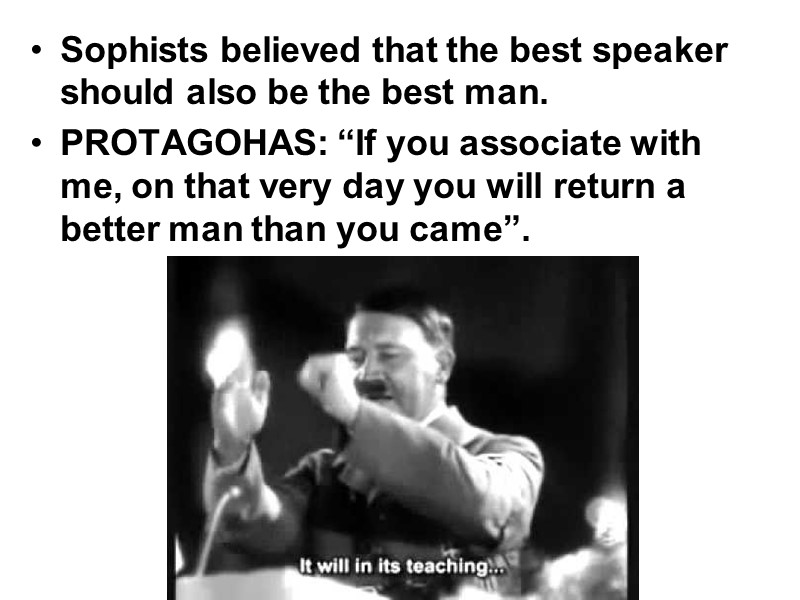
Sophists believed that the best speaker should also be the best man. PROTAGOHAS: “If you associate with me, on that very day you will return a better man than you came”.
SOCRATES - education should render a man away and afar better citizen and, therefore, a happier men. Socrates emphasized man as a member of the group, not as an individual. The knowledge came to be most precious thing to posses; such knowledge was to be got by removing individual discrepancies and finding out the core beliefs upon which all men could concord.
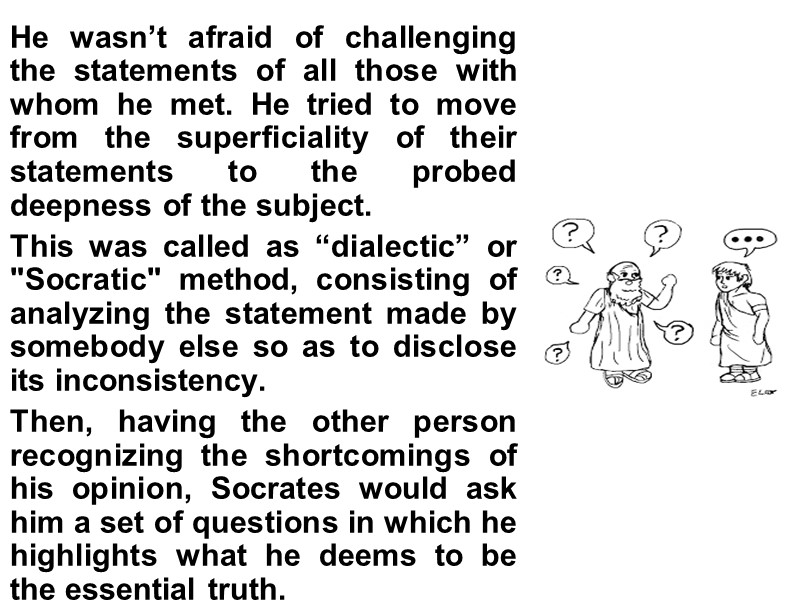
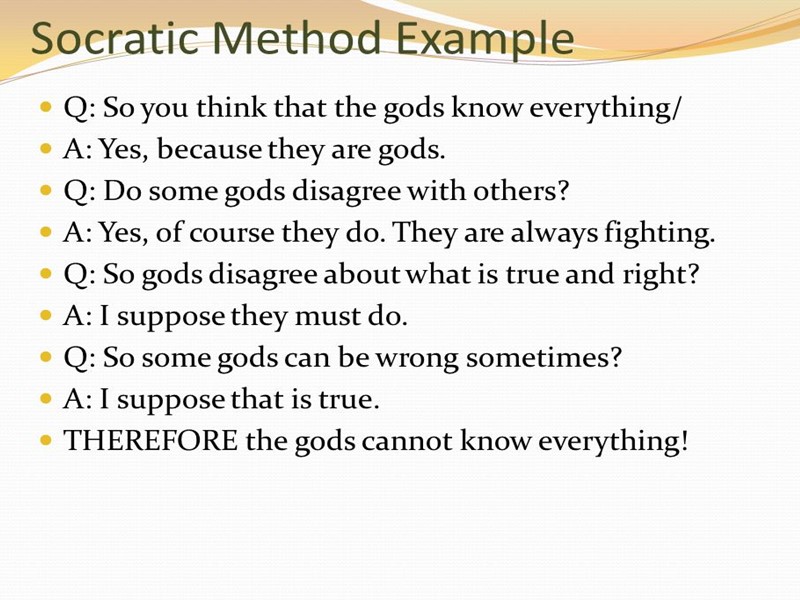
He wasn’t afraid of challenging the statements of all those with whom he met. He tried to move from the superficiality of their statements to the probed deepness of the subject. This was called as “dialectic” or "Socratic" method, consisting of analyzing the statement made by somebody else so as to disclose its inconsistency. Then, having the other person recognizing the shortcomings of his opinion, Socrates would ask him a set of questions in which he highlights what he deems to be the essential truth.
PLATO - in the “Republic” we see an educational system which is thought to make sure that a state is happy and just. Men are different and should be allotted into classes according with their basic different traits of character.
During the first eighteen years, a boy was to be trained in gymnastics, music, and literature, taught to read and write, to sing, and to partake in various sports. At eighteen those who elicited ability were given further preparation, the rest being stopped and made to ply as tradesmen or merchants.
Those boys who were retained in the educational system were given two years of cadet training. At twenty, those who were designated to be unable to go on, were entered into the military class and assigned the task of defending the country.
The remainder were given all the more extensive training in philosophy, mathematics, music, science, and other cultural subjects, and would eventually become the leaders of society. Education was held to be a matter of the state interest. Those were guidelines for an ideal society in which everyone would do the work for which he is befitting and trained and thus would be happy.
ARISTOTLE - education aims at making people virtuous. The first period, from birth to seven years of age, is about the training of the body. The second period would be one of formal schooling, from seven to twenty-one years of age (it will include training in literature, music, gymnastics, and so on).
Aristotle would have the state delineate what children should live and what ones should be destroyed soon after birth because of physical shortcomings. Further, he would have the state determine whom a man should marry with the view to ascertain the desired offspring.
Still, the Sophist position that education was for individual interests dominated. People were carried away with visions of personal success and were in no mood to listen to those who suggested that both success and happiness in the long run stood over the welfare of the group.
The ideal of the Roman was the orator who could inspire the multitudes with his eloquence. Orator must also turn out to be "a good man, one of "excellent mind". They believed that "the man who can duly sustain his character as a citizen, who is qualified for the management of public and private affairs, and who can govern communities by his counsels, settle them by means of laws, and improve them by means of judicial enactments, can certainly be nothing else but an orator.“ All this included knowledge of logic, good morals, a careful schooling in the laws of the nation, and a character that was above suspicion.
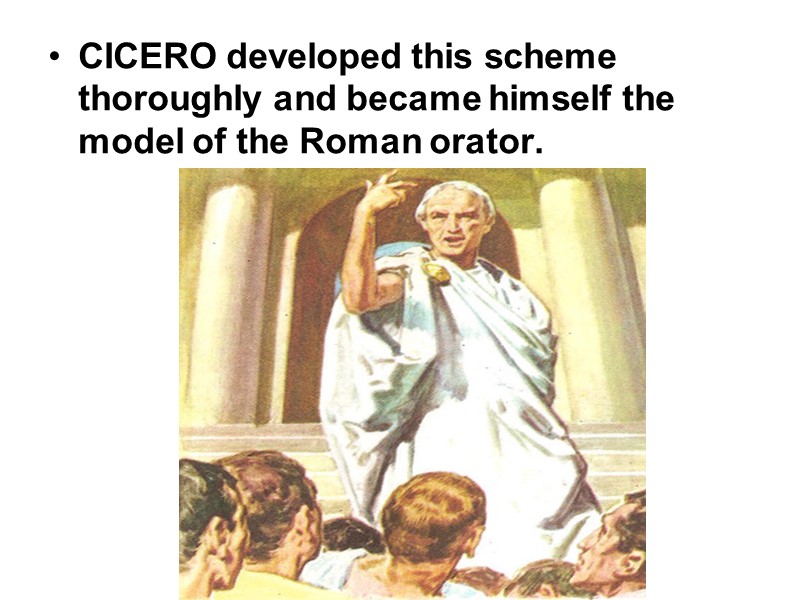
CICERO developed this scheme thoroughly and became himself the model of the Roman orator.
With the development of Christianity religious questions recurred. The so-called "catechumenal schools” were established to give instruction to the "catechumens' or candidates for admission to the Christian group.
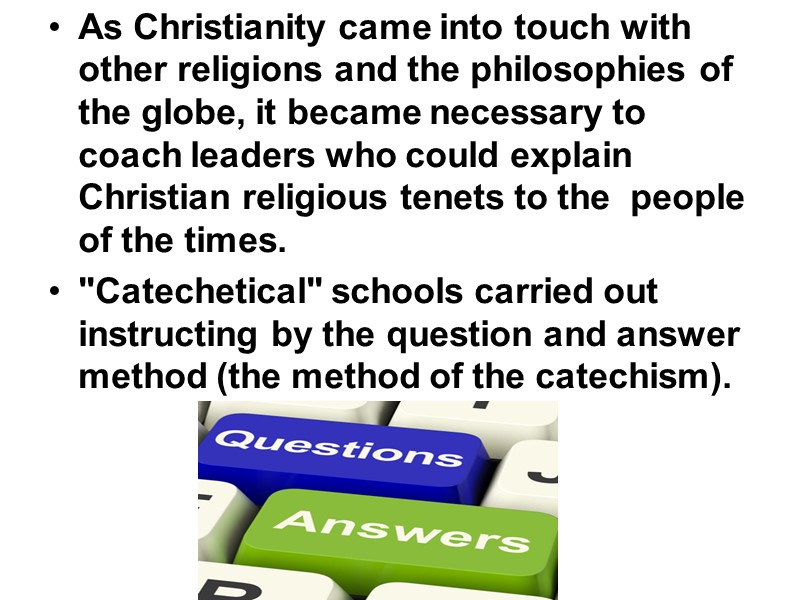
As Christianity came into touch with other religions and the philosophies of the globe, it became necessary to coach leaders who could explain Christian religious tenets to the people of the times. "Catechetical" schools carried out instructing by the question and answer method (the method of the catechism).
Out of these schools came the Apologists – people able to answer the numerous critics of the early Christian movement. CLEMENT OF ALEXANDRIA and the great theologian ORIGEN were those who, on receiving the instructions in the schools, spread the Christian message throughout the world. For them education was not a toolkit for the state, but a toolkit for the church, to be deployed in the service of God.
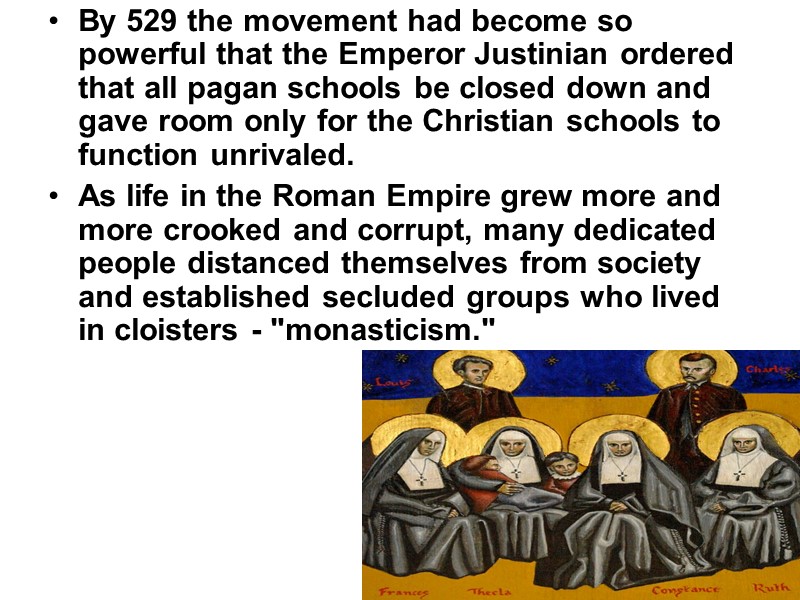
By 529 the movement had become so powerful that the Emperor Justinian ordered that all pagan schools be closed down and gave room only for the Christian schools to function unrivaled. As life in the Roman Empire grew more and more crooked and corrupt, many dedicated people distanced themselves from society and established secluded groups who lived in cloisters - "monasticism."
SAINT BENEDICT, principle of the famous monastery at Monte Cassino in southern Italy, established a "rule for the government of the members of his monastery” - work and study, and the idea that education was necessary for the continuance of Christianity. The influence of Saint Benedict spread and his "rule" was adopted in principle by other monasteries, with the result that schools became part-and-parcel of monastic life.
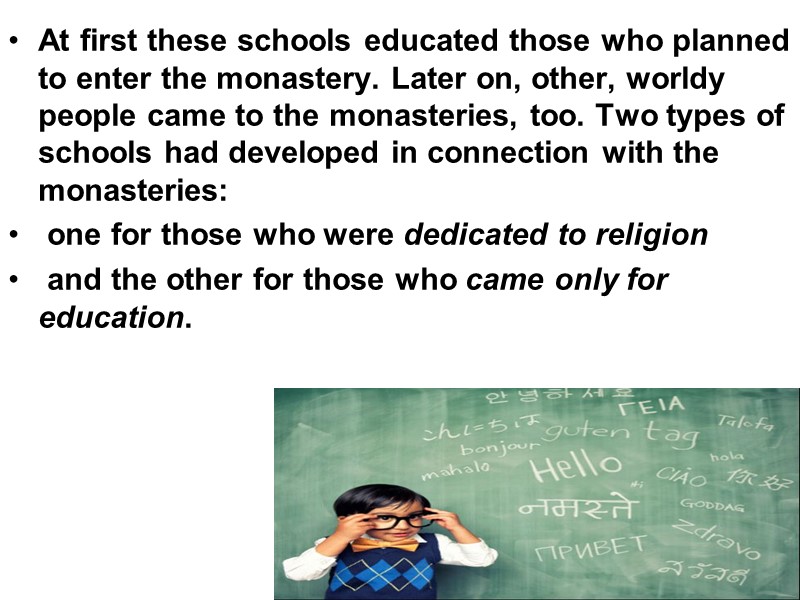
At first these schools educated those who planned to enter the monastery. Later on, other, worldy people came to the monasteries, too. Two types of schools had developed in connection with the monasteries: one for those who were dedicated to religion and the other for those who came only for education.
At first the education consisted of reading in order to study the Bible writing to copy the sacred books some calculation for the figuring of holy days and other church festivals. Still, by the end of the sixth century it had grown until it covered the "seven liberal arts" - grammar, rhetoric, dialectic, arithmetic, geometry, music, astronomy.
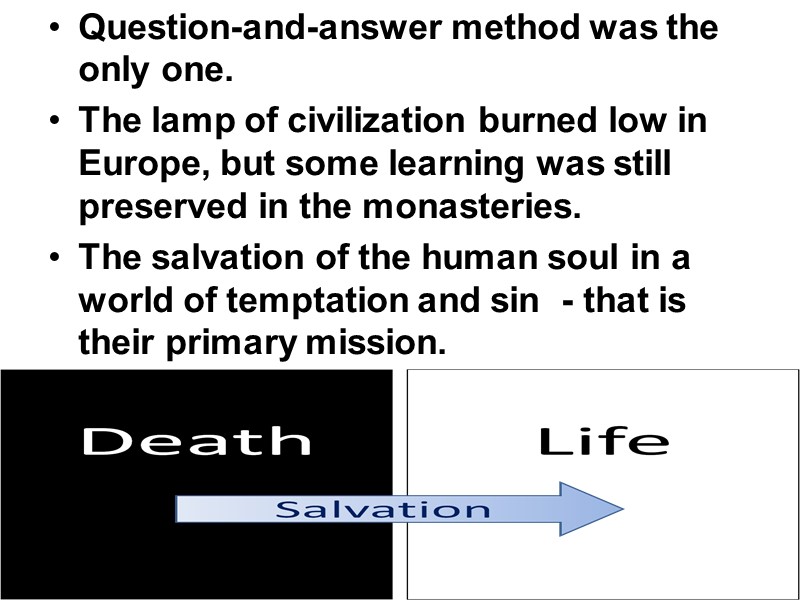
Question-and-answer method was the only one. The lamp of civilization burned low in Europe, but some learning was still preserved in the monasteries. The salvation of the human soul in a world of temptation and sin - that is their primary mission.
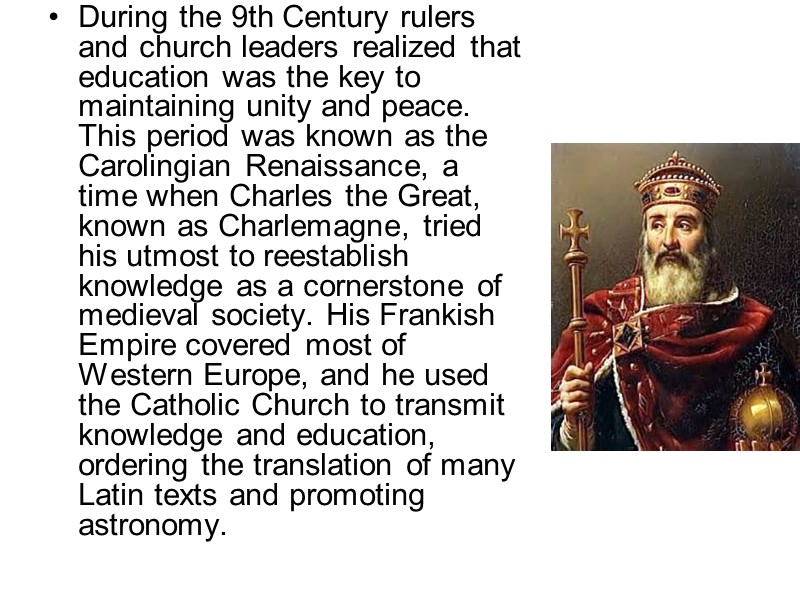
During the 9th Century rulers and church leaders realized that education was the key to maintaining unity and peace. This period was known as the Carolingian Renaissance, a time when Charles the Great, known as Charlemagne, tried his utmost to reestablish knowledge as a cornerstone of medieval society. His Frankish Empire covered most of Western Europe, and he used the Catholic Church to transmit knowledge and education, ordering the translation of many Latin texts and promoting astronomy.
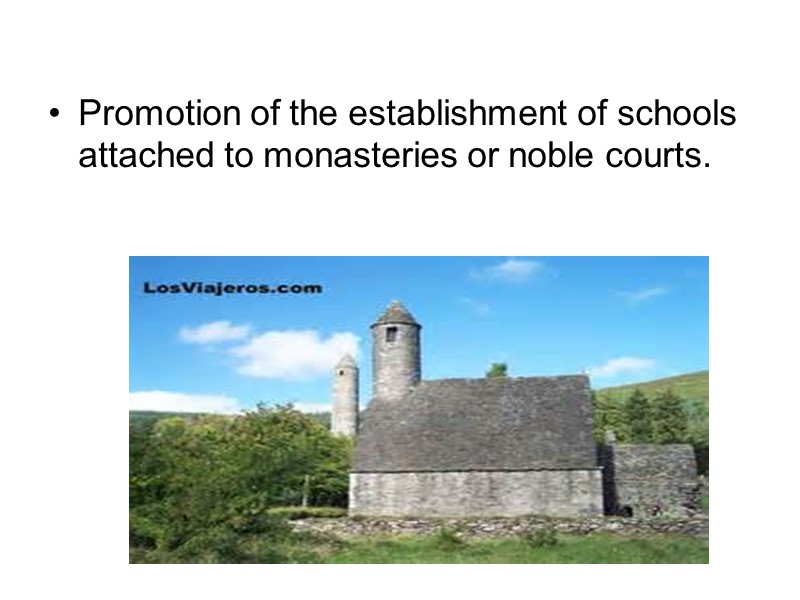
Promotion of the establishment of schools attached to monasteries or noble courts.
Cathedral schools gradually developed as centers of education into the medieval universities which were the launch-pad to many of Western Europe's later achievements. Among the first Catholic universities were Bologna University (1088); Paris University (c 1150); Oxford University (1167); Salerno University (1173); Vicenza University (1204); Cambridge University (1209) and so on.
Only with creation of the first universities in 12 and 13th centuries Christian scholars started to be occupied by Greek science and medicine. In the High Middle Ages, about one-third of the undergraduate curriculum of the universities was constituted of scientific texts and topics. Scientific questions started to be debated.
From 1000 until 1300, the European populations grew and the shared Christian identity gave them some unity of purpose (from the Ireland to Italy, and from Denmark to Spain). Trade and the sharing of ideas were common, and merchants and mercenaries brought back ideas from Moorish Spain, the Holy Land, and Byzantium. The Muslims translated many of the Ancient Greek texts into Arabic and, in the middle of the 11th Century, scholars from all parts of Europe surged to Spain to translate these books from Arabic into Latin. Many of these scholars, such as Gerard of Cremona (c. 1114-1187), learned Arabic so that they might complete their task.
ALCUIN was commissioned by him to help establish a palace school and to reform education in the empire. Alcuin wrote many textbooks on grammar, rhetoric, and dialectic and psychology, having great influence in the empire and leaving his imprint upon many scholars, for example, JOHN SCOTUS ERIGENA.
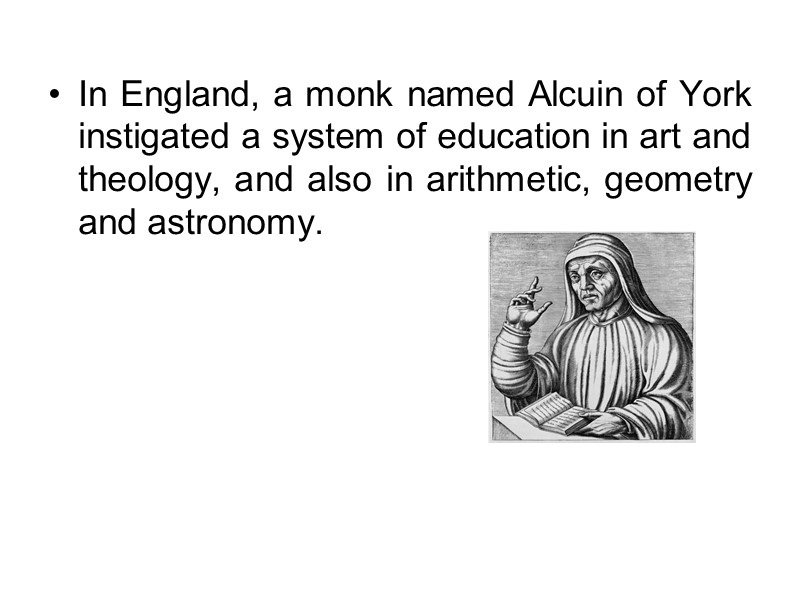
In England, a monk named Alcuin of York instigated a system of education in art and theology, and also in arithmetic, geometry and astronomy.
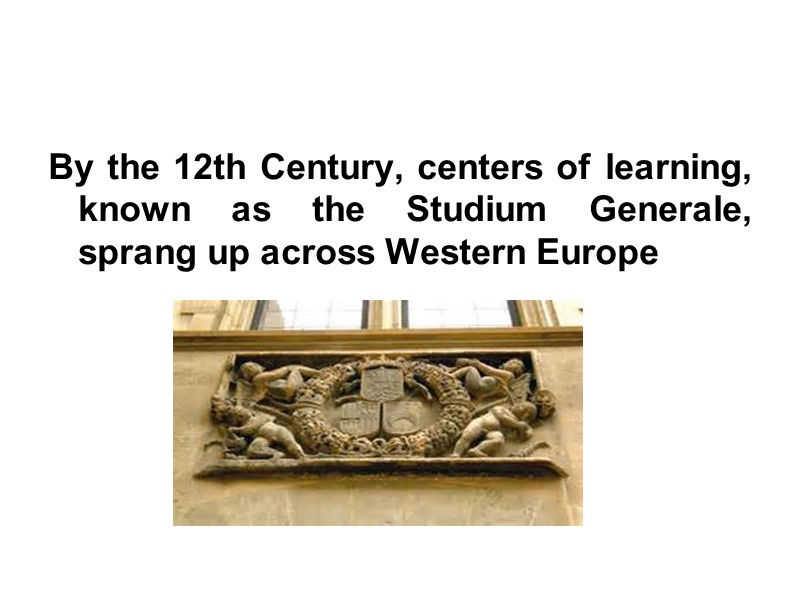
By the 12th Century, centers of learning, known as the Studium Generale, sprang up across Western Europe
Erigena - popular education was to be based wholly on religious matters, with everything taught pointing to religion in some way. To establish the reasonableness of the dogmas of the church was their main pursuit. PETER ABELARD played an important role in the founding of the University of Paris, where the core of teaching was the instalment of the teachings of the church.
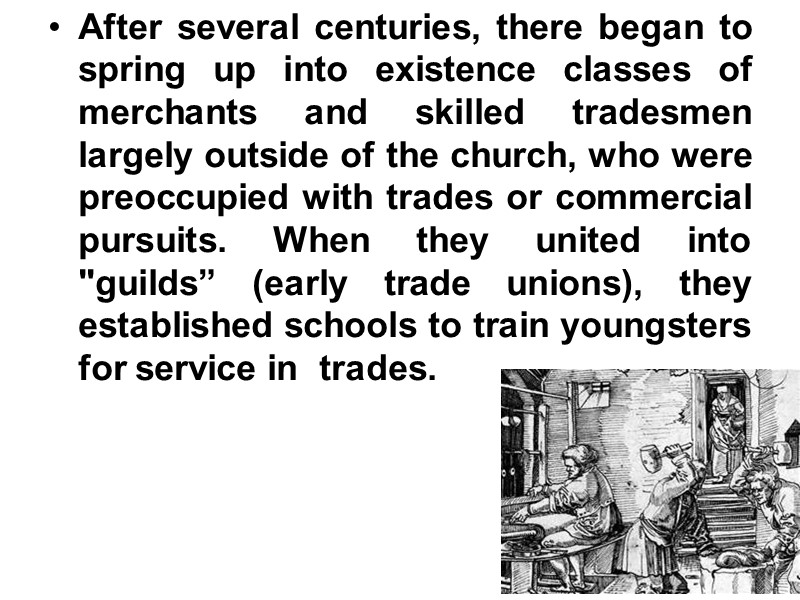
After several centuries, there began to spring up into existence classes of merchants and skilled tradesmen largely outside of the church, who were preoccupied with trades or commercial pursuits. When they united into "guilds” (early trade unions), they established schools to train youngsters for service in trades.
Along with them, court schools supported by wealthy rulers of the Italian cities arose, where a harmonious development of mind, body, and morals were sought. Latin, mathematics, fencing, wrestling, dancing, ball-playing and other physical exercise were given importance; also the Latin and Greek classics rediscovered by such men as Petrarch.
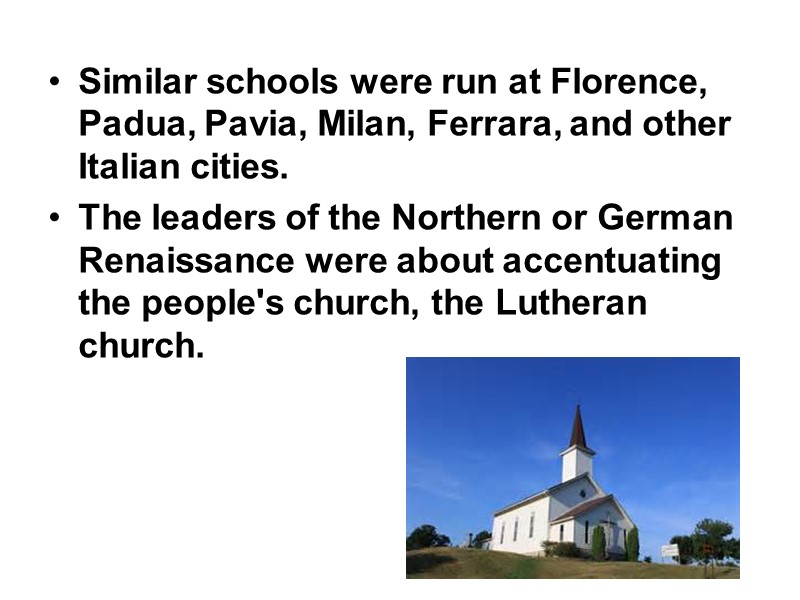
Similar schools were run at Florence, Padua, Pavia, Milan, Ferrara, and other Italian cities. The leaders of the Northern or German Renaissance were about accentuating the people's church, the Lutheran church.
MARTIN LUTHER, spearhead of the Protestants, the northern equal of the Italian Renaissance, thought that everybody should know how to interpret the Bible according to his own understanding. Reading, writing, and figuring were championed by them in order to enable people to understand the Bible and religion; still, they contended it was also necessary for good citizenship.
Luther wrote that even though there were no heaven nor hell, education would be necessary for the citizen. Cities and interested private groups started opening schools, which aimed at "piety, knowledge, and eloquence".
Drawing up of a philosophy of education started. JOHN MILTON, the great English poet and a schoolmaster, called on his students to look at to the ancient writings of Greece and Rome, thinking that they contained all that people needed to live a happy life.
The devotion to the past did not hold its own in the face of the mounting interest in the physical world. Science became all-too-respected.
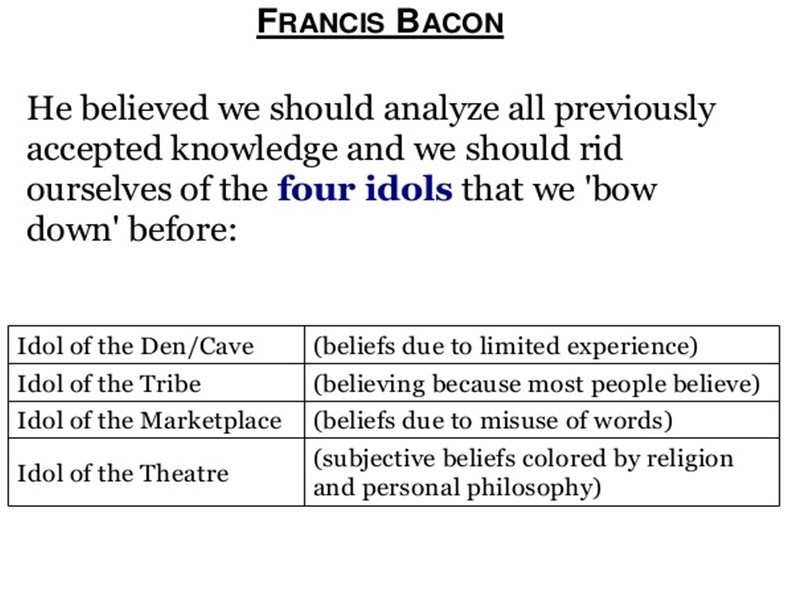
FRANCIS BACON – accurate thinking is needed; any mastery of the Universe was standing over careful understanding it. He was the first European philosopher to rid the mind of all possible biases. The young in schools should start in their thinking where the older left off. Science is accumulative by nature.
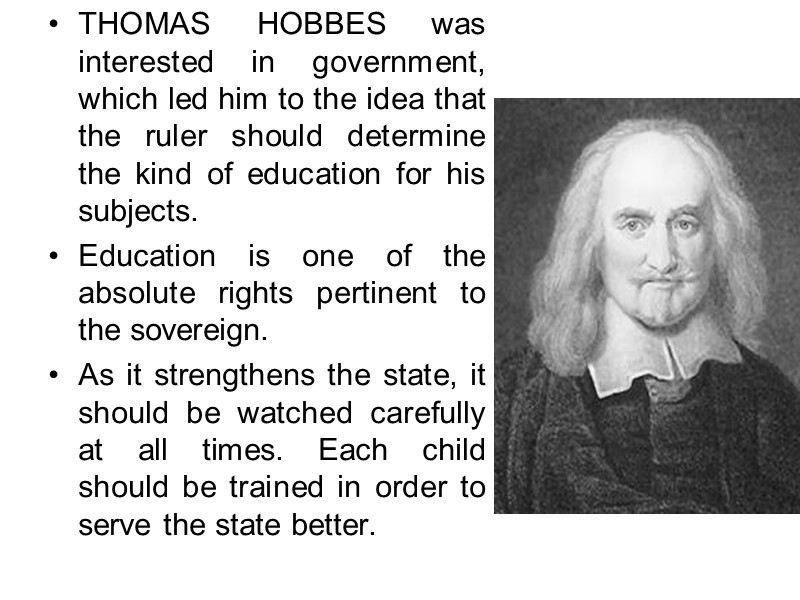
THOMAS HOBBES was interested in government, which led him to the idea that the ruler should determine the kind of education for his subjects. Education is one of the absolute rights pertinent to the sovereign. As it strengthens the state, it should be watched carefully at all times. Each child should be trained in order to serve the state better.
JOHN AMOS COMENIXIS, a bishop and teacher. He visioned a long period of encyclopedic training introducing students to all scientific knowledge accrued by the time. At first everything is to be taught in “a general and undefined manner”; as the child grew, teaching was to get more exact and specific. The pupil is to be exposed to the world, let observe, and thereby led to an understanding of things around him.
JOHN LOCKE was interested in the training of the “English Gentleman” - a youth of breeding and wisdom. Locke held that the human soul initially is a “blank tablet”, but possesses the power to take in impressions from the outer world driven by a desire for pleasure. A sound mind in a sound body were his ideal. Much physical exercise is needed in order to enable us to endure long physical strains without breaking. We have to expose ourselves to the world in order to have as much impressions as possible through traveling, teaching by private tutors, and wide experience in the social world.
The aim of education - an individual who knows all the appropriate methods of association with his fellows, who can be considered to be wise in the ways of the world, who is pious.
JEAN JACQUES ROUSSEAU said that society warps the child and that its influence is wholly evil. We should be protected from society at all times until we are as developed as to make any attempts of the society to destroy our inner nature futile. For the first four years physical training is important, Then, from five to twelve years the child would develop all of his senses. Intellectual training, through books is to begin only when the child is thirteen years old, following the in-born curiosity of the child. No instructions without child’s demanding it!
Between fifteen and twenty the child is to be given the moral training. It is here when he would come into contact with his fellows and, thus, learn the basics of sympathy, goodness, and altruism, with religion coming into his sight. As for girls, they are to be educated to serve men and fitted into a pattern of restraint. That life should be freed from the many restraints which had been put about it was the watchword of many.
Many educational institutions in which Rousseau's ideas were put into actual teaching, were founded. They emphasized conversation and play, rendering the school a "child-centered one”. Everything there was begining with those things in which the child was interested, and moved along as interests developed. There are two fundamental principles in philosophy of education - the principle of social control and that of nature.
It is the old problem of the individual and the group. Which should dominate? JOHANN GOCTLEB FICHTE - the state is prior! In his famous “Addresses to the German Nation” he argued for collective unity and social oneness such as to fashion a new and powerful nation. Education was to be the basis for that. For him, education should concern itself with the greatness of the nation. Education is a way to come to know and love those elements of national life which were of significance.
JOHANN FRIEDRICH HERBERT. His interest was rather psychological, experience, for him, being the sole source of all knowledge. Impressions organized by mind – that’s what we are! Thence, the environment in which the child is placed is of greatest influence. Setting the scene such that enables the child to receive right impressions will lead to a well-developed and intrinsically good character.
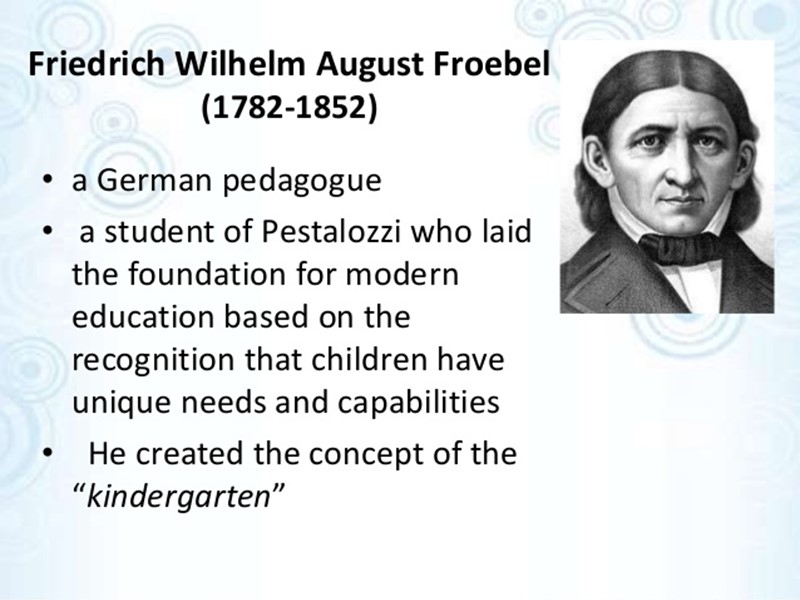
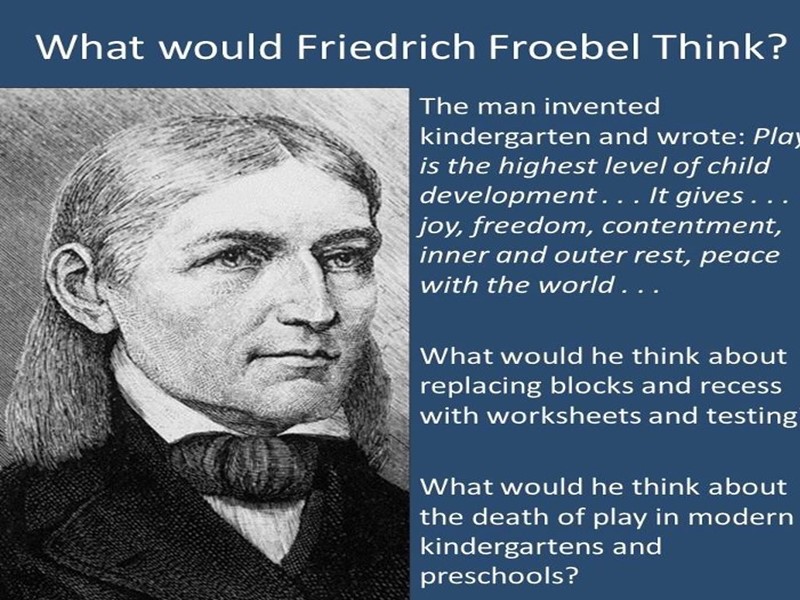
He called his school the Kindergarten, the garden of children. For him the school was to be operated as one might operate a garden. The teacher should permit and help the children to grow, just as the gardener helps the flowers to grow.
in Froebel we see reconciliation between the two divergent doctrines of education - the value of natural growth and development is not contradictory to society playing a great part in making the person civilized. Thus, social participation and work in groups were a definite part of the kindergarten.

At the beginning of the day the children form a circle, each child holding the hands of those on either side of him, thus symbolizing the unity; then the circle was to be broken up, and children were supposed to play either alone or in small teams. At the end of the day the circle was formed once more to accentuate that even if the child was an individual, he was also a member of the whole society.
Today, public schools are set up by society and are supported by taxes. Thus, society has recognized the necessity of education. Moreover, it has defined what will be taught in the schools, having teachers certified by society, and met certain standards set also by no one but society. As a result, there are many who maintain that the fundamental purpose of education is to mould individuals into service of the state. In totalitarian educational systems education is controlled completely by the state.
Still, educators see the danger of destroying the individuality of children. People are able to make a contribution to society such as will further its progress only if left to grow on their own.
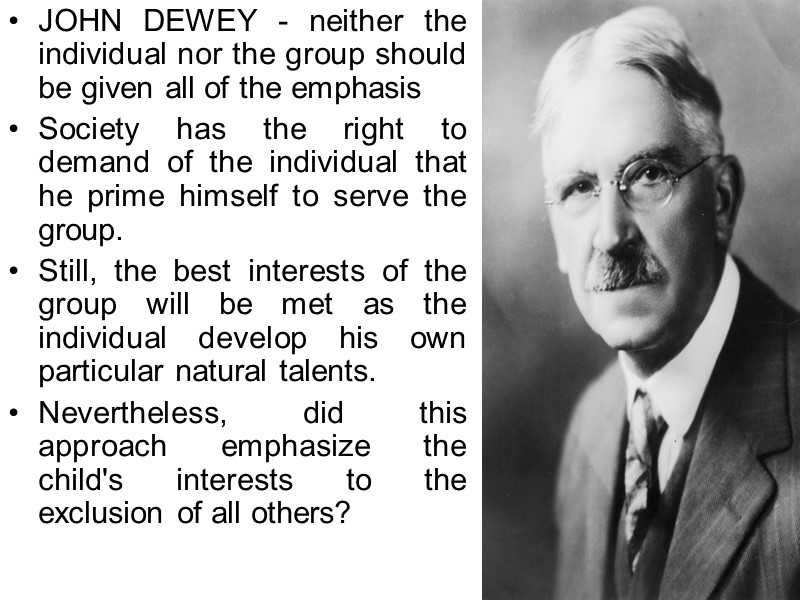
JOHN DEWEY - neither the individual nor the group should be given all of the emphasis Society has the right to demand of the individual that he prime himself to serve the group. Still, the best interests of the group will be met as the individual develop his own particular natural talents. Nevertheless, did this approach emphasize the child's interests to the exclusion of all others?
A proper adjustment and firm reconciliation between the two extremes of emphasis on the individual and on society are still to be effected. School must a place in which individual interests and talents are deemed to be means to invest into the weal of the whole.
 Скачать презентацию Man and Why do we establish schools and
29062-lecture_9_-_man_and_education.ppt
- Количество слайдов: 71