


 Скачать презентацию Malaria Prevention and Control An Example of
adcaea4404905243016250b1787b4cbd.ppt
- Количество слайдов: 25
 Malaria Prevention and Control : An Example of Uganda National Academy of Sciences in Action 5 th Annual Meeting of the African Science Academy Development Initiative November 10 -11 2009 Accra, Ghana
 Presentation compiled by Dr James Tibenderana Interim Head Uganda Malaria Research Centre And Director Case Management Malaria Consortium Email: j. tibenderana@malariaconsortium. org
 Outline of presentation Set the stage to illustrate a case of translating knowledge into action Describe the intervention/s used for knowledge translation Illustrate the national and media interest in DDT Describe a framework of the knowledge transfer process and contextualise to this case Relevance of the consensus report
 A case of knowledge into action
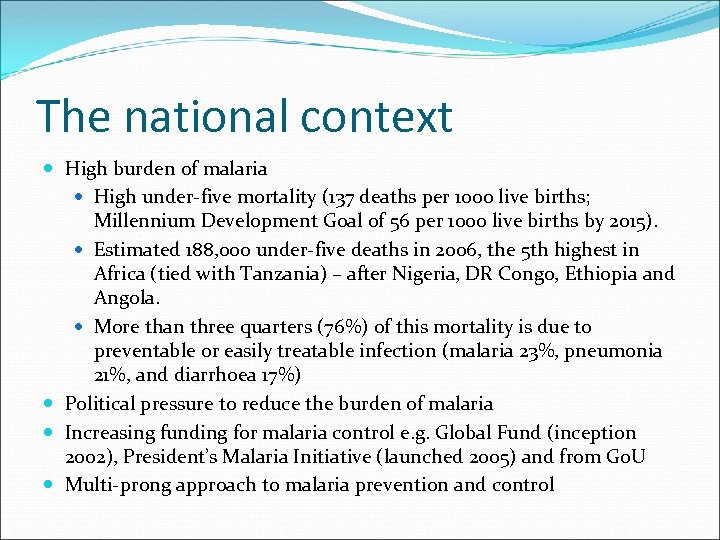 The national context High burden of malaria High under-five mortality (137 deaths per 1000 live births; Millennium Development Goal of 56 per 1000 live births by 2015). Estimated 188, 000 under-five deaths in 2006, the 5 th highest in Africa (tied with Tanzania) – after Nigeria, DR Congo, Ethiopia and Angola. More than three quarters (76%) of this mortality is due to preventable or easily treatable infection (malaria 23%, pneumonia 21%, and diarrhoea 17%) Political pressure to reduce the burden of malaria Increasing funding for malaria control e. g. Global Fund (inception 2002), President’s Malaria Initiative (launched 2005) and from Go. U Multi-prong approach to malaria prevention and control
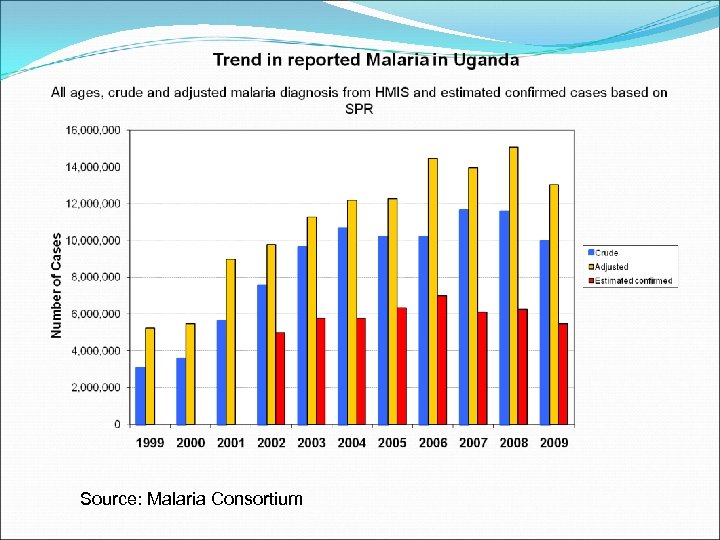 Source: Malaria Consortium
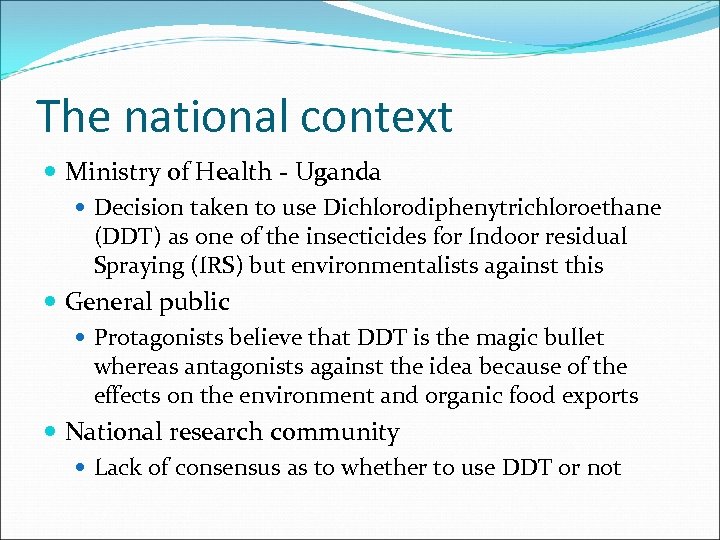 The national context Ministry of Health - Uganda Decision taken to use Dichlorodiphenytrichloroethane (DDT) as one of the insecticides for Indoor residual Spraying (IRS) but environmentalists against this General public Protagonists believe that DDT is the magic bullet whereas antagonists against the idea because of the effects on the environment and organic food exports National research community Lack of consensus as to whether to use DDT or not
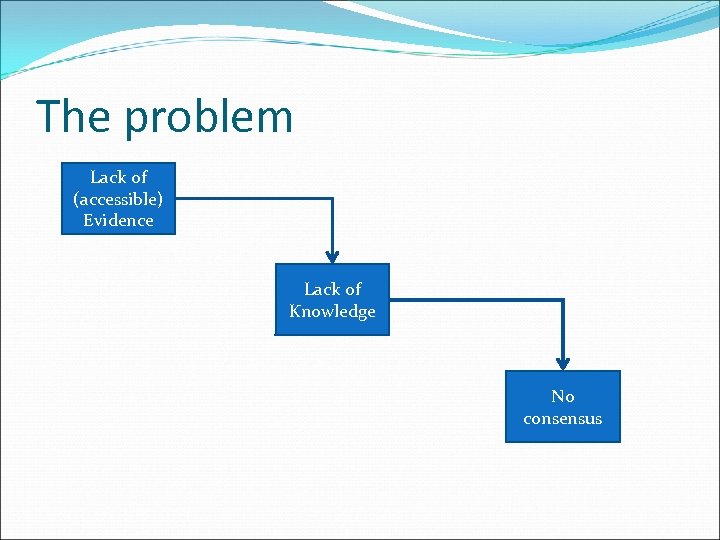 The problem Lack of (accessible) Evidence Lack of Knowledge No consensus
 Taking on the challenge “In September 2006, UNAS held a workshop on Malaria Control and Prevention: Strategies and Policy Issues. The findings of the workshop summary report served as the basis on which the UNAS executive council selected the topic for their first consensus study addressing malaria vector resistance to insecticides used for indoor residual spraying in Uganda. ” UNAS brochure
 Intervention Consensus study (July 2007) comprising Committee of nine multi-disciplinary experts (national, regional and international) Committee of ten reviewers (mirror composition of above) Use clear statement of task to identify, review and assess the current state of knowledge and policies pertinent to monitoring malaria vector resistance in the context of an effective national program for IRS with DDT for controlling malaria Recommend best practices for the effective use of DDT and other malaria vector insecticides for use in Uganda that take into consideration insecticide susceptibility Dissemination of report targeting key stakeholders
 Output of interest Malaria Mosquito Alert Approaches to assessing and managing malaria vector resistance to insecticides used for IRS in Uganda – contributing to a National IRS strategy © 2008 Uganda National Academy of Sciences
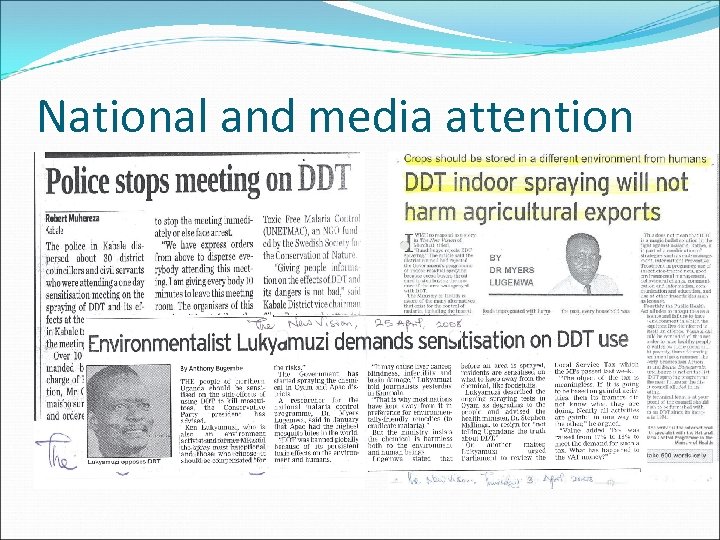 National and media attention
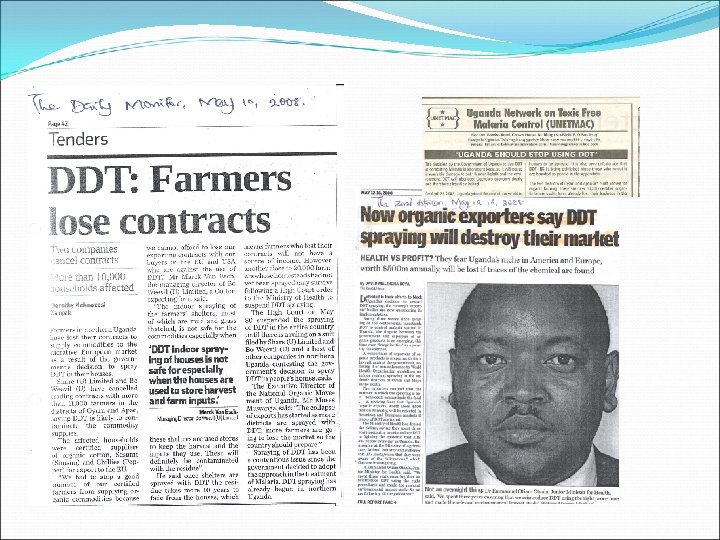
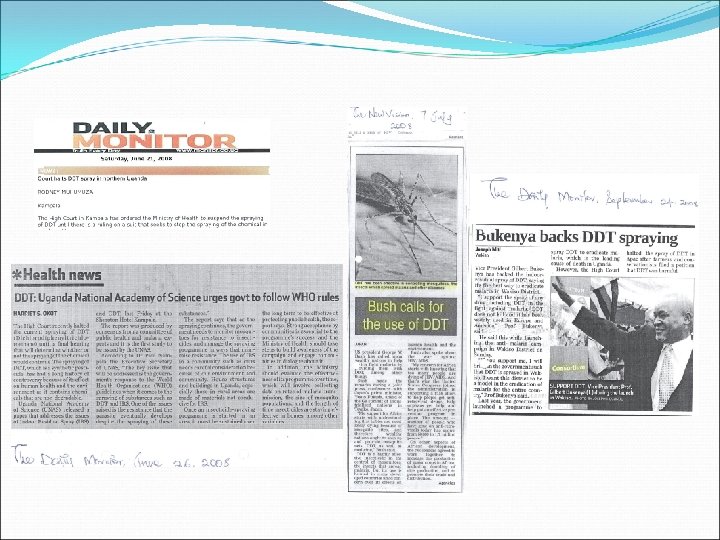
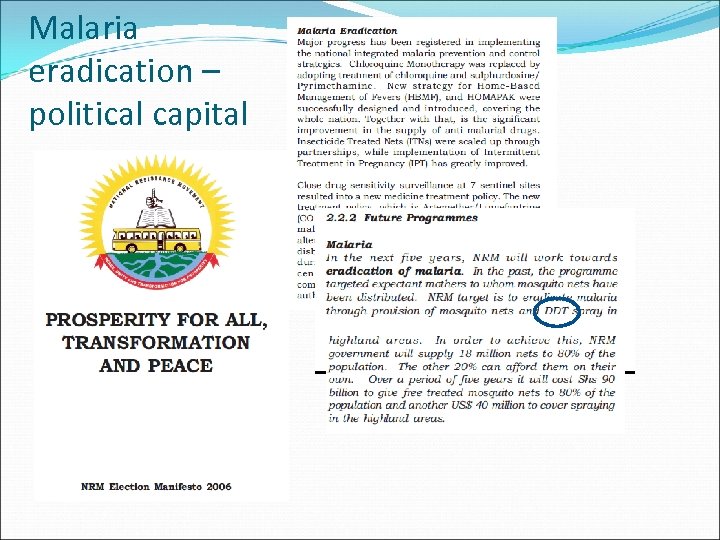 Malaria eradication – political capital
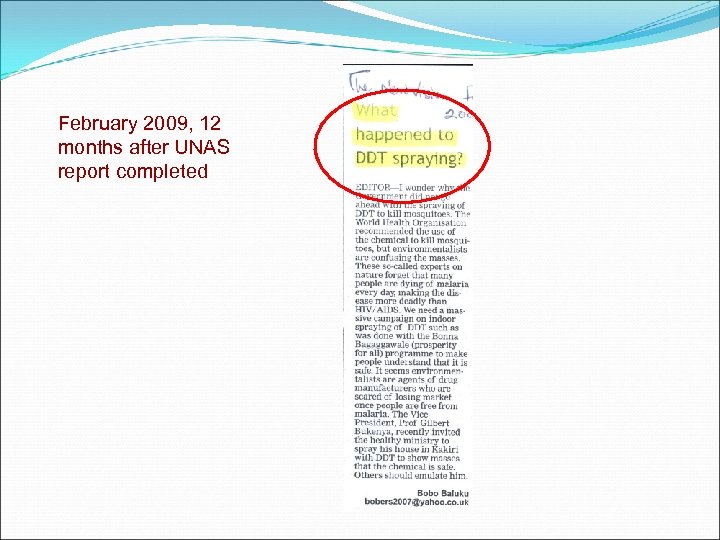 February 2009, 12 months after UNAS report completed
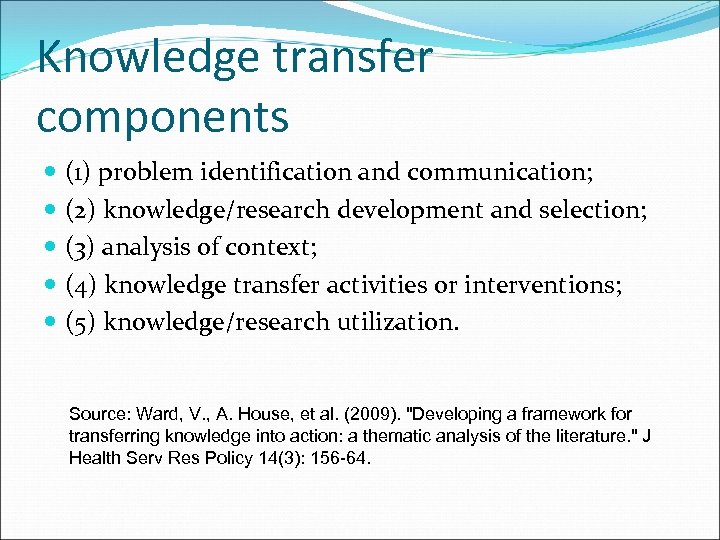 Knowledge transfer components (1) problem identification and communication; (2) knowledge/research development and selection; (3) analysis of context; (4) knowledge transfer activities or interventions; (5) knowledge/research utilization. Source: Ward, V. , A. House, et al. (2009). "Developing a framework for transferring knowledge into action: a thematic analysis of the literature. " J Health Serv Res Policy 14(3): 156 -64.
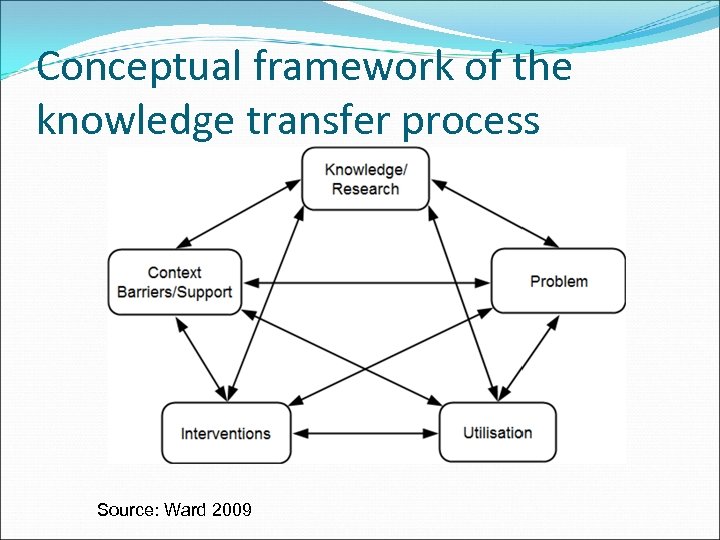 Conceptual framework of the knowledge transfer process Source: Ward 2009
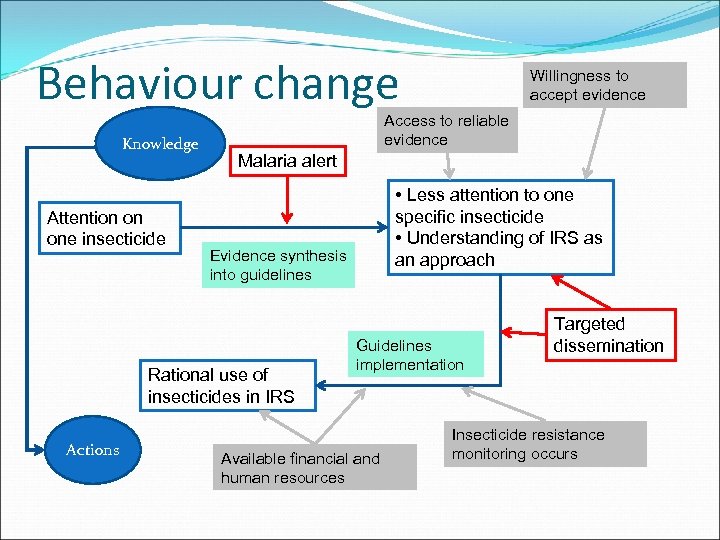 Behaviour change Knowledge Attention on one insecticide Access to reliable evidence Malaria alert • Less attention to one specific insecticide • Understanding of IRS as an approach Evidence synthesis into guidelines Rational use of insecticides in IRS Actions Willingness to accept evidence Guidelines implementation Available financial and human resources Targeted dissemination Insecticide resistance monitoring occurs
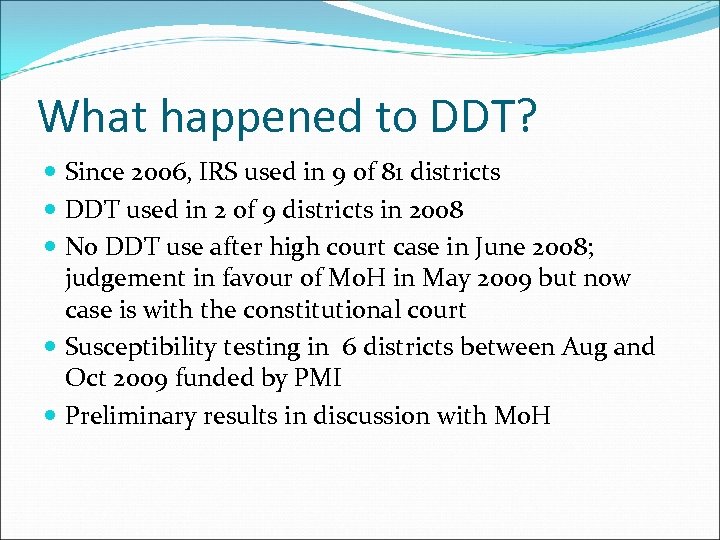 What happened to DDT? Since 2006, IRS used in 9 of 81 districts DDT used in 2 of 9 districts in 2008 No DDT use after high court case in June 2008; judgement in favour of Mo. H in May 2009 but now case is with the constitutional court Susceptibility testing in 6 districts between Aug and Oct 2009 funded by PMI Preliminary results in discussion with Mo. H
 Relevance of the report “The report was the first published document to highlight the possibility of DDT resistance in the country” “It was a useful document to convince the decision makers of the need to monitor insecticide resistance” Expert Malariologist, Uganda
 Is it time for an evaluation of the impact of the report?
 Report recommendations moving into action 1 a: Previously conducted susceptibility tests carried out in 2005 and 2006 should be confirmed……. 2: The Mo. H should carry out a baseline assessment of key entomological variables such as mosquito species and biting behaviour …. . 3: In selecting insecticides for IRS, the Mo. H should be guided by the ITS policy and the strategy for insecticide resistance management…. . Cause-effect association not verified
 In summary – an example of KT Steps in knowledge transfer Step 1 – the “what” Step 2 – “to whom” Step 3 – “by whom” Step 4 – “how” Step 5 – “with what effect” Sources: WHO (2004). World Report on Knowledge for Better Health - Strengthening Health Systems. Geneva, World Health Organisation. Lavis, J. N. , D. Robertson, et al. (2003). "How can research organizations more effectively transfer research knowledge to decision makers? " Milbank Q 81(2): 221 -48, 171 -2.
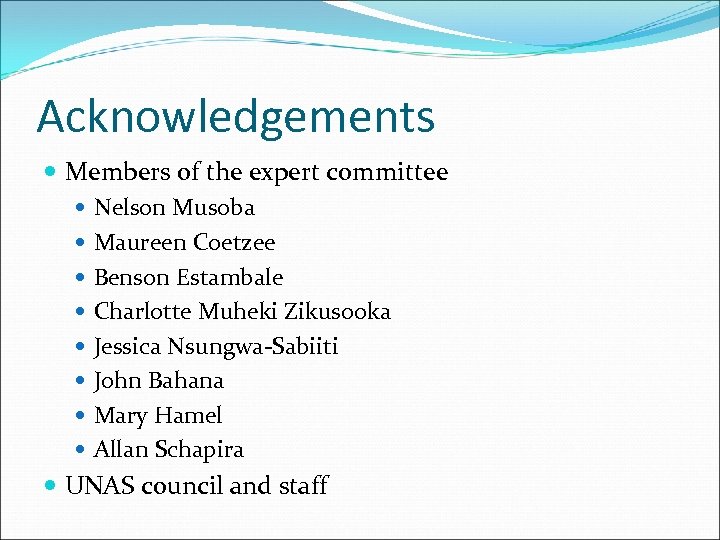 Acknowledgements Members of the expert committee Nelson Musoba Maureen Coetzee Benson Estambale Charlotte Muheki Zikusooka Jessica Nsungwa-Sabiiti John Bahana Mary Hamel Allan Schapira UNAS council and staff