


 Скачать презентацию Malaria Elimination Concepts Strategic direction 20082010 Steps Activities
b83634046ca499659023a295834c9205.ppt
- Количество слайдов: 67
 Malaria Elimination Concepts, Strategic direction (20082010), Steps, Activities, Requirements Feedback on New Global “Malaria elimination” Initiative to NMCP 12 th November 2007 Morogoro Mkude. S (MD); NMCP/Mo. HSW
 Contents of Presentation • Introduction • The concept: towards malaria elimination • Strategic direction (2008 -2010) • Steps & activities (Global level) • “Resource moderators” • Requirements for initiation of the process ü Sub regional responsibility ü Countries initiation process ü WHO country office responsibilities & support to be given Mkude. S (MD); NMCP/Mo. HSW
 Introduction Mkude. S (MD); NMCP/Mo. HSW
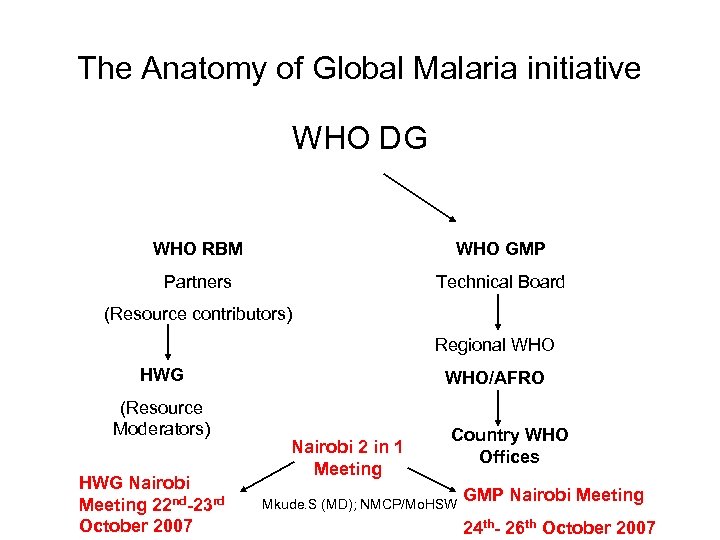 The Anatomy of Global Malaria initiative WHO DG WHO RBM WHO GMP Partners Technical Board (Resource contributors) Regional WHO HWG (Resource Moderators) HWG Nairobi Meeting 22 nd-23 rd October 2007 WHO/AFRO Nairobi 2 in 1 Meeting Country WHO Offices Mkude. S (MD); NMCP/Mo. HSW GMP Nairobi Meeting 24 th- 26 th October 2007
 Introduction (1) • There is a Global movement which has created new “Malaria Elimination” initiative • The initiative is going to be in full scale within 6 months • It advocate rapid scaling of intervention to achieve RBM targets of universal coverage of 80% by 2010 (Intensive 36 months) • What is immediately required by donors community is to know the individual country needs (Needs Assessment) • Thereafter a business plan before February 2008 • The country Needs Assessment (NA) & Business Plan (BP) must be Mkude. S (MD); NMCP/Mo. HSW MMTSP in line with (our)
 Introduction 2 • The RBM Harmonization Working Group (HWG) will fill the gap of required resources • WHO will be the focal partner at country level • There was a 2 in 1 meeting (WHO GMP & RBM HWG) in Nairobi to initiate the process of country NA & BP • The meeting was attended by ü NMCP’s PMs and their WHO Malaria NPO from selected 15 African countries ü Representation from all WHO regional offices world wide ü WHO HQ Mkude. S (MD); NMCP/Mo. HSW ü RBM HWG members
 Introduction 3 • There was a request from participating countries for an official communication to Government Ministries of Health. • In principal we are “nominated” but we have to fulfil the requirements: üInitiate prescribed process in a tight framework of timelines üCentre to all is the re-orientation of Country Malaria STP Mkude. S (MD); NMCP/Mo. HSW
 The concept: towards malaria elimination Mkude. S (MD); NMCP/Mo. HSW
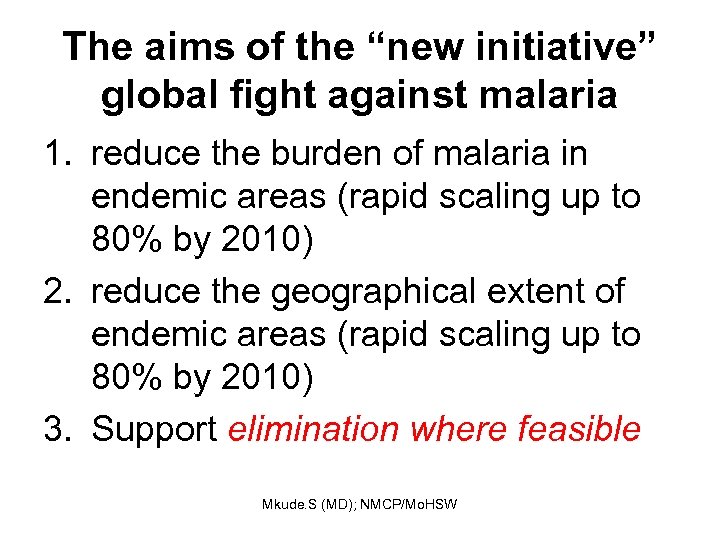 The aims of the “new initiative” global fight against malaria 1. reduce the burden of malaria in endemic areas (rapid scaling up to 80% by 2010) 2. reduce the geographical extent of endemic areas (rapid scaling up to 80% by 2010) 3. Support elimination where feasible Mkude. S (MD); NMCP/Mo. HSW
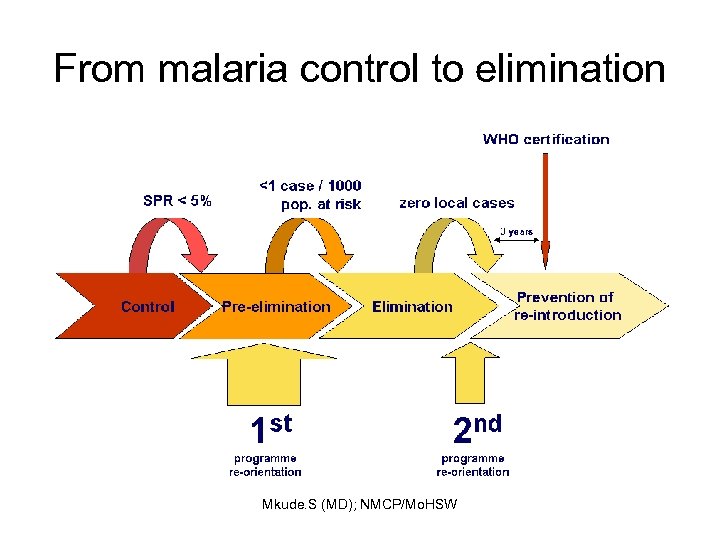 From malaria control to elimination Mkude. S (MD); NMCP/Mo. HSW
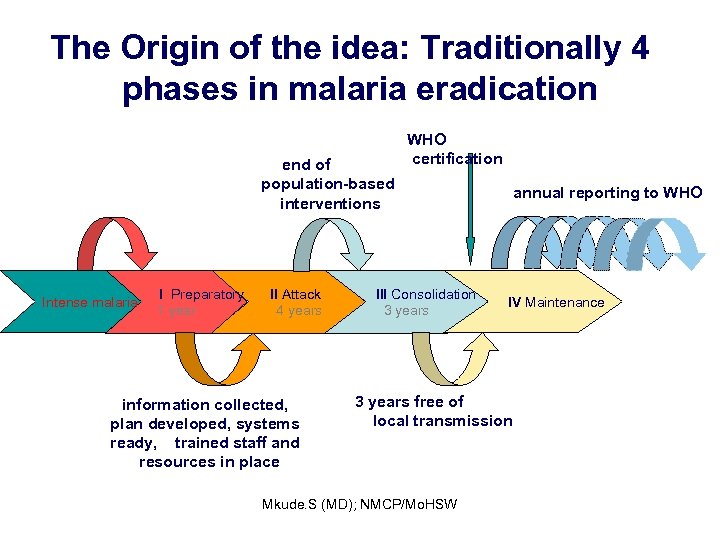 The Origin of the idea: Traditionally 4 phases in malaria eradication end of population-based interventions Intense malaria I Preparatory 1 year II Attack 4 years information collected, plan developed, systems ready, trained staff and resources in place WHO certification III Consolidation 3 years annual reporting to WHO IV Maintenance 3 years free of local transmission Mkude. S (MD); NMCP/Mo. HSW
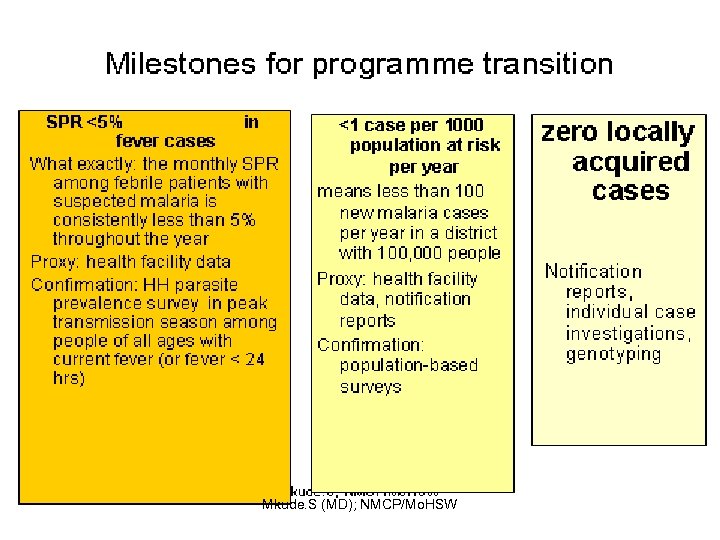
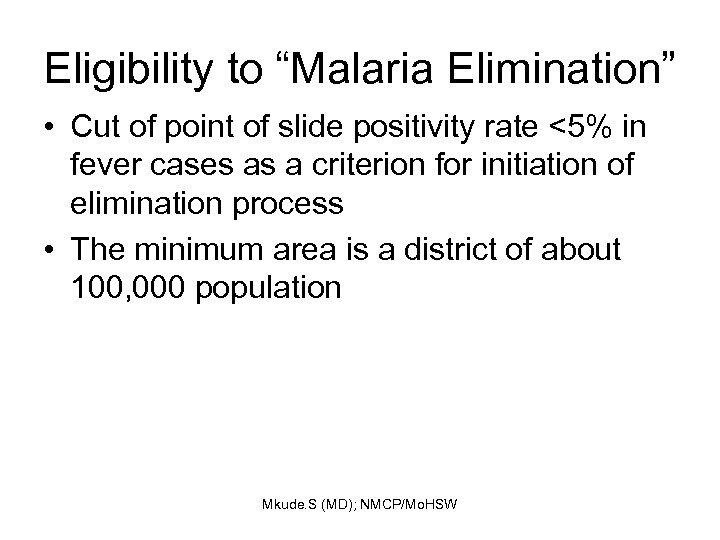 Eligibility to “Malaria Elimination” • Cut of point of slide positivity rate <5% in fever cases as a criterion for initiation of elimination process • The minimum area is a district of about 100, 000 population Mkude. S (MD); NMCP/Mo. HSW
 Mkude. S (MD); NMCP/Mo. HSW
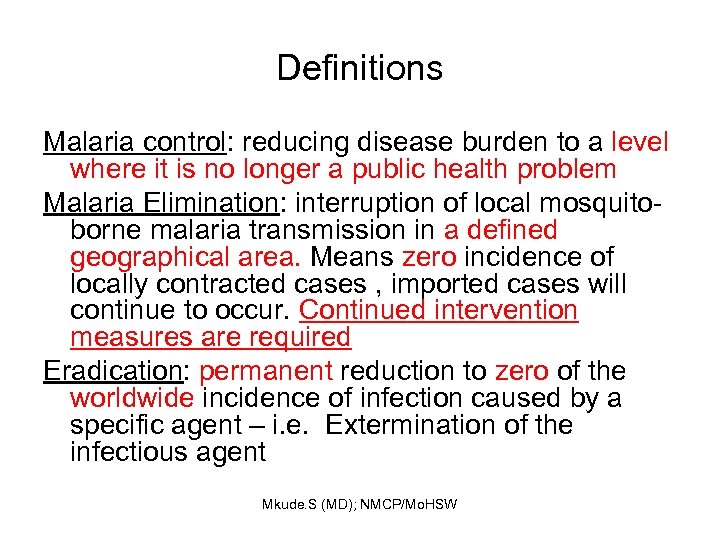 Definitions Malaria control: reducing disease burden to a level where it is no longer a public health problem Malaria Elimination: interruption of local mosquitoborne malaria transmission in a defined geographical area. Means zero incidence of locally contracted cases , imported cases will continue to occur. Continued intervention measures are required Eradication: permanent reduction to zero of the worldwide incidence of infection caused by a specific agent – i. e. Extermination of the infectious agent Mkude. S (MD); NMCP/Mo. HSW
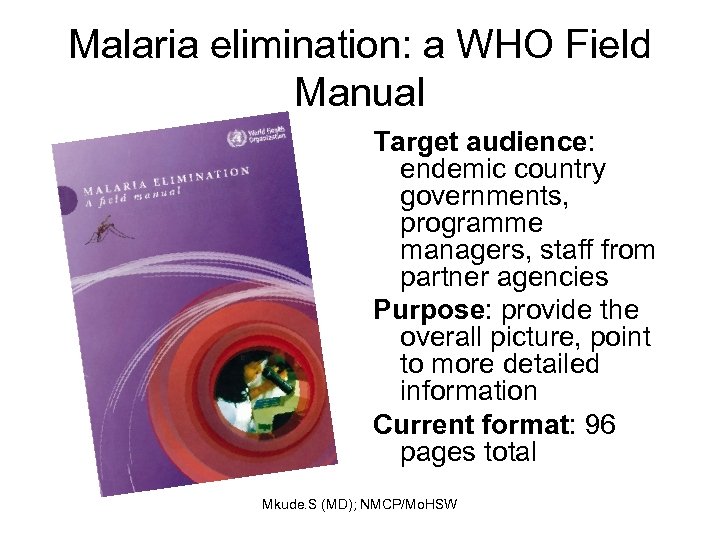 Malaria elimination: a WHO Field Manual Target audience: endemic country governments, programme managers, staff from partner agencies Purpose: provide the overall picture, point to more detailed information Current format: 96 pages total Mkude. S (MD); NMCP/Mo. HSW
 GMP malaria elimination field manual v. Clarity on malaria elimination concepts (for moderate-to-high transmission countries that consider moving towards elimination) v. Clarity on WHO policies, procedures and reporting requirements (for countries that are near malaria elimination or have recently achieved it) Mkude. S (MD); NMCP/Mo. HSW
 Strategic direction (20082010) Mkude. S (MD); NMCP/Mo. HSW
 Strategic direction (2008 -2010) 1. Develop scientific consensus on control strategy and business plan 2. Intensified implementation of national malaria programmes 3. Effective advocacy / resource mobilization Mkude. S (MD); NMCP/Mo. HSW
 Recommended (proven intervention) Malaria control package (1) • Diagnosis-based treatment ü Diagnostic use ü Treatment use • Prevention (LLITN + IRS) ü Transmission control with ITNs ü Transmission control with IRS • Monitoring and evaluation ü Performance monitoring and impact evaluation • Insurance (protect effectiveness of current tools) • Operational research Mkude. S (MD); NMCP/Mo. HSW
 Malaria control package(2) • "Documentable" effective case management systems l National – District – Health facility, Community, Private Sector • Prevention l LLITN for community prevention, 80% coverage of total population at risk l IRS for community prevention as a supplement to LLITN, for epidemic preparedness, etc. Mkude. S (MD); NMCP/Mo. HSW
 Strategic direction (2008 -2010) 1. Develop scientific consensus on control strategy and business plan 2. Intensified implementation of national malaria programmes 3. Effective advocacy / resource mobilization Mkude. S (MD); NMCP/Mo. HSW
 2. Intensified implementation • Effective treatment and prevention coverage increased to 80% in 54 countries • Elimination / certification in 25 countries • More gradual scale up in 28 countries Mkude. S (MD); NMCP/Mo. HSW
 Intensified implementation • 57 Programmes*: support led by WHO – Endemic (10 in Africa; 22 in other regions) – elimination / certification: 25 • 22 Programmes* in Africa: support coordinated by RBM harmonization working group (which includes WHO) • 28 Programmes*: scaling up gradually, supported by WHO & other interested partners • Coordination with International Health Partnership on health systems strengthening (Burundi, Cambodia, Ethiopia, Kenya, Mozambique, Nepal, Zambia) * Proposed Mkude. S (MD); NMCP/Mo. HSW
 Proposed countries • Group A: Scaling up Malaria control to 80% (2008 -2010) – Africa: Angola, Benin, Burundi, Burkina Faso, Cameroon, CAR, Chad, Congo, DRC, Equatorial Guinea, Eritrea, Ethiopia, Ghana, Guinea, Kenya, Liberia, Madagascar, Malawi, Mali, Mozambique, Nigeria, Rwanda, Sao Tome & Principe Senegal, Sierra Leone, Somalia, Sudan, Tanzania, Uganda, Zambia, Zimbabwe – Latin America: Brazil, Colombia, Guatemala, Honduras, Nicaragua, Peru, Venezuela – Asia & Middle East: Afghanistan, Bangladesh, Cambodia, China, India, Indonesia, Laos, Myanmar, Papua New Guinea, Philippines, Thailand, Solomon Islands, Vanuatu, Vietnam, Yemen • Group B: Pre-elimination to elimination phase (2008 -2010) – Algeria, Argentina, Azerbaijan, DPRK, El Salvador, Georgia, Iran, Iraq, Krygsztan, Malaysia, Mexico, Paraguay, Tajikistan, Turkey, Turkmenistan, Russia, Sri Lanka, Saudi Arabia, Swaziland • Group C: Certified Malaria Free (2008 -2010) – Mauritius, Morocco, Oman, Armenia, Syria, Mkude. S (MD); NMCP/Mo. HSW • Group D: Gradual scale-up in remaining 28 countries
 Strategic direction (2008 -2010) 1. Develop scientific consensus on control strategy and business plan 2. Intensified implementation of national malaria programmes 3. Effective advocacy / resource mobilization Mkude. S (MD); NMCP/Mo. HSW
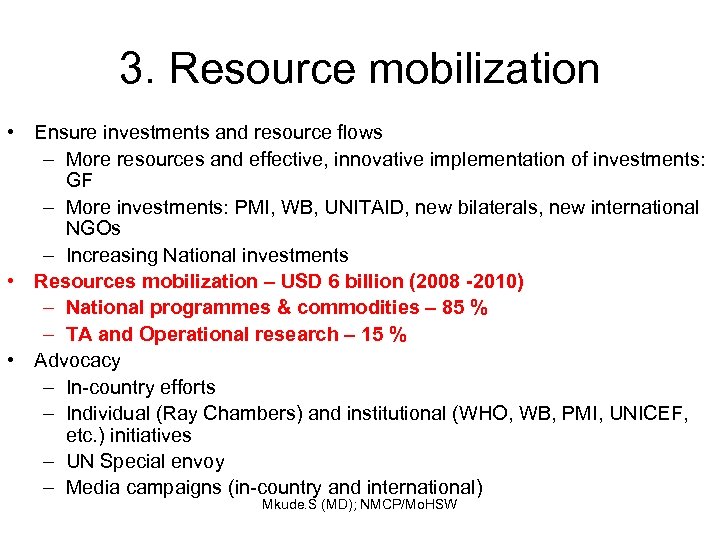 3. Resource mobilization • Ensure investments and resource flows – More resources and effective, innovative implementation of investments: GF – More investments: PMI, WB, UNITAID, new bilaterals, new international NGOs – Increasing National investments • Resources mobilization – USD 6 billion (2008 -2010) – National programmes & commodities – 85 % – TA and Operational research – 15 % • Advocacy – In-country efforts – Individual (Ray Chambers) and institutional (WHO, WB, PMI, UNICEF, etc. ) initiatives – UN Special envoy – Media campaigns (in-country and international) Mkude. S (MD); NMCP/Mo. HSW
 Phase 1(Strategic Direction): 6 months (Sep 07 – Feb 08) • Development of the plan • Consensus building • Endorsement and launch of the plan Mkude. S (MD); NMCP/Mo. HSW
 Steps & Activities (Global level) Mkude. S (MD); NMCP/Mo. HSW
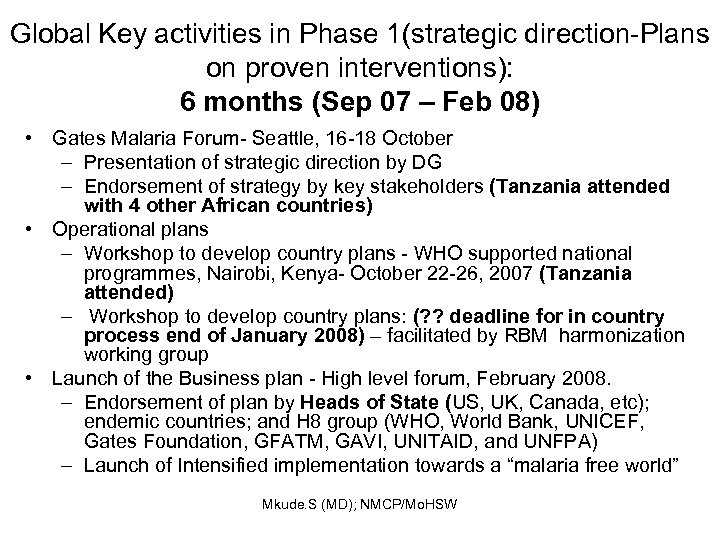 Global Key activities in Phase 1(strategic direction-Plans on proven interventions): 6 months (Sep 07 – Feb 08) • Gates Malaria Forum- Seattle, 16 -18 October – Presentation of strategic direction by DG – Endorsement of strategy by key stakeholders (Tanzania attended with 4 other African countries) • Operational plans – Workshop to develop country plans - WHO supported national programmes, Nairobi, Kenya- October 22 -26, 2007 (Tanzania attended) – Workshop to develop country plans: (? ? deadline for in country process end of January 2008) – facilitated by RBM harmonization working group • Launch of the Business plan - High level forum, February 2008. – Endorsement of plan by Heads of State (US, UK, Canada, etc); endemic countries; and H 8 group (WHO, World Bank, UNICEF, Gates Foundation, GFATM, GAVI, UNITAID, and UNFPA) – Launch of Intensified implementation towards a “malaria free world” Mkude. S (MD); NMCP/Mo. HSW
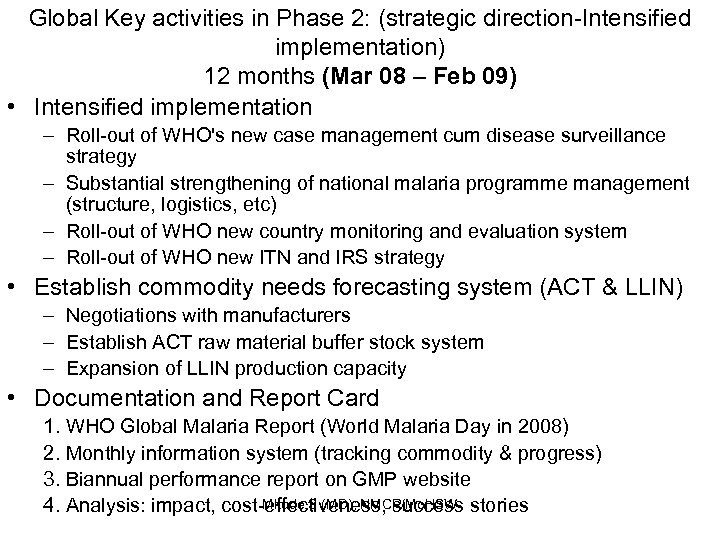 Global Key activities in Phase 2: (strategic direction-Intensified implementation) 12 months (Mar 08 – Feb 09) • Intensified implementation – Roll-out of WHO's new case management cum disease surveillance strategy – Substantial strengthening of national malaria programme management (structure, logistics, etc) – Roll-out of WHO new country monitoring and evaluation system – Roll-out of WHO new ITN and IRS strategy • Establish commodity needs forecasting system (ACT & LLIN) – Negotiations with manufacturers – Establish ACT raw material buffer stock system – Expansion of LLIN production capacity • Documentation and Report Card 1. WHO Global Malaria Report (World Malaria Day in 2008) 2. Monthly information system (tracking commodity & progress) 3. Biannual performance report on GMP website Mkude. S (MD); NMCP/Mo. HSW 4. Analysis: impact, cost-effectiveness, success stories
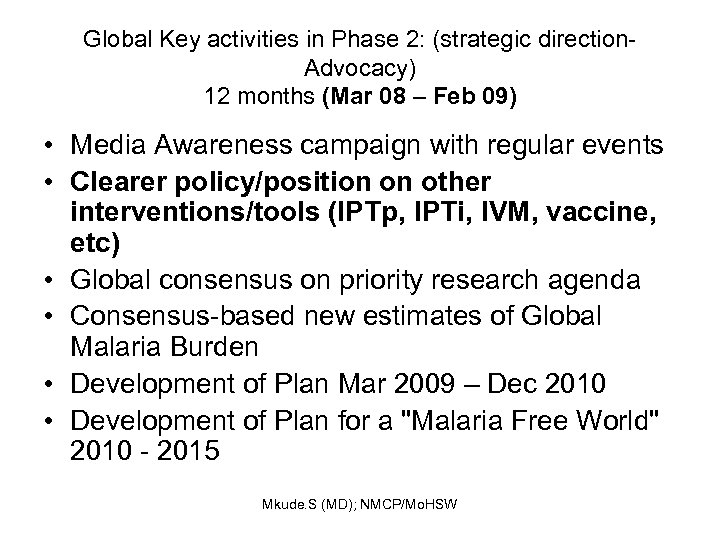 Global Key activities in Phase 2: (strategic direction. Advocacy) 12 months (Mar 08 – Feb 09) • Media Awareness campaign with regular events • Clearer policy/position on other interventions/tools (IPTp, IPTi, IVM, vaccine, etc) • Global consensus on priority research agenda • Consensus-based new estimates of Global Malaria Burden • Development of Plan Mar 2009 – Dec 2010 • Development of Plan for a "Malaria Free World" 2010 - 2015 Mkude. S (MD); NMCP/Mo. HSW
 “Resource Harmonization” Mkude. S (MD); NMCP/Mo. HSW
 RBM Harmonization Working Group (HWG) • Major financial and implementation support partners • Constituency Membership is decided by RBM Board • Membership includes: WHO (AFRO and HQ), UNICEF, World Bank, Global Fund, MACEPA, Bill and Melinda Gates Foundation, Malaria No More, UN Foundation, Johns Hopkins VOICES Project, Millennium Project, UNF, PSI • All RBM sub-regional networks and RBM Working Group Chairs Mkude. S (MD); NMCP/Mo. HSW
 Scaling-up for impact: • The Board has endorsed a new rallying cry at the core of Roll Back Malaria: • “Scale Up” – Existing full package of proven interventions • Nation-wide to high coverage – Rapidly • “For Impact” – Track action and document changes in coverage and benefits in human and economic terms – Moving from high coverage towards elimination as a public health problem and eventually eradication Mkude. S (MD); NMCP/Mo. HSW
 RBM Harmonization Working Group (HWG) 1. 2. 3. 4. 5. 6. Coordinate a process to support the development of and adherence to the “ 3 -ones” concept at country level Assist countries to identify support needs for scaling-up through comprehensive gap analyses and needs assessment Track and Facilitate resource flows from partners to countries Harmonize partner efforts to fill country-identified gaps Facilitate the development of a “rapid-response” mechanism to support countries to overcome implementation bottlenecks (reactively and proactively) Secure additional resources from the Global Fund, PMI, World Bank and others in support of country scale-up Mkude. S (MD); NMCP/Mo. HSW
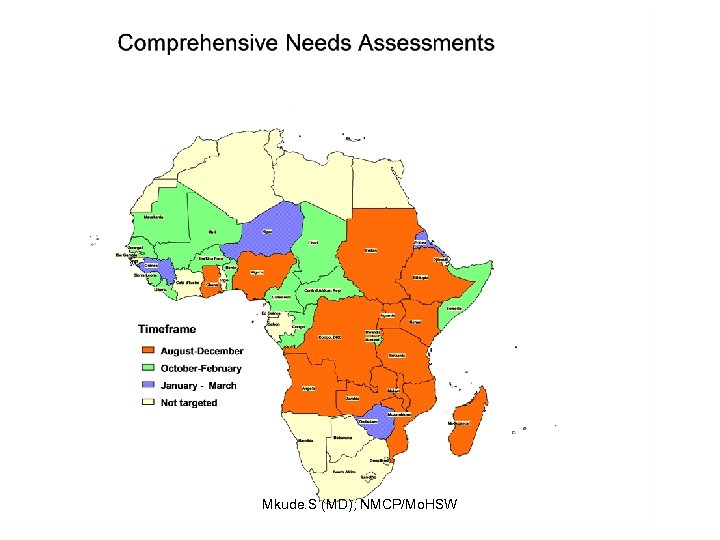
 But, 1 st……Needs Assessments • Support >30 national programs to develop malaria needs assessments and business plans over the next 4 -6 months that will result in achievement of 2010 RBM Goals (>80% coverage) • Plans will result in an improved understanding of country support needs (financial and technical/implementation support) and the resources and strategies required to fill them. • Present plans to a series of high-level donor meetings, as well as to individual partners, for immediate support Mkude. S (MD); NMCP/Mo. HSW
 Process for Needs Assessments • Develop common template for needs assessment and plan • Countries lead needs assessment and business plan development • Each country will be paired with one lead partner and additional supporting partners • Each country will be offered consultant support to assist in writing/documentation of assessment and plan • RBM will aggregate assessments and plans, and assist in the development of regional/cross-border Mkude. S investments/actions (MD); NMCP/Mo. HSW
 Mkude. S (MD); NMCP/Mo. HSW
 Process for Needs Assessments & Business plan Needs Assessments: • Workshop (Nairobi), October 22 nd -23 rd , 2007 with initial 15 countries to be hosted by WHO • Template to be developed by MACEPA and revised by wider partnership • Consultants will be contracted to carry out the data collection and actual writing/filling-in of the template to ensure consistency Business Plans: • Template to be developed by MACEPA • Process for country level development to be managed by RBM HWG Task Force members with in-country presence, namely WHO, UNICEF, MACEPA, US PMI, and the World Bank, under the auspices of the (MD); NMCP/Mo. HSW Mkude. S RBM sub-regional networks.
 Requirements (Sub regional & Countries) Mkude. S (MD); NMCP/Mo. HSW
 Requirement (1): Sub regional Mkude. S (MD); NMCP/Mo. HSW
 1 st Nairobi workshop, October 22, 2007 with initial 15 countries • Adaptation of proposed initiation process to individual countries – Identification of key milestones in country – (Selection and) timing of consultants – Discussion on mechanism of in-country initiation of the processes (Need Assessment) (workshops/retreats) – Financial requirements Mkude. S (MD); NMCP/Mo. HSW
 Sub region requirements • HWG develop a template for business plan by end November • 2 nd workshop for countries on business plan template (early February 2008? ). • translation of needs assessment to business plan through in-country planning • Finalization (March) Mkude. S (MD); NMCP/Mo. HSW
 Sub region to facilitate • Global level synthesis (March) • High level donor/partner consultation (march) to mobilize necessary resources to meet identified needs: – financial – technical – implementation support Mkude. S (MD); NMCP/Mo. HSW
 INITIATION FOR RAPID SCALING OF MALARIA INTERVENTIONS IN TANZANIA Stepping in “Malaria Elimination” Initiative Mkude. S (MD); NMCP/Mo. HSW
 Contents • Where are we in line with what is required? • Key milestones (events) in the initiation process • Resources to support Focal Partner (WHO Country Office) • Some future implementation issues to be considered Mkude. S (MD); NMCP/Mo. HSW
 Where are we in line with what is required? Requirement 1: In each individual country Malaria Medium Term Strategic Plan (MMTSP) will be the reference document to the “Malaria Elimination” initiative • The current 2002 -2007 Malaria MTSP is in its last days. • In the development process of the new MMTSP (2008 -12) we are aware that: The context of malaria prevention and control has changed and a much more aggressive approach is needed Mkude. S (MD); NMCP/Mo. HSW
 Where are we in line with what is required? • At present the consensus on the framework of our new MMTSP (2008 -2012) has been much influenced by GFR 7 application, it is a right direction: üConcept part üNeeds assessment/Gap analysis üOperational plan/Business plan (1 year roll out plan? Fixed. e. g. 3 yrs plan? . e. t. c. ) Mkude. S (MD); NMCP/Mo. HSW
 Where are we in line with what is required? • In the meantime available needs assessment/Gap Analysis (NA/GA) have been calculated through different recent requested proposal (GF R 7, IRS Master Plan, ITN “Sacchs”) based on the new strategies identified in the draft of 2008 -12 MMTSP • Through different above proposals we have in place the patchy frame works for MMTSP Needs Assessment/Gap Analysis which will contribute to our MTSP Operational/business plan • The MMTSP (2008 -2012) draft still needs developed/adoptation NA/GA from different recent proposal to contribute to operational/business plan (a resource moderation component of MMTSP) Mkude. S (MD); NMCP/Mo. HSW
 Where are we in line with what is required? • Mid of November 2008 there is an already planned NMCP workshop to finalize the draft of the MMTSP/dissemination • In principle, we have to review our Goals, Objectives & Targets in the concept part in the new MMTSP to address the high universal coverage (80% or above) concept to every intervention (SUFI). • The timing for the country initiation process of new “Malaria Elimination” with regard to MMTSP is perfect • Finalization of our MMTSP in November 2008 is now a must! It will in time(!) merge issues from the new Malaria Elimination initiative required to be reflected in Mkude. S (MD); NMCP/Mo. HSW MMTSP
 Where are we in line with what is required? Requirement 2: In each individual country WHO country office is proposed to be focal partner among country partners • In Tanzania is a known fact among Development Partners Group in SWAP: WHO is the lead partners for health Mkude. S (MD); NMCP/Mo. HSW
 Requirement 3: Initiation & process for Needs Assessment – Identification of preparatory ground key milestones (Events) for Needs Assessment – Selection/confirmation of local/ international consultant – Implementation framework for Needs Assessment – Financial requirements Mkude. S (MD); NMCP/Mo. HSW
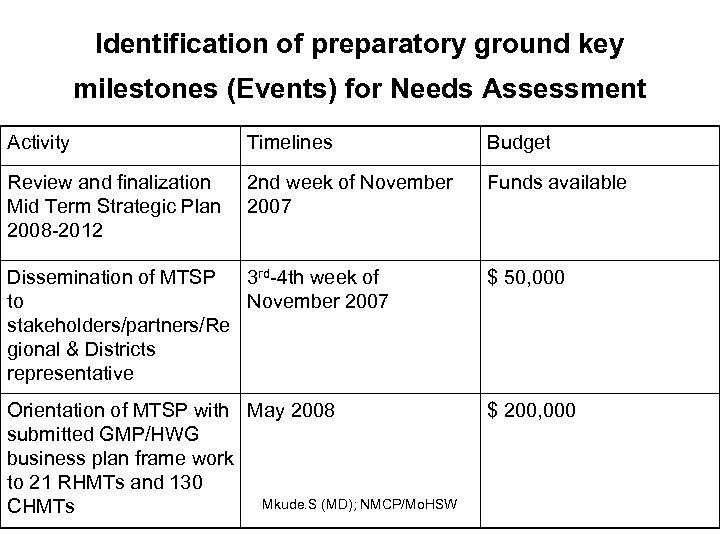 Identification of preparatory ground key milestones (Events) for Needs Assessment Activity Timelines Budget Review and finalization Mid Term Strategic Plan 2008 -2012 2 nd week of November 2007 Funds available Dissemination of MTSP 3 rd-4 th week of to November 2007 stakeholders/partners/Re gional & Districts representative $ 50, 000 Orientation of MTSP with May 2008 submitted GMP/HWG business plan frame work to 21 RHMTs and 130 Mkude. S (MD); NMCP/Mo. HSW CHMTs $ 200, 000
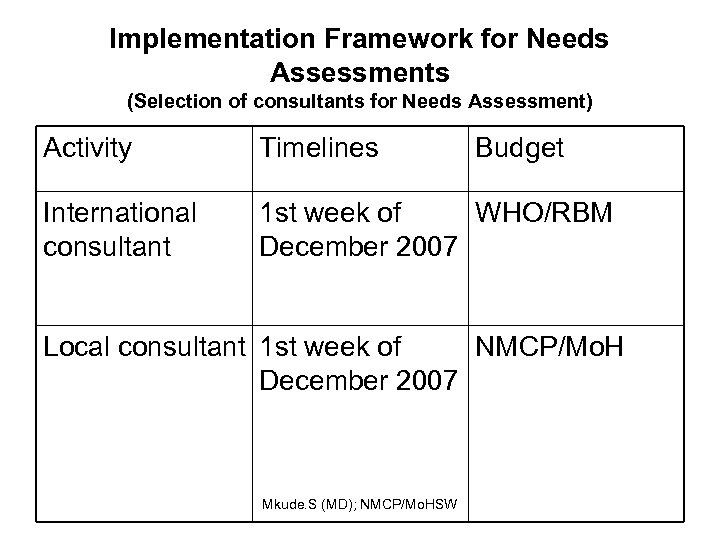 Implementation Framework for Needs Assessments (Selection of consultants for Needs Assessment) Activity Timelines Budget International consultant 1 st week of WHO/RBM December 2007 Local consultant 1 st week of NMCP/Mo. H December 2007 Mkude. S (MD); NMCP/Mo. HSW
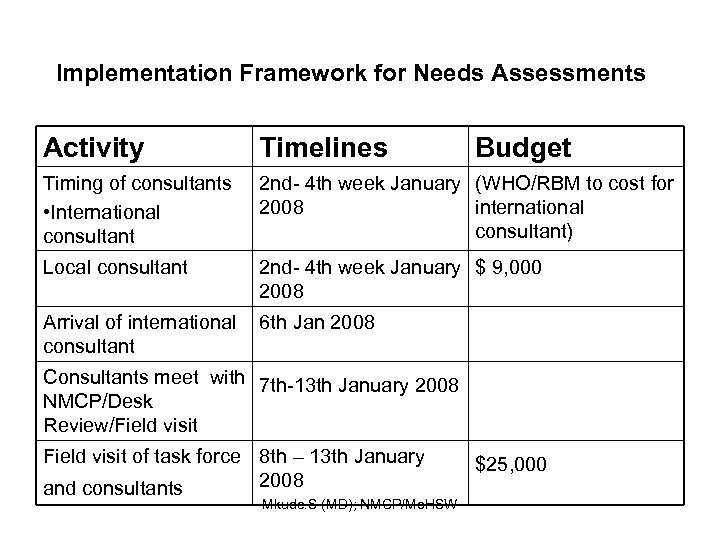 Implementation Framework for Needs Assessments Activity Timelines Budget Timing of consultants • International consultant 2 nd- 4 th week January (WHO/RBM to cost for 2008 international consultant) Local consultant 2 nd- 4 th week January $ 9, 000 2008 Arrival of international consultant 6 th Jan 2008 Consultants meet with 7 th-13 th January 2008 NMCP/Desk Review/Field visit of task force 8 th – 13 th January 2008 and consultants Mkude. S (MD); NMCP/Mo. HSW $25, 000
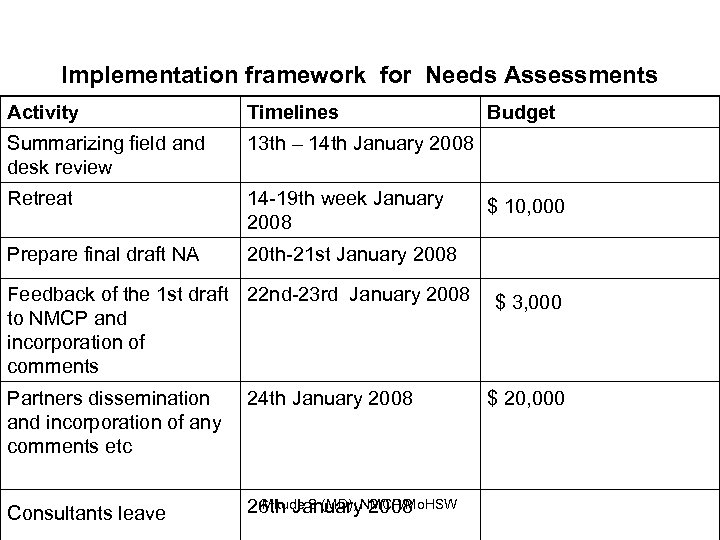 Implementation framework for Needs Assessments Activity Timelines Summarizing field and desk review 13 th – 14 th January 2008 Retreat 14 -19 th week January 2008 Prepare final draft NA 20 th-21 st January 2008 Feedback of the 1 st draft 22 nd-23 rd January 2008 to NMCP and incorporation of comments Partners dissemination and incorporation of any comments etc Consultants leave 24 th January 2008 Mkude. S (MD); 2008 26 th January. NMCP/Mo. HSW Budget $ 10, 000 $ 3, 000 $ 20, 000
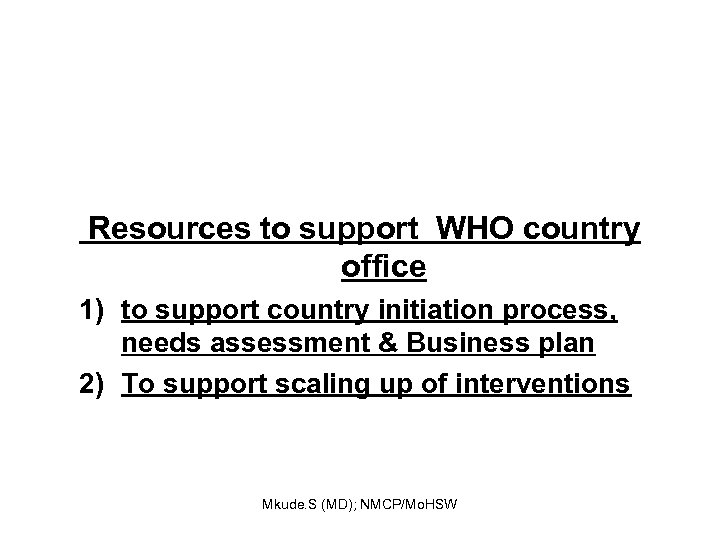 Resources to support WHO country office 1) to support country initiation process, needs assessment & Business plan 2) To support scaling up of interventions Mkude. S (MD); NMCP/Mo. HSW
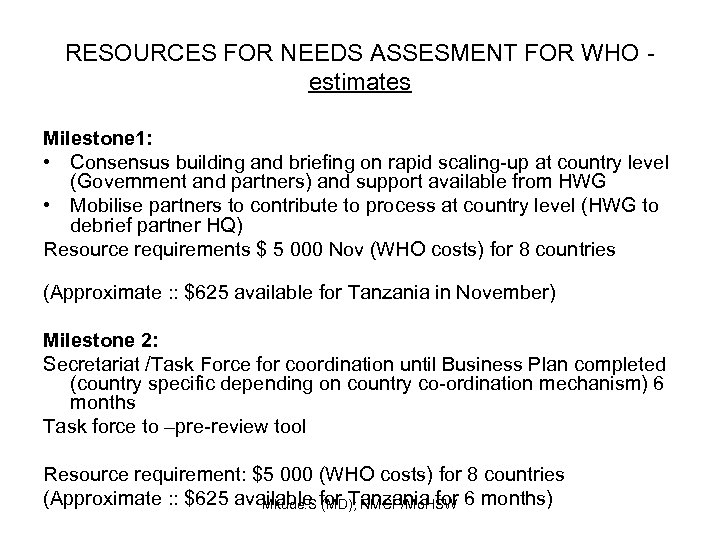 RESOURCES FOR NEEDS ASSESMENT FOR WHO estimates Milestone 1: • Consensus building and briefing on rapid scaling-up at country level (Government and partners) and support available from HWG • Mobilise partners to contribute to process at country level (HWG to debrief partner HQ) Resource requirements $ 5 000 Nov (WHO costs) for 8 countries (Approximate : : $625 available for Tanzania in November) Milestone 2: Secretariat /Task Force for coordination until Business Plan completed (country specific depending on country co-ordination mechanism) 6 months Task force to –pre-review tool Resource requirement: $5 000 (WHO costs) for 8 countries (Approximate : : $625 available for Tanzania for 6 months) Mkude. S (MD); NMCP/Mo. HSW
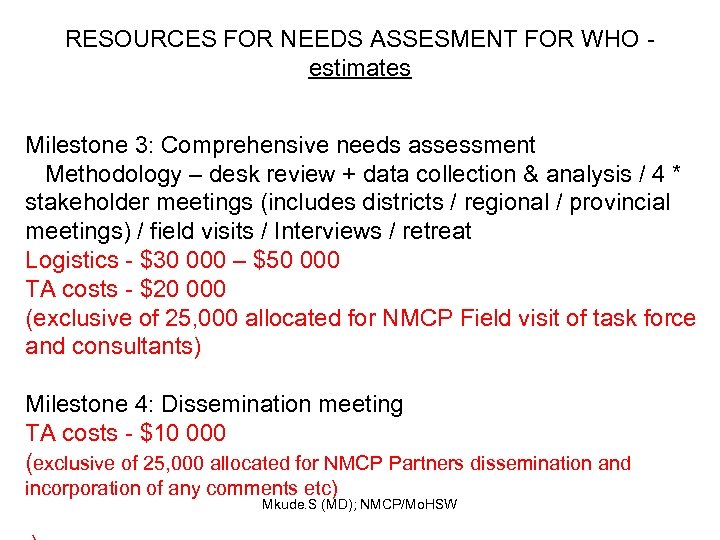 RESOURCES FOR NEEDS ASSESMENT FOR WHO estimates Milestone 3: Comprehensive needs assessment Methodology – desk review + data collection & analysis / 4 * stakeholder meetings (includes districts / regional / provincial meetings) / field visits / Interviews / retreat Logistics - $30 000 – $50 000 TA costs - $20 000 (exclusive of 25, 000 allocated for NMCP Field visit of task force and consultants) Milestone 4: Dissemination meeting TA costs - $10 000 (exclusive of 25, 000 allocated for NMCP Partners dissemination and incorporation of any comments etc) Mkude. S (MD); NMCP/Mo. HSW
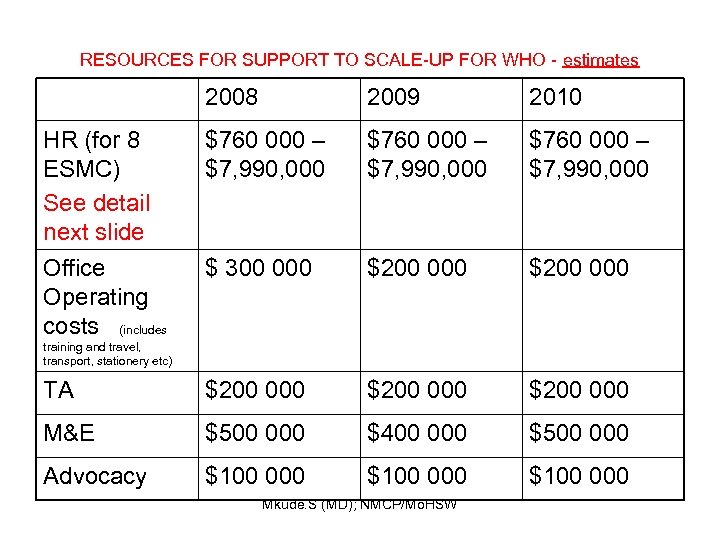 RESOURCES FOR SUPPORT TO SCALE-UP FOR WHO - estimates 2008 2009 2010 HR (for 8 ESMC) See detail next slide $760 000 – $7, 990, 000 Office Operating costs (includes $ 300 000 $200 000 TA $200 000 M&E $500 000 $400 000 $500 000 Advocacy $100 000 training and travel, transport, stationery etc) Mkude. S (MD); NMCP/Mo. HSW
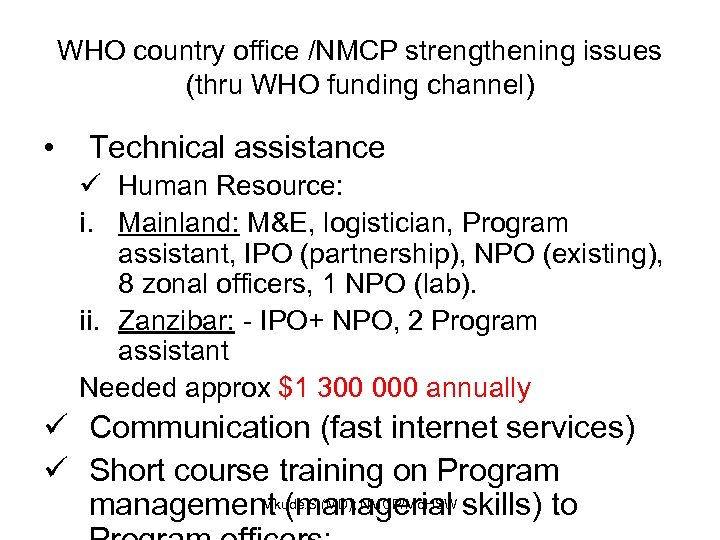 WHO country office /NMCP strengthening issues (thru WHO funding channel) • Technical assistance ü Human Resource: i. Mainland: M&E, logistician, Program assistant, IPO (partnership), NPO (existing), 8 zonal officers, 1 NPO (lab). ii. Zanzibar: - IPO+ NPO, 2 Program assistant Needed approx $1 300 000 annually ü Communication (fast internet services) ü Short course training on Program Mkude. S (MD); NMCP/Mo. HSW management (managerial skills) to
 Some future implementation issues to be considered (Raised by NMCP Program Manager during feed back) Mkude. S (MD); NMCP/Mo. HSW
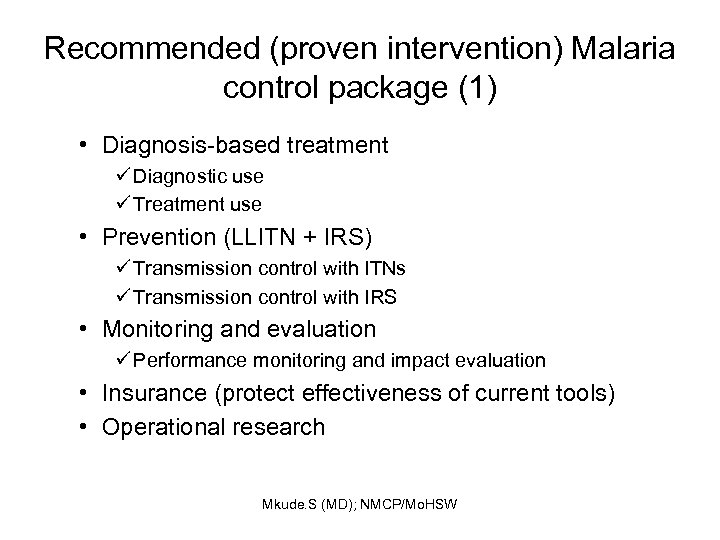
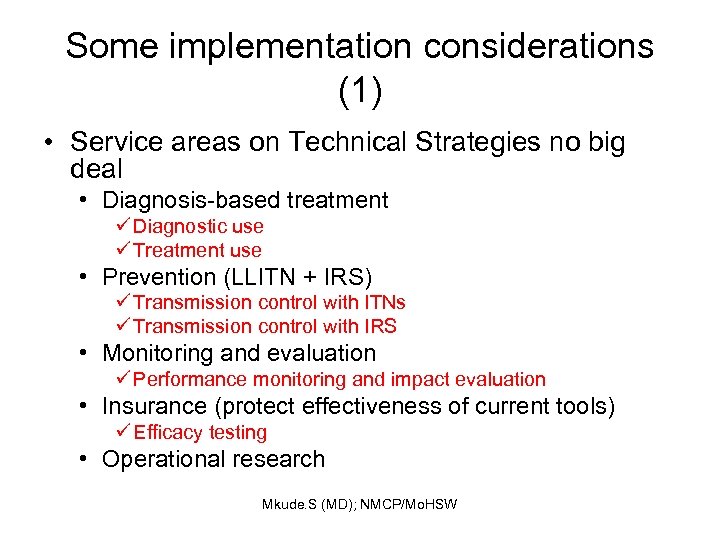 Some implementation considerations (1) • Service areas on Technical Strategies no big deal • Diagnosis-based treatment ü Diagnostic use ü Treatment use • Prevention (LLITN + IRS) ü Transmission control with ITNs ü Transmission control with IRS • Monitoring and evaluation ü Performance monitoring and impact evaluation • Insurance (protect effectiveness of current tools) ü Efficacy testing • Operational research Mkude. S (MD); NMCP/Mo. HSW
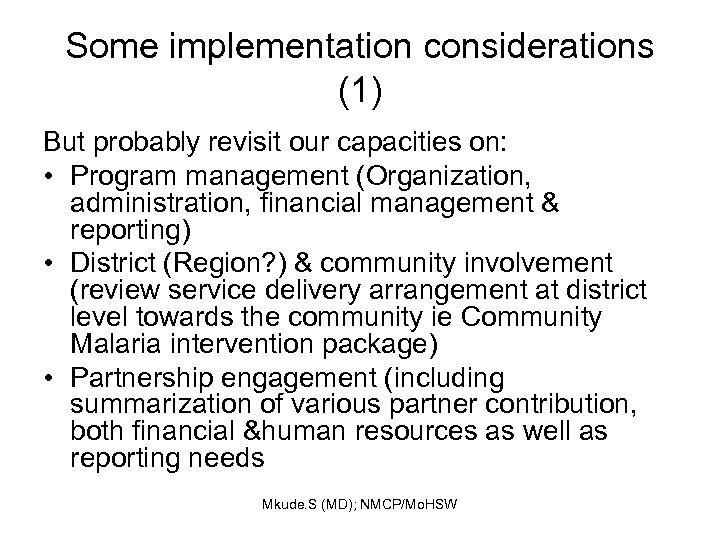 Some implementation considerations (1) But probably revisit our capacities on: • Program management (Organization, administration, financial management & reporting) • District (Region? ) & community involvement (review service delivery arrangement at district level towards the community ie Community Malaria intervention package) • Partnership engagement (including summarization of various partner contribution, both financial &human resources as well as reporting needs Mkude. S (MD); NMCP/Mo. HSW
 Some implementation considerations (1) • Given the expected very rapid scale up of activities, resource available & recommended Malaria control package. i. Coordination (inside NMCP)? a. Critical analysis of strength & weaknesses of NMCP for the expected activities ii. Revisit Home Malaria Management (HMM) approach? a. Prepare community ant malaria based package(RDTs, peripheral rectal artesunate, paracetamol, case reporting data) b. Should we explore further the issue of (C/VHW) with other programs (Structural/functions/coverage) and have at least 2 C/V-HWs per village as 1° implementers of HMM (Approx 20, 000 C/V-HWs country wide) Mkude. S (MD); NMCP/Mo. HSW
 Some implementation considerations (2) iii. Coordination (outside NMCP)? a. Should we explore further the potential roles of “Regional Malaria Focal Person” (RMIFP)? Train them with CMIFP like package? b. Should we find the way to facilitate the RMIFP to easily access the districts? (4 -wheel car? , fuel? ) c. NGOs network to facilitate CHMTs (CMIFP) coordination of C/V-HWs ? Through peripheral HFs? etc Mkude. S (MD); NMCP/Mo. HSW
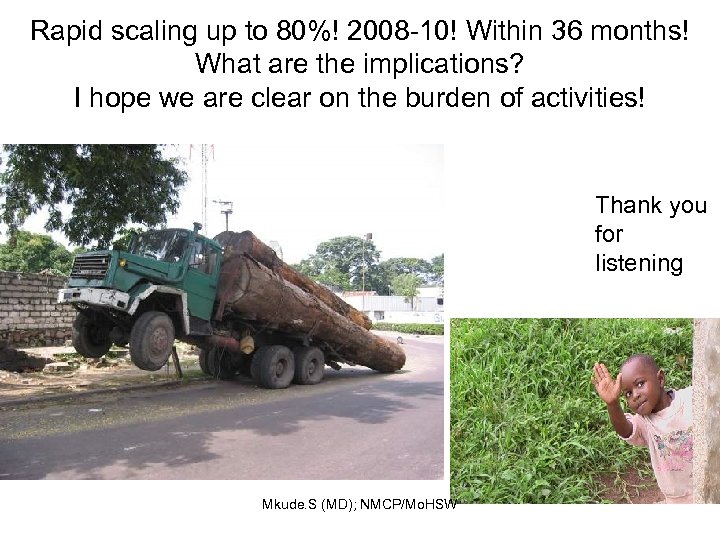 Rapid scaling up to 80%! 2008 -10! Within 36 months! What are the implications? I hope we are clear on the burden of activities! Thank you for listening Mkude. S (MD); NMCP/Mo. HSW