


 Скачать презентацию Making Work Work Across Cultures A Training Course
e3f6130e5da019db67241d02850101d0.ppt
- Количество слайдов: 60
 Making ‘Work’ Work Across Cultures A Training Course on Cross-Cultural Awareness and Communications with a Focus on Indian and American Cultures
 Learning Objectives: § Become more aware of cultural differences and similarities in the workplace § Gain a better understanding of how culture influences communications and other behaviors at work § Learn some techniques to adapt or flex your own ways of communicating so you may become more effective § Take away more information and tips about crosscultural business communications.
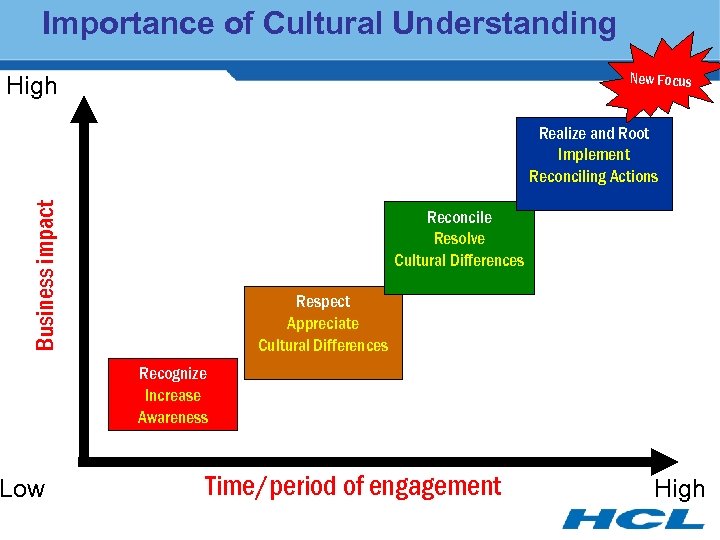 Importance of Cultural Understanding New Focus High Business impact Realize and Root Implement Reconciling Actions Low Reconcile Resolve Cultural Differences Respect Appreciate Cultural Differences Recognize Increase Awareness Time/period of engagement High
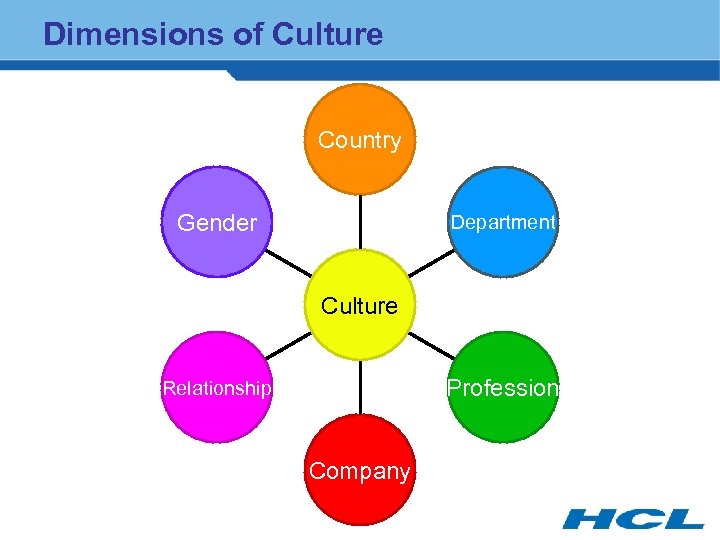 Dimensions of Culture Country Gender Department Culture Profession Relationship Company
 The Power of Culture in Business “Imagine that your beautifully crafted strategy failed when the divisions within your organization clashed. Logically, it seems that strategy should drive behavior—but, in reality, it's your culture (underlying norms, values, belief systems) that dictates how people are going to work together. As a result, employee behavior directly impacts your bottom line—your costs, revenue, productivity, customer base, even your brand. Every aspect of your business is affected. ” Juli Ann Reynolds, CEO, Tom Peters Company & Susan A. Murphy, Ph. D. & Chief Consultant
 Model for Culture What are some more of the elements that are a part of a culture?
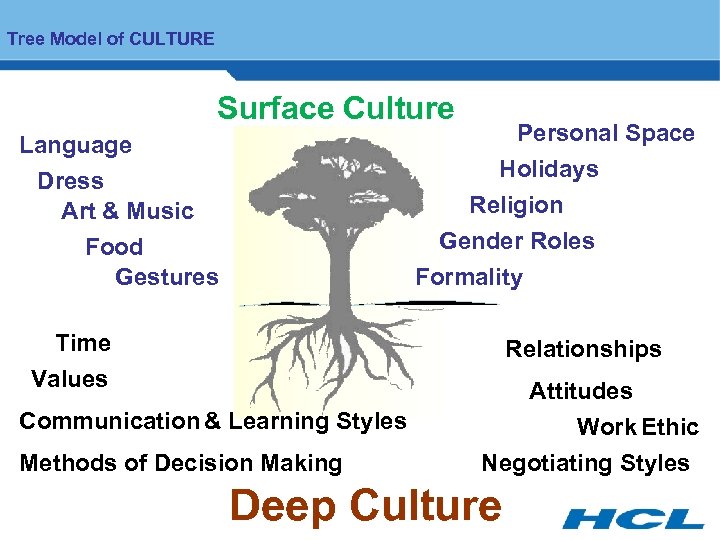 Tree Model of CULTURE Surface Culture Language Dress Art & Music Food Gestures Personal Space Holidays Religion Gender Roles Formality Time Values Relationships Communication & Learning Styles Methods of Decision Making Attitudes Work Ethic Negotiating Styles Deep Culture
 Culture is always evolving and changing “It is not the strongest who survive, or the fastest. It is the ones who can change the quickest. ” - Charles Darwin
 INDIA (Republic of India) Some Facts and Figures Internet Domain: . in

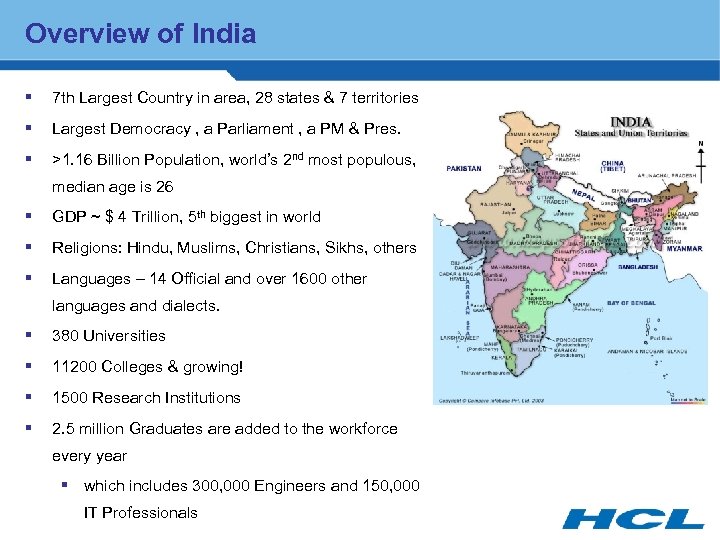 Overview of India § 7 th Largest Country in area, 28 states & 7 territories § Largest Democracy , a Parliament , a PM & Pres. § >1. 16 Billion Population, world’s 2 nd most populous, median age is 26 § GDP ~ $ 4 Trillion, 5 th biggest in world § Religions: Hindu, Muslims, Christians, Sikhs, others § Languages – 14 Official and over 1600 other languages and dialects. § 380 Universities § 11200 Colleges & growing! § 1500 Research Institutions § 2. 5 million Graduates are added to the workforce every year § which includes 300, 000 Engineers and 150, 000 IT Professionals
 Some perceptions about Indians § Shy, soft spoken, reserved & speak in a low voice § Takes time to “warm up” or “get started” § Lack of common interest conversational topics with the client § Mutual dependence and interdependence - family bonds § Hesitant to shake hands especially with opposite gender § Eye contact with female colleagues is low § Public display of emotions/affections is discouraged
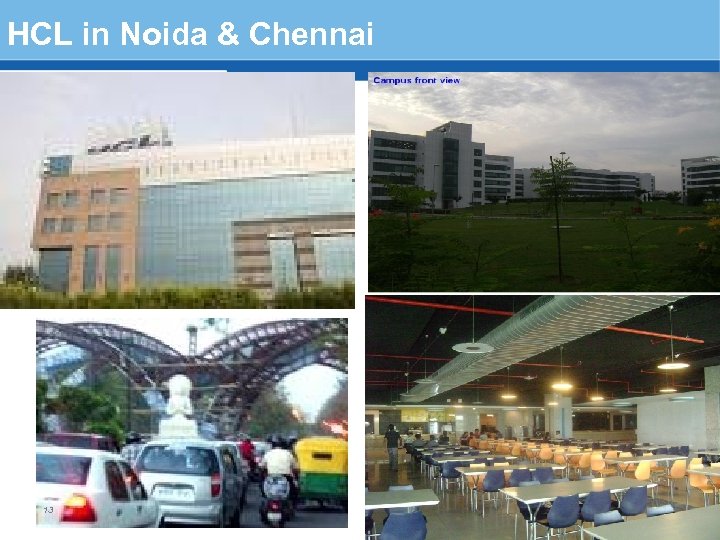 HCL in Noida & Chennai 13
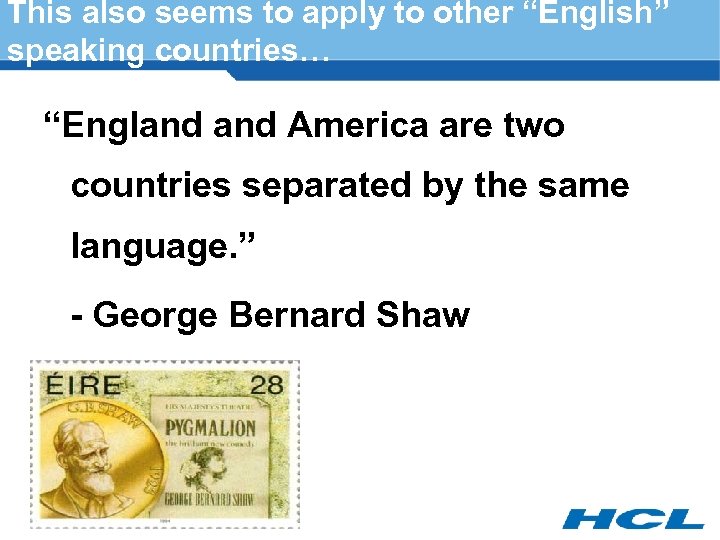 This also seems to apply to other “English” speaking countries… “England America are two countries separated by the same language. ” - George Bernard Shaw
 Asian Indian English vs. American English § Hello = Hi § Phone is engaged = Busy § Disconnect a Phone = Hang-up § Petrol Pump = Gas Station § Lift = Elevator § Bill = Check § Note = Bill § Too = Very/ A Lot § Repair = Fix § Fix = Assemble § Clear (a test) = Pass § Fresher = Recent Grad § Revision = Review of a subject § Tick off = Check off a list § Schedule = S(k)edule § Route (Root) = Route (Raut) § Fast (Faast) = Fast (Fa’st) § Z (Zed) = Z (Zee) § Zero = ‘O’ § One Lakh = Hundred Thousand § One Crore = Ten Million § 1, 00, 000=10, 000 § Brinjal = Eggplant
 Group Discussion What are 5 aspects of Indian culture that you may have noticed are different from your own culture?
 Cross-Cultural Business Behavior What are some cultural differences to keep in mind at work?
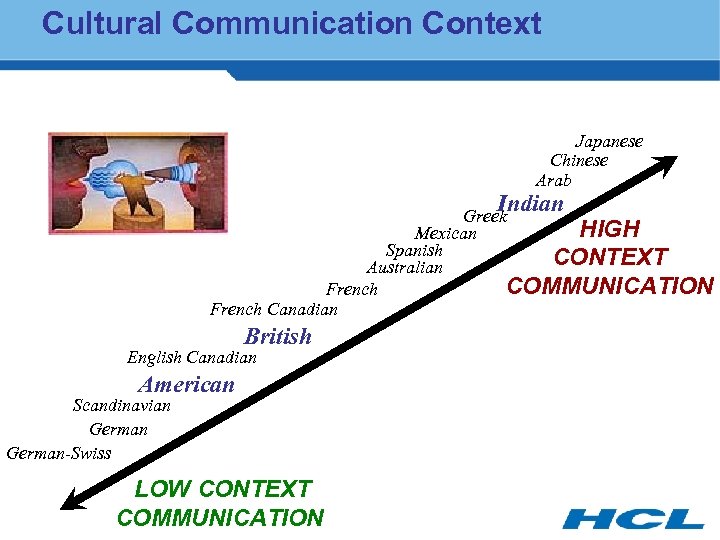 Cultural Communication Context Japanese Chinese Arab Indian Greek HIGH Mexican Spanish CONTEXT Australian COMMUNICATION French Canadian British English Canadian American Scandinavian German-Swiss LOW CONTEXT COMMUNICATION
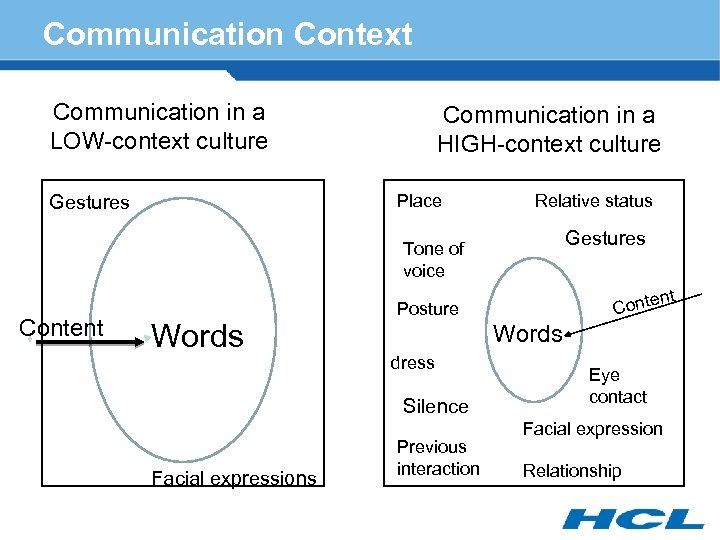 Communication Context Communication in a LOW-context culture Communication in a HIGH-context culture Place Gestures Relative status Gestures Tone of voice Content Words dress Silence Facial expressions Conte Posture Previous interaction Eye contact Facial expression Relationship
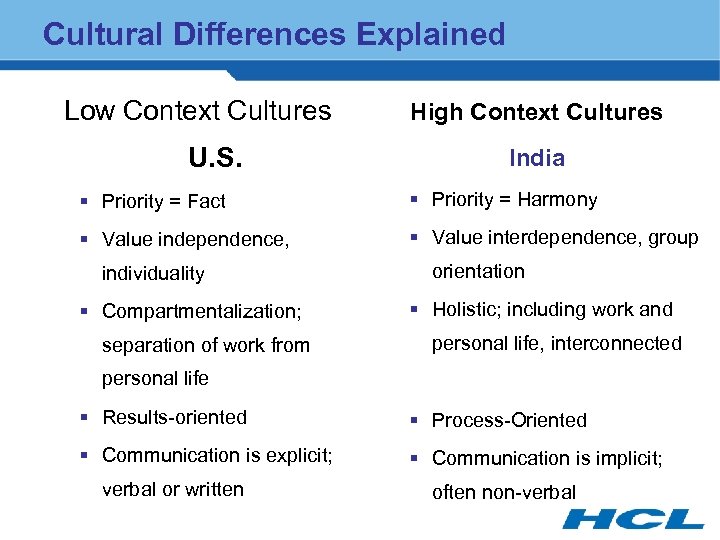 Cultural Differences Explained Low Context Cultures U. S. High Context Cultures India § Priority = Fact § Priority = Harmony § Value independence, § Value interdependence, group individuality § Compartmentalization; separation of work from orientation § Holistic; including work and personal life, interconnected personal life § Results-oriented § Process-Oriented § Communication is explicit; § Communication is implicit; verbal or written often non-verbal
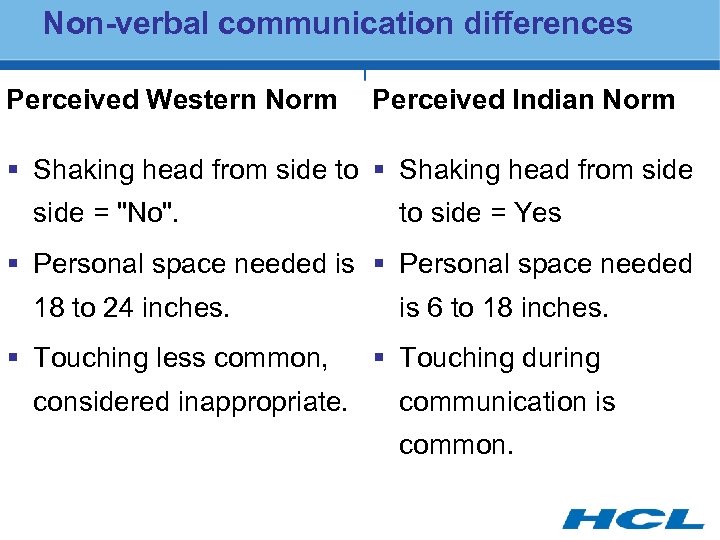 Non-verbal communication differences Perceived Western Norm Perceived Indian Norm § Shaking head from side to § Shaking head from side = "No". to side = Yes § Personal space needed is § Personal space needed 18 to 24 inches. § Touching less common, considered inappropriate. is 6 to 18 inches. § Touching during communication is common.
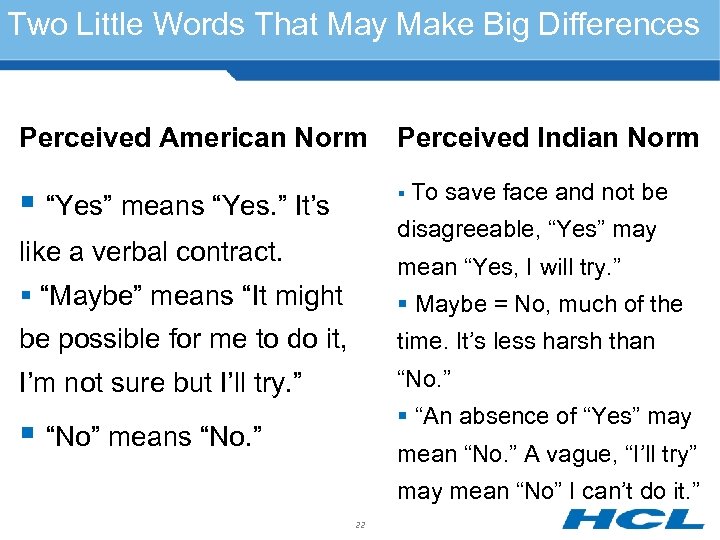 Two Little Words That May Make Big Differences Perceived American Norm Perceived Indian Norm § “Yes” means “Yes. ” It’s § To save face and not be disagreeable, “Yes” may like a verbal contract. mean “Yes, I will try. ” § “Maybe” means “It might § Maybe = No, much of the be possible for me to do it, time. It’s less harsh than I’m not sure but I’ll try. ” “No. ” § “No” means “No. ” § “An absence of “Yes” may mean “No. ” A vague, “I’ll try” may mean “No” I can’t do it. ” 22
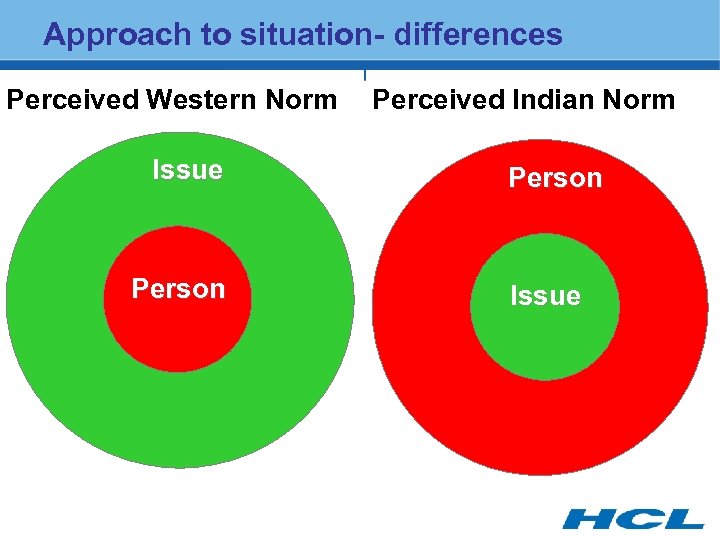 Approach to situation- differences Perceived Western Norm Issue Person Perceived Indian Norm Person Issue
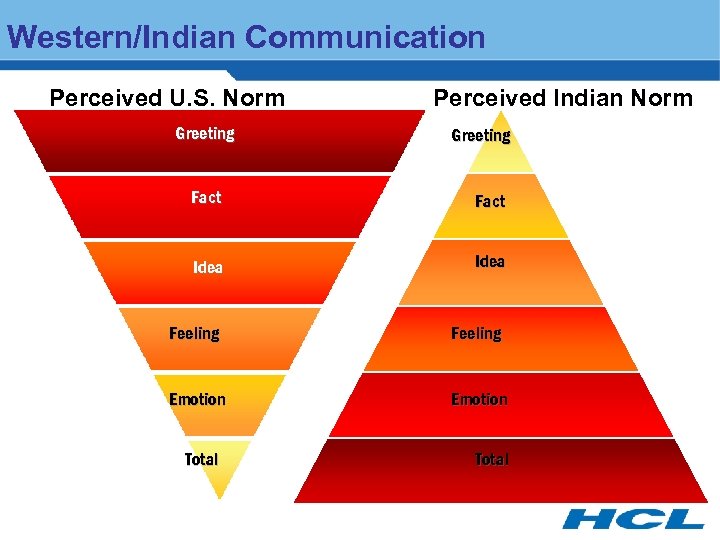 Western/Indian Communication Perceived U. S. Norm Greeting Fact Idea Feeling Emotion Total Perceived Indian Norm Greeting Fact Idea Feeling Emotion Total
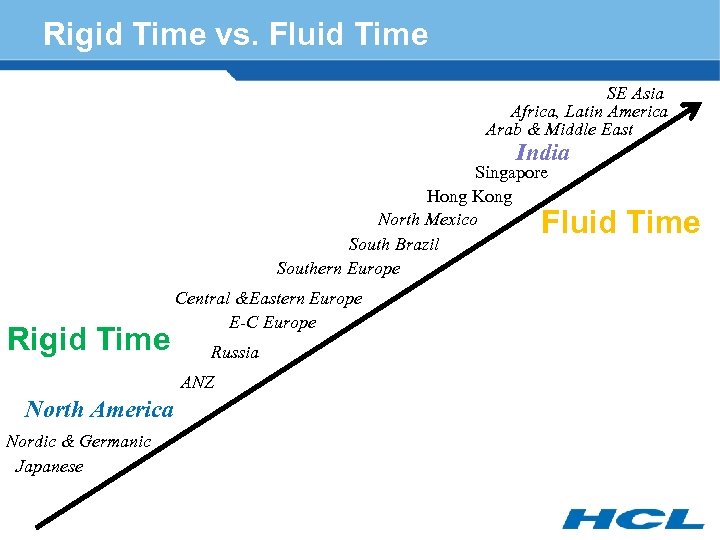 Rigid Time vs. Fluid Time SE Asia Africa, Latin America Arab & Middle East India Singapore Hong Kong North Mexico South Brazil Southern Europe Fluid Time Rigid Time Central &Eastern Europe E-C Europe Russia ANZ North America Nordic & Germanic Japanese
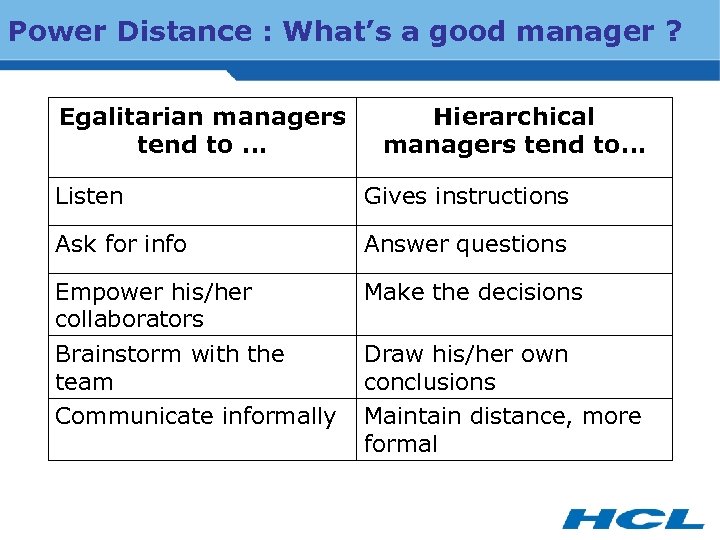 Power Distance : What’s a good manager ? Egalitarian managers tend to … Hierarchical managers tend to… Listen Gives instructions Ask for info Answer questions Empower his/her collaborators Make the decisions Brainstorm with the team Draw his/her own conclusions Communicate informally Maintain distance, more formal
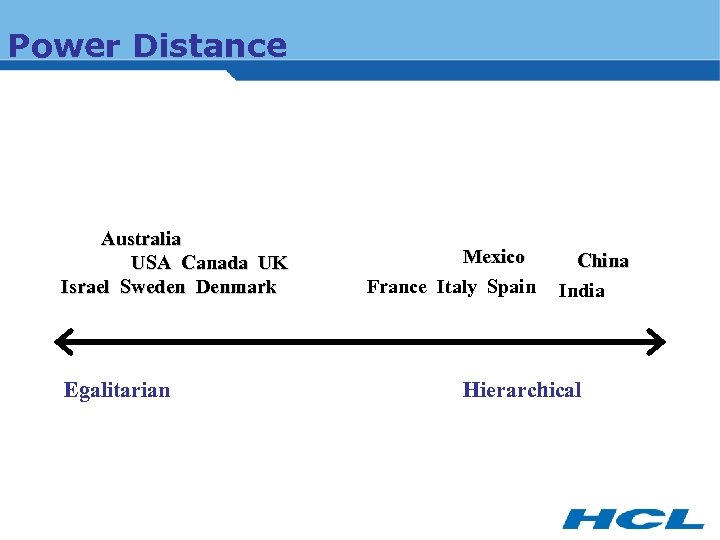 Power Distance Australia USA Canada UK Israel Sweden Denmark Egalitarian Mexico France Italy Spain China India Hierarchical
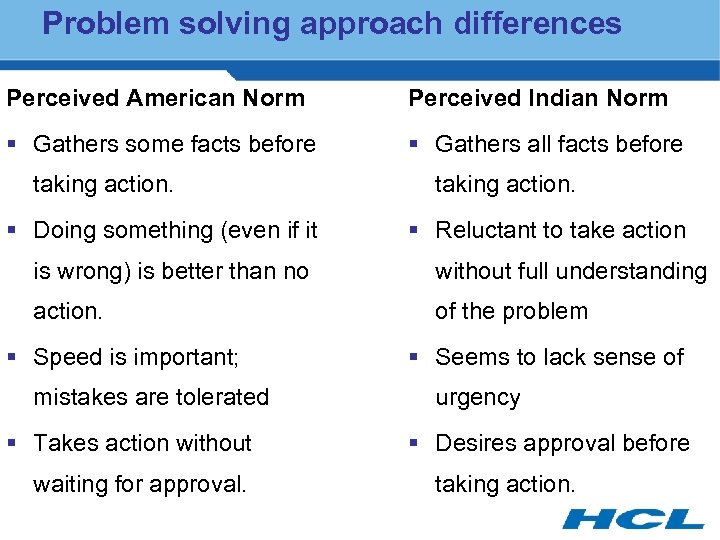 Problem solving approach differences Perceived American Norm Perceived Indian Norm § Gathers some facts before § Gathers all facts before taking action. § Doing something (even if it taking action. § Reluctant to take action is wrong) is better than no without full understanding action. of the problem § Speed is important; mistakes are tolerated § Takes action without waiting for approval. § Seems to lack sense of urgency § Desires approval before taking action.
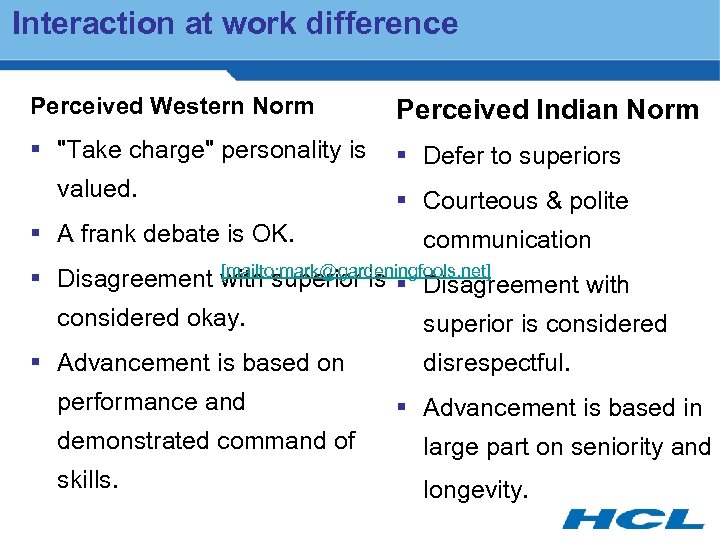 Interaction at work difference Perceived Western Norm Perceived Indian Norm § "Take charge" personality is § Defer to superiors valued. § Courteous & polite § A frank debate is OK. communication [mailto: mark@gardeningfools. net] § Disagreement with superior is § Disagreement with considered okay. superior is considered § Advancement is based on performance and disrespectful. § Advancement is based in demonstrated command of large part on seniority and skills. longevity.
 Homework § Who scored highest § Who scored second in: highest in: § W § A § N § F § C 30
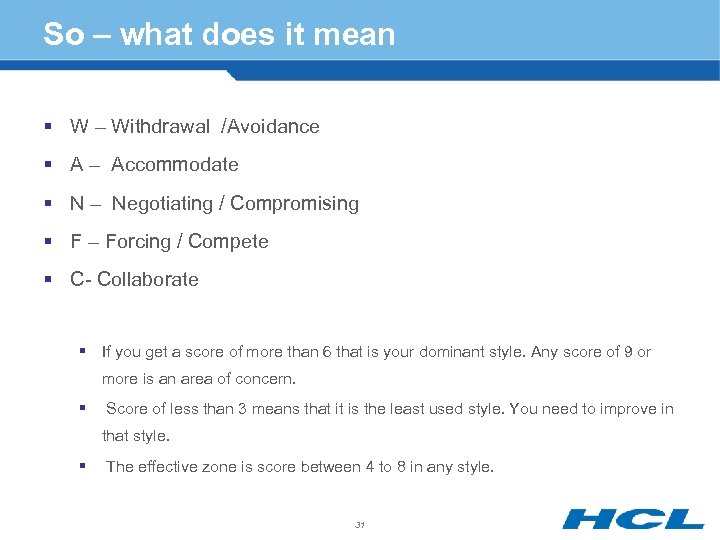 So – what does it mean § W – Withdrawal /Avoidance § A – Accommodate § N – Negotiating / Compromising § F – Forcing / Compete § C- Collaborate § If you get a score of more than 6 that is your dominant style. Any score of 9 or more is an area of concern. § Score of less than 3 means that it is the least used style. You need to improve in that style. § The effective zone is score between 4 to 8 in any style. 31
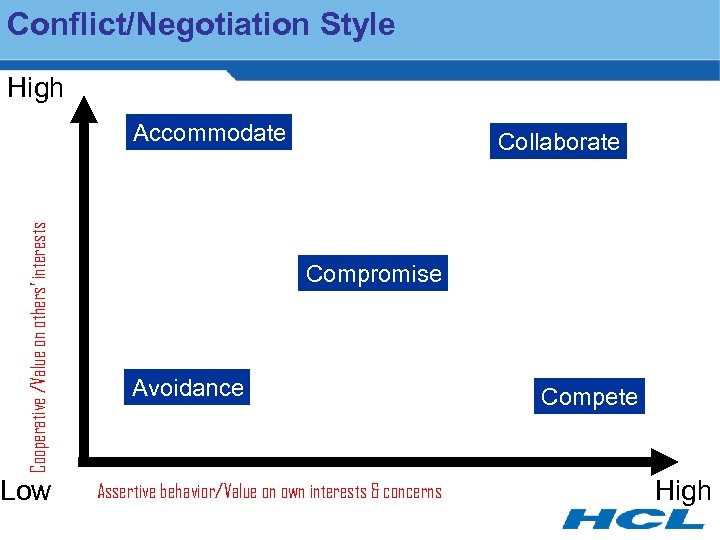 Conflict/Negotiation Style High Cooperative /Value on others’ interests Accommodate Low Collaborate Compromise Avoidance Assertive behavior/Value on own interests & concerns Compete High
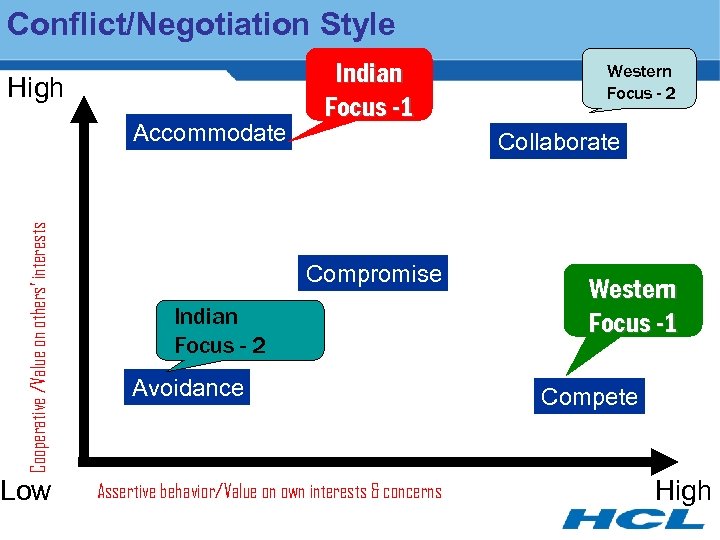 Conflict/Negotiation Style High Cooperative /Value on others’ interests Accommodate Low Indian Focus -1 Western Focus - 2 Collaborate Compromise Indian Focus - 2 Avoidance Assertive behavior/Value on own interests & concerns Western Focus -1 Compete High
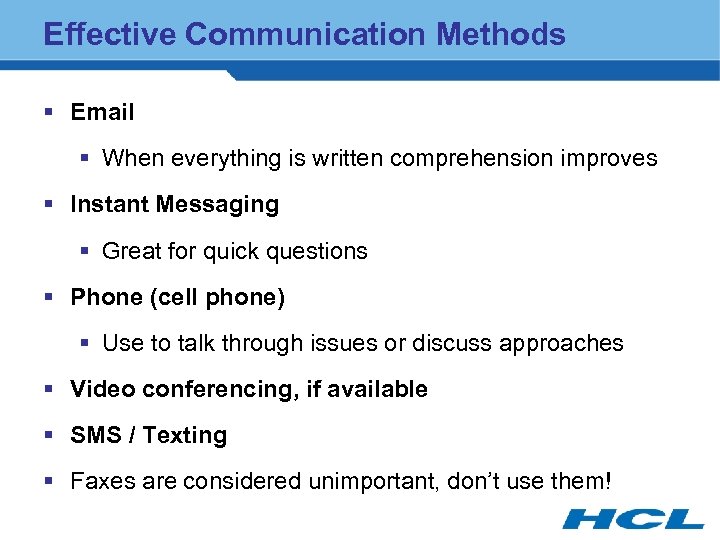 Effective Communication Methods § Email § When everything is written comprehension improves § Instant Messaging § Great for quick questions § Phone (cell phone) § Use to talk through issues or discuss approaches § Video conferencing, if available § SMS / Texting § Faxes are considered unimportant, don’t use them!
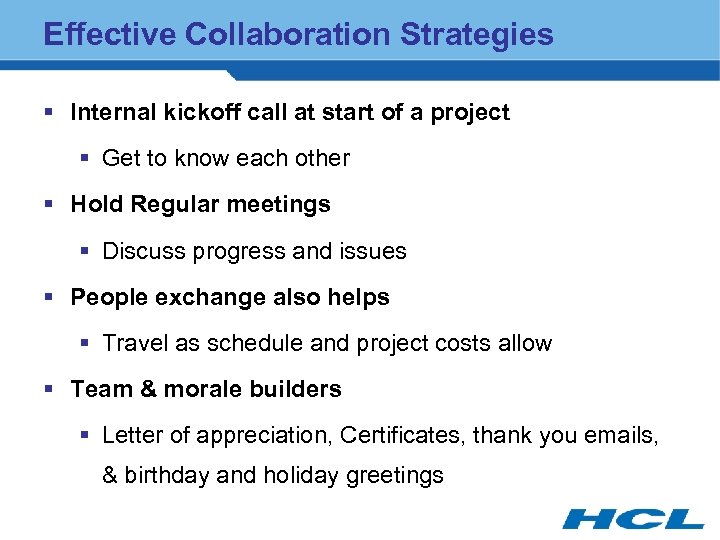 Effective Collaboration Strategies § Internal kickoff call at start of a project § Get to know each other § Hold Regular meetings § Discuss progress and issues § People exchange also helps § Travel as schedule and project costs allow § Team & morale builders § Letter of appreciation, Certificates, thank you emails, & birthday and holiday greetings
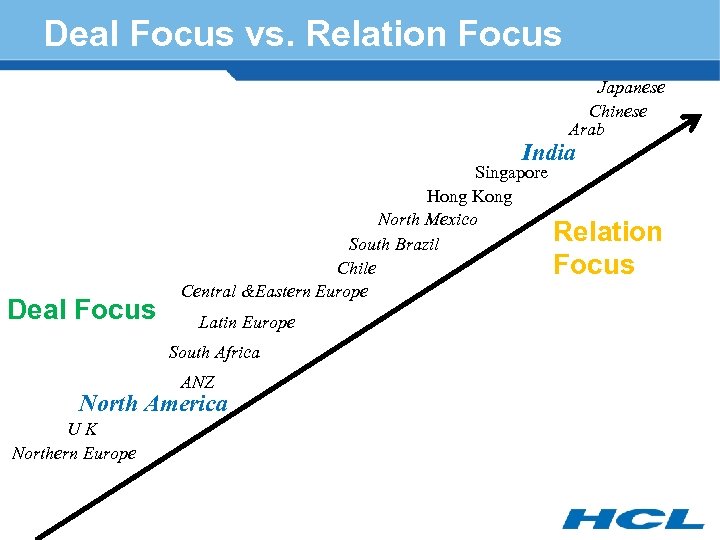 Deal Focus vs. Relation Focus Japanese Chinese Arab India Deal Focus Singapore Hong Kong North Mexico Relation South Brazil Chile Focus Central &Eastern Europe Latin Europe South Africa ANZ North America UK Northern Europe
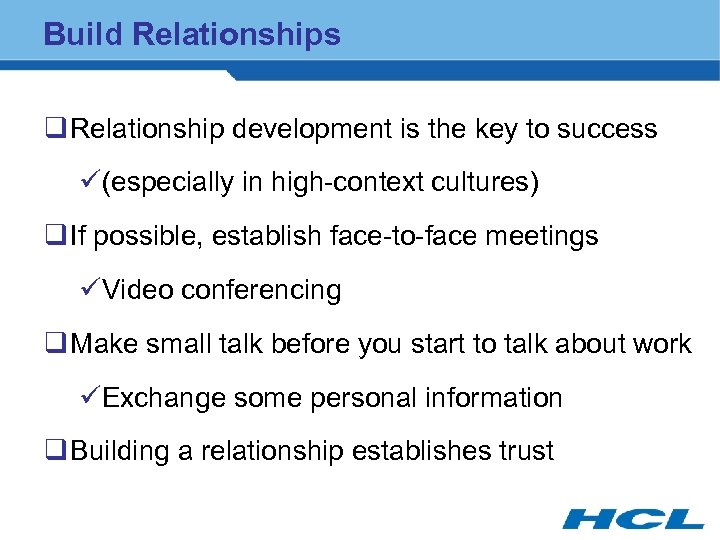 Build Relationships q Relationship development is the key to success ü(especially in high-context cultures) q If possible, establish face-to-face meetings üVideo conferencing q Make small talk before you start to talk about work üExchange some personal information q Building a relationship establishes trust
 Some action steps: 1. Follow the “KISS” principle 2. Use a word that has the fewest different meanings whenever possible. For example, “set” has over 100 meanings so using a different word may be better. 3. Avoid using sports, military, popular movie or TV metaphors or expressions. These uniquely American words or terms may cause more confusion than clarity. 4. During phone calls, summarize key points and/or ask the other person to do so while still on the call.
 Guide to navigate through the tool February 2012 – Version 1
 Getting Started with Globe Smart § What is this tool? This tool equips an individual to understand his/ her own cultural orientation. § How is this tool different from any other? This tool is comprehensive as well as gives a subjective input in case one would want to look at it at a glance. A detailed report is important to bridge the gaps in all parameters. The parameters spoken about, are standard parameters in all cultural orientations. § What is in it for me, as an individual? You as an individual will be able to gauge where you stand in your personal cultural orientation and thus know how well you understand your customers and your international peers. § What is in it for my project and my account? This tool enables you not only to understand your own cultural orientation but also helps you understand your team and your account’s/ project’s cultural orientation at large. This is possible, only after your entire team has undertaken the self assessment and informed the SPOC assigned. § What is in it for HCL as an organisation? Given the understanding that every organisation is made up of employees from all spectrum & that as an organisation, are a global organisation, we need to have a tool that equips us to be sensitized enough and enables us working across borders.
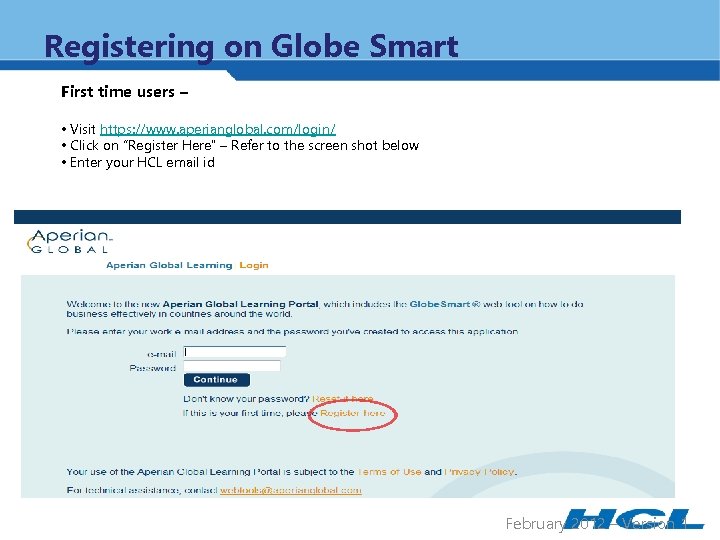 Registering on Globe Smart First time users – • Visit https: //www. aperianglobal. com/login/ • Click on “Register Here” – Refer to the screen shot below • Enter your HCL email id February 2012 – Version 1
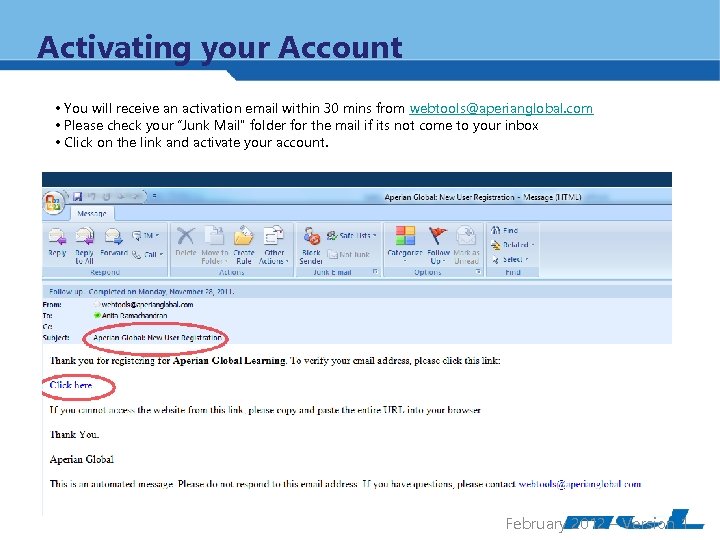 Activating your Account • You will receive an activation email within 30 mins from webtools@aperianglobal. com • Please check your “Junk Mail” folder for the mail if its not come to your inbox • Click on the link and activate your account. February 2012 – Version 1
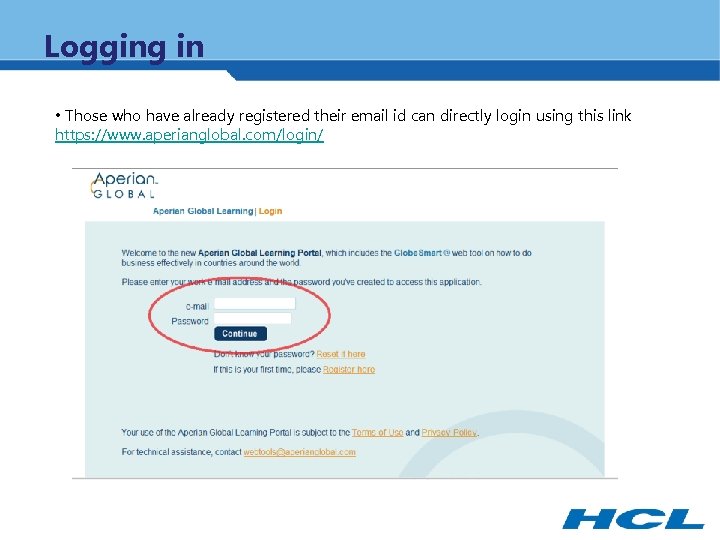 Logging in • Those who have already registered their email id can directly login using this link https: //www. aperianglobal. com/login/
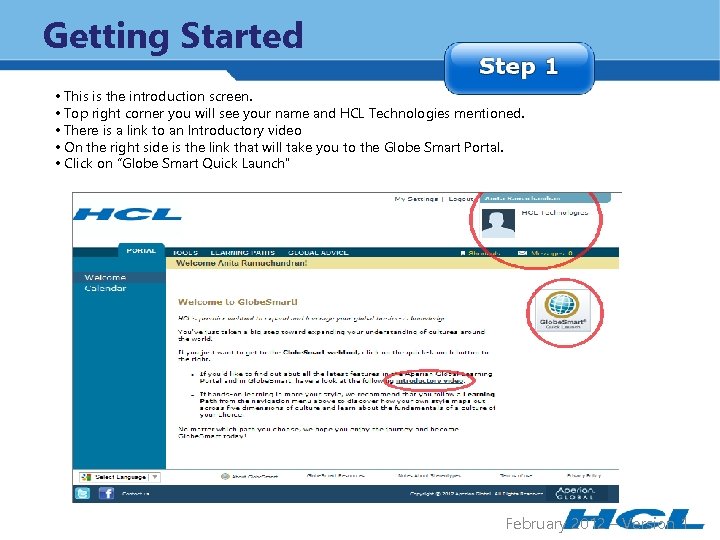 Getting Started • This is the introduction screen. • Top right corner you will see your name and HCL Technologies mentioned. • There is a link to an Introductory video • On the right side is the link that will take you to the Globe Smart Portal. • Click on “Globe Smart Quick Launch” February 2012 – Version 1
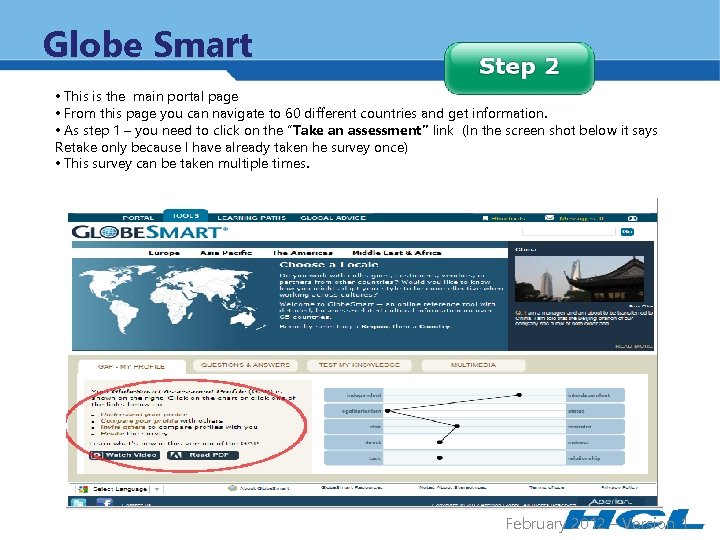 Globe Smart • This is the main portal page • From this page you can navigate to 60 different countries and get information. • As step 1 – you need to click on the “Take an assessment” link (In the screen shot below it says Retake only because I have already taken he survey once) • This survey can be taken multiple times. February 2012 – Version 1
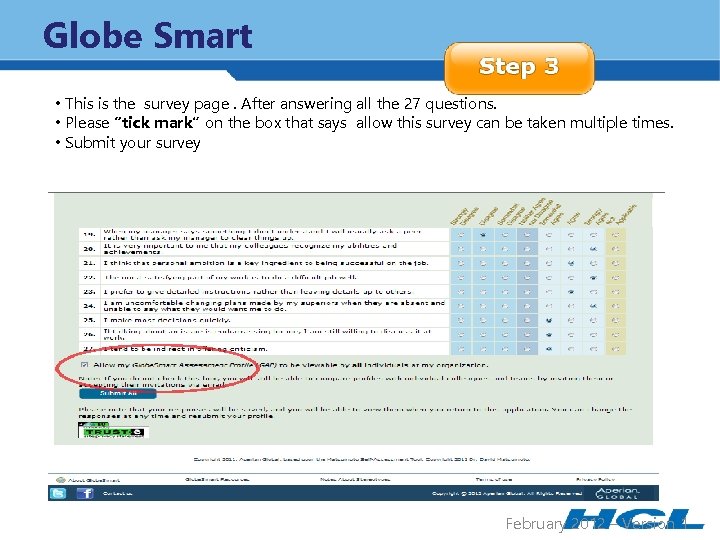 Globe Smart • This is the survey page. After answering all the 27 questions. • Please “tick mark” on the box that says allow this survey can be taken multiple times. • Submit your survey February 2012 – Version 1
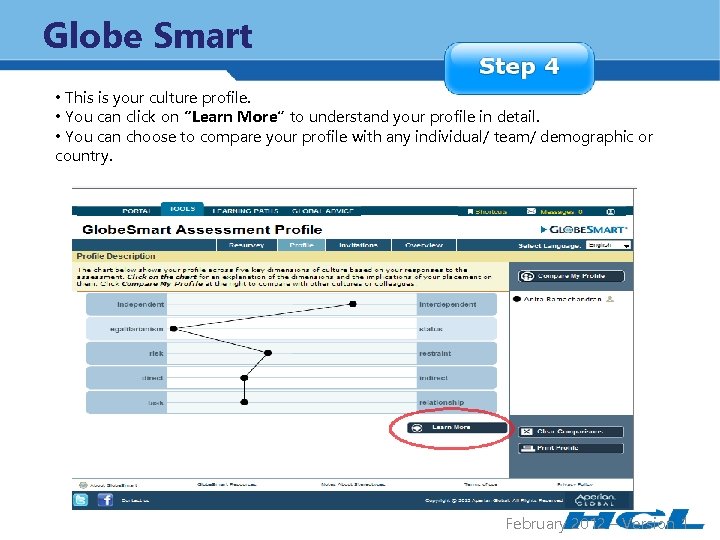 Globe Smart • This is your culture profile. • You can click on “Learn More” to understand your profile in detail. • You can choose to compare your profile with any individual/ team/ demographic or country. February 2012 – Version 1
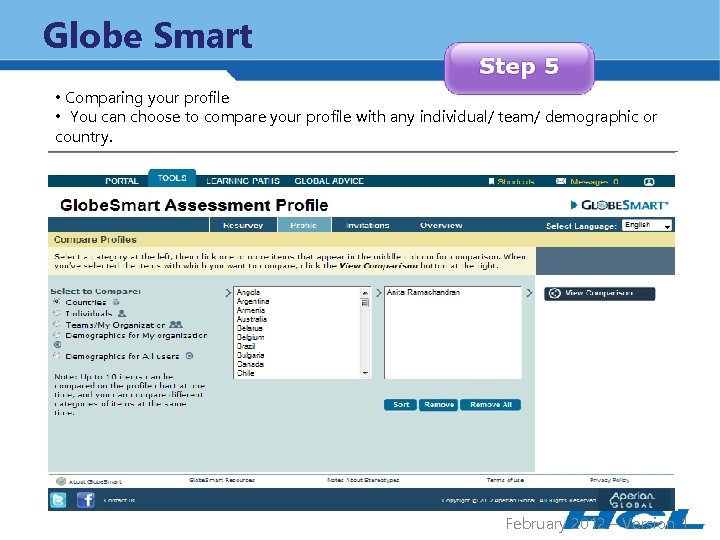 Globe Smart • Comparing your profile • You can choose to compare your profile with any individual/ team/ demographic or country. February 2012 – Version 1
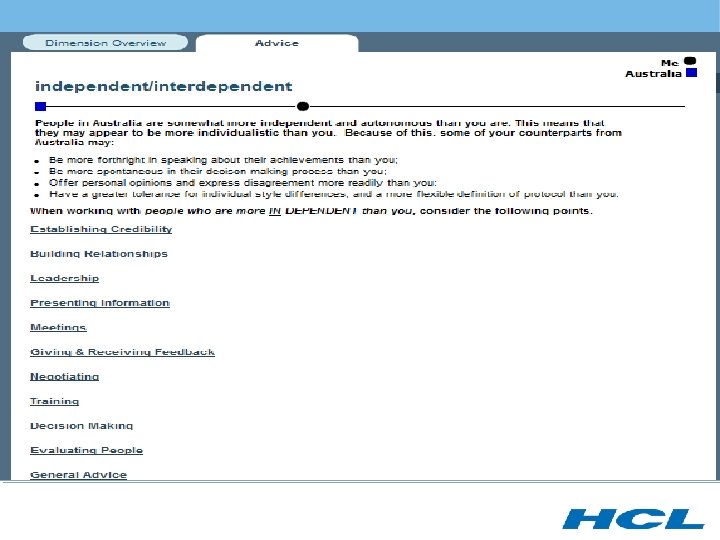
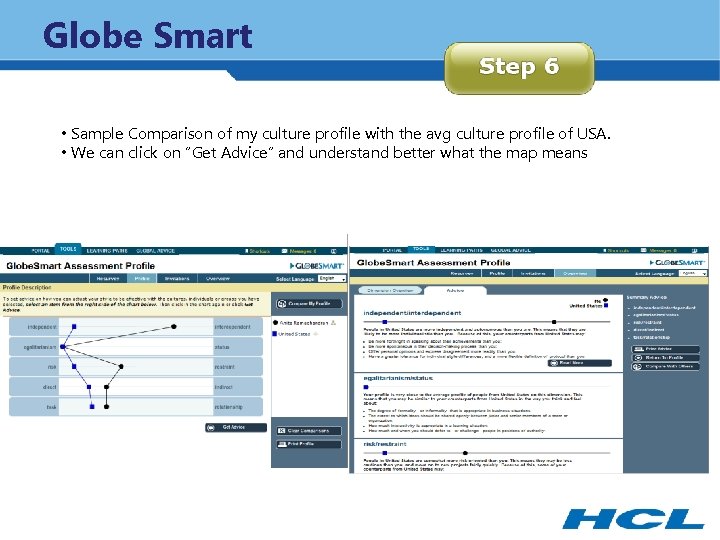 Globe Smart • Sample Comparison of my culture profile with the avg culture profile of USA. • We can click on “Get Advice” and understand better what the map means
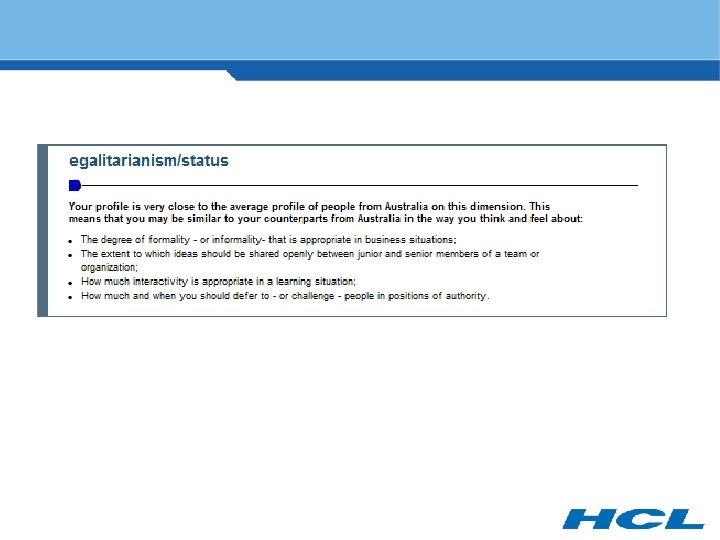
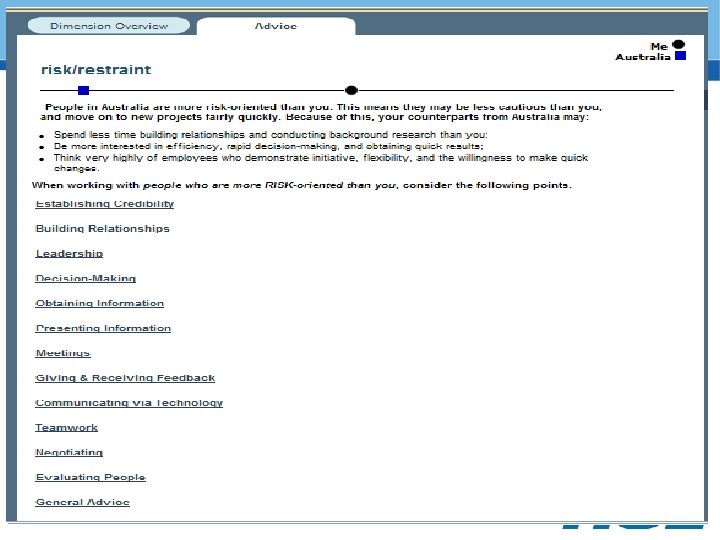
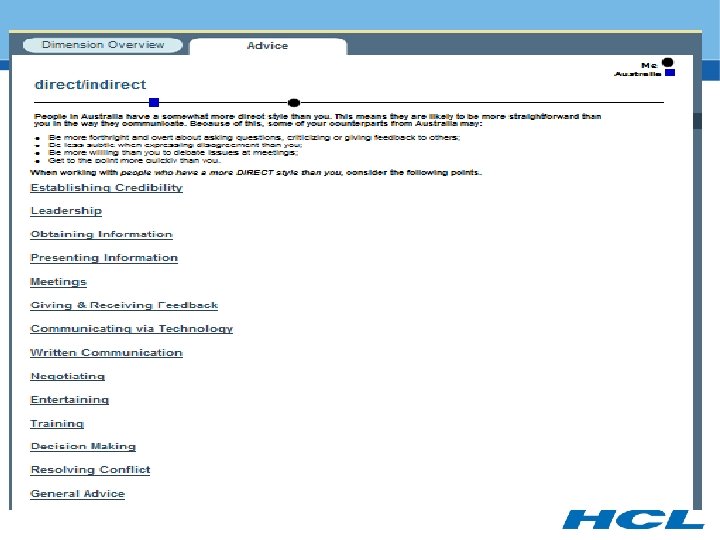
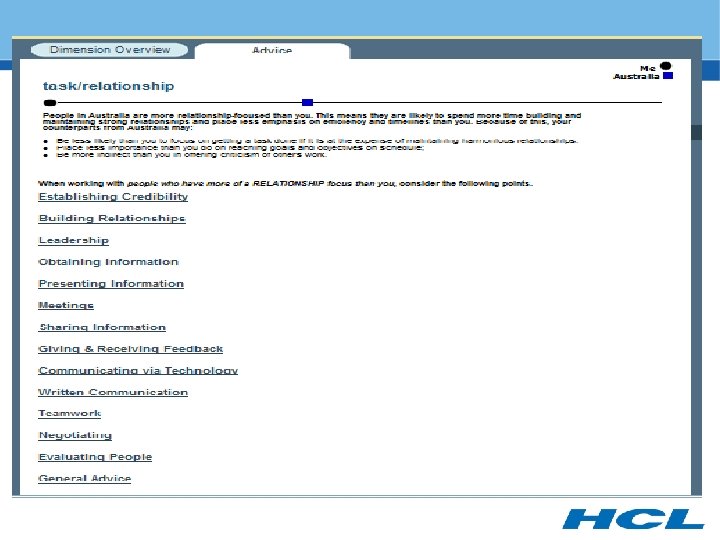
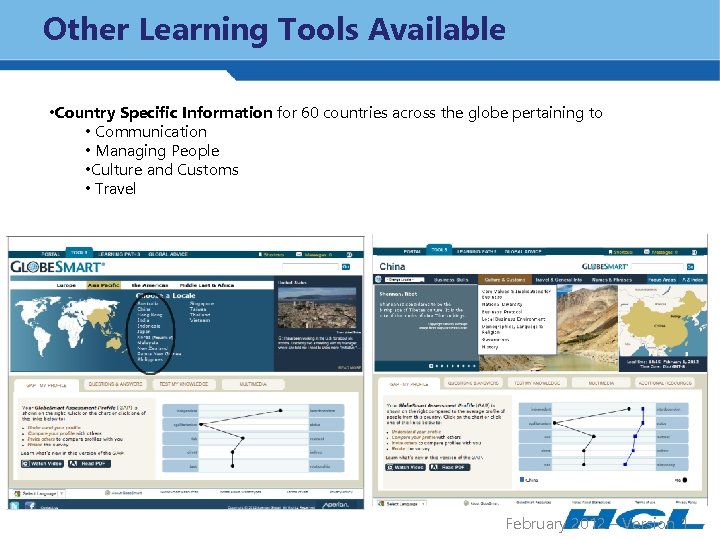 Other Learning Tools Available • Country Specific Information for 60 countries across the globe pertaining to • Communication • Managing People • Culture and Customs • Travel February 2012 – Version 1
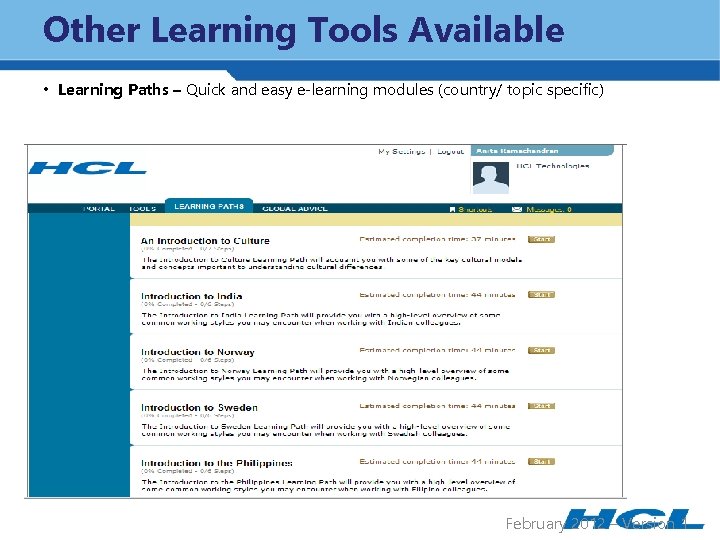 Other Learning Tools Available • Learning Paths – Quick and easy e-learning modules (country/ topic specific) February 2012 – Version 1
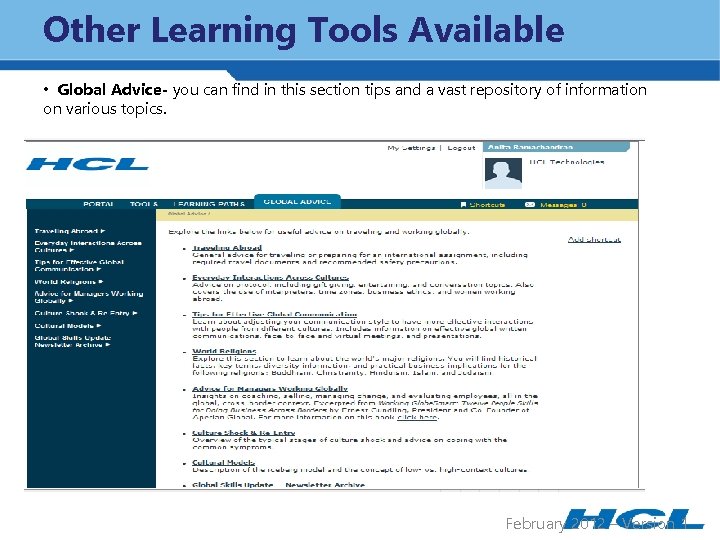 Other Learning Tools Available • Global Advice- you can find in this section tips and a vast repository of information on various topics. February 2012 – Version 1
 Globesmart § The link to take the survey and know the personal cultural profiling is: https: //www. aperianglobal. com/login/ 58
 In conclusion “You must be the change you wish to see in the world. ” - Mahatma Gandhi
 Making ‘Work’ Work across cultures Questions? Concerns? Comments?