


 Скачать презентацию Making Use of Immigrant Skills to Strengthen the
7a9ba990b34cbc7b696add418136ec6a.ppt
- Количество слайдов: 25
 Making Use of Immigrant Skills to Strengthen the City of London Voices for Change Centre for Research and Education in Human Services
 An Action Research Project in the Waterloo, London and Grand Erie Areas Lead Research Organization: Centre for Research and Education in Human Services 73 King St. West Suite 202 Kitchener, Ontario N 2 G 1 A 7 519. 741. 1318 www. crehs. on. ca London Lead Organization: WIL Counselling and Training for Employment 141 Dundas St. London, Ontario N 6 A 1 G 3 519. 663. 0774 www. wil. ca Project Funder: Canadian Heritage Centre for Research and Education in Human Services
 London Steering Committee Bob Ashcroft Canadian Manufacturers and Exporters Lori Cunningham John Howard Society of London and District Haitham El-Hourani International Centre for Development Claudia Falquez-Warkentin Canadian Colombian Professionals’ Association Lissa Foster WIL Counselling and Training for Employment Dharshi Lacey WIL Counselling and Training for Employment Kapil Lakhotia London Economic Development Corporation Deb Mountenay Elgin Middlesex Oxford Local Training Board Mimi Lo Canadian Heritage Christine Lyszczarz Association canadienne-francaise l’Ontario (ACFO) Larry Mac. Kinnon London Economic Development Corporation Estela Quintero United Way of London and Middlesex Hani Shamout Internationally Educated Engineer Harold Usher City Councillor Mary Williamson Cross Cultural Learner Centre for Research and Education in Human Services
 Making Use of Immigrant Skills Purpose: Raise awareness about the need to use the skills of immigrants more fully and to mobilize people in London, Waterloo and Grand Erie to call for change to that end. Activities: • • Local Steering Committees to guide the project Key informant interviews with experts in the field Labour market scan of skills needed within each community Survey of immigrant skills and the extent to which they are being used in each community International media scan and document review Series of case studies highlighting the human story behind the issue Community forums/press conferences Centre for Research and Education in Human Services
 Why Make Use of Immigrant Skills? ü Help relieve skill shortages resulting from an aging population and low birth-rate. ü Compete in the increasingly global marketplace with international perspectives and connections. ü Job satisfaction of working in field of expertise contributes to personal, family, and corporate well-being. ü Take advantage of human capital (“brain gain”) brought to our country. ü Benefit our economy with higher taxes, disposable income, and increased productivity. ü Capitalize on savings in educational costs. ü Add new, innovative ideas in the workplace. ü Demonstrate that our society gives equal opportunity to all and embraces cultural diversity. Centre for Research and Education in Human Services
 Growing Voices for Change The voices are saying that Canadians need the skills that immigrants bring to their new home country. They are saying that many immigrants are bringing the exact skills that we need to make our communities strong and vibrant. But, most importantly, they are saying that immigrant skills—the very skills that we need—are not being used to their full potential. We are left with a backlog of underused skills. In the end, we all lose. Centre for Research and Education in Human Services
 Immigrant Skills… We Need Them § One in two Canadian businesses are concerned with the shortage of qualified labour. § A shortage of up to 1 million workers is expected in Canada within the next 20 years. § Critical job shortages loom, particularly in the health, education, and construction fields. § 2001 Census estimated that by 2011 Canada’s entire net labour growth will come from immigration. § About 225, 000 immigrants come to Canada each year with higher targets in the future. § Other industrialized countries are competing for immigrant labour. Centre for Research and Education in Human Services
 The City of London Needs These Skills Regulated Professions • Nurse/Practical Nurse • Teacher • Physician or Surgeon • Engineering Technician • Engineer • Medical Radiation Technologist • Medical Laboratory Technologist • Respiratory Therapist • Dental Surgeon • Dental Technologist Trades • • • Mechanic Transmission Mechanic Automotive Service Technician Alignment and Brakes Mechanic Mobile Crane Operator Truck and Coach Technician Automotive Painter General Carpenter Industrial Electrician Cement Finisher Centre for Research and Education in Human Services
 Immigrant Skills… We Have Them § Since Canada’s beginning as a country in 1867, approximately onesixth of its population has remained foreign-born. § Today, over 18% of all Canadians are immigrants—only Australia has a higher percentage of immigrants. § Since the 1970’s immigrants have become more diverse. § Toronto, Vancouver, and Montreal’s percentage of foreign-born populations ranks very highly among world cities (#1, #3 and #7). § Forty-four percent of Toronto residents are foreign-born. Its schools serve children from over 170 countries. § Each year approximately 60% of Canada’s immigrants come to Ontario. § Ontario has receives over 100, 000 immigrants annually. § The vast majority settle in Toronto and along the highway 401 corridor. § Immigrants are typically more educated than the average Ontario resident and bring many skills to their new community. Centre for Research and Education in Human Services
 The City of London Has Immigrants § 20% of London residents are immigrants (2001 Census). § Between 1996 and 2001, 18, 475 new Canadians came to London. § Citizenship and Immigration data shows that between 1997 -2003, 18 nurses, 38 teachers, and 15 physicians arrived in London. § In one year alone (April 2002 -March 2003) there were 139 professional engineers, 76 medical professionals, and 54 teachers as new immigrant clients to the Cross Cultural Learner Centre in downtown London. § A recent study of 1, 678 immigrants showed that 46% had a university degree, in such fields such as health care, education, and engineering. Another 28% held a college degree or trade certificate. Centre for Research and Education in Human Services
 Immigrant Skills… Let’s Use Them Voices from the Past: § 1988 Provincial Task Force on Access to Professions and Trades (APT) § Increasing media coverage in the 1990’s § Internationally educated associations began lobbying governments in the 1990’s § Provincial APT Unit and Federal/Provincial Working Group on APT issues § But still the problem remains—even worse Centre for Research and Education in Human Services
 Immigrant Skills… Let’s Use Them Voices from the Present: § Many research studies showing immigrants to have higher unemployment rates, typically aren’t working in their profession, aren’t earning as much, get stuck in low paying jobs, face multiple barriers in accessing profession. § Leading economists warning of labour shortages and barriers in utilizing needed immigrant skills. § Many business/professional government to break down barriers. § All 3 provincial associations calling on parties have platforms on the issue. But still immigrant skills are being under-used… Centre for Research and Education in Human Services
 Immigrant Skills… Let’s Use Them Why is this still a problem? Policy within and between levels of government is neither consistent nor coordinated x No formal ways to ensure that government, occupational regulatory bodies, and employers are accountable for their actions on this issue x Negative attitudes and practices of: Canadian society, regulators and employers x Centre for Research and Education in Human Services
![What Will it Take? “The critical moment [in social change] is when the issue](https://present5.com/presentation/7a9ba990b34cbc7b696add418136ec6a/image-14.jpg "What Will it Take? “The critical moment [in social change] is when the issue") What Will it Take? “The critical moment [in social change] is when the issue becomes present in national consciousness…for an issue to become recognized as a wide-spread social problem is key. ” -Ratna Omidvar, Maytree Foundation Local Calls for Change are needed that demonstrate broad-based support (outside of Toronto!) of the need to make better use of immigrant skills. This is an issue of concern for the whole community. These Calls for Change compliment the work of those who are developing, proposing, and implementing workable solutions that increase access to professions and trades for immigrants. Centre for Research and Education in Human Services
What Will it Take? “The critical moment [in social change] is when the issue becomes present in national consciousness…for an issue to become recognized as a wide-spread social problem is key. ” -Ratna Omidvar, Maytree Foundation Local Calls for Change are needed that demonstrate broad-based support (outside of Toronto!) of the need to make better use of immigrant skills. This is an issue of concern for the whole community. These Calls for Change compliment the work of those who are developing, proposing, and implementing workable solutions that increase access to professions and trades for immigrants. Centre for Research and Education in Human Services
 London Calls for Change Whereas the city of London welcomes, and is increasingly dependent on, the skills brought by immigrants, citizens, employers and leaders of our city call on: Government: The federal and provincial governments to demonstrate increased leadership toward removing barriers to professions and trades for internationally educated persons. Regulatory Bodies: All occupational regulatory bodies to improve their standards of practice by ensuring licensing processes for internationally educated professionals are fair, timely, transparent, and consistent. Employers: Local employers to increasingly recognize the skills that immigrants bring to London through fair hiring practices and internship opportunities. Educational Institutions: Post-secondary educational institutions across Ontario to demonstrate increased leadership in recognizing the prior learning of internationally educated persons and responding to their educational and training upgrading needs. Centre for Research and Education in Human Services
 Action Needed by the Federal Government In order to implement these Calls for Change, immediate action is needed: Action #1: The federal government ensure better policy coherence, as it relates to the access to professions and trades for internationally educated people, within and between government jurisdictions. Action #2: The federal government provide leadership in promoting positive attitudes towards immigrants and people of colour. Action #3: The federal government develop a pre-immigration strategy that would provide accurate information about Canada needed for immigrants to make informed decisions. Action #4: The federal government negotiate an agreement with the provincial government to better coordinate the funding and delivery of employment and training programs for immigrants. Action #5: The federal government provide additional resources to promote access to professions and trades, including funding organizations representing internationally educated professionals that would enable them to propose effective and equitable systems towards the integration of immigrants into their professions. Centre for Research and Education in Human Services
 Action Needed by the Provincial Government In order to implement these Calls for Change, immediate action is needed: Action #1: The provincial government ensure better policy coherence, as it relates to the access to professions and trades for internationally educated people, within and between government jurisdictions. Action #2: The provincial government have a greater role in developing a comprehensive settlement strategy, which will assure that any federal funding committed at that time would be dedicated to settlement needs. Action #3: The provincial government negotiate an agreement with the federal government to better coordinate the funding and delivery of employment and training programs for immigrants. Action #4: The provincial government integrate the successful pilot “Bridging Programs” (programs that help integrate skilled immigrants in specific professions and trades into the labour market) into existing service delivery models to ensure increased access. Centre for Research and Education in Human Services
 Action Needed by the Provincial Government (Con’t) In order to implement these Calls for Change, immediate action is needed: Action #5: The provincial government develop standards of practice for regulatory bodies that would ensure that their licensing processes are fair, timely, transparent and consistent; with annual reporting on compliance of these standards and non-compliance mechanisms put into place. Action #6: The provincial government provide additional resources for occupational regulatory bodies, post secondary educational institutions and organizations representing internationally educated professionals that would enable them to develop effective and equitable systems towards the integration of immigrants into their professions. Action #7: The provincial Ministry of Health and Long Term Care, the Ministry of Attorney General, and the Ministry of Education move quickly to implement Actions #4 -5, as health-related professionals, engineering technicians/technologists, and teachers are the professions needed most urgently in the city of London. Action #8: The provincial Ministry of Health and Long Term Care increase substantially the annual number of spaces for International Medical Graduates (IMG). Centre for Research and Education in Human Services
 Action Needed by Regulatory Bodies In order to implement these Calls for Change, immediate action is needed: Action #1: All 38 occupational regulatory bodies consult with associations representing internationally educated professionals to develop standards of practice that ensure licensing processes are fair, timely, transparent, and consistent. . Action #2: All 38 occupational regulatory bodies provide public reports outlining the number of applications for license by internationally educated professionals, and the number of licenses actually issued to internationally educated professionals. Action #3: All 38 occupational regulatory bodies provide public reports of where internationally educated applicants reached an impasse in the process of licensure, and why the impasse was reached. Centre for Research and Education in Human Services
 Action Needed by Regulatory Bodies (Con’t) In order to implement these Calls for Change, immediate action is needed: Action #4: All 38 occupational regulatory bodies undertake licensing reviews to identify any potential barriers that exist in their licensing procedures. Action #5: The 22 health-related regulatory bodies, the Professional Engineers of Ontario, the Ontario Association of Certified Engineering Technicians and Technologists, and the Ontario College of Teachers move quickly to implement Actions #1 -3 as health-related professionals, engineering technicians/technologists, and teachers are the professions needed most urgently in the city of London. Action #6: The Ontario College of Teachers act on the recent resolution of the provincial school board trustee association (OPSBA) towards streamlining and expediting the approval of qualified foreign-trained credentials. Centre for Research and Education in Human Services
 Action Needed by Employers In order to implement these Calls for Change, immediate action is needed: Action #1: Local employers work closely with local immigrant employment services in identifying suitable skills for their workforce. Action #2: Local employers participate in co-op placement and mentorship/internship arrangements to provide skilled immigrants with opportunities to gain knowledge of Canadian workplace practices. Action #3: Local employers ensure that their hiring procedures are free from bias based on place of education. Centre for Research and Education in Human Services
 Action Needed by Educational Institutions In order to implement these Calls for Change, immediate action is needed: Action #1: Post-secondary educational institutions recognize and adequately assess the prior learning of internationally educated persons. Action #2: Post-secondary educational institutions consult immigrant services and other educational institutions across Canada in developing suitable individual academic courses to fill identified gaps for internationally educated professionals and tradespeople, without requiring them to take a full diploma or degree program. Action #3: Faculties of Medicine increase substantially the annual number of spaces for International Medical Graduates (IMG). Centre for Research and Education in Human Services
 What YOU Can Do Listen: Listen to the experiences of immigrants who are trying to make use of their skills. Speak Up: Add your own voice to the growing chorus of voices calling for change. Endorse London’s Calls for Change. Log on to: www. crehs. on. ca Centre for Research and Education in Human Services
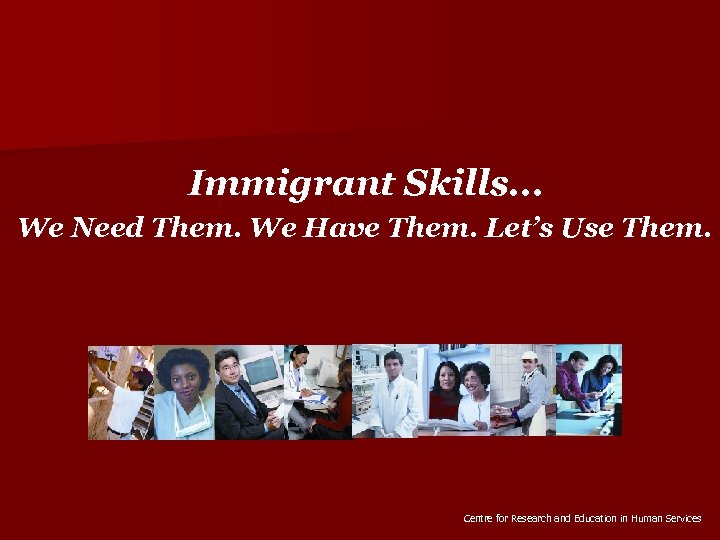 Immigrant Skills. . . We Need Them. We Have Them. Let’s Use Them. Centre for Research and Education in Human Services
 Centre for Research and Education in Human Services 73 King Street West, Suite 202 Kitchener, Ontario N 2 G 1 A 7 Phone: (519) 741 -1318 Fax: (519) 741 -8262 E-mail: general@crehs. on. ca Web page: www. crehs. on. ca Centre for Research and Education in Human Services