 Скачать презентацию Making unseen processes visible Looking at DNA replication
627f4b59996736125d1bdc0cae9bddf4.ppt
- Количество слайдов: 20



Making unseen processes visible: Looking at DNA replication in a test tube Hagit Yarden and Anat yarden Department of Science Teaching Weizmann Institute of Science Rehovot, Israel Yarden, H. & Yarden, A. (2009). Learning using dynamic and static visualizations: Students’ comprehension, prior knowledge and conceptual status of a biotechnological method. Research in Science Education, In press
Outline • • • Problem Context Objective Approach Results Conclusions
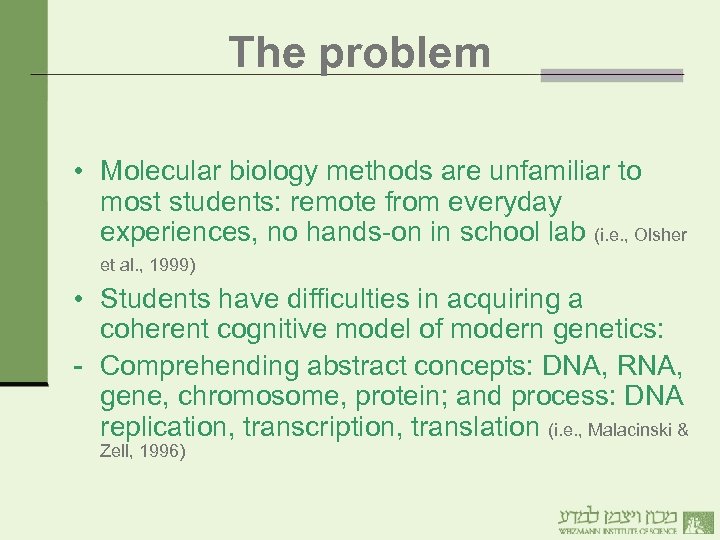
The problem • Molecular biology methods are unfamiliar to most students: remote from everyday experiences, no hands-on in school lab (i. e. , Olsher et al. , 1999) • Students have difficulties in acquiring a coherent cognitive model of modern genetics: - Comprehending abstract concepts: DNA, RNA, gene, chromosome, protein; and process: DNA replication, transcription, translation (i. e. , Malacinski & Zell, 1996)
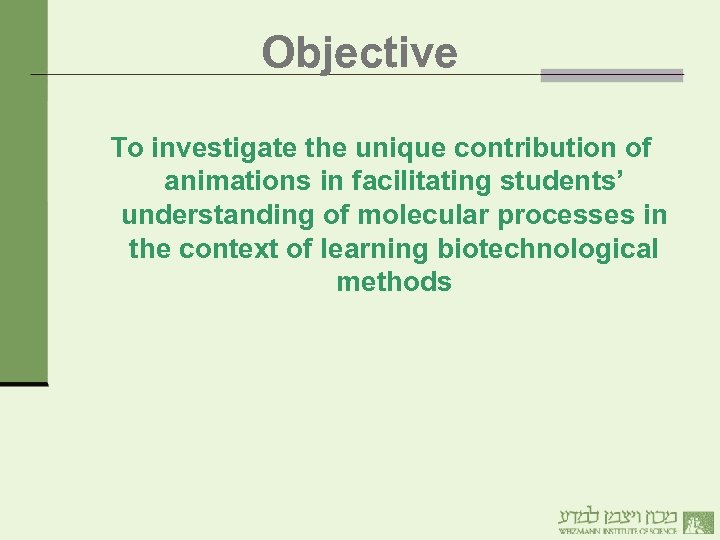
Objective To investigate the unique contribution of animations in facilitating students’ understanding of molecular processes in the context of learning biotechnological methods
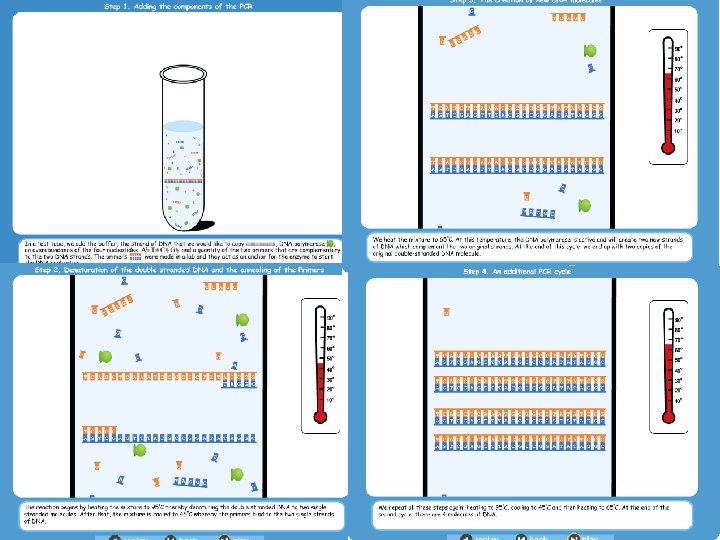
Context • 12 th graders • Biology majors • Study ‘Gene Tamers—Studying Biotechnology through Research’ (Falk et al. 2003), based on Adapted Primary Literature (APL) • In the Methods section of APL: Polymerase Chain Reaction (PCR) - synthesize multiple copies of a desired DNA fragment in a test tube (Mullis, 1983) http: //stwww. weizmann. ac. il/g%2 Dbio/biotech/mavomethods. html
Methodology • Population: 12 th graders (17 -18 yrs old, n=173), biology majors, 9 classes, 2006 -2007 academic year • Research approach: both quantitative and qualitative • Data sources: students' prior content knowledge questionnaire, students’ post questionnaires, audiotapes of verbal interactions of pairs of students while using the animation or the cards
Methodology (cont. ) • Analysis of audiotapes: 4 transcripts of animation group and 4 of the cards group • Qualitative analysis: based on the conceptual change framework (Hewson & Lemberger, 2000; Tsui & Treagust, 2007) • Quantitative analysis: collect all status elements, group them under the relevant conceptual status
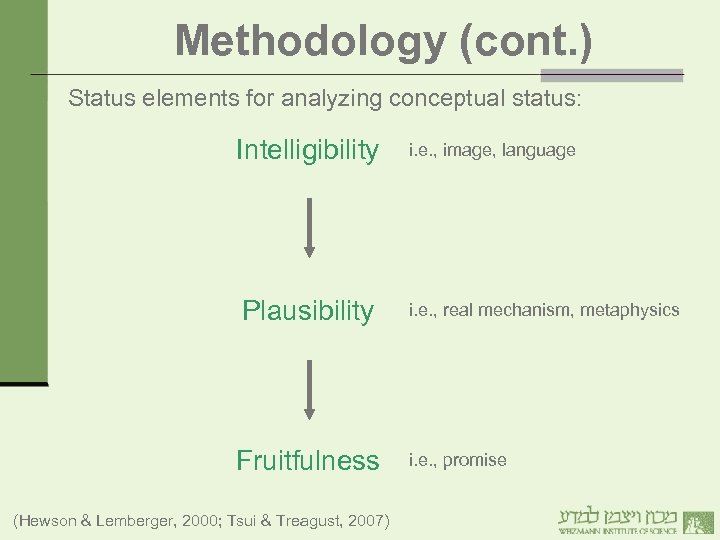
Methodology (cont. ) Status elements for analyzing conceptual status: Intelligibility i. e. , image, language Plausibility i. e. , real mechanism, metaphysics Fruitfulness (Hewson & Lemberger, 2000; Tsui & Treagust, 2007) i. e. , promise
Research questions • Is there a difference in the comprehension of PCR between students who learned using animation and those who learned using still images? • What are the relationships between students' prior content knowledge and their comprehension of the PCR method, using animation or still images? • What is the difference in conceptual status of the PCR method between students who learned using animation and those who learned using still images?
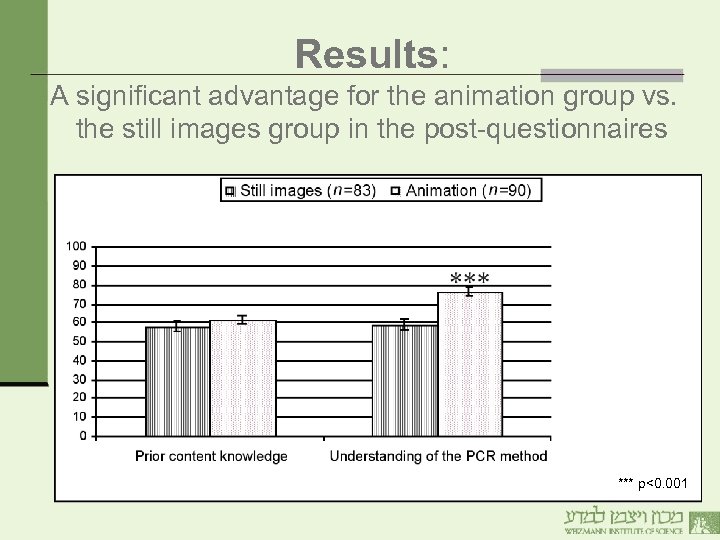
Results: A significant advantage for the animation group vs. the still images group in the post-questionnaires *** p<0. 001
Research questions • Is there a difference in the comprehension of PCR between students who learned using animation and those who learned using still images? • What are the relationships between students' prior content knowledge and their comprehension of the PCR method, using animation or still images? • What is the difference in conceptual status of the PCR method between students who learned using animation and those who learned using still images?
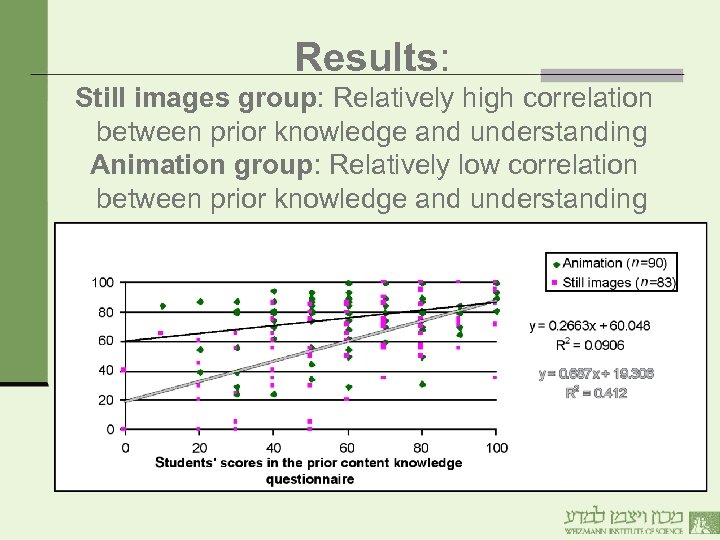
Results: Still images group: Relatively high correlation between prior knowledge and understanding Animation group: Relatively low correlation between prior knowledge and understanding
Research questions • Is there a difference in the comprehension of PCR between students who learned using animation and those who learned using still images? • What are the relationships between students' prior content knowledge and their comprehension of the PCR method, using animation or still images? • What is the difference in conceptual status of the PCR method between students who learned using animation and those who learned using still images?
![Results: • The function of DNA Polymerase: Animation group: 2: So [DNA] polymerase is](https://present5.com/presentation/627f4b59996736125d1bdc0cae9bddf4/image-15.jpg "Results: • The function of DNA Polymerase: Animation group: 2: So [DNA] polymerase is")
Results: • The function of DNA Polymerase: Animation group: 2: So [DNA] polymerase is causing the small ones [the nucleotides] (+image), right? (+real mechanism) 1: Yes, and this is why they put a lot of them [nucleotides], so instead of only two strands there will be a lot of them (+real mechanism) Cards group: 1: What does it mean? They [the primers] are already attached, so what does it [the DNA polymerase] do? (-metaphysics) 2: Maybe it [the DNA polymerase] is connecting between them [the primers], I don't know… (-real mechanism)
Results: • The function of the primers: Animation group: The primers are those we saw in the beginning [of the animation], which are attached in 45 o. C, those big small ones (+image), I think they are involved in the initial stages of the process (+language). Cards group: 1: They serve as enzymes, right? 2: I think they are. (-metaphysics)
Results: • The specific temperatures at which different stages in the PCR method occur: Animation group: 2: O. K, but in the question they are asking why these [the primers] are attached and not these [the DNA strands]? 1: Because they are smaller (+real mechanism). The primers are starting (+language), and then the DNA polymerase is helping to complete them [the DNA strands] (+real mechanism). Cards group: 1: "We heat the mixture to 65 o. C. At this temperature, the DNA polymerase creates… At the end of this cycle, we end up with two copies of the original double-stranded DNA molecule" [reading from the text]. 2: Well, no, I did not understand it (-real mechanism). Move, move to the next card…
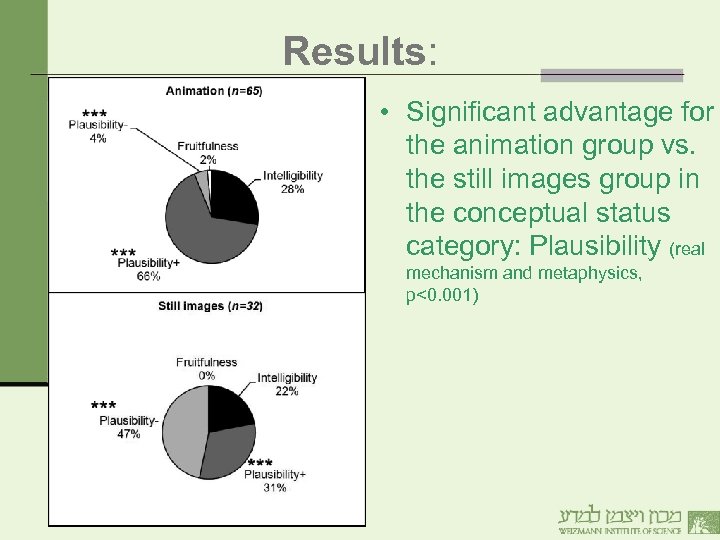
Results: • Significant advantage for the animation group vs. the still images group in the conceptual status category: Plausibility (real mechanism and metaphysics, p<0. 001)
Conclusions • The use of the PCR animation provides an advantage to learning the method vs. still images • Low prior knowledge does not harm students’ ability to learn the PCR method if they use animation • Students from both groups reached the stage of intelligibility, while the next level – plausibility – appeared only among students who learned using the animation
Acknowledgments • Hagit Yarden • • Hedda Falk Rachel Cohen Michal Stolarsky Ben-Nun Eilat Hasson Yardena David Ronit Rozenszayn Carmit Shpalter Yossy Machluf
Скачать презентацию Making unseen processes visible Looking at DNA replication
627f4b59996736125d1bdc0cae9bddf4.ppt