 Скачать презентацию Making the links domestic violence and disabled women
226ff2fa97ada0a7182eaff155ec687c.ppt
- Количество слайдов: 50



Making the links: domestic violence and disabled women Professor Gill Hague Co-Director Violence Against Women Research Group, UK
Thank you § A privilege to be here and to have this opportunity to give this address
LECTURE Domestic violence and disability The lacks - The gaps - The lack of interest. The literature, what do we know? Also report on our national UK study What were the recommendations that we can learn from?
Our recent study § The first ever national study in the UK § Attempted to break new ground § After many years of trying to get funding, this project was run by Women’s Aid, the national domestic violence charity and coordinating body in the UK
Research Team § Women’s Aid commissioned: § VAWRG, U of Bristol, UK § Centre for the Study of Safety and Wellbeing, U of Warwick, UK § Mixed team of disabled and non-disabled researchers § Advisory group of disability activists/ consultants
Researchers § Prof. Gill Hague, Dr. Ravi Thiara, Dr. Pauline Magowan, with Prof. Audrey Mullender Consultants / Advisers § Brenda Ellis Anne Pridmore Disability Equality Trainer § Ruth Bashall
A NOTE ABOUT TERMS § In common with the wishes of the disability activist movement in the UK, the term: § Disabled women is used, not women with disabilities § Disability used only in the singular to refer to social and structural disadvantage § With impairments used to describe individual conditions § Recognise that this is not the case for disability movements in Australia where women with disabilities would be the term of choice
§‘NOTHING ABOUT US §WITHOUT US’
Underpinnings § Social model of understanding disability § Women’s Aid definition of domestic violence: range of types of abuse, most often experienced by women § Seeking further funding for national research for people with learning difficulties / intellectual disabilities
What we know § Gaps in policy & service development § Gaps in research evidence to support this § Barriers – lack of accessible services, low take-up of DV provision, tiny numbers disclosing to disability orgs, absence of awareness campaigns § Issues of increased power & control over disabled women § Greater need for services § Poor Provision
This distressing situation § Is not just in one place -- or an anomaly § It is illustrated time and time again in whatever research there is § In country after country. § All research evidence: Across the world, disabled women facing intimate abuse are neglected and overlooked
Some important research especially in Australia § Lesley Chenoweth: key contributions § Including (among very many): § § Invisibility of disabled women Abuse of power, infantilisation De-sexualisation (because disabled women often so devalued they are made invisible and perceived as asexual, exposing them to grave risk of emotional, physical and sexual abuse. ) § Chenoweth finds they are then likely to be ignored by both disability and gender violence support systems
Important US research § Margaret Nosek and colleagues § Much of this work reveals inadequate service provision, coupled with a higher incidence of domestic abuse among American disabled women, compared with non-disabled women § Work by Nosek on increased vulnerabilities of abused disabled women
Compound disadvantage § Limited nature of the evidence from compounded by the fact that previous studies in both Britain and internationally have often failed to include the experiences of lesbians, and of disabled women from black and minority ethnic (BME) backgrounds
Activist Groups of Disabled Women § e. g. Dawn in Canada: equality rights, inclusion and empowerment of disabled women and girls through education, advocacy, campaigning, coalition-building and publications, and combining research with activist initiatives. § e. g. In UK, GLAD (now ex- ): leading role: policy, training by disabled women, website for disabled dv survivors
Women with Disabilities Australia (WWDA): ‘We’re Women Too’ § § § § § Dependence on others Fear of disclosure Poverty Lack of educational opportunities Isolation Limited communication Lack of services, support, CJS assistance Impact of different types of impairment Low self-esteem: Devastating catalogue
Many positive developments § Victorian Women with Disabilities Network § Victorian Women with Disabilities Advocacy Information Service, peer support, leadership, mentoring etc § Key new research:
‘Building the Evidence § Healey, Howe, Humphreys, Jennings, Julian, 2008, Victorian Women with Disabilities Network and Women’s Health Victoria § (Presented earlier today) § Report corroborates much of our study § Significant advances, but insufficient progress in incorporating disabled women into policy responses, including Indigenous women § Minimum collaboration between disability and family violence sectors § Serious lack of accessible accommodation, often interpreted mainly in physical terms
Some recommendations § Support for SAFER project: a nexus for research and practice § Further representation women with disabilities on state committees etc § Promote their interests to build responses and services § Continue to increase provision of information, support, mentoring, advocacy § Make it a central issue
Our study: Aims § Further understanding of the needs of disabled women experiencing domestic violence § Scope of existing provision and what is needed § Gaps in provision § Examples of good practice and policy § Recommendations for policy and service development
Methods § § § Consultation disabled women and projects Interview set with key experts National survey domestic violence services National survey disabled people's orgs. In-depth interviews with abused disabled women inc, BME women, lesbians, diversity § Case studies of good practice examples § Interview set with strategic managers and commissioners § Use women’s words in this presentation: raise disabled women’s voices
Women’s abuse experiences § § § Varied and multiple abusers Wide range of types of violence Pervasive ‘non-stop- abuse for some Women’s impairments used in the abuse 100%: being disabled had made abuse worse § Two particular features: § High levels degrading emotional abuse § High levels often extreme sexual violence
Sexual Violence § Many of the interviewees spoke about being sexually violated by the perpetrators. This included repeated rape, forced sex while being pinned down, and demands for sex in return for the provision of care. § Sometimes, more than one perpetrator had been involved. ‘It was sex all the time, twice a day. He would hold me down with his hand over my mouth always, and I hated it, I hated it. He said because I was Deaf, I deserved it’
Questioning prevailing definitions ‘I think that the domestic violence thing in a way kind of misleads disabled women because you always think of a man and a woman married or in a partnership. He hits her. But actually it’s far more complex than that…it’s big, it’s so big and I think it’s uncomfortable for non-disabled people to face up to. ’ Issues of increased control and power, the abuse has different dimensions
When abuser is carer: neglect, isolation and intense vulnerability ‘At night times, he’d shut the door on me so I couldn’t call him for anything, so he wouldn’t hear me if I wanted to like use the toilet or anything’ ‘Once I fell on the floor with my dinner and said ‘that’s where you eat your dinner, that’s where you belong’
When abuser is carer: neglect, isolation and intense vulnerability… ‘I had a motability car, he would take it and disappear for days on end with it, leaving me stranded in the house, unable to get the shopping etc. But you don’t say anything as a disabled woman, I felt so ashamed that this was happening, so I didn’t tell anyone, didn’t ask anyone for help. I’d just be stranded…. ’
When abuser is carer: neglect, isolation and intense vulnerability… ‘Oh yes, he would drag me along the floor because I couldn’t walk or get away that was how it would start, the way it always went. He’d insult me with all those names, ‘you spassy’ ‘you ugly f** spassy. who’d want to marry you’. And shouting insults, ’ you cripple’, all that sort of thing…you get used to it’
INTENSE VULNERABILITY § ‘One time, he actually took the battery out of this wheelchair I’m in now. He just unplugged it so I couldn’t move. …. . or sometimes -- this is a good one – he’d quickly move my wheelchair just as I was shifting myself into it’ § ‘He’d make me wait for help or he’d tut a lot or he’ll say ‘Oh god not again, Oh come on then, get it over and done with’. And shove me about sometimes and push me hard, like in the bathroom when I washing…’
Financial abuse by abusers who are carers § Taking control over women’s finances § Using her social security money to fund alcohol / drug dependency § Women denied money for their prescriptions and other essentials related to impairment § ‘Getting rid of her’ because she could no longer work
Not believed and meant to be grateful § Dominant view of disabled women and intimate relationships: ‘People pity him because he is taking care of you and so noble. So people are reluctant to criticise this saint or to think he could be doing these terrible things. And there’s a sort of, I think, an idea … people don’t easily see a disabled woman as a wife, partner, and mother, as a sexual ordinary person. So I think for some people it’s hard to think well this might be a woman who’s being sexually or physically abused by her partner, … because disabled women don’t have sex, do they? ’
Reinforcing control and dependency ‘Because they become your carer and they make you believe you need them because of your disability. And they do everything. ‘And I’m making life so much easier for you’. You know and I thought it was wonderful. Nobody had taken care of me in that way. No one. But he gradually took over. And a lot of it was being disabled…. He always made a thing about carrying me out to the car instead of me using my chair. Just so people would see and to emphasise it more. ’
Responding to the abuse § § § § Being disabled made abuse worse a) limited capacity to get away b) impairment used as part of it e. g. not being able to see or hear an attack coming or to get out of the way Issues for women with ‘no recourse’ Women don’t tell – ashamed, self blame Abuse preferable to ‘a life of care agencies’ = stay in abuse for many years
Aftermath…. § Post-separation violence: § Impact on self – severe depression, losing sense of self, feeling worthless, eating disorders, sleeping problems § Impact on children – ongoing – impairment used by professional agencies sometimes – Some agencies colluded with abuser – child contact, losing the children
Women’s help-seeking § Many never sought formal or informal help – So had no information § Other barriers – physical accessibility, thought no services, racism and feeling ‘doubly different’, ‘no recourse’, not being believed § Not being believed esp. lesbian interviewees – ‘They don’t believe a woman could do it…She was really skinny. And she would kick me regularly -and they just wouldn’t acknowledge it at all. I think that people still have this vision of abusers to be male, to be stronger’ § Formal support – needs very rarely met § Very few accessible services
Helpful or not helpful? § Strong reactions to who was ‘most unhelpful’ § 80% said social workers the most unhelpful, 50% also the police § But few could think of any agencies at all that were ‘most helpful’ (possibly a dv refuge or disabled people’s organisation) § Instead: devastating catalogue of disasters
What did the surveys reveal? § Survey of all dv services across the country § Services patchy or minimal & lack of resources big issue. § Some refuges good practice, specially adapted premises, accessibility § But many not accessible at all; not DDA compliant § Still a very long way to go § Even more a problem: Attitudes, disability equality awareness often poor among staff, § Disability Equality Training usually poor/ short
What did the surveys reveal? § Survey of disabled people’s organisations – Lack of resources huge issue – Majority don’t see DV as part of their remit & don’t ask about DV. DV not an issue for them to deal with. – May have only male advocates – Majority do not have DV policies – Majority not members of DV inter-agency projects – Lack of info about DV among staff common – Highlighted problems in finding accessible specialist services
Need for ‘sea change’ § Lack of resources a major issue for both sectors -- esp DPOs § Despite best intentions, responses to disabled abused women are patchy and inadequate § Clear evidence: need for more accessible refuge and outreach services § Clear need for a ‘sea change’ to finally to take on the needs of abused disabled women § Sea / culture change in a) Women’s Aid b) disability orgs. § Both at operational and management / strategic level in all relevant agencies
In Sum, from our research… § § Lack of attention: policy, service development Lack of sensitive training e. g. for dv services Lack of awareness raising: victims, public Disabled women experience – A greater need for services, coupled with – Far less provision and what there is often inadequate and lose out on both counts placing disabled women in a desperate situation often Study wide range of recommendations:
Disabled Women’s Advice § Remember, proportionally, many more disabled women are abused than non-disabled § Be informed about disabled women’s needs § Take advice from / consult disabled women § Provide accessible well-publicised domestic violence services that disabled women know about § Do not threaten disabled women with institutionalisation § Develop disability equality schemes and reviews with input from disabled women. § Take disabled women seriously and do not patronise us
What is needed § § More comprehensive services Awareness raising across the board The allocation of dedicated resources Advised by / involvement of disabled women as both service providers and service users § Partnership work: § Domestic violence and disability sectors learning from each other
Policies and training § Disability and/or domestic violence policies § Disability equality training and/or domestic violence training § Provided by disabled women with expertise in domestic violence issues
Best practice § A gendered approach to domestic violence § The social model approach to disability § Training would be expected to cover diversity issues, including for disabled BME women, lesbians, older women….
Accessible in all ways Awareness raising and reaching out to disabled women All policy and service devt, decisionmaking, with disabled women and employing disabled women experts
The State Sector § Mainstreaming in the state sector, written into work targets and integral to all relevant budgets and policies § Disabled woman must have as much control as possible, balance protection and risk assessment with a women’s empowerment approach
Many specific recommendations Community care packages Disabled people’s organisations Domestic violence organisations Strategic and Commissioning Frameworks
Strategic and Commissioning Frameworks, Plans etc § Use international /national Human Rights instruments/ laws § Include in: – all relevant strategic agendas and commissioning frameworks and at sufficient priority level – national and local performance indicators
Two general principles § Disability needs to be included in all domestic violence strategies, agendas and frameworks § Domestic violence and disabled women should feature in all diversity and equality strategies, agendas and frameworks, both locally and nationally § Domestic violence and disability quality marks; Domestic violence and disability minimum standards
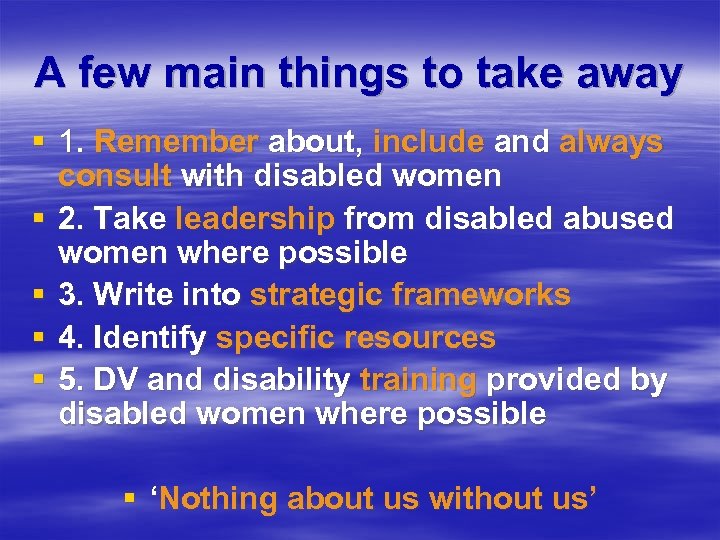
A few main things to take away § 1. Remember about, include and always consult with disabled women § 2. Take leadership from disabled abused women where possible § 3. Write into strategic frameworks § 4. Identify specific resources § 5. DV and disability training provided by disabled women where possible § ‘Nothing about us without us’
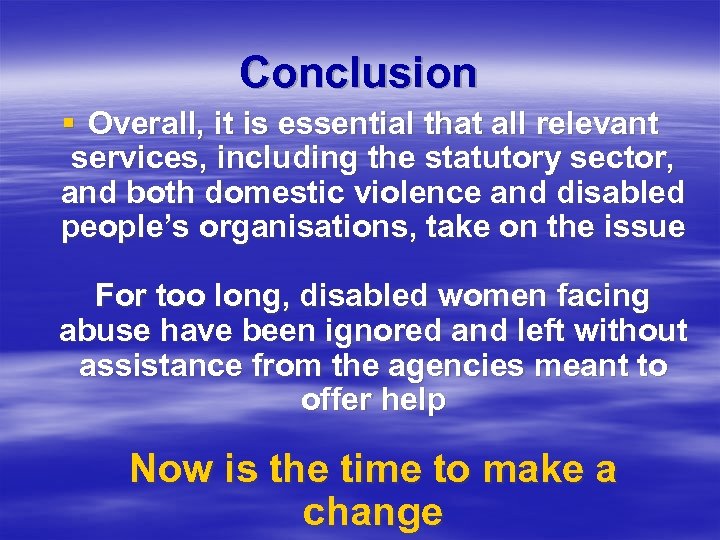
Conclusion § Overall, it is essential that all relevant services, including the statutory sector, and both domestic violence and disabled people’s organisations, take on the issue For too long, disabled women facing abuse have been ignored and left without assistance from the agencies meant to offer help Now is the time to make a change
Скачать презентацию Making the links domestic violence and disabled women
226ff2fa97ada0a7182eaff155ec687c.ppt