


 Скачать презентацию Making the Case for Central Scheduling Taking Control
b2d0669a06238568a828d9f3f287a1b2.ppt
- Количество слайдов: 25
 Making the Case for Central Scheduling Taking Control of Your Schedules to Improve Revenues and Patient and Physician Satisfaction Jessica Mc. Kinney, AVP Patient Access January 16, 2015 © 2013 PARALLON BUSINESS SOLUTIONS, LLC
 Introduction - Healthcare services, over the last few decades have trended from inpatient to outpatient settings - Outpatient visits doubled from 1990 – 2010, while inpatient admissions for that same period grew by just 13% - Efficient scheduling is vital to the financial health of the organization (hospitals, imaging centers, healthcare systems) - 2 Volume growth Physician and Patient satisfaction Maximizing the schedule Cost reduction Improved cash flow
 Background - In 2009, Parallon was approached by HCA leadership with a request to create Central Scheduling units for 45 hospitals in 5 regional markets, concentrated in Florida, Georgia, and South Carolina - Parallon leadership leveraged experiences gained by the Richmond Shared Services Center which had implemented Centralized Scheduling in other HCA Markets - The project was completed over the course of a 1 year time period, with a new facility transitioning to each Central Scheduling location every 4 weeks - Subsequently Parallon has implemented this solution for additional HCA facilities and now operates 13 Central Scheduling Units, serving more than 110 hospitals and imaging centers - Parallon is also responsible for the management and support of a new consolidated Pre-Access center in Cincinnati, which will serve 21 hospitals in KY and OH for a non-HCA Parallon client 3
 Building the Business Case for Central Scheduling The Challenges - Inconsistent scheduling department structure at each hospital - Some scheduling areas were decentralized and schedulers were managed by the ancillary departments while others were somewhat centralized into one department - Leadership of the departments had other priorities, not solely focused on the scheduling and pre-service process - Lack of sophisticated telephone system and other technology - No view into call volume, lost/abandoned calls, or hold times - No view into Customer Service issues - No view into volumes exiting the system when one facility had no availability for a particular modality - Inconsistent oversight, education and system knowledge - Inconsistent asset utilization with variability from hospital to hospital - Ancillary department staff had the access to block rooms and equipment 4
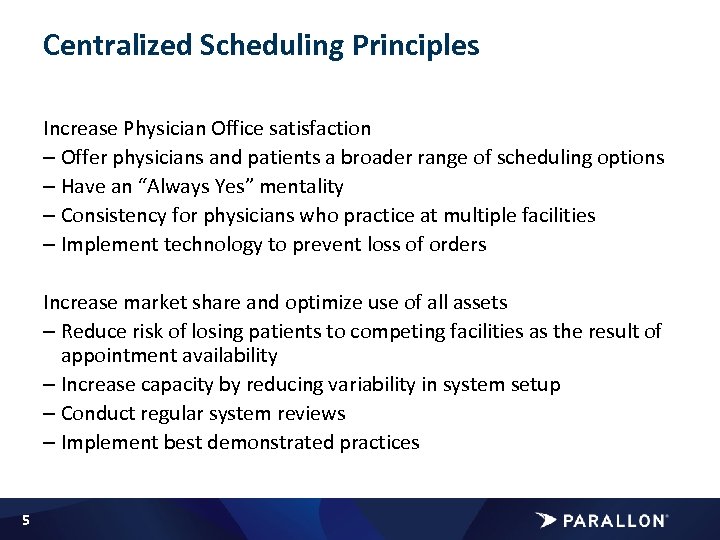 Centralized Scheduling Principles Increase Physician Office satisfaction – Offer physicians and patients a broader range of scheduling options – Have an “Always Yes” mentality – Consistency for physicians who practice at multiple facilities – Implement technology to prevent loss of orders Increase market share and optimize use of all assets – Reduce risk of losing patients to competing facilities as the result of appointment availability – Increase capacity by reducing variability in system setup – Conduct regular system reviews – Implement best demonstrated practices 5
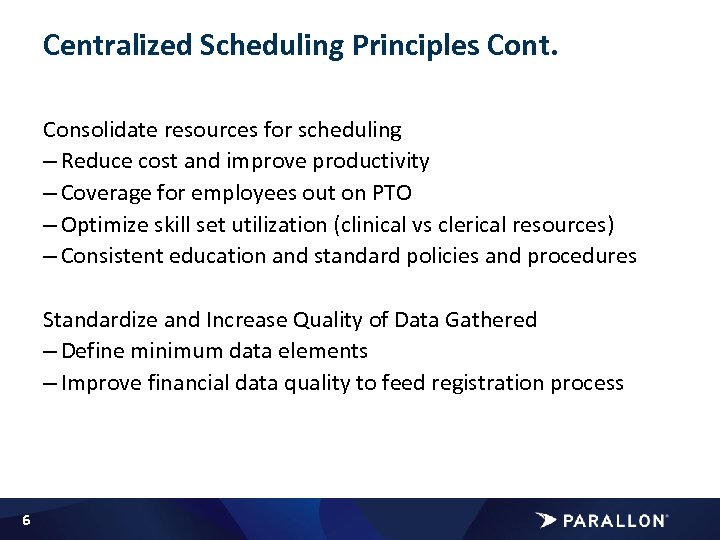 Centralized Scheduling Principles Cont. Consolidate resources for scheduling – Reduce cost and improve productivity – Coverage for employees out on PTO – Optimize skill set utilization (clinical vs clerical resources) – Consistent education and standard policies and procedures Standardize and Increase Quality of Data Gathered – Define minimum data elements – Improve financial data quality to feed registration process 6
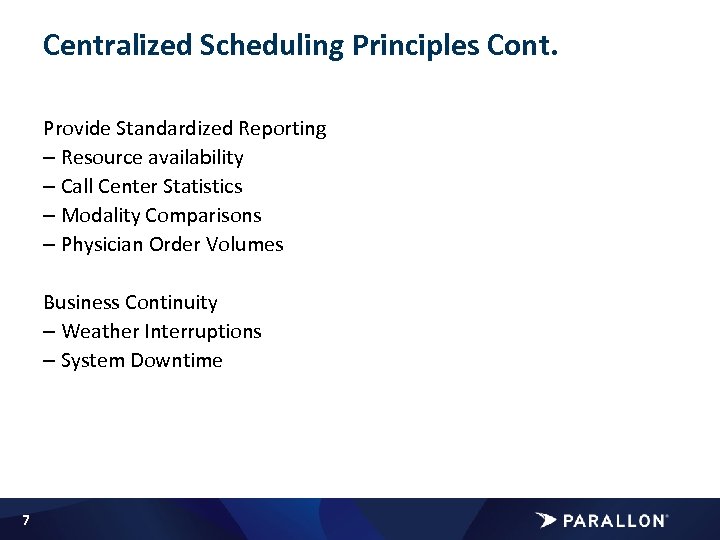 Centralized Scheduling Principles Cont. Provide Standardized Reporting – Resource availability – Call Center Statistics – Modality Comparisons – Physician Order Volumes Business Continuity – Weather Interruptions – System Downtime 7
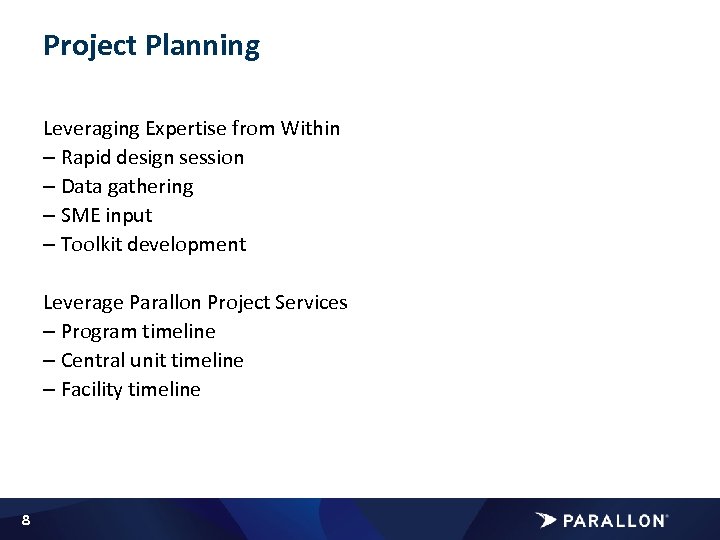 Project Planning Leveraging Expertise from Within – Rapid design session – Data gathering – SME input – Toolkit development Leverage Parallon Project Services – Program timeline – Central unit timeline – Facility timeline 8
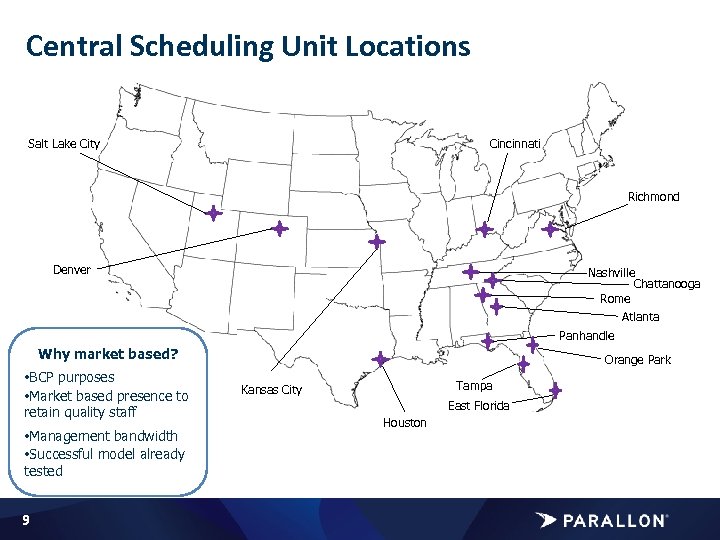 Central Scheduling Unit Locations Cincinnati Salt Lake City Richmond Denver Nashville Chattanooga Rome Atlanta Panhandle Why market based? • BCP purposes • Market based presence to retain quality staff • Management bandwidth • Successful model already tested 9 Orange Park Tampa Kansas City East Florida Houston
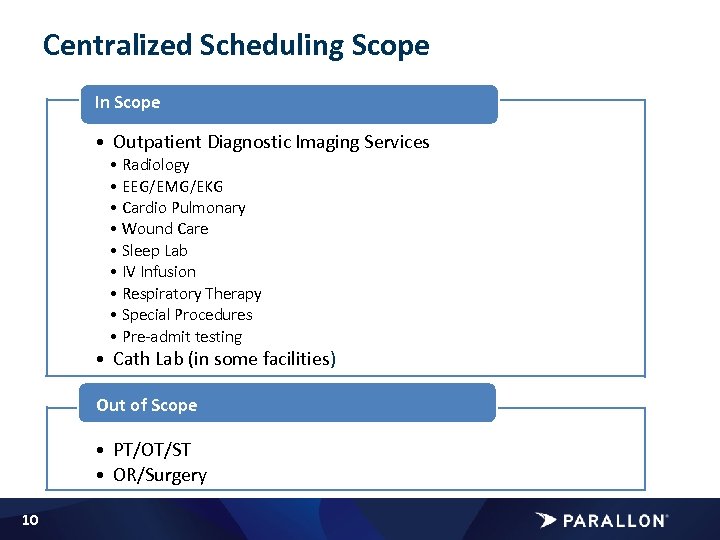 Centralized Scheduling Scope In Scope • Outpatient Diagnostic Imaging Services • Radiology • EEG/EMG/EKG • Cardio Pulmonary • Wound Care • Sleep Lab • IV Infusion • Respiratory Therapy • Special Procedures • Pre-admit testing • Cath Lab (in some facilities) Out of Scope • PT/OT/ST • OR/Surgery 10
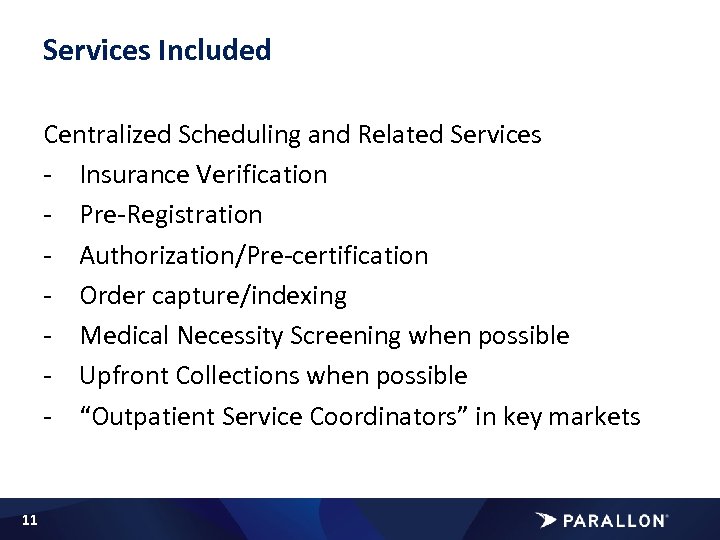 Services Included Centralized Scheduling and Related Services - Insurance Verification - Pre-Registration - Authorization/Pre-certification - Order capture/indexing - Medical Necessity Screening when possible - Upfront Collections when possible - “Outpatient Service Coordinators” in key markets 11
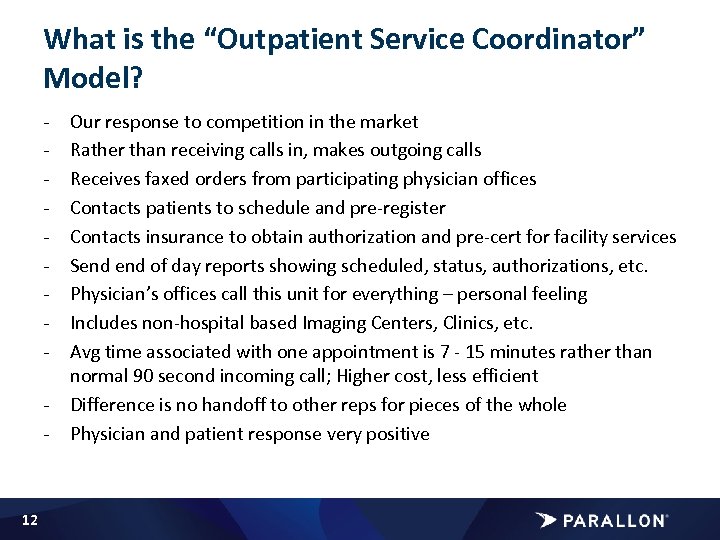 What is the “Outpatient Service Coordinator” Model? - 12 Our response to competition in the market Rather than receiving calls in, makes outgoing calls Receives faxed orders from participating physician offices Contacts patients to schedule and pre-register Contacts insurance to obtain authorization and pre-cert for facility services Send of day reports showing scheduled, status, authorizations, etc. Physician’s offices call this unit for everything – personal feeling Includes non-hospital based Imaging Centers, Clinics, etc. Avg time associated with one appointment is 7 - 15 minutes rather than normal 90 second incoming call; Higher cost, less efficient Difference is no handoff to other reps for pieces of the whole Physician and patient response very positive
 Critical Success Factors - Staff retention and employee transfers - Maintain or improve relationships with physician and office staff - Maintain or improve relationships with Ancillary Directors - Staff competency and knowledge - Technology - Dictionary refinement, standardization and maintenance - No loss of personal touch - Well documented processes - Improve performance and volume 13
 Technology - Management of Multiple HIS solutions within several of the units - Physician Order Management - - Call Routing and Recording Insurance Eligibility Medical Necessity Automated Notice of Admission - 14 Hyland Central Scheduling Workflow Existing Technology – SCI Order Facilitator UHC Aetna
 Physician Order Management • Fax Management Solution • Imports documents for indexing at patient level • Leverages HL 7 from HIS system for autofill keywords • • Patient Name Account Number Medical Record Number Physician • Ability to route documents received for special processing • Incomplete Orders • Pending • Additional tools • Reporting • “Virtual Print Driver” 15
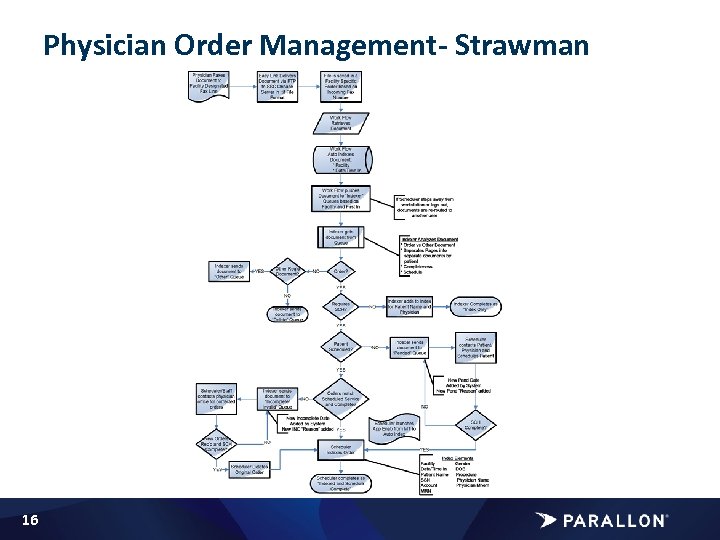 Physician Order Management- Strawman 16
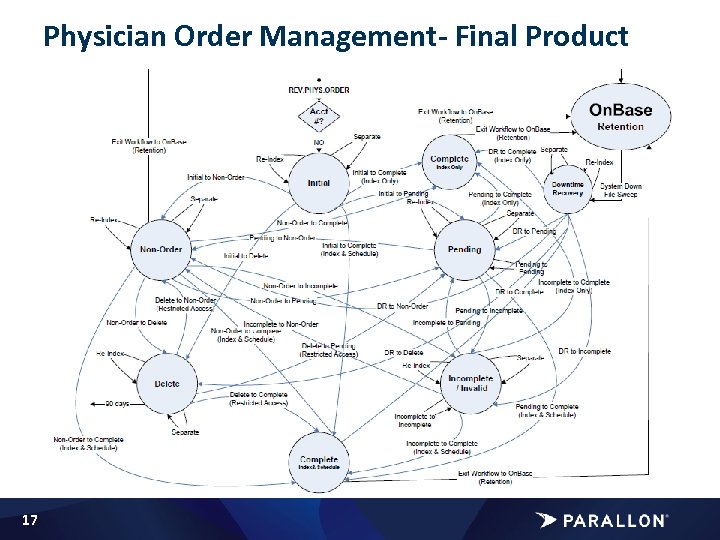 Physician Order Management- Final Product 17
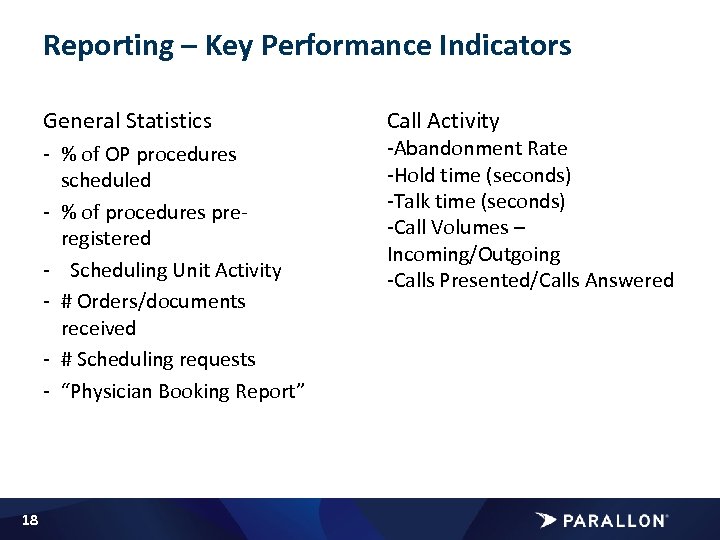 Reporting – Key Performance Indicators General Statistics - % of OP procedures scheduled - % of procedures preregistered - Scheduling Unit Activity - # Orders/documents received - # Scheduling requests - “Physician Booking Report” 18 Call Activity -Abandonment Rate -Hold time (seconds) -Talk time (seconds) -Call Volumes – Incoming/Outgoing -Calls Presented/Calls Answered
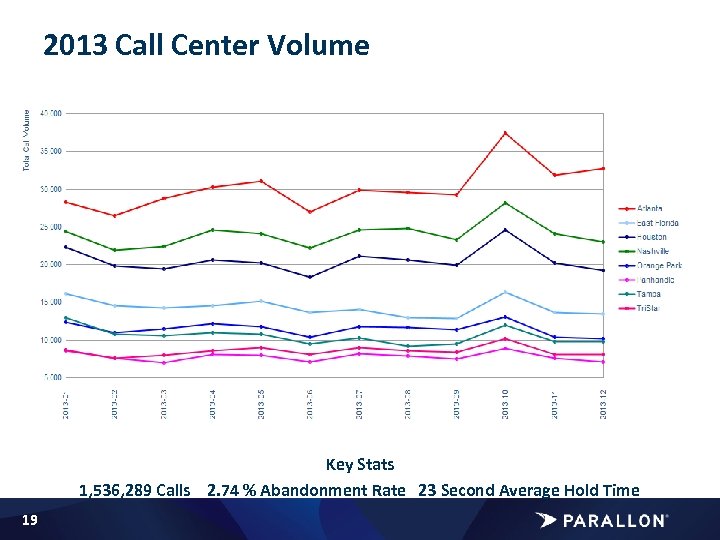 2013 Call Center Volume Key Stats 1, 536, 289 Calls 2. 74 % Abandonment Rate 23 Second Average Hold Time 19
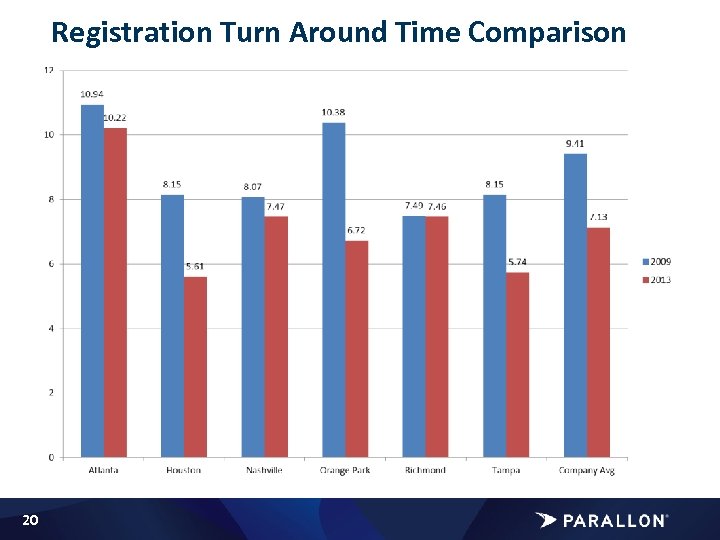 Registration Turn Around Time Comparison 20
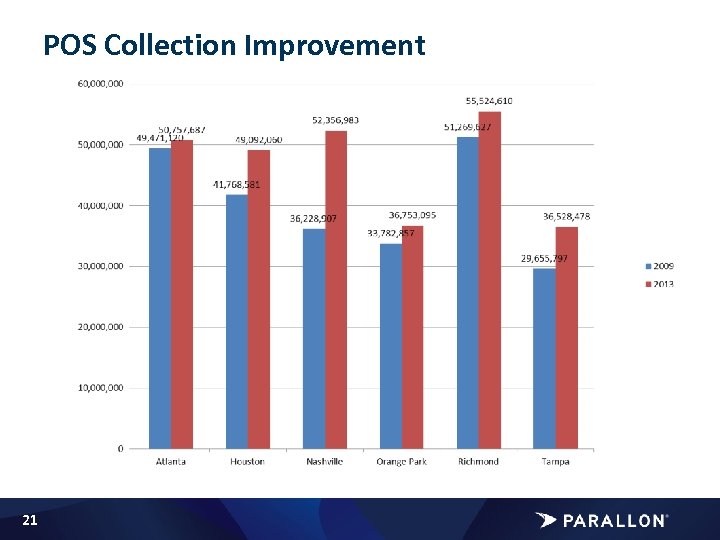 POS Collection Improvement 21
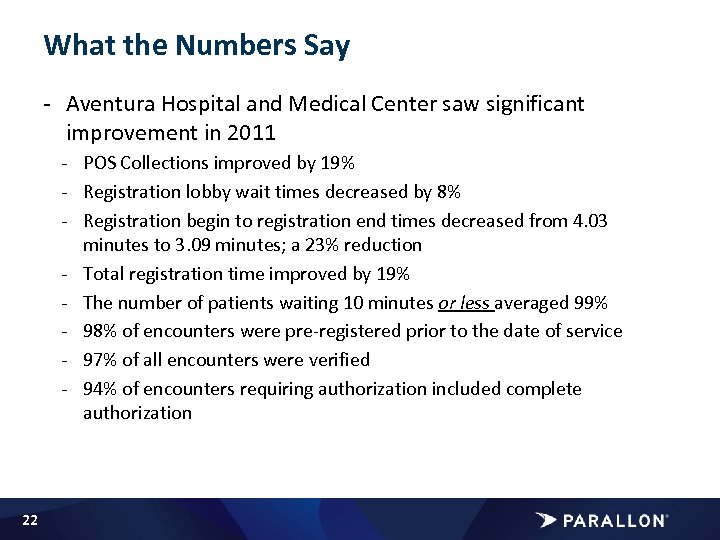 What the Numbers Say - Aventura Hospital and Medical Center saw significant improvement in 2011 - POS Collections improved by 19% - Registration lobby wait times decreased by 8% - Registration begin to registration end times decreased from 4. 03 minutes to 3. 09 minutes; a 23% reduction - Total registration time improved by 19% - The number of patients waiting 10 minutes or less averaged 99% - 98% of encounters were pre-registered prior to the date of service - 97% of all encounters were verified - 94% of encounters requiring authorization included complete authorization 22
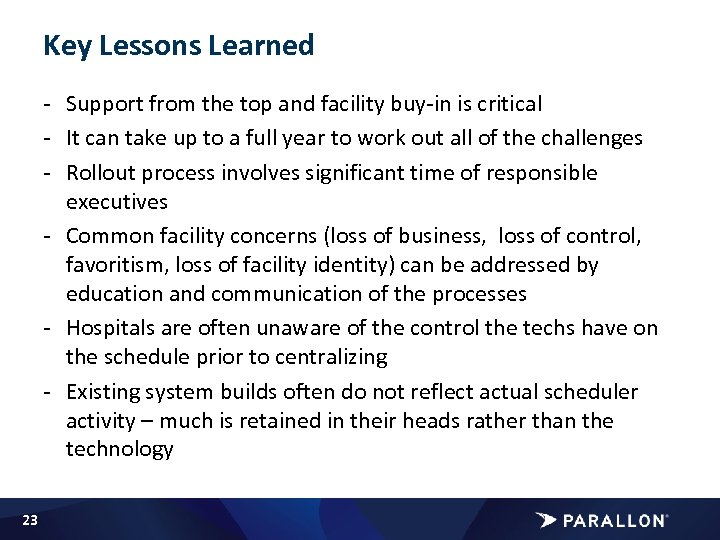 Key Lessons Learned - Support from the top and facility buy-in is critical - It can take up to a full year to work out all of the challenges - Rollout process involves significant time of responsible executives - Common facility concerns (loss of business, loss of control, favoritism, loss of facility identity) can be addressed by education and communication of the processes - Hospitals are often unaware of the control the techs have on the schedule prior to centralizing - Existing system builds often do not reflect actual scheduler activity – much is retained in their heads rather than the technology 23
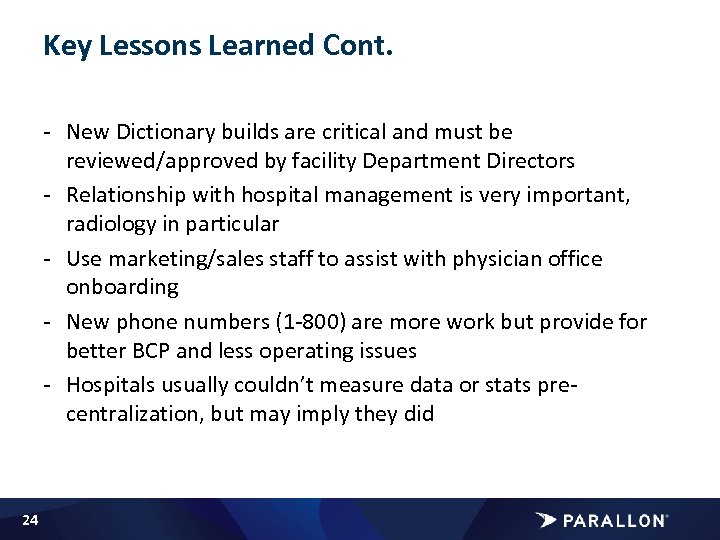 Key Lessons Learned Cont. - New Dictionary builds are critical and must be reviewed/approved by facility Department Directors - Relationship with hospital management is very important, radiology in particular - Use marketing/sales staff to assist with physician office onboarding - New phone numbers (1 -800) are more work but provide for better BCP and less operating issues - Hospitals usually couldn’t measure data or stats precentralization, but may imply they did 24
 Summary and Questions 25