


 Скачать презентацию Making Services Work for Poor People world development
d916465aed60058a4019e24919699142.ppt
- Количество слайдов: 32
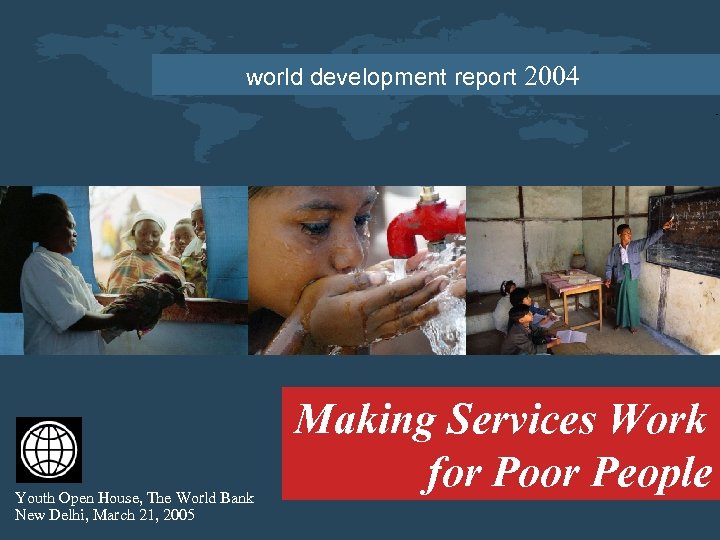 Making Services Work for Poor People world development report 2004 Youth Open House, The World Bank New Delhi, March 21, 2005 Making Services Work for Poor People
 Making Services Work for Poor People Messages • Services are failing poor people • But they can work. How? • By empowering poor people to – Monitor and discipline service providers – Raise their voice in policymaking • By strengthening incentives for service providers to serve the poor
 Making Services Work for Poor People The reality of South Asia • No city in South Asia has 24 x 7 water supply – Delhi & Dhaka: 6 -8 hours a day; Hyderabad & Karachi: 3 hours every second day – intermittent supply and attendant health problems • Over 50 percent of water not accounted for: South Asian cities are leaking buckets • Cost recovery only 20 percent of O&M: decaying infrastructure
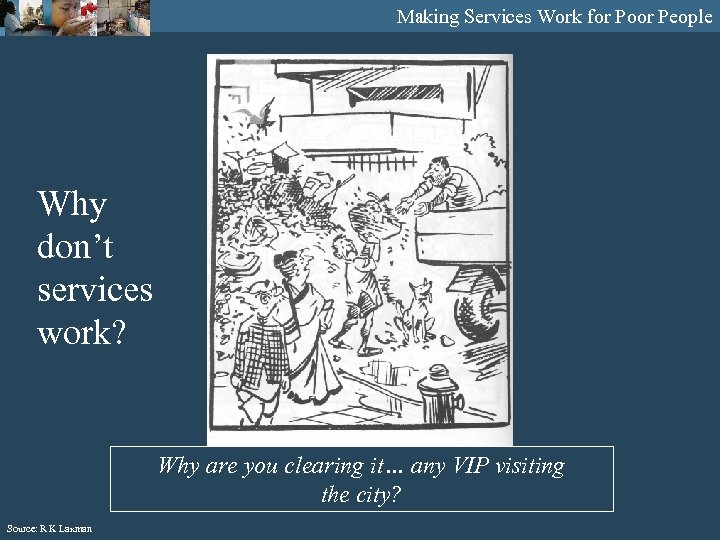 Making Services Work for Poor People Why don’t services work? Why are you clearing it… any VIP visiting the city? Source: R K Laxman
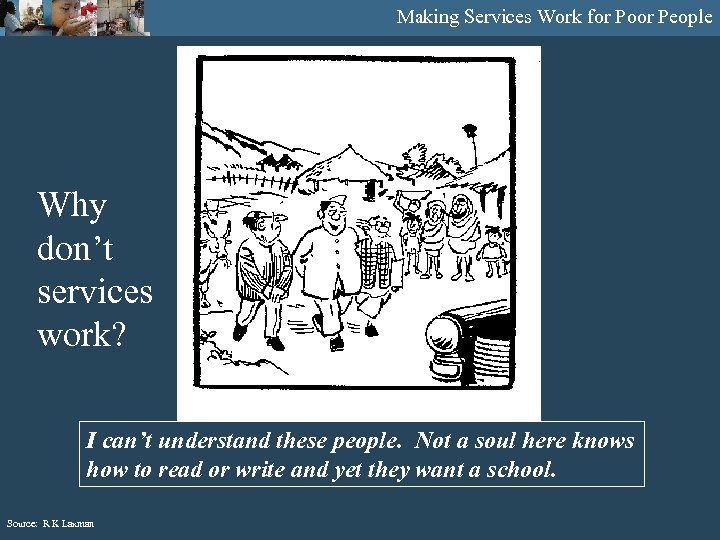 Making Services Work for Poor People Why don’t services work? I can’t understand these people. Not a soul here knows how to read or write and yet they want a school. Source: R K Laxman
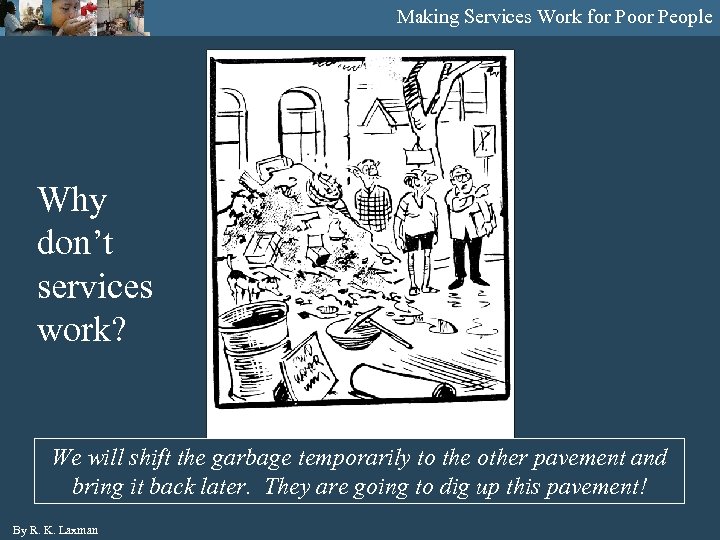 Making Services Work for Poor People Why don’t services work? We will shift the garbage temporarily to the other pavement and bring it back later. They are going to dig up this pavement! By R. K. Laxman
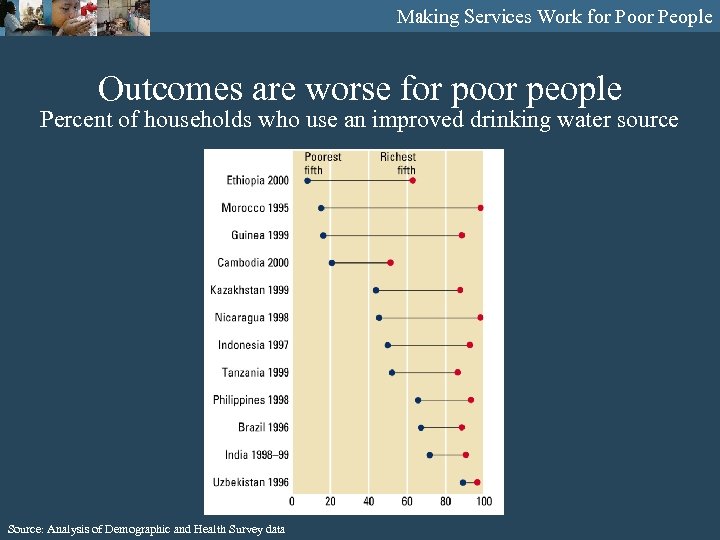 Making Services Work for Poor People Outcomes are worse for poor people Percent of households who use an improved drinking water source Source: Analysis of Demographic and Health Survey data
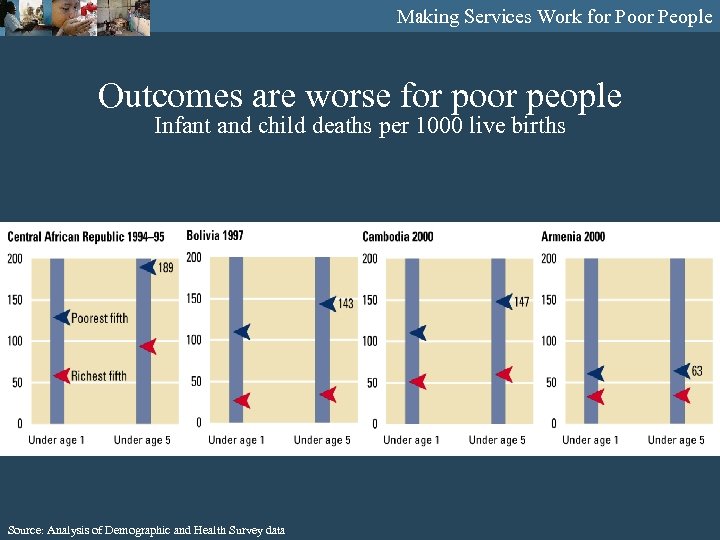 Making Services Work for Poor People Outcomes are worse for poor people Infant and child deaths per 1000 live births Source: Analysis of Demographic and Health Survey data
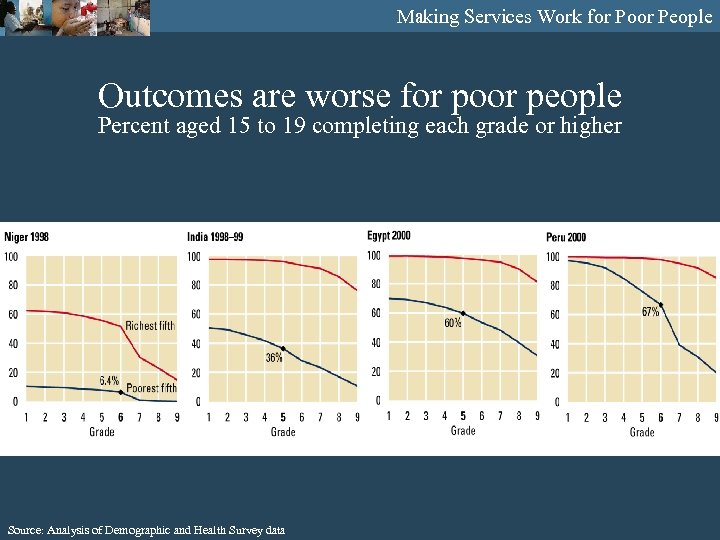 Making Services Work for Poor People Outcomes are worse for poor people Percent aged 15 to 19 completing each grade or higher Source: Analysis of Demographic and Health Survey data
 Making Services Work for Poor People How are services failing poor people? • Public spending usually benefits the rich, not the poor
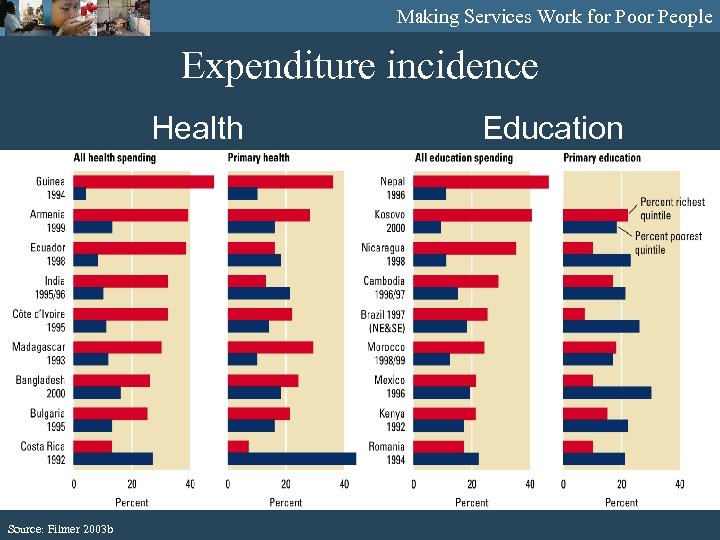 Making Services Work for Poor People Expenditure incidence Health Source: Filmer 2003 b Education
 Making Services Work for Poor People How are services failing poor people? • Public spending benefits the rich more than the poor • Money fails to reach frontline service providers – In Uganda, only 13 percent of non-wage recurrent spending on primary education reached primary schools
 Making Services Work for Poor People How are services failing poor people? • Public spending benefits the rich more than the poor • Money fails to reach frontline service providers • Service quality is low for poor people
 Making Services Work for Poor People Examples of low service quality • India: Absenteeism rates for teachers in government primary schools: 50 percent • Bangladesh: Absenteeism rates for doctors in primary health care centers: 74 percent • Zimbabwe: “nurses hit mothers during delivery” • Guinea: 70 percent government drugs disappeared • Bangladesh: Arsenic has reduced rural drinking water access from 97 to 75 percent • India: Delhi & Chennai get 4 to 6 hours of water per day, Hyderabad gets 1. 5 hours every other day
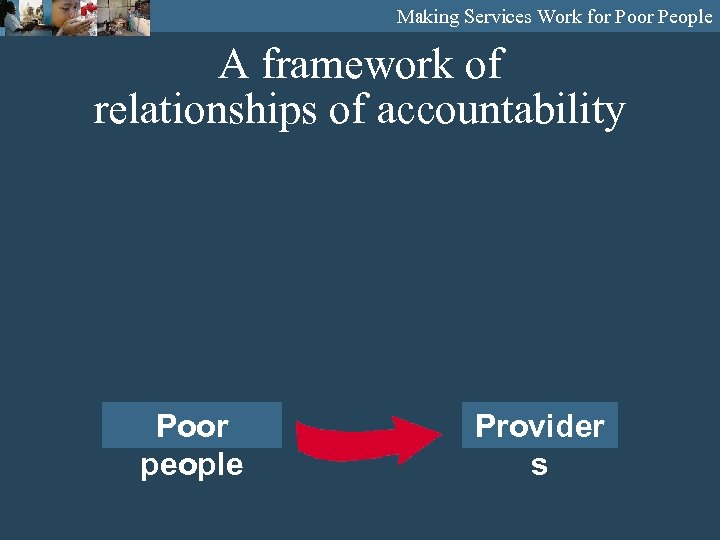 Making Services Work for Poor People A framework of relationships of accountability Poor people Provider s
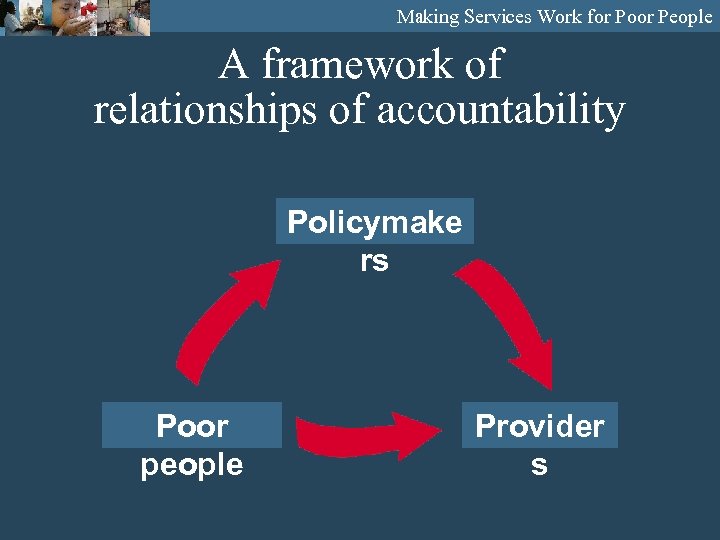 Making Services Work for Poor People A framework of relationships of accountability Policymake rs Poor people Provider s
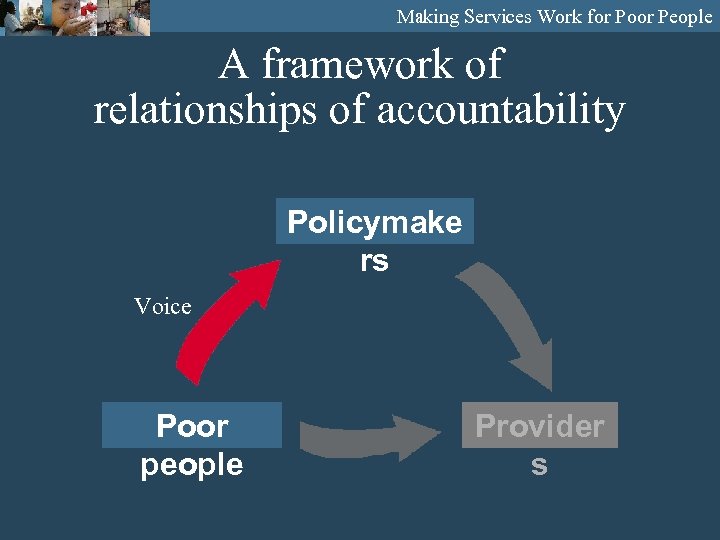 Making Services Work for Poor People A framework of relationships of accountability Policymake rs Voice Poor people Provider s
 Making Services Work for Poor People Mexico’s PRONASOL, 1989 -94 • Large social assistance program (1. 2 percent of GDP) • Water, sanitation, electricity and education construction to poor communities • Limited poverty impact – Reduced poverty by 3 percent – Even an untargeted, uniform per capita transfer would have reduced poverty by 13 percent
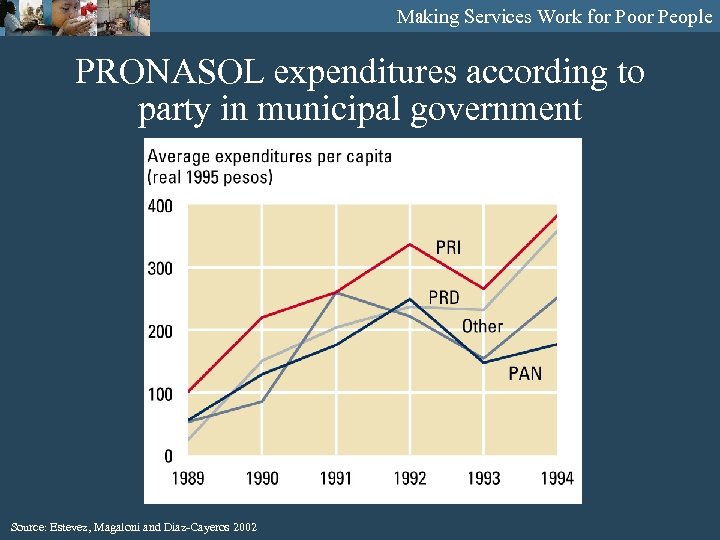 Making Services Work for Poor People PRONASOL expenditures according to party in municipal government Source: Estevez, Magaloni and Diaz-Cayeros 2002
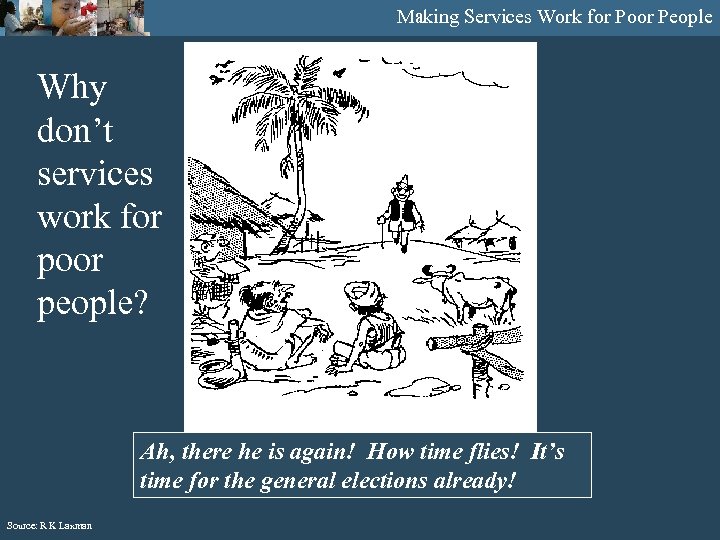 Making Services Work for Poor People Why don’t services work for poor people? Ah, there he is again! How time flies! It’s time for the general elections already! Source: R K Laxman
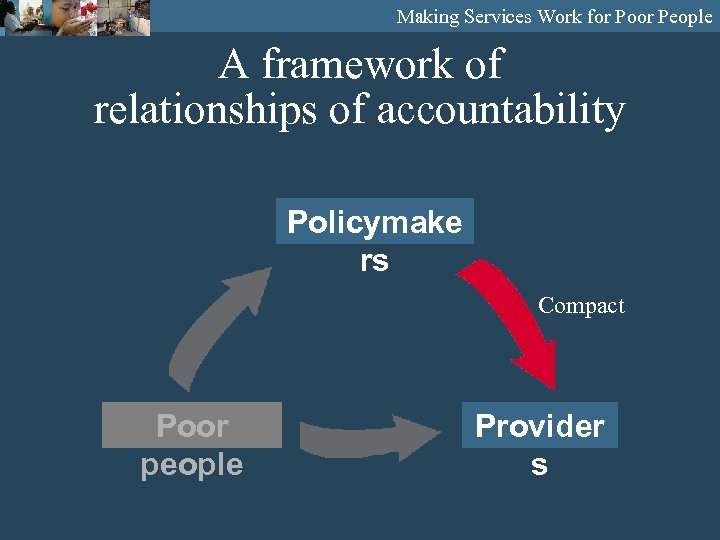 Making Services Work for Poor People A framework of relationships of accountability Policymake rs Compact Poor people Provider s
 Making Services Work for Poor People Policymaker-provider: Contracting NGOs in Cambodia • Contracted out: NGO managed & could hire, fire, & transfer staff, set wages, procure drugs • Contracted in: NGO managed and could transfer but not hire and fire staff • Control group: Services run by government 12 districts randomly assigned to each category
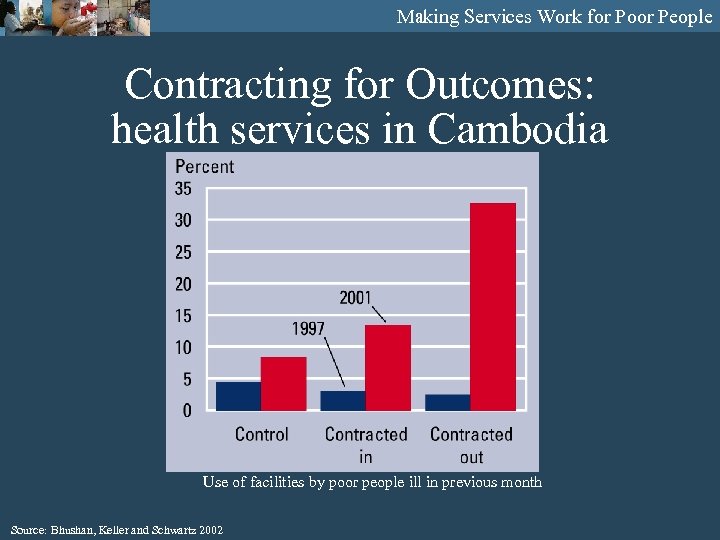 Making Services Work for Poor People Contracting for Outcomes: health services in Cambodia Use of facilities by poor people ill in previous month Source: Bhushan, Keller and Schwartz 2002
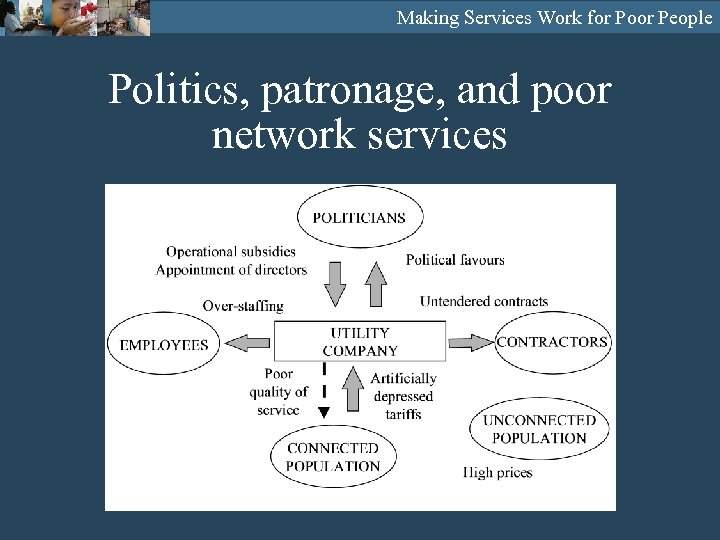 Making Services Work for Poor People Politics, patronage, and poor network services
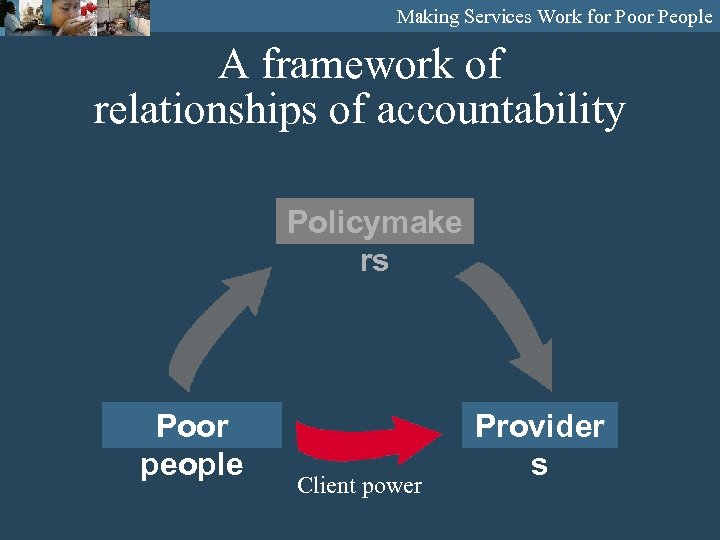 Making Services Work for Poor People A framework of relationships of accountability Policymake rs Poor people Client power Provider s
 Making Services Work for Poor People Keeping girls in secondary school in Bangladesh • Girls to receive scholarship deposited to bank account set up in their name if • Attend school regularly • Maintain passing grade • Stay unmarried • Schools receive grants based on number of girls enrolled
 Making Services Work for Poor People What not to do • Leave it to the private sector • Simply increase public spending • Apply technocratic solutions
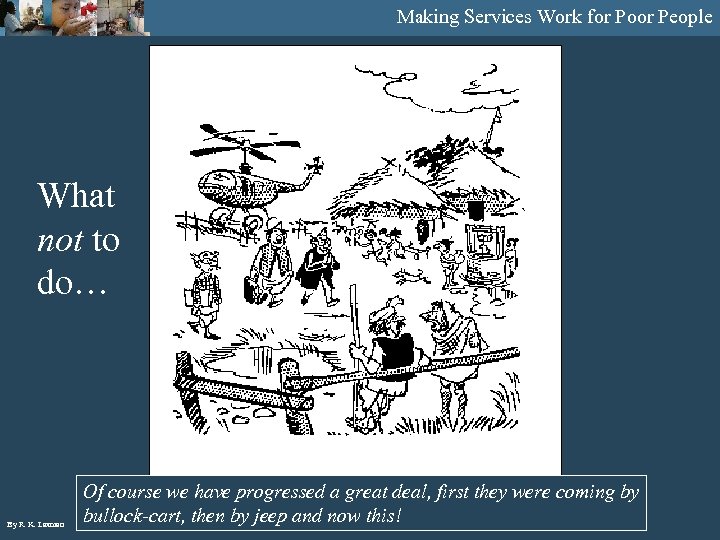 Making Services Work for Poor People What not to do… By R. K. Laxman Of course we have progressed a great deal, first they were coming by bullock-cart, then by jeep and now this!
 Making Services Work for Poor People What is to be done? • Expand information • Tailor service delivery arrangements. One size does not fit all • Why do democracies fail to deliver services? Think about the politics of service delivery • Services just for poor people or for all?
 Making Services Work for Poor People One size does not fit all • Different sectors & countries need different accountability relationships to be strengthened • Making just one link more effective may not be enough, & may cause problems: over-supervising curative care, promoting user groups to detriment of local government • So, a constellation of solutions needed to enhance accountability, each matching a particular set of conditions • Impact evaluation helps us learn what works, where, and why
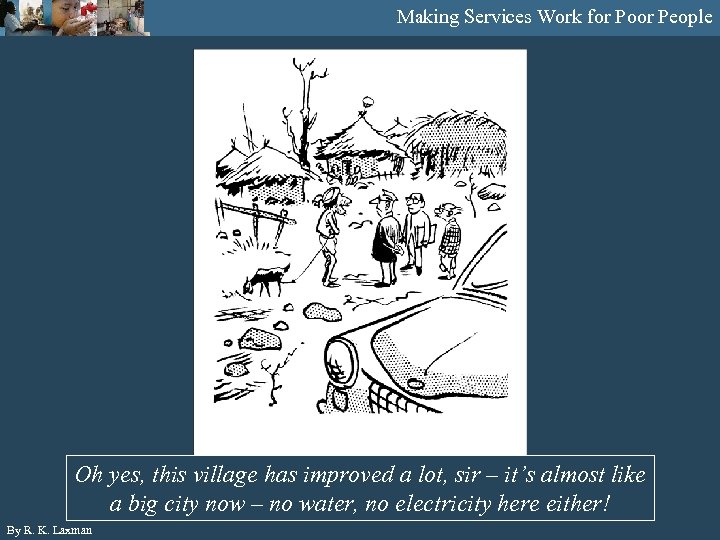 Making Services Work for Poor People Oh yes, this village has improved a lot, sir – it’s almost like a big city now – no water, no electricity here either! By R. K. Laxman
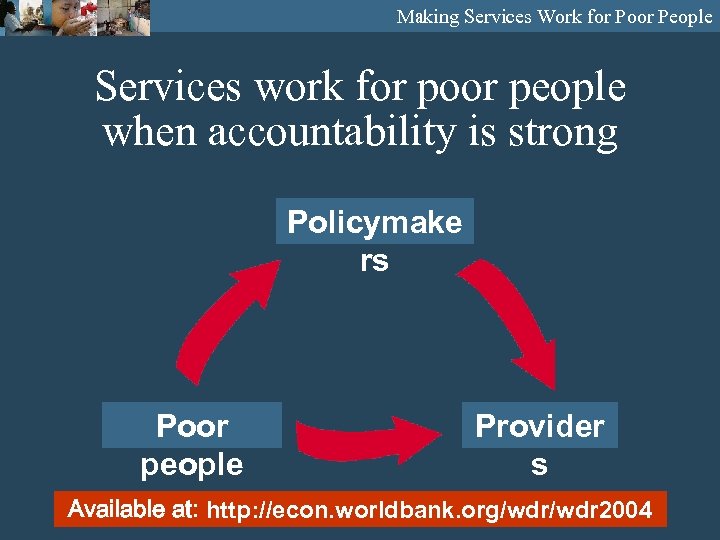 Making Services Work for Poor People Services work for poor people when accountability is strong Policymake rs Poor people Provider s Available at: http: //econ. worldbank. org/wdr 2004