


 Скачать презентацию Making presentations Psych 231 Research Methods in Psychology
391dcf2f7bf9bc85ca70d13bdf560d7e.ppt
- Количество слайдов: 22
 Making presentations Psych 231: Research Methods in Psychology
 Announcements Final drafts due, turn in first drafts too n Remember to bring your group project materials (intro, methods, results, etc. ) to lab n Additional Presentation resources on you syllabus page n – syllabus page
 Presentations n Presenting your research – Posters – Talks – Papers
 Why do presentations? n To present your work/theory/research – Get feedback • It is an opportunity for peers to ask you questions about your work • For you to ask them questions – You want your audience to walk away remembering a few key points n So your goal is to be as clear as possible
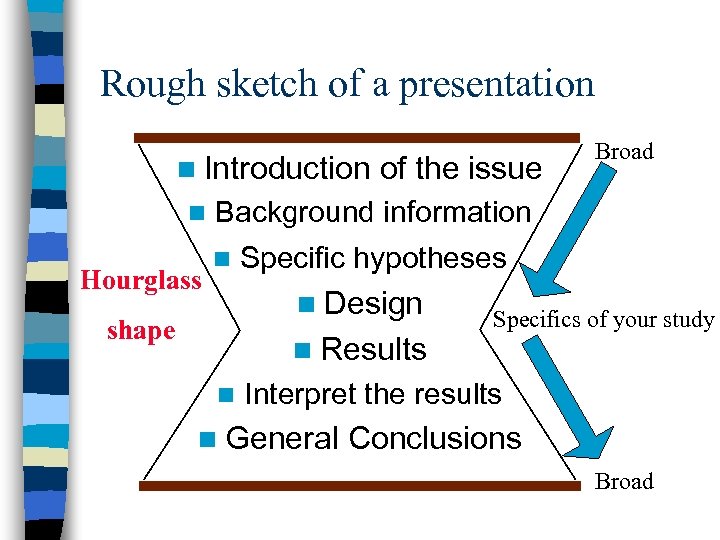 Rough sketch of a presentation n Introduction n Hourglass of the issue Broad Background information n Specific hypotheses n Design shape n Results n Specifics of your study Interpret the results n General Conclusions Broad
 Preparation n Consider your audience - who are they, what do they want, what do they already know n Start collecting the things that you think that you’ll need - graphs, tables, pictures, examples, data analyses, etc. n Determine the key points that you want them to remember – focus your presentation on these points n Camping trip analogy – Your initial pack usually has too much stuff – Need to figure out what to take out n Practice, rehearse, and then practice again
 Poster content Stick to the hourglass shape for content n Balance of text and figures n – Use bullet points – Give example stimuli Use large enough font to read from 6 feet away n End with 3 or 4 key “take home” points n
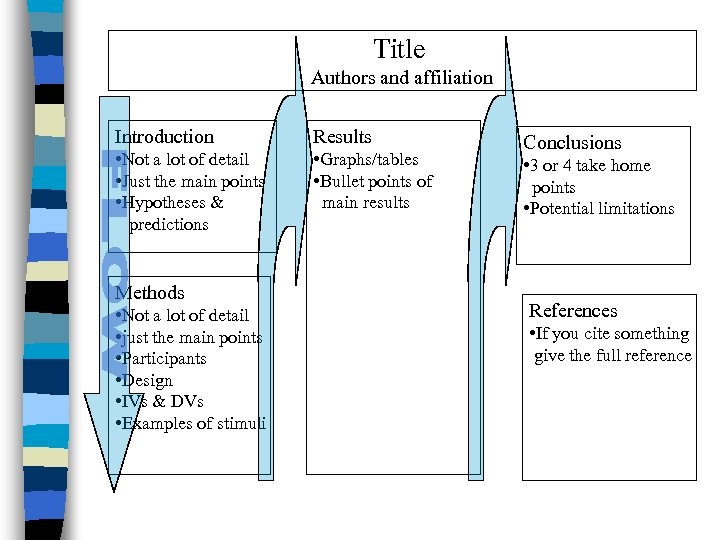 Title Authors and affiliation Introduction Results • Not a lot of detail • Just the main points • Hypotheses & predictions • Graphs/tables • Bullet points of main results Methods • Not a lot of detail • just the main points • Participants • Design • IVs & DVs • Examples of stimuli Conclusions • 3 or 4 take home points • Potential limitations References • If you cite something give the full reference
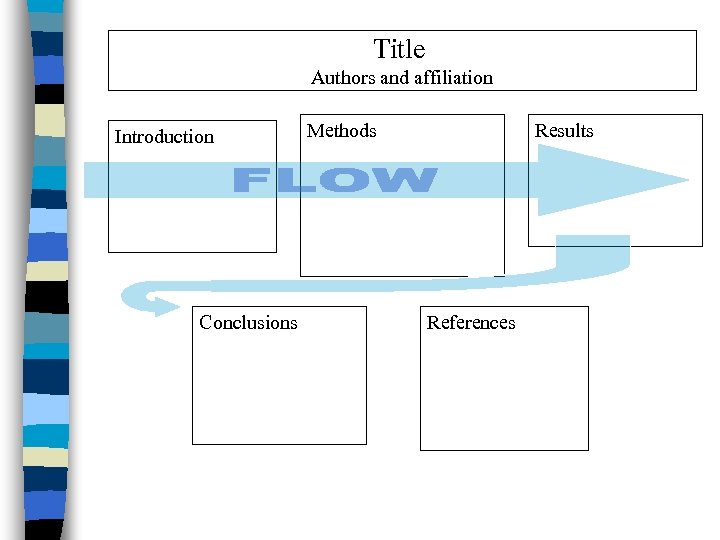 Title Authors and affiliation Introduction Conclusions Methods Results References
 Brief checklist for the poster Initial sketch/outline n Rough layout n – – n Balance (text/pictures, data/conclusions) Typography Movement Simplicity Final layout
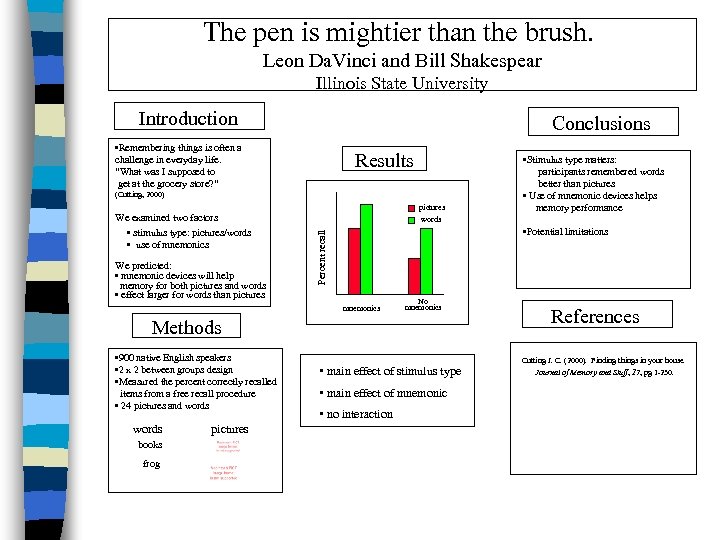 The pen is mightier than the brush. Leon Da. Vinci and Bill Shakespear Illinois State University Introduction Conclusions • Remembering things is often a challenge in everyday life. “What was I supposed to get at the grocery store? ” Results (Cutting, 2000) pictures words We examined two factors We predicted: • mnemonic devices will help memory for both pictures and words • effect larger for words than pictures • Potential limitations Percent recall • stimulus type: pictures/words • use of mnemonics No mnemonics Methods • 900 native English speakers • 2 x 2 between groups design • Measured the percent correctly recalled items from a free recall procedure • 24 pictures and words books frog pictures • Stimulus type matters: participants remembered words better than pictures • Use of mnemonic devices helps memory performance • main effect of stimulus type • main effect of mnemonic • no interaction References Cutting J. C. (2000). Finding things in your house. Journal of Memory and Stuff, 17, pg 1 -230.
 Presentation of the poster n n n Arrive early and set up Author(s) stand next to poster Have a short “walk through” presentation ready Answer questions (also ask questions) Handout copies of the poster available (sometimes), or a request sign-up
 Your posters (our checklist) n Content – Introduction • • Problem of interest Very brief summary of past research Basic purpose of experiment(s) Hypotheses – Method • • Brief but clear Design Materials Procedure (brief)
 Your posters (our checklist) n Content cont. – Results • Descriptive statistics • Inferential results – Discussion • Hypothesis rejected or supported • Implication of results • A few take home points – References – Tables and figures • Useful info to reader • Easy to understand
 Your posters (our checklist) n Format – – – Overall clarity Organization Font size Figure/text balance Title Authors
 Different kinds of talks n Research Presentations – (typically 10 to 30 mins) Paper with respondent n Panel Presentation n Workshop n
 Talk Content n Create a logical progression to the talk – Hourglass shape – Work on the transitions between slides n Be brief, but include enough details so that the audience can follow the arguments – Use slides to help simplify/clarify points • Include tables, graphs, pictures, etc. • Don’t just read the slides • but do “walk through” those that need it (e. g. graphs of results) – Be careful of jargon, explain terms (if in fact you really need them)
 Presentation of the talk n n n n Make it smooth (lots of practice will help) Watch your speaking rate (again, practice) Maintain eye contact with whole audience Emphasize the key points, make sure that the audience can identify these Point to the slides if it helps Beware jokes, can be a double-edged sword Don’t go over your time
 Dealing with questions n Repeat the question in your own words – so that the rest of the audience can hear it – to make sure that you understood the question – to buy yourself some time to think about the answer n Try not to be nervous – you know your study better than anyone else n When preparing, try to think of likely questions and prepare answers
 Checklist for the talk n Preparation – Analyze the audience – Choose your main points – etc. n Prepare the Final Outline – fix any problems/loose ends n Construct your “speaking” outline – e. g. , the note cards that you’ll read n Rehearse, rehearse
 Next time n Summarizing the research process
 Preparation n Consider your audience - who are they, what do they want, what do they already know n Start collecting the things that you think that you’ll need - graphs, tables, pictures, examples, data analyses, etc. n Determine the key points that you want them to remember – focus your presentation on these points n Camping trip analogy – Your initial pack usually has too much stuff – Need to figure out what to take out n Practice, rehearse, and then practice again