


 Скачать презентацию Making Performance Management Real From the Myth to
c1786e92a711e2ad8d90b6468179a1a5.ppt
- Количество слайдов: 29
 Making Performance Management Real From the Myth to the Reality Olivier Derrien Area Vice President Southern Europe Cognos, an IBM Company
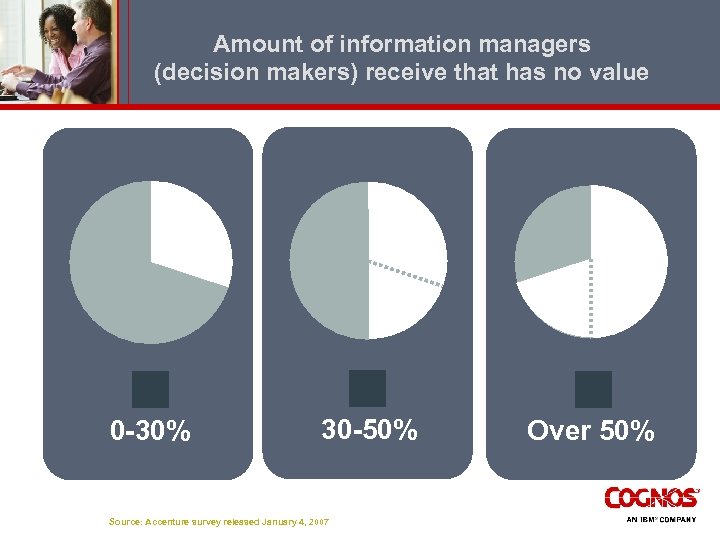 Amount of information managers (decision makers) receive that has no value 0 -30% 30 -50% Source: Accenture survey released January 4, 2007 Over 50%
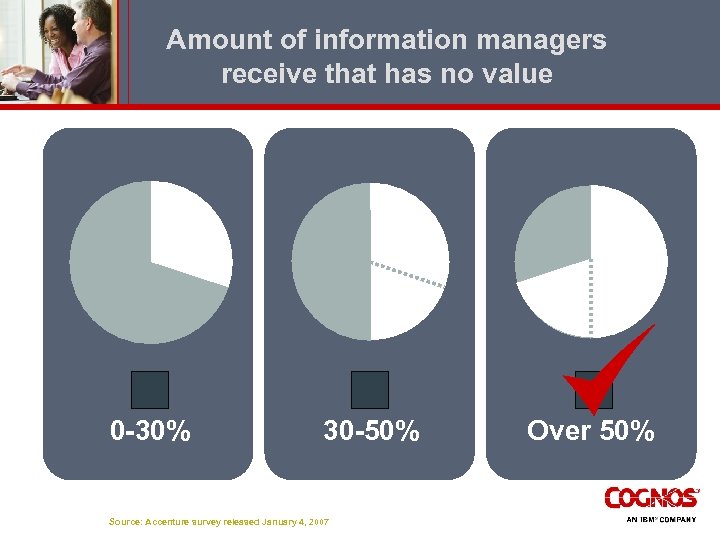 Amount of information managers receive that has no value 0 -30% 30 -50% Source: Accenture survey released January 4, 2007 Over 50%
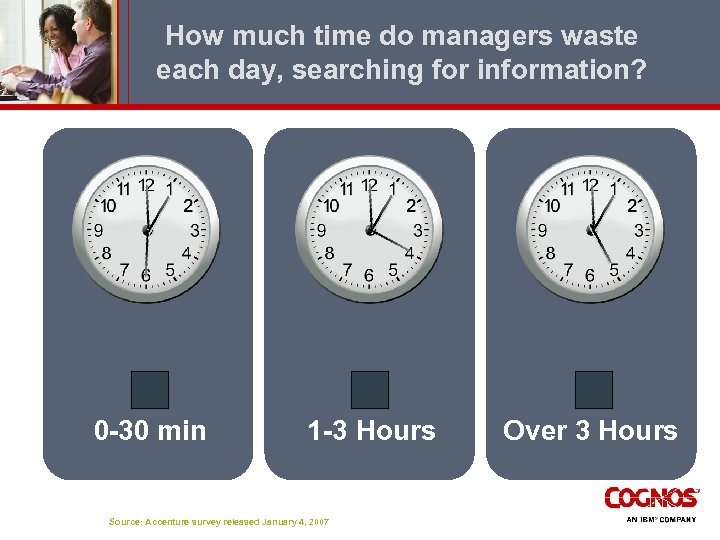 How much time do managers waste each day, searching for information? 0 -30 min 1 -3 Hours Source: Accenture survey released January 4, 2007 Over 3 Hours
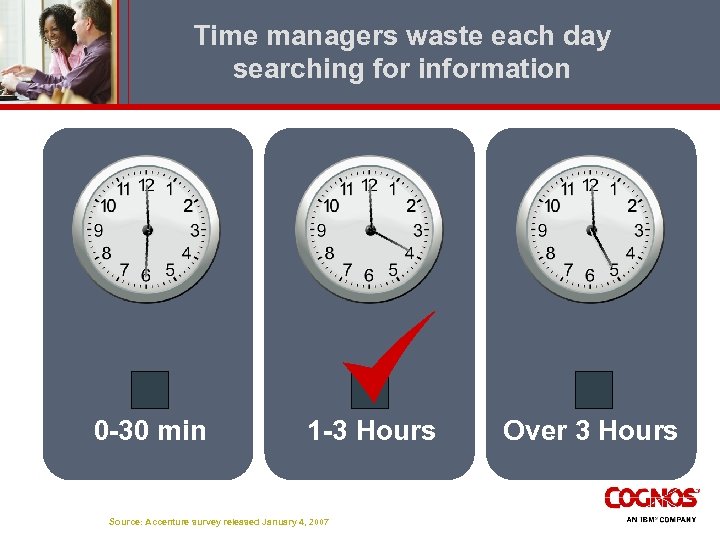 Time managers waste each day searching for information 0 -30 min 1 -3 Hours Source: Accenture survey released January 4, 2007 Over 3 Hours
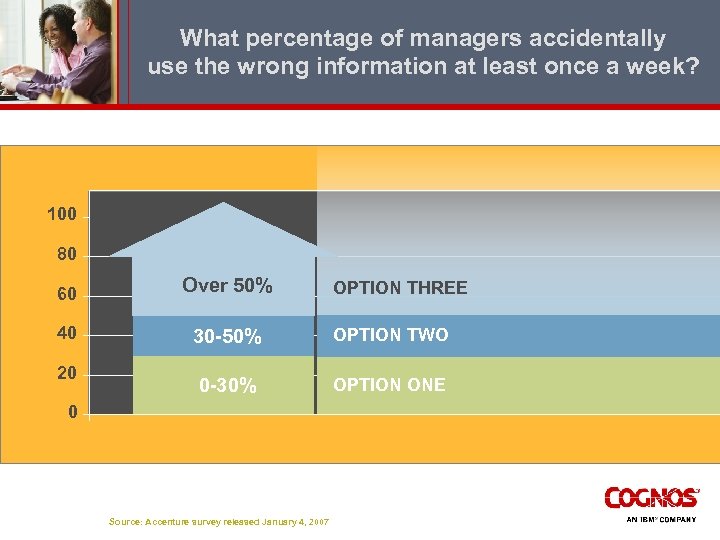 What percentage of managers accidentally use the wrong information at least once a week? 100 80 60 Over 50% 40 30 -50% OPTION TWO 0 -30% OPTION ONE 20 0 Source: Accenture survey released January 4, 2007 OPTION THREE
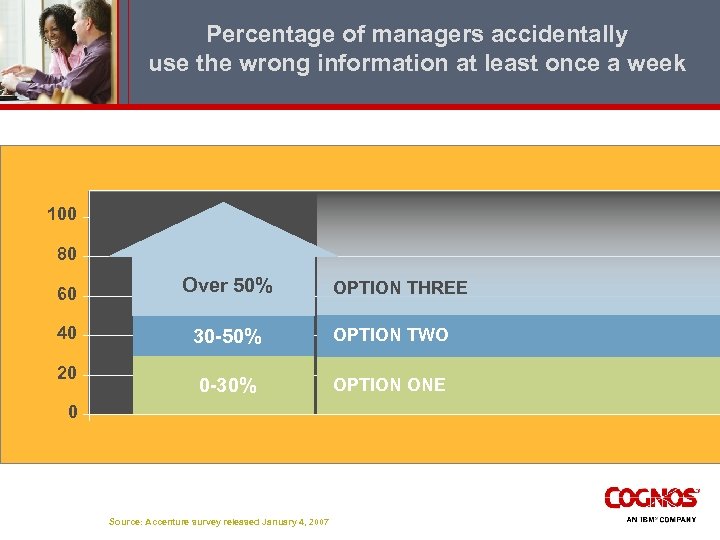 Percentage of managers accidentally use the wrong information at least once a week 100 80 60 Over 50% 40 30 -50% OPTION TWO 0 -30% OPTION ONE 20 0 Source: Accenture survey released January 4, 2007 OPTION THREE
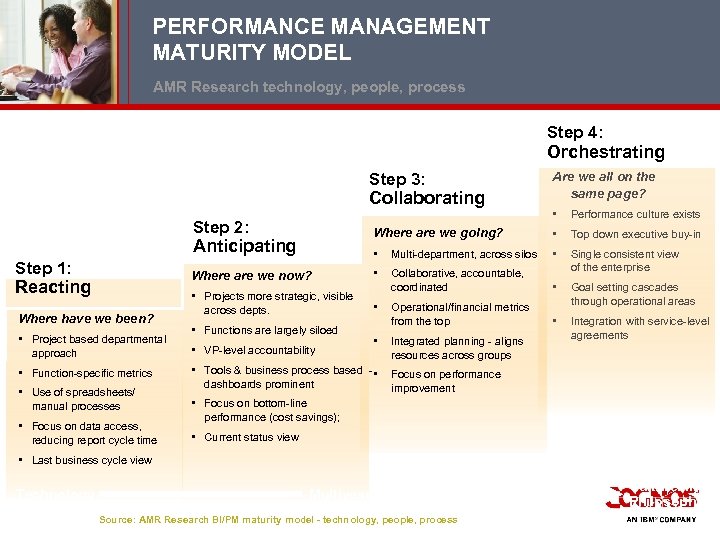 PERFORMANCE MANAGEMENT MATURITY MODEL AMR Research technology, people, process Step 4: Orchestrating Step 3: Collaborating Are we all on the same page? • Performance culture exists Where are we going? • Top down executive buy-in • Multi-department, across silos • Where are we now? • • Projects more strategic, visible across depts. Collaborative, accountable, coordinated Single consistent view of the enterprise • • Operational/financial metrics from the top Goal setting cascades through operational areas • Integration with service-level agreements Step 2: Anticipating Step 1: Reacting Where have we been? • Project based departmental approach • Function-specific metrics • Use of spreadsheets/ manual processes • Focus on data access, reducing report cycle time • Functions are largely siloed • VP-level accountability • • Tools & business process based - • dashboards prominent Integrated planning - aligns resources across groups Focus on performance improvement • Focus on bottom-line performance (cost savings); • Current status view • Last business cycle view Technology Multiyear Effort Source: AMR Research BI/PM maturity model - technology, people, process Culture/Mgt. Philosophy
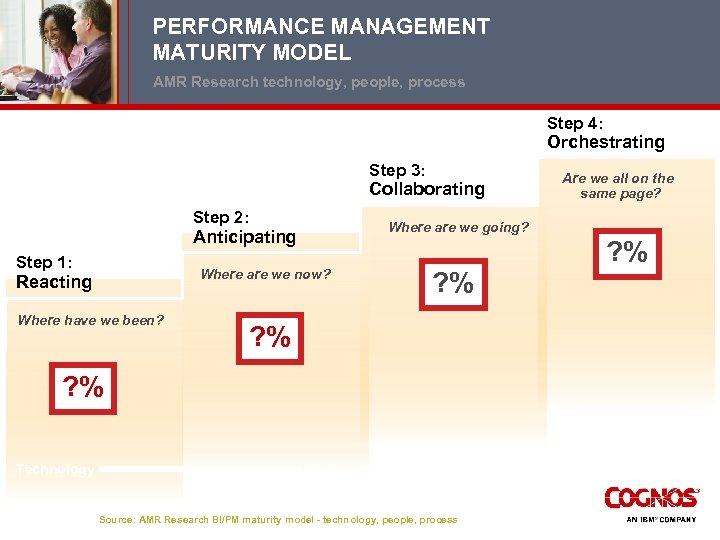 PERFORMANCE MANAGEMENT MATURITY MODEL AMR Research technology, people, process Step 4: Orchestrating Step 3: Collaborating Step 2: Where are we going? Anticipating Step 1: Where are we now? Reacting Where have we been? Are we all on the same page? ? % ? % Technology Multiyear Effort Source: AMR Research BI/PM maturity model - technology, people, process Culture/ Philosophy
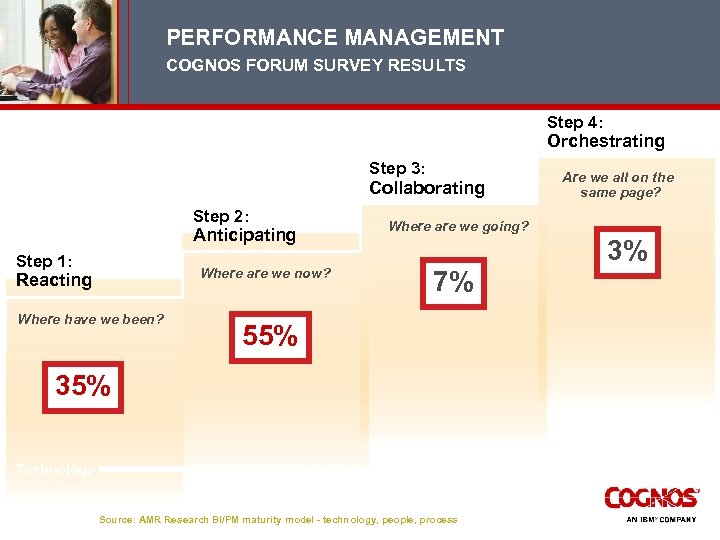 PERFORMANCE MANAGEMENT COGNOS FORUM SURVEY RESULTS Step 4: Orchestrating Step 3: Collaborating Step 2: Where are we going? Anticipating Step 1: Where are we now? Reacting Where have we been? Are we all on the same page? 7% 3% 55% 35% Technology Multiyear Effort Source: AMR Research BI/PM maturity model - technology, people, process Culture/ Philosophy
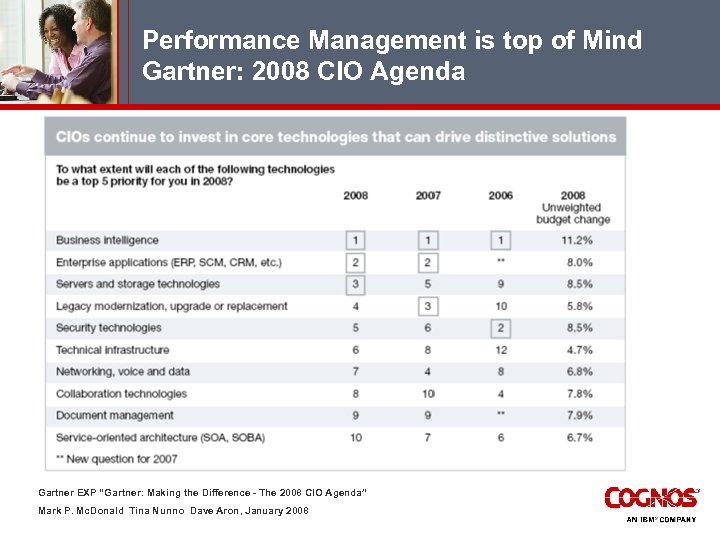 Performance Management is top of Mind Gartner: 2008 CIO Agenda Gartner EXP “Gartner: Making the Difference - The 2008 CIO Agenda” Mark P. Mc. Donald Tina Nunno Dave Aron, January 2008
 IT CHALLENGES AND TRENDS § Top goals of the CIO: § Business: “Aligning IT and Business” § Technical: Business Intelligence § Complex infrastructures; flat budgets § BI and PM standardization on the rise § Hot technologies are changing the landscape
 WHAT IS NEEDED? § Enterprise-class platform § Reliable and scalable software that is low cost to deploy, manage and maintain § Complete, consistent view of information, anytime, anywhere § Capabilities for all user communities to ensure access to the right information for better decision-making § Solutions based on Best Practices § Analytic Applications, Services, Support and more that accelerate deployment and success
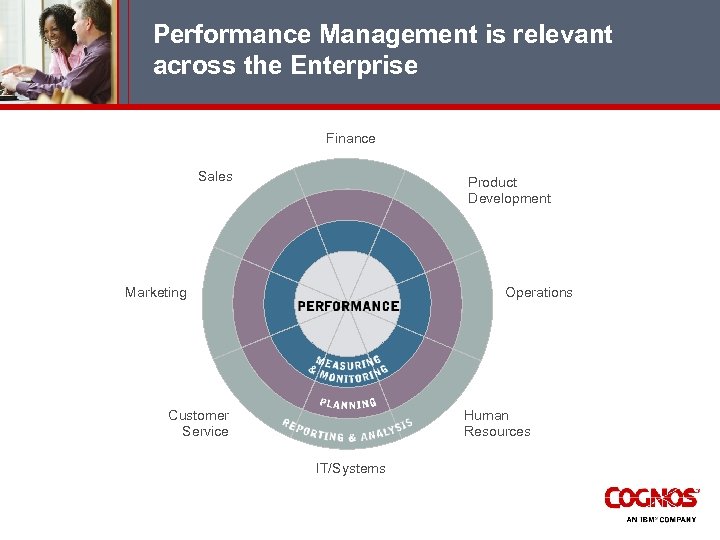 Performance Management is relevant across the Enterprise Finance Sales Product Development Marketing Operations Customer Service Human Resources IT/Systems
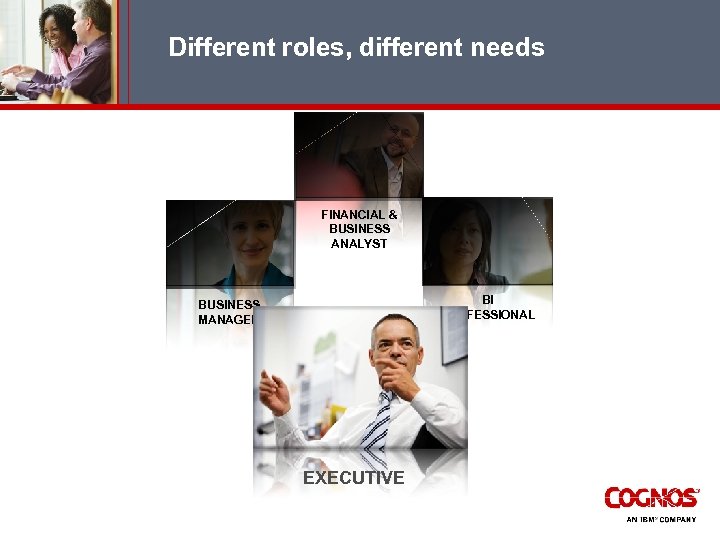 Different roles, different needs FINANCIAL & BUSINESS ANALYST BI PROFESSIONAL BUSINESS MANAGER EXECUTIVE
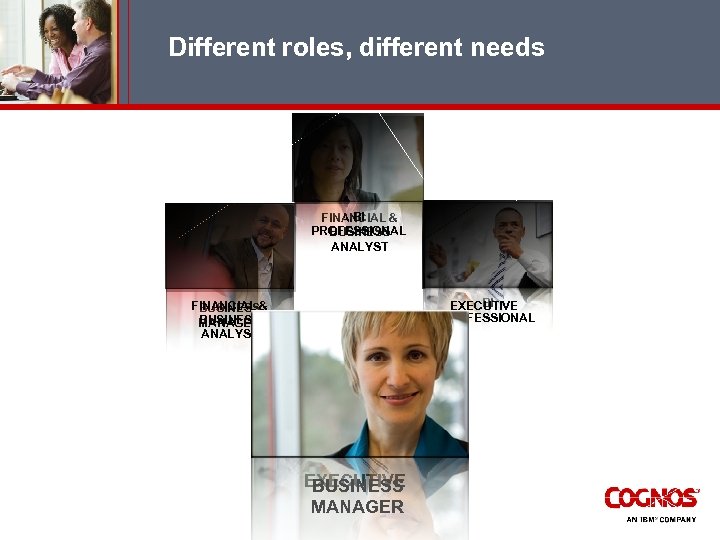 Different roles, different needs BI FINANCIAL & PROFESSIONAL BUSINESS ANALYST BI EXECUTIVE PROFESSIONAL FINANCIAL & BUSINESS MANAGER ANALYST EXECUTIVE BUSINESS MANAGER
 Different roles, different needs BI EXECUTIVE PROFESSIONAL FINANCIAL & BI BUSINESS PROFESSIONAL ANALYST EXECUTIVE BUSINESS MANAGER FINANCIAL & BUSINESS ANALYST MANAGER
 Different roles, different needs BUSINESS EXECUTIVE MANAGER EXECUTIVE BI PROFESSIONAL FINANCIAL & BUSINESS MANAGER ANALYST BI PROFESSIONAL FINANCIAL & BUSINESS ANALYST
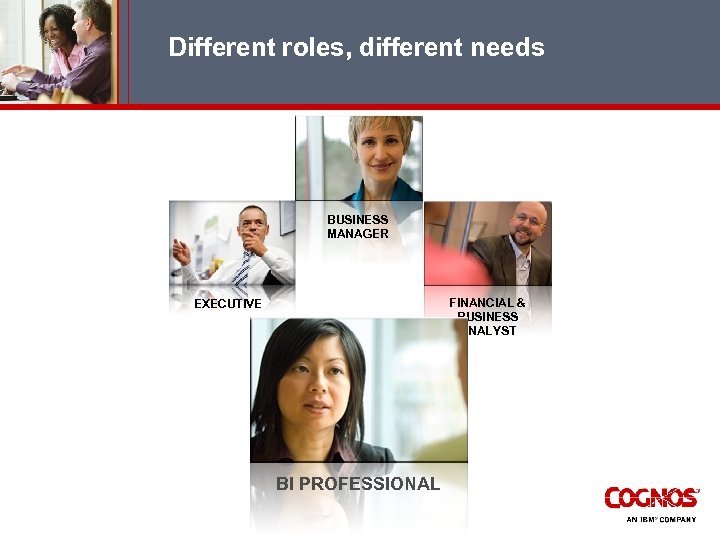 Different roles, different needs BUSINESS MANAGER FINANCIAL & BUSINESS ANALYST EXECUTIVE BI PROFESSIONAL
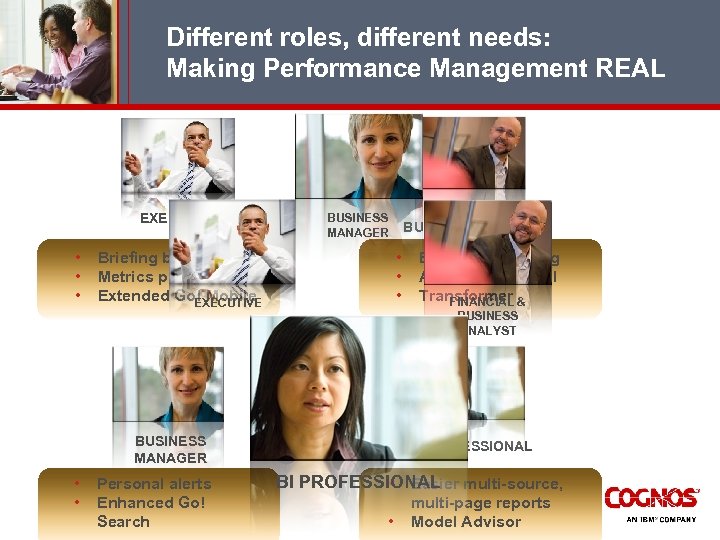 Different roles, different needs: Making Performance Management REAL EXECUTIVE • • • Briefing books Metrics portlets Extended Go! Mobile EXECUTIVE Personal alerts Enhanced Go! Search Express authoring Analysis for Excel Transformer & FINANCIAL BUSINESS ANALYST BUSINESS MANAGER • • FINANCIAL & BUSINESS ANALYST BUSINESS MANAGER BI PROFESSIONAL multi-source, • Easier • multi-page reports Model Advisor
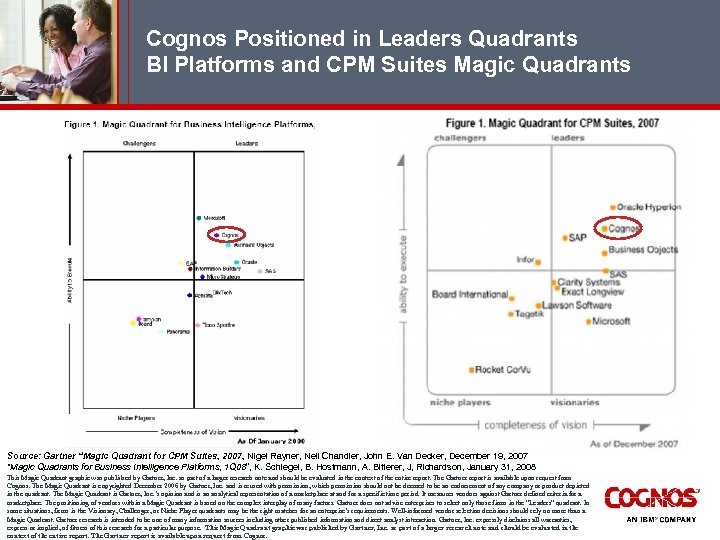 Cognos Positioned in Leaders Quadrants BI Platforms and CPM Suites Magic Quadrants Source: Gartner “Magic Quadrant for CPM Suites, 2007, Nigel Rayner, Neil Chandler, John E. Van Decker, December 19, 2007 “Magic Quadrants for Business Intelligence Platforms, 1 Q 08”, K. Schlegel, B. Hostmann, A. Bitterer, J, Richardson, January 31, 2008 This Magic Quadrant graphic was published by Gartner, Inc. as part of a larger research note and should be evaluated in the context of the entire report. The Gartner report is available upon request from Cognos. The Magic Quadrant is copyrighted December 2006 by Gartner, Inc. and is reused with permission, which permission should not be deemed to be an endorsement of any company or product depicted in the quadrant. The Magic Quadrant is Gartner, Inc. ’s opinion and is an analytical representation of a marketplace at and for a specific time period. It measures vendors against Gartner defined criteria for a marketplace. The positioning of vendors within a Magic Quadrant is based on the complex interplay of many factors. Gartner does not advise enterprises to select only those firms in the "Leaders" quadrant. In some situations, firms in the Visionary, Challenger, or Niche Player quadrants may be the right matches for an enterprise's requirements. Well-informed vendor selection decisions should rely on more than a Magic Quadrant. Gartner research is intended to be one of many information sources including other published information and direct analyst interaction. Gartner, Inc. expressly disclaims all warranties, express or implied, of fitness of this research for a particular purpose. This Magic Quadrant graphic was published by Gartner, Inc. as part of a larger research note and should be evaluated in the context of the entire report. The Gartner report is available upon request from Cognos.
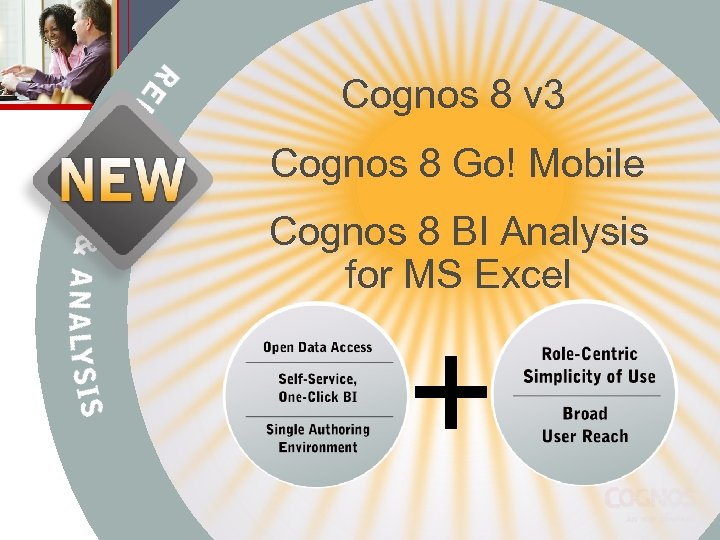 Cognos 8 v 3 Cognos 8 Go! Mobile Cognos 8 BI Analysis for MS Excel
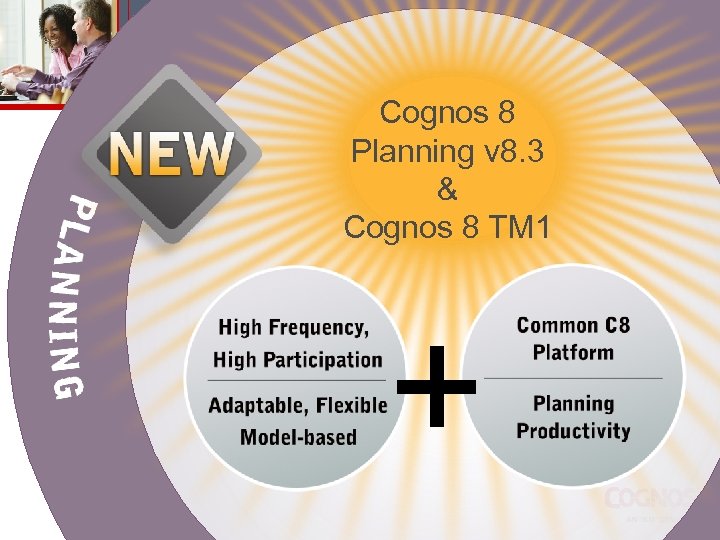 Cognos 8 Planning v 8. 3 & Cognos 8 TM 1
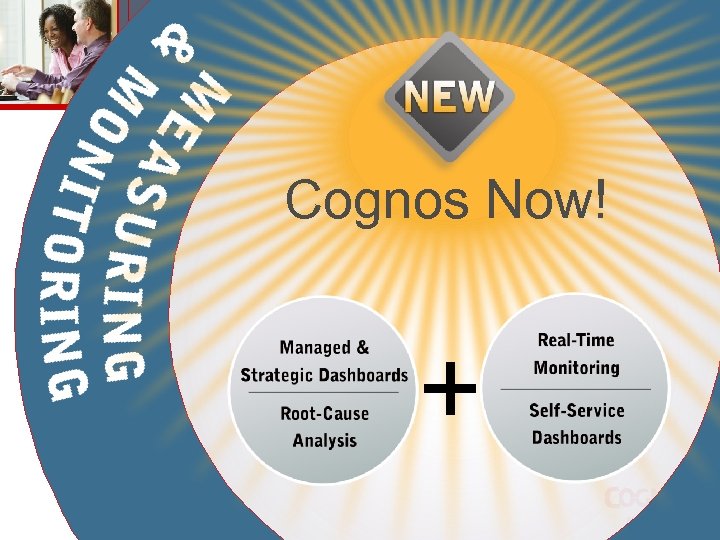 Cognos Now!
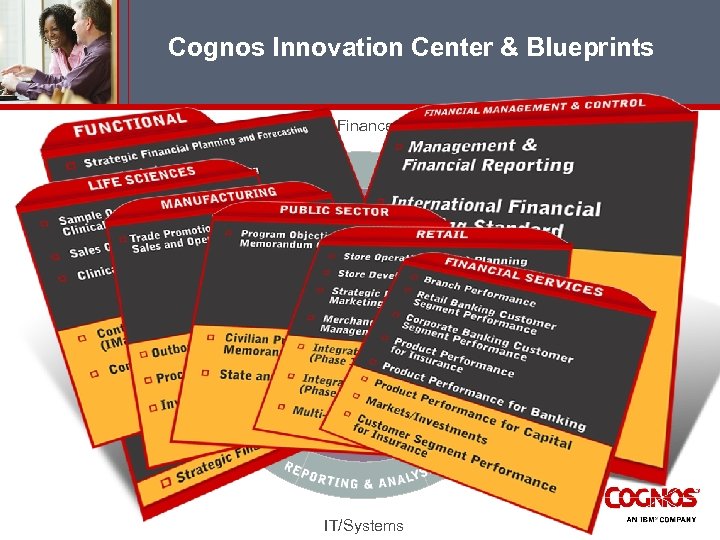 Cognos Innovation Center & Blueprints Finance Sales Product Development Marketing Operations Human Resources Customer Service IT/Systems
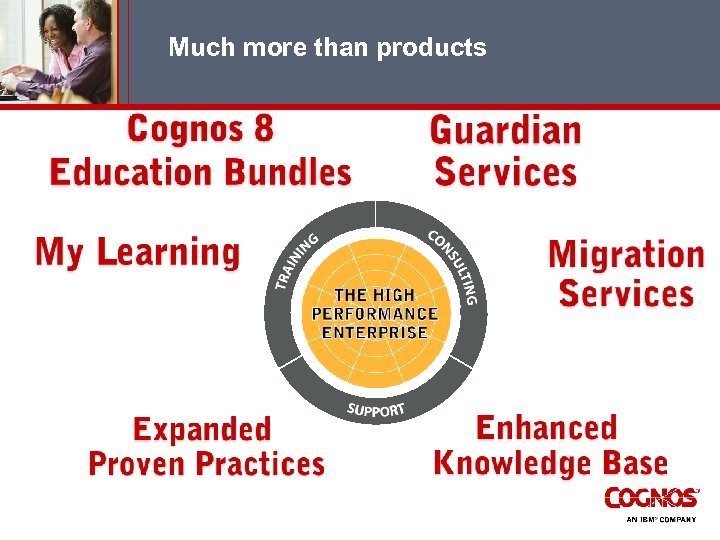 Much more than products
 Thank You!