


 Скачать презентацию Making Linux POCs successful Andy Greco Mainline Information
e83c72fde8b5ca1cbd103974fb87cac7.ppt
- Количество слайдов: 23
 Making Linux POCs successful Andy Greco Mainline Information Systems andy. greco@mainline. com
 CONTENTS • • • Why Mainline? Why linux on z Series? Steps for a successful POC What apps make sense? POC organizational issues Next steps after successful POC
 About Mainline • Founded in 1989; 20 year partnership with IBM • Specializing in System z, System p, System i, System x, System Storage, Software Networking, Retail and Services • Has grown to become an IBM Premier Business Partner and global provider of information technology and infrastructure solutions with more than 600 employees nationwide • Offices are located in Tallahassee, Los Angeles, Chicago, Jersey City, Nashville Sao Paulo, and Monterrey
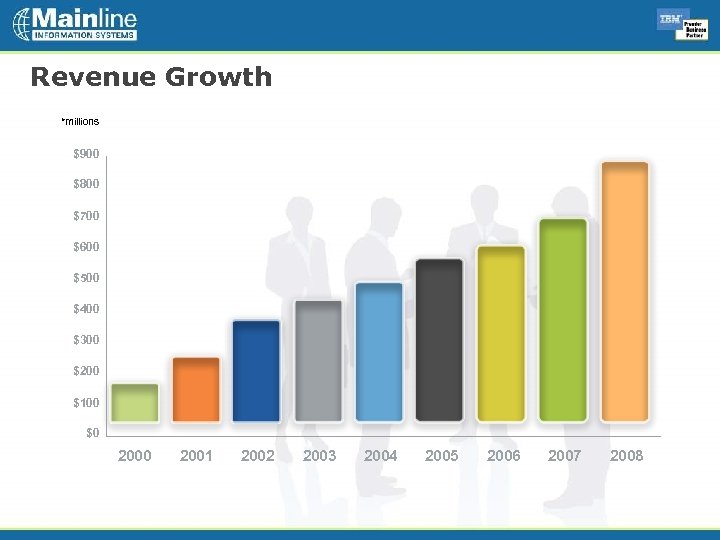 Revenue Growth *millions $900 $800 $700 $600 $500 $400 $300 $200 $100 $0 2001 2002 2003 2004 2005 2006 2007 2008
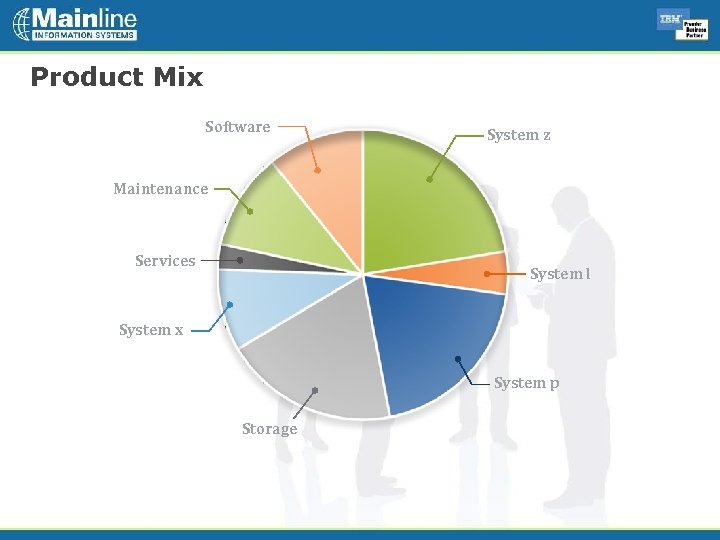 Product Mix Software System z Maintenance Services System l System x System p Storage
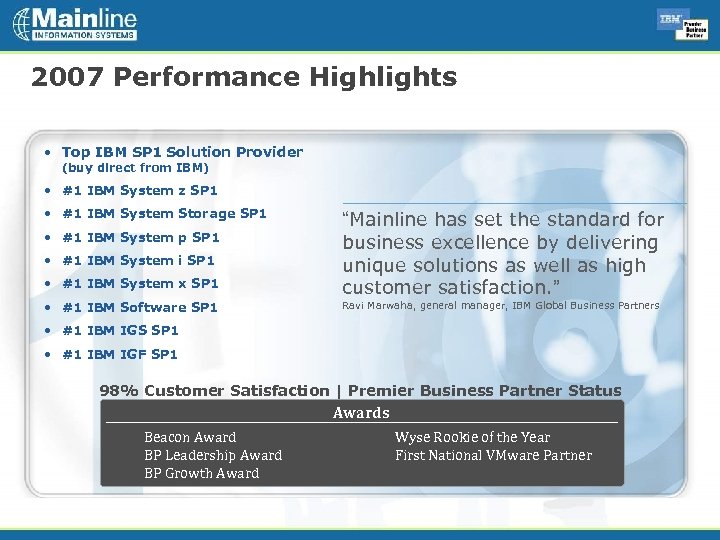 2007 Performance Highlights • Top IBM SP 1 Solution Provider (buy direct from IBM) • #1 IBM System z SP 1 • #1 IBM System Storage SP 1 • #1 IBM System p SP 1 • #1 IBM System i SP 1 • #1 IBM System x SP 1 • #1 IBM Software SP 1 “Mainline has set the standard for business excellence by delivering unique solutions as well as high customer satisfaction. ” Ravi Marwaha, general manager, IBM Global Business Partners • #1 IBM IGS SP 1 • #1 IBM IGF SP 1 98% Customer Satisfaction | Premier Business Partner Status Awards Beacon Award BP Leadership Award BP Growth Award Wyse Rookie of the Year First National VMware Partner
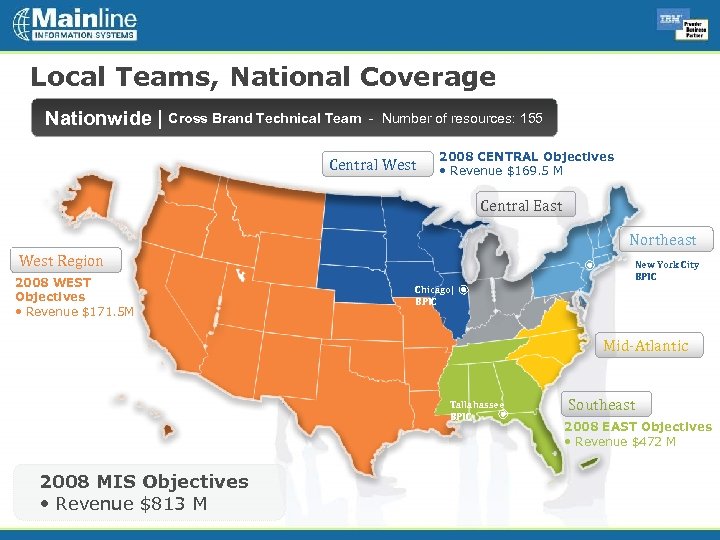 Local Teams, National Coverage Nationwide | Cross Brand Technical Team - Number of resources: 155 Central West 2008 CENTRAL Objectives • Revenue $169. 5 M Central East Northeast West Region 2008 WEST Objectives • Revenue $171. 5 M New York City BPIC Chicago| BPIC Mid-Atlantic Tallahassee BPIC 2008 MIS Objectives • Revenue $813 M Southeast 2008 EAST Objectives • Revenue $472 M
 Why linux on z series? • Leverage classic strengths of the z. Series – High availability – High i/o bandwidth capabilities – Flexibility to run disparate workloads concurrently – Requirement for excellent disaster recovery capabilities – Security • Shortening end to end path length for applications – Collocation of applications – Consolidation of applications from distributed servers – Reduction in network traffic – Simplification of support model
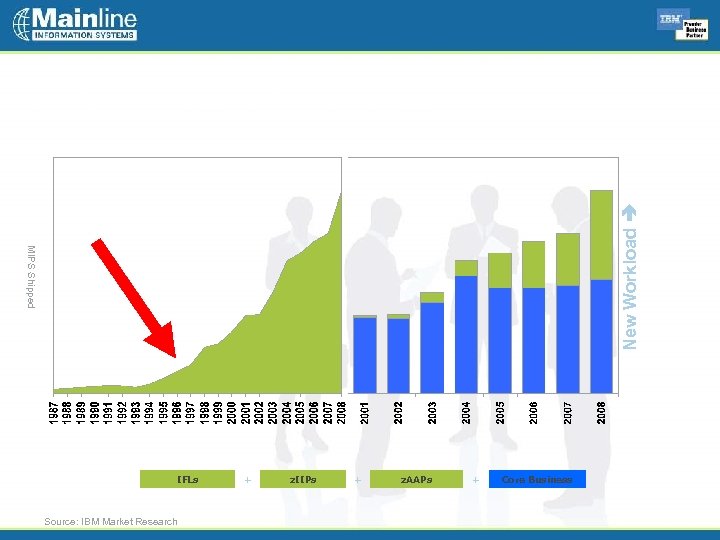 MIPS Shipped New Workload IBM System z Workload Growth Worldwide IFLs Source: IBM Market Research + z. IIPs + z. AAPs + Core Business
 What System z brings to Linux • The most reliable hardware platform available – Redundant processors and memory – Error detection and correction – Remote Support Facility (RSF) • Centralized Linux systems are easier to manage • Designed to support mixed work loads – Allows consolidation while maintaining one server per application – Complete work load isolation – High speed inter-server connectivity 10 • Scalability – System z 10 EC scales to 64 application processors – System z 9 EC scales to 54 application processors – System z 9 BC scales to 7 application processors – e. Server z. Series 990 scales to 32 application processors – Dedicated I/O processors – Hundreds of Linux virtual servers
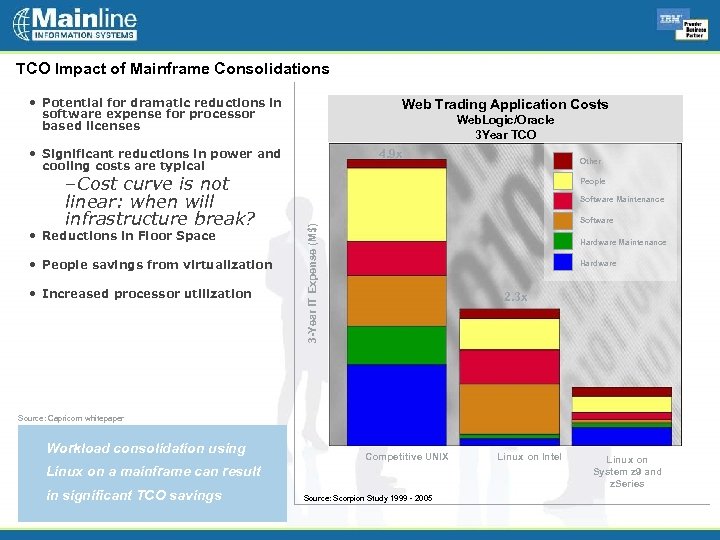 TCO Impact of Mainframe Consolidations • Potential for dramatic reductions in software expense for processor based licenses Web Trading Application Costs Web. Logic/Oracle 3 Year TCO • Significant reductions in power and cooling costs are typical • Reductions in Floor Space • People savings from virtualization • Increased processor utilization Other People Software Maintenance Software 3 -Year IT Expense (M$) –Cost curve is not linear: when will infrastructure break? 4. 9 x Hardware Maintenance Hardware 2. 3 x Source: Capricorn whitepaper Workload consolidation using Competitive UNIX Linux on a mainframe can result in significant TCO savings Source: Scorpion Study 1999 - 2005 Linux on Intel Linux on System z 9 and z. Series
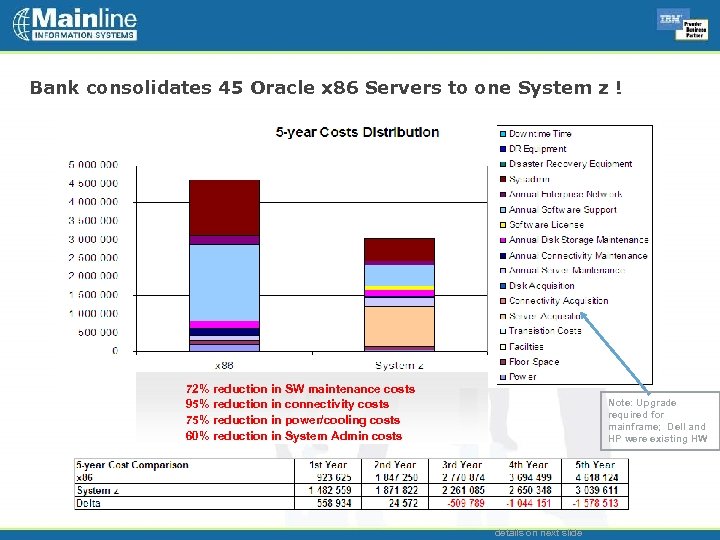 Bank consolidates 45 Oracle x 86 Servers to one System z ! 72% reduction in SW maintenance costs 95% reduction in connectivity costs 75% reduction in power/cooling costs 60% reduction in System Admin costs Note: Upgrade required for mainframe; Dell and HP were existing HW details on next slide
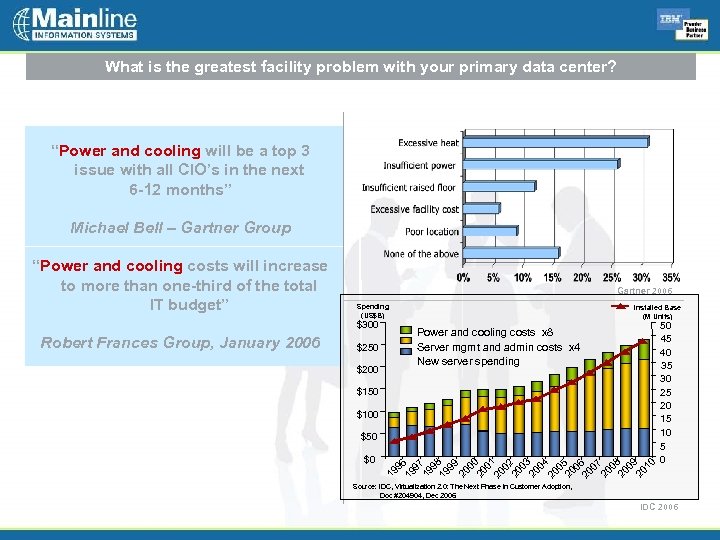 What is the greatest facility problem with your primary data center? “Power and cooling will be a top 3 issue with all CIO’s in the next 6 -12 months” Michael Bell – Gartner Group Gartner 2006 Spending (US$B) $300 Robert Frances Group, January 2006 $250 $200 Installed Base (M Units) Power and cooling costs x 8 Server mgmt and admin costs x 4 New server spending $150 $100 $50 $0 19 96 19 97 19 9 19 8 99 20 00 20 01 20 02 20 03 20 04 20 05 20 0 20 6 07 20 08 20 09 20 10 “Power and cooling costs will increase to more than one-third of the total IT budget” 50 45 40 35 30 25 20 15 10 5 0 Source: IDC, Virtualization 2. 0: The Next Phase in Customer Adoption, Doc #204904, Dec 2006 IDC 2006
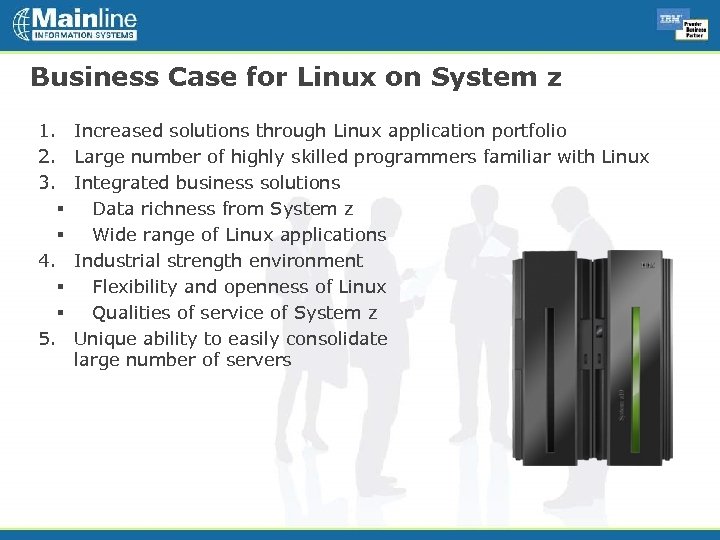 Business Case for Linux on System z 1. 2. 3. § § 4. § § 5. 14 Increased solutions through Linux application portfolio Large number of highly skilled programmers familiar with Linux Integrated business solutions Data richness from System z Wide range of Linux applications Industrial strength environment Flexibility and openness of Linux Qualities of service of System z Unique ability to easily consolidate large number of servers
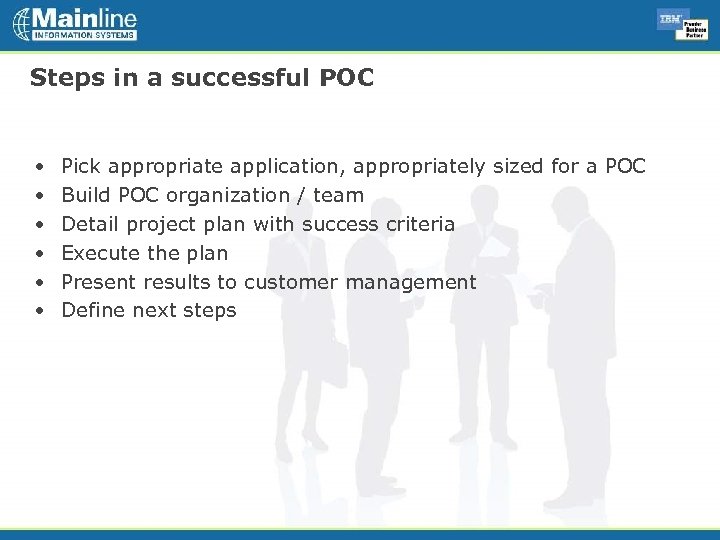 Steps in a successful POC • • • Pick appropriate application, appropriately sized for a POC Build POC organization / team Detail project plan with success criteria Execute the plan Present results to customer management Define next steps
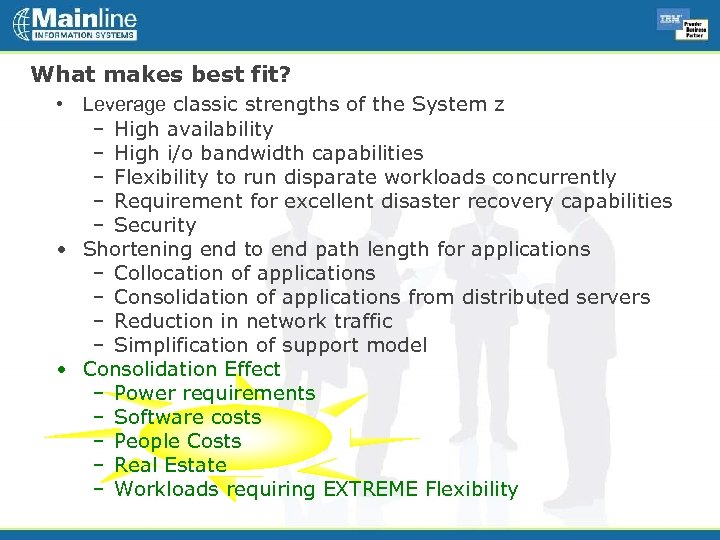 What makes best fit? • Leverage classic strengths of the System z – High availability – High i/o bandwidth capabilities – Flexibility to run disparate workloads concurrently – Requirement for excellent disaster recovery capabilities – Security • Shortening end to end path length for applications – Collocation of applications – Consolidation of applications from distributed servers – Reduction in network traffic – Simplification of support model • Consolidation Effect – Power requirements – Software costs – People Costs – Real Estate – Workloads requiring EXTREME Flexibility
 Best Fit applications Websphere MQ Series DB 2 Connect CICS Transaction Gateway , IMS Connect for Java SAP Web. Sphere and JAVA applications development Web. Sphere Application Server (WAS), Portal Domino Network Infrastructure, FTP, NFS, DNS etc. . , Oracle Database Applications requiring top end disaster recovery model Com. Server and Communications Controller for Linux Virtualization and Security Services Info. Sphere/Cognos Communigate Pro (Vo. IP) Weblogic
 What Makes Good Fit Applications • Evaluate server choices • Shortening end to end path length for applications – – – Correct application availability, Supporting applications, Total Cost of Ownership (TCO) Politics within the organization. Porting issues – Collocation of applications – Consolidation of applications from distributed servers – Reduction in network traffic – Simplification of support model • Consolidation Effect • Power requirements • Software costs • People Costs • Real Estate • Workloads requiring EXTREME flexibility
 Good Fit Application Workloads • • UDB (DB 2) Informix, (IDS) Apache web serving SAMBA TIM/TAM (LDAP Services) TSM Existing Linux Workloads
 Selecting an application • Performance on System z CPUs is superior to any other CPUs on any other platforms – CPU speed is not the entire story – it’s in the architecture! – Architecture designed for multiple or consolidated workloads – System z has definite advantage with applications that have mixed CPU and I/O – System z 10 Enterprise Quad Core 4. 4 GHZ • System z and z/VM provide the best virtualization capabilities – All workload types are eligible • Good planning is essential • Mainline with IBM’s assistance can: – Perform sizing estimate with actual server statistics – Perform Application Assessment – Perform TCO Business Case Analysis (Alinean tool, RACEv) – Assist with planning and initial installation needs 20
 Organizational issues that need to be addressed • Need executive sponsor • Customer must provide systems, application and network representation • Customer must have dedicated resource for the POC • Get distributed team engaged • Customer assigned tasks and accountability • Status calls required on a weekly basis measuring progress
 Detailed project plan • Project plan clearly defined and agreed upon by all parties involved (examples are available upon request) • CLEARLY defined success criteria must be agreed upon (examples available upon request) • Dates and names assigned to each task • Loaner equipment (if required) needs lead time for paperwork to be processed and equipment installed • Determine loaner software (if needed) with required lead time • Weekly status calls required for measure of progress • Engage technical resources (MIS and IBM) when issues arise
 What’s next after success? • • • Present success story to customer management Get management commitment for production Plan for production Develop support organization structure within customer Plan for additional applications Develop a cross platform virtualization strategy