


 Скачать презентацию Making Cities Work Reproductive and Environmental Health in
0635afa166703fd5d37ff160db82f26f.ppt
- Количество слайдов: 17
 Making Cities Work: Reproductive and Environmental Health in the Peruvian Andes Delicia Ferrando American Public Health Association 132 nd Annual Meeting Washington, D. C. November 7 -11, 2004
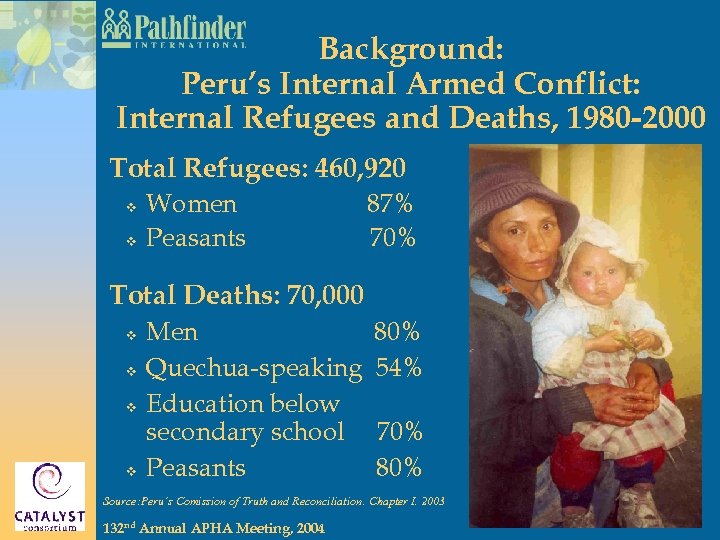 Background: Peru’s Internal Armed Conflict: Internal Refugees and Deaths, 1980 -2000 Total Refugees: 460, 920 v v Women Peasants 87% 70% Total Deaths: 70, 000 v v Men Quechua-speaking Education below secondary school Peasants 80% 54% 70% 80% Source: Peru´s Comission of Truth and Reconciliation. Chapter I. 2003 132 nd Annual APHA Meeting, 2004
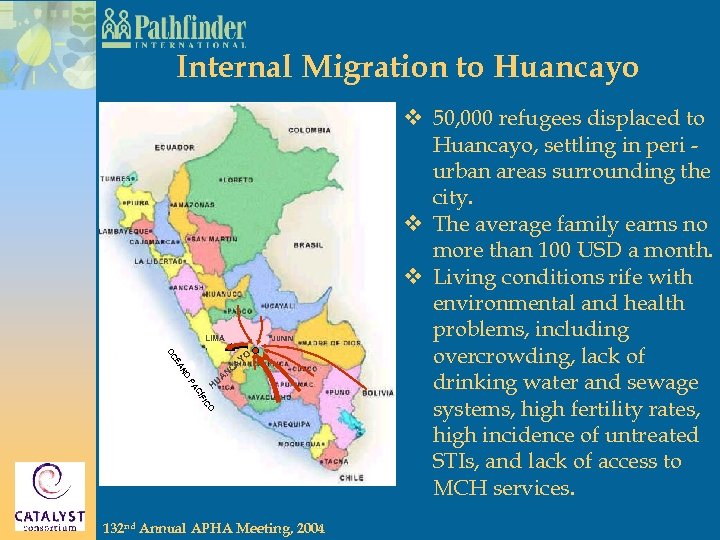 Internal Migration to Huancayo • JUNIN LIMA NO EA OC YO CO FI CÍ PA A HU A NC 132 nd Annual APHA Meeting, 2004 v 50, 000 refugees displaced to Huancayo, settling in peri urban areas surrounding the city. v The average family earns no more than 100 USD a month. v Living conditions rife with environmental and health problems, including overcrowding, lack of drinking water and sewage systems, high fertility rates, high incidence of untreated STIs, and lack of access to MCH services.
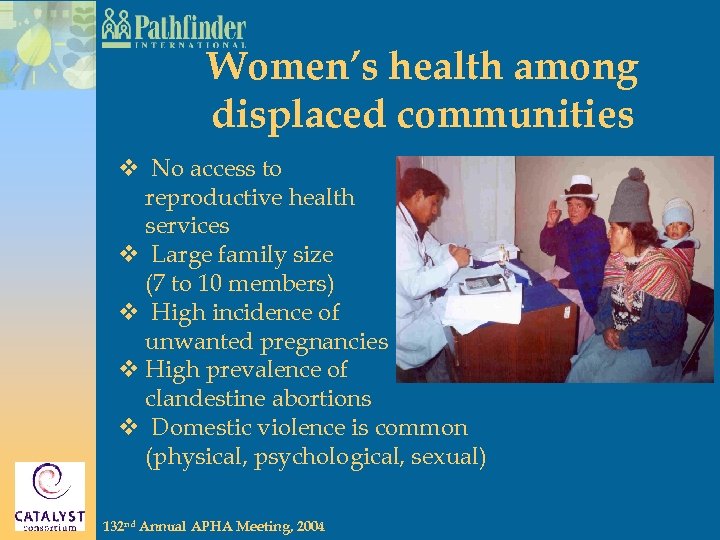 Women’s health among displaced communities v No access to reproductive health services v Large family size (7 to 10 members) v High incidence of unwanted pregnancies v High prevalence of clandestine abortions v Domestic violence is common (physical, psychological, sexual) 132 nd Annual APHA Meeting, 2004
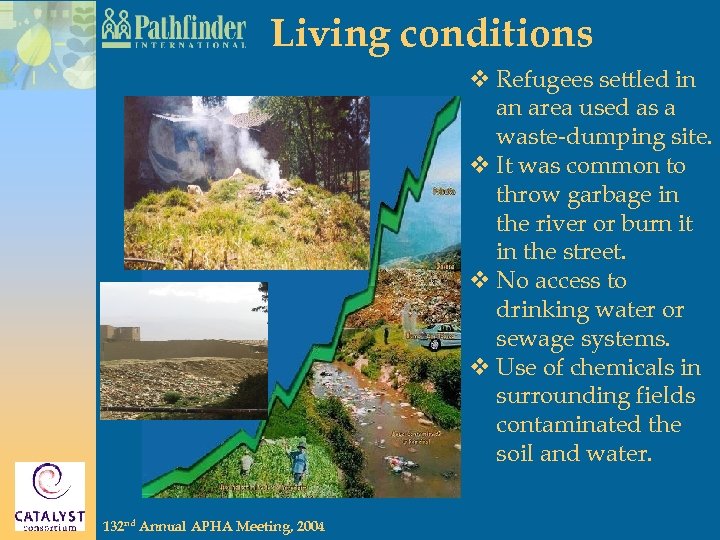 Living conditions v Refugees settled in an area used as a waste-dumping site. v It was common to throw garbage in the river or burn it in the street. v No access to drinking water or sewage systems. v Use of chemicals in surrounding fields contaminated the soil and water. 132 nd Annual APHA Meeting, 2004
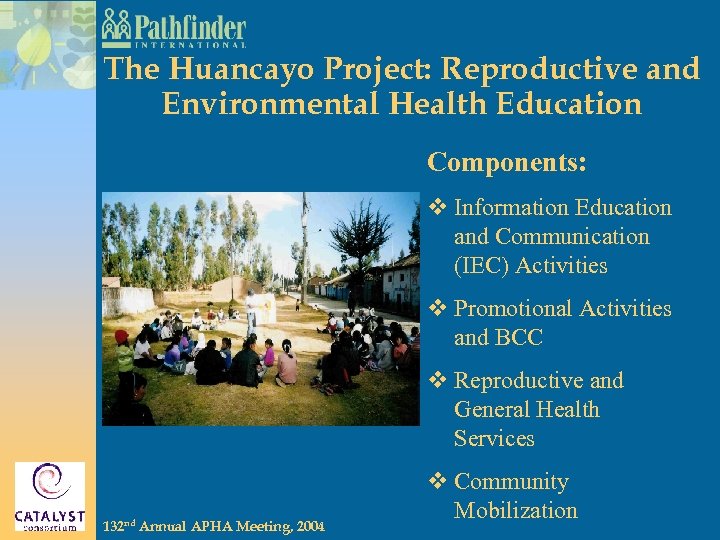 The Huancayo Project: Reproductive and Environmental Health Education Components: v Information Education and Communication (IEC) Activities v Promotional Activities and BCC v Reproductive and General Health Services 132 nd Annual APHA Meeting, 2004 v Community Mobilization
 Partners The CATALYST Consortium is a global reproductive health activity initiated in September 2000 by the Office of Population and Reproductive Health at USAID, and comprises 5 organizations: Pathfinder International, the Academy for Educational Development (AED), Center for Development and Population Activities (CEDPA), Meridian Group International, Inc. , and PROFAMILIA/Colombia. v COOPERANDES is a Huancayo-based NGO that works with hard-to-reach and marginalized populations. v 132 nd Annual APHA Meeting, 2004
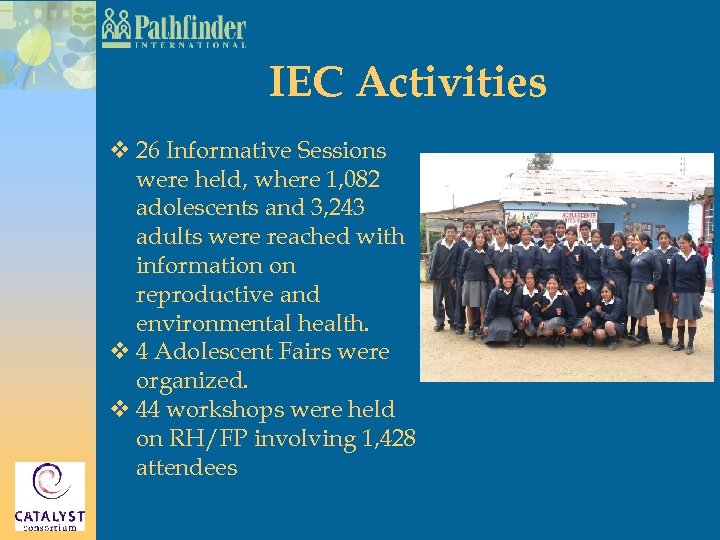 IEC Activities v 26 Informative Sessions were held, where 1, 082 adolescents and 3, 243 adults were reached with information on reproductive and environmental health. v 4 Adolescent Fairs were organized. v 44 workshops were held on RH/FP involving 1, 428 attendees
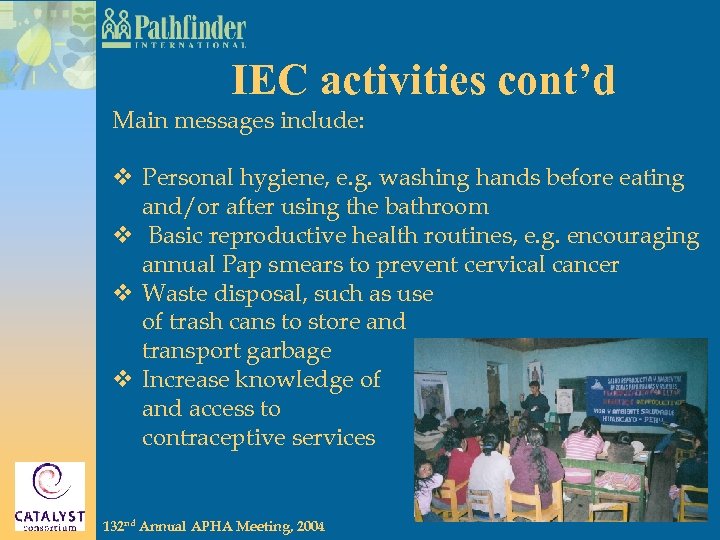 IEC activities cont’d Main messages include: v Personal hygiene, e. g. washing hands before eating and/or after using the bathroom v Basic reproductive health routines, e. g. encouraging annual Pap smears to prevent cervical cancer v Waste disposal, such as use of trash cans to store and transport garbage v Increase knowledge of and access to contraceptive services 132 nd Annual APHA Meeting, 2004
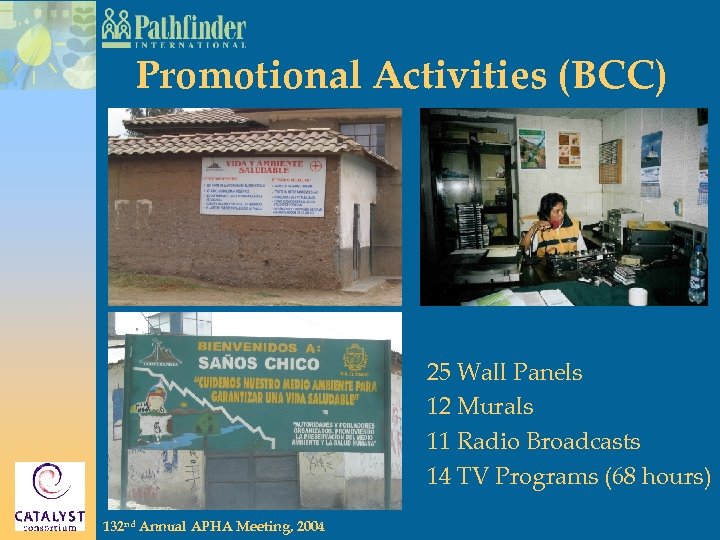 Promotional Activities (BCC) 25 Wall Panels 12 Murals 11 Radio Broadcasts 14 TV Programs (68 hours) 132 nd Annual APHA Meeting, 2004
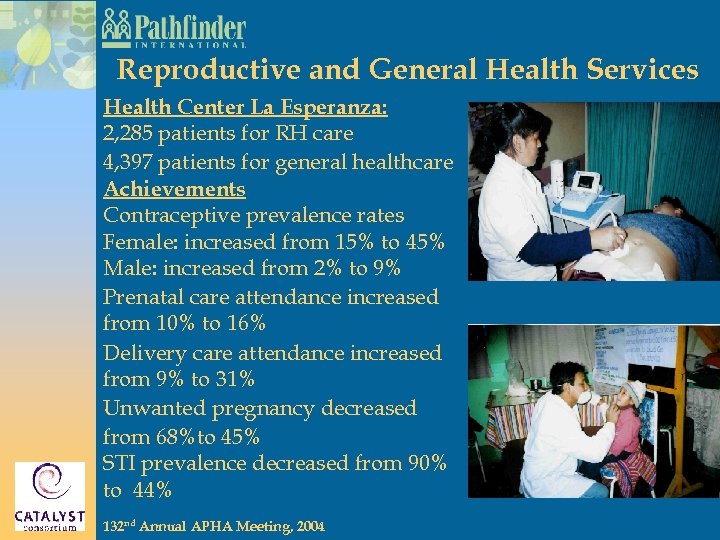 Reproductive and General Health Services Health Center La Esperanza: 2, 285 patients for RH care 4, 397 patients for general healthcare Achievements Contraceptive prevalence rates Female: increased from 15% to 45% Male: increased from 2% to 9% Prenatal care attendance increased from 10% to 16% Delivery care attendance increased from 9% to 31% Unwanted pregnancy decreased from 68%to 45% STI prevalence decreased from 90% to 44% 132 nd Annual APHA Meeting, 2004
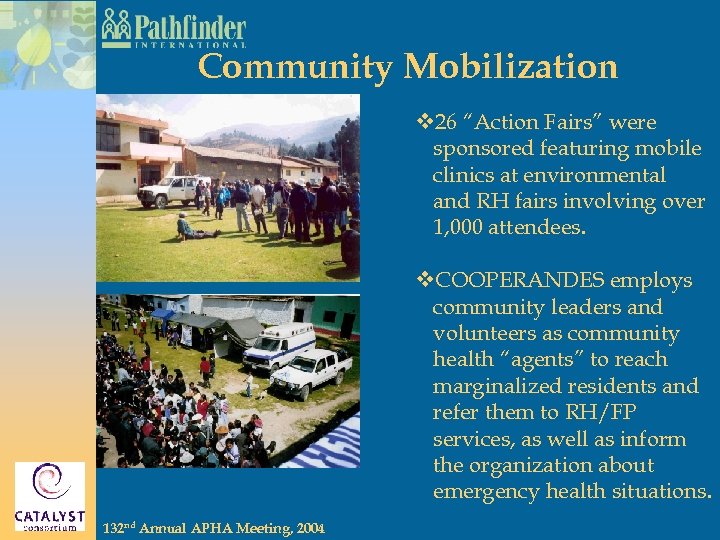 Community Mobilization v 26 “Action Fairs” were sponsored featuring mobile clinics at environmental and RH fairs involving over 1, 000 attendees. v. COOPERANDES employs community leaders and volunteers as community health “agents” to reach marginalized residents and refer them to RH/FP services, as well as inform the organization about emergency health situations. 132 nd Annual APHA Meeting, 2004
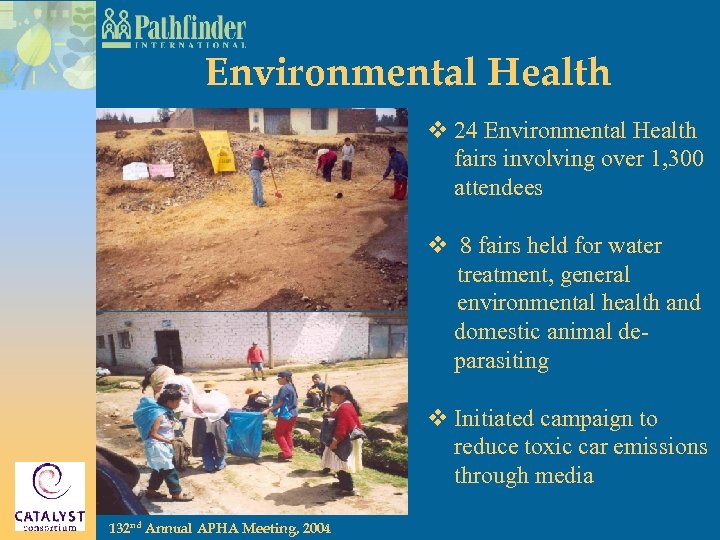 Environmental Health v 24 Environmental Health fairs involving over 1, 300 attendees v 8 fairs held for water treatment, general environmental health and domestic animal deparasiting v Initiated campaign to reduce toxic car emissions through media 132 nd Annual APHA Meeting, 2004
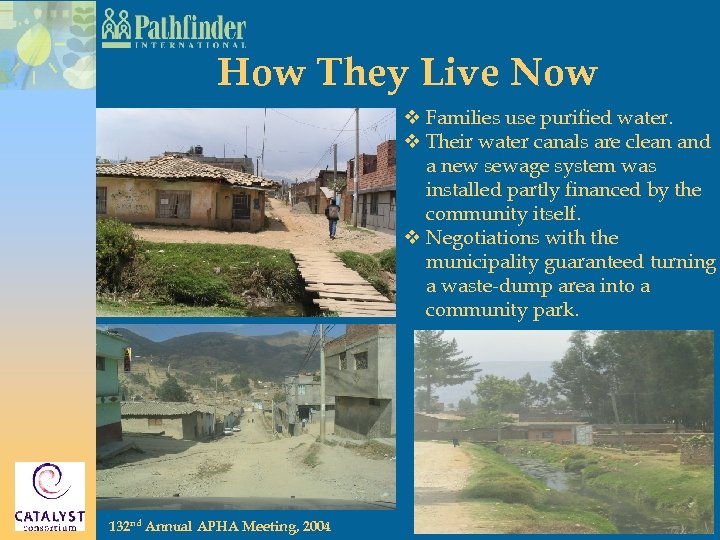 How They Live Now v Families use purified water. v Their water canals are clean and a new sewage system was installed partly financed by the community itself. v Negotiations with the municipality guaranteed turning a waste-dump area into a community park. 132 nd Annual APHA Meeting, 2004
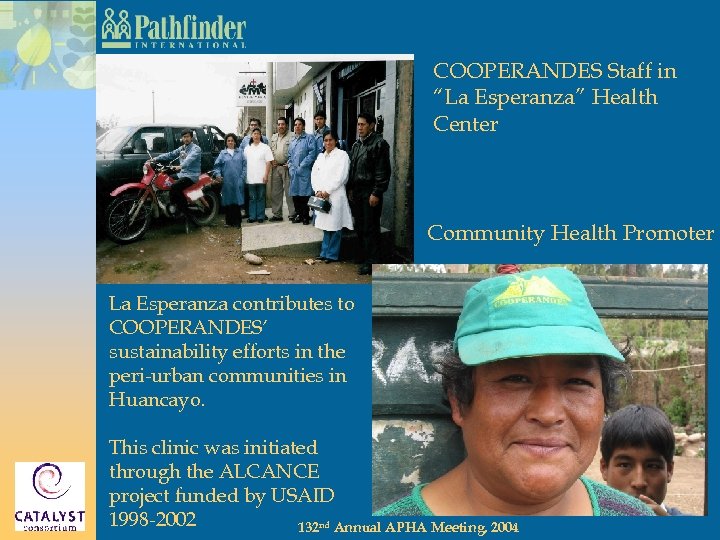 COOPERANDES Staff in “La Esperanza” Health Center Community Health Promoter La Esperanza contributes to COOPERANDES’ sustainability efforts in the peri-urban communities in Huancayo. This clinic was initiated through the ALCANCE project funded by USAID 1998 -2002 132 nd Annual APHA Meeting, 2004
 Conclusions v v Local NGOs can scale up successful projects through creating links with national organizations and municipalities to improve the reproductive and environmental health of marginalized populations. Community health agents are key in determining efficacy of mobile clinics, action fairs and outreach strategies. Community activism and awareness are now appreciated as legitimate negotiating tools. The project is now self-sustaining and COOPERANDES is scaling up in other periurban areas in Peru.
 Thank you!! Pathfinder International Alameda La Floresta 285 San Borja Lima, Peru www. pathfind. org With funding from the United States Department of International Aid