


 Скачать презентацию Making Change Meaningful A review of paediatric speech
3bbbb73cdfe1313eb7f38a0e45172097.ppt
- Количество слайдов: 16
 Making Change Meaningful A review of paediatric speech and language therapy provision in Dublin South East Rosemary Kavanagh Eilís Dignan Senior Speech and Language Therapists
 Communication a fundamental human right and need ¡ Speech, Language and Communication Needs ¡ ¡ ¡ a life-enabling skill ¡ ¡ Lifelong Prevalence rate is 7 -10% 2 to 3 children in every classroom in the UK Without help a proportion of these children will need therapy for mental health difficulties in adulthood Speech and Language Therapy Department HSE Dublin South East
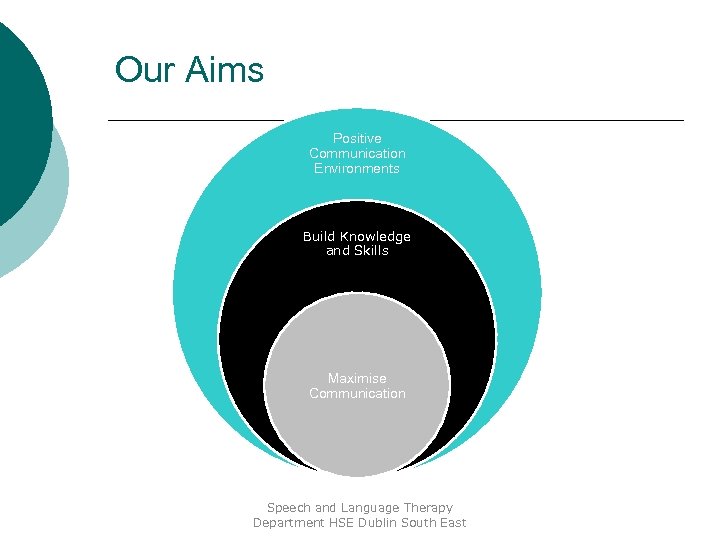 Our Aims Positive Communication Environments Build Knowledge and Skills Maximise Communication Speech and Language Therapy Department HSE Dublin South East
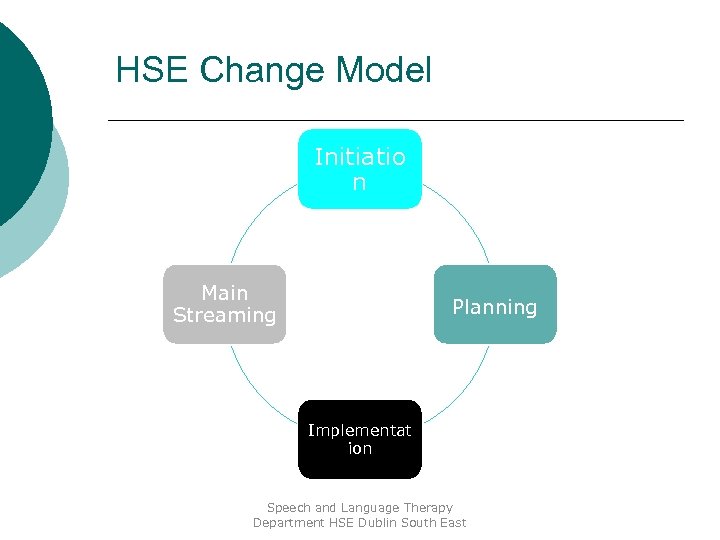 HSE Change Model Initiatio n Main Streaming Planning Implementat ion Speech and Language Therapy Department HSE Dublin South East
 Initiation Speech and Language Therapy Department HSE Dublin South East
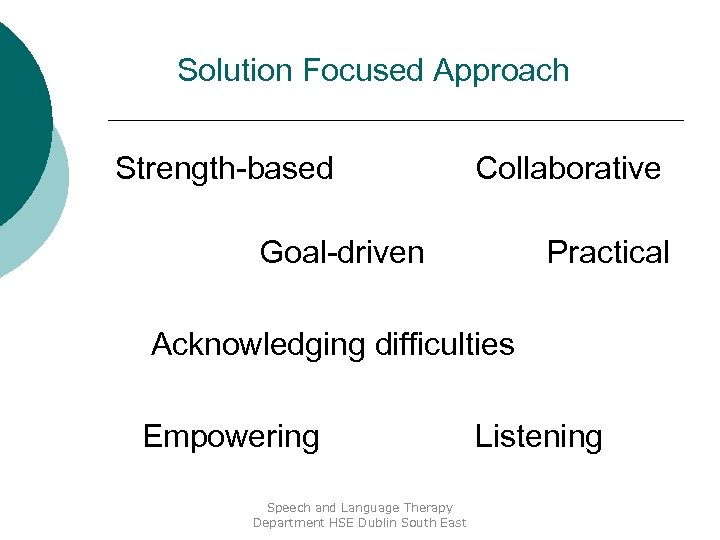 Solution Focused Approach Strength-based Collaborative Goal-driven Practical Acknowledging difficulties Empowering Speech and Language Therapy Department HSE Dublin South East Listening
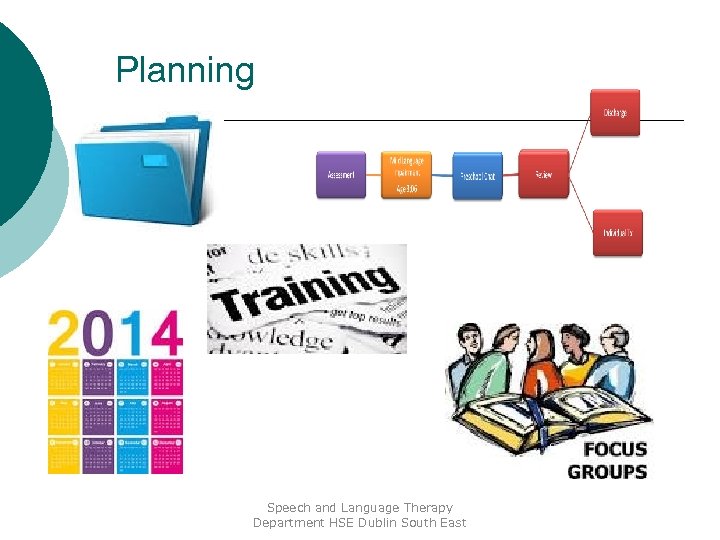 Planning Speech and Language Therapy Department HSE Dublin South East
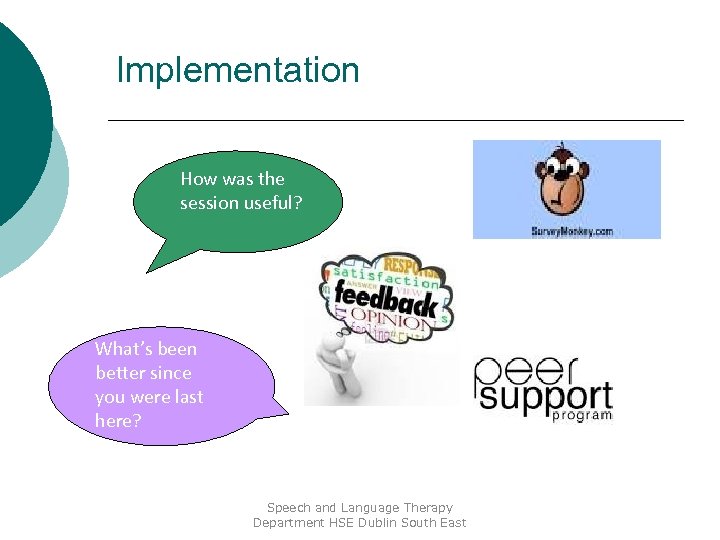 Implementation How was the session useful? What’s been better since you were last here? Speech and Language Therapy Department HSE Dublin South East
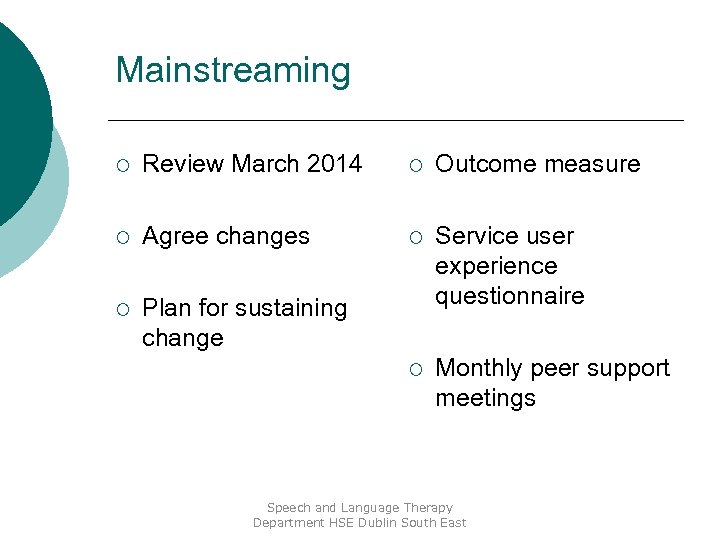 Mainstreaming ¡ Review March 2014 ¡ Outcome measure ¡ Agree changes ¡ ¡ Plan for sustaining change Service user experience questionnaire ¡ Monthly peer support meetings Speech and Language Therapy Department HSE Dublin South East
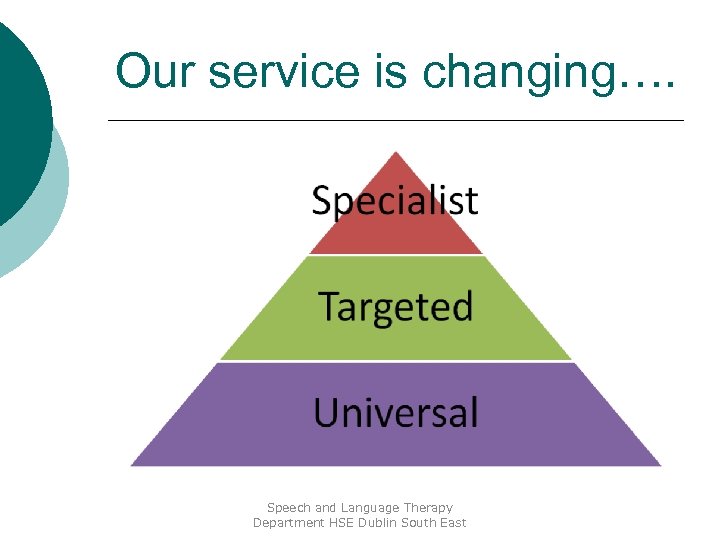 Our service is changing…. Speech and Language Therapy Department HSE Dublin South East
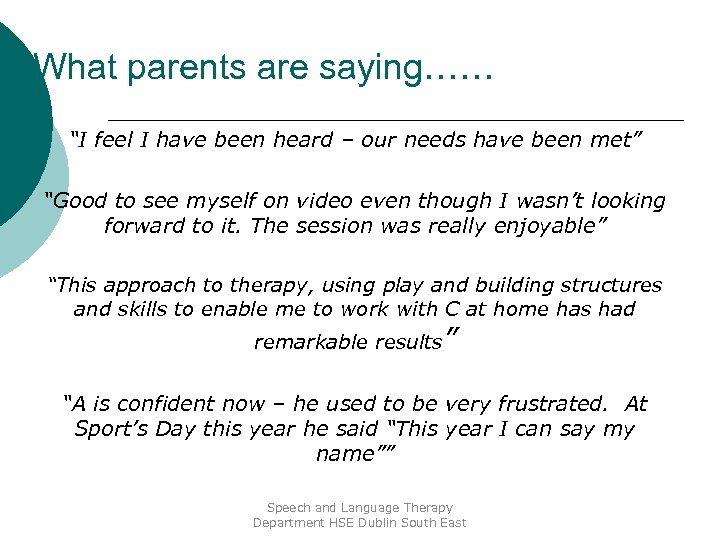 What parents are saying…… “I feel I have been heard – our needs have been met” “Good to see myself on video even though I wasn’t looking forward to it. The session was really enjoyable” “This approach to therapy, using play and building structures and skills to enable me to work with C at home has had remarkable results” “A is confident now – he used to be very frustrated. At Sport’s Day this year he said “This year I can say my name”” Speech and Language Therapy Department HSE Dublin South East
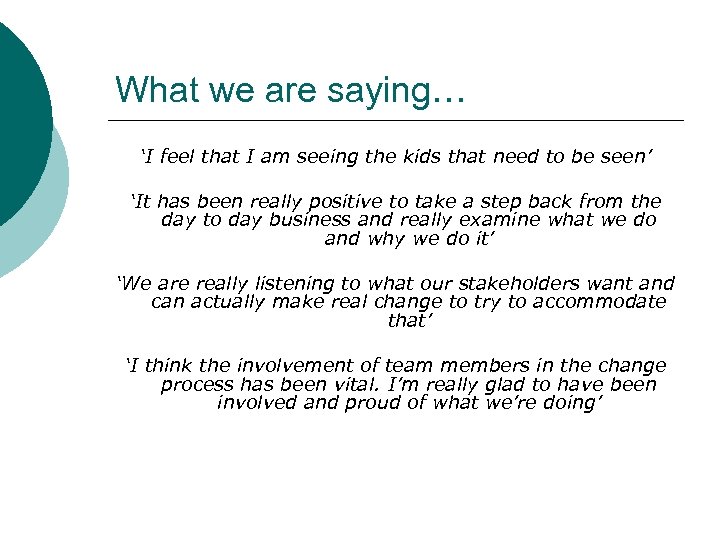 What we are saying… ‘I feel that I am seeing the kids that need to be seen’ ‘It has been really positive to take a step back from the day to day business and really examine what we do and why we do it’ ‘We are really listening to what our stakeholders want and can actually make real change to try to accommodate that’ ‘I think the involvement of team members in the change process has been vital. I’m really glad to have been involved and proud of what we’re doing’
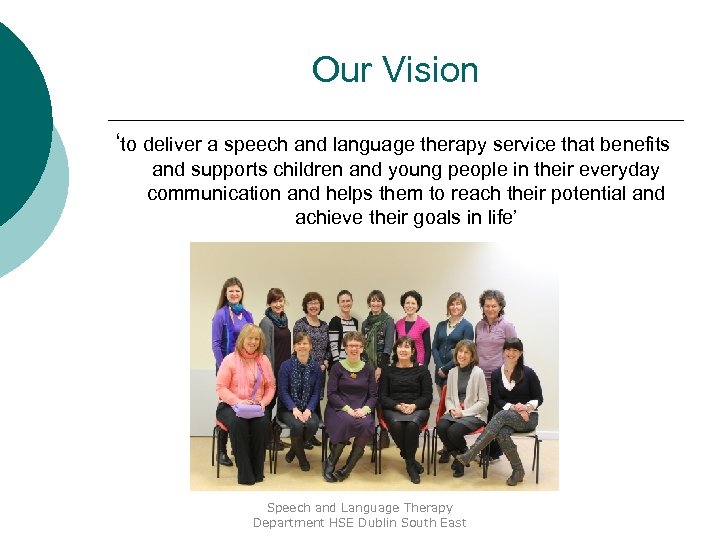 Our Vision ‘to deliver a speech and language therapy service that benefits and supports children and young people in their everyday communication and helps them to reach their potential and achieve their goals in life’ Speech and Language Therapy Department HSE Dublin South East
 References ¡ Baker, E. and Mc. Leod, S (2011) Evidence-based practice for children with speech sound disorders: part ! narrative review. Language Speech and Hearing Services in School s. Vol 42. pp 102 -139. ¡ Baker, E. and Mc. Leod, S (2011) Evidence-based practice for children with speech sound disorders: part 2 application to clinical practice. Language Speech and Hearing Services in School s. Vol 42. pp 140 -151. ¡ Beardshaw, V and Hosford, A. (2007). in Cross, M. Language and Social Exclusion. I Can Talk Series. Issue 4. ¡ Boyle, J. , Mc. Carthy, E. , O Hare, A. & Law, J. (2010) Intervention for mixed receptive-expressive language impairment; A review. Developmental Medicine and Child Neurology. 52. pp 994 -999. ¡ Bowen, C and Cupples, L (2006). PACT: Parents and children together in phonological therapy. Advances in Speech Pathology. 8 (3). ¡ Broomfield, J. & Dodd, B. (2005) ‘Clinical effectiveness’ in Differential Diagnosis and Treatment of Children with Speech Disorder. Barbara Dodd (ed. ) Whurr. London ¡ Broomfield, J. & Dodd, B. (2011). Is speech and language therapy effective for children with primary speech and language impairment? Report of a RCT. International Journal of Language and Communication Disorders. Vol 46, 6. 628 -640. ¡ Enderby, P (2012) How much therapy is enough? The impossible question! International Journal of Speech-language Pathology. 14 (5) 432 -437. ¡ Gascoigne, M and Jordan E. (2011). Joint Commissioning Services to Children and Young People with Speech, Language & Communication Needs Service Redesign - Proposed Model of Service Delivery. NHS Worcestershire and Worcestershire County Council.
 References ¡ Gascoigne, M. (ed). (2012). Better Communication – Shaping Speech, Language and Communication Services for Children and Young People. London. RCSLT. ¡ Gibbon, F et al. (2012). Growing Up in Ireland – National Longitudinal Study of Children – The Prevalence of Speech and Language Impairment among a Nationally Representative Sample of Irish Children. Paper presented at the Growing Up in Ireland Annual Conference. ¡ Kelman, E. & Schneider, C. (1994) Parent child interaction therapy: an alternative approach to the management of children’s language difficulties. Child Language Teaching and Therapy. 10 (1). ¡ Law, J. , Garret, Z & Nye, C (2004) The Efficacy of treatment for children with developmental speech and language delay/disorder: a meta analysis. Journal of Speech, Language and Hearing Research. Vol 47. pp 924 -943. ¡ Law, J and Garret, z. (2003). Speech and language therapy interventions for children with primary speech and language delay or disorder. Cochrane Database of Systematic Reviews (3). ¡ Law, J et al. (2013). Child speech, language and communication need re-examined in a public health context: a new direction for the speech and language therapy profession. International Journal of Language and Communication Disorders. Vol 48, (5), 486 -496. ¡ Mercow et al. (2010). An exploratory trial of the effectiveness of an enhanced consultative approach to delivering speech and language intervention in schools. International Journal of Language and Communication Disorders, 45 (3).
 References ¡ Mc. Cartney, E. et al (2011). Indirect language therapy for children with persistent language impairment in mainstream primary schools: outcomes from a cohort intervention. International Journal of Language and Communication Disorders, 46 (1). ¡ Mc. Intosh, B & Dodd, B (2008) Evaluation of core vocabulary intervention for treatment of inconsistent phonological disorder: Three treatment case studies. Child Language Teaching and Therapy. 25 (1), pp 09 -30. ¡ Morgan, AT & Vogel, AP (2009) Intervention for childhood apraxia of speech (review) The Cochrane Collaboration. ¡ Roberts, M. & Kaiser, A. (2011). The effectiveness of parent implemented language interventions: a meta analysis. American Journal of Speech-Language Pathology, 20 pp 180 -199. ¡ Roberts, M. & Kaiser, A. (2012). Assessing the effects of a parent implemented language intervention for children with language impairments using empirical benchmarks: A pilot study. Journal of Speech Language and Hearing Research, 55, pp 1655 -1670. ¡ Snowling, M et al. (2006). Psychosocial outcomes at 15 years of children with a preschool history of speech-language impairment. Journal of Child Psychology and Psychiatry. 47(8), 759 -765 ¡ Williams, L (2012). Intensity in Phonological Intervention: is there a prescribed amount? International Journal of Speech-language Pathology. 14 (5) pp 456 -461. ¡ www. ican. org. uk