


 Скачать презентацию Making a Grope for an Understanding of Taiwan s
e438659b004062fb5f6182153cdaa85a.ppt
- Количество слайдов: 39
 Making a Grope for an Understanding of Taiwan’s Scientific Performance through the Use of Quantified Indicators Prof. Dr. Hsien-Chun Meng Science and Technology Information Center (STIC) National Science Council 2002/12/ 1
 Outline n n n Research Background Research Goals Methodology Results & Discussion Future Works References 2
 Research Background n Insufficient bibliometric indicators to evaluate scientific research performance in Taiwan n Limited inquiry function of NSI and JCR Lack of international comparison of the performance with benchmarking countries STIC has aggressively involved in evaluating scientific activities 3
 Research questions… n n n Is Taiwan’s research performance world class? Has the performance improved or deteriorated? What are the relatively strong and weak fields? 4
 Research Goals n n n To assess the position of Taiwan’s S&T research system in an international comparative perspective To identify relative strengths and weaknesses of scientific fields To serve as a reference for technology policy formulation and for the future allocation of innovation resources 5
 Methodology n n Methodology : Bibliometric Method Study Scope : n n Time interval : 1995~2001 Benchmarking Country Selection : n n n 7 advanced countries 4 developing countries in Eastern Asia CWTS Classification system : n 7 broad areas 43 fields 6
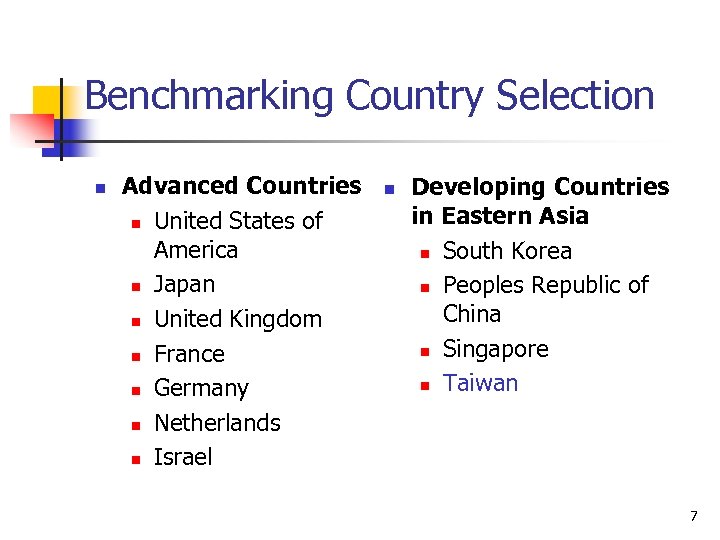 Benchmarking Country Selection n Advanced Countries n United States of America n Japan n United Kingdom n France n Germany n Netherlands n Israel n Developing Countries in Eastern Asia n South Korea n Peoples Republic of China n Singapore n Taiwan 7
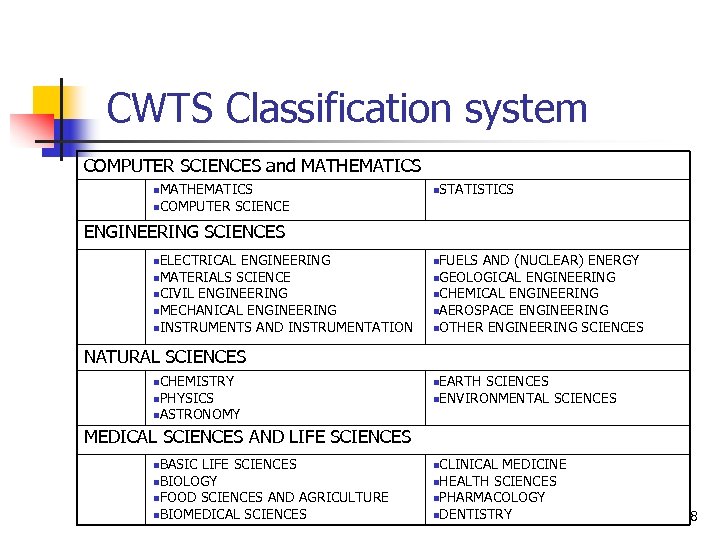 CWTS Classification system COMPUTER SCIENCES and MATHEMATICS n. COMPUTER SCIENCE n. STATISTICS ENGINEERING SCIENCES n. ELECTRICAL ENGINEERING n. MATERIALS SCIENCE n. CIVIL ENGINEERING n. MECHANICAL ENGINEERING n. INSTRUMENTS AND INSTRUMENTATION n. FUELS AND (NUCLEAR) ENERGY n. GEOLOGICAL ENGINEERING n. CHEMICAL ENGINEERING n. AEROSPACE ENGINEERING n. OTHER ENGINEERING SCIENCES NATURAL SCIENCES n. CHEMISTRY n. PHYSICS n. ASTRONOMY n. EARTH SCIENCES n. ENVIRONMENTAL SCIENCES MEDICAL SCIENCES AND LIFE SCIENCES n. BASIC LIFE SCIENCES n. BIOLOGY n. FOOD SCIENCES AND AGRICULTURE n. BIOMEDICAL SCIENCES n. CLINICAL MEDICINE n. HEALTH SCIENCES n. PHARMACOLOGY n. DENTISTRY 8
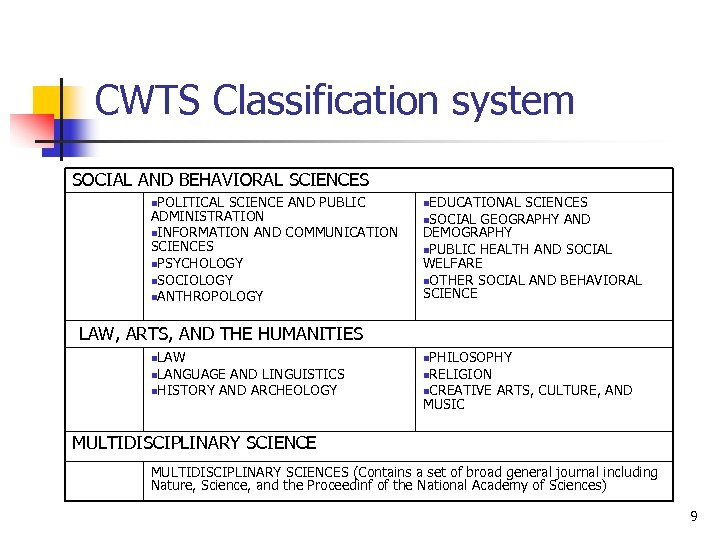 CWTS Classification system SOCIAL AND BEHAVIORAL SCIENCES n. POLITICAL SCIENCE AND PUBLIC ADMINISTRATION n. INFORMATION AND COMMUNICATION SCIENCES n. PSYCHOLOGY n. SOCIOLOGY n. ANTHROPOLOGY n. EDUCATIONAL SCIENCES n. SOCIAL GEOGRAPHY AND DEMOGRAPHY n. PUBLIC HEALTH AND SOCIAL WELFARE n. OTHER SOCIAL AND BEHAVIORAL SCIENCE LAW, ARTS, AND THE HUMANITIES n. LAW n. LANGUAGE AND LINGUISTICS n. HISTORY AND ARCHEOLOGY n. PHILOSOPHY n. RELIGION n. CREATIVE MUSIC ARTS, CULTURE, AND MULTIDISCIPLINARY SCIENCES (Contains a set of broad general journal including Nature, Science, and the Proceedinf of the National Academy of Sciences) 9
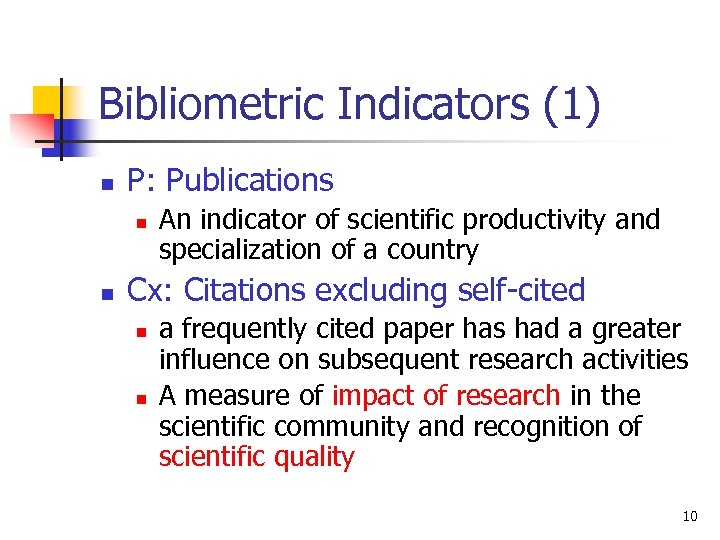 Bibliometric Indicators (1) n P: Publications n n An indicator of scientific productivity and specialization of a country Cx: Citations excluding self-cited n n a frequently cited paper has had a greater influence on subsequent research activities A measure of impact of research in the scientific community and recognition of scientific quality 10
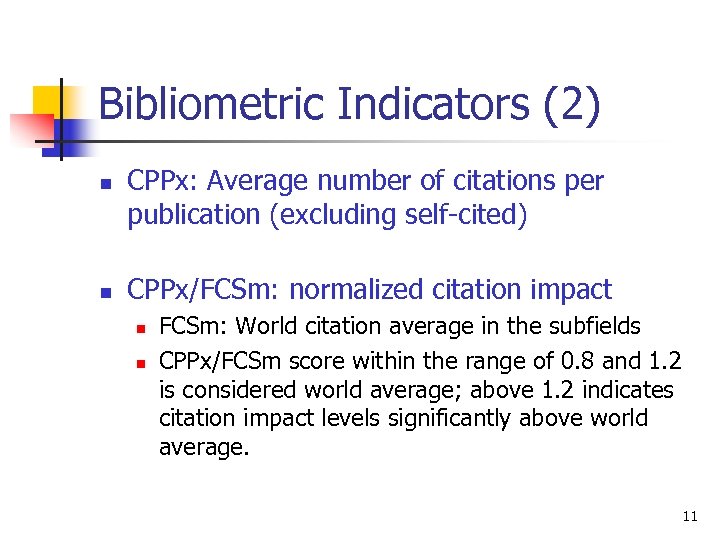 Bibliometric Indicators (2) n n CPPx: Average number of citations per publication (excluding self-cited) CPPx/FCSm: normalized citation impact n n FCSm: World citation average in the subfields CPPx/FCSm score within the range of 0. 8 and 1. 2 is considered world average; above 1. 2 indicates citation impact levels significantly above world average. 11
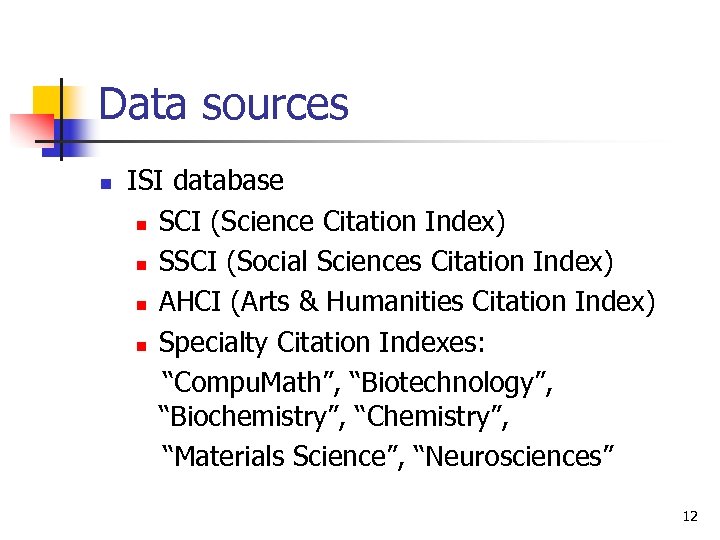 Data sources n ISI database n SCI (Science Citation Index) n SSCI (Social Sciences Citation Index) n AHCI (Arts & Humanities Citation Index) n Specialty Citation Indexes: “Compu. Math”, “Biotechnology”, “Biochemistry”, “Chemistry”, “Materials Science”, “Neurosciences” 12
 Result and Discussion 13
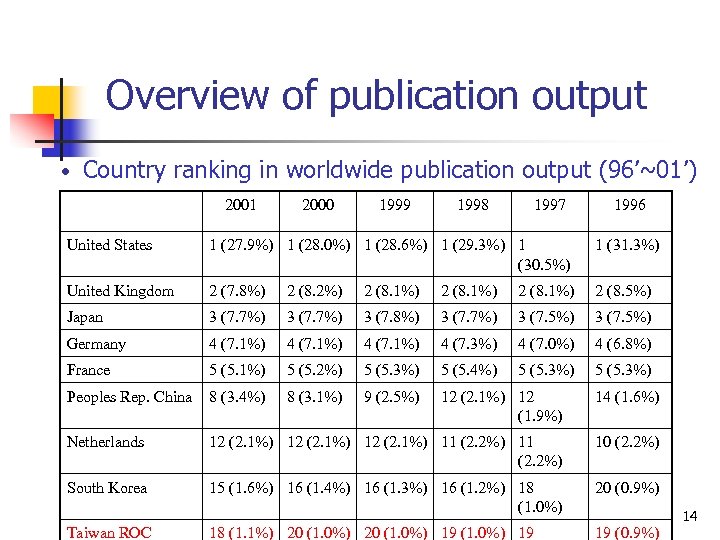 Overview of publication output • Country ranking in worldwide publication output (96’~01’) 2001 2000 1999 1998 1997 1996 United States 1 (27. 9%) 1 (28. 0%) 1 (28. 6%) 1 (29. 3%) 1 (30. 5%) 1 (31. 3%) United Kingdom 2 (7. 8%) 2 (8. 2%) 2 (8. 1%) 2 (8. 5%) Japan 3 (7. 7%) 3 (7. 8%) 3 (7. 7%) 3 (7. 5%) Germany 4 (7. 1%) 4 (7. 3%) 4 (7. 0%) 4 (6. 8%) France 5 (5. 1%) 5 (5. 2%) 5 (5. 3%) 5 (5. 4%) 5 (5. 3%) Peoples Rep. China 8 (3. 4%) 8 (3. 1%) 9 (2. 5%) 12 (2. 1%) 12 (1. 9%) 14 (1. 6%) Netherlands 12 (2. 1%) 11 (2. 2%) 10 (2. 2%) South Korea 15 (1. 6%) 16 (1. 4%) 16 (1. 3%) 16 (1. 2%) 18 (1. 0%) 20 (0. 9%) 18 (1. 1%) 20 (1. 0%) 19 19 (0. 9%) Taiwan ROC 14
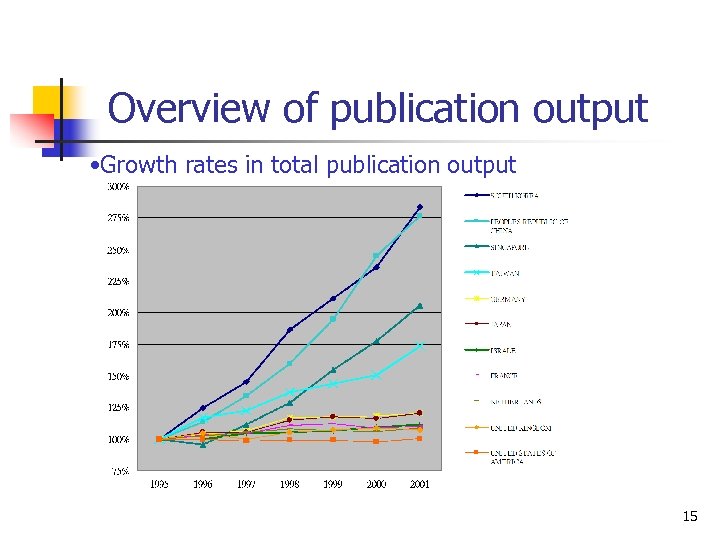 Overview of publication output • Growth rates in total publication output 15
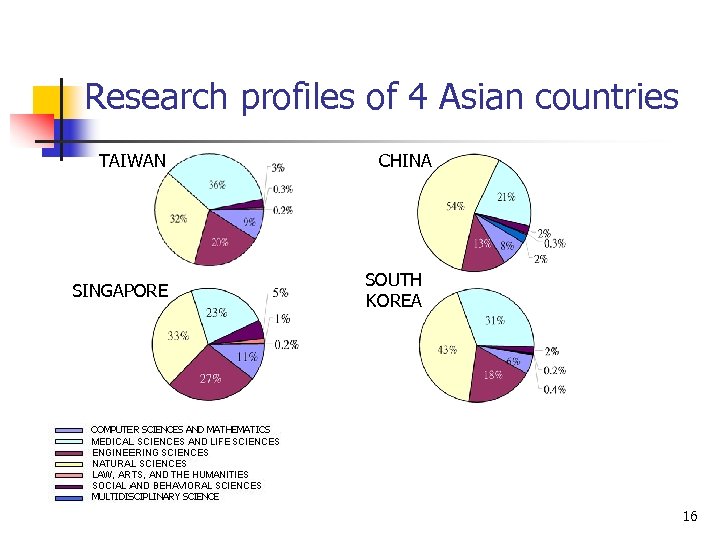 Research profiles of 4 Asian countries TAIWAN SINGAPORE CHINA SOUTH KOREA 16
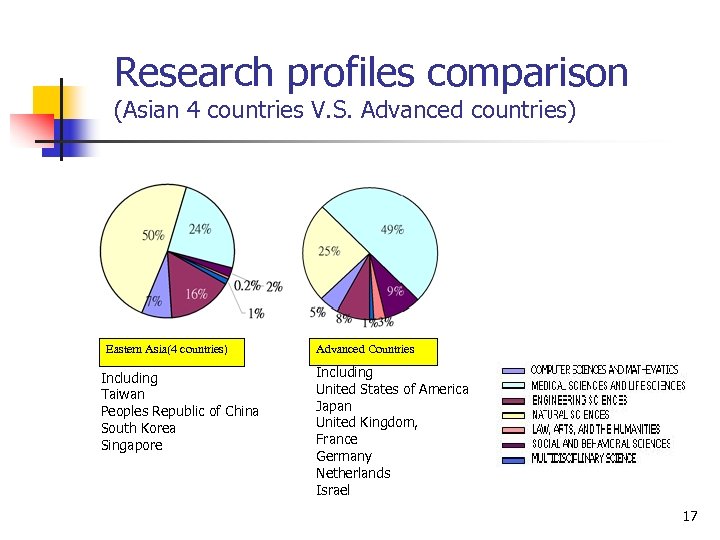 Research profiles comparison (Asian 4 countries V. S. Advanced countries) Eastern Asia(4 countries) Including Taiwan Peoples Republic of China South Korea Singapore Advanced Countries Including United States of America Japan United Kingdom, France Germany Netherlands Israel 17
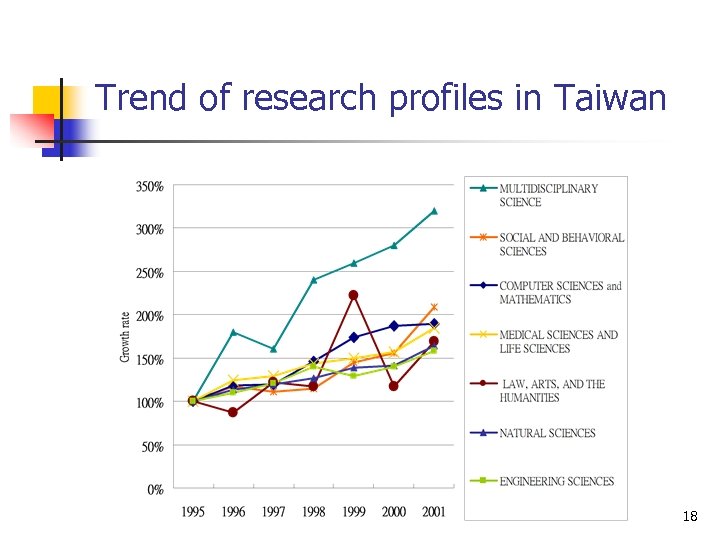 Trend of research profiles in Taiwan 18
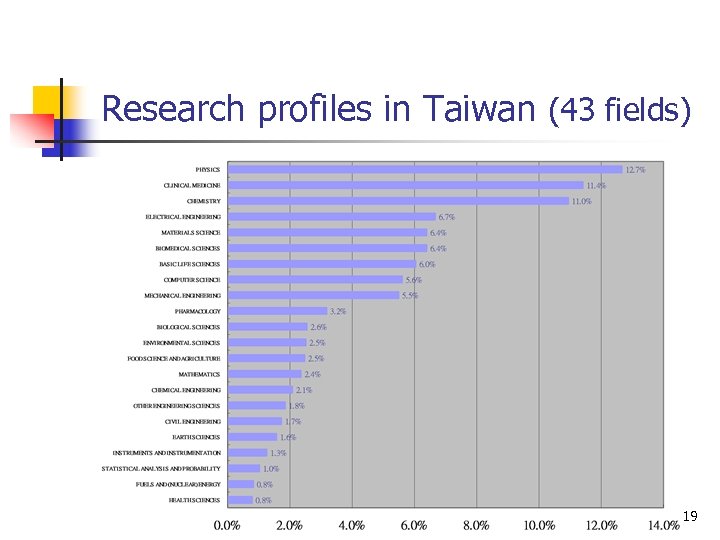 Research profiles in Taiwan (43 fields) 19
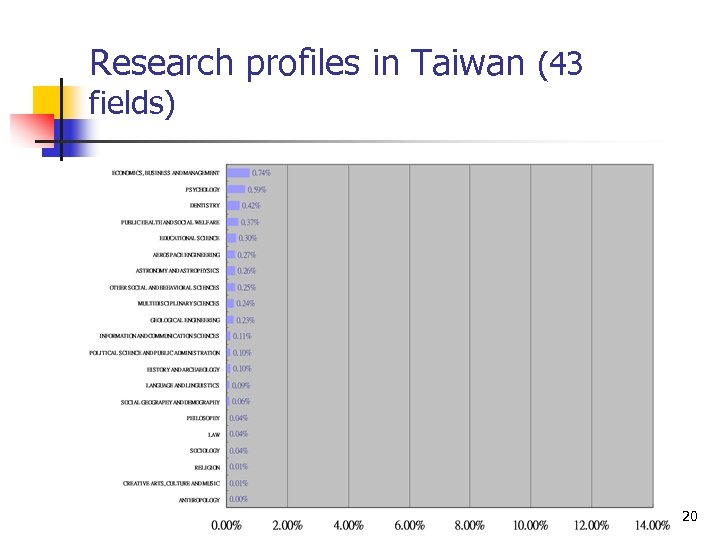 Research profiles in Taiwan (43 fields) 20
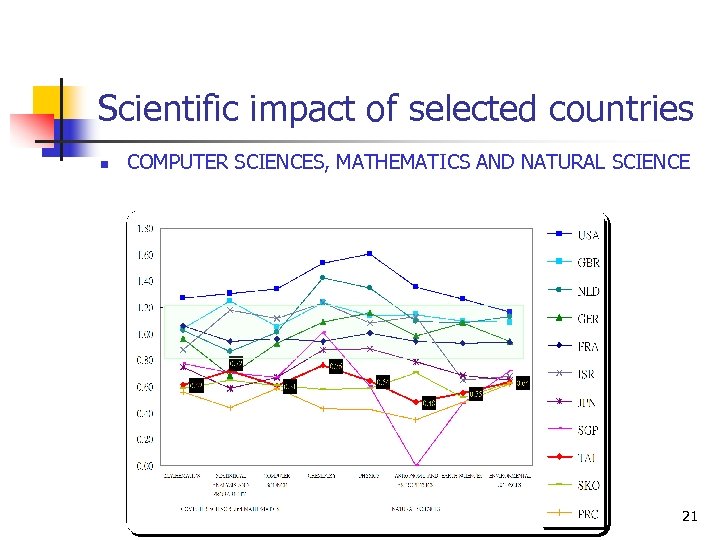 Scientific impact of selected countries n COMPUTER SCIENCES, MATHEMATICS AND NATURAL SCIENCE 21
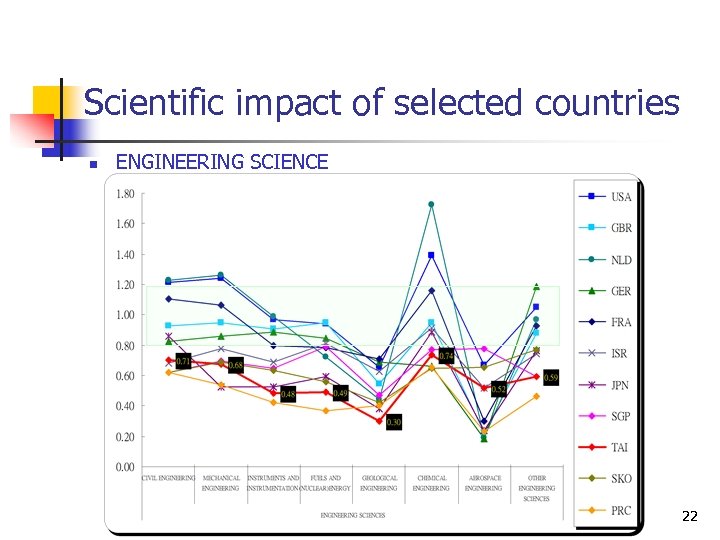 Scientific impact of selected countries n ENGINEERING SCIENCE 22
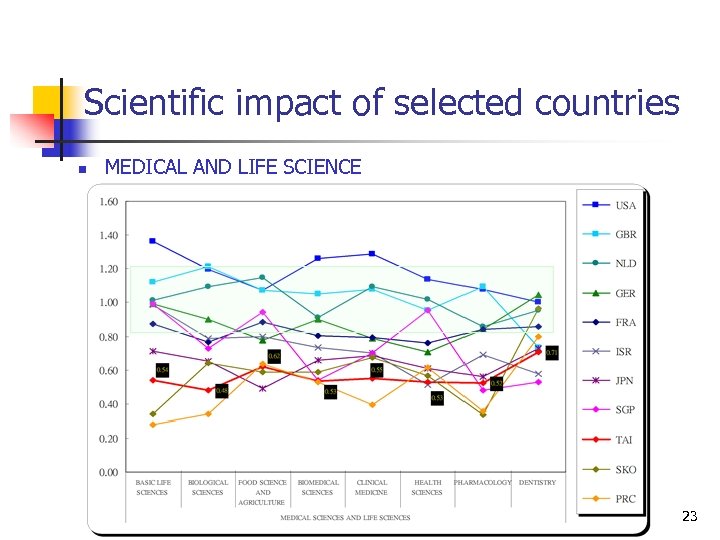 Scientific impact of selected countries n MEDICAL AND LIFE SCIENCE 23
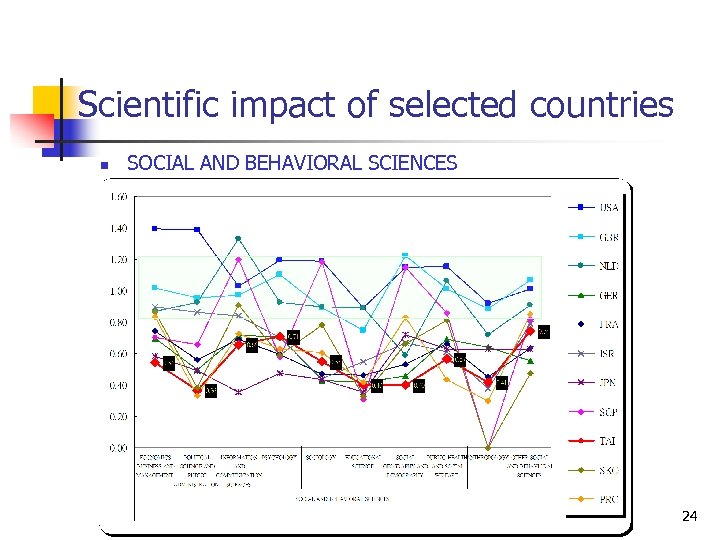 Scientific impact of selected countries n SOCIAL AND BEHAVIORAL SCIENCES 24
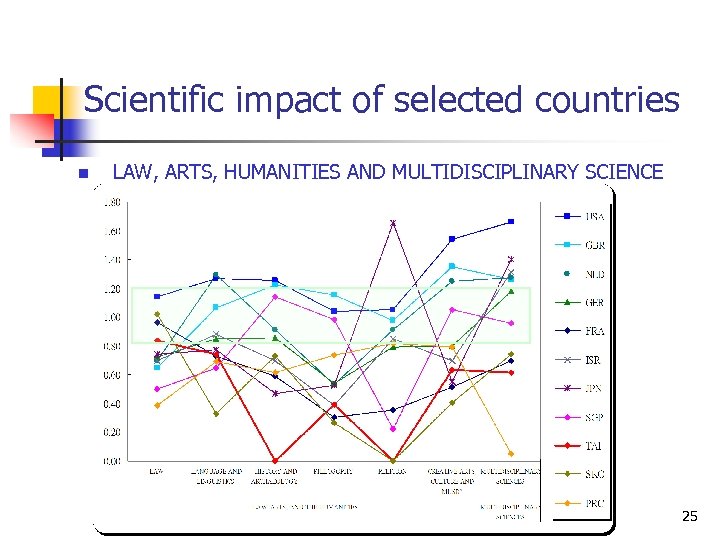 Scientific impact of selected countries n LAW, ARTS, HUMANITIES AND MULTIDISCIPLINARY SCIENCE 25
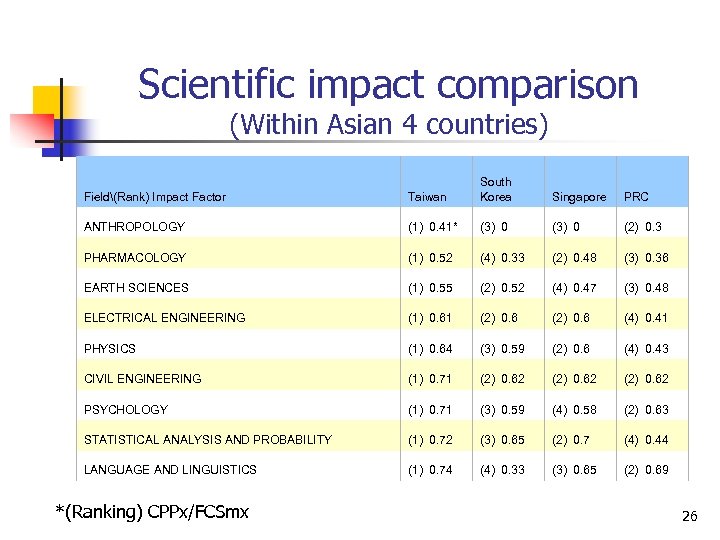 Scientific impact comparison (Within Asian 4 countries) Field(Rank) Impact Factor Taiwan South Korea ANTHROPOLOGY (1) 0. 41* (3) 0 (2) 0. 3 PHARMACOLOGY (1) 0. 52 (4) 0. 33 (2) 0. 48 (3) 0. 36 EARTH SCIENCES (1) 0. 55 (2) 0. 52 (4) 0. 47 (3) 0. 48 ELECTRICAL ENGINEERING (1) 0. 61 (2) 0. 6 (4) 0. 41 PHYSICS (1) 0. 64 (3) 0. 59 (2) 0. 6 (4) 0. 43 CIVIL ENGINEERING (1) 0. 71 (2) 0. 62 PSYCHOLOGY (1) 0. 71 (3) 0. 59 (4) 0. 58 (2) 0. 63 STATISTICAL ANALYSIS AND PROBABILITY (1) 0. 72 (3) 0. 65 (2) 0. 7 (4) 0. 44 LANGUAGE AND LINGUISTICS (1) 0. 74 (4) 0. 33 (3) 0. 65 (2) 0. 69 *(Ranking) CPPx/FCSmx Singapore PRC 26
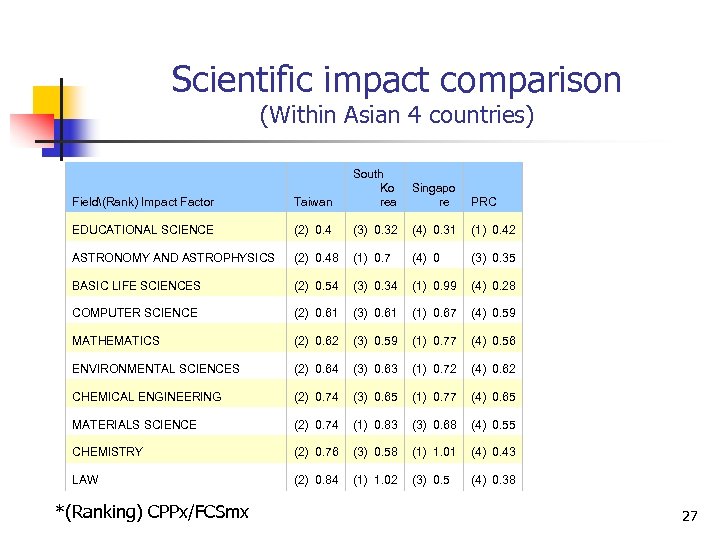 Scientific impact comparison (Within Asian 4 countries) Field(Rank) Impact Factor Taiwan South Ko rea EDUCATIONAL SCIENCE (2) 0. 4 (3) 0. 32 (4) 0. 31 (1) 0. 42 ASTRONOMY AND ASTROPHYSICS (2) 0. 48 (1) 0. 7 (4) 0 (3) 0. 35 BASIC LIFE SCIENCES (2) 0. 54 (3) 0. 34 (1) 0. 99 (4) 0. 28 COMPUTER SCIENCE (2) 0. 61 (3) 0. 61 (1) 0. 67 (4) 0. 59 MATHEMATICS (2) 0. 62 (3) 0. 59 (1) 0. 77 (4) 0. 56 ENVIRONMENTAL SCIENCES (2) 0. 64 (3) 0. 63 (1) 0. 72 (4) 0. 62 CHEMICAL ENGINEERING (2) 0. 74 (3) 0. 65 (1) 0. 77 (4) 0. 65 MATERIALS SCIENCE (2) 0. 74 (1) 0. 83 (3) 0. 68 (4) 0. 55 CHEMISTRY (2) 0. 76 (3) 0. 58 (1) 1. 01 (4) 0. 43 LAW (2) 0. 84 (1) 1. 02 (3) 0. 5 (4) 0. 38 *(Ranking) CPPx/FCSmx Singapo re PRC 27
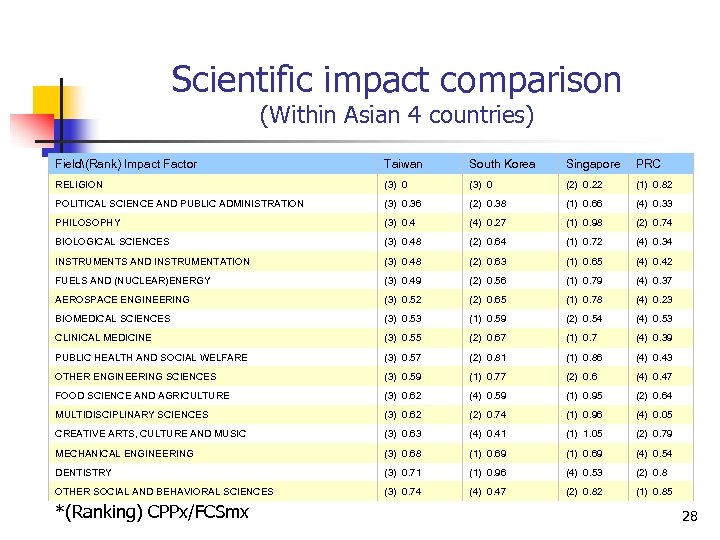 Scientific impact comparison (Within Asian 4 countries) Field(Rank) Impact Factor Taiwan South Korea Singapore PRC RELIGION (3) 0 (2) 0. 22 (1) 0. 82 POLITICAL SCIENCE AND PUBLIC ADMINISTRATION (3) 0. 36 (2) 0. 38 (1) 0. 66 (4) 0. 33 PHILOSOPHY (3) 0. 4 (4) 0. 27 (1) 0. 98 (2) 0. 74 BIOLOGICAL SCIENCES (3) 0. 48 (2) 0. 64 (1) 0. 72 (4) 0. 34 INSTRUMENTS AND INSTRUMENTATION (3) 0. 48 (2) 0. 63 (1) 0. 65 (4) 0. 42 FUELS AND (NUCLEAR)ENERGY (3) 0. 49 (2) 0. 56 (1) 0. 79 (4) 0. 37 AEROSPACE ENGINEERING (3) 0. 52 (2) 0. 65 (1) 0. 78 (4) 0. 23 BIOMEDICAL SCIENCES (3) 0. 53 (1) 0. 59 (2) 0. 54 (4) 0. 53 CLINICAL MEDICINE (3) 0. 55 (2) 0. 67 (1) 0. 7 (4) 0. 39 PUBLIC HEALTH AND SOCIAL WELFARE (3) 0. 57 (2) 0. 81 (1) 0. 86 (4) 0. 43 OTHER ENGINEERING SCIENCES (3) 0. 59 (1) 0. 77 (2) 0. 6 (4) 0. 47 FOOD SCIENCE AND AGRICULTURE (3) 0. 62 (4) 0. 59 (1) 0. 95 (2) 0. 64 MULTIDISCIPLINARY SCIENCES (3) 0. 62 (2) 0. 74 (1) 0. 96 (4) 0. 05 CREATIVE ARTS, CULTURE AND MUSIC (3) 0. 63 (4) 0. 41 (1) 1. 05 (2) 0. 79 MECHANICAL ENGINEERING (3) 0. 68 (1) 0. 69 (4) 0. 54 DENTISTRY (3) 0. 71 (1) 0. 96 (4) 0. 53 (2) 0. 8 OTHER SOCIAL AND BEHAVIORAL SCIENCES (3) 0. 74 (4) 0. 47 (2) 0. 82 (1) 0. 85 *(Ranking) CPPx/FCSmx 28
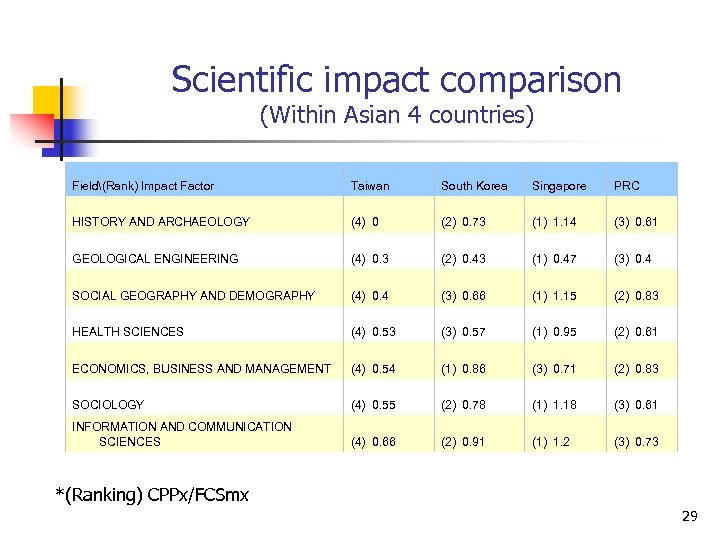 Scientific impact comparison (Within Asian 4 countries) Field(Rank) Impact Factor Taiwan South Korea Singapore PRC HISTORY AND ARCHAEOLOGY (4) 0 (2) 0. 73 (1) 1. 14 (3) 0. 61 GEOLOGICAL ENGINEERING (4) 0. 3 (2) 0. 43 (1) 0. 47 (3) 0. 4 SOCIAL GEOGRAPHY AND DEMOGRAPHY (4) 0. 4 (3) 0. 66 (1) 1. 15 (2) 0. 83 HEALTH SCIENCES (4) 0. 53 (3) 0. 57 (1) 0. 95 (2) 0. 61 ECONOMICS, BUSINESS AND MANAGEMENT (4) 0. 54 (1) 0. 86 (3) 0. 71 (2) 0. 83 SOCIOLOGY (4) 0. 55 (2) 0. 78 (1) 1. 18 (3) 0. 61 INFORMATION AND COMMUNICATION SCIENCES (4) 0. 66 (2) 0. 91 (1) 1. 2 (3) 0. 73 *(Ranking) CPPx/FCSmx 29
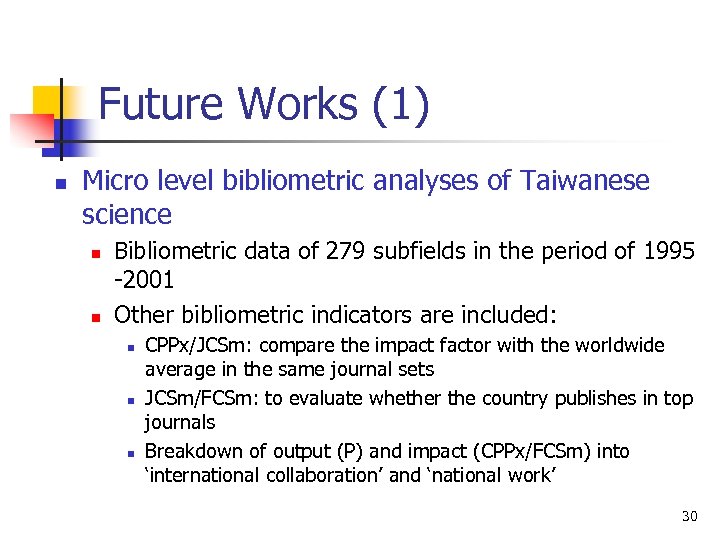 Future Works (1) n Micro level bibliometric analyses of Taiwanese science n n Bibliometric data of 279 subfields in the period of 1995 -2001 Other bibliometric indicators are included: n n n CPPx/JCSm: compare the impact factor with the worldwide average in the same journal sets JCSm/FCSm: to evaluate whether the country publishes in top journals Breakdown of output (P) and impact (CPPx/FCSm) into ‘international collaboration’ and ‘national work’ 30
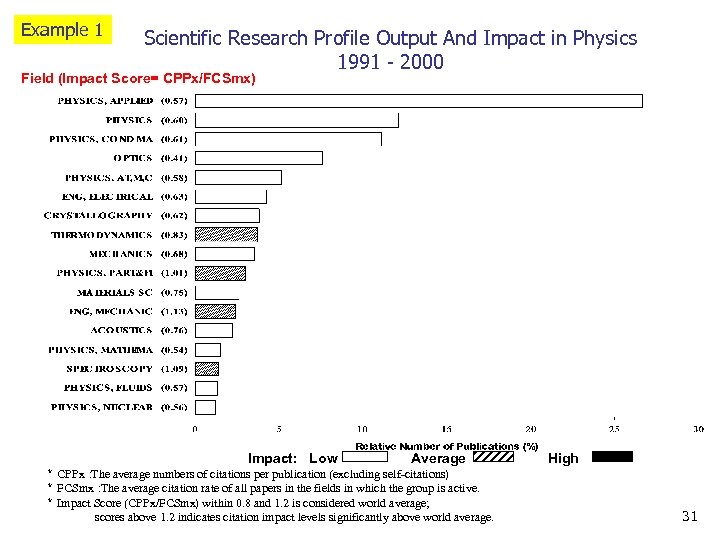 Example 1 Scientific Research Profile Output And Impact in Physics 1991 - 2000 Field (Impact Score= CPPx/FCSmx) Impact: Low Average * CPPx: average numbers of citations per publication (excluding self-citations) The * FCSmx: average citation rate of all papers in the fields in which the group is active. The * Impact Score (CPPx/FCSmx) within 0. 8 and 1. 2 is considered world average; scores above 1. 2 indicates citation impact levels significantly above world average. High 31
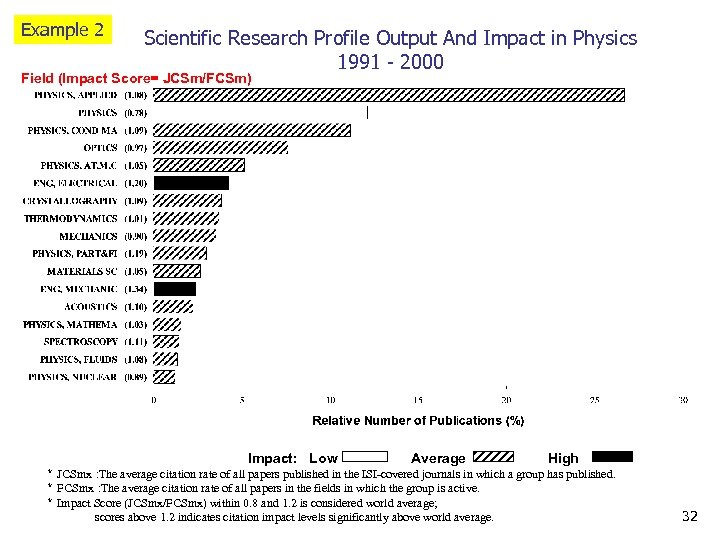 Example 2 Scientific Research Profile Output And Impact in Physics 1991 - 2000 Field (Impact Score= JCSm/FCSm) Impact: Low Average High * JCSmx: average citation rate of all papers published in the ISI-covered journals in which a group has published. The * FCSmx: average citation rate of all papers in the fields in which the group is active. The * Impact Score (JCSmx/FCSmx) within 0. 8 and 1. 2 is considered world average; scores above 1. 2 indicates citation impact levels significantly above world average. 32
 Future Works (2) n The research performance of Taiwan’s universities/institutions n n n 55 universities and 20 institutions are included Breakdown of output and impact into scientific fields International collaboration will be analyzed 33
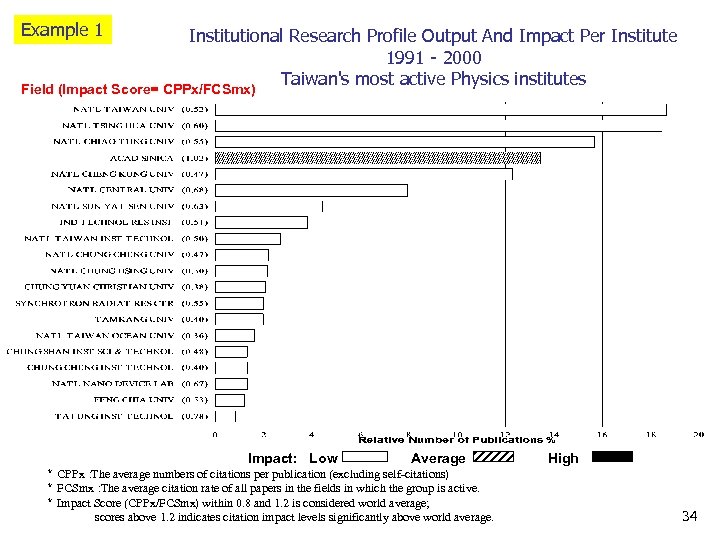 Example 1 Institutional Research Profile Output And Impact Per Institute 1991 - 2000 Taiwan's most active Physics institutes Field (Impact Score= CPPx/FCSmx) Impact: Low Average * CPPx: average numbers of citations per publication (excluding self-citations) The * FCSmx: average citation rate of all papers in the fields in which the group is active. The * Impact Score (CPPx/FCSmx) within 0. 8 and 1. 2 is considered world average; scores above 1. 2 indicates citation impact levels significantly above world average. High 34
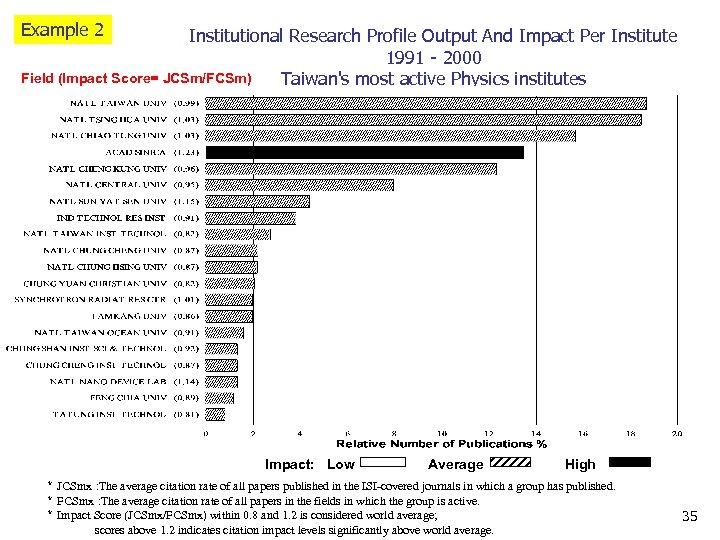 Example 2 Institutional Research Profile Output And Impact Per Institute 1991 - 2000 Field (Impact Score= JCSm/FCSm) Taiwan's most active Physics institutes Impact: Low Average High * JCSmx: average citation rate of all papers published in the ISI-covered journals in which a group has published. The * FCSmx: average citation rate of all papers in the fields in which the group is active. The * Impact Score (JCSmx/FCSmx) within 0. 8 and 1. 2 is considered world average; scores above 1. 2 indicates citation impact levels significantly above world average. 35
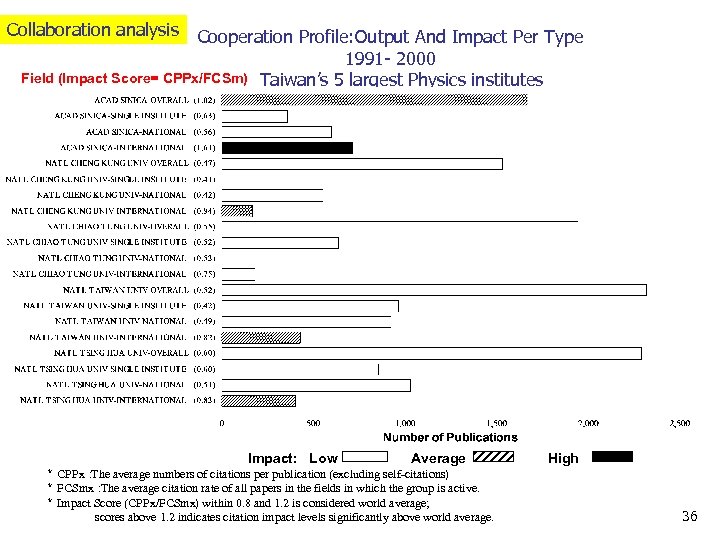 Collaboration analysis Cooperation Profile: Output And Impact Per Type 1991 - 2000 Field (Impact Score= CPPx/FCSm) Taiwan’s 5 largest Physics institutes Impact: Low Average * CPPx: average numbers of citations per publication (excluding self-citations) The * FCSmx: average citation rate of all papers in the fields in which the group is active. The * Impact Score (CPPx/FCSmx) within 0. 8 and 1. 2 is considered world average; scores above 1. 2 indicates citation impact levels significantly above world average. High 36
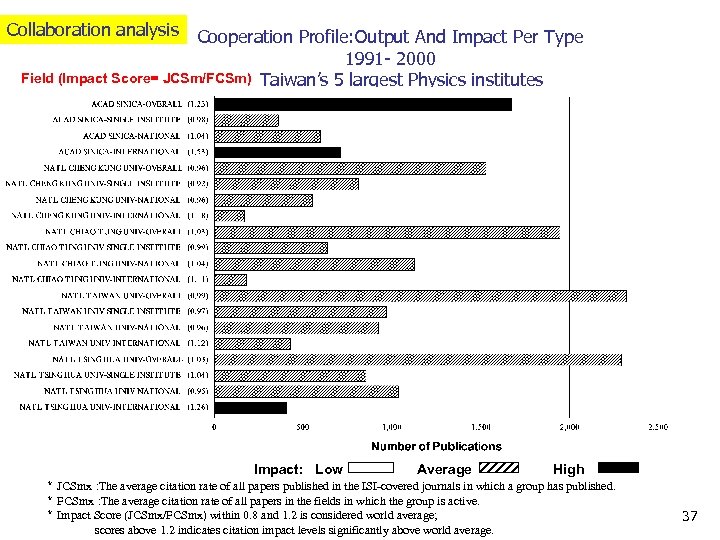 Collaboration analysis Cooperation Profile: Output And Impact Per Type 1991 - 2000 Field (Impact Score= JCSm/FCSm) Taiwan’s 5 largest Physics institutes Impact: Low Average High * JCSmx: average citation rate of all papers published in the ISI-covered journals in which a group has published. The * FCSmx: average citation rate of all papers in the fields in which the group is active. The * Impact Score (JCSmx/FCSmx) within 0. 8 and 1. 2 is considered world average; scores above 1. 2 indicates citation impact levels significantly above world average. 37
 Future Works (3) n The links between scientific knowledge and patents n n n To evaluate the contribution of science to technological development in Taiwan–academiaindustry linkages To identify knowledge flows in the domestic S&T system (e. g. , public-private R&D networks; role of patent citations) To develop a model to describe the relationships (e. g. , links, flows, users, providers, feedbacks) 38
 Reference n New bibliometric tools for the assessment of national research performance: Database description, overview of indicators and first applications n n Mapping the scientific performance of German medical research n n H. F. Moed, R. E. De Bruin, T. N. van Leeuwen, Scientometrics, 5(1995) 381 -422 R. J. W. Tijssen, T. N. van Leeuwen, A. F. J. van Raan, 2002 Bibliometric mapping as a science policy and research management tool 39