


 Скачать презентацию Make up schedule Monday 8 00 am Apr
5603f75ca8eb42a3192056b7230097af.ppt
- Количество слайдов: 44
 Make up schedule Monday 8: 00 am Apr 24? ? ? 9: 00 10: 00 11: 00 12: 00 pm 1: 00 2: 00 3: 00 4: 00 5: 00 6: 00 Apr 24? ? ? 7: 00 Tuesday Wednesday Thursday Apr 25? ? ? April 11 114 Ferguson April 11 catch a 1: 00 pm flight April 27 leave early morning by car Friday
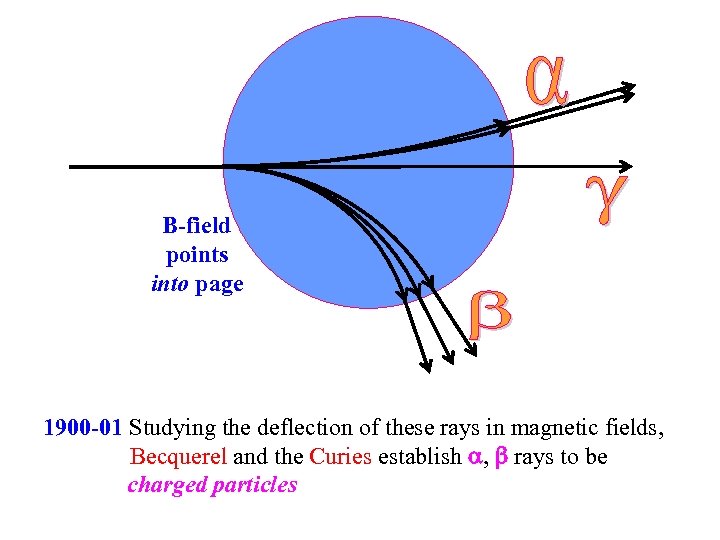 B-field points into page 1900 -01 Studying the deflection of these rays in magnetic fields, Becquerel and the Curies establish rays to be charged particles
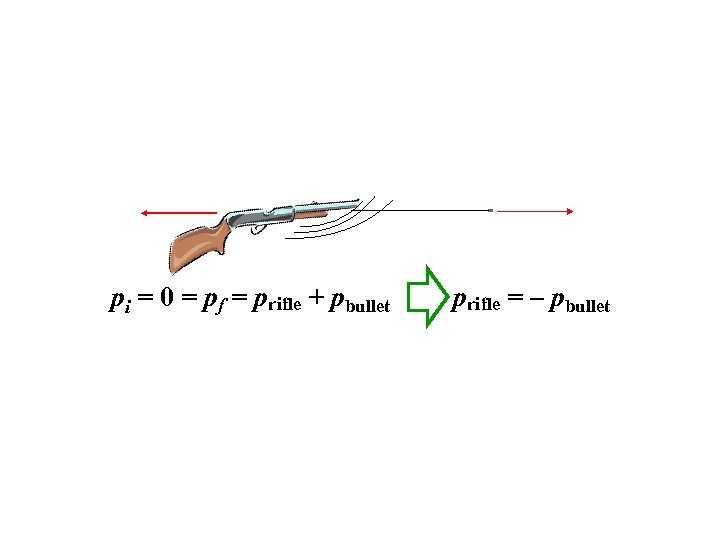 pi = 0 = pf = prifle + pbullet prifle = – pbullet
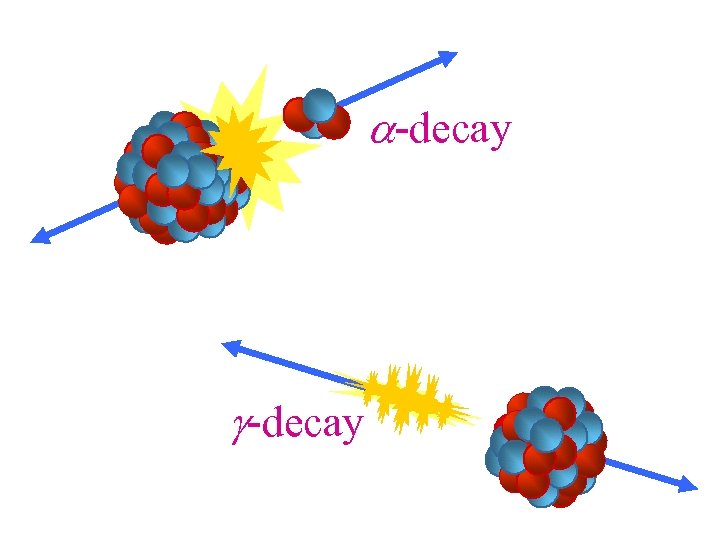 -decay
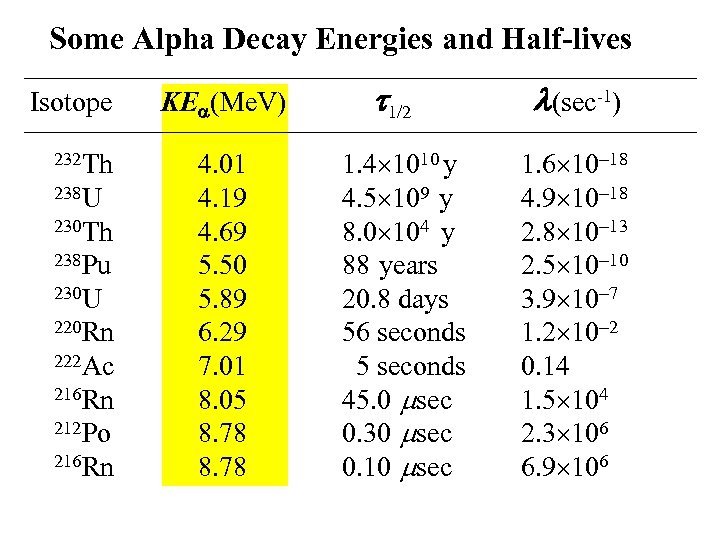 Some Alpha Decay Energies and Half-lives Isotope 232 Th 238 U 230 Th 238 Pu 230 U 220 Rn 222 Ac 216 Rn 212 Po 216 Rn KE (Me. V) 4. 01 4. 19 4. 69 5. 50 5. 89 6. 29 7. 01 8. 05 8. 78 1/2 1. 4 1010 y 4. 5 109 y 8. 0 104 y 88 years 20. 8 days 56 seconds 5 seconds 45. 0 sec 0. 30 sec 0. 10 sec l(sec-1) 1. 6 10 18 4. 9 10 18 2. 8 10 13 2. 5 10 10 3. 9 10 7 1. 2 10 2 0. 14 1. 5 104 2. 3 106 6. 9 106
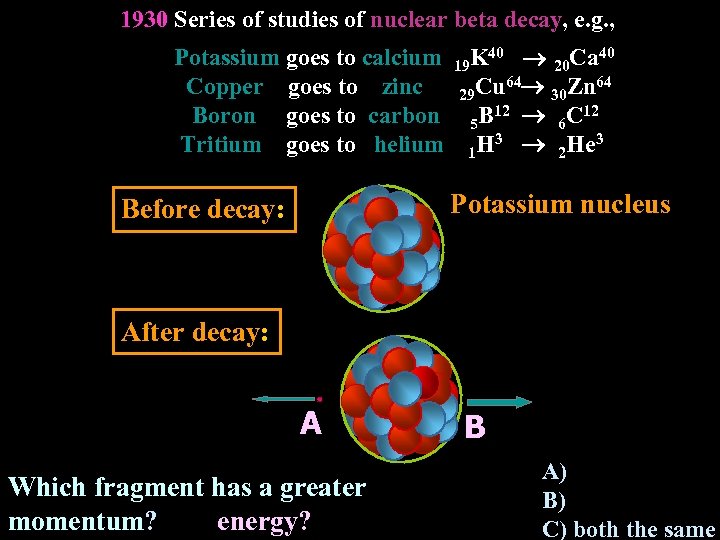 1930 Series of studies of nuclear beta decay, e. g. , Potassium goes to calcium Copper goes to zinc Boron goes to carbon Tritium goes to helium 20 Ca 40 64 64 29 Cu 30 Zn B 12 6 C 12 5 3 He 3 1 H 2 19 K 40 Potassium nucleus Before decay: After decay: A Which fragment has a greater momentum? energy? B A) B) C) both the same
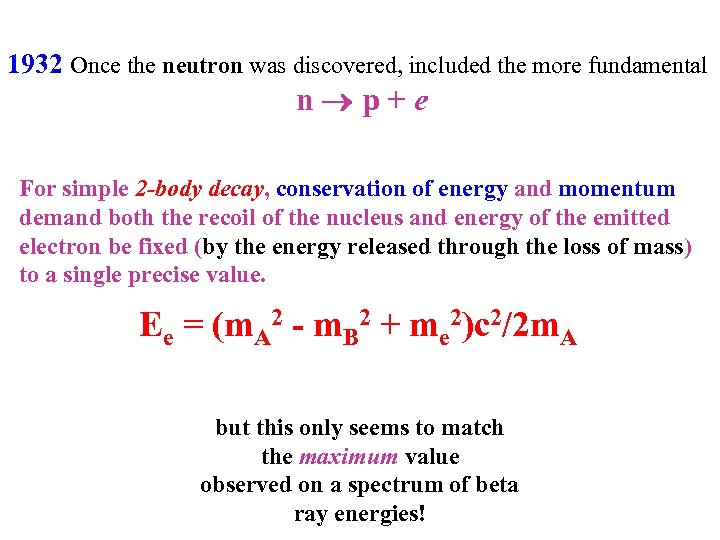 1932 Once the neutron was discovered, included the more fundamental n p+e For simple 2 -body decay, conservation of energy and momentum demand both the recoil of the nucleus and energy of the emitted electron be fixed (by the energy released through the loss of mass) to a single precise value. Ee = (m. A 2 - m. B 2 + me 2)c 2/2 m. A but this only seems to match the maximum value observed on a spectrum of beta ray energies!
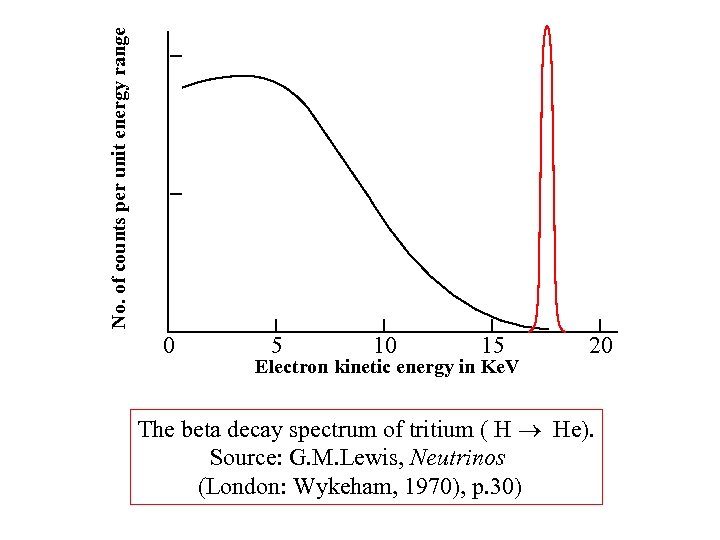 No. of counts per unit energy range 0 5 10 15 Electron kinetic energy in Ke. V 20 The beta decay spectrum of tritium ( H He). Source: G. M. Lewis, Neutrinos (London: Wykeham, 1970), p. 30)
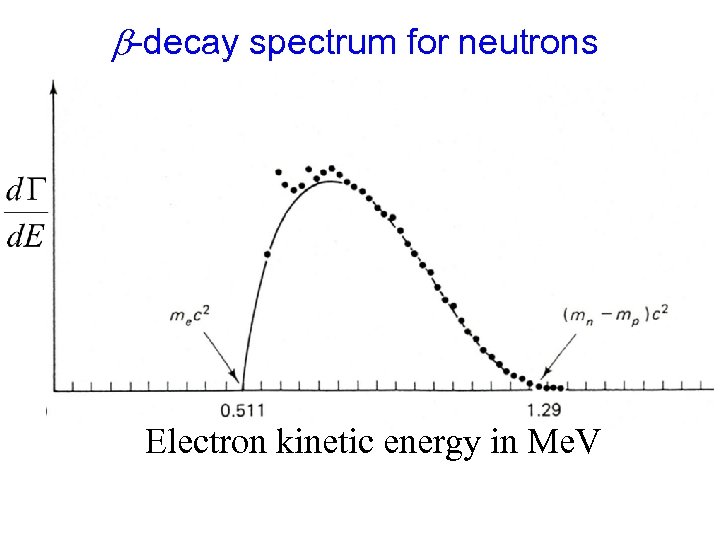 -decay spectrum for neutrons Electron kinetic energy in Me. V
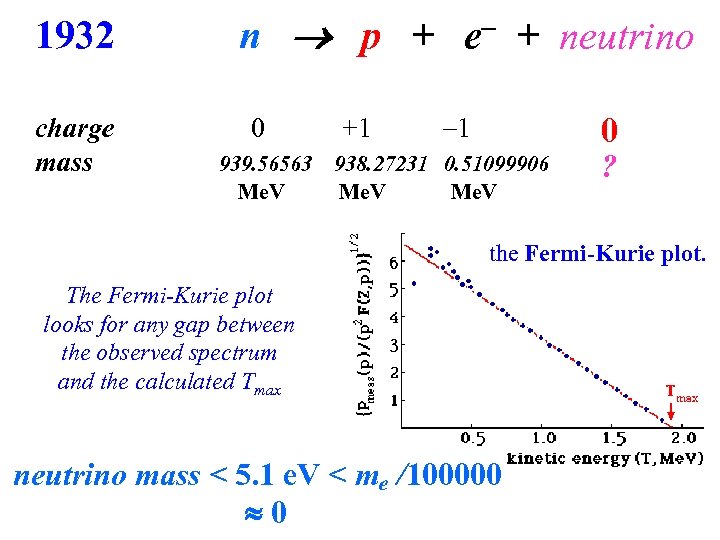 1932 charge mass n p + e + neutrino ? ? ? 0 939. 56563 Me. V +1 1 938. 27231 0. 51099906 Me. V ? 0 ? the Fermi-Kurie plot. The Fermi-Kurie plot looks for any gap between the observed spectrum and the calculated Tmax neutrino mass < 5. 1 e. V < me /100000 0
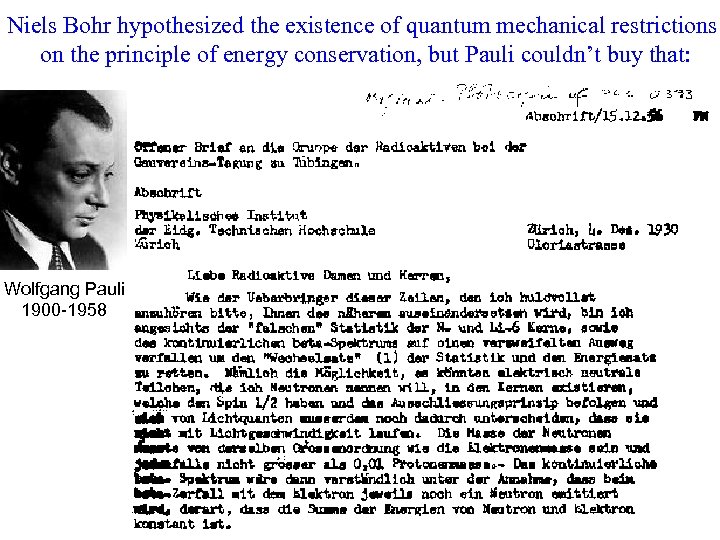 Niels Bohr hypothesized the existence of quantum mechanical restrictions on the principle of energy conservation, but Pauli couldn’t buy that: Wolfgang Pauli 1900 -1958
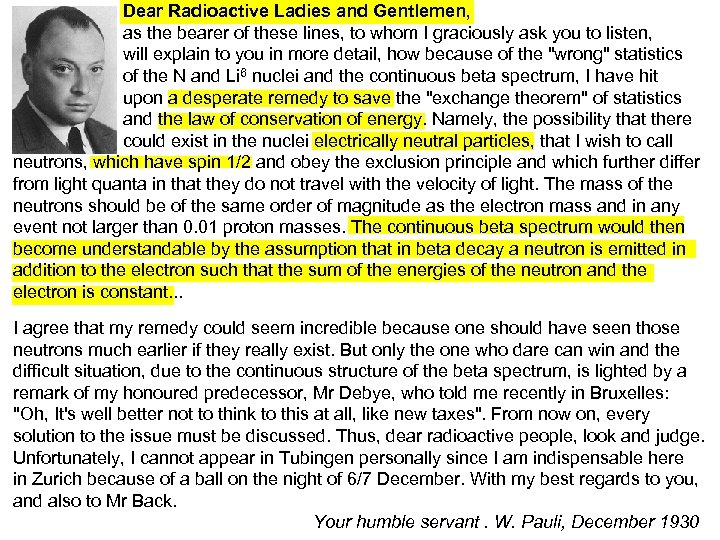 Dear Radioactive Ladies and Gentlemen, as the bearer of these lines, to whom I graciously ask you to listen, will explain to you in more detail, how because of the "wrong" statistics of the N and Li 6 nuclei and the continuous beta spectrum, I have hit upon a desperate remedy to save the "exchange theorem" of statistics and the law of conservation of energy. Namely, the possibility that there could exist in the nuclei electrically neutral particles, that I wish to call neutrons, which have spin 1/2 and obey the exclusion principle and which further differ from light quanta in that they do not travel with the velocity of light. The mass of the neutrons should be of the same order of magnitude as the electron mass and in any event not larger than 0. 01 proton masses. The continuous beta spectrum would then become understandable by the assumption that in beta decay a neutron is emitted in addition to the electron such that the sum of the energies of the neutron and the electron is constant. . . I agree that my remedy could seem incredible because one should have seen those neutrons much earlier if they really exist. But only the one who dare can win and the difficult situation, due to the continuous structure of the beta spectrum, is lighted by a remark of my honoured predecessor, Mr Debye, who told me recently in Bruxelles: "Oh, It's well better not to think to this at all, like new taxes". From now on, every solution to the issue must be discussed. Thus, dear radioactive people, look and judge. Unfortunately, I cannot appear in Tubingen personally since I am indispensable here in Zurich because of a ball on the night of 6/7 December. With my best regards to you, and also to Mr Back. Your humble servant. W. Pauli, December 1930
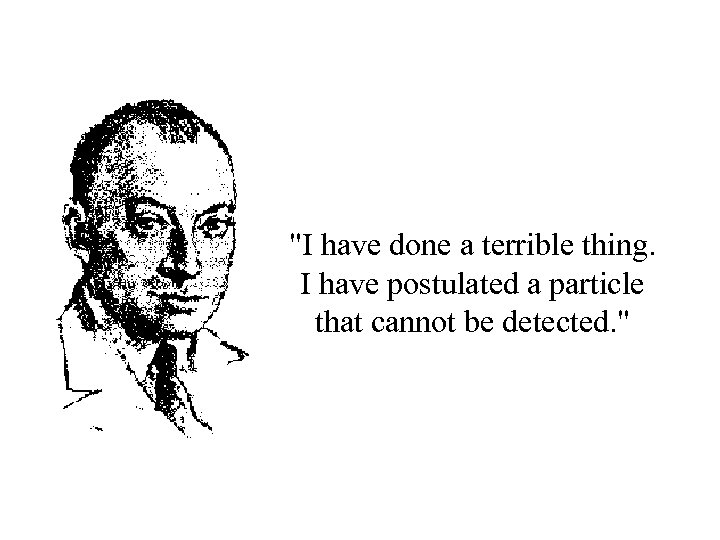 "I have done a terrible thing. I have postulated a particle that cannot be detected. "
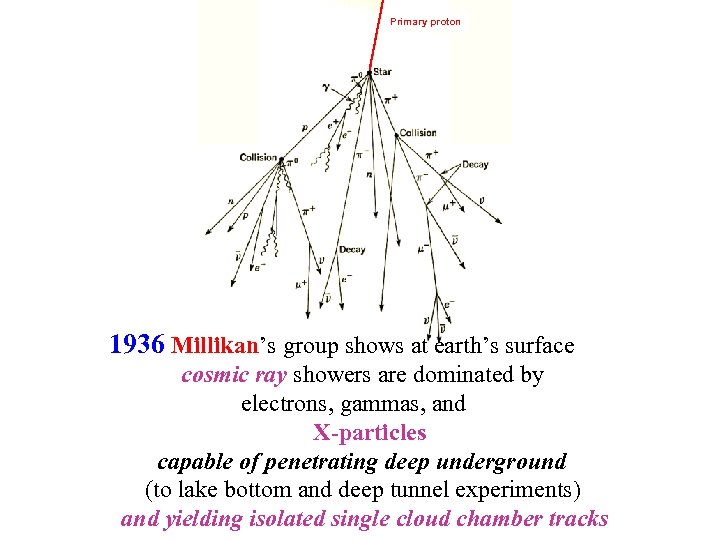 Primary proton 1936 Millikan’s group shows at earth’s surface cosmic ray showers are dominated by electrons, gammas, and X-particles capable of penetrating deep underground (to lake bottom and deep tunnel experiments) and yielding isolated single cloud chamber tracks
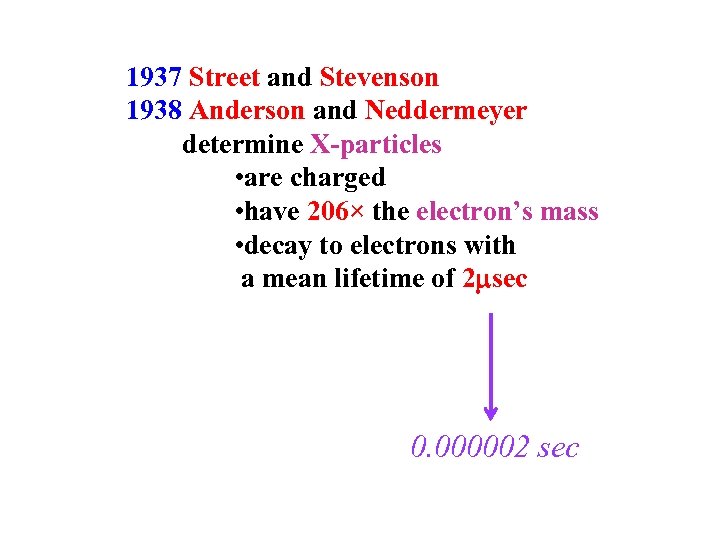 1937 Street and Stevenson 1938 Anderson and Neddermeyer determine X-particles • are charged • have 206× the electron’s mass • decay to electrons with a mean lifetime of 2 sec 0. 000002 sec
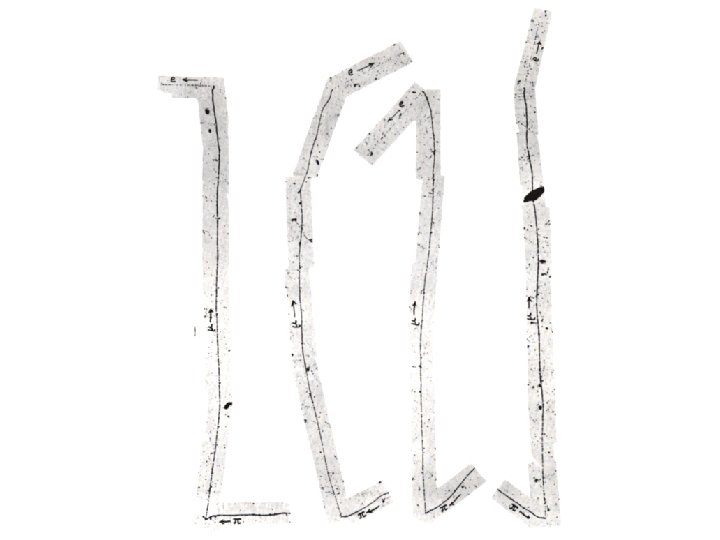
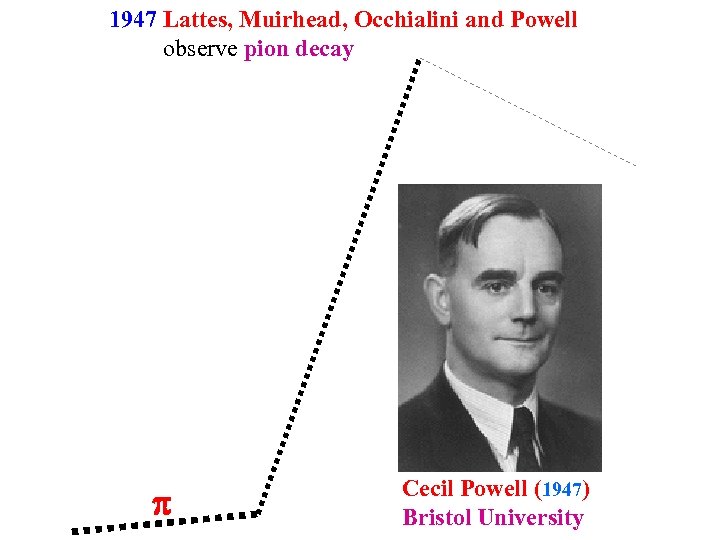 1947 Lattes, Muirhead, Occhialini and Powell observe pion decay Cecil Powell (1947) Bristol University
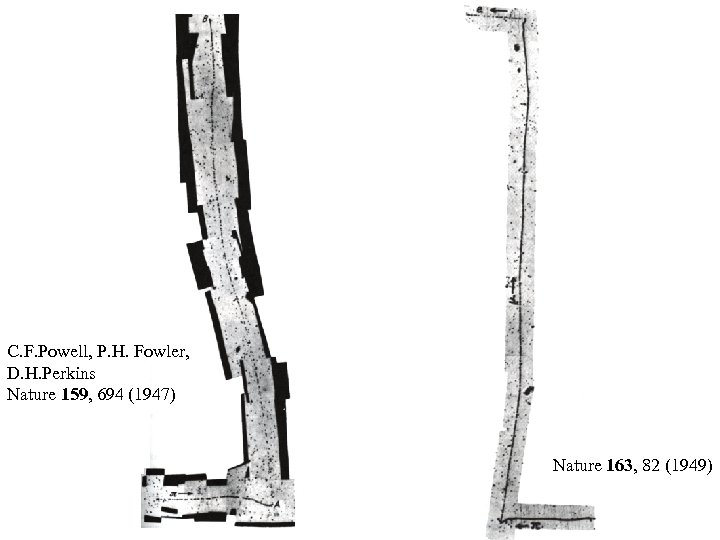 C. F. Powell, P. H. Fowler, D. H. Perkins Nature 159, 694 (1947) Nature 163, 82 (1949)
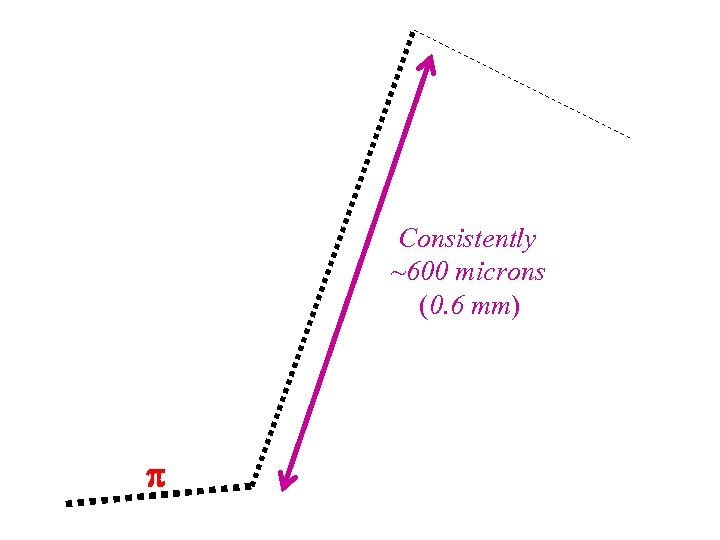 Consistently ~600 microns (0. 6 mm)
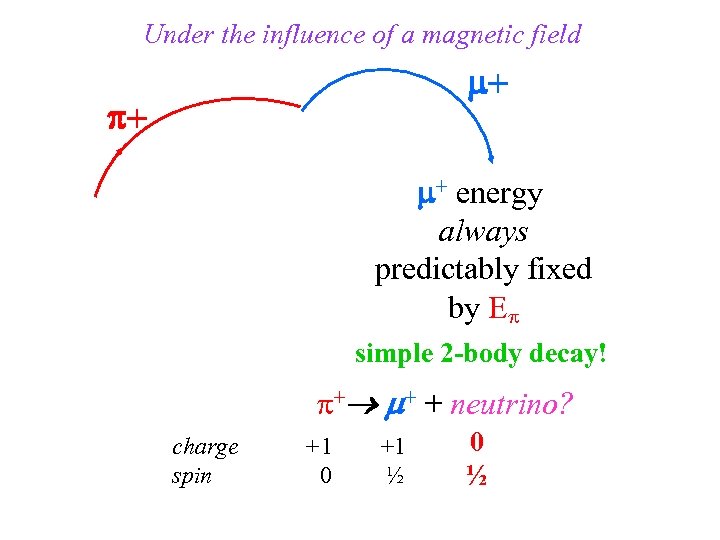 Under the influence of a magnetic field + + + energy always predictably fixed by E simple 2 -body decay! + + + neutrino? charge spin +1 0 +1 ½ 0 ? ? ½
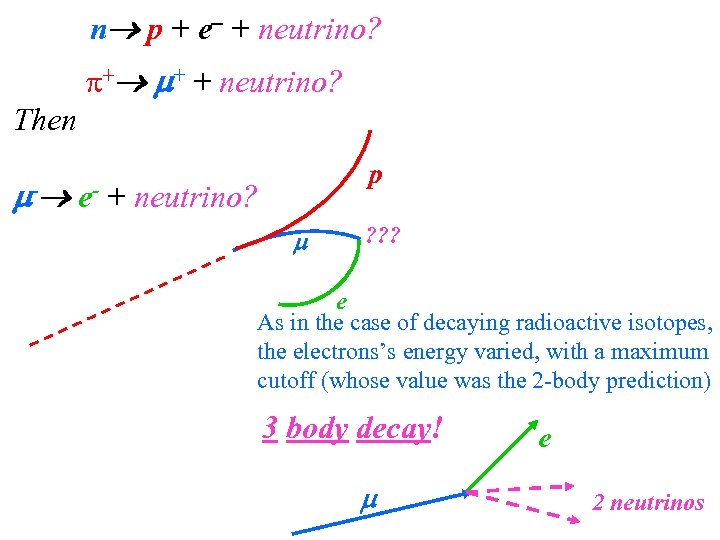 n p + e + neutrino? + + + neutrino? Then p - e- + neutrino? ? e As in the case of decaying radioactive isotopes, the electrons’s energy varied, with a maximum cutoff (whose value was the 2 -body prediction) 3 body decay! e 2 neutrinos
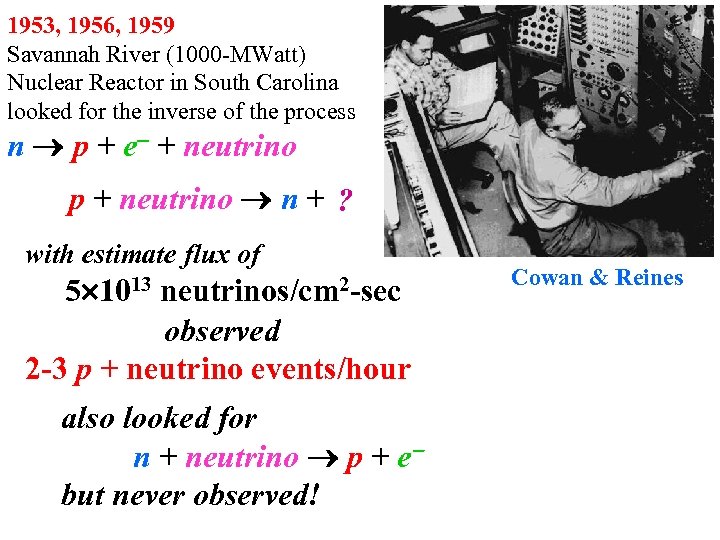 1953, 1956, 1959 Savannah River (1000 -MWatt) Nuclear Reactor in South Carolina looked for the inverse of the process n p + e + neutrino p + neutrino n + e+ ? with estimate flux of 5 1013 neutrinos/cm 2 -sec observed 2 -3 p + neutrino events/hour also looked for n + neutrino p + ebut never observed! Cowan & Reines
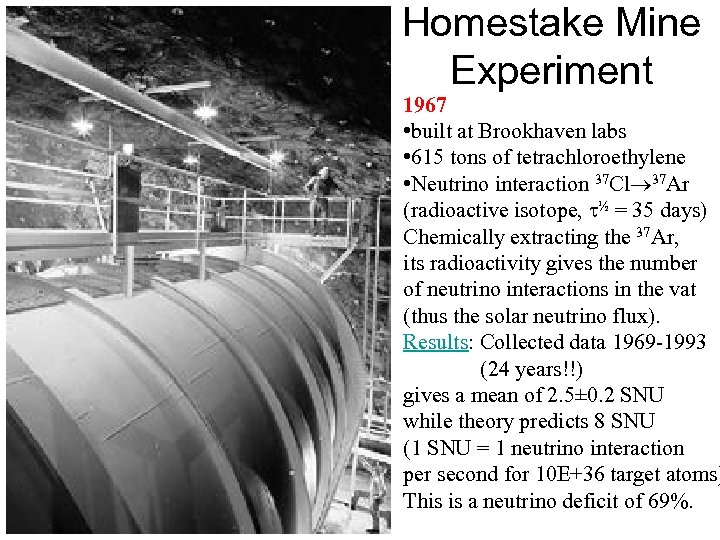 Homestake Mine Experiment 1967 • built at Brookhaven labs • 615 tons of tetrachloroethylene • Neutrino interaction 37 Cl 37 Ar (radioactive isotope, ½ = 35 days) Chemically extracting the 37 Ar, its radioactivity gives the number of neutrino interactions in the vat (thus the solar neutrino flux). Results: Collected data 1969 -1993 (24 years!!) gives a mean of 2. 5± 0. 2 SNU while theory predicts 8 SNU (1 SNU = 1 neutrino interaction per second for 10 E+36 target atoms) This is a neutrino deficit of 69%.
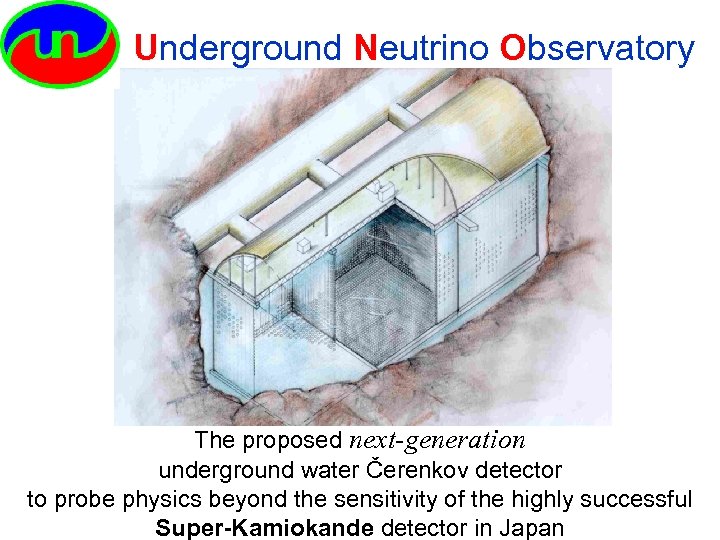 Underground Neutrino Observatory The proposed next-generation underground water Čerenkov detector to probe physics beyond the sensitivity of the highly successful Super-Kamiokande detector in Japan
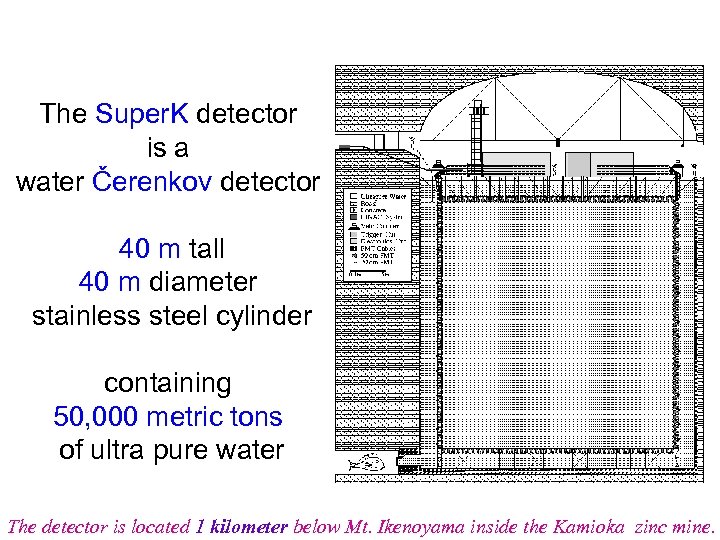 The Super. K detector is a water Čerenkov detector 40 m tall 40 m diameter stainless steel cylinder containing 50, 000 metric tons of ultra pure water The detector is located 1 kilometer below Mt. Ikenoyama inside the Kamioka zinc mine.
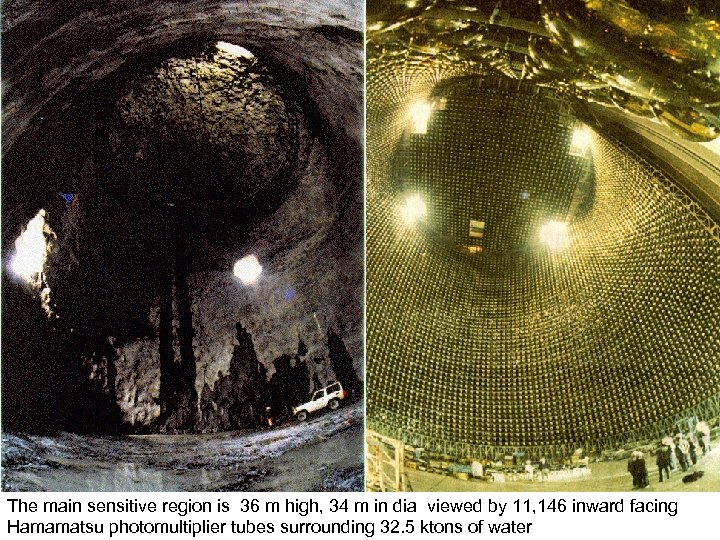 The main sensitive region is 36 m high, 34 m in dia viewed by 11, 146 inward facing Hamamatsu photomultiplier tubes surrounding 32. 5 ktons of water
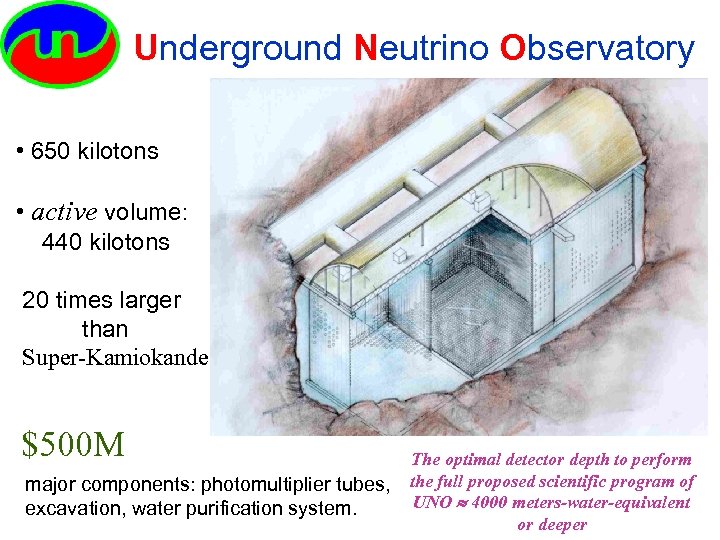 Underground Neutrino Observatory • 650 kilotons • active volume: 440 kilotons 20 times larger than Super-Kamiokande $500 M major components: photomultiplier tubes, excavation, water purification system. The optimal detector depth to perform the full proposed scientific program of UNO 4000 meters-water-equivalent or deeper
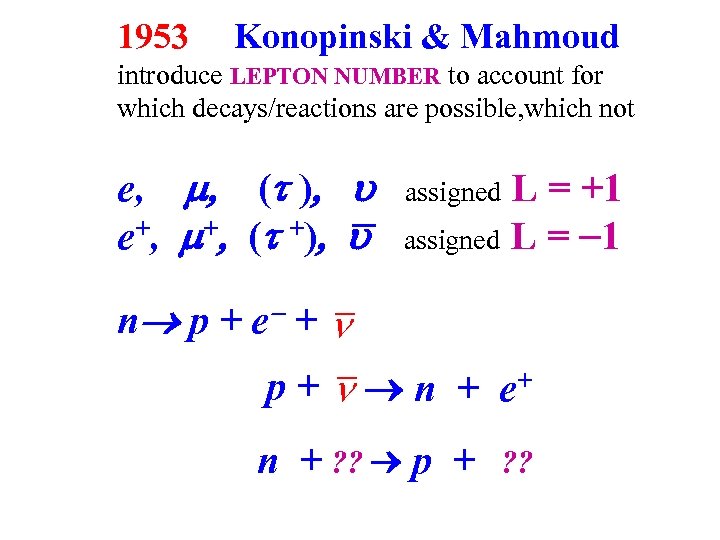 1953 Konopinski & Mahmoud introduce LEPTON NUMBER to account for which decays/reactions are possible, which not e, ( ) assigned L = +1 _ e+, + ( +) assigned L = 1 _ n p + e- + neutrino _ p + neutrinoe n + e+ n + + ? ? n + ? ? p + e
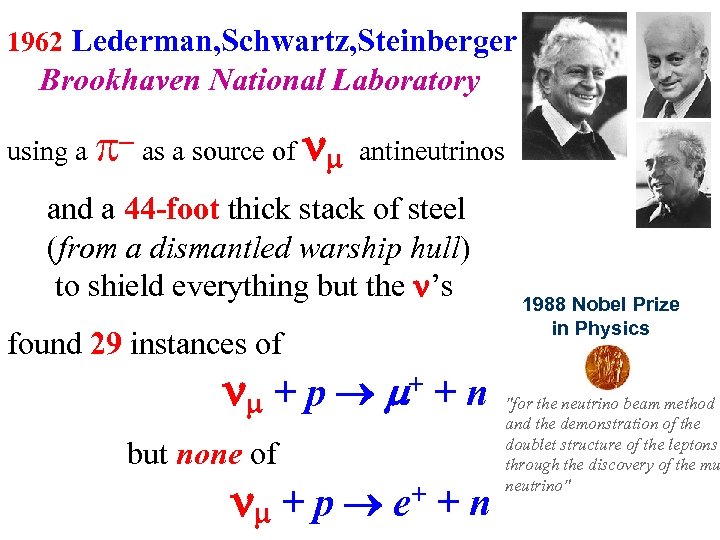 1962 Lederman, Schwartz, Steinberger Brookhaven National Laboratory using a as a source of antineutrinos and a 44 -foot thick stack of steel (from a dismantled warship hull) to shield everything but the ’s found 29 instances of + p + + n but none of + p e+ + n 1988 Nobel Prize in Physics "for the neutrino beam method and the demonstration of the doublet structure of the leptons through the discovery of the mu neutrino"
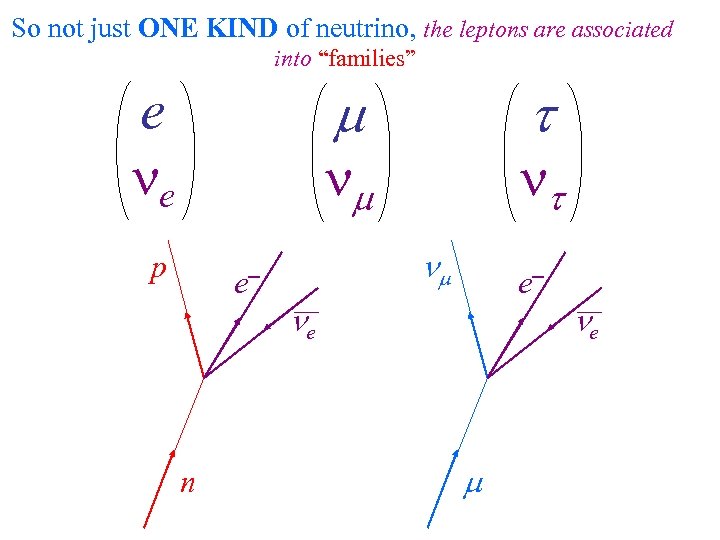 So not just ONE KIND of neutrino, the leptons are associated into “families” e e p e n e e e
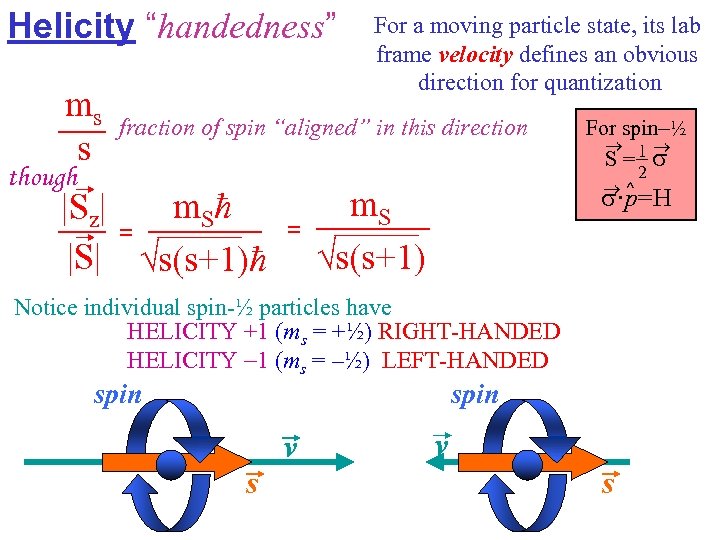 Helicity “handedness” ms s For a moving particle state, its lab frame velocity defines an obvious direction for quantization fraction of spin “aligned” in this direction For spin ½ 1 S= 2 though |Sz| m Sħ = |S| s(s+1)ħ = ^ ·p=H m. S s(s+1) Notice individual spin-½ particles have HELICITY +1 (ms = +½) RIGHT-HANDED HELICITY 1 (ms = ½) LEFT-HANDED spin v s
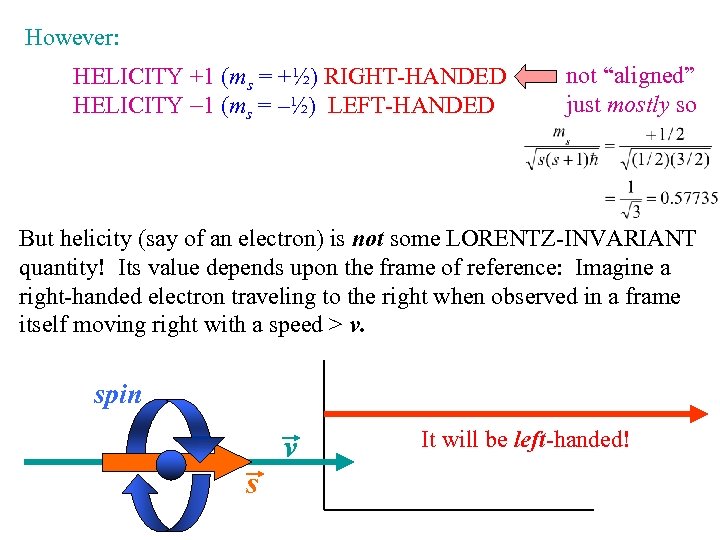 However: HELICITY +1 (ms = +½) RIGHT-HANDED HELICITY 1 (ms = ½) LEFT-HANDED not “aligned” just mostly so But helicity (say of an electron) is not some LORENTZ-INVARIANT quantity! Its value depends upon the frame of reference: Imagine a right-handed electron traveling to the right when observed in a frame itself moving right with a speed > v. spin v s It will be left-handed!
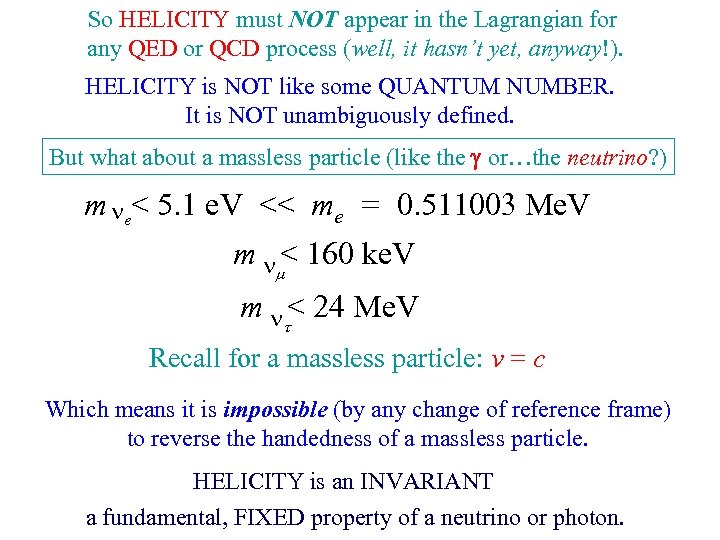 So HELICITY must NOT appear in the Lagrangian for any QED or QCD process (well, it hasn’t yet, anyway!). HELICITY is NOT like some QUANTUM NUMBER. It is NOT unambiguously defined. But what about a massless particle (like the or…the neutrino? ) m e< 5. 1 e. V << me = 0. 511003 Me. V m < 160 ke. V m < 24 Me. V Recall for a massless particle: v = c Which means it is impossible (by any change of reference frame) to reverse the handedness of a massless particle. HELICITY is an INVARIANT a fundamental, FIXED property of a neutrino or photon.
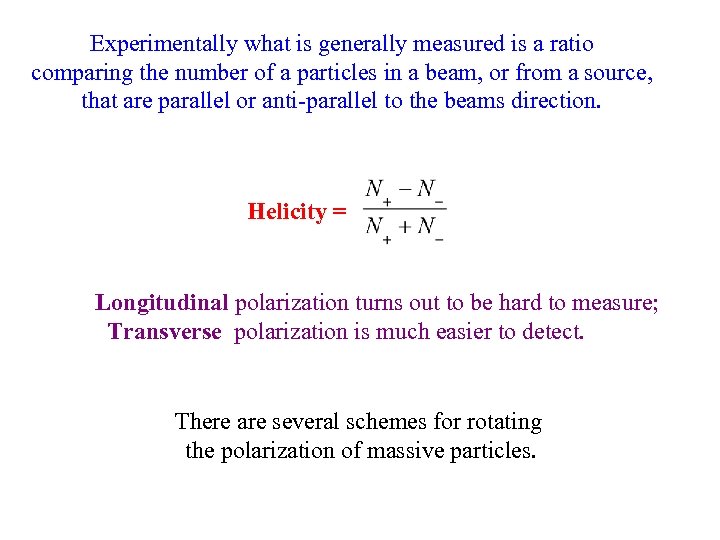 Experimentally what is generally measured is a ratio comparing the number of a particles in a beam, or from a source, that are parallel or anti-parallel to the beams direction. Helicity = Longitudinal polarization turns out to be hard to measure; Transverse polarization is much easier to detect. There are several schemes for rotating the polarization of massive particles.
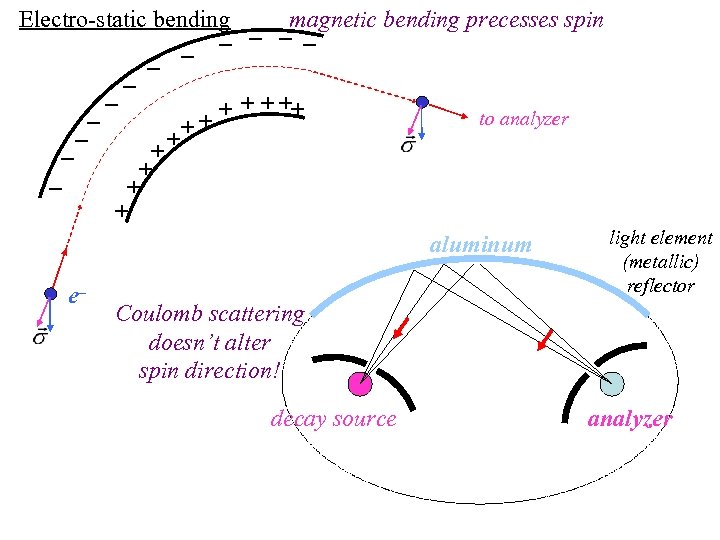 Electro-static bending magnetic bending precesses spin + ++ to analyzer ++ + + + light element aluminum e (metallic) reflector Coulomb scattering doesn’t alter spin direction! decay source analyzer
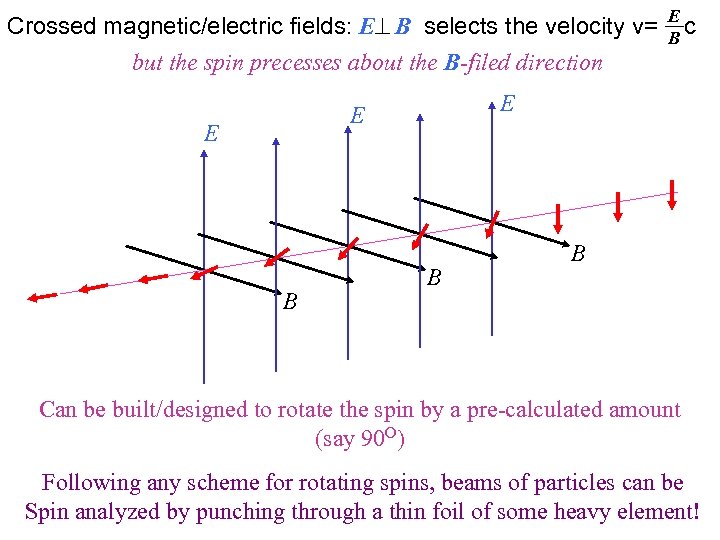 Crossed magnetic/electric fields: E B selects the velocity v= E c B but the spin precesses about the B-filed direction E E E B B B Can be built/designed to rotate the spin by a pre-calculated amount (say 90 O) Following any scheme for rotating spins, beams of particles can be Spin analyzed by punching through a thin foil of some heavy element!
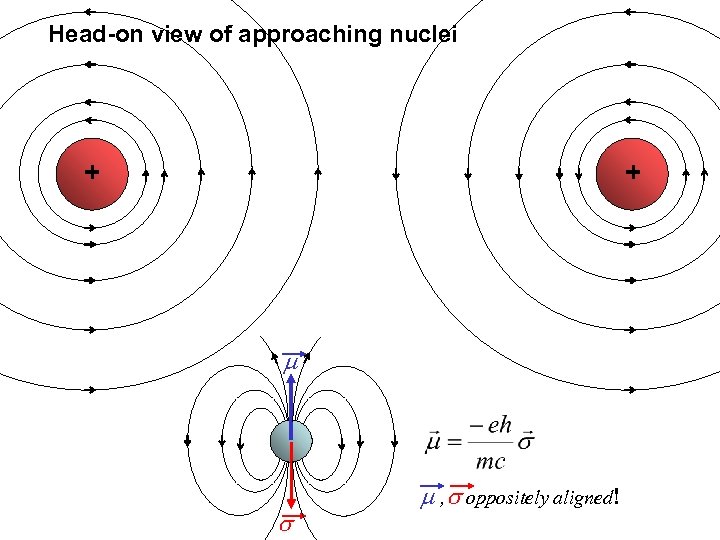 Head-on view of approaching nuclei + + , oppositely aligned!
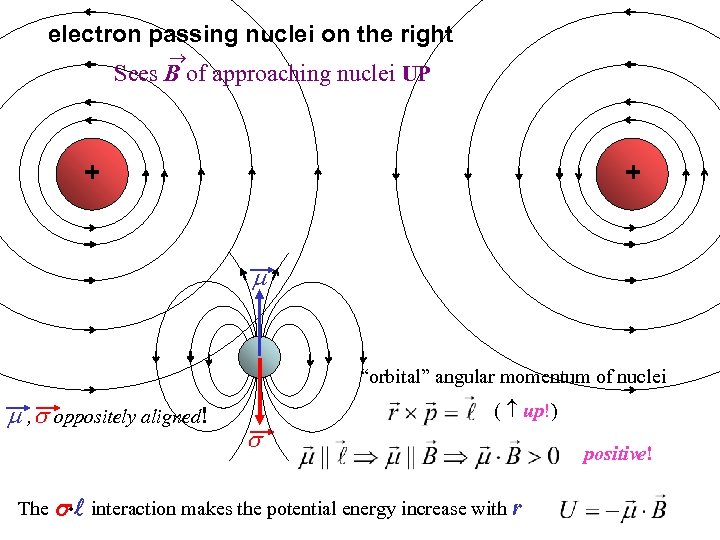 electron passing nuclei on the right Sees B of approaching nuclei UP + + “orbital” angular momentum of nuclei , oppositely aligned! ( up!) The interaction makes the potential energy increase with r positive!
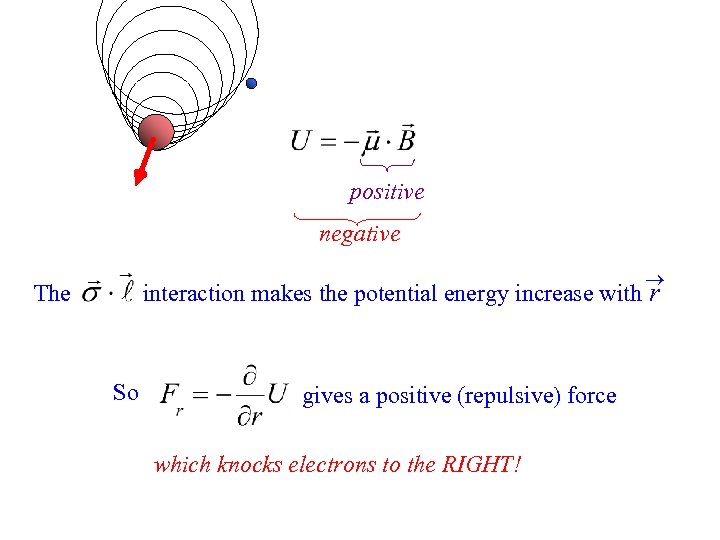 positive negative interaction makes the potential energy increase with r The So gives a positive (repulsive) force which knocks electrons to the RIGHT!
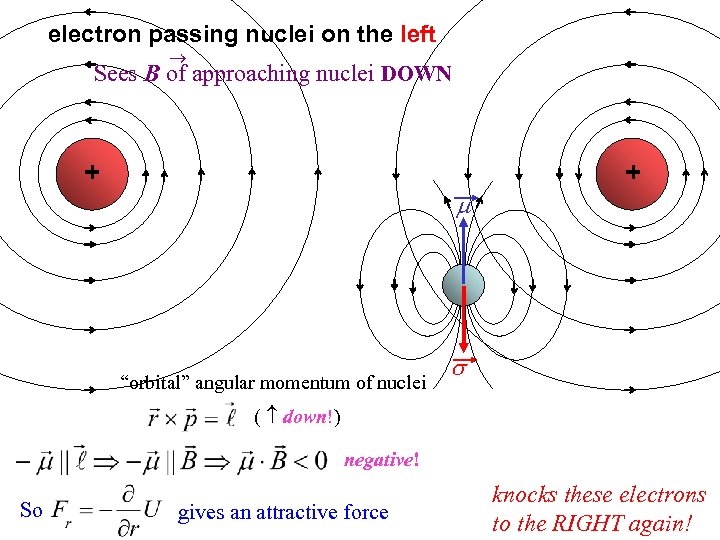 electron passing nuclei on the left Sees B of approaching nuclei DOWN + “orbital” angular momentum of nuclei + ( down!) negative! So gives an attractive force knocks these electrons to the RIGHT again!
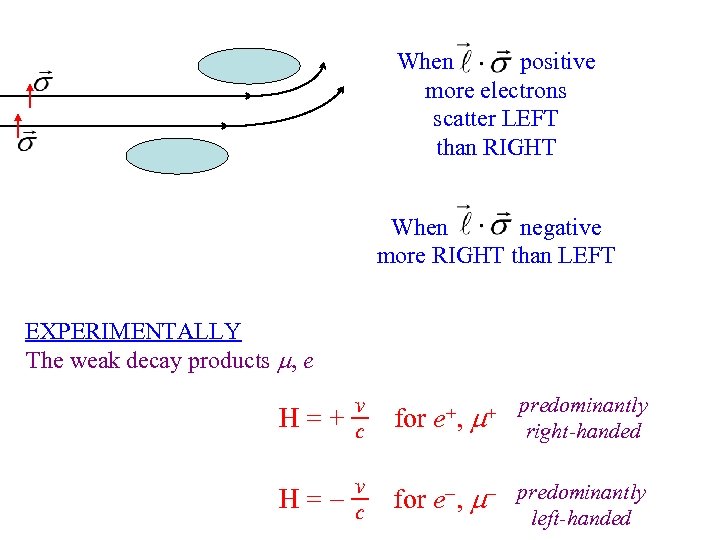 When positive more electrons scatter LEFT than RIGHT When negative more RIGHT than LEFT EXPERIMENTALLY The weak decay products , e H=+ v c for + predominantly right-handed H= v c for e , predominantly left-handed e +,
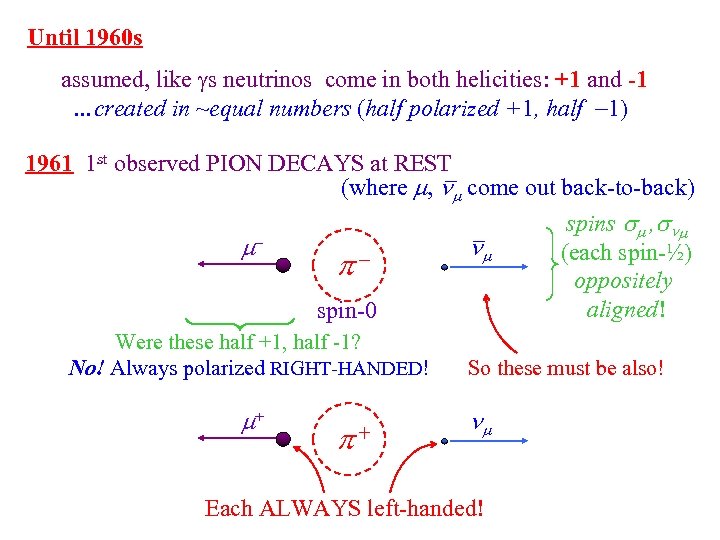 Until 1960 s assumed, like s neutrinos come in both helicities: +1 and -1 …created in ~equal numbers (half polarized +1, half 1) 1961 1 st observed PION DECAYS at REST _ (where , come out back-to-back) spins , _ (each spin-½) oppositely aligned! spin-0 Were these half +1, half -1? No! Always polarized RIGHT-HANDED! + + So these must be also! Each ALWAYS left-handed!
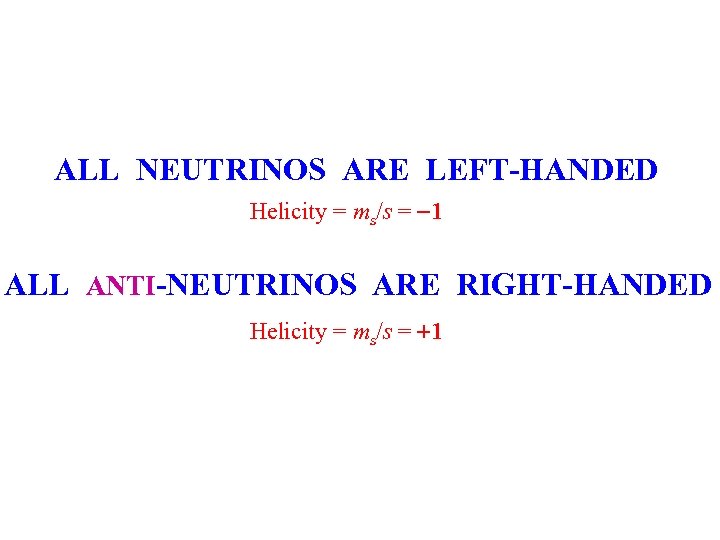 ALL NEUTRINOS ARE LEFT-HANDED Helicity = ms/s = 1 ALL ANTI-NEUTRINOS ARE RIGHT-HANDED Helicity = ms/s = +1