


 Скачать презентацию Major communities and country of origins In Sweden
d846e878a73ff557f97953857fb2356c.ppt
- Количество слайдов: 14
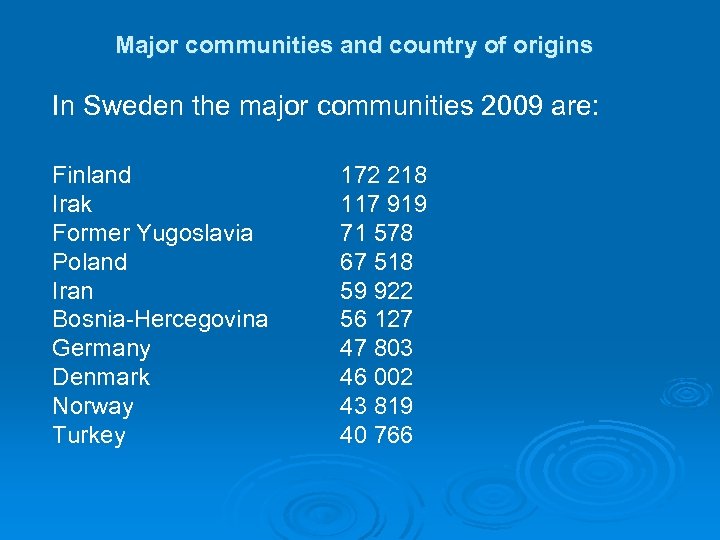 Major communities and country of origins In Sweden the major communities 2009 are: Finland Irak Former Yugoslavia Poland Iran Bosnia-Hercegovina Germany Denmark Norway Turkey 172 218 117 919 71 578 67 518 59 922 56 127 47 803 46 002 43 819 40 766
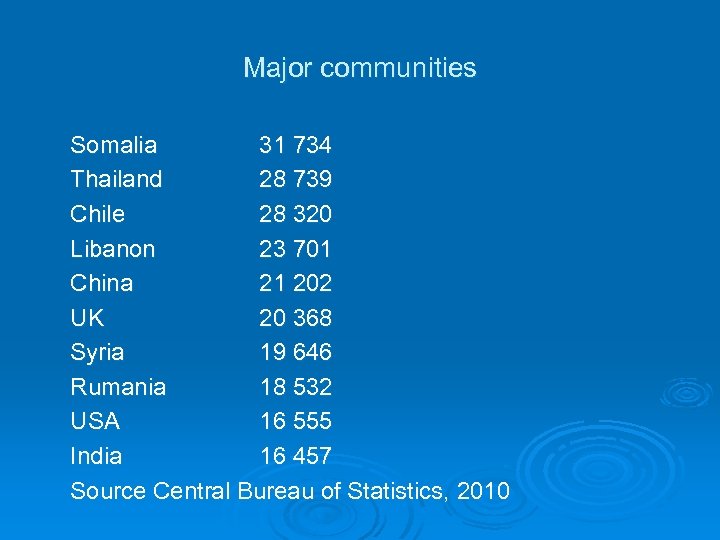 Major communities Somalia 31 734 Thailand 28 739 Chile 28 320 Libanon 23 701 China 21 202 UK 20 368 Syria 19 646 Rumania 18 532 USA 16 555 India 16 457 Source Central Bureau of Statistics, 2010
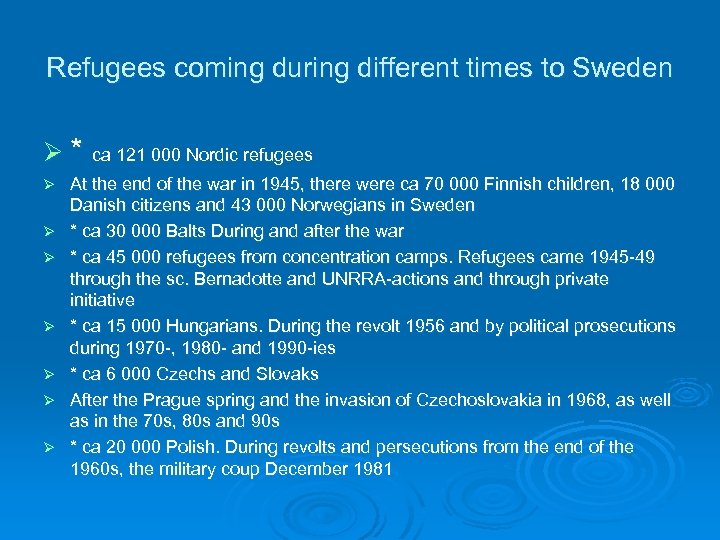 Refugees coming during different times to Sweden Ø * ca 121 000 Nordic refugees Ø Ø Ø Ø At the end of the war in 1945, there were ca 70 000 Finnish children, 18 000 Danish citizens and 43 000 Norwegians in Sweden * ca 30 000 Balts During and after the war * ca 45 000 refugees from concentration camps. Refugees came 1945 -49 through the sc. Bernadotte and UNRRA-actions and through private initiative * ca 15 000 Hungarians. During the revolt 1956 and by political prosecutions during 1970 -, 1980 - and 1990 -ies * ca 6 000 Czechs and Slovaks After the Prague spring and the invasion of Czechoslovakia in 1968, as well as in the 70 s, 80 s and 90 s * ca 20 000 Polish. During revolts and persecutions from the end of the 1960 s, the military coup December 1981
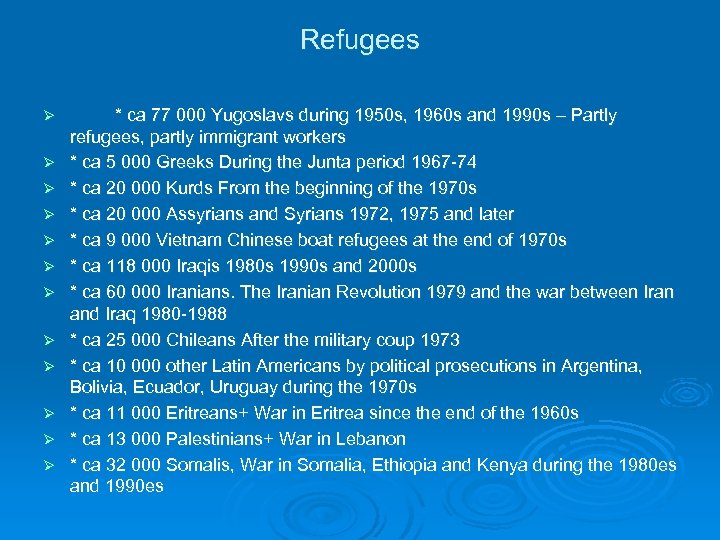 Refugees Ø Ø Ø * ca 77 000 Yugoslavs during 1950 s, 1960 s and 1990 s – Partly refugees, partly immigrant workers * ca 5 000 Greeks During the Junta period 1967 -74 * ca 20 000 Kurds From the beginning of the 1970 s * ca 20 000 Assyrians and Syrians 1972, 1975 and later * ca 9 000 Vietnam Chinese boat refugees at the end of 1970 s * ca 118 000 Iraqis 1980 s 1990 s and 2000 s * ca 60 000 Iranians. The Iranian Revolution 1979 and the war between Iran and Iraq 1980 -1988 * ca 25 000 Chileans After the military coup 1973 * ca 10 000 other Latin Americans by political prosecutions in Argentina, Bolivia, Ecuador, Uruguay during the 1970 s * ca 11 000 Eritreans+ War in Eritrea since the end of the 1960 s * ca 13 000 Palestinians+ War in Lebanon * ca 32 000 Somalis, War in Somalia, Ethiopia and Kenya during the 1980 es and 1990 es
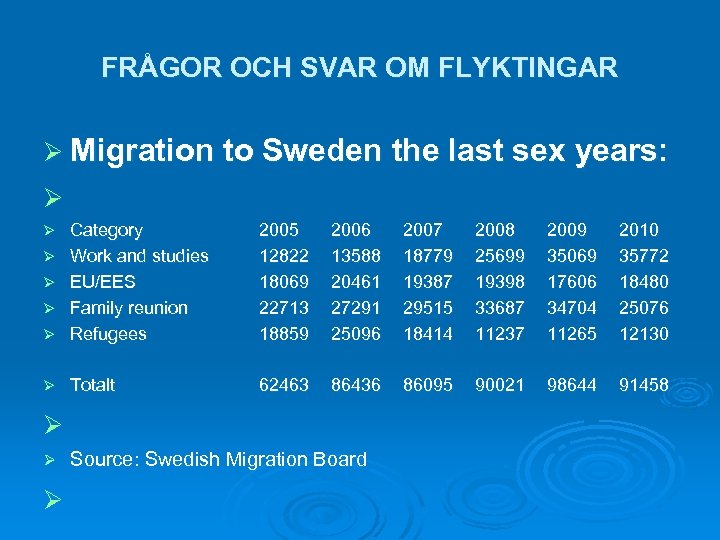 FRÅGOR OCH SVAR OM FLYKTINGAR Ø Migration to Sweden the last sex years: Ø Ø Category Work and studies EU/EES Family reunion Refugees 2005 12822 18069 22713 18859 2006 13588 20461 27291 25096 2007 18779 19387 29515 18414 2008 25699 19398 33687 11237 2009 35069 17606 34704 11265 2010 35772 18480 25076 12130 Ø Totalt 62463 86436 86095 90021 98644 91458 Ø Ø Ø Source: Swedish Migration Board Ø
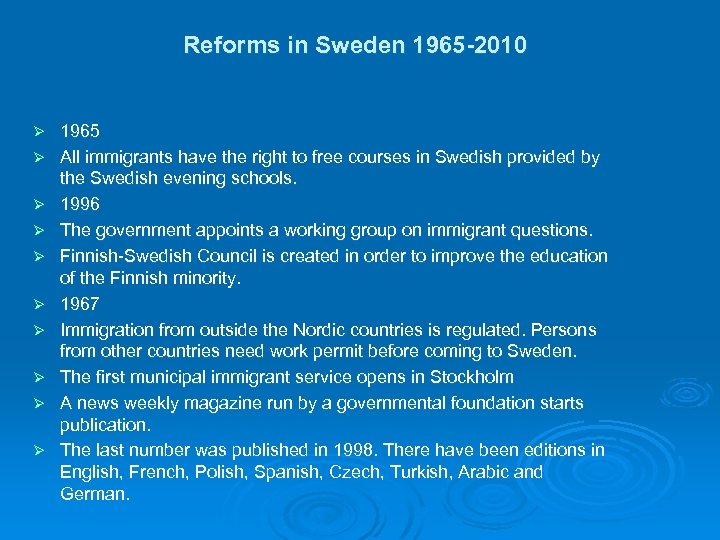 Reforms in Sweden 1965 -2010 Ø Ø Ø Ø Ø 1965 All immigrants have the right to free courses in Swedish provided by the Swedish evening schools. 1996 The government appoints a working group on immigrant questions. Finnish-Swedish Council is created in order to improve the education of the Finnish minority. 1967 Immigration from outside the Nordic countries is regulated. Persons from other countries need work permit before coming to Sweden. The first municipal immigrant service opens in Stockholm A news weekly magazine run by a governmental foundation starts publication. The last number was published in 1998. There have been editions in English, French, Polish, Spanish, Czech, Turkish, Arabic and German.
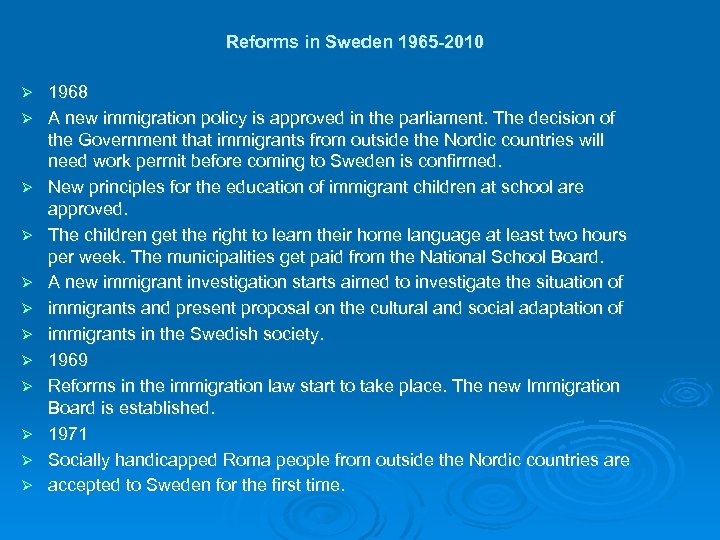 Reforms in Sweden 1965 -2010 Ø Ø Ø 1968 A new immigration policy is approved in the parliament. The decision of the Government that immigrants from outside the Nordic countries will need work permit before coming to Sweden is confirmed. New principles for the education of immigrant children at school are approved. The children get the right to learn their home language at least two hours per week. The municipalities get paid from the National School Board. A new immigrant investigation starts aimed to investigate the situation of immigrants and present proposal on the cultural and social adaptation of immigrants in the Swedish society. 1969 Reforms in the immigration law start to take place. The new Immigration Board is established. 1971 Socially handicapped Roma people from outside the Nordic countries are accepted to Sweden for the first time.
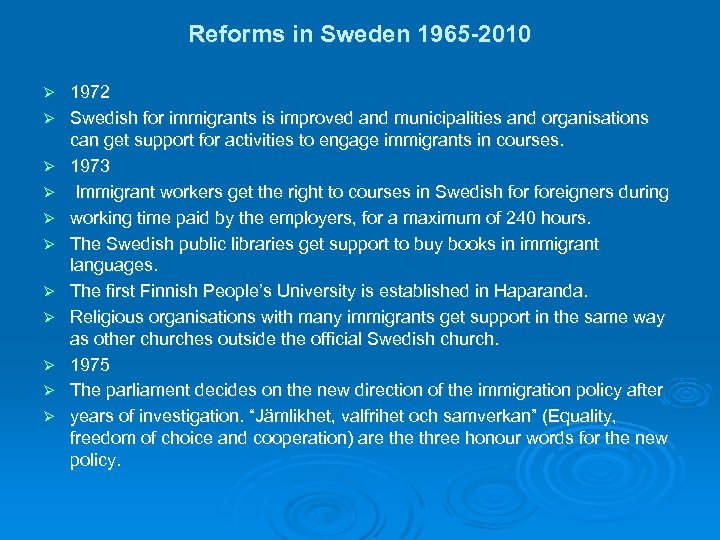 Reforms in Sweden 1965 -2010 Ø Ø Ø 1972 Swedish for immigrants is improved and municipalities and organisations can get support for activities to engage immigrants in courses. 1973 Immigrant workers get the right to courses in Swedish foreigners during working time paid by the employers, for a maximum of 240 hours. The Swedish public libraries get support to buy books in immigrant languages. The first Finnish People’s University is established in Haparanda. Religious organisations with many immigrants get support in the same way as other churches outside the official Swedish church. 1975 The parliament decides on the new direction of the immigration policy after years of investigation. “Jämlikhet, valfrihet och samverkan” (Equality, freedom of choice and cooperation) are three honour words for the new policy.
 Reforms in Sweden 1965 -2010 Ø Ø Ø Ø During this and coming years the parliament decides about a long list of reforms: The Swedish Immigration Board gives support to immigrant organisations. Journals and magazines in other languages than Swedish can now get economic support either by the Swedish Immigration Board or the Swedish Cultural Board, depending of the journals orientation. 1976 Foreign citizens living in Sweden for more than three years get the right to vote in the local and regional elections, as well as in the elections to the Swedish Church (this last election depending of if they are or not members of the Swedish Church – for instance many Finnish citizens, for whom the Swedish Church does not differ from the official Finnish one. The parliament decides that immigrant children should have the right to follow courses in their mother tongue both in the pre-school and in the primary education from class 1 to class 9.
 Reforms in Sweden 1965 -2010 Ø Ø Ø Ø Ø The Swedish Radio and the Television Company start programs in immigrant languages, besides the Finnish, which was established some years before. 1984 The responsibility for refugees is transfered from the Employment Office to the Swedish Immigration Board. The parliament decides that the refugees should move to different cities around Sweden, instead of being concentrated in a few places. This was called the whole-country-strategy 1986 The 1 st of July starts the new ethnic discrimination ombudsman. His/her work is to help immigrants in personal cases of discrimination due to their ethnic background. 1997 A new integration policy is approved in the parliament. The Swedish Immigration Board is divided in two different organisations, the Swedish Integration Board and the Swedish Immigration Board.
 Reforms in Sweden 1965 -2010 Ø Ø Ø Ø Ø 2000 The Swedish Immigration Board changes its name to Swedish Migration Board. 2001 The 1 st of July is implemented the new law on Swedish citizenship, which allows double citizenship. It gives also children to stateless persons to become Swedish from birth. 2003 A new law on discrimination, which comprises all kinds of discrimination by ethnicity, religion, sexual preference or handicap. 2008 A new law for work migration at the end of the year. 2010 The Employment office is in charge of the introduction to refugees.
 Thanks! Miguel Benito Questions? Write to: info@immi. se www. immi. se Immigrant-institutet
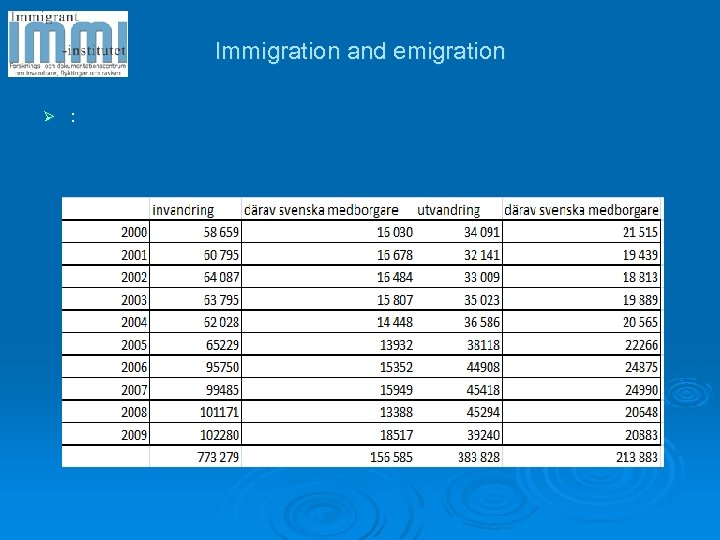 Immigration and emigration Ø :
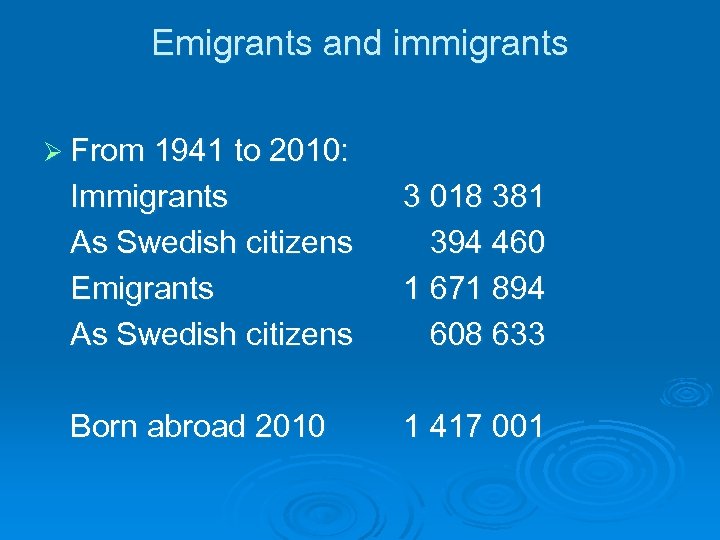 Emigrants and immigrants Ø From 1941 to 2010: Immigrants As Swedish citizens Emigrants As Swedish citizens 3 018 381 394 460 1 671 894 608 633 Born abroad 2010 1 417 001