


 Скачать презентацию MAINTENANCE OF COMPLEX SYSTEMS ISSUES AND CHALLENGES Professor
24d7a6c6157fcbf3d8d58ad02b045d95.ppt
- Количество слайдов: 52
 MAINTENANCE OF COMPLEX SYSTEMS: ISSUES AND CHALLENGES Professor D. N. P. Murthy The University of Queensland Brisbane, Australia
 OUTLINE • • Concepts and Overview Evolution of Maintenance Study of Maintenance Illustrative case [Rail Operations] Outsourcing and Leasing Modelling and Analysis Issues and Challenges
 CONCEPTS AND OVERVIEW
 RELIABILITY Reliability of a product (system) conveys the concept of dependability, successful operation or performance and the absence of failures. Unreliability (or lack of reliability) conveys the opposite.
 SYSTEMS • All systems are unreliable in the sense that they degrade with age and/or usage and ultimately fail. • A system is said to have failed when it is incapable of meeting the designed performance.
 MAINTENANCE • Preventive Maintenance: Actions to control the degradation and reduce the likelihood of a failure. • Corrective Maintenance: Actions to restore a failed unit back to operational state. • If systems do not degrade and/or fail there is no need for maintenance.
 STUDY OF MAINTENANCE • A proper study of maintenance requires a good understanding of reliability theory. • There are several aspects to both reliability and maintenance and they cover a wide spectrum as indicated in the next few slides.
 RELIABILITY THEORY Deals with the interdisciplinary use of probability, statistics and stochastic modelling, combined with engineering insights into the design and the scientific understanding of the failure mechanisms, to study the various aspects of reliability.
 RELIABILITY THEORY Encompasses several topics: • Reliability modelling • Reliability analysis and optimisation • Reliability engineering • Reliability science • Reliability technology • Reliability management • Etc.
 ASPECTS OF MAINTENANCE • Technical – – Engineering (Reliability, Maintainability) Science (Predicting degradation) Technologies (Sensor, IT, etc) Etc. • Management – – Operational (Execution of maintenance tasks) Tactical (Planning of maintenance tasks) Strategic (Linking to business objectives) Etc.
 EVOLUTION OF MAINTENANCE
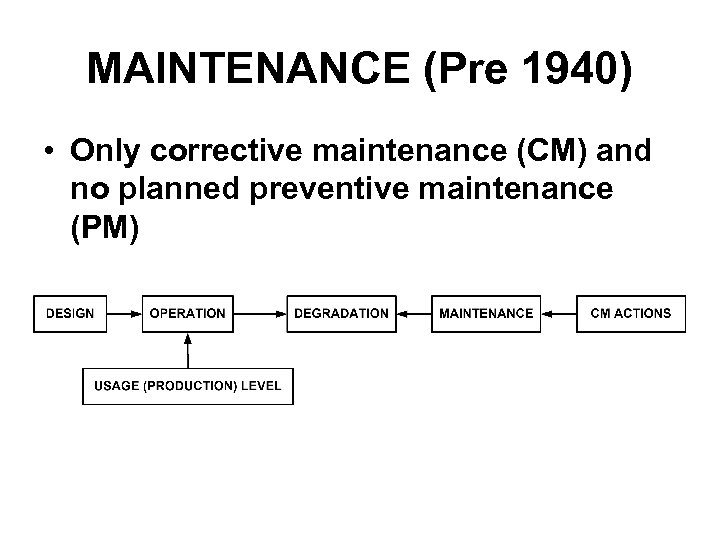 MAINTENANCE (Pre 1940) • Only corrective maintenance (CM) and no planned preventive maintenance (PM)
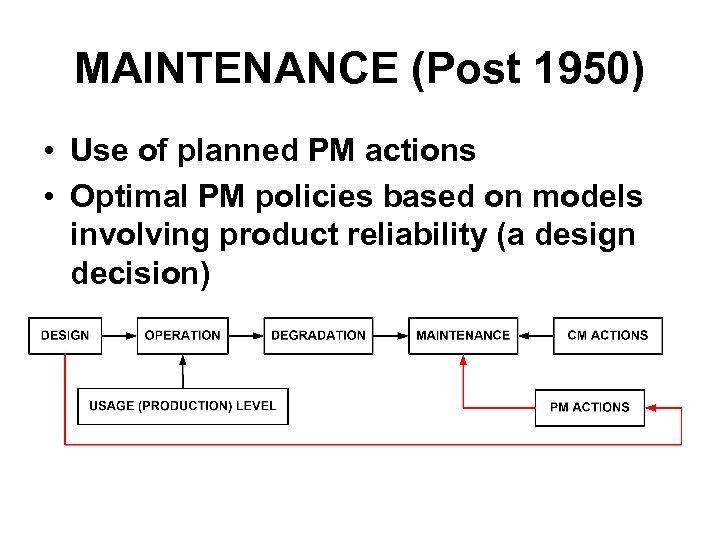 MAINTENANCE (Post 1950) • Use of planned PM actions • Optimal PM policies based on models involving product reliability (a design decision)
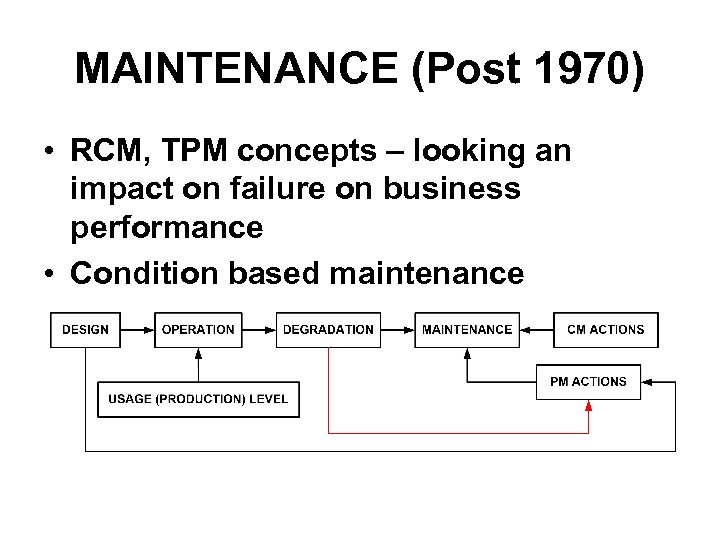 MAINTENANCE (Post 1970) • RCM, TPM concepts – looking an impact on failure on business performance • Condition based maintenance
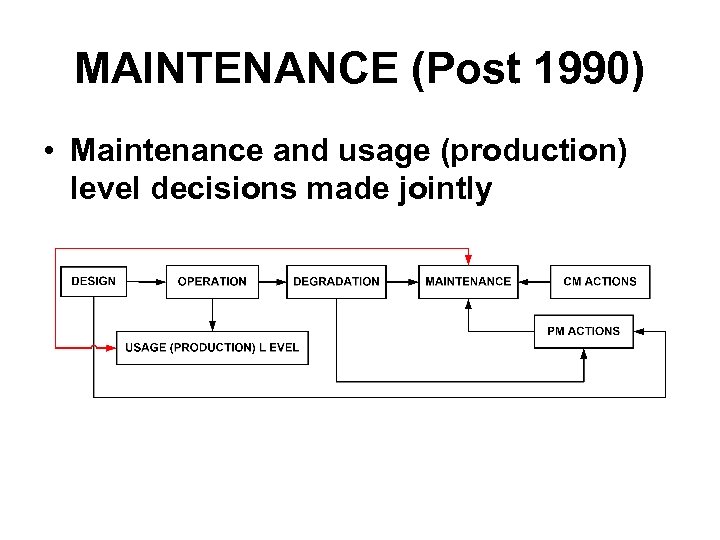 MAINTENANCE (Post 1990) • Maintenance and usage (production) level decisions made jointly
 STUDY OF MAINTENANCE
 SOME OBSERVATIONS • Reliability depends on design and manufacturing • Degradation and failures depend on usage (production) rate • Failures impact on performance • Cost implications • Linking of technical and commercial aspects
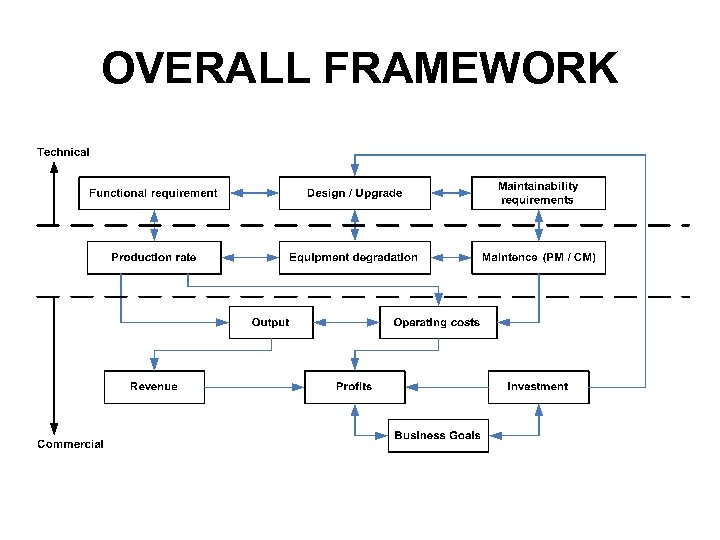 OVERALL FRAMEWORK
 STAKEHOLDERS • Several stakeholders – Owner of asset – Operators (users) – External agents (maintenance service) – Regulators (Health and safety) – Etc. • The interests and objective of each is different.
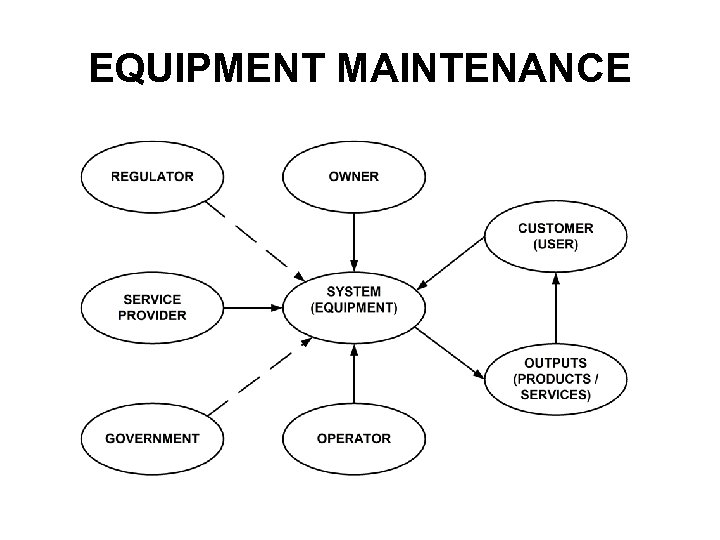 EQUIPMENT MAINTENANCE
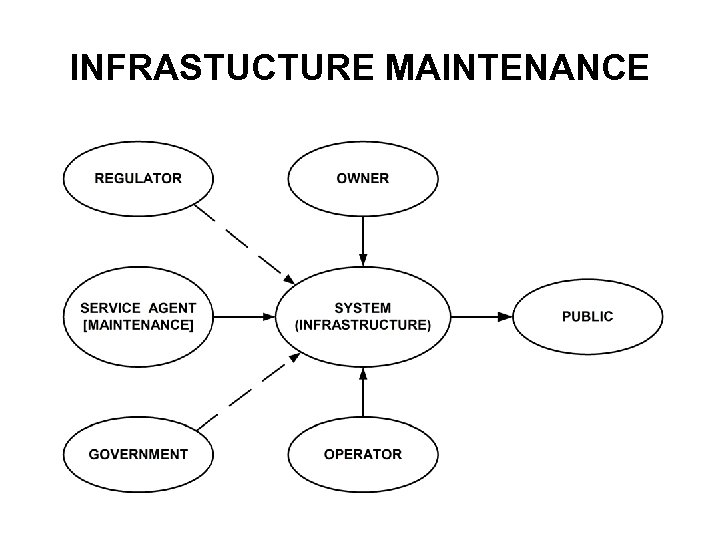 INFRASTUCTURE MAINTENANCE
 SCIENTIFIC APPROACH • Identifying the key elements and the interaction between the elements • Use of models – Qualitative and Quantitative • This involves model building and this in turn requires proper data collection and analysis.
 MICRO vs. MACRO • The number of elements involved depends on the focus of the study • Micro: Few elements [Technical and narrow] – The rate of degradation as a function of usage – Scheduling of maintenance tasks • Macro: Many elements [Management and broad] – Deciding on maintenance strategy [many technical and commercial elements]
 AN ILLUSTRATIVE CASE RAIL OPERATIONS
 CHANGES IN OPERATIONS • Past: Government owned, operated and maintained the complete system (infrastructure and rolling stock) • Current: Infrastructure owned by an independent business unit of government • Rolling stock: Owned and operated by several independent business units
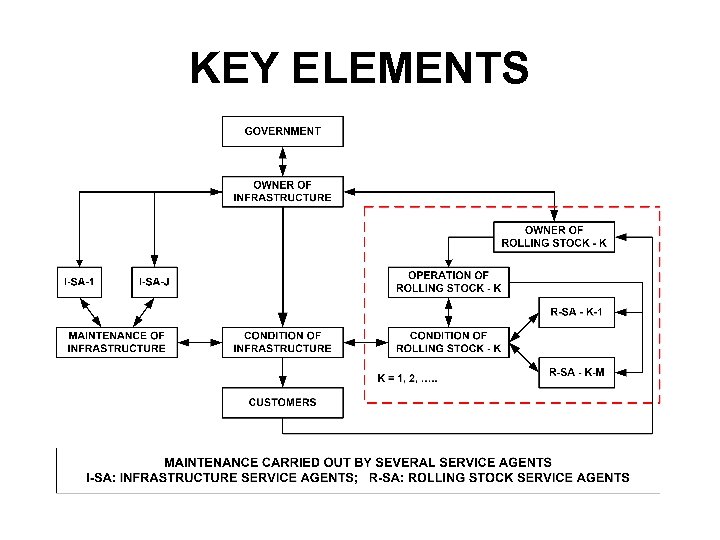 KEY ELEMENTS
 DECISION - MAKING • Increase in traffic (goods and passenger) • How to cope? Several options -- More frequent operations; More wagons; Greater axle load; Faster speeds etc • Implications: More load on the track faster degradation • What should be the optimal strategy?
 DECISION - MAKING • Need to integrate operation (commercial decision) with maintenance (technical decision) • Increase load? Short term gain but long term loss! • Upgrade track? Costly • Design better rolling stock?
 CHALLENGES • Need to model the different elements (technical, commercial, operational and managerial) • Need to understand the underlying degradation processes involved (Reliability science) • Adequate data to build and validate models (Reliability modeling)
 OTHER ISSUES • Rolling stock Operators – Owing versus leasing – Outsourcing of maintenance – Joint optimization of maintenance and operations • Maintenance: In-house versus outsourcing • Contracts between different parties
 MODELLING • Damage and degradation resulting from the interaction between rolling stock and infrastructure • Modeling track failures – distributed models with two dimensional ROCOF [ (t, x), t: time and x: spatial coordinate] • Modeling contracts • Dispute resolution
 MAINTENANCE OUTSOURCING • D-1: What (components) need to be maintained? • D-2: When should the maintenance be carried out? • D-3: How should the maintenance be carried out
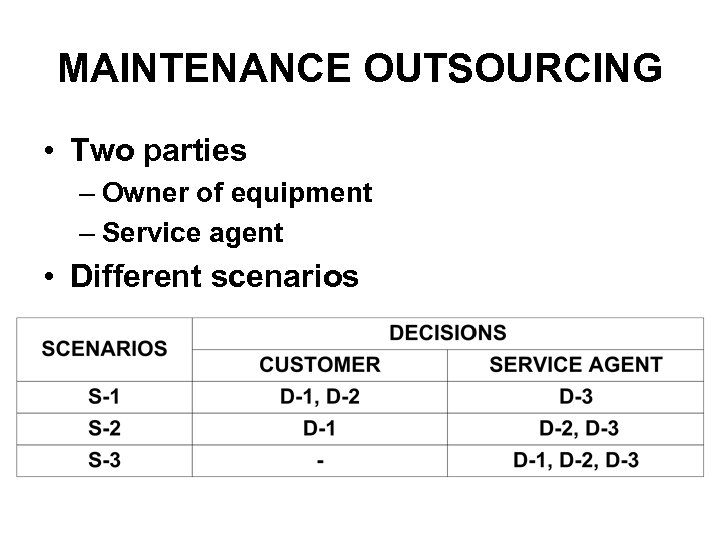 MAINTENANCE OUTSOURCING • Two parties – Owner of equipment – Service agent • Different scenarios
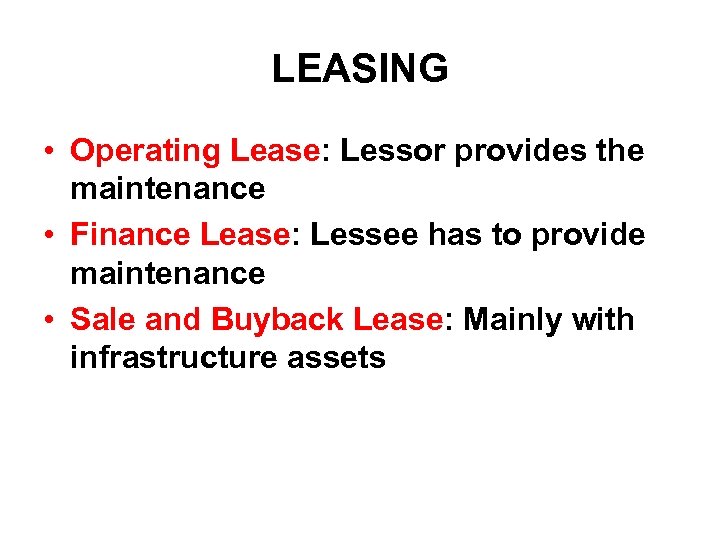 LEASING • Operating Lease: Lessor provides the maintenance • Finance Lease: Lessee has to provide maintenance • Sale and Buyback Lease: Mainly with infrastructure assets
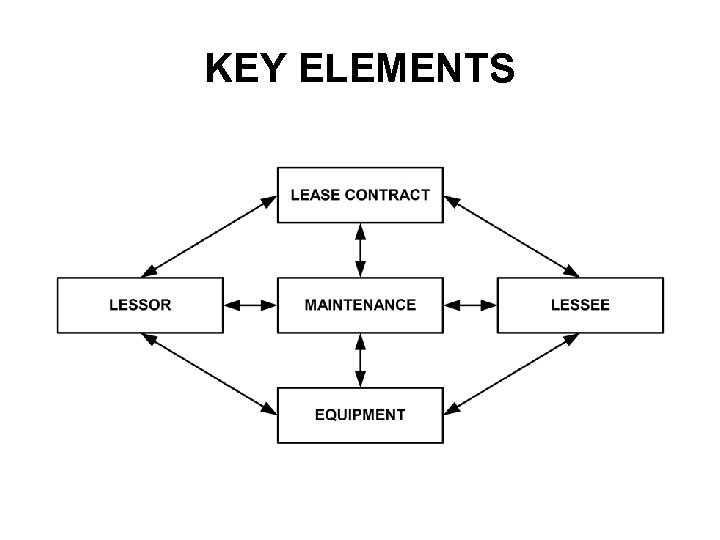 KEY ELEMENTS
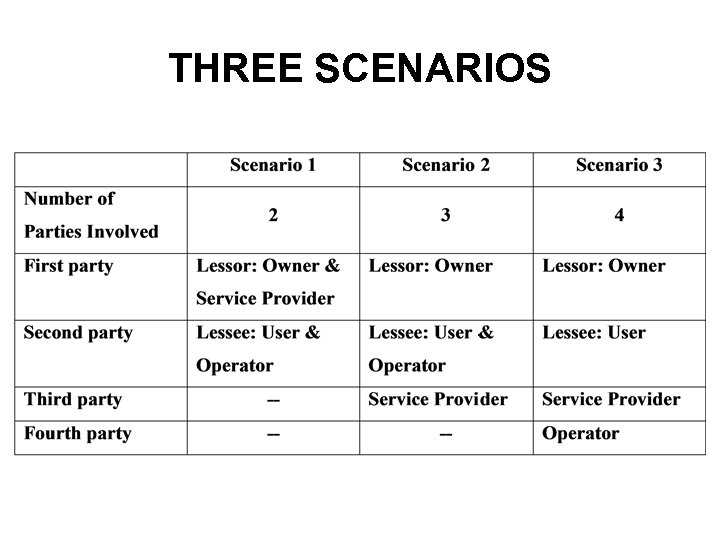 THREE SCENARIOS
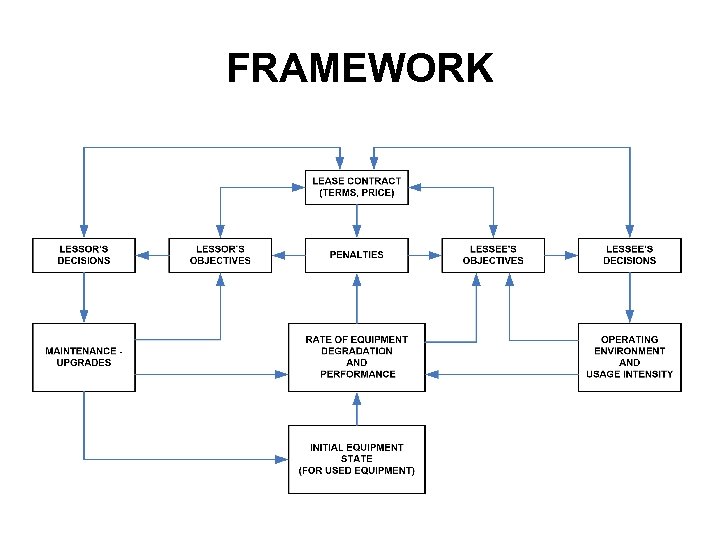 FRAMEWORK
 MODELING AND ANALYSIS
 METHODOLOGY • Characterization of the relevant elements (depends on the problem) • Selection of appropriate model formulations • Estimation of model parameters (need appropriate data) • Model validation • Model analysis and optimization
 SYSTEM CHARACTERIZATION • The number of elements needed depends on the problem • Level of understanding: Low to high • Sources for getting the information • Level of detail determines complexity • Trade-off between complexity and tractability (data needed, analysis, etc. )
 MODEL FORMULATION • Two approaches to modeling – Black-box: Based solely on data (empirical approach) – White box: Based on the physical characterization of the underlying processes • Stochastic formulations: As variables change with time in an uncertain manner
 APPROACH • Game-theoretic if there are multiple decision-makers • Different scenarios – Leader – follower: Stackelberg game – No leader: Nash game • Data and information available to each decision-maker becomes important
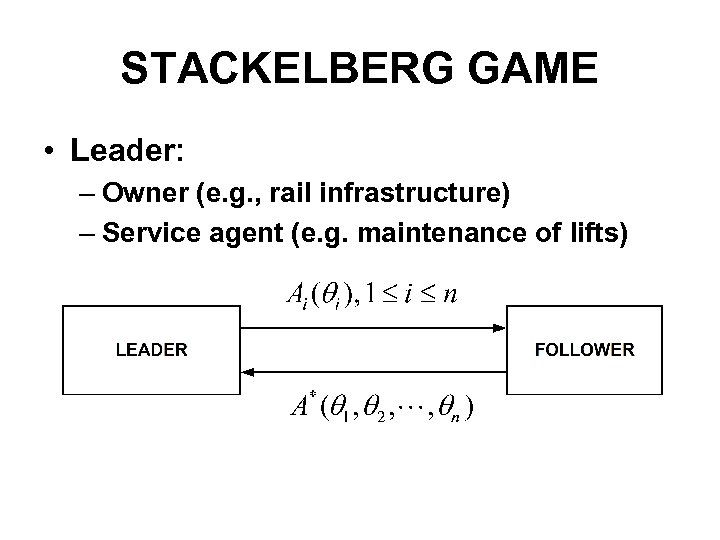 STACKELBERG GAME • Leader: – Owner (e. g. , rail infrastructure) – Service agent (e. g. maintenance of lifts)
 ISSUES AND CHALLENGES
 ISSUES • Stackelberg game is closely related to agency theory [Principal and Agent – Principal delegating tasks to Agent] • Auction [Rail operators bidding for number of trips per day] • Tendering [for carrying out maintenance] • Contract – critical element
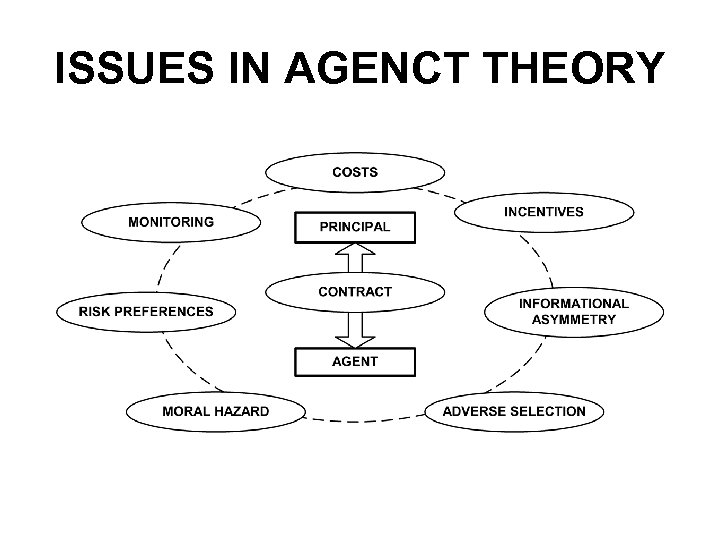 ISSUES IN AGENCT THEORY
 DATA RELATED ISSUES • Data collection • Data classification – Structured and unstructured data – Equipment, cost, servicing, etc. • Data storage • Data problems (delays, missing, uncertainties, errors, etc. ) • Information content
 DATA ANALYSIS • Preliminary data analysis: To get better insight • More refined analysis: Various plots to assist in model selection • Data for estimating model parameters (various methods)
 CHALLENGES • Maintenance of complex system involves dealing with several issues • Bulk of the literature on maintenance deals with different elements treated separately and from a micro perspective • Some literature dealing from a macro perspective
 CHALLENGES • Lot of scope to do new research in maintenance of complex systems • Models will be more complex • Need concepts from many disciplines – Operations research (game theory); Economics (agency theory), Reliability theory; Stochastic processes; IT, Statistics, etc.
 REFERENCES • Blischke, R. and Murthy, D. N. P. (2000), Reliability, Wiley, New York • Jiang, R. and Murthy, D. N. P. (2008), Maintenance – Decision Models for Management, Science Press, Beijing • Kobbacy, K. A. H. and Murthy, D. N. P. (eds) (2008), Complex System Maintenance Handbook, Springer Verlag, London • Murthy, D. N. P, Atrens, A and Eccleston, J. A. (2002), Strategic maintenance management, Journal of Quality in Maintenance Engineering, 8, 287 -305
 REFERENCES • Murthy, D. N. P. Ashgarizadeh, E. (1999), Optimal decision making in a maintenance service operation, European Journal of Operational Research, 116, 259273 • Jaturnnatee, J. , Murthy, D. N. P. and Boodiskulchok, R. (2005), Optimal preventive maintenance of leased equipment, European Journal of Operational Research, 174, 201 -215 • Blischke, W. R. , Karim, M. Z. and Murthy, D. N. P. (2010), Warranty Data Collection and Analysis, Under preparation for publication.