


 Скачать презентацию Maintenance of Certification What Does it Mean What
78f9f1bdba4a9b3c36ac051995fb3453.ppt
- Количество слайдов: 47
 Maintenance of Certification What Does it Mean? What Does it Mean for YOU? Anne Roberts, MD
 What is Maintenance of Certification (MOC)? A process designed to document that physician specialists, certified by one of the Member Boards of ABMS, maintain the necessary competencies to provide quality patient care Unlike recertification, MOC is a continuous process
 Maintenance of Certification ETHICS. HONOR. SKILL Developed to provide the public, payers, healthcare organizations/entities, government agencies, members of the medical profession confidence that specialist physicians are competent and maintain their competency throughout the span of their professional careers ─ Stephen Miller, MD, MPH Exec V. President, Am Board of Medical Specialties, 2003
 ABMS Member Boards Approved Certificates General Certificates = 37 (some boards issue more than one primary certificate) ØExample: Radiology (Diagnostic, Oncology, Physics) Subspecialty Certificates = 92 (some are shared by two or more boards examples VIR, Neuroradiology, Pediatrics) Almost 90% of all practicing physicians are certified by one (or more) of the 24 ABMS Member Boards
 Why Recertification? Changing scope of medical information Public concern for need to re-credentialled physicians Decline in knowledge and skills over time “The goal of recertification is to evaluate the continuing competence of a diplomate in the specialty in which he/she was certified initially. ” September 1973
 Why the Change? IOM reports More scrutiny from the media and public on “quality of care” Patient expectations Rapid advances in science and technology
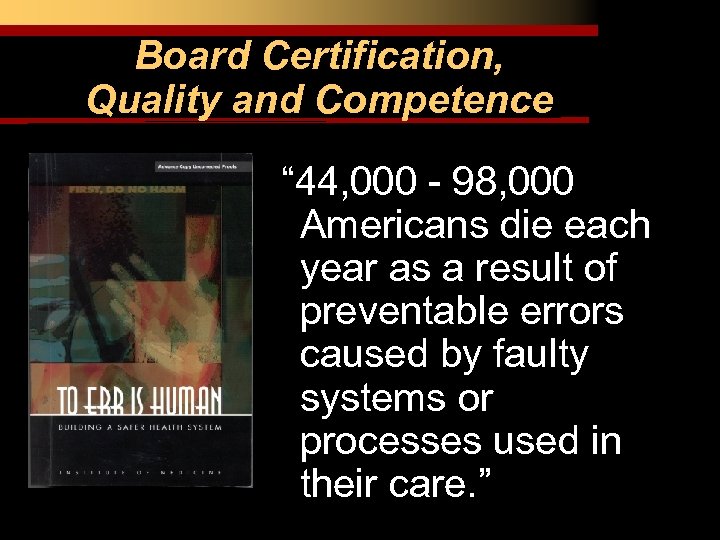 Board Certification, Quality and Competence “ 44, 000 - 98, 000 Americans die each year as a result of preventable errors caused by faulty systems or processes used in their care. ”
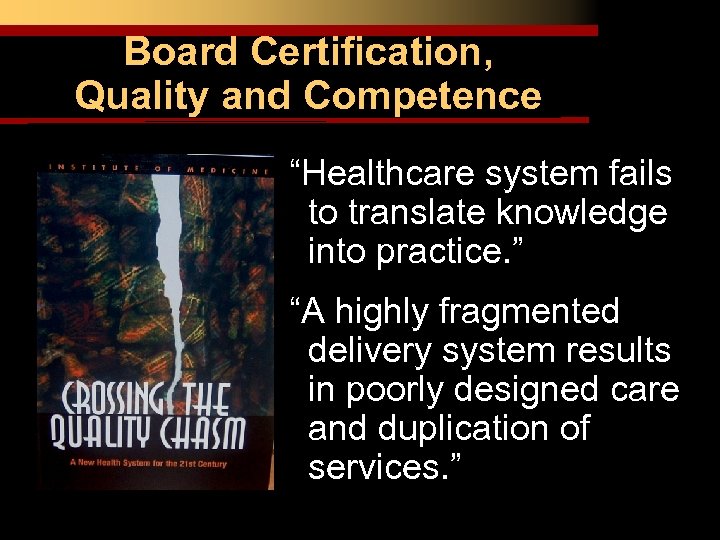 Board Certification, Quality and Competence “Healthcare system fails to translate knowledge into practice. ” “A highly fragmented delivery system results in poorly designed care and duplication of services. ”
 Why MOC? Physicians need to be out front on the quality issue… not reacting to proposals or mandates of others MOC not meant to replace efforts to improve quality of medical care generated outside of the profession
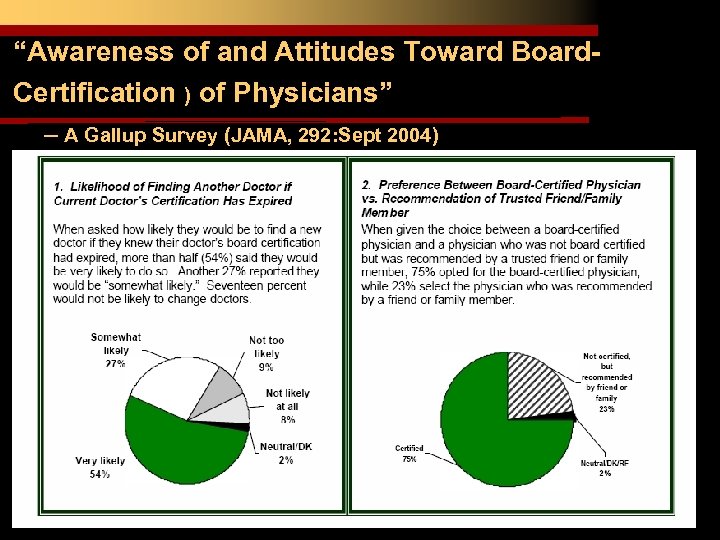 “Awareness of and Attitudes Toward Board. Certification ) of Physicians” ─ A Gallup Survey (JAMA, 292: Sept 2004)
 Shift from Lifetime Certification to Continuous Certification Lifetime certification is no longer the benchmark of quality Continuous certification will be the benchmark of the future
 MOC is supported by… Accreditation Council for Graduate Medical Education (ACGME) American Hospital Association (AHA) American Medical Association (AMA) Association of American Medical Colleges (AAMC) Council of Medical Specialty Societies (CMSS) Educational Commission for Foreign Medical Graduates (ECFMG) Federation of State Medical Boards of the U. S. (FSMB) National Board of Medical Examiners (NBME) Joint Commission on Accreditation of Healthcare Organizations (JCAHO)
 A New Role for ABMS Our profession is becoming increasingly marginalized through the actions of health plans, insurance companies, Medicare, and many other organizations working to determine public health policy. Our way out of this problem, as Rosemary Stevens puts it, is “to convince the public that the profession has different, and perhaps loftier goals than the other players. ” President’s Message, D. L. Nahrwold, MD – 2004
 A New Role for ABMS The template for practicing patient-centered, evidence-based medicine is certification and maintenance of certification (MOC). Through MOC the profession can demonstrate the patient-centered six general competencies, which are those desired in the contemporary physician by our patients and the public at large. President’s Message, D. L. Nahrwold, MD – 2004
 MOC History 1998 – Task Force on Competence established 1999 – General Competencies established 2000 – Member Board Commitment to Maintenance of Certification 2002 – Four Components of Maintenance of Certification© 2003 – Board of Directors and ABMS Officers and Executive Committee Members commitment to MOC participation
 Benefits for Physicians ØImprove effectiveness of practice ØImprove patient, staff and physician satisfaction ØReduce duplicate assessments and applications ØImprove learning opportunities based on practice needs ØMinimize re-licensure difficulties ØPossible reduction in malpractice premiums
 American Board of Radiology Maintenance of Certification Program Diagnostic Radiology Radiation Oncology Medical Physics
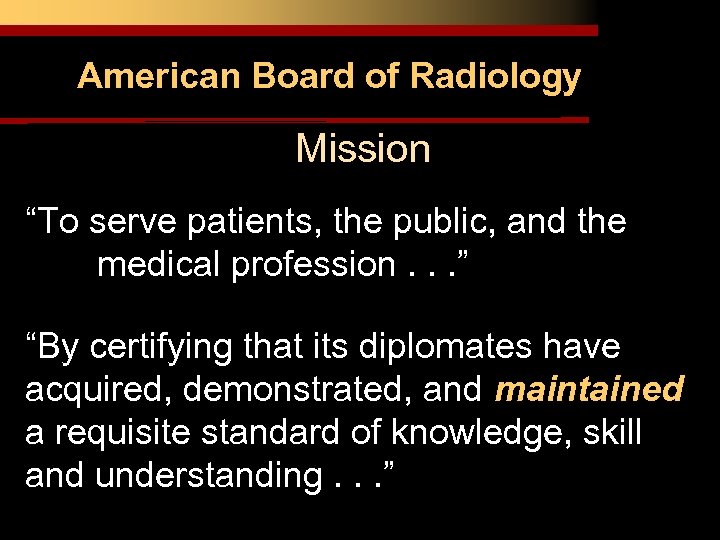 American Board of Radiology Mission “To serve patients, the public, and the medical profession. . . ” “By certifying that its diplomates have acquired, demonstrated, and maintained a requisite standard of knowledge, skill and understanding. . . ”
 Where are we? Where are we going? PAST TRANSITION FUTURE
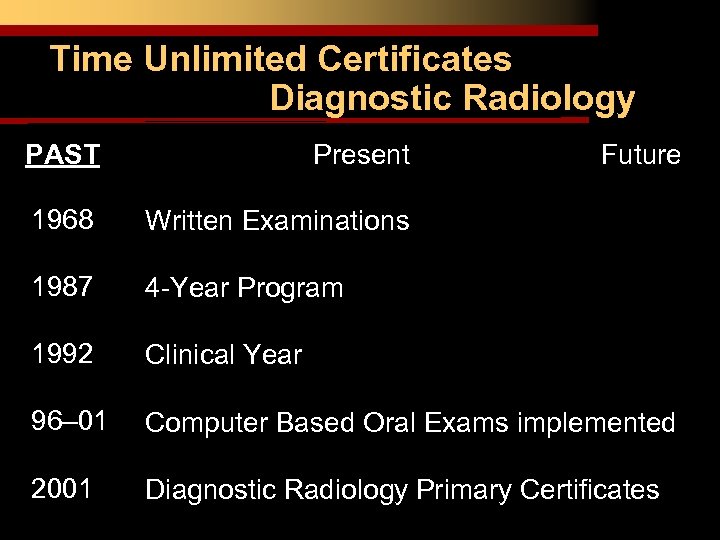 Time Unlimited Certificates Diagnostic Radiology PAST Present Future 1968 Written Examinations 1987 4 -Year Program 1992 Clinical Year 96– 01 Computer Based Oral Exams implemented 2001 Diagnostic Radiology Primary Certificates
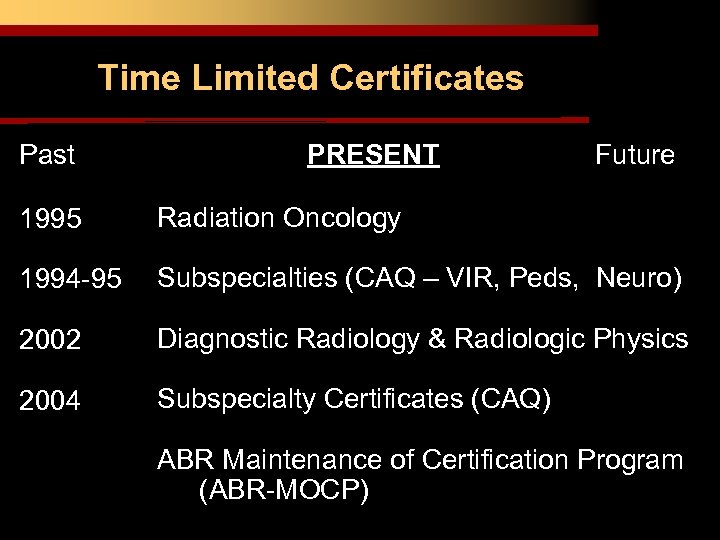 Time Limited Certificates Past PRESENT Future 1995 Radiation Oncology 1994 -95 Subspecialties (CAQ – VIR, Peds, Neuro) 2002 Diagnostic Radiology & Radiologic Physics 2004 Subspecialty Certificates (CAQ) ABR Maintenance of Certification Program (ABR-MOCP)
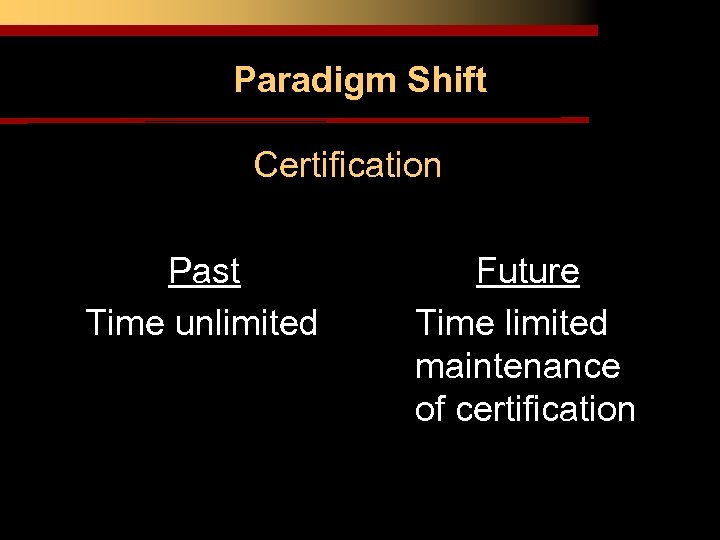 Paradigm Shift Certification Past Time unlimited Future Time limited maintenance of certification
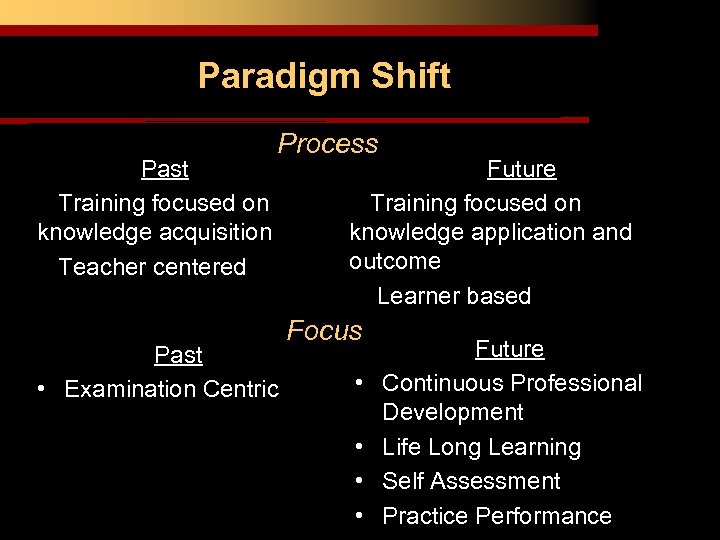 Paradigm Shift Past • Training focused on knowledge acquisition • Teacher centered Process Past • Examination Centric Future • Training focused on knowledge application and outcome • Learner based Focus • • Future Continuous Professional Development Life Long Learning Self Assessment Practice Performance
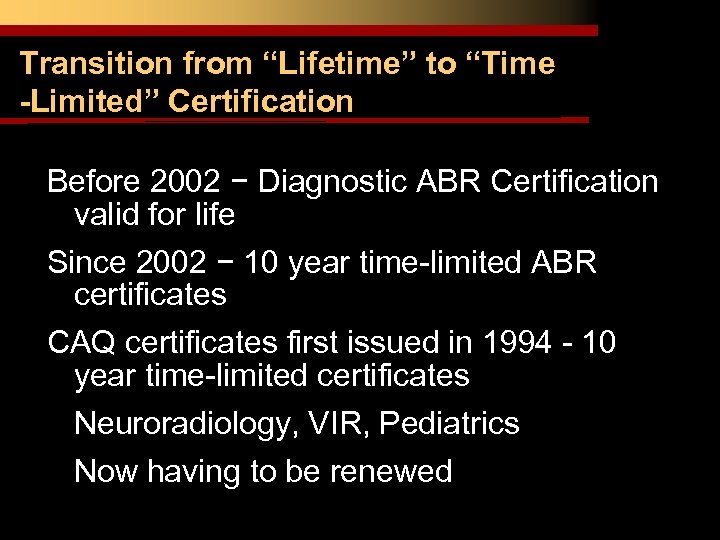 Transition from “Lifetime” to “Time -Limited” Certification Before 2002 − Diagnostic ABR Certification valid for life Since 2002 − 10 year time-limited ABR certificates CAQ certificates first issued in 1994 - 10 year time-limited certificates Neuroradiology, VIR, Pediatrics Now having to be renewed
 Transition from “Lifetime” to “Time. Limited” Certification Before 1995 − Radiation Oncology ABR Certification valid for life Since 1995 − 10 year time-limited ABR certificates First ABR Recertification Examination (RO) offered in 1999 ~25% of practicing radiation oncologists have time limited certificates ~120 time-limited certificates will lapse in 2005
 MOC ─ The General Competencies Maintenance of competence should be demonstrated throughout the physician’s career by evidence of lifelong learning and ongoing improvement of practice ─ ABMS Task Force, ’ 99
 MOC ─ The General Competencies Ømedical knowledge Øpatient care Øinterpersonal and communication skills Ømedical professionalism Øpractice-based learning and improvement Øsystems-based practice
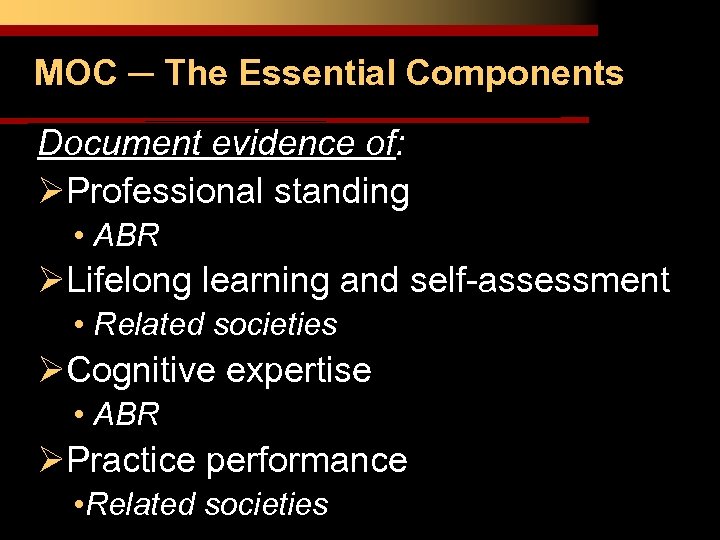
 MOC - 4 Components • Professional standing • Lifelong learning and self-assessment • Cognitive expertise • Practice performance
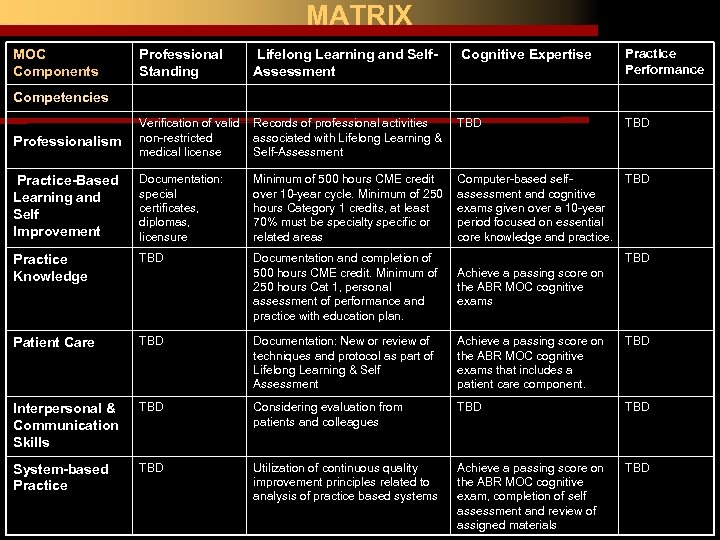 MATRIX MOC Components Cognitive Expertise Practice Performance Professional Standing Lifelong Learning and Self. Assessment Records of professional activities associated with Lifelong Learning & Self-Assessment TBD Professionalism Verification of valid non-restricted medical license Practice-Based Learning and Self Improvement Documentation: special certificates, diplomas, licensure Minimum of 500 hours CME credit over 10 -year cycle. Minimum of 250 hours Category 1 credits, at least 70% must be specialty specific or related areas Computer-based self. TBD assessment and cognitive exams given over a 10 -year period focused on essential core knowledge and practice. Practice Knowledge TBD Documentation and completion of 500 hours CME credit. Minimum of 250 hours Cat 1, personal assessment of performance and practice with education plan. Achieve a passing score on the ABR MOC cognitive exams Patient Care TBD Documentation: New or review of techniques and protocol as part of Lifelong Learning & Self Assessment Achieve a passing score on the ABR MOC cognitive exams that includes a patient care component. TBD Interpersonal & Communication Skills TBD Considering evaluation from patients and colleagues TBD System-based Practice TBD Utilization of continuous quality improvement principles related to analysis of practice based systems Achieve a passing score on the ABR MOC cognitive exam, completion of self assessment and review of assigned materials TBD Competencies TBD
 MOC ─ The Essential Components Document evidence of: ØProfessional standing • ABR ØLifelong learning and self-assessment • Related societies ØCognitive expertise • ABR ØPractice performance • Related societies
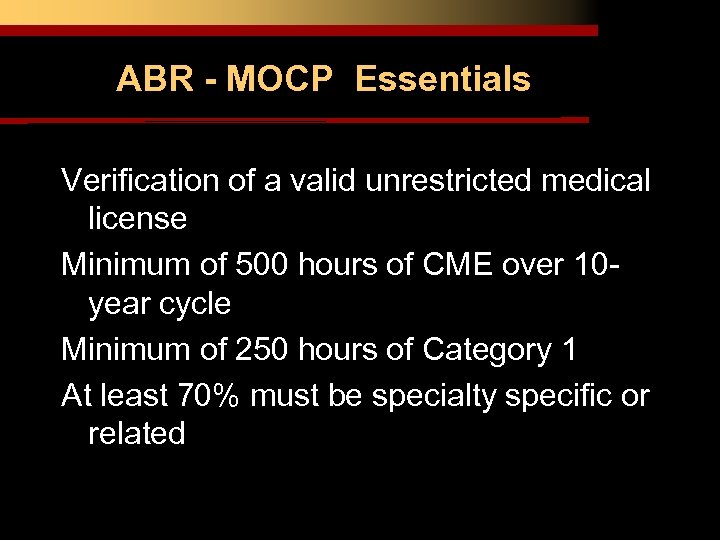 ABR - MOCP Essentials Verification of a valid unrestricted medical license Minimum of 500 hours of CME over 10 year cycle Minimum of 250 hours of Category 1 At least 70% must be specialty specific or related
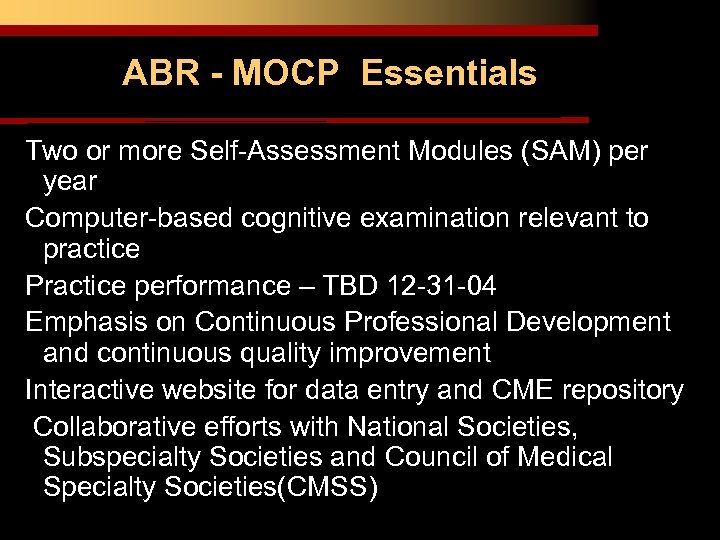 ABR - MOCP Essentials Two or more Self-Assessment Modules (SAM) per year Computer-based cognitive examination relevant to practice Practice performance – TBD 12 -31 -04 Emphasis on Continuous Professional Development and continuous quality improvement Interactive website for data entry and CME repository Collaborative efforts with National Societies, Subspecialty Societies and Council of Medical Specialty Societies(CMSS)
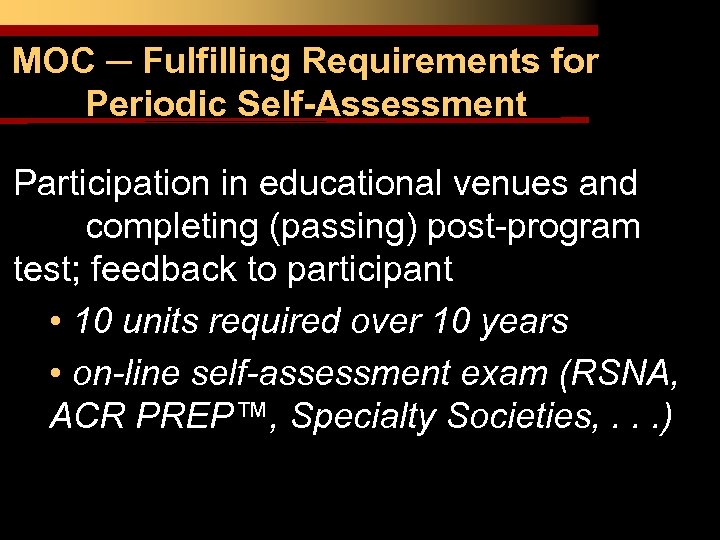 MOC ─ Fulfilling Requirements for Periodic Self-Assessment Participation in educational venues and completing (passing) post-program test; feedback to participant • 10 units required over 10 years • on-line self-assessment exam (RSNA, ACR PREP™, Specialty Societies, . . . )
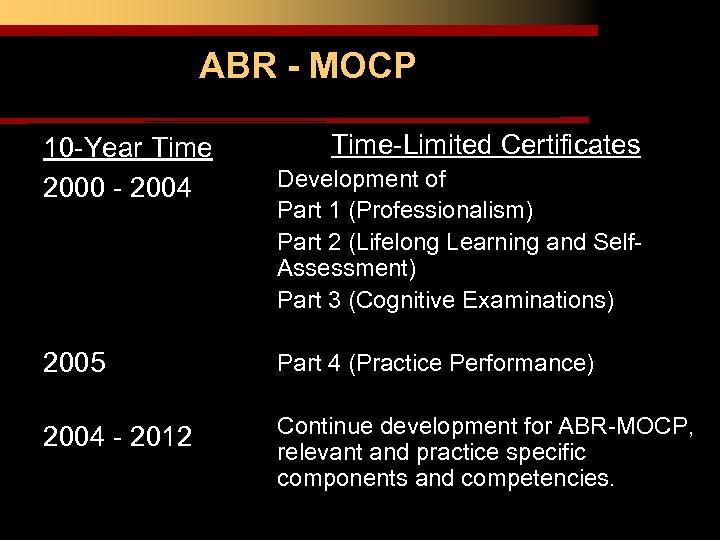 ABR - MOCP 10 -Year Time 2000 - 2004 Time-Limited Certificates Development of Part 1 (Professionalism) Part 2 (Lifelong Learning and Self. Assessment) Part 3 (Cognitive Examinations) 2005 Part 4 (Practice Performance) 2004 - 2012 Continue development for ABR-MOCP, relevant and practice specific components and competencies.
 American College of Radiology ACR PREP (ACR PRioritized Education for Physicians) Lifelong Learning & Self Assessment Program
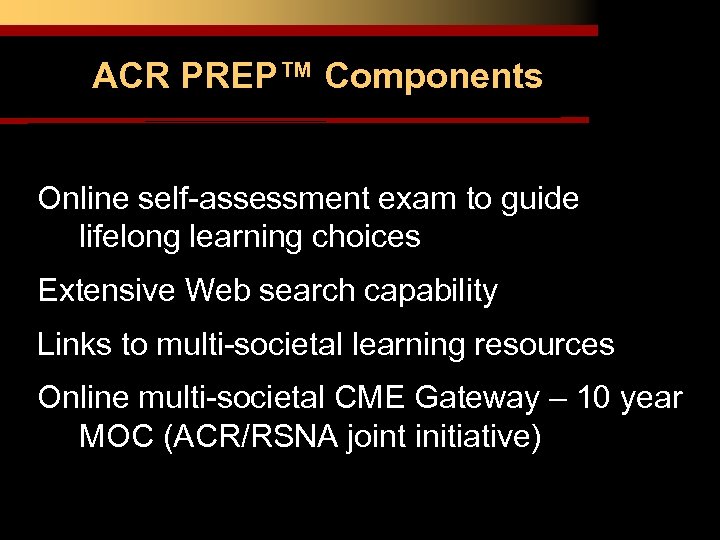 ACR PREP™ Components Online self-assessment exam to guide lifelong learning choices Extensive Web search capability Links to multi-societal learning resources Online multi-societal CME Gateway – 10 year MOC (ACR/RSNA joint initiative)
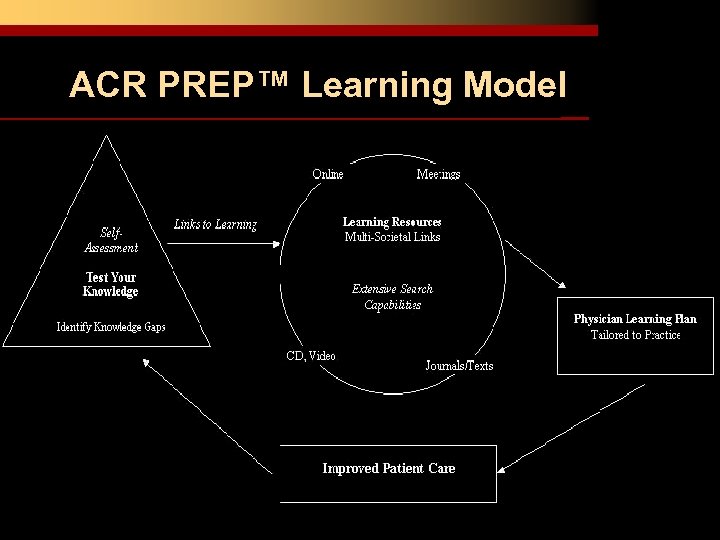 ACR PREP™ Learning Model
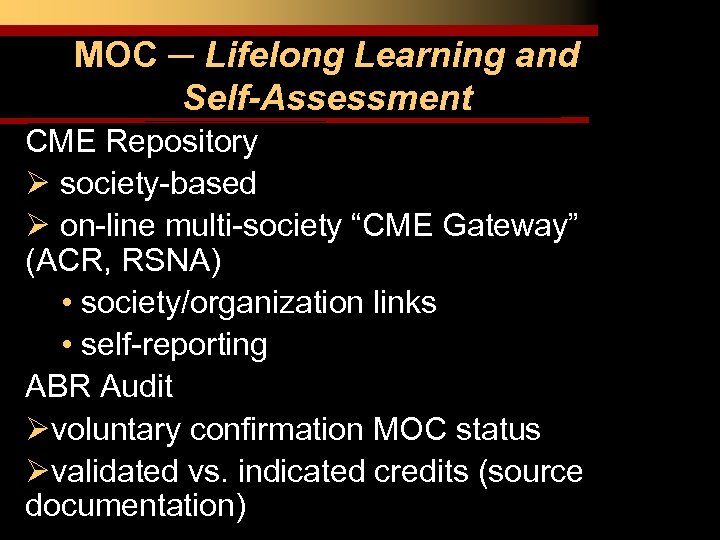 MOC ─ Lifelong Learning and Self-Assessment CME Repository Ø society-based Ø on-line multi-society “CME Gateway” (ACR, RSNA) • society/organization links • self-reporting ABR Audit Øvoluntary confirmation MOC status Øvalidated vs. indicated credits (source documentation)
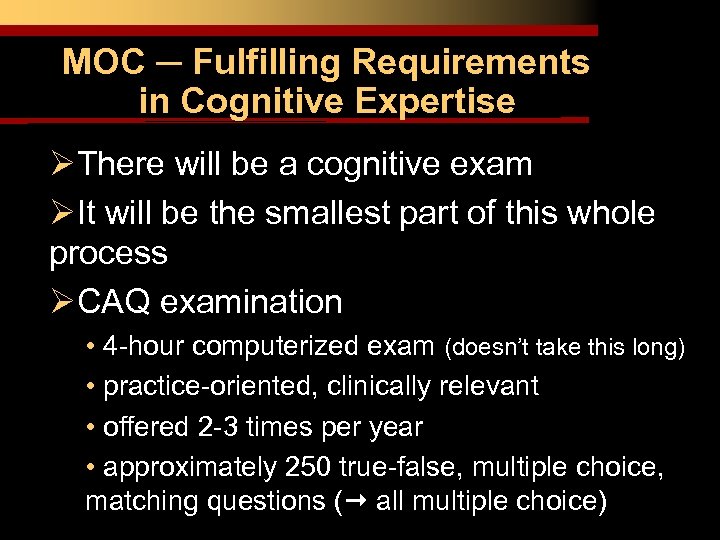 MOC ─ Fulfilling Requirements in Cognitive Expertise ØThere will be a cognitive exam ØIt will be the smallest part of this whole process ØCAQ examination • 4 -hour computerized exam (doesn’t take this long) • practice-oriented, clinically relevant • offered 2 -3 times per year • approximately 250 true-false, multiple choice, matching questions ( all multiple choice)
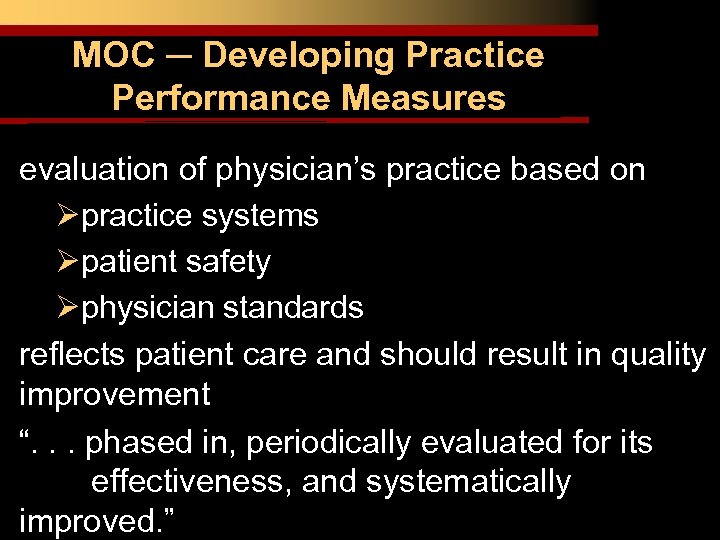 MOC ─ Developing Practice Performance Measures evaluation of physician’s practice based on Øpractice systems Øpatient safety Øphysician standards reflects patient care and should result in quality improvement “. . . phased in, periodically evaluated for its effectiveness, and systematically improved. ”
 MOC ─ Developing Practice Performance Measures Initial proposal due to ABMS December ’ 04 potential practice performance modules: ØACR /PEER™ ØTrying to make measures fit with items that are already being required by JACHO, and other regulatory bodies
 RADPEER™ Model Allows peer review during routine interpretation of current images Ø Summary statistics and comparison for each participating radiologist by modality Ø Summary data for the facility by modality Ø Data summed across all participating facilities by modality Assesses adherence to evidence based practice and outcomes
 Practice Performance─ACR RADPEER™ Pathway 1 Physicians in facilities that are undergoing review for ACR accreditation will have patient cases reviewed for assessment of their individual practice performance. Pathway 2 For physicians seeking practice assessment outside of facility accreditation, the ACR will offer practice performance assessment through remote review of patient cases.
 Maintenance of Certification Program Diplomates with non time-limited certificates: Ø Encouraged to participate; issued additional certificate Diplomates with time-limited certificates: Ø Will need to comply with ABR MOC program Candidates for initial certification: Ø Certificates subject to terms/conditions of MOC program
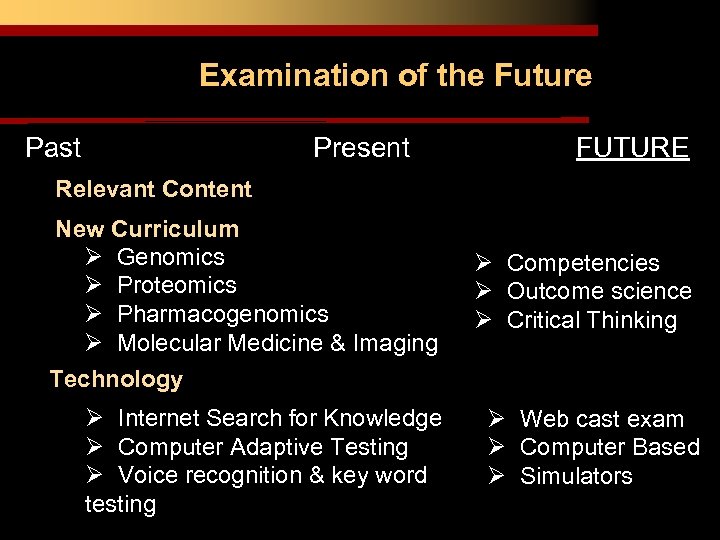 Examination of the Future Past Present FUTURE Relevant Content New Curriculum Ø Genomics Ø Proteomics Ø Pharmacogenomics Ø Molecular Medicine & Imaging Technology Ø Internet Search for Knowledge Ø Computer Adaptive Testing Ø Voice recognition & key word testing Ø Competencies Ø Outcome science Ø Critical Thinking Ø Web cast exam Ø Computer Based Ø Simulators
 Paradigm Shift Deming – “You don’t have to (change), survival is not compulsory. ” Darwin – “It’s not the strongest of the species that survive, nor the most intelligent, but the one most responsive to change. ” Hendee –a 20 th Century physicist once remarked, “Scientific progress moves forward, one funeral at a time. ”
 In the End: We may say we have trained “better” physicians based on higher board scores or decrease in the number of medical errors; however, the “real differences” can be measured only in the quality of care delivered to our patients. Pediatrics Vol. 113 No. 2 February 2004