 Скачать презентацию Maintaining Identity WYBIWYE and consumer assurance Duncan Leadbitter
a6784c71527f2896d30cbf96123b8b4c.ppt
- Количество слайдов: 23



Maintaining Identity: WYBIWYE and consumer assurance Duncan Leadbitter Regional Director – Asia Pacific Marine Stewardship Council Sydney
The Marine Stewardship Council • Global • Non profit • Accreditation • Labelling Established to provide market based incentives for improved fisheries management. Increasing evidence that consumers are concerned about the state of fisheries and 57% here in Australia would welcome an ecolabel
Multi stage process but two main stages: 1. Fishery certification 2. Chain of custody certification Consumer concerns and confidence affected by: 1. The robustness of the certification assessments, and 2. Being assured that what they buy is what they expect.
MSC Chain of Custody • • What is it? Who needs it? How does it start? What is involved? – Groups • • • How can you tell? Cost Interim certification The Logo Questions
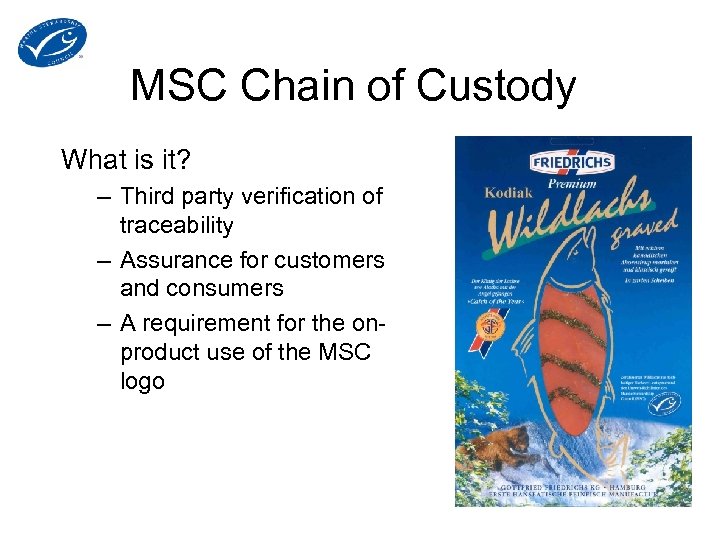
MSC Chain of Custody What is it? – Third party verification of traceability – Assurance for customers and consumers – A requirement for the onproduct use of the MSC logo
MSC Chain of Custody Who needs it? – Every party in the supply chain that takes ownership of the product before it’s in its final, consumer-ready packaging – The Cof. C requirements therefore: • START: immediately after the fish is caught - i. e. when processing or transport begin • END: with the company that applies the logo (i. e. puts the product into its final packaging)
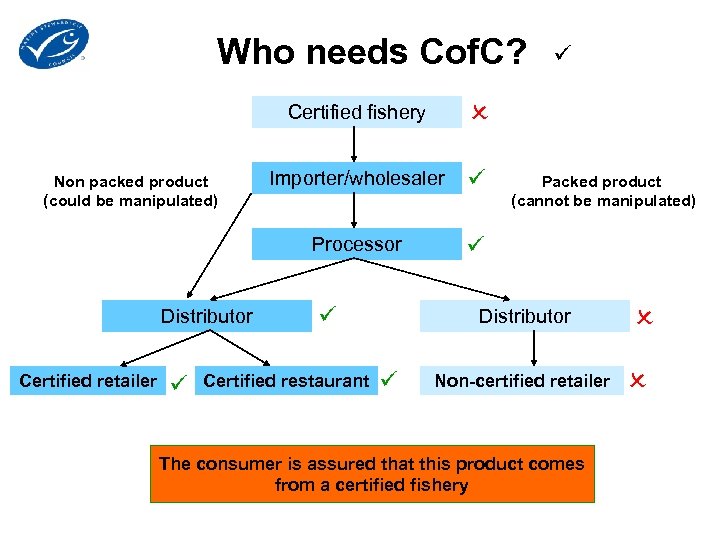
Who needs Cof. C? Certified fishery Distributor Certified retailer Importer/wholesaler Processor Non packed product (could be manipulated) Certified restaurant Packed product (cannot be manipulated) Distributor Non-certified retailer The consumer is assured that this product comes from a certified fishery
MSC Chain of Custody How does it start? 1. MSC Outreach or Customer Request 2. Contact MSC • • Send a list of accredited certification bodies (CBs) Refer to the MSC website Recommend asking for quotes Suggest talking to their customers (who is their CB? ) 3. Sign a contract with a CB to complete Cof. C
MSC Chain of Custody What is involved? 1. Initial desktop review – Certification body reviews the client’s operational procedures 2. On-site assessment – Certifier visits site – Meets with client staff, reviews activities and documents – If a company has multiple outlets with a single control point, a sample of the total number can be visited
MSC Chain of Custody ‘Group’ Chain of Custody Two categories 1. Small independent retail outlets (e. g. fish mongers association) Colchester Borough Council 2. Multiple (e. g. Whole Foods Market fresh fish counters) Whole Foods Market
MSC Chain of Custody What is involved? (cont’d) 3. Report composition – Includes: • Assessment summary • Scope of certificate • Corrective actions 4. Surveillance audits – Certificate valid for 3 years – Annual audits take place – planned but also random
MSC Chain of Custody How can you tell a product has Cof. C? – Every product bearing the MSC logo MUST also display: 1. The relevant copyright/trademark code (©, ®, ) 2. Chain of custody licence code 3. MSC website: www. msc. org 4. The MSC Claim: ‘This product comes from a fishery which meets the Marine Stewardship Council’s environmental standard for a well-managed and sustainable fishery’
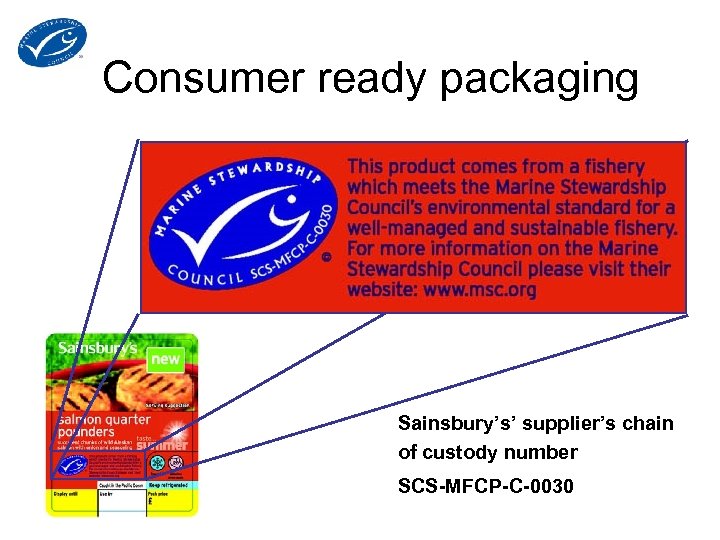
Consumer ready packaging Sainsbury’s’ supplier’s chain of custody number SCS-MFCP-C-0030

MSC Chain of Custody What does it cost? • Based on the time spent by a certification body • Number of days are variable, affected by risk assessment and number of sites • Prices vary; £ 500 -£ 600 (around US$1000) per day, plus expenses • One site: Approximately 1. 5 days – but variable – ½ day desktop review and liaising – ½ day site visit – ½ day report write-up
MSC Chain of Custody Interim Certification • Can occur when: – It is not immediately practicable to visit site, – MSC Executive is satisfied that risk levels are minimal, – CB is confident the client understands and meets requirements and – An on-site assessment will be completed in three months. • Expires in three months • Requires submission of risk assessment to MSC Executive based on various criteria
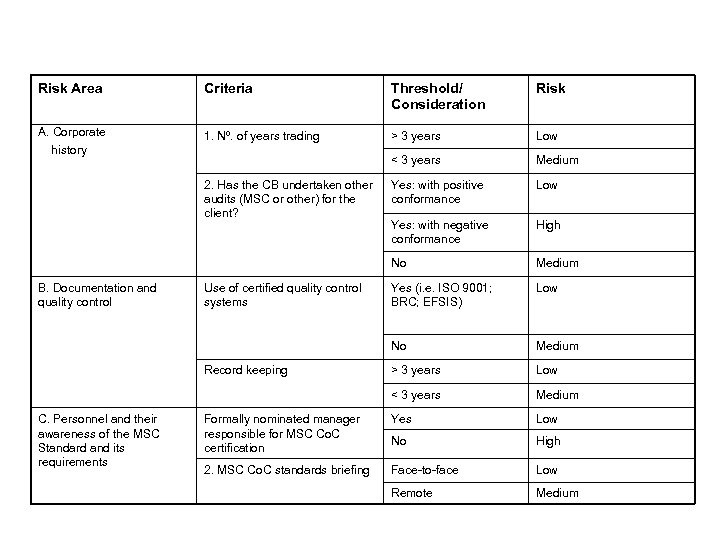
Risk Area Criteria Threshold/ Consideration Risk A. Corporate history 1. Nº. of years trading > 3 years Low < 3 years Medium Yes: with positive conformance Low Yes: with negative conformance High No Medium Yes (i. e. ISO 9001; BRC; EFSIS) Low No Medium > 3 years Low < 3 years Medium Formally nominated manager responsible for MSC Co. C certification Yes Low No High 2. MSC Co. C standards briefing Face-to-face Low Remote Medium 2. Has the CB undertaken other audits (MSC or other) for the client? B. Documentation and quality control Use of certified quality control systems Record keeping C. Personnel and their awareness of the MSC Standard and its requirements
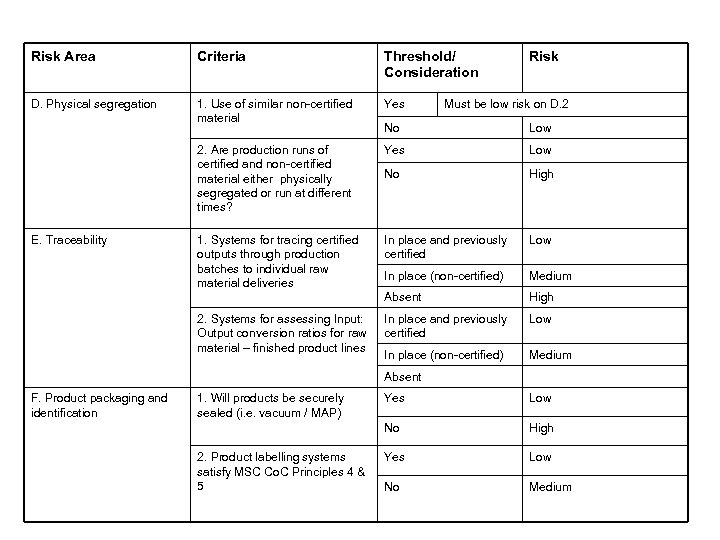
Risk Area Criteria Threshold/ Consideration D. Physical segregation 1. Use of similar non-certified material Yes No Low 2. Are production runs of certified and non-certified material either physically segregated or run at different times? Yes Low No High 1. Systems for tracing certified outputs through production batches to individual raw material deliveries In place and previously certified Low In place (non-certified) Medium Absent High In place and previously certified Low In place (non-certified) Medium E. Traceability 2. Systems for assessing Input: Output conversion ratios for raw material – finished product lines Risk Must be low risk on D. 2 Absent F. Product packaging and identification 1. Will products be securely sealed (i. e. vacuum / MAP) Low No 2. Product labelling systems satisfy MSC Co. C Principles 4 & 5 Yes High Yes Low No Medium
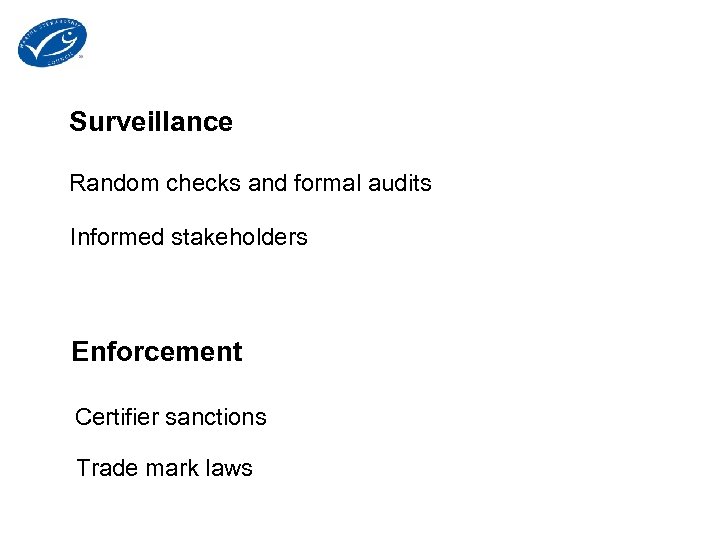
Surveillance Random checks and formal audits Informed stakeholders Enforcement Certifier sanctions Trade mark laws
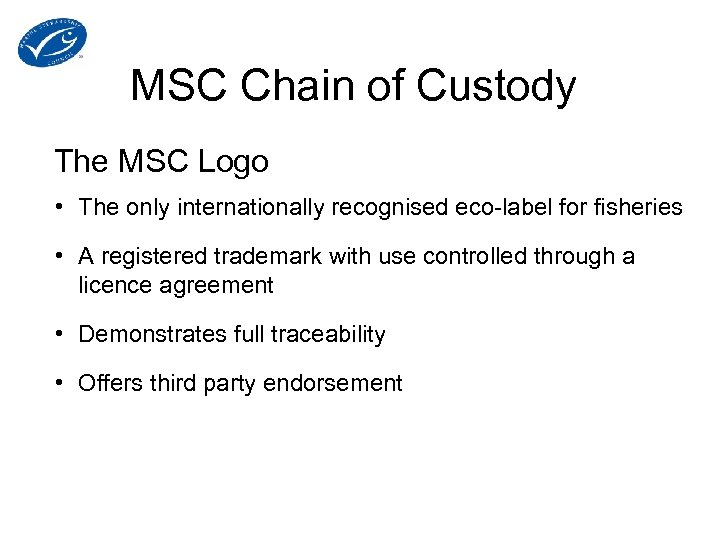
MSC Chain of Custody The MSC Logo • The only internationally recognised eco-label for fisheries • A registered trademark with use controlled through a licence agreement • Demonstrates full traceability • Offers third party endorsement
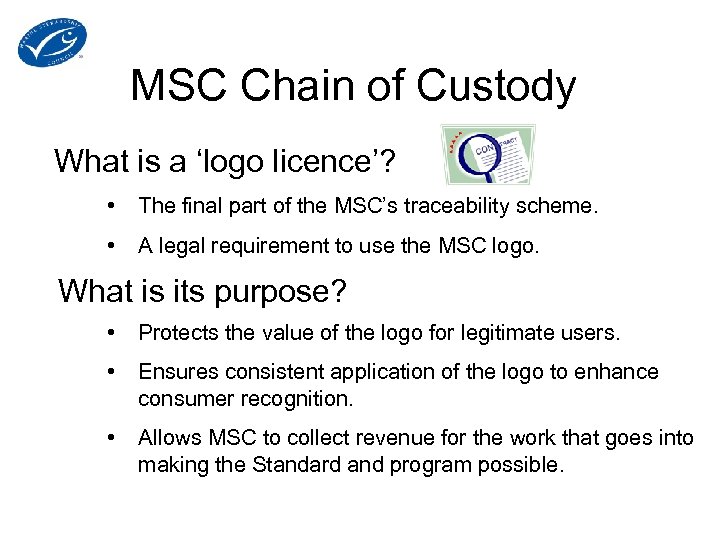
MSC Chain of Custody What is a ‘logo licence’? • The final part of the MSC’s traceability scheme. • A legal requirement to use the MSC logo. What is its purpose? • Protects the value of the logo for legitimate users. • Ensures consistent application of the logo to enhance consumer recognition. • Allows MSC to collect revenue for the work that goes into making the Standard and program possible.
MSC Chain of Custody Designed to address consumer concerns that what they buy is what they expect – increasingly important in today’s marketplaces Helps that MSC protect its reputation – i. e. risk minimisation Helps the MSC to creates value in its brand (logo)
MSC Chain of Custody
Скачать презентацию Maintaining Identity WYBIWYE and consumer assurance Duncan Leadbitter
a6784c71527f2896d30cbf96123b8b4c.ppt