 Скачать презентацию Maintaining Broad-Based Athletic Programs in an Era of
441625b6215e28b34239c05cb988e1c5.ppt
- Количество слайдов: 18



Maintaining Broad-Based Athletic Programs in an Era of Rapid Expenditure Growth John J. Cheslock University of Arizona
Outline n n n Basic trends in sports participation and sports sponsorship. Basic trends in athletic expenditures. Which colleges and universities will offer broad-based athletic programs and sponsor “Olympic” sports?
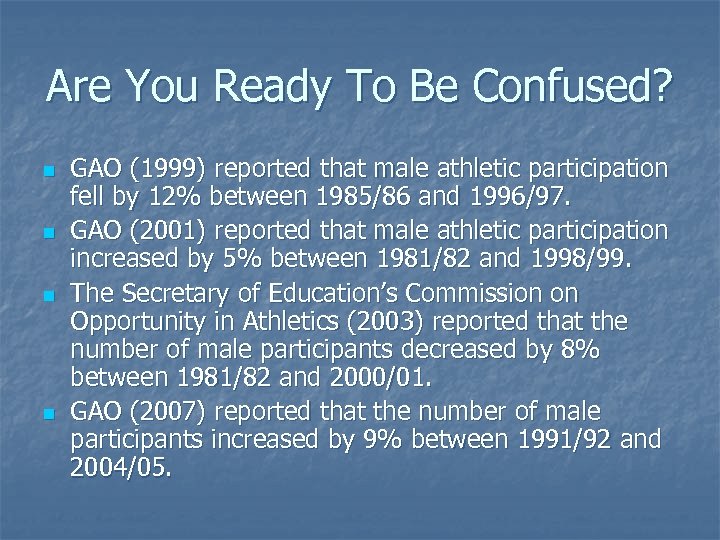
Are You Ready To Be Confused? n n GAO (1999) reported that male athletic participation fell by 12% between 1985/86 and 1996/97. GAO (2001) reported that male athletic participation increased by 5% between 1981/82 and 1998/99. The Secretary of Education’s Commission on Opportunity in Athletics (2003) reported that the number of male participants decreased by 8% between 1981/82 and 2000/01. GAO (2007) reported that the number of male participants increased by 9% between 1991/92 and 2004/05.
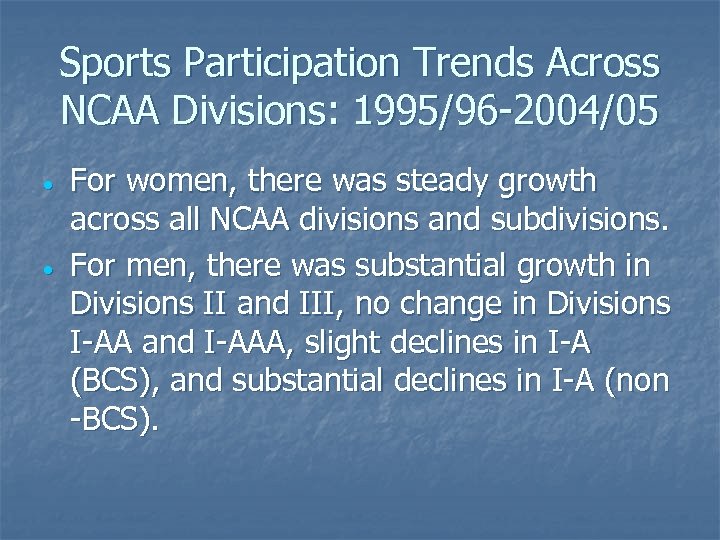
Sports Participation Trends Across NCAA Divisions: 1995/96 -2004/05 For women, there was steady growth across all NCAA divisions and subdivisions. For men, there was substantial growth in Divisions II and III, no change in Divisions I-AA and I-AAA, slight declines in I-A (BCS), and substantial declines in I-A (non -BCS).
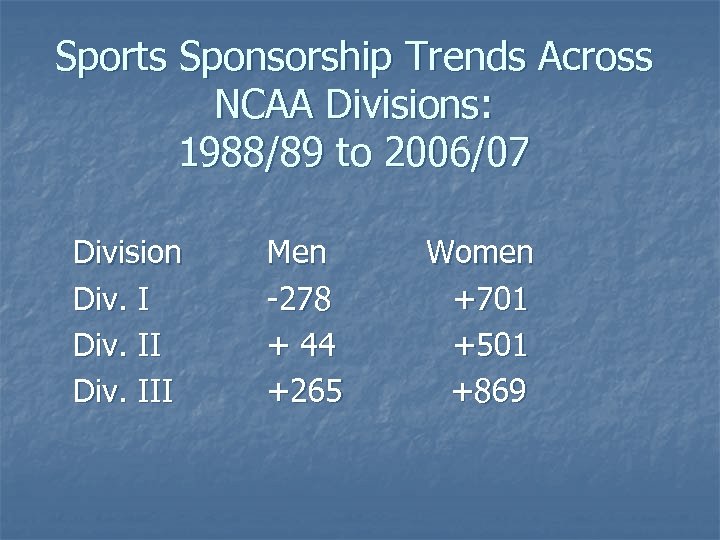
Sports Sponsorship Trends Across NCAA Divisions: 1988/89 to 2006/07 Division Div. III Men -278 + 44 +265 Women +701 +501 +869
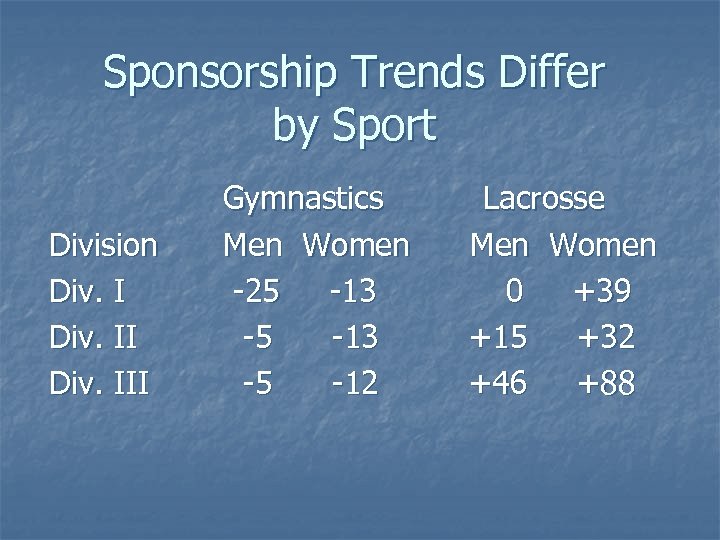
Sponsorship Trends Differ by Sport Division Div. III Gymnastics Men Women -25 -13 -5 -12 Lacrosse Men Women 0 +39 +15 +32 +46 +88
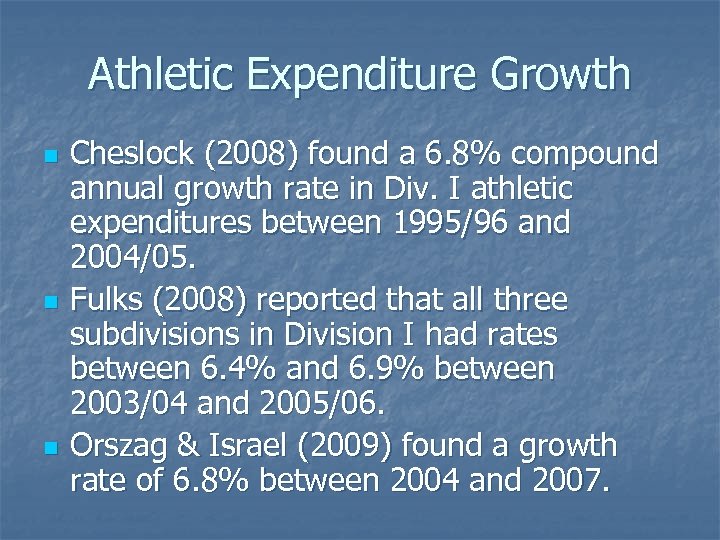
Athletic Expenditure Growth n n n Cheslock (2008) found a 6. 8% compound annual growth rate in Div. I athletic expenditures between 1995/96 and 2004/05. Fulks (2008) reported that all three subdivisions in Division I had rates between 6. 4% and 6. 9% between 2003/04 and 2005/06. Orszag & Israel (2009) found a growth rate of 6. 8% between 2004 and 2007.
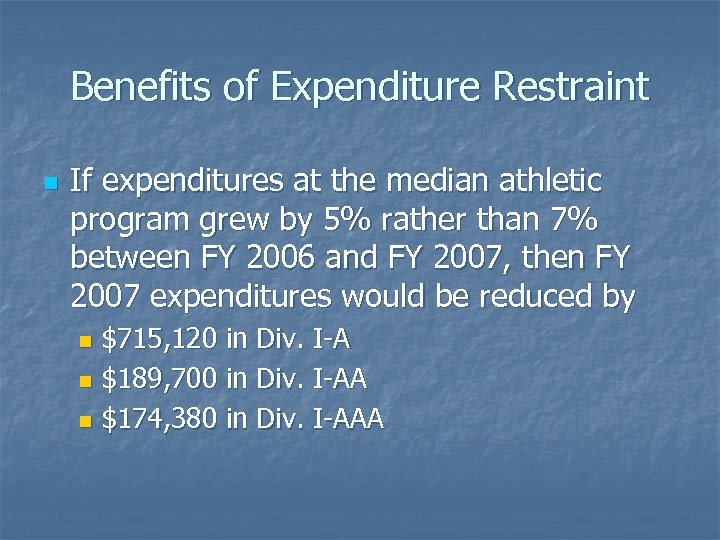
Benefits of Expenditure Restraint n If expenditures at the median athletic program grew by 5% rather than 7% between FY 2006 and FY 2007, then FY 2007 expenditures would be reduced by $715, 120 in Div. I-A n $189, 700 in Div. I-AA n $174, 380 in Div. I-AAA n
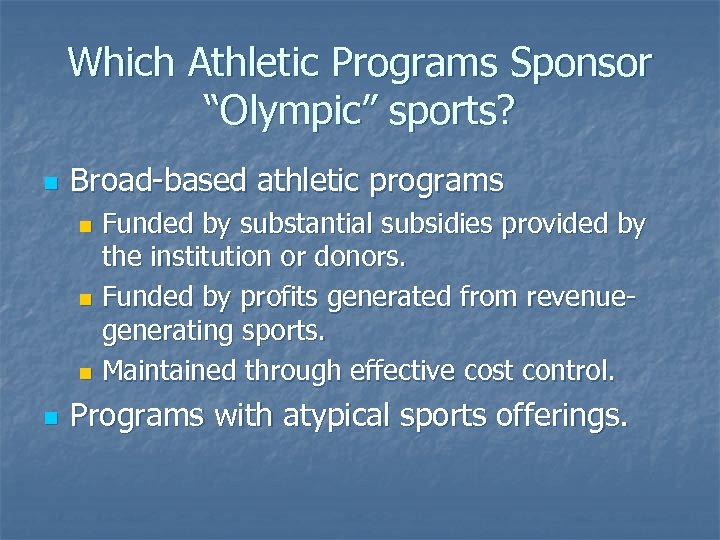
Which Athletic Programs Sponsor “Olympic” sports? n Broad-based athletic programs Funded by substantial subsidies provided by the institution or donors. n Funded by profits generated from revenuegenerating sports. n Maintained through effective cost control. n n Programs with atypical sports offerings.
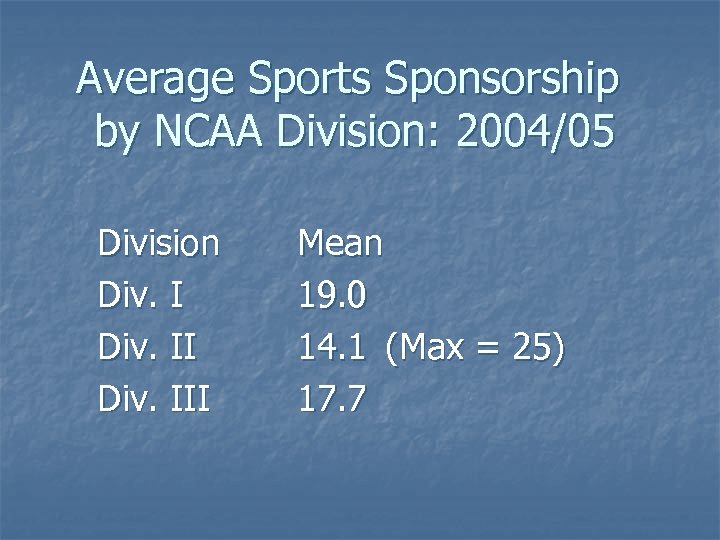
Average Sports Sponsorship by NCAA Division: 2004/05 Division Div. III Mean 19. 0 14. 1 (Max = 25) 17. 7
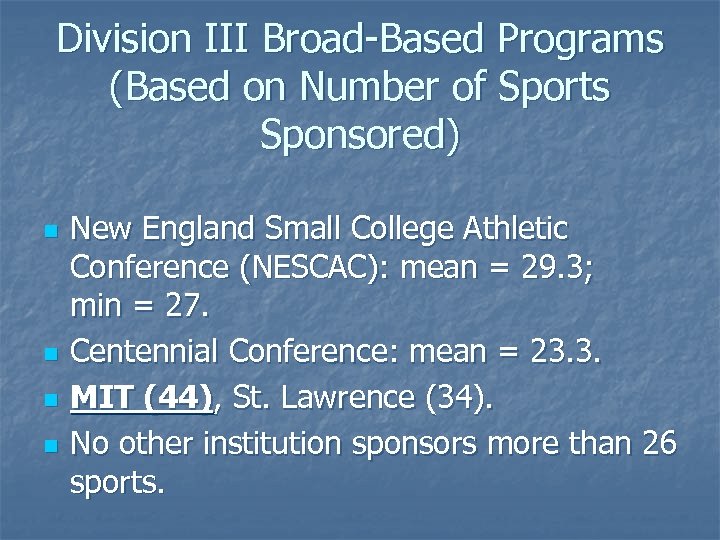
Division III Broad-Based Programs (Based on Number of Sports Sponsored) n n New England Small College Athletic Conference (NESCAC): mean = 29. 3; min = 27. Centennial Conference: mean = 23. 3. MIT (44), St. Lawrence (34). No other institution sponsors more than 26 sports.
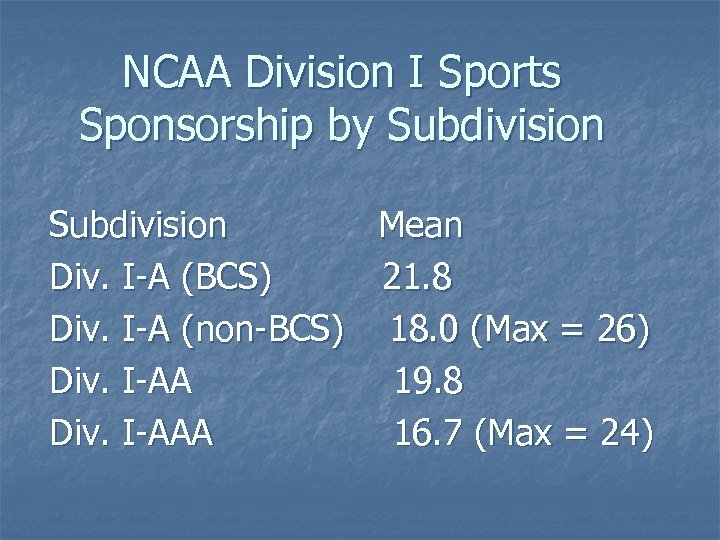
NCAA Division I Sports Sponsorship by Subdivision Mean Div. I-A (BCS) 21. 8 Div. I-A (non-BCS) 18. 0 (Max = 26) Div. I-AA 19. 8 Div. I-AAA 16. 7 (Max = 24)
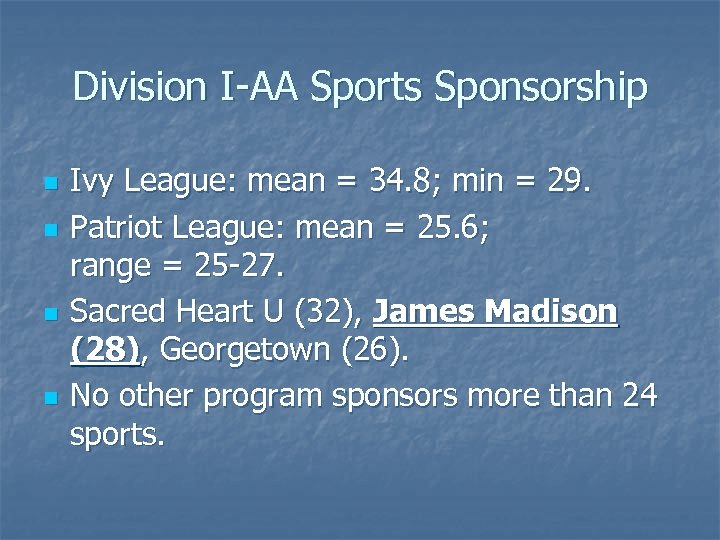
Division I-AA Sports Sponsorship n n Ivy League: mean = 34. 8; min = 29. Patriot League: mean = 25. 6; range = 25 -27. Sacred Heart U (32), James Madison (28), Georgetown (26). No other program sponsors more than 24 sports.
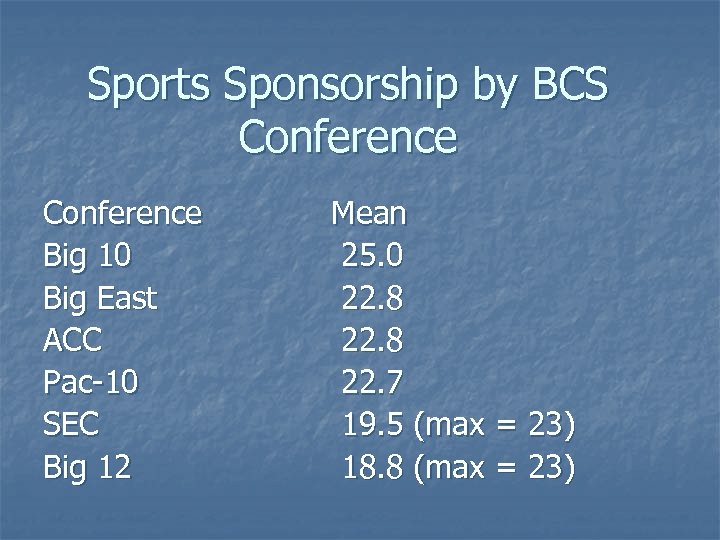
Sports Sponsorship by BCS Conference Big 10 Big East ACC Pac-10 SEC Big 12 Mean 25. 0 22. 8 22. 7 19. 5 (max = 23) 18. 8 (max = 23)
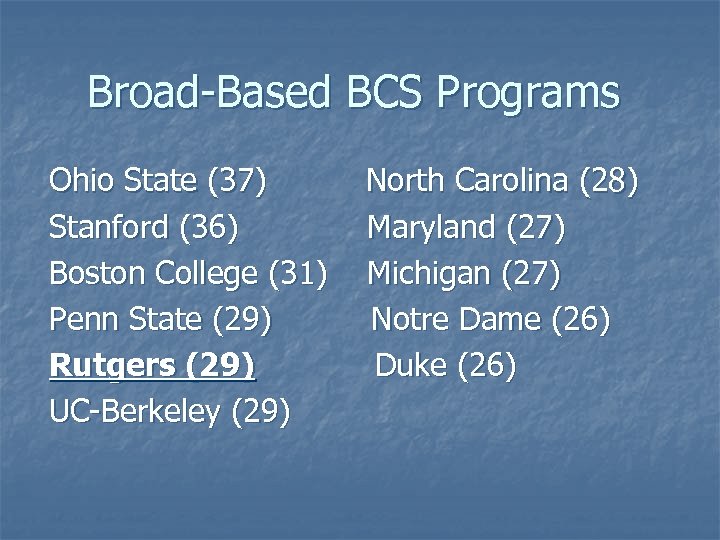
Broad-Based BCS Programs Ohio State (37) Stanford (36) Boston College (31) Penn State (29) Rutgers (29) UC-Berkeley (29) North Carolina (28) Maryland (27) Michigan (27) Notre Dame (26) Duke (26)
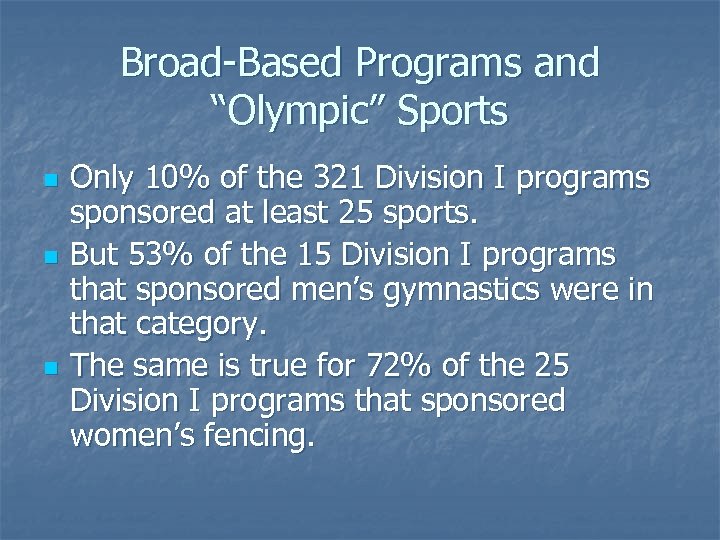
Broad-Based Programs and “Olympic” Sports n n n Only 10% of the 321 Division I programs sponsored at least 25 sports. But 53% of the 15 Division I programs that sponsored men’s gymnastics were in that category. The same is true for 72% of the 25 Division I programs that sponsored women’s fencing.
Broad-Based Programs and “Olympic” Sports (part 2) n When broad-based programs cut sports, rarely sponsored “Olympic” sports are usually the first to be eliminated: Rutgers (fencing, men’s crew) n James Madison (fencing, gymnastics, wrestling, archery) n MIT (gymnastics, wrestling, pistol, ice hockey) n
Setting the Stage n n Can current broad-based athletic programs continue to sponsor large numbers of sports in the future if rapid expenditure growth continues? How do we restrain expenditures?
Скачать презентацию Maintaining Broad-Based Athletic Programs in an Era of
441625b6215e28b34239c05cb988e1c5.ppt