


 Скачать презентацию Mainstreaming of a Child Centred Approach to Governance
1f74a209f8bfdf78558be0ab2ee1be85.ppt
- Количество слайдов: 23
 Mainstreaming of a Child Centred Approach to Governance and Service Delivery Processes OFFICE ON THE RIGHTS OF THE CHILD PRESIDENCY REPUBLIC OF SOUTH AFRICA

 What is “MAINSTREAM” Mainstream is a set of inter-related dominant development ideology, decisions and practices. This definition emphasizes the relationship between theories or assumptions about “development”, and the ideas or practices of organizations or people making decisions. Output of Mainstreaming Processes or Strategies = Synergy between Development theories, legislation, policy, planning, practice, programming, funding and communication
 What is being Mainstreamed? The legitimacy of the child’s welfare and rights as a fundamental value to be reflected in all Government’s institutional and governance processes Implications: Prioritization of: - child survival, protection and development in governance processes - best interest of the child - child participation “Child Centred Governance Approach” (CCGA)
 What does it Mean to be Part of the Mainstream Equitable access to society’s resources, rewards and opportunities Equal participation in: - Influencing what is valued - shaping development directions - Distribution of opportunities Children from poor, rural, remote or Black communities ?
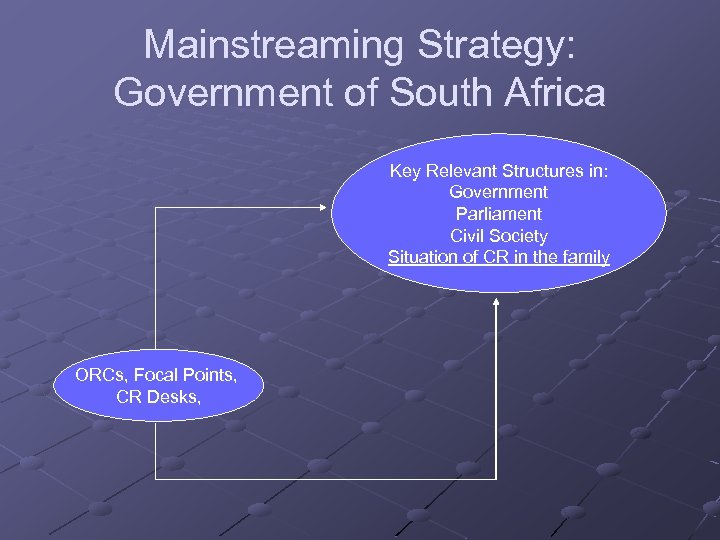 Mainstreaming Strategy: Government of South Africa Key Relevant Structures in: Government Parliament Civil Society Situation of CR in the family ORCs, Focal Points, CR Desks,
 Why Mainstreaming of CCGA To facilitate a shift Government and society, in the understanding of the problem Ensure the understanding that child development, protection and participation is central to development and economic goals
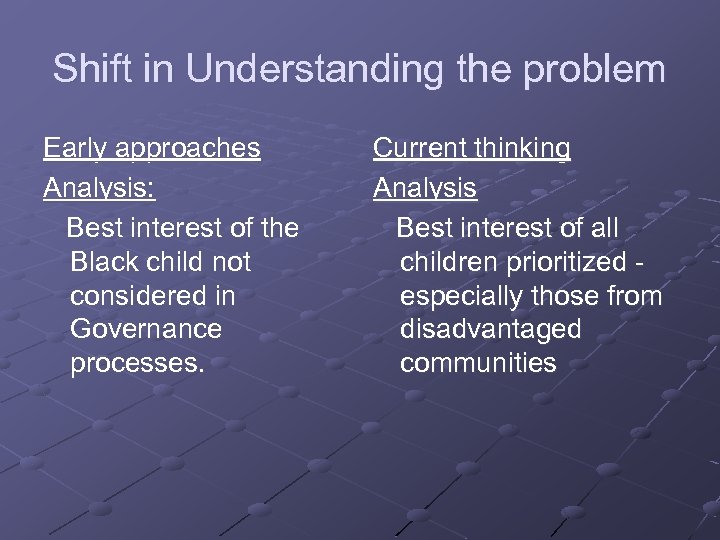 Shift in Understanding the problem Early approaches Analysis: Best interest of the Black child not considered in Governance processes. Current thinking Analysis Best interest of all children prioritized especially those from disadvantaged communities
 Focus of Mainstreaming Process in in Government / Provincial ORCS Policy, prioritization, planning, application, funding, monitoring & evaluation, reporting and communication by children’s rights mainstreaming and coordination structures

 Communication Strategy: National Children’s Rights Programme Ten Yr Review: National Children’s Rights Framework and Communication underpinned by capacity building towards successful mainstreaming of a CCGA FOSAD Cabinet Clusters Road Show: National Children’s Rights Coordination Framework
 Additional Information Elements of the National CR Framework National Accountability Framework Linkage between Gov. priorities and the national CR programme Linkage between millennium goals and the national children’s rights programme Performance milestones since 1994 Challenges
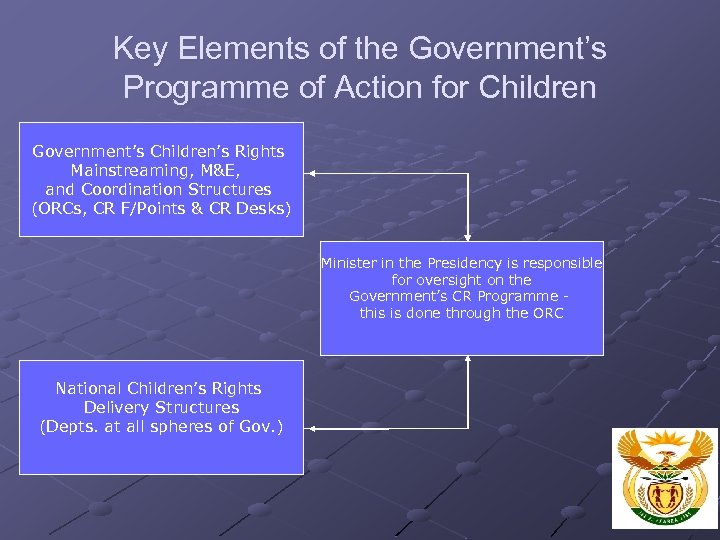 Key Elements of the Government’s Programme of Action for Children Government’s Children’s Rights Mainstreaming, M&E, and Coordination Structures (ORCs, CR F/Points & CR Desks) Minister in the Presidency is responsible for oversight on the Government’s CR Programme this is done through the ORC National Children’s Rights Delivery Structures (Depts. at all spheres of Gov. )
 Key Elements of the Government’s Programme of Action for Children Government’s Children’s Rights Mainstreaming, M&E, and Coordination Structures (ORCs, CR F/Points & CR Desks) Minister in the Presidency is responsible for oversight on the Government’s CR Programme this is done through the ORC National Children’s Rights Delivery Structures (Depts at all spheres of Gov. )
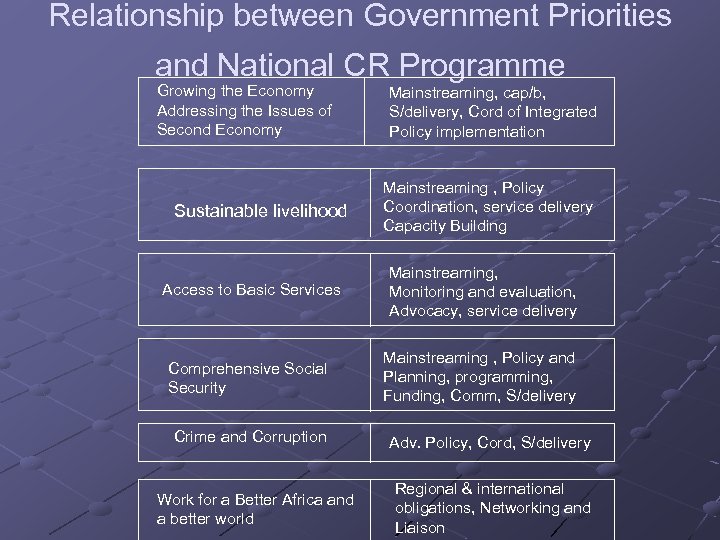 Relationship between Government Priorities and National CR Programme Growing the Economy Addressing the Issues of Second Economy Sustainable livelihood Mainstreaming, cap/b, S/delivery, Cord of Integrated Policy implementation Mainstreaming , Policy Coordination, service delivery Capacity Building Access to Basic Services Mainstreaming, Monitoring and evaluation, Advocacy, service delivery Comprehensive Social Security Mainstreaming , Policy and Planning, programming, Funding, Comm, S/delivery Crime and Corruption Work for a Better Africa and a better world Adv. Policy, Cord, S/delivery Regional & international obligations, Networking and Liaison
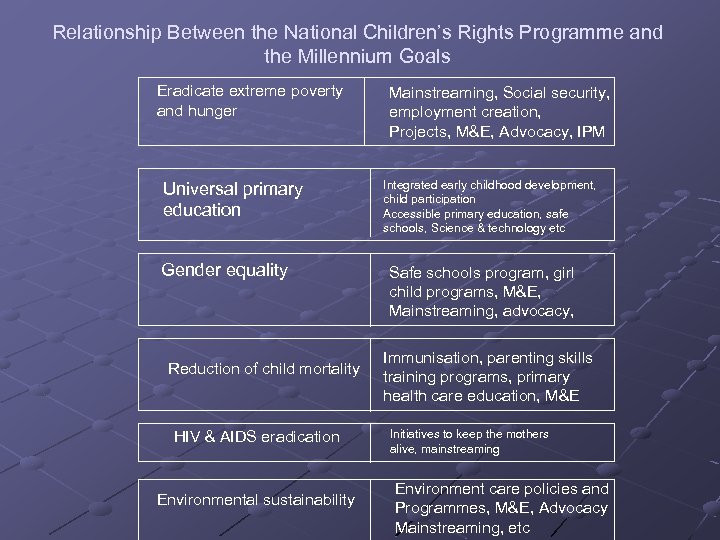 Relationship Between the National Children’s Rights Programme and the Millennium Goals Eradicate extreme poverty and hunger Universal primary education Gender equality Reduction of child mortality HIV & AIDS eradication Environmental sustainability Mainstreaming, Social security, employment creation, Projects, M&E, Advocacy, IPM Integrated early childhood development, child participation Accessible primary education, safe schools, Science & technology etc Safe schools program, girl child programs, M&E, Mainstreaming, advocacy, Immunisation, parenting skills training programs, primary health care education, M&E Initiatives to keep the mothers alive, mainstreaming Environment care policies and Programmes, M&E, Advocacy Mainstreaming, etc
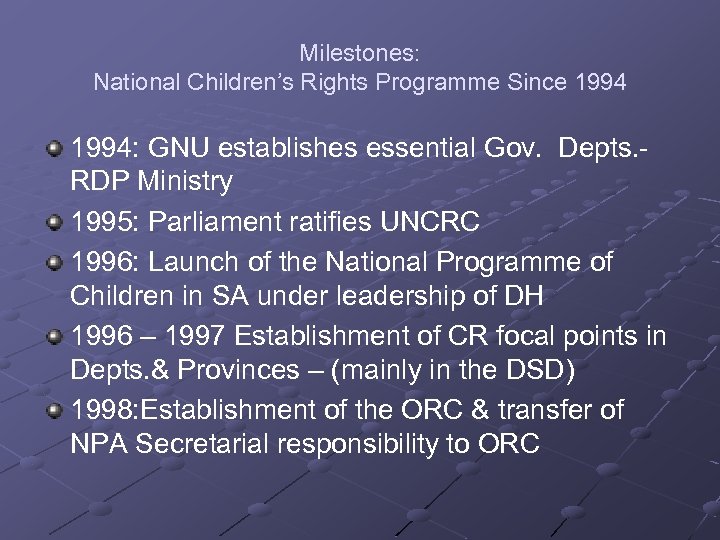 Milestones: National Children’s Rights Programme Since 1994: GNU establishes essential Gov. Depts. RDP Ministry 1995: Parliament ratifies UNCRC 1996: Launch of the National Programme of Children in SA under leadership of DH 1996 – 1997 Establishment of CR focal points in Depts. & Provinces – (mainly in the DSD) 1998: Establishment of the ORC & transfer of NPA Secretarial responsibility to ORC
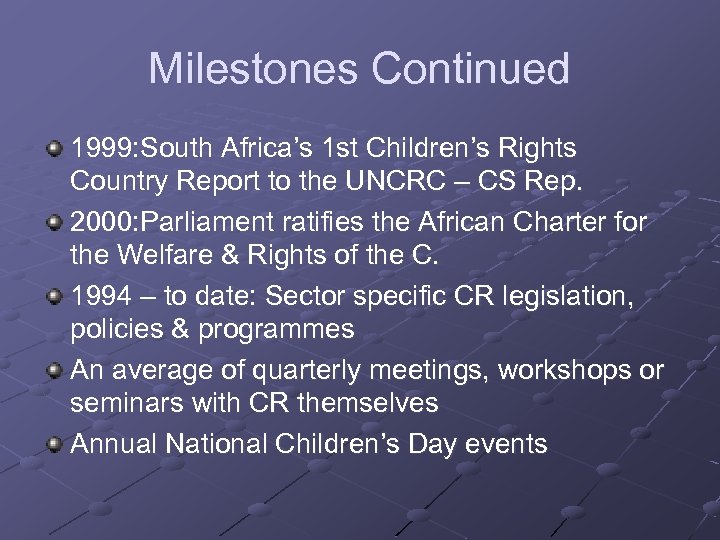 Milestones Continued 1999: South Africa’s 1 st Children’s Rights Country Report to the UNCRC – CS Rep. 2000: Parliament ratifies the African Charter for the Welfare & Rights of the C. 1994 – to date: Sector specific CR legislation, policies & programmes An average of quarterly meetings, workshops or seminars with CR themselves Annual National Children’s Day events
 Milestones Continued 2004 -05 Ten yr Review and Improvement of the National CR Framework Clarification of the roles of the component parts of the national CR framework Development of the National CR Coordination F/work Ten yr Review: National GDC Programmes & Positive public opinion – significant improvement on quality of life of children in South Africa Addition of Local Government CR structures in the national CR framework 1998 -2005: Establishment of ORCS in the offices of Premiers
 Milestones Continued 2005: Initiation of a process that aims to formalize the institutional arrangements in the implementation of the national CR programme Country wide Government and Civil Society partnerships Re-Activation of issue specific task teams
 Challenges Inadequate understanding of the “mainstreaming” approach to governance processes in Government Inadequate technical mainstreaming, M&E, and integrated policy implementation capacity in CR structures in Government Inadequate administrative capacity
 Beneficiaries of the Revised CR Framework Children, families & Communities The three spheres of Government Component parts of the national CR framework
 THANK YOU