


 Скачать презентацию Magruder s American Government 27544 C H A P
e683b1087161831149a1aec84a717302.ppt
- Количество слайдов: 78
 Magruder’s American Government 27544 C H A P T E R 13 The Presidency © 2001 by Prentice Hall, Inc.
 The President’s Roles Chief of State l The President is chief of state. This means he is the ceremonial head of the government of the United States, the symbol of all the people of the nation. Chief Executive l The Constitution vests the President with the executive power of the United States, making him or her the nation’s chief executive. Chief Administrator l The President is the chief administrator, or director, of the United States government. Chief Diplomat l As the nation’s chief diplomat, the President is the main architect of American foreign policy and chief spokesperson to the rest of the world. 2 3 4 5 Chapter 13, Section 1
 More Roles of the President Commander in Chief l The Constitution makes the President the commander in chief, giving him or her complete control of the nation’s armed forces. Chief Legislator l The President is the chief legislator, the main architect of the nation’s public policies. Chief of Party l The President acts as the chief of party, the acknowledged leader of the political party that controls the executive branch. Chief Citizen l The President is expected to be “the representative of all the people. ” Chapter 13, Section 1 2 3 4 5 Chapter 13, Section 1
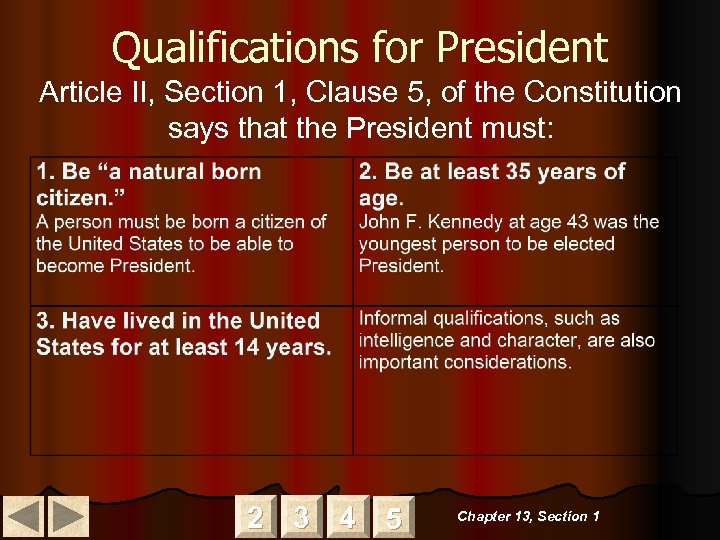 Qualifications for President Article II, Section 1, Clause 5, of the Constitution says that the President must: 2 3 4 5 Chapter 13, Section 1
 The President’s Term Until 1951, the Constitution placed no limit on the number of terms a President might serve. l Traditionally, Presidents limited the number of terms served to two. This tradition was broken by Franklin D. Roosevelt in 1940 when he ran for and won a third term in office. He then went on to be elected to a fourth term in 1944. l The 22 nd Amendment placed limits on presidential terms. A President now may not be elected more than twice or only once if they became President due to succession. l 2 3 4 5 Chapter 13, Section 1
 Pay and Benefits Congress determines the President’s salary, and this salary cannot be changed during a presidential term. l Besides monetary benefits, The President’s pay was the President gets to live in first set at $25, 000 a year. the 132 -room mansion that Currently, the President is we call the White House. paid $400, 000 a year. l The President is also l Congress has also granted other benefits, approved an expense including a large suite of allowance for the offices, a staff, the use of President, which is Air Force One, and many currently $50, 000 a year. other fringe benefits. l 2 3 4 5 Chapter 13, Section 1
 Chapter 13: Executive Branch Section 2 Presidential Succession & the Vice Presidency
 The Constitution & Succession l Presidential Succession – Scheme by which presidential vacancy is filled l 1 st in line = Vice President l Originally constitution did not provide succession of the V. P. – Offices and duties transfer to V. P. not the office itself l 25 th Amendment 1967 – V. P. Shall become P. in case of death/resignation
 The Constitution & Succession l Congress fixed the succession after V. P. – Presidential Succession Act of 1947 l Succession V. P. , Speaker of the House, President pro Tempore, Secretary of State, 14 Cabinet Heads l Order determined by Congress
 l B 4 Presidential Disability 25 th Amendment no provisions for a disabled president – 180 years the nation gambled with fate l (1) Eisenhower suffered 3 illnesses l (2) James Garfield disabled for 80 B 4 dying l (3) Woodrow Wilson suffered a stroke that knocked him out for the rest of his 2 nd term
 l 25 th Presidential Disability Amendment – Sections 3 & 4 deal with disability l V. P. will take over when l (1) P. informs Congress in writing that he is unable to perform his duties l (2) V. P. and Cabinet informs Congress in writing that President is incapacitated
 Presidential Disability l President may resume powers by informing Congress that no disability exists l V. P. & a majority of the Cabinet may challenge – if they do so, Congress has 21 days to decide l Disability Provision used 2 l (1) Ronald Regan – 8 hours l (2) George W. – 2 hours
 l 2 The Vice Presidency formal duties assigned by the Constitution l (1) Preside over the Senate l (2) help decide the question of presidential disability l “President-in-waiting” l Office of little real consequence and butt of many jokes
 The Vice Presidency l Blame 4 low status placed on parties and how they select their candidates l National Convention names President – President chooses someone who will “Balance the Ticket” Running mate who can strengthen his chance of being elected by virtue of certain ideological, geographic, racial, ethnic, gender, etc.
 Vice Presidential Vacancy l V. P. has been vacant 18 times (9 out of Presidential succession, 2 resignations, 7 deaths) l Not until 25 th Amendment did the Constitution deal with V. P. succession l President nominates someone – confirm by majority vote of both houses
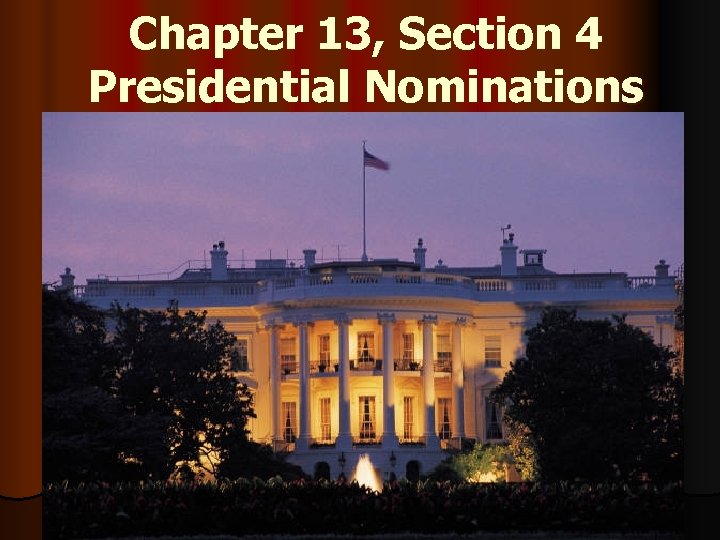 Chapter 13, Section 4 Presidential Nominations
 l So…How Introduction are President’s nominated? l Framers designed a system where presidential electors would select the “wisest and best man” to be president BUT the rise of political parties altered this system…
 The Role of Conventions l Primary role: to elect presidential candidates l First method the parties developed: Congressional Caucus – but the nonrepresentative character of this system led to its downfall in the mid 1820 s l 1832 – Both parties began using National Conventions (what we still use today)
 Convention Arrangements l How do conventions work? Not found in the Constitution; developed by the 2 parties l National Committees (one for each party) make arrangements for their party’s convention l Sets the date and location l Party not in power meets 1 st (July) l Party in Power (Aug) l Big cities try to bid for location
 The Apportionment of Delegates l National committee issues a “call” (a formal announcement) for the convention l Each state party gets a certain # of delegates based on that State’s electoral vote l Some states get bonus delegates for good past support l 2004: Republican Party – 2, 509 delegates Democratic Party – 4, 353 delegates NOT a deliberative body!
 Selection of Candidates l There are really 2 campaigns for the Presidency l 1. Contest b/t Republican & Democrat in the fall l 2. Much earlier & takes place within each party – the struggle for convention delegates
 Selection of Candidates l State laws &/or party rules decide how state delegates are chosen – a reflection of federalism l Republican party: delegate selection based on State law & State organizations l Democratic party: adopted several nat’l rules adopted to broaden participation in the process (especially by young, minorities, & women)
 Presidential Primaries l¾ of delegates come from states that hold presidential primaries l Presidential Primary – an election in which a party’s voters l 1. Choose some or all of a State party organization’s delegates to their party’s nat’l convention &/or l 2. express a preference among various contenders for their party’s presidential nomination
 History of the Presidential Primary l 1 st appeared in early 1900 s l Wisconsin passed the 1 st presidential primary law in 1905 l 1916 – nearly ½ states had adopted presidential primary laws l 1960 s – primaries became unpopular l 1970 s – reforms, particularly by Democrats reversed the trend
 Primaries Today l Reminder: presidential primary is either or both of 2 things – a delegate-selection process &/or a candidate preference election l After that, different among every state l Why? l Details of delegate-selection process is determined by each States’ laws l Ongoing reform efforts by the Democratic Party have prompted changes in States’ laws
 Proportional Representation Several primaries were winner-take-all: the candidate who won the preference vote automatically won the support of all delegates chosen at the primary (not used any longer by Democrats) l Instead Democrats use Proportional representation: any candidate who wins at least 15% of the votes in a primary gets the # of that State’s Democratic convention delegates that corresponds to his or her share of that primary vote (complicated) l Republicans use both Proportional representation & winner-take-all l
 Evaluation of the Primary l Despite the complication & confusion of primaries, they are vital l Presidential primaries democratize the delegate-selection process & force candidates to be tested and screen out unqualified contenders
 Evaluation of the Primary l Most important for the party out of power l Why is it not as important for party in power? l b/c (1) president is up for reelection or (2) he is backing someone for the nomination l There are exceptions of course
 Reform Proposals l Presidential primaries demand a lot of candidates (time, effort, money, scheduling, & fatigue) and test the public l Therefore, critics would either do away with conventions or propose a series of regional primaries
 The Caucus-Convention Process l For states that do not hold presidential primaries, delegates are chosen in a system of caucuses and conventions l Local caucuses choose delegates to a local convention and then those delegates chosen at a state convention l Oldest method for picking national convention delegates
 The National Convention Once all of the primaries and caucuses have been held & delegates are chosen – the 2 major parties hold their National Conventions (the mtgs at which the delegates vote to pick their presidential and VP candidates l Each convention seeks 3 major goals l 1. naming the party’s presidential and VP candidates l 2. bringing the various factions & the leading personalities together for a common purpose l 3. adopting the party’s platform (its formal statement of basic principles, stands on major policy matters, and objectives for the campaign and beyond) l
 The National Convention II l Successful parties also: promote party unity, mobilize support for the party ticket, & capture the interest & attention of the country l 1 st 2 Days: welcome, organize, speeches, adopt platform, & deliver keynote address l Last 2 Days: nominate party’s candidates for Pres. & VP; nominating, voting, & selecting of the party’s presidential candidate; & presidential acceptance speech
 l Party Who is Nominated? in power: if an incumbent President wants it, he usually gets the nomination l When the president is not in the field, many contend for the nomination l Many characteristics play a role in who is nominated l Political experience – clean records; often governors or Senators l Religion – Protestant; home state – large states; appearance, family life, and speaking ability– b/c of TV; gender – males; etc
 SECTION 5 The Election l What are the flaws in the electoral college? l What is the function of the electoral college today? l What are the advantages and disadvantages of proposed reforms in the electoral college? 34 SECTION 5 1 2 3 4 Chapter 13, Section 5
 SECTION 5 The Election l What is the function of the electoral college today? l What are the flaws in the electoral college? l What are the advantages and disadvantages of proposed reforms in the electoral college? 35 SECTION 5 Chapter 13, Section 5
 The Electoral College Today Voters do not vote directly for the President. Instead, they vote for electors in the electoral college. • All States, except two (Maine and Nebraska), selectors based on the winner of the popular vote in that State. • Electors then meet in the State capitals on the Monday after the second Wednesday in December and cast their votes for President and Vice 1 2 3 4 President. • On January 6, the electoral votes cast are counted by the president of the Senate, and the President and Vice President are formally elected. • If no candidate wins a majority of electoral votes (270), the election is thrown into the House of Chapter 13, Section 5 Representatives.
 Flaws in the Electoral College There are three major defects in the electoral college: (1) It is possible to win the popular vote in the presidential election, but lose the electoral college vote. This happened four times in U. S. history (1824, 1876, 1888, and 2000). (2) Nothing in the Constitution, nor in any federal statute, requires the electors to vote for the candidate favored by the popular vote in their State. (3) If no candidate gains a majority in the electoral college, the election is thrown into the House, a situation that has happened twice (1800 and 1824). In this process, each State is given one vote, meaning that States with smaller populations wield the same power as those with larger populations. Chapter 13, Section 5
 l l Proposed Reforms In the district plan, electors would be chosen the same way members of Congress are selected: each congressional district would select one elector (just as they select representatives), and two electors would be selected based on the overall popular vote in a State (just as senators are selected). The proportional plan suggests that each candidate would receive the same share of a State’s electoral vote as he or she received in the State’s popular vote. l l A commonly heard reform suggests that the electoral college be done away with altogether in favor of direct popular election. At the polls, voters would vote directly for the President and Vice President instead of electors. The national bonus plan would automatically offer the winner of the popular vote 102 electoral votes in addition to the other electoral votes he or she might gain. Chapter 13, Section 5
 Electoral College Supporters There are two major strengths of the electoral college that its supporters espouse: l It is a known process. Each of the proposed, but untried, reforms may very well have defects that could not be known until they appeared in practice. l In most election years, the electoral college defines the winner of the presidential election quickly and certainly. Chapter 13, Section 5
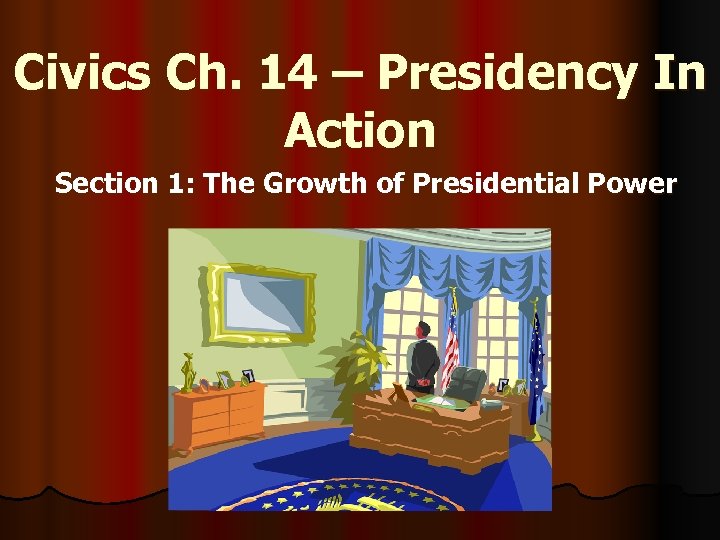 Civics Ch. 14 – Presidency In Action Section 1: The Growth of Presidential Power
 Introduction l “most powerful office in the world” l What the Framers wanted? l Framers want a Checked or Limited presidency
 Article II l Article II – Constitution’s Executive Article l Sets out powers such as: l. Command Armed Forces, Make Treaties, Send/Receive Diplomats, Etc. l Powers of the President very sketchy – Article II most loosely drawn part of the nations law l Struggle around defining the power of the presidency
 Why Presidential Power Has Grown l Constitution’s formal grants of power to the President has not changed but Presidential power has grown a lot l Why – 6 Things
 1. Why Presidential Power Has Grown Unity of the Presidency – Office & Powers held by one person where as Congress is Two houses 2. Strong Presidents – Abraham Lincoln, FDR 3. Nation’s Complex Social & Economic Life – U. S. became more industrialized, people demanded the Federal Gov’t especially President to take larger role in transportation, wealth, welfare, education, etc.
 Why Presidential Power Has Grown War – Need for immediate and decisive actions 5. Congress – Congress has time to only provide outlines for policies Pass legislation that allows the Executive Branch to carry out laws 4.
 Why Presidential Power Has Grown l President has ability to attract attention & build support for policies – How? l Use Mass Media Forms of communications, esp. radio and T. V. l Remember – President not all powerful l Truman – Overstepped Constitutional power by seizing private property l Bush (W) – Overstepped with containment of persons captured in the War
 Presidential View Presidents take 2 views on powers of the Presidency l (1) Roosevelt Stewardship Theory – President should have undefined and limitless power unless specifically forbidden by the Constitution l (2) Taft Only exercise those powers specifically granted by the Constitution or through Congressional Legislation l
 l Critics Presidential View of strong Presidential power condemn Imperial Presidency – President as Emperor who makes strong actions without consulting Congress or acting in secrecy l. Richard l Worried Nixon that Presidents have become isolated policy makers
 Chapter 14, Section 2 The President’s Executive Power
 Introduction l The President’s power to execute the law endows him with an enormous amount of authority.
 Executing the Law l President is Chief Executive – executes (enforces, administers, carries out) the provisions of federal law l 2 constitutional provisions provides these powers l 1. oath of office – sworn by President on day he takes office (“I do solemnly swear that I will faithfully execute the office of President…” l 2. Constitutions command that “he shall take that the laws be faithfully executed”
 Executing the Law l President’s power to execute the law covers all federal laws (ex: social security, gun control, minimum wages, affirmative action, immigration, and MANY others) l In executing & enforcing law, the executive branch also interprets it l The Pres. may, & does, use discretion to how vigorously and in what particular way any given law will be applied in practice l Congress sets out basic policies; specific details left to be worked out by exec. branch
 Introduction to the Ordinance Power Job of administering & applying most federal laws is the day-today work of all of the many depts, bureaus, offices, boards, commissions, councils, & other agencies that make up the huge executive branch (2. 7 million men & women) l Pres has power to issue executive orders – a directive rule, or regulation that has the effect of law l
 Ordinance Power l Ordinance power – the power to issue executive orders; comes from 2 sources: l 1. The Constitution l 2. The acts of congress
 The Appointment Power l Pres cannot succeed without loyal subordinates that support him l With Senate’s consent, the Pres names most of the top-ranking officers of the fed govt (process=graphic organizer) l 1. Ambassadors & other diplomats l 2. Cabinet members & their top aides l 3. The heads of such independent agencies as the EPA & NASA l 4. All federal judges, US marshals, & attorneys l 5. All officers in the armed forces
 The Removal Power Constitution does not say how or by whom appointed officers may be dismissed l The Historical Debate: l 1. Should the Senate be responsible for removing offices OR l 2. Should the President (the 1 st congress gave the Pres the power to remove any officer he appointed, except federal judges; Congress has tried to restrict this power) l
 The Removal Power: Removal & the Court l l l 1926 Myers v US – question of President’s removal power brought to Supreme Court 1920 Woodrow Wilson removed Frank Myers (postmaster of Portland, OR) Myers sued for salary of his 4 year term Supreme Court stated that power of removal was an essential part of the executive power 1935 Supreme Court placed limits on President’s removal power Ruled that Congress has the power to set conditions under which officers might be removed by the Pres l FYI dismissals are often called “resignations” l
 Chapter 14 – The Presidency in Action Section 3: Diplomatic & Military Powers
 The Power to Make Treaties l Treaty – Formal agreement B/T 2 or more sovereign states l Negotiated by President through Secretary of State – Requires 2/3 vote of approval by Senate l Senate does not ratify treaties – “Advice & Consent” l President Ratifies after approved
 The Power to Make Treaties l Treaties have same legal standing as acts passed by Congress l Congress can appeal (Abrogate) by passing a law contrary to the Treaty & a law can be repealed by a treaty
 The Power to Make Treaties l If Treaty & Federal Law conflict last enacted is law l Treaty cannot conflict with Constitution but none have been found unconstitutional
 The Power to Make Treaties l Framers chose Senate to advise President on Treaties B/C of its size & secrecy important – House to Big to keep secret l 2/3 s Rule possibility that minority can kill a treaty l Treaty of Versailles (1920)
 Executive Agreement l Many agreements esp. routine ones are Executive Agreement – Pact B/T President and foreign head of State or B/T their subordinates l Can be made without Congressional consent but usually come from Congressional legislation or current treaty
 The Power of Recognition l When Pres. receives diplomats from another sovereign states he exercises his power of Recognition President, acting for U. S. , acknowledges the legal existence of that country & its gov’t, accepts it as an equal l Does not mean that it approves the character/conduct l. China
 The Power of Recognition l Often used as weapon – T. Roosevelt (Panama) & Truman (Israel) Guaranteed success of the nations l Show displeasure by declaring a Persona Non Grata – Recalling a nation’s ambassadors or diplomats Very harsh
 Commander in Chief l Congress has War Powers but Pres. dominates Military policy – almost no limit l. T. Roosevelt – sent Great White Fleet around the world. Congress objected l Presidents can delegate
 Making Undeclared War l Can the Pres. declare war without Congressional consent? l Many people say NO but History proves otherwise l John Adams 1 st to send troops w/out declaration – James Madison & Jefferson followed l Korea & Vietnam – most extensive “Undeclared Wars”
 Congressional Resolutions l Congress had not declared war since WW 2 l Enacted 8 Joint Resolutions allowing Pres. to use military force internationally
 Congressional Resolutions 1. 2. 3. 4. 1955 – Eisenhower wanted to guard Taiwan against China 1957 – Eisenhower allowed to check Soviet in M. E. 1962 – Kennedy & Cuban Missile Crisis 1962 – Kennedy, military response with construct of Berlin Wall
 Congressional Resolutions 5. 1964 – Johnson, defeat Communism is SE Asia 6. 1991 – Bush Sr. , Desert Storm & Persian Gulf 7. 2001 – W, Post 9/11 War in Afghanistan, Philippines, Georgia, & Yemen 8. 2002 – W, Operation Iraqi Freedom Eliminate Hussein
 Other Uses of Military Power l President have deployed armed forces without Congressional Resolution – 4 Examples l (1) Korean War l (2) Reagan – Invasion of Grenada in 1983 to settle coup l (3) Bush Sr. – Invasion of Panama to oust a dictatorship l (4) Clinton – Troops to the Balkans B/C of ugly Civil War
 War Powers Resolutions l National frustrations with Vietnam led Congress to pass the War Resolution Act of 1973 Place limits on Pres. war making powers – 3 Provisions
 War Powers Resolutions W/in 48 hrs. of sending troops, President must report to Congress with details 2. Combat commitment must end W/in 60 days unless Congress agrees to a longer period (Can be extended 30 Days) 3. Congress can end Combat Commitment @ anytime with concurrent resolution **Constitutionality of War Powers Resolution is still being debated 1.
 Chapter 14 S E C T I O N 4 Legislative and Judicial Powers l How are the President’s legislative powers an important part of the system of checks and balances? l What are the President’s major judicial powers? 1 2 3 Chapter 14, Section 4
 Legislative Powers The Veto Power Recommending • All legislation passed by Legislation Congress is sent to the • • The Constitution provides that the President shall report to Congress on the state of the Union and recommend necessary legislation. This power is often called the message power. President for approval. • If the President disapproves of a bill, he can veto it. That veto can only be overturned by a two-thirds vote of both houses of Congress. Chapter 14, Section 4
 The Line-Item Veto and Other Legislative Powers The Line Item Veto A line-item veto measure would allow the President to reject specific dollar amounts in spending bills enacted by Congress. l In 1996, Congress passed the Line Item Veto Act; however, it was struck down by the Supreme Court in 1998. l Other Legislative Powers l According to Article II, Section 3 of the Constitution, only the President can call a Congress into special session. 1 2 3 Chapter 14, Section 4
 Judicial Powers l l The Constitution gives the President the power to “. . . grant reprieves and pardons for offenses against the United States, except in cases of impeachment. ” —Article II, Section 2, Clause 1 A reprieve is the postponement of the execution of a sentence. A pardon is legal forgiveness for a crime. These powers of clemency (mercy or leniency) may be used only in cases of federal crimes. 1 2 3 Chapter 14, Section 4
 Section 4 Review 1. A presidential veto of legislation can only be overturned by a l (a) two-thirds vote in both houses of Congress. l (b) two-thirds vote in the Senate. l (c) two-thirds vote in the House. l (d) three-fifths vote in both houses of Congress. 2. Reprieves and pardons are both examples of the President’s l (a) appointment power. l (b) wartime powers. l (c) ordinance power. l (d) clemency power. Want to connect to the Magruder’s link for this section? Click Here! 1 2 3 Chapter 14, Section 4