


 Скачать презентацию Magnitude 4 2 earthquake Ramsgate Kent UK Friday
ac65aaa989fcc43c287ef2c22e800691.ppt
- Количество слайдов: 7
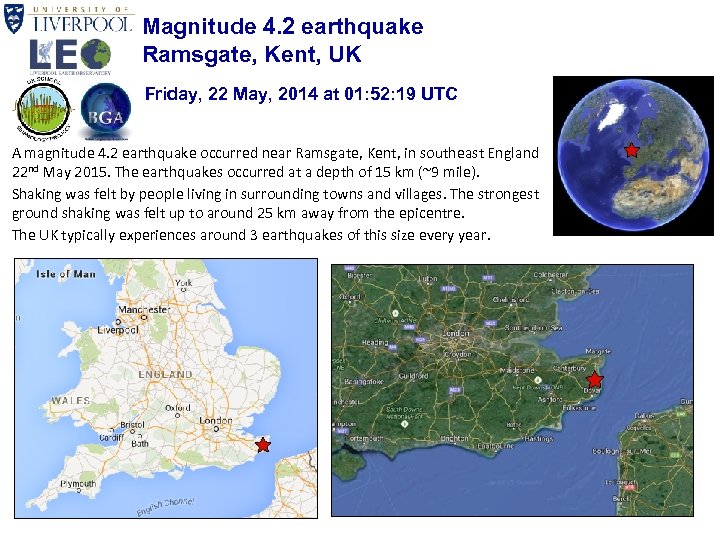 Magnitude 4. 2 earthquake Ramsgate, Kent, UK Friday, 22 May, 2014 at 01: 52: 19 UTC A magnitude 4. 2 earthquake occurred near Ramsgate, Kent, in southeast England 22 nd May 2015. The earthquakes occurred at a depth of 15 km (~9 mile). Shaking was felt by people living in surrounding towns and villages. The strongest ground shaking was felt up to around 25 km away from the epicentre. The UK typically experiences around 3 earthquakes of this size every year.
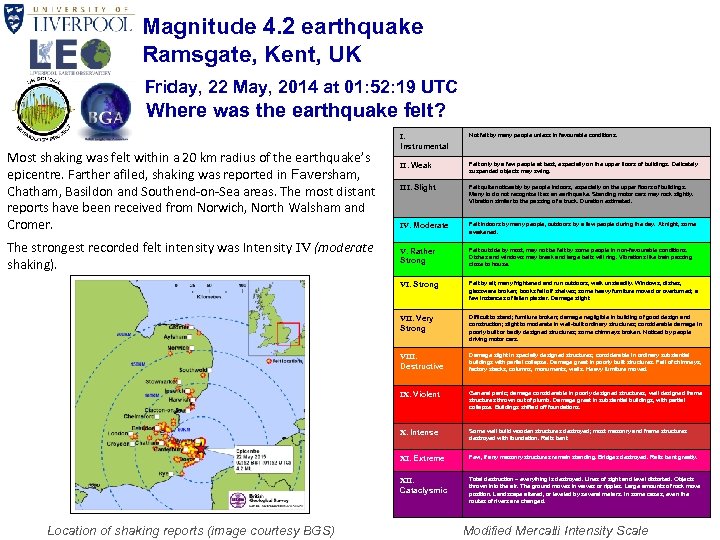 Magnitude 4. 2 earthquake Ramsgate, Kent, UK Friday, 22 May, 2014 at 01: 52: 19 UTC Where was the earthquake felt? Felt only by a few people at best, especially on the upper floors of buildings. Delicately suspended objects may swing. III. Slight Felt quite noticeably by people indoors, especially on the upper floors of buildings. Many to do not recognise it as an earthquake. Standing motor cars may rock slightly. Vibration similar to the passing of a truck. Duration estimated. IV. Moderate Felt indoors by many people, outdoors by a few people during the day. At night, some awakened. V. Rather Strong Felt outside by most, may not be felt by some people in non-favourable conditions. Dishes and windows may break and large bells will ring. Vibrations like train passing close to house. Felt by all; many frightened and run outdoors, walk unsteadily. Windows, dishes, glassware broken; books fall off shelves; some heavy furniture moved or overturned; a few instances of fallen plaster. Damage slight. Difficult to stand; furniture broken; damage negligible in building of good design and construction; slight to moderate in well-built ordinary structures; considerable damage in poorly built or badly designed structures; some chimneys broken. Noticed by people driving motor cars. VIII. Destructive Damage slight in specially designed structures; considerable in ordinary substantial buildings with partial collapse. Damage great in poorly built structures. Fall of chimneys, factory stacks, columns, monuments, walls. Heavy furniture moved. IX. Violent General panic; damage considerable in poorly designed structures, well designed frame structures thrown out of plumb. Damage great in substantial buildings, with partial collapse. Buildings shifted off foundations. X. Intense Some well build wooden structures destroyed; most masonry and frame structures destroyed with foundation. Rails bent. XI. Extreme Few, if any masonry structures remain standing. Bridges destroyed. Rails bent greatly. XII. Cataclysmic Location of shaking reports (image courtesy BGS) II. Weak VII. Very Strong The strongest recorded felt intensity was Intensity IV (moderate shaking). Not felt by many people unless in favourable conditions. VI. Strong Most shaking was felt within a 20 km radius of the earthquake’s epicentre. Farther afiled, shaking was reported in Faversham, Chatham, Basildon and Southend-on-Sea areas. The most distant reports have been received from Norwich, North Walsham and Cromer. I. Instrumental Total destruction – everything is destroyed. Lines of sight and level distorted. Objects thrown into the air. The ground moves in waves or ripples. Large amounts of rock move position. Landscape altered, or leveled by several meters. In some cases, even the routes of rivers are changed. Modified Mercalli Intensity Scale
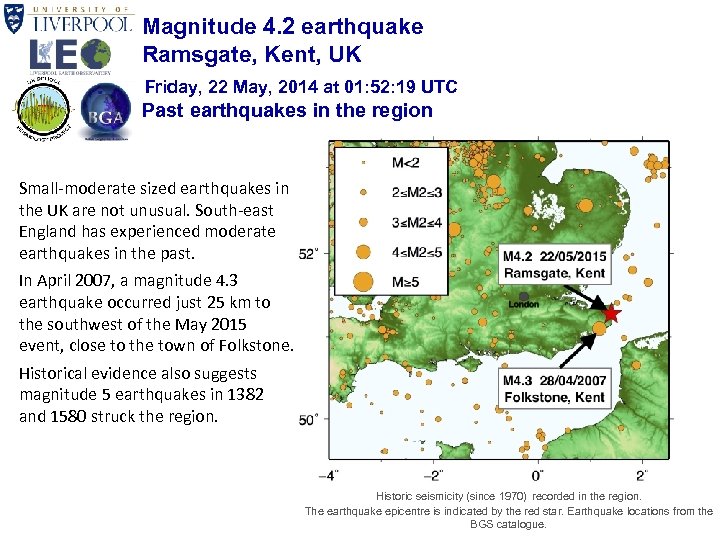 Magnitude 4. 2 earthquake Ramsgate, Kent, UK Friday, 22 May, 2014 at 01: 52: 19 UTC Past earthquakes in the region Small-moderate sized earthquakes in the UK are not unusual. South-east England has experienced moderate earthquakes in the past. In April 2007, a magnitude 4. 3 earthquake occurred just 25 km to the southwest of the May 2015 event, close to the town of Folkstone. Historical evidence also suggests magnitude 5 earthquakes in 1382 and 1580 struck the region. Historic seismicity (since 1970) recorded in the region. The earthquake epicentre is indicated by the red star. Earthquake locations from the BGS catalogue.
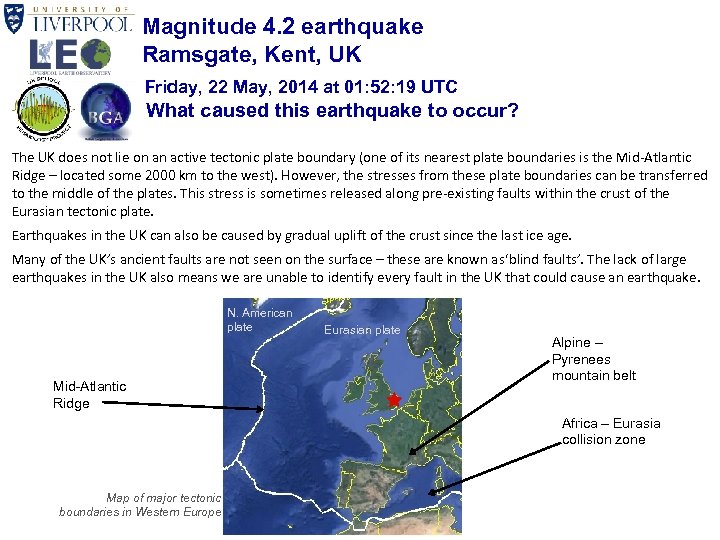 Magnitude 4. 2 earthquake Ramsgate, Kent, UK Friday, 22 May, 2014 at 01: 52: 19 UTC What caused this earthquake to occur? The UK does not lie on an active tectonic plate boundary (one of its nearest plate boundaries is the Mid-Atlantic Ridge – located some 2000 km to the west). However, the stresses from these plate boundaries can be transferred to the middle of the plates. This stress is sometimes released along pre-existing faults within the crust of the Eurasian tectonic plate. Earthquakes in the UK can also be caused by gradual uplift of the crust since the last ice age. Many of the UK’s ancient faults are not seen on the surface – these are known as‘blind faults’. The lack of large earthquakes in the UK also means we are unable to identify every fault in the UK that could cause an earthquake. N. American plate Mid-Atlantic Ridge Eurasian plate Alpine – Pyrenees mountain belt Africa – Eurasia collision zone Map of major tectonic boundaries in Western Europe
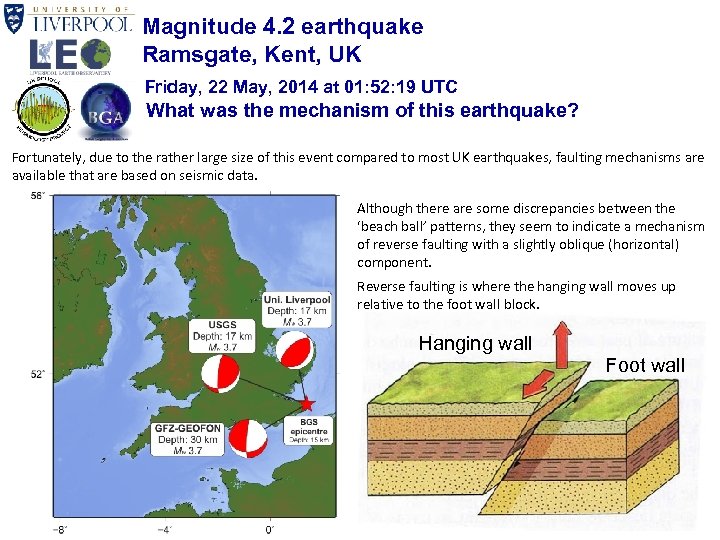 Magnitude 4. 2 earthquake Ramsgate, Kent, UK Friday, 22 May, 2014 at 01: 52: 19 UTC What was the mechanism of this earthquake? Fortunately, due to the rather large size of this event compared to most UK earthquakes, faulting mechanisms are available that are based on seismic data. Although there are some discrepancies between the ‘beach ball’ patterns, they seem to indicate a mechanism of reverse faulting with a slightly oblique (horizontal) component. Reverse faulting is where the hanging wall moves up relative to the foot wall block. Hanging wall Foot wall
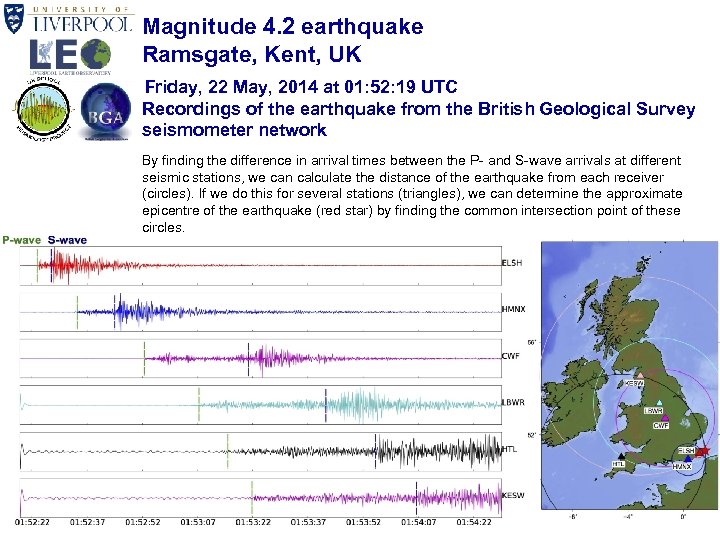 Magnitude 4. 2 earthquake Ramsgate, Kent, UK Friday, 22 May, 2014 at 01: 52: 19 UTC Recordings of the earthquake from the British Geological Survey seismometer network By finding the difference in arrival times between the P- and S-wave arrivals at different seismic stations, we can calculate the distance of the earthquake from each receiver (circles). If we do this for several stations (triangles), we can determine the approximate epicentre of the earthquake (red star) by finding the common intersection point of these circles.
 Magnitude 4. 2 earthquake Ramsgate, Kent, UK Friday, 22 May, 2014 at 01: 52: 19 UTC Find out more … • BGS webpage for this earthquake http: //www. earthquakes. bgs. ac. uk/earthquakes/recent_events/20150522015216. html#page=summary • BGS (British Geological Survey) – seismology and earthquakes – frequently asked questions http: //www. earthquakes. bgs. ac. uk/education/faqs/faq_index. html • BBC News article on this earthquake -england-32840579 • IRIS (Incorporated Research Institutions for Seismology) – learning about earthquakes http: //www. iris. edu/hq/programs/education_and_outreach/students • UK School Seismology Project – classroom activities, videos and support documents http: //www. bgs. ac. uk/schoolseismology/home. html • USGS (United States Geological Survey) – FAQs, glossary, posters, animations http: //earthquake. usgs. gov/learn/ • EMSC (European Mediterranean Seismological Centre) csem. org/ http: //www. bbc. co. uk/news/uk http: //www. emsc-