


 Скачать презентацию Magnets for Linacs WAMSDO 08 more exactly A
c0c1e11596bdd1249c4e894a17a4a961.ppt
- Количество слайдов: 33
 Magnets for Linacs WAMSDO’ 08 more exactly: A Survey of Interesting Superconducting Magnets for Linacs The Technical, R&D Challenges they pose Linear Colliders Low Energy Linacs Michael Tartaglia Fermilab WAMSDO 2008 Magnets for Linacs 1
 Introduction There are MANY LINACS around the world Too many to cover comprehensively in a short talk (also beyond my level of breadth and depth) [see refs: LINAC 96, …, 04, 06, (08)] Superconducting Magnets used only if needed In general, they are NOT, even in Sc. RF LINACS (e. g. , SNS) ‘Usual’ Magnet Parameters (strength, field quality) are not exceptionally challenging Focus on recent areas, where I have had some involvement The International Linear Collider Requires a broad spectrum of Sc Magnet Types across six diverse accelerator systems Ø Examples which may be found in other LINAC systems Challenges are representative of those faced elsewhere WAMSDO 2008 Magnets for Linacs 2
 Introduction Low Energy LINACs High Intensity sources leveraged by / pushing Sc. RF developments new / upgrades to facilities Sc Solenoid Focusing offers a compact alternative to use of conventional Quads in Front End WAMSDO 2008 Magnets for Linacs 3
 International Linear Collider Machine Overview Baseline Conceptual Design (Dec. 2005) q Reference Design (Feb. 2007) Report (RDR) and Cost Estimate for 250 Ge. V e- x 250 Ge. V e+ q International Team (Scientists/Engineers/Designers/Support Staff) Ø Leadership in each geographic region (Americas, Europe, Asia) Ø Area Systems (e+ / e- sources, DR, RTML, Main Linac, BDS) Ø Global Systems (Commissioning, Operations & Reliability, Controls, q Ø Cryogenics, Conventional Facilities & Siting, Installation) Technical Systems [R. I. P. ] (Vacuum, Magnets, Cryomodule, Cavity, RF Power, Instrumentation, Dumps/Collimators, Accelerator Physics) This is a challenging machine: A long train of small, intense, closely spaced bunches are created, quickly damped to very small cross sections, transported long distances during acceleration, then focused to nanometer size and brought into collisions at small crossing angle. WAMSDO 2008 Magnets for Linacs 4
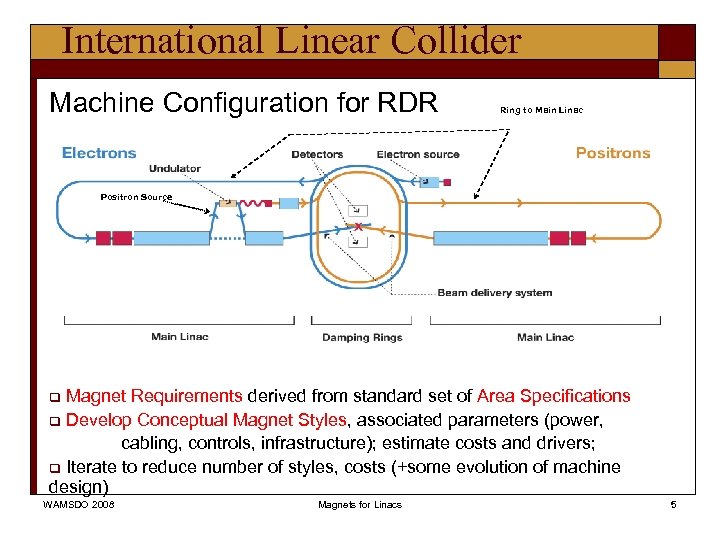 International Linear Collider Machine Configuration for RDR Ring to Main Linac Positron Source Magnet Requirements derived from standard set of Area Specifications q Develop Conceptual Magnet Styles, associated parameters (power, cabling, controls, infrastructure); estimate costs and drivers; q Iterate to reduce number of styles, costs (+some evolution of machine design) q WAMSDO 2008 Magnets for Linacs 5
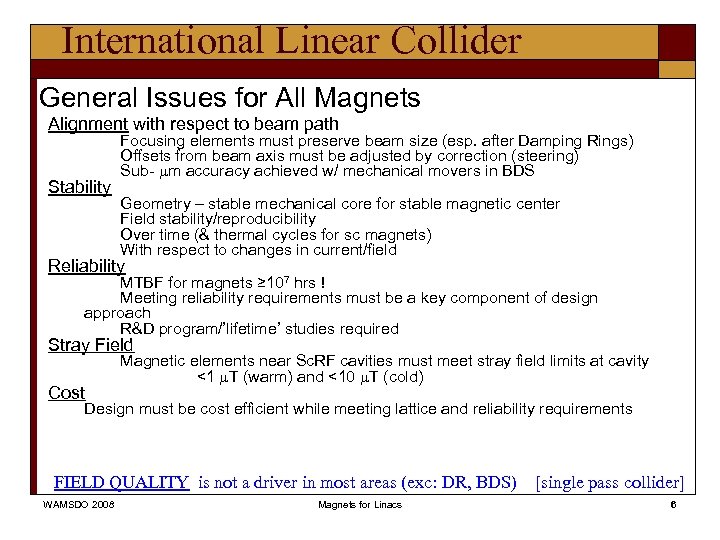 International Linear Collider General Issues for All Magnets Alignment with respect to beam path Stability Focusing elements must preserve beam size (esp. after Damping Rings) Offsets from beam axis must be adjusted by correction (steering) Sub- m accuracy achieved w/ mechanical movers in BDS Geometry – stable mechanical core for stable magnetic center Field stability/reproducibility Over time (& thermal cycles for sc magnets) With respect to changes in current/field Reliability MTBF for magnets ≥ 107 hrs ! Meeting reliability requirements must be a key component of design approach R&D program/’lifetime’ studies required Stray Field Cost Magnetic elements near Sc. RF cavities must meet stray field limits at cavity <1 T (warm) and <10 T (cold) Design must be cost efficient while meeting lattice and reliability requirements FIELD QUALITY is not a driver in most areas (exc: DR, BDS) WAMSDO 2008 Magnets for Linacs [single pass collider] 6
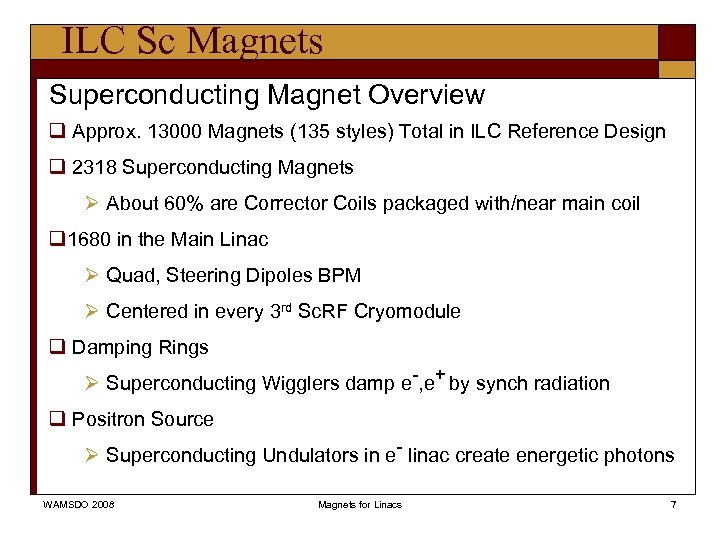 ILC Sc Magnets Superconducting Magnet Overview q Approx. 13000 Magnets (135 styles) Total in ILC Reference Design q 2318 Superconducting Magnets Ø About 60% are Corrector Coils packaged with/near main coil q 1680 in the Main Linac Ø Quad, Steering Dipoles BPM Ø Centered in every 3 rd Sc. RF Cryomodule q Damping Rings Ø Superconducting Wigglers damp e-, e+ by synch radiation q Positron Source Ø Superconducting Undulators in e- linac create energetic photons WAMSDO 2008 Magnets for Linacs 7
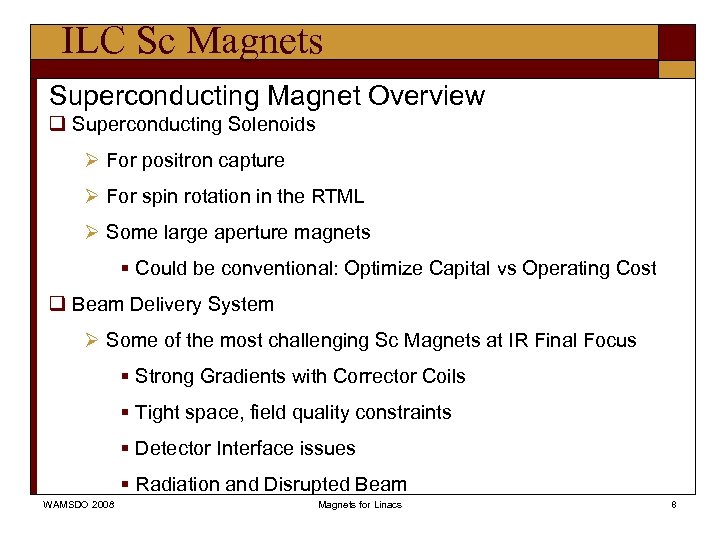 ILC Sc Magnets Superconducting Magnet Overview q Superconducting Solenoids Ø For positron capture Ø For spin rotation in the RTML Ø Some large aperture magnets § Could be conventional: Optimize Capital vs Operating Cost q Beam Delivery System Ø Some of the most challenging Sc Magnets at IR Final Focus § Strong Gradients with Corrector Coils § Tight space, field quality constraints § Detector Interface issues § Radiation and Disrupted Beam WAMSDO 2008 Magnets for Linacs 8
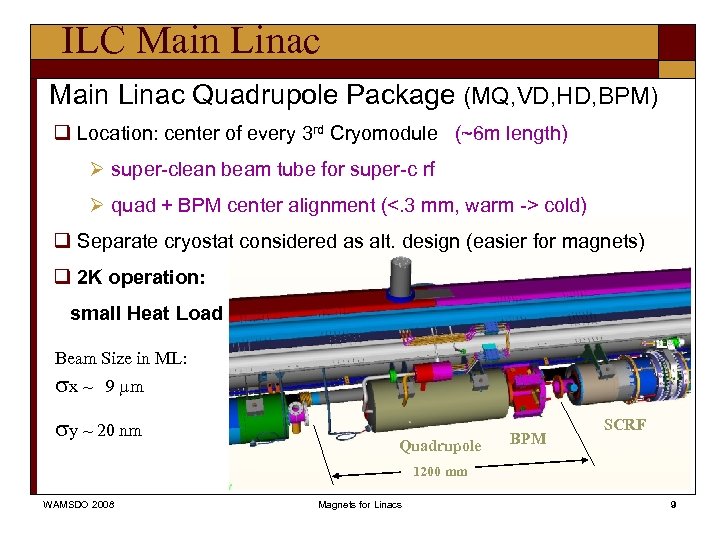 ILC Main Linac Quadrupole Package (MQ, VD, HD, BPM) q Location: center of every 3 rd Cryomodule (~6 m length) Ø super-clean beam tube for super-c rf Ø quad + BPM center alignment (<. 3 mm, warm -> cold) q Separate cryostat considered as alt. design (easier for magnets) q 2 K operation: small Heat Load Beam Size in ML: sx ~ 9 m sy ~ 20 nm Quadrupole BPM SCRF 1200 mm WAMSDO 2008 Magnets for Linacs 9
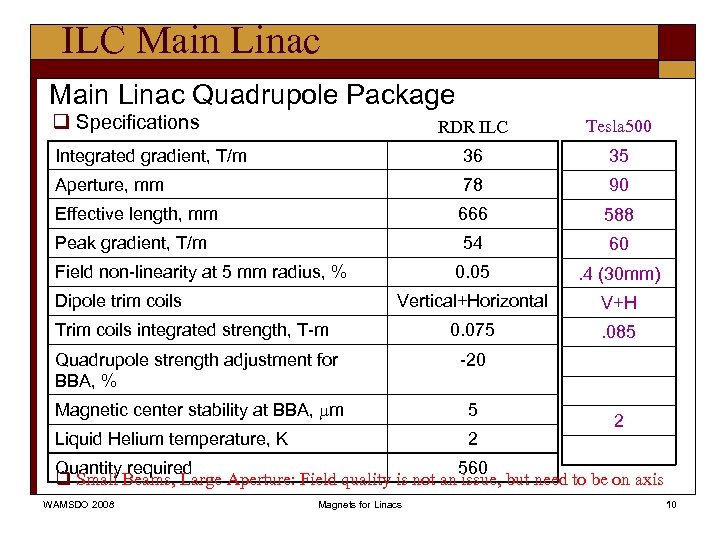 ILC Main Linac Quadrupole Package q Specifications RDR ILC Tesla 500 Integrated gradient, T/m 36 35 Aperture, mm 78 90 Effective length, mm 666 588 Peak gradient, T/m 54 60 0. 05 . 4 (30 mm) Vertical+Horizontal V+H Trim coils integrated strength, T-m 0. 075 . 085 Quadrupole strength adjustment for BBA, % -20 Magnetic center stability at BBA, m 5 Liquid Helium temperature, K 2 Field non-linearity at 5 mm radius, % Dipole trim coils 2 Quantity required 560 q Small Beams, Large Aperture: Field quality is not an issue, but need to be on axis WAMSDO 2008 Magnets for Linacs 10
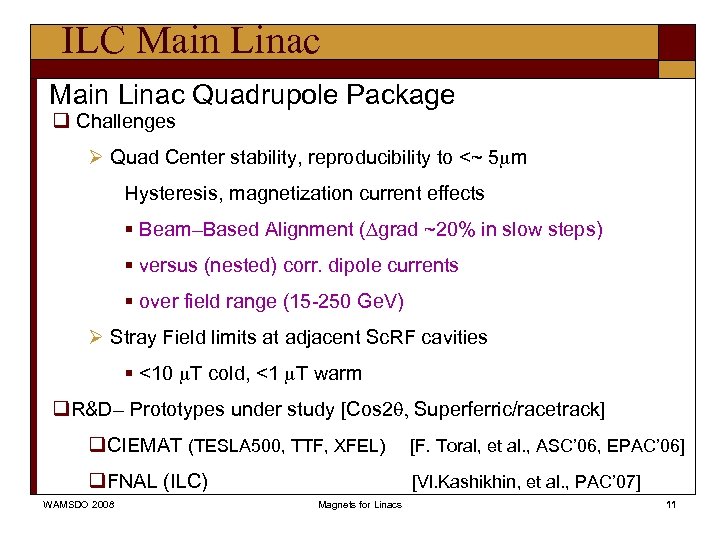 ILC Main Linac Quadrupole Package q Challenges Ø Quad Center stability, reproducibility to <~ 5 m Hysteresis, magnetization current effects § Beam–Based Alignment (Dgrad ~20% in slow steps) § versus (nested) corr. dipole currents § over field range (15 -250 Ge. V) Ø Stray Field limits at adjacent Sc. RF cavities § <10 T cold, <1 T warm q. R&D– Prototypes under study [Cos 2 q, Superferric/racetrack] q. CIEMAT (TESLA 500, TTF, XFEL) [F. Toral, et al. , ASC’ 06, EPAC’ 06] q. FNAL (ILC) [Vl. Kashikhin, et al. , PAC’ 07] WAMSDO 2008 Magnets for Linacs 11
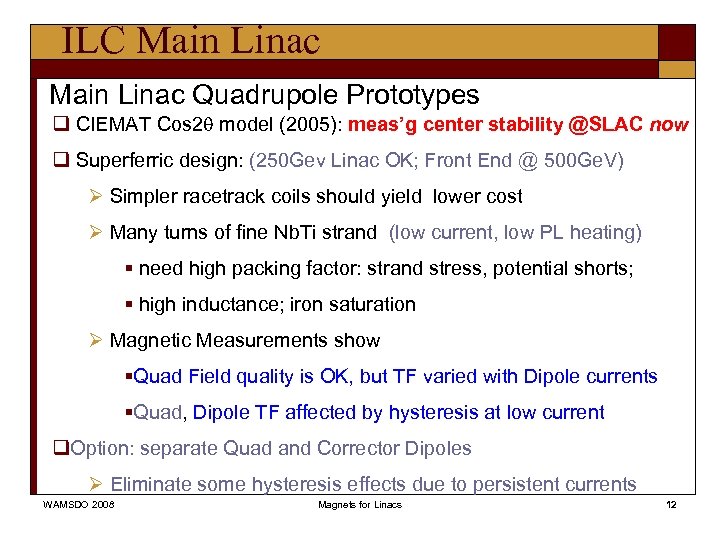 ILC Main Linac Quadrupole Prototypes q CIEMAT Cos 2 q model (2005): meas’g center stability @SLAC now q Superferric design: (250 Gev Linac OK; Front End @ 500 Ge. V) Ø Simpler racetrack coils should yield lower cost Ø Many turns of fine Nb. Ti strand (low current, low PL heating) § need high packing factor: strand stress, potential shorts; § high inductance; iron saturation Ø Magnetic Measurements show §Quad Field quality is OK, but TF varied with Dipole currents §Quad, Dipole TF affected by hysteresis at low current q. Option: separate Quad and Corrector Dipoles Ø Eliminate some hysteresis effects due to persistent currents WAMSDO 2008 Magnets for Linacs 12
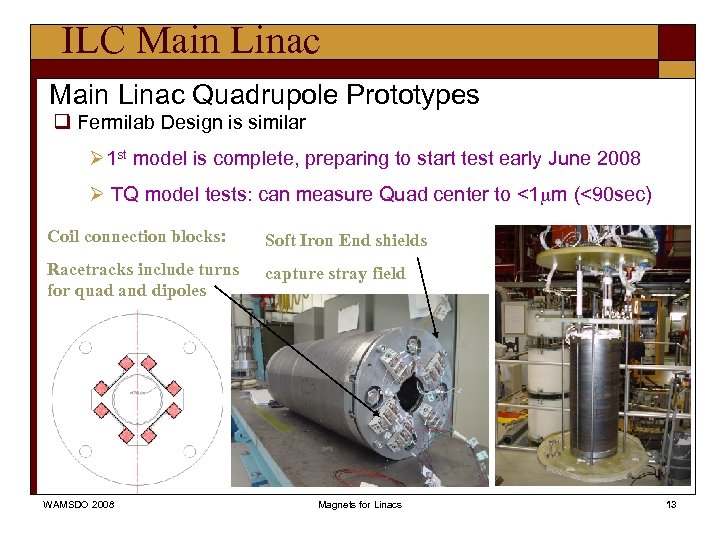 ILC Main Linac Quadrupole Prototypes q Fermilab Design is similar Ø 1 st model is complete, preparing to start test early June 2008 Ø TQ model tests: can measure Quad center to <1 m (<90 sec) Coil connection blocks: Soft Iron End shields Racetracks include turns for quad and dipoles capture stray field WAMSDO 2008 Magnets for Linacs 13
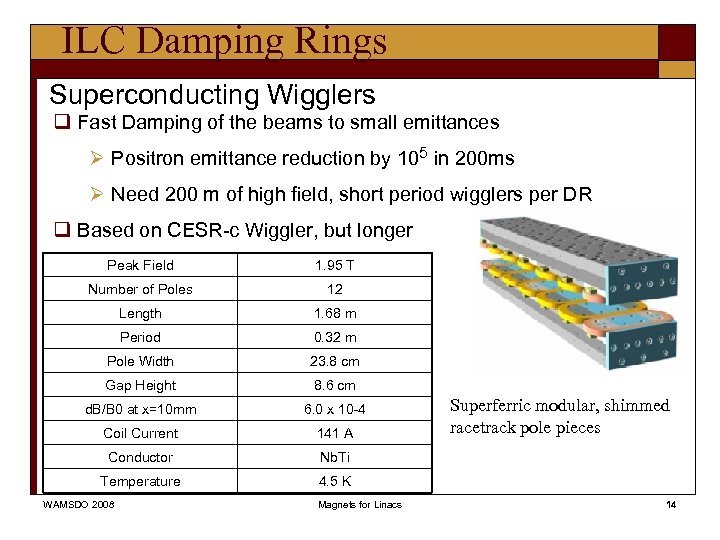 ILC Damping Rings Superconducting Wigglers q Fast Damping of the beams to small emittances Ø Positron emittance reduction by 105 in 200 ms Ø Need 200 m of high field, short period wigglers per DR q Based on CESR-c Wiggler, but longer Peak Field 1. 95 T Number of Poles 12 Length 1. 68 m Period 0. 32 m Pole Width 23. 8 cm Gap Height 8. 6 cm d. B/B 0 at x=10 mm 6. 0 x 10 -4 Coil Current 141 A Conductor Nb. Ti Temperature 4. 5 K WAMSDO 2008 Magnets for Linacs Superferric modular, shimmed racetrack pole pieces 14
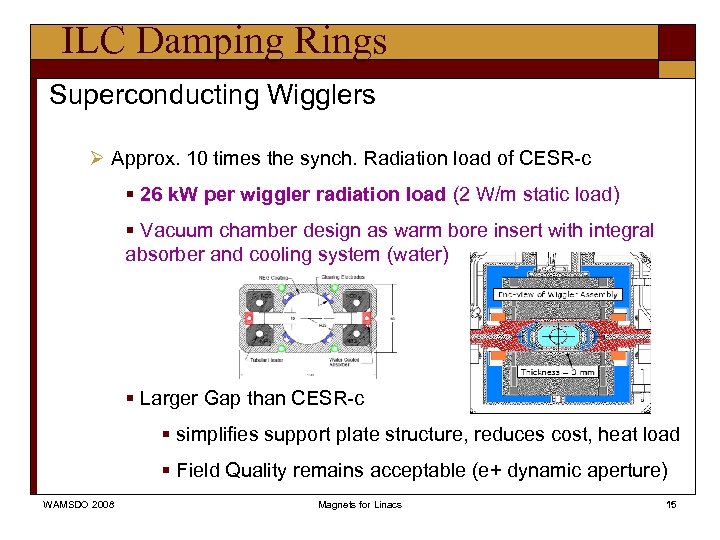 ILC Damping Rings Superconducting Wigglers Ø Approx. 10 times the synch. Radiation load of CESR-c § 26 k. W per wiggler radiation load (2 W/m static load) § Vacuum chamber design as warm bore insert with integral absorber and cooling system (water) § Larger Gap than CESR-c § simplifies support plate structure, reduces cost, heat load § Field Quality remains acceptable (e+ dynamic aperture) WAMSDO 2008 Magnets for Linacs 15
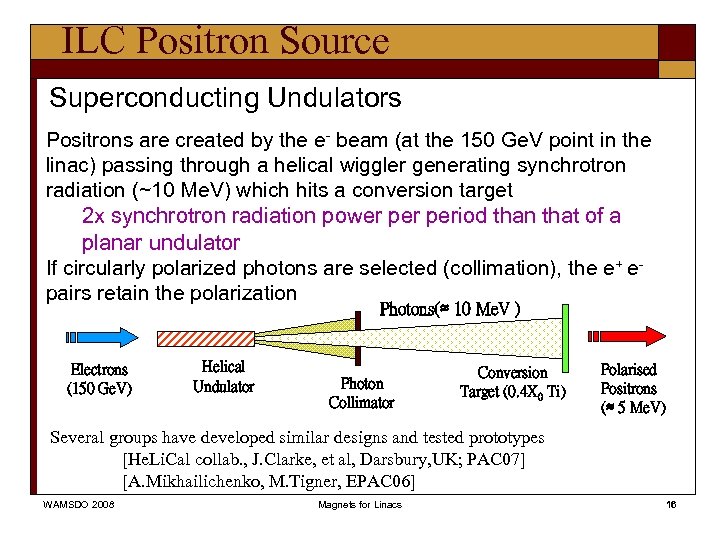 ILC Positron Source Superconducting Undulators Positrons are created by the e- beam (at the 150 Ge. V point in the linac) passing through a helical wiggler generating synchrotron radiation (~10 Me. V) which hits a conversion target 2 x synchrotron radiation power period than that of a planar undulator If circularly polarized photons are selected (collimation), the e+ epairs retain the polarization Photons(≈ 10 Me. V ) Electrons (150 Ge. V) Helical Undulator Photon Collimator Conversion Target (0. 4 X 0 Ti) Polarised Positrons (≈ 5 Me. V) Several groups have developed similar designs and tested prototypes [He. Li. Cal collab. , J. Clarke, et al, Darsbury, UK; PAC 07] [A. Mikhailichenko, M. Tigner, EPAC 06] WAMSDO 2008 Magnets for Linacs 16
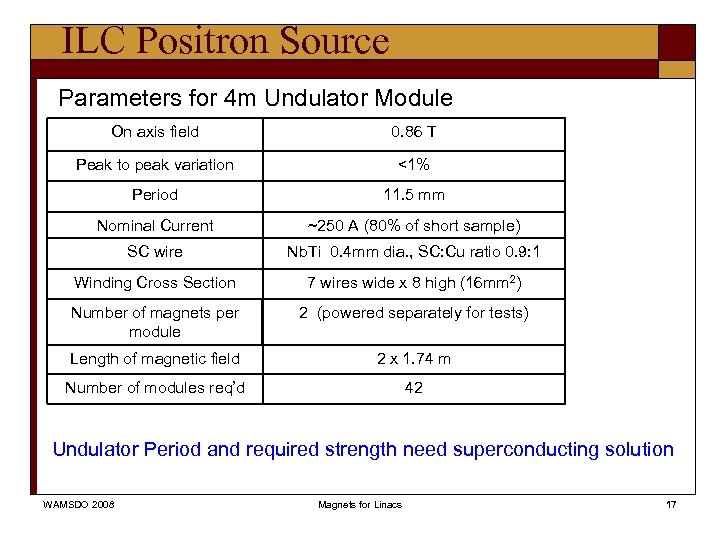 ILC Positron Source Parameters for 4 m Undulator Module On axis field 0. 86 T Peak to peak variation <1% Period 11. 5 mm Nominal Current ~250 A (80% of short sample) SC wire Nb. Ti 0. 4 mm dia. , SC: Cu ratio 0. 9: 1 Winding Cross Section 7 wires wide x 8 high (16 mm 2) Number of magnets per module 2 (powered separately for tests) Length of magnetic field 2 x 1. 74 m Number of modules req’d 42 Undulator Period and required strength need superconducting solution WAMSDO 2008 Magnets for Linacs 17
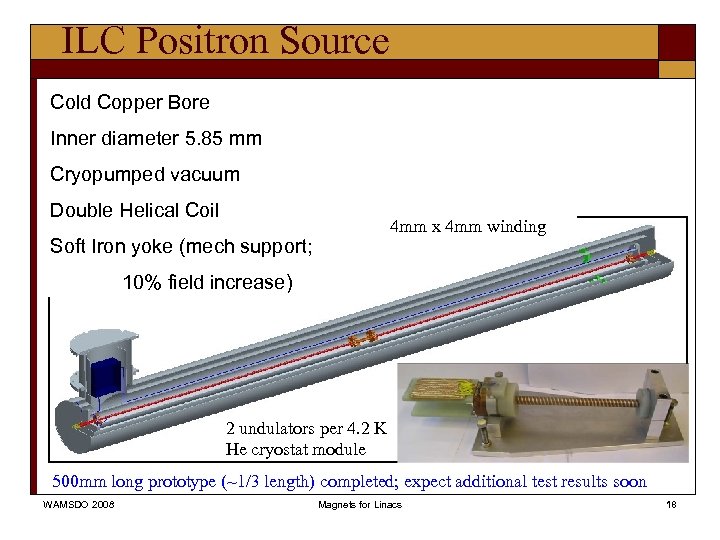 ILC Positron Source Cold Copper Bore Inner diameter 5. 85 mm Cryopumped vacuum Double Helical Coil 4 mm x 4 mm winding Soft Iron yoke (mech support; 10% field increase) 2 undulators per 4. 2 K He cryostat module 500 mm long prototype (~1/3 length) completed; expect additional test results soon WAMSDO 2008 Magnets for Linacs 18
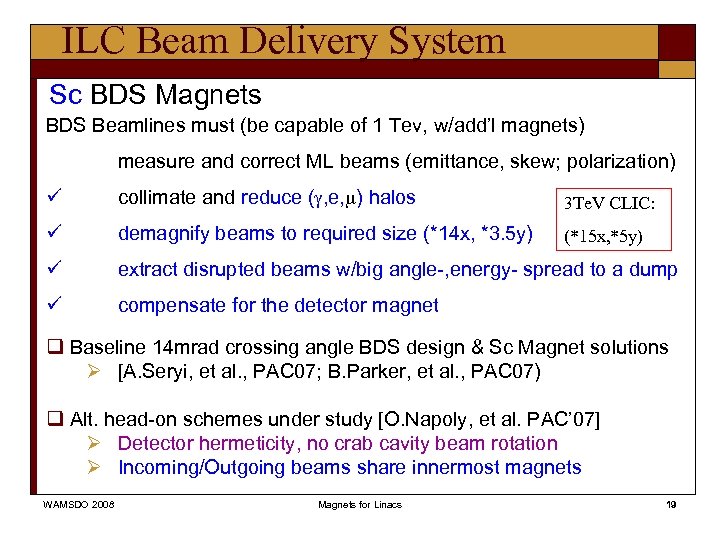 ILC Beam Delivery System Sc BDS Magnets BDS Beamlines must (be capable of 1 Tev, w/add’l magnets) measure and correct ML beams (emittance, skew; polarization) ü collimate and reduce (g, e, ) halos 3 Te. V CLIC: ü demagnify beams to required size (*14 x, *3. 5 y) (*15 x, *5 y) ü extract disrupted beams w/big angle-, energy- spread to a dump ü compensate for the detector magnet q Baseline 14 mrad crossing angle BDS design & Sc Magnet solutions Ø [A. Seryi, et al. , PAC 07; B. Parker, et al. , PAC 07) q Alt. head-on schemes under study [O. Napoly, et al. PAC’ 07] Ø Detector hermeticity, no crab cavity beam rotation Ø Incoming/Outgoing beams share innermost magnets WAMSDO 2008 Magnets for Linacs 19
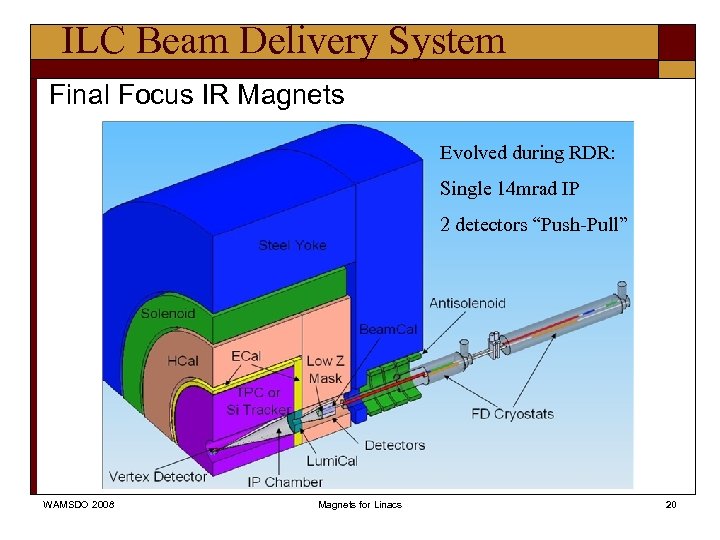 ILC Beam Delivery System Final Focus IR Magnets Evolved during RDR: Single 14 mrad IP 2 detectors “Push-Pull” WAMSDO 2008 Magnets for Linacs 20
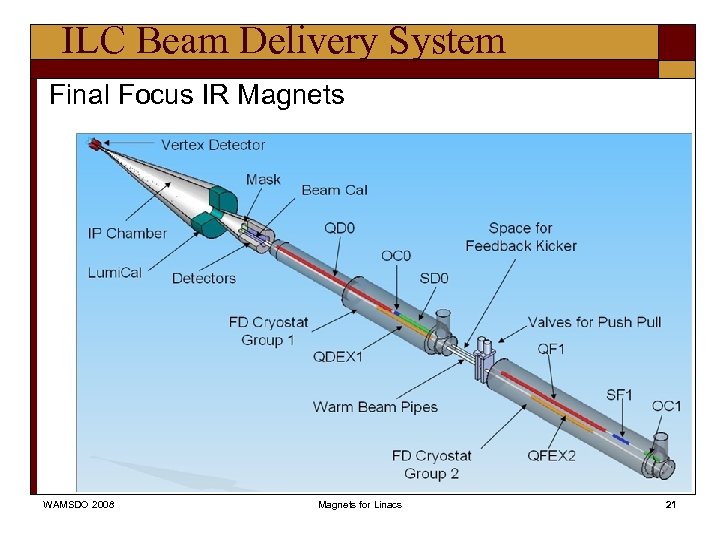 ILC Beam Delivery System Final Focus IR Magnets WAMSDO 2008 Magnets for Linacs 21
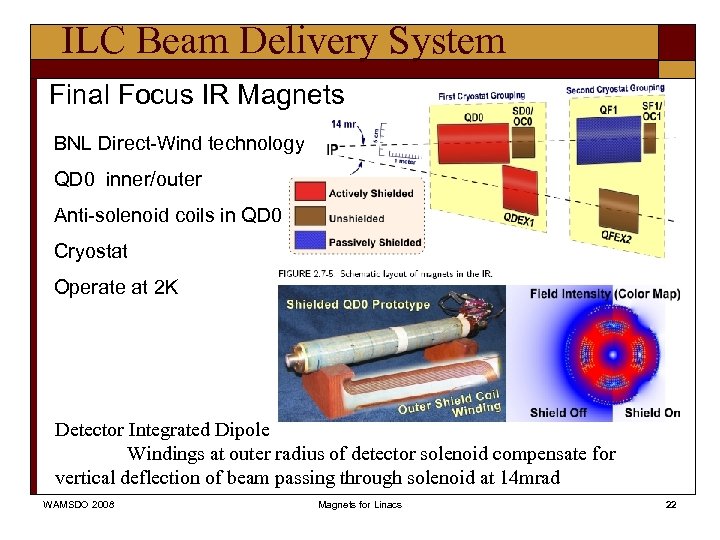 ILC Beam Delivery System Final Focus IR Magnets BNL Direct-Wind technology QD 0 inner/outer Anti-solenoid coils in QD 0 Cryostat Operate at 2 K Detector Integrated Dipole Windings at outer radius of detector solenoid compensate for vertical deflection of beam passing through solenoid at 14 mrad WAMSDO 2008 Magnets for Linacs 22
 ILC Beam Delivery System Final Focus IR Magnets q Strong Focusing Doublet (BDS design for up to 1 Te. V) Ø Intrudes into detector; “push-pull” complication CLIC: (43, 1)nm 450 T/m § IP size (x=640, y=6) nm needs extraordinary stability Ø Cancellation of stray field nearby (can’t affect disrupted beam) Ø detector solenoid cancellation coils (force neutral) Ø steering and sextupole (local chromatic) correctors needed q “Tail-Folding” Doublets of Superferric octupoles upstream of FF nonlin. Optics to clear halo but not affect core beam Ø design for high gradient, but avoid pole saturation Ø implementation with a clever winding scheme, low cost Ø use cryocooler WAMSDO 2008 Magnets for Linacs 23
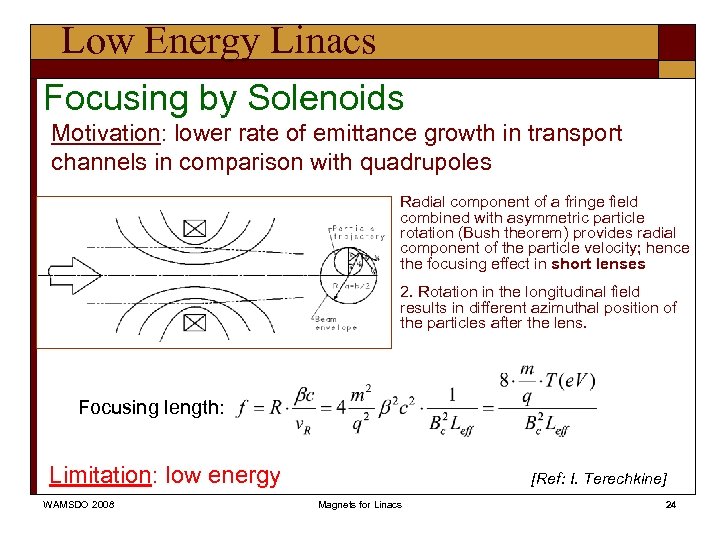 Low Energy Linacs Focusing by Solenoids Motivation: lower rate of emittance growth in transport channels in comparison with quadrupoles Radial component of a fringe field combined with asymmetric particle rotation (Bush theorem) provides radial component of the particle velocity; hence the focusing effect in short lenses 2. Rotation in the longitudinal field results in different azimuthal position of the particles after the lens. Focusing length: Limitation: low energy WAMSDO 2008 [Ref: I. Terechkine] Magnets for Linacs 24
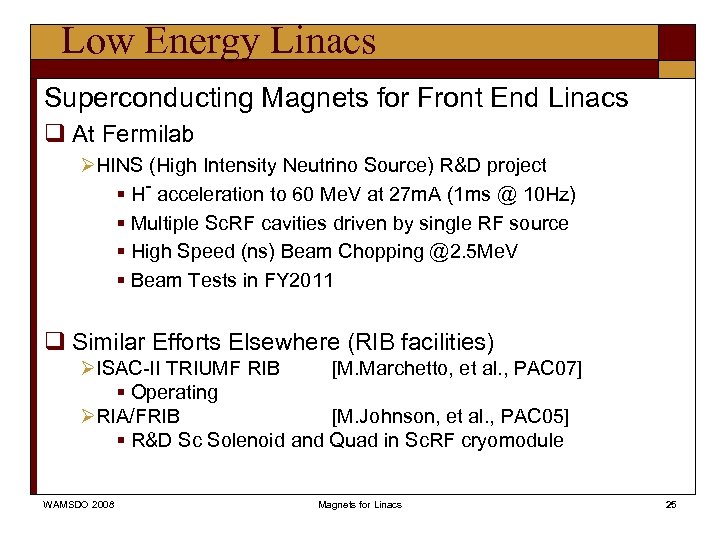 Low Energy Linacs Superconducting Magnets for Front End Linacs q At Fermilab ØHINS (High Intensity Neutrino Source) R&D project § H- acceleration to 60 Me. V at 27 m. A (1 ms @ 10 Hz) § Multiple Sc. RF cavities driven by single RF source § High Speed (ns) Beam Chopping @2. 5 Me. V § Beam Tests in FY 2011 q Similar Efforts Elsewhere (RIB facilities) ØISAC-II TRIUMF RIB [M. Marchetto, et al. , PAC 07] § Operating ØRIA/FRIB [M. Johnson, et al. , PAC 05] § R&D Sc Solenoid and Quad in Sc. RF cryomodule WAMSDO 2008 Magnets for Linacs 25
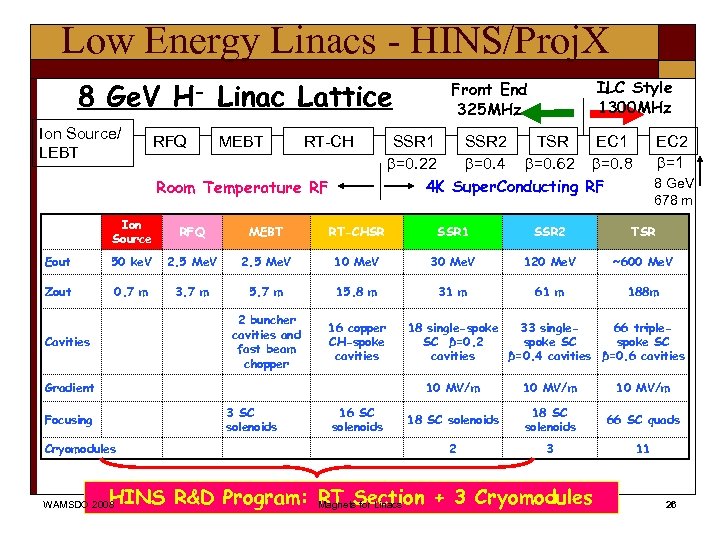 Low Energy Linacs - HINS/Proj. X 8 Ge. V H- Linac Lattice Ion Source/ LEBT RFQ MEBT RT-CH Room Temperature RF ILC Style 1300 MHz Front End 325 MHz SSR 1 SSR 2 TSR EC 1 b=0. 22 b=0. 4 b=0. 62 b=0. 8 4 K Super. Conducting RF EC 2 b=1 8 Ge. V 678 m Ion Source RFQ MEBT RT-CHSR SSR 1 SSR 2 TSR Eout 50 ke. V 2. 5 Me. V 10 Me. V 30 Me. V 120 Me. V ~600 Me. V Zout 0. 7 m 3. 7 m 5. 7 m 15. 8 m 31 m 61 m 188 m 2 buncher cavities and fast beam chopper 16 copper CH-spoke cavities Cavities Gradient 18 single-spoke 33 single 66 triple. SC β=0. 2 spoke SC cavities β=0. 4 cavities β=0. 6 cavities 10 MV/m 3 SC solenoids Focusing Cryomodules 16 SC solenoids 10 MV/m 18 SC solenoids 66 SC quads 2 3 11 HINS R&D Program: RT Section + 3 Cryomodules Magnets for Linacs WAMSDO 2008 26
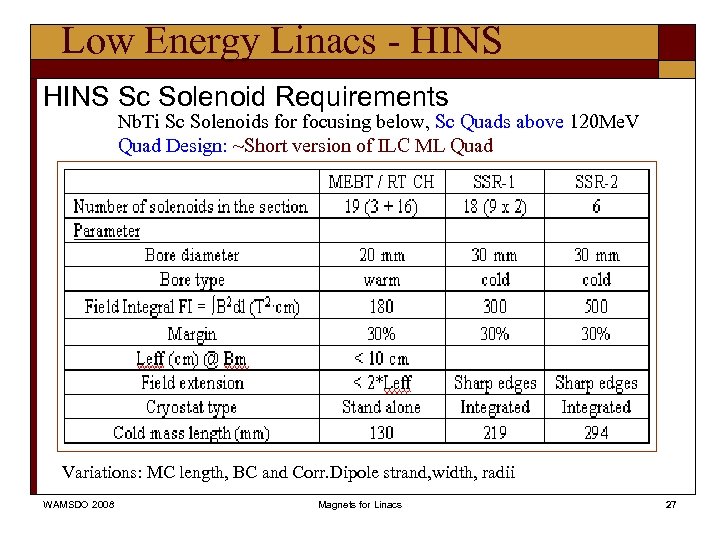 Low Energy Linacs - HINS Sc Solenoid Requirements Nb. Ti Sc Solenoids for focusing below, Sc Quads above 120 Me. V Quad Design: ~Short version of ILC ML Quad Variations: MC length, BC and Corr. Dipole strand, width, radii WAMSDO 2008 Magnets for Linacs 27
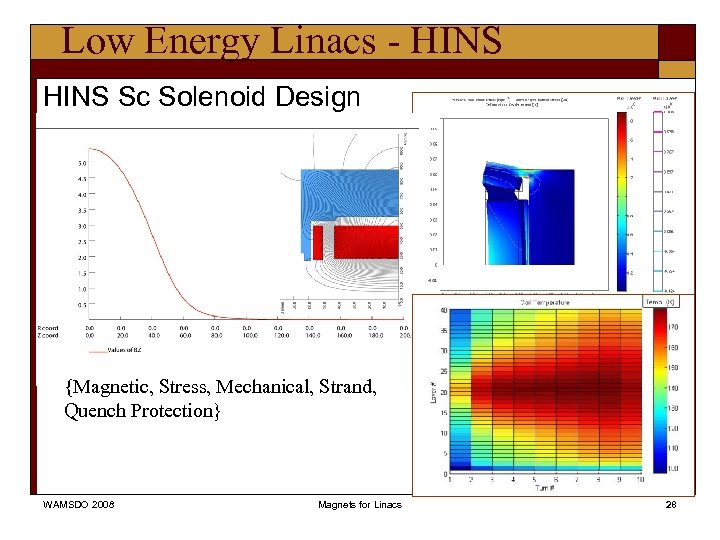 Low Energy Linacs - HINS Sc Solenoid Design {Magnetic, Stress, Mechanical, Strand, Quench Protection} WAMSDO 2008 Magnets for Linacs 28
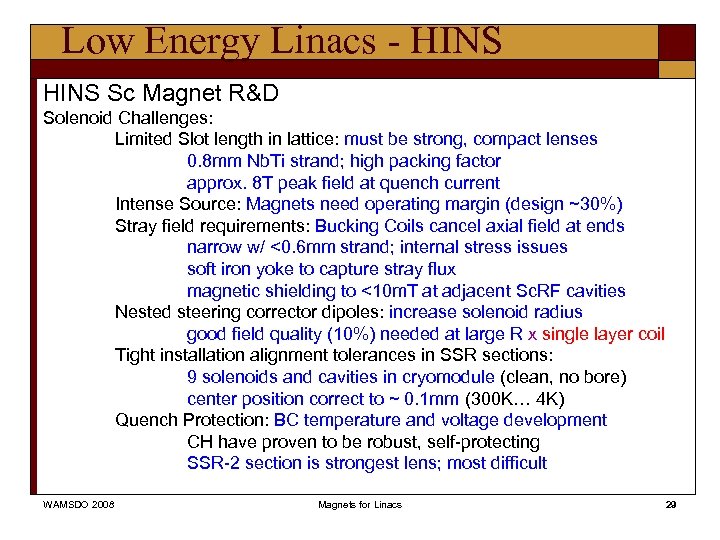 Low Energy Linacs - HINS Sc Magnet R&D Solenoid Challenges: Limited Slot length in lattice: must be strong, compact lenses 0. 8 mm Nb. Ti strand; high packing factor approx. 8 T peak field at quench current Intense Source: Magnets need operating margin (design ~30%) Stray field requirements: Bucking Coils cancel axial field at ends narrow w/ <0. 6 mm strand; internal stress issues soft iron yoke to capture stray flux magnetic shielding to <10 m. T at adjacent Sc. RF cavities Nested steering corrector dipoles: increase solenoid radius good field quality (10%) needed at large R x single layer coil Tight installation alignment tolerances in SSR sections: 9 solenoids and cavities in cryomodule (clean, no bore) center position correct to ~ 0. 1 mm (300 K… 4 K) Quench Protection: BC temperature and voltage development CH have proven to be robust, self-protecting SSR-2 section is strongest lens; most difficult WAMSDO 2008 Magnets for Linacs 29
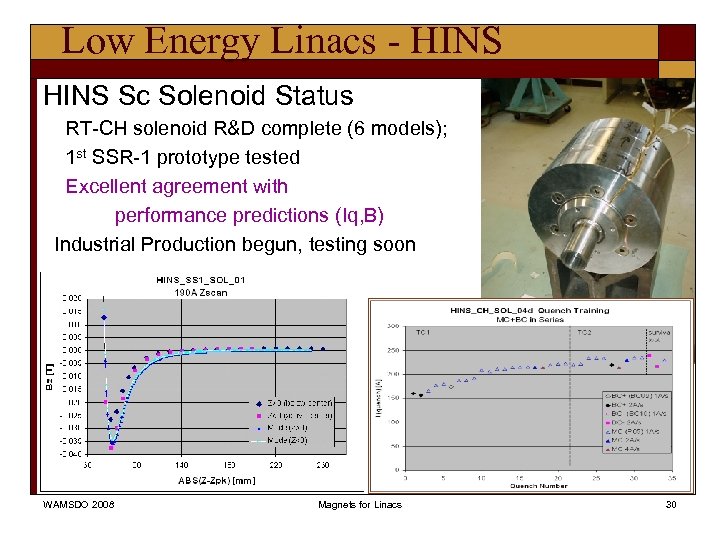 Low Energy Linacs - HINS Sc Solenoid Status RT-CH solenoid R&D complete (6 models); 1 st SSR-1 prototype tested Excellent agreement with performance predictions (Iq, B) Industrial Production begun, testing soon WAMSDO 2008 Magnets for Linacs 30
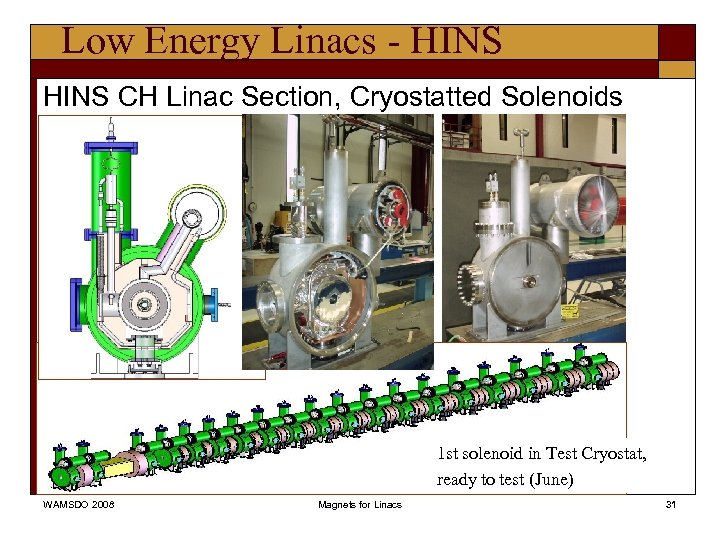 Low Energy Linacs - HINS CH Linac Section, Cryostatted Solenoids 1 st solenoid in Test Cryostat, ready to test (June) WAMSDO 2008 Magnets for Linacs 31
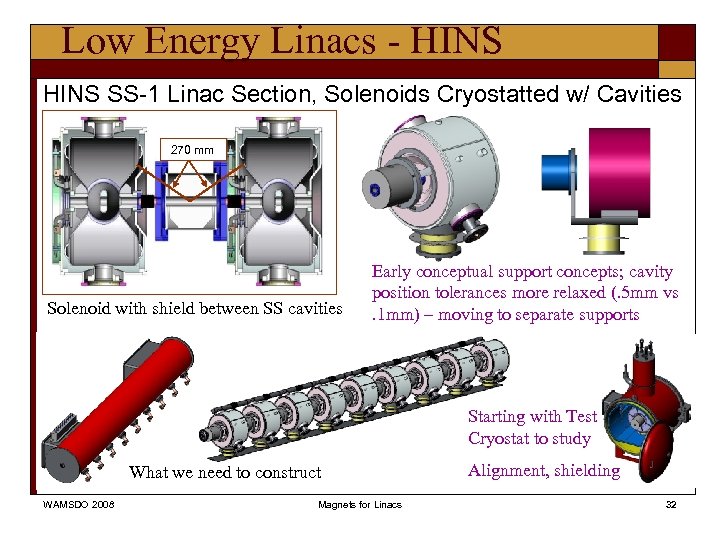 Low Energy Linacs - HINS SS-1 Linac Section, Solenoids Cryostatted w/ Cavities 270 mm Solenoid with shield between SS cavities Early conceptual support concepts; cavity position tolerances more relaxed (. 5 mm vs. 1 mm) – moving to separate supports Starting with Test Cryostat to study What we need to construct WAMSDO 2008 Magnets for Linacs Alignment, shielding 32
 Magnets for LINACS Summary Sc Magnets are necessary for satisfying the requirements in many areas of the High Energy, High Intensity International Linear Collider. They also provide flexibility in solving some interesting challenges that arise in response to particular machine demands. Technical challenges span the gamut of areas in magnet design: Strength, Field Quality, Operating Margin, Alignment, Mechanical and Magnetic Axis Stability, Stray Field Limits, Reliability, Cost, Machine. Detector Interfaces. Innovative solutions have been devised (and continue to evolve) and prototype model development/testing is advanced. Much work remains to complete integrated system designs WAMSDO 2008 Magnets for Linacs 33