 Скачать презентацию Magnetic Properties of the Carbonyl Cluster Ni 16
3a10b28ffc1ebc5170f9d27f783648b7.ppt
- Количество слайдов: 11



![Magnetic Properties of the Carbonyl Cluster [Ni 16 Pd 16(CO)40]4 M. Riccò, T. Shiroka,](https://present5.com/presentation/3a10b28ffc1ebc5170f9d27f783648b7/image-1.jpg "Magnetic Properties of the Carbonyl Cluster [Ni 16 Pd 16(CO)40]4 M. Riccò, T. Shiroka,")
Magnetic Properties of the Carbonyl Cluster [Ni 16 Pd 16(CO)40]4 M. Riccò, T. Shiroka, S. Carretta Dipartimento di Fisica. Università di Parma INFM, PARMA , e C. Femoni M. C. Iapalucci G. Longoni , , Dipartimento di Chimica Fisica ed Inorganica, Università di Bologna, BOLOGNA F. Bolzoni IMEM-CNR, PARMA
Introduction § Only carbonyl clusters with an odd number of valence electrons display a significant magnetic behaviour arising from the presence of a single unpaired electron. § The bimetallic compound [NBu 4]4[Ni 16 Pd 16(CO)40] represents an example of a metal-carbonyl cluster which, in spite of an even number of unpaired electrons, shows clear magnetic properties. § In this work we present the results of investigation of magnetism in this cluster using SQUID magnetometry and muon spin spectroscopy (µSR).
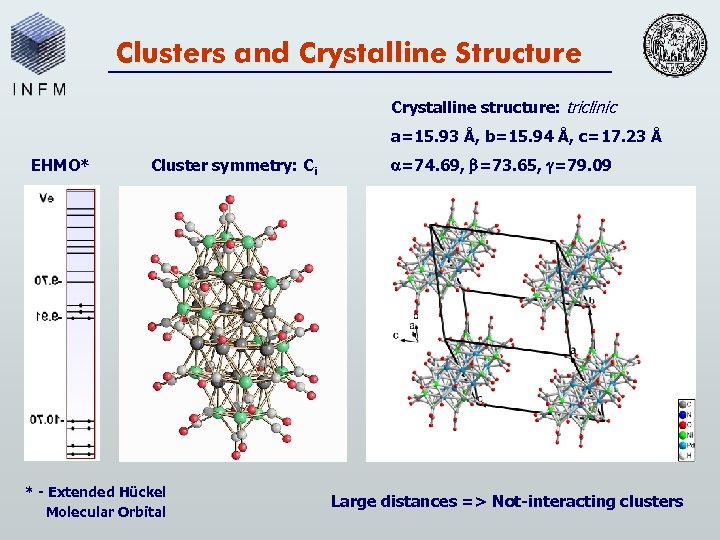
Clusters and Crystalline Structure Crystalline structure: triclinic a=15. 93 Å, b=15. 94 Å, c=17. 23 Å EHMO* Cluster symmetry: Ci * - Extended Hückel Molecular Orbital =74. 69, =73. 65, =79. 09 Large distances => Not-interacting clusters
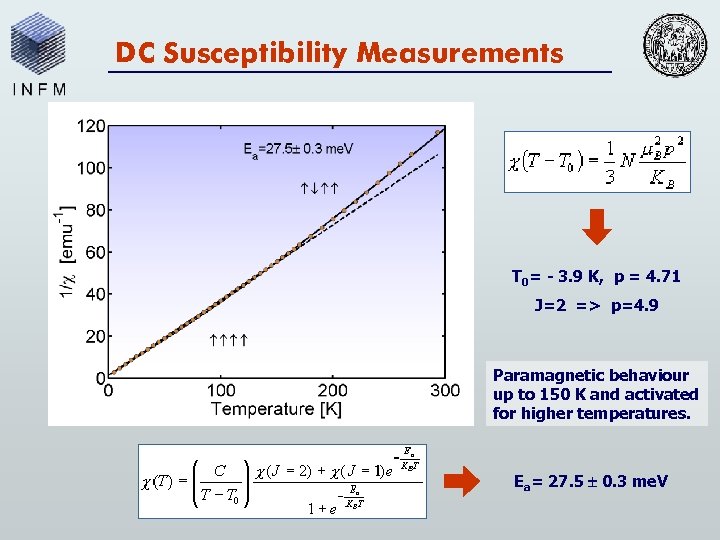
DC Susceptibility Measurements T 0= - 3. 9 K, p = 4. 71 J=2 => p=4. 9 Paramagnetic behaviour up to 150 K and activated for higher temperatures. Ea= 27. 5 0. 3 me. V
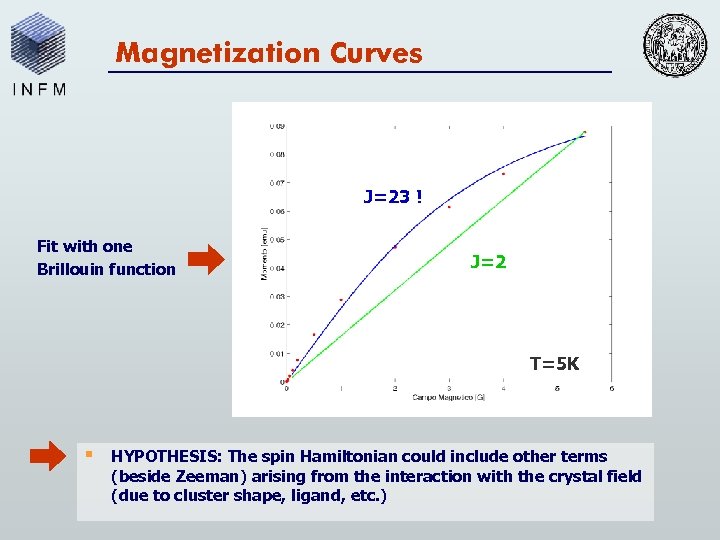
Magnetization Curves J=23 ! Fit with one Brillouin function J=2 T=5 K § HYPOTHESIS: The spin Hamiltonian could include other terms (beside Zeeman) arising from the interaction with the crystal field (due to cluster shape, ligand, etc. )
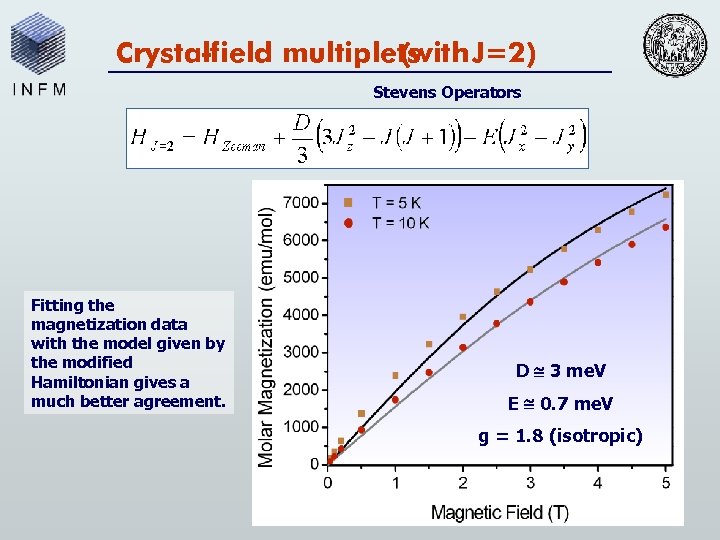
Crystalfield multiplets (with J=2) Stevens Operators Fitting the magnetization data with the model given by the modified Hamiltonian gives a much better agreement. D 3 me. V E 0. 7 me. V g = 1. 8 (isotropic)
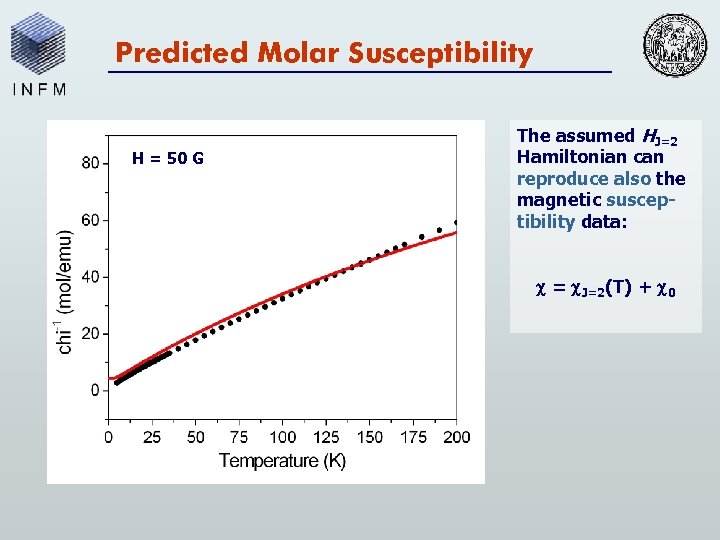
Predicted Molar Susceptibility H = 50 G The assumed HJ=2 Hamiltonian can reproduce also the magnetic susceptibility data: = J=2(T) + 0
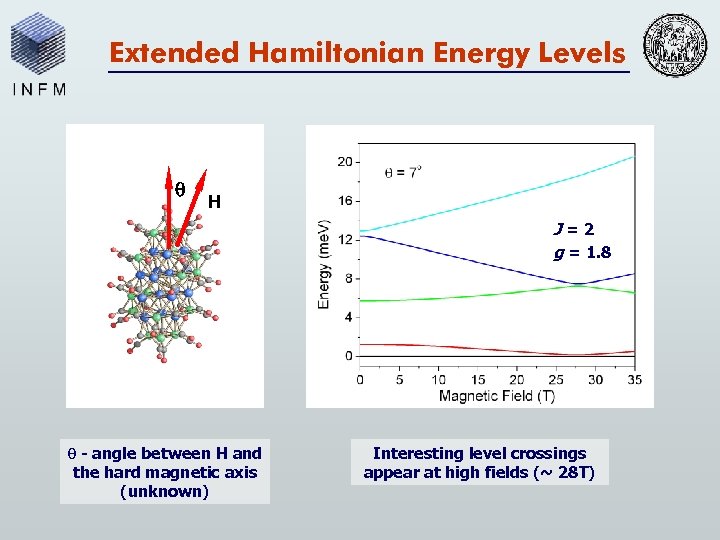
Extended Hamiltonian Energy Levels H J=2 g = 1. 8 q - angle between H and the hard magnetic axis (unknown) Interesting level crossings appear at high fields (~ 28 T)
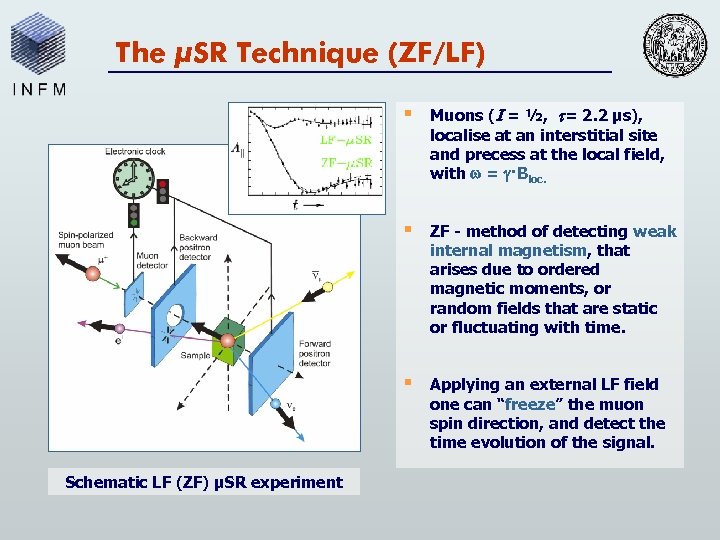
The µSR Technique (ZF/LF) § § ZF - method of detecting weak internal magnetism, that arises due to ordered magnetic moments, or random fields that are static or fluctuating with time. § Schematic LF (ZF) µSR experiment Muons (I = ½, = 2. 2 µs), localise at an interstitial site and precess at the local field, with = ·Bloc. Applying an external LF field one can “freeze” the muon spin direction, and detect the time evolution of the signal.
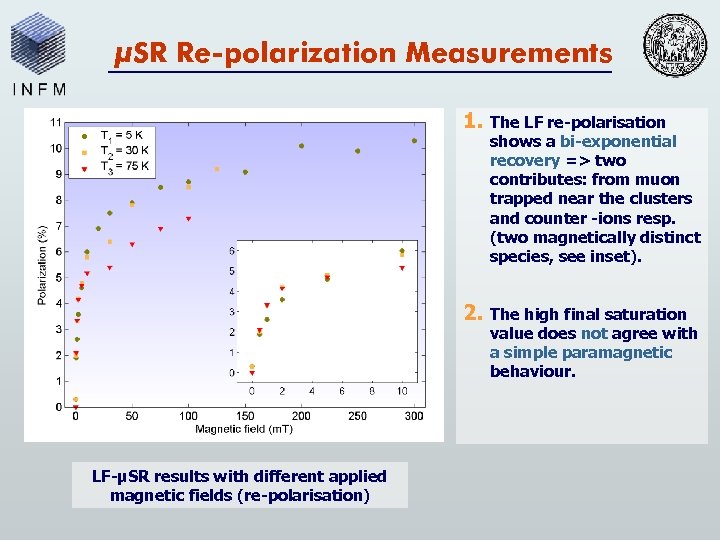
µSR Re-polarization Measurements 1. 2. LF-µSR results with different applied magnetic fields (re-polarisation) The LF re-polarisation shows a bi-exponential recovery => two contributes: from muon trapped near the clusters and counter -ions resp. (two magnetically distinct species, see inset). The high final saturation value does not agree with a simple paramagnetic behaviour.
![Conclusions § The molecular [Ni 16 Pd 16(CO) 40]4 - cluster shows a high](https://present5.com/presentation/3a10b28ffc1ebc5170f9d27f783648b7/image-11.jpg "Conclusions § The molecular [Ni 16 Pd 16(CO) 40]4 - cluster shows a high")
Conclusions § The molecular [Ni 16 Pd 16(CO) 40]4 - cluster shows a high number of unpaired electrons (4 => J = 2). § The magnetometry measurement results, as well as µSR data, cannot be interpreted only on the basis of a simple Zeeman Hamiltonian. § The introduction of an effective crystal field (arising from the cluster’s shape, the ligand, etc. ) allows a consistent interpretation of the experimental data and also predicts the cluster behaviour at higher applied fields.
Скачать презентацию Magnetic Properties of the Carbonyl Cluster Ni 16
3a10b28ffc1ebc5170f9d27f783648b7.ppt