 Скачать презентацию Magnetars in the Fermi Era On behalf of
2f51365987816a5bea7aa21316d811c6.ppt
- Количество слайдов: 36



Magnetars in the Fermi Era On behalf of the Fermi/GBM Magnetar Team C. Kouveliotou (PI, NASA/MSFC) E. Gogus, Y. Kaneko (Sabanci University, Turkey) E. Ramirez-Ruiz (UCSC, USA) J. Granot (University of Hertfordshire, UK) P. Woods (Dynetics, USA) A. von Kienlin (MPE, Germany) A. van der Horst (NPP, USA) A. Watts, M. van der Klis, L. Kaper (U. of Amsterdam, The Netherlands) M. Finger (USRA, USA) C. Wilson-Hodge (NASA/MSFC, USA) V. Connaughton (UAHuntsville, USA) A. Pe’er (STSc. I, USA) J. Mc. Enery, N. Gehrels (NASA/GSFC, USA) S. Wachter (Caltech/IPAC, USA) V. Kaspi (Mc. Gill University, Canada)
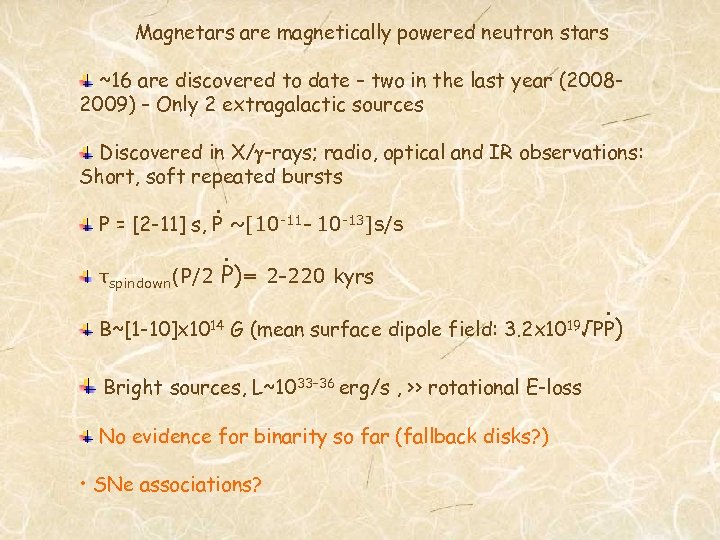
Magnetars are magnetically powered neutron stars ~16 are discovered to date – two in the last year (20082009) – Only 2 extragalactic sources Discovered in X/ -rays; radio, optical and IR observations: Short, soft repeated bursts . P = [2 -11] s, P ~[10 -11 - 10 -13]s/s . τspindown(P/2 P)= 2 -220 kyrs . B~[1 -10]x 1014 G (mean surface dipole field: 3. 2 x 10¹⁹√PP) Bright sources, L~1033– 36 erg/s , >> rotational E-loss No evidence for binarity so far (fallback disks? ) • SNe associations?
Neutron star populations which may comprise Magnetars: Soft Gamma Repeaters (SGRs) Anomalous X-ray Pulsars (AXPs) Dim Isolated Neutron Stars (DINs) Compact Central X-ray Objects (CCOs)
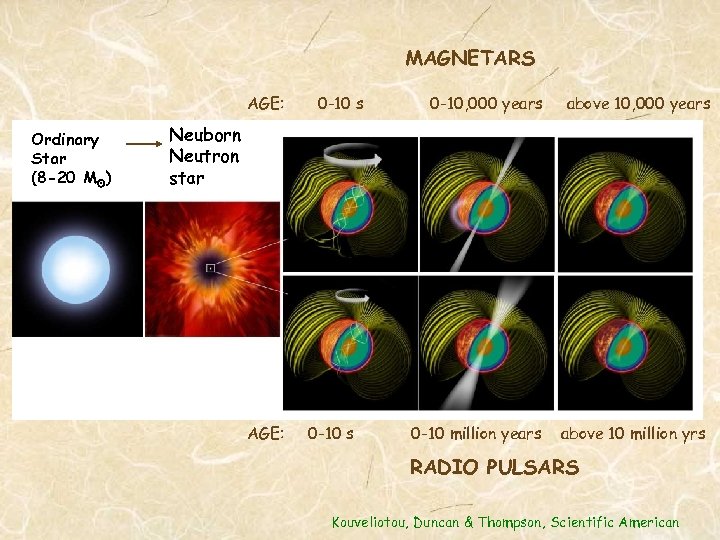
MAGNETARS AGE: Ordinary Star (8 -20 Mʘ) 0 -10 s 0 -10, 000 years above 10, 000 years Neuborn Neutron star AGE: 0 -10 s 0 -10 million years above 10 million yrs RADIO PULSARS Kouveliotou, Duncan & Thompson, Scientific American
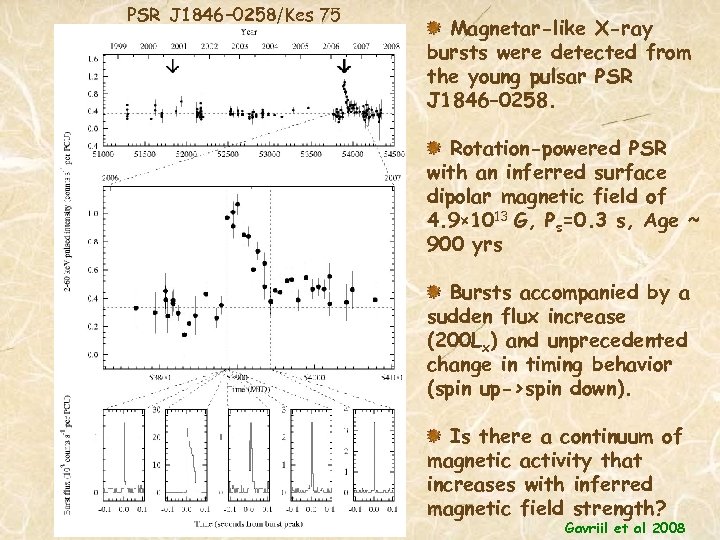
PSR J 1846− 0258/Kes 75 Magnetar-like X-ray bursts were detected from the young pulsar PSR J 1846− 0258. Rotation-powered PSR with an inferred surface dipolar magnetic field of 4. 9× 10¹³ G, Ps=0. 3 s, Age ~ 900 yrs Bursts accompanied by a sudden flux increase (200 Lx) and unprecedented change in timing behavior (spin up->spin down). Is there a continuum of magnetic activity that increases with inferred magnetic field strength? Gavriil et al 2008
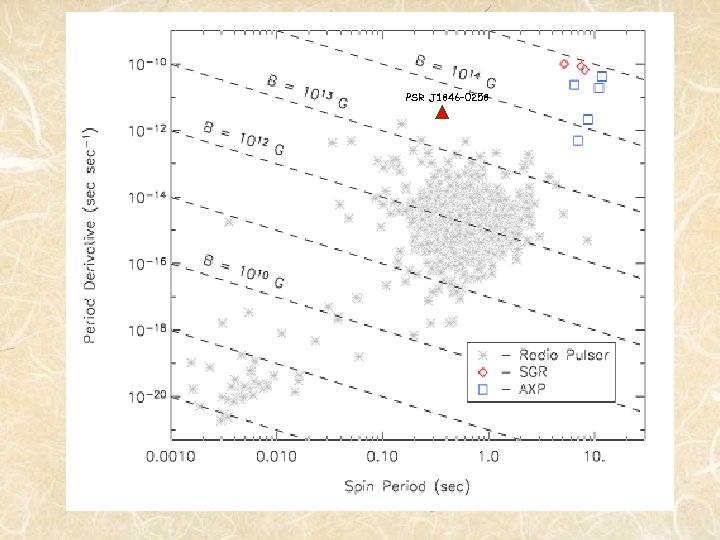
PSR J 1846− 0258
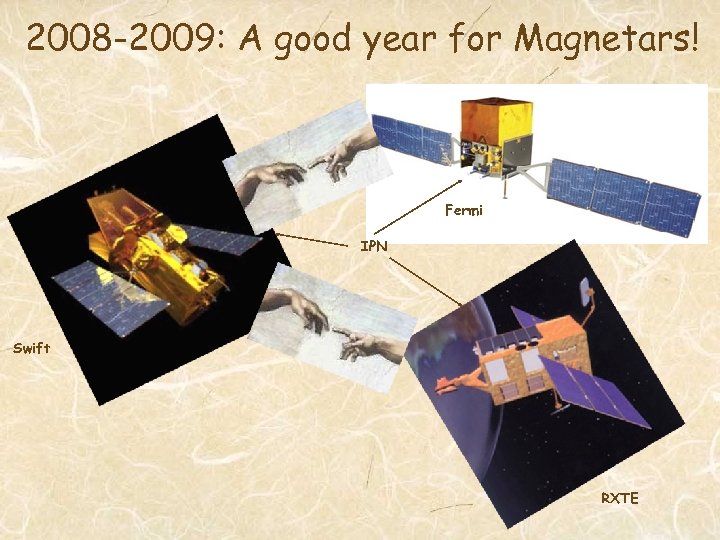
2008 -2009: A good year for Magnetars! Fermi IPN Swift RXTE
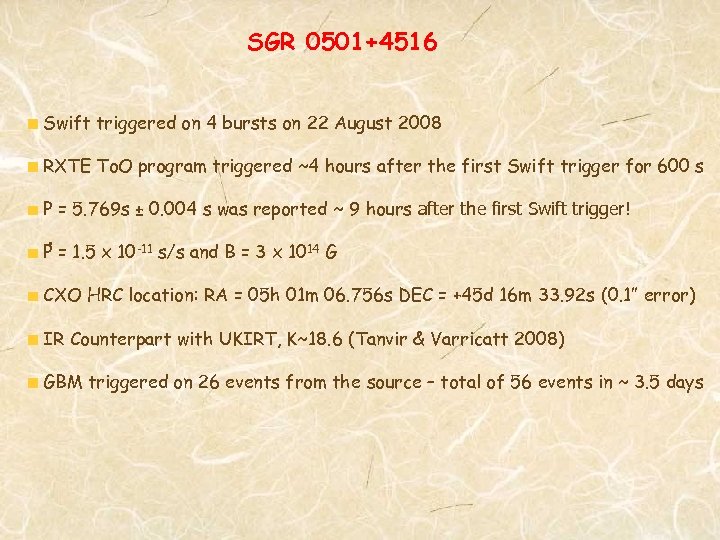
SGR 0501+4516 Swift triggered on 4 bursts on 22 August 2008 RXTE To. O program triggered ~4 hours after the first Swift trigger for 600 s P = 5. 769 s ± 0. 004 s was reported ~ 9 hours after the first Swift trigger! . P = 1. 5 x 10 -11 s/s and B = 3 x 10¹⁴ G CXO HRC location: RA = 05 h 01 m 06. 756 s DEC = +45 d 16 m 33. 92 s (0. 1” error) IR Counterpart with UKIRT, K~18. 6 (Tanvir & Varricatt 2008) GBM triggered on 26 events from the source – total of 56 events in ~ 3. 5 days
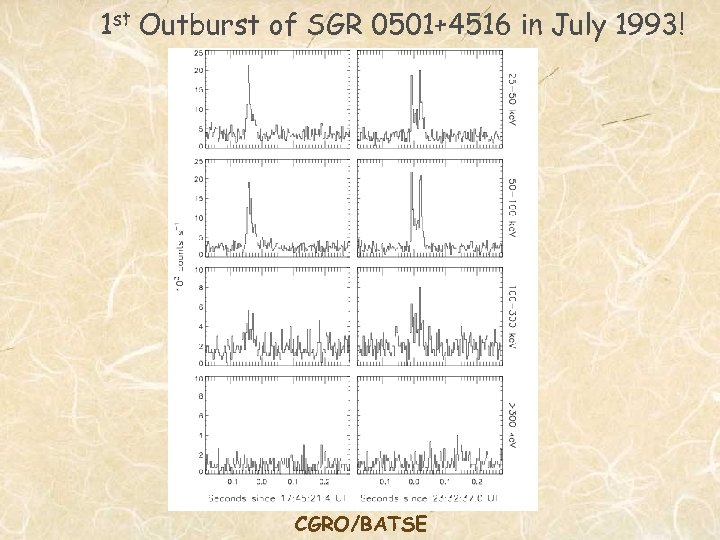
1 st Outburst of SGR 0501+4516 in July 1993! CGRO/BATSE
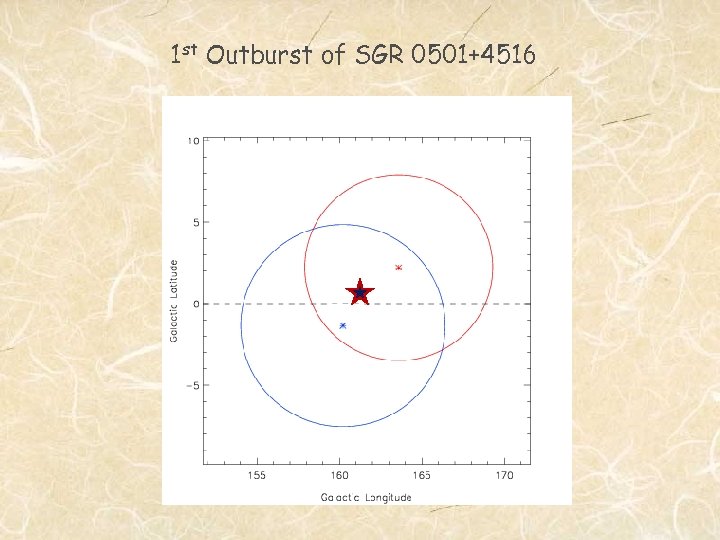
1 st Outburst of SGR 0501+4516
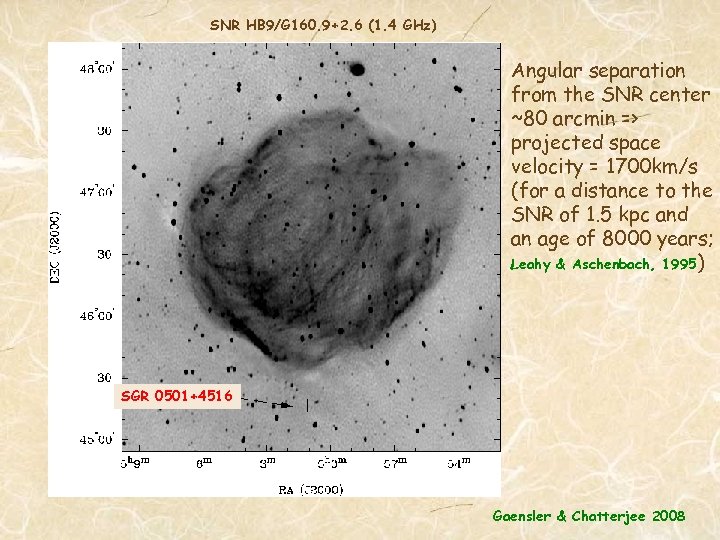
SNR HB 9/G 160. 9+2. 6 (1. 4 GHz) Angular separation from the SNR center ~80 arcmin => projected space velocity = 1700 km/s (for a distance to the SNR of 1. 5 kpc and an age of 8000 years; Leahy & Aschenbach, 1995) SGR 0501+4516 Gaensler & Chatterjee 2008
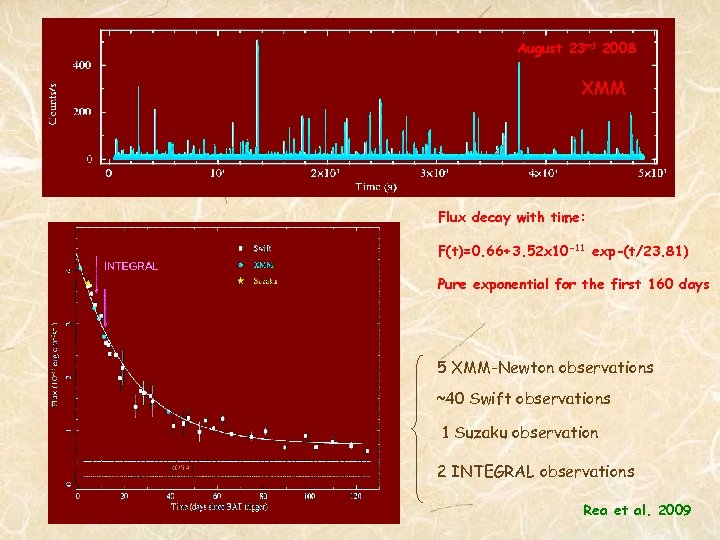
August 23 rd 2008 XMM Flux decay with time: F(t)=0. 66+3. 52 x 10 -11 exp-(t/23. 81) Pure exponential for the first 160 days 5 XMM-Newton observations ~40 Swift observations 1 Suzaku observation 2 INTEGRAL observations Rea et al. 2009
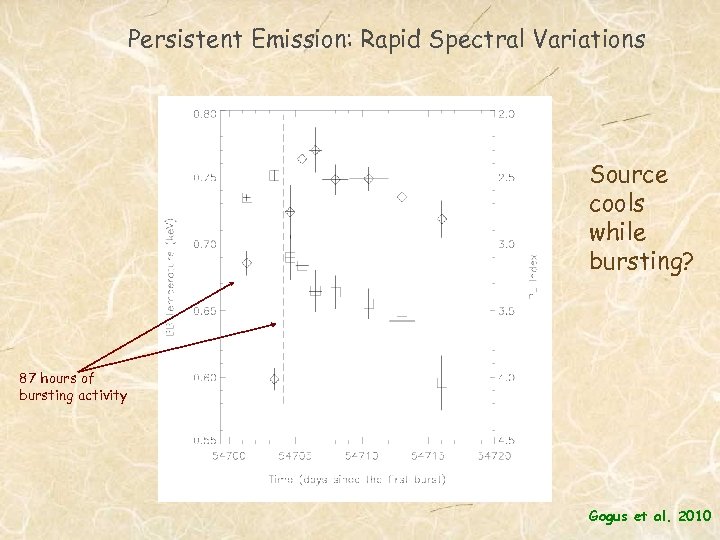
Persistent Emission: Rapid Spectral Variations Source cools while bursting? 87 hours of bursting activity Gogus et al. 2010
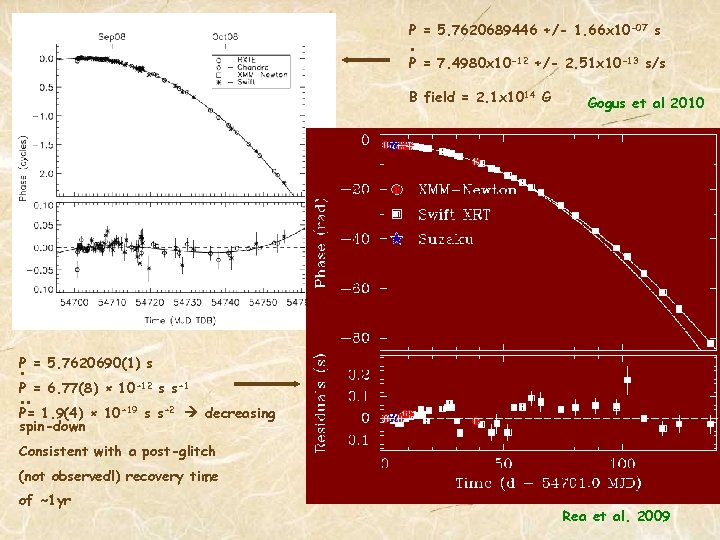
P = 5. 7620689446 +/- 1. 66 x 10 -07 s . P = 7. 4980 x 10 -12 +/- 2. 51 x 10 -13 s/s B field = 2. 1 x 10¹⁴ G . P = 6. 77(8) × 10. . Gogus et al 2010 P = 5. 7620690(1) s − 12 s s− 1 P= 1. 9(4) × 10− 19 s s− 2 decreasing spin-down Consistent with a post-glitch (not observed!) recovery time of ~1 yr Rea et al. 2009
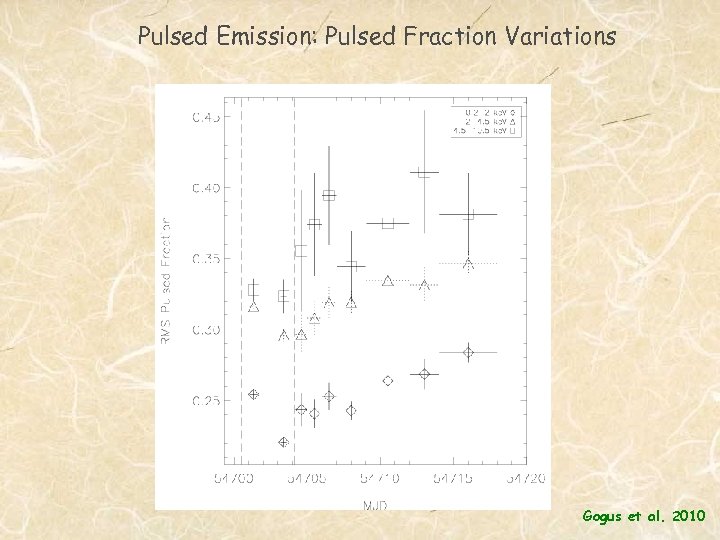
Pulsed Emission: Pulsed Fraction Variations Gogus et al. 2010
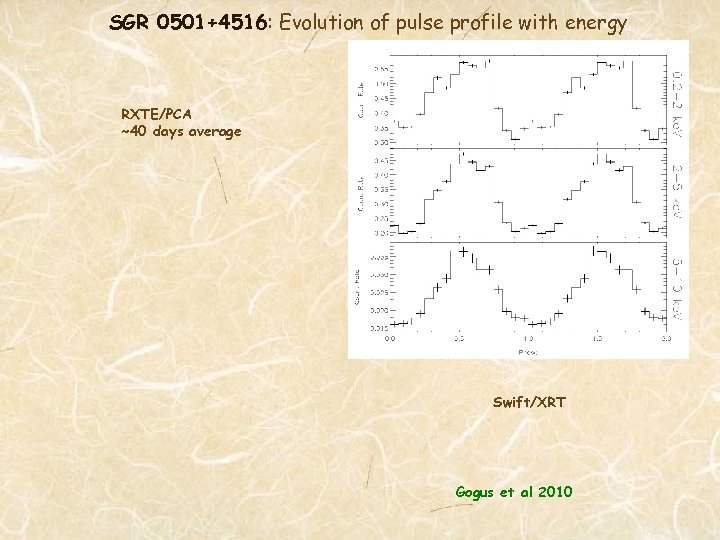
SGR 0501+4516: Evolution of pulse profile with energy RXTE/PCA ~40 days average Swift/XRT Gogus et al 2010
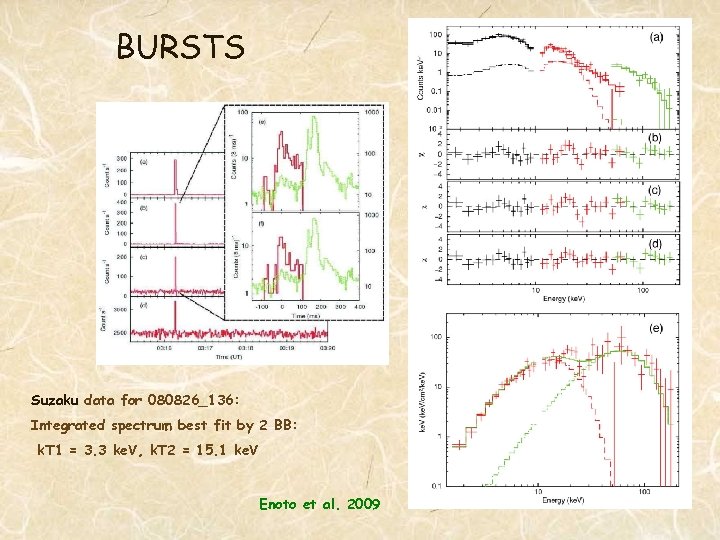
BURSTS Suzaku data for 080826_136: Integrated spectrum best fit by 2 BB: k. T 1 = 3. 3 ke. V, k. T 2 = 15. 1 ke. V Enoto et al. 2009
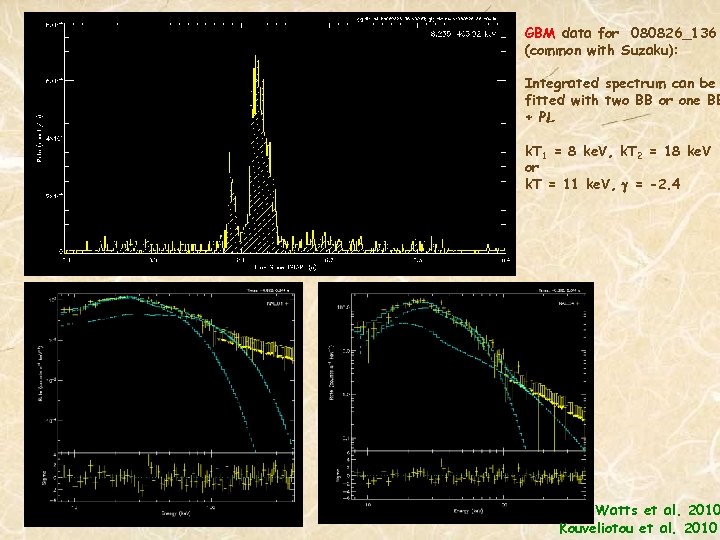
GBM data for 080826_136 (common with Suzaku): Integrated spectrum can be fitted with two BB or one BB + PL k. T 1 = 8 ke. V, k. T 2 = 18 ke. V or k. T = 11 ke. V, = -2. 4 Watts et al. 2010 Kouveliotou et al. 2010
SGR 1550 -5418 formerly known as AXP 1 E 1547. 0 -5408 formerly known as an ASCA CCO in G 327. 0 -0. 13 Three episodes detected with GBM: Oct. 2008, Jan. & Mar. 2009 P = 2. 069 s . P = 2. 318 x 10 -11 s/s and B = 2. 2 x 10¹⁴ G Near IR detection, Ks = 18. 5± 0. 3 GBM triggered on 131 events from the source; many more in the data
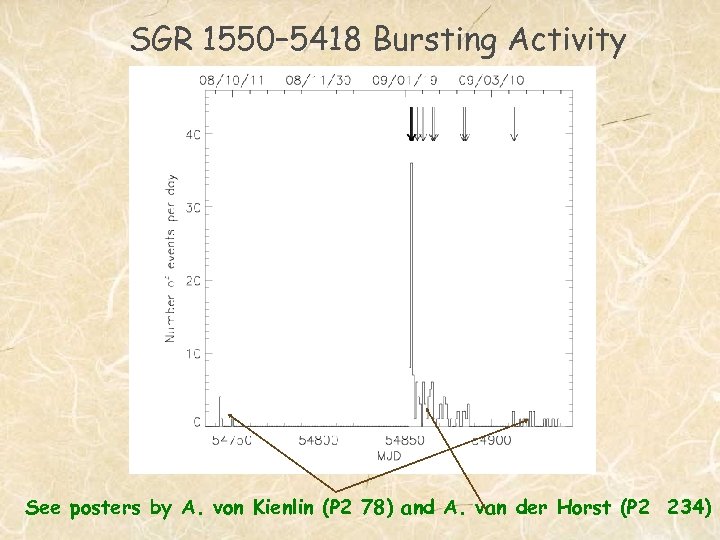
SGR 1550– 5418 Bursting Activity See posters by A. von Kienlin (P 2 78) and A. van der Horst (P 2 234)
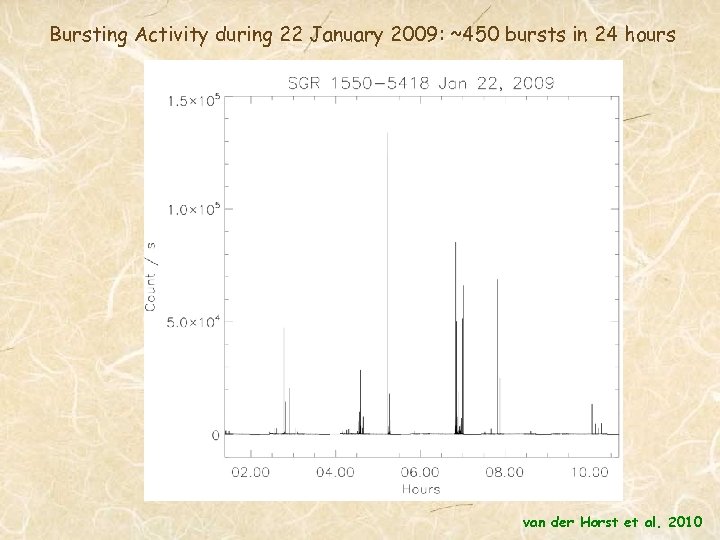
Bursting Activity during 22 January 2009: ~450 bursts in 24 hours van der Horst et al. 2010
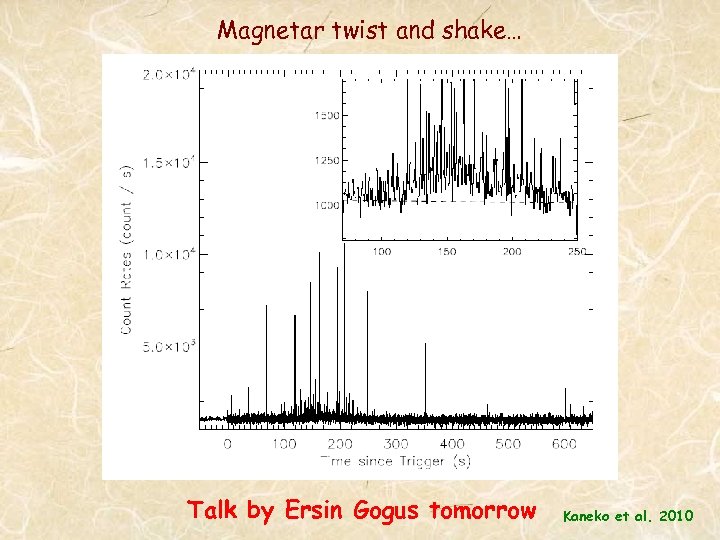
Magnetar twist and shake… Talk by Ersin Gogus tomorrow Kaneko et al. 2010
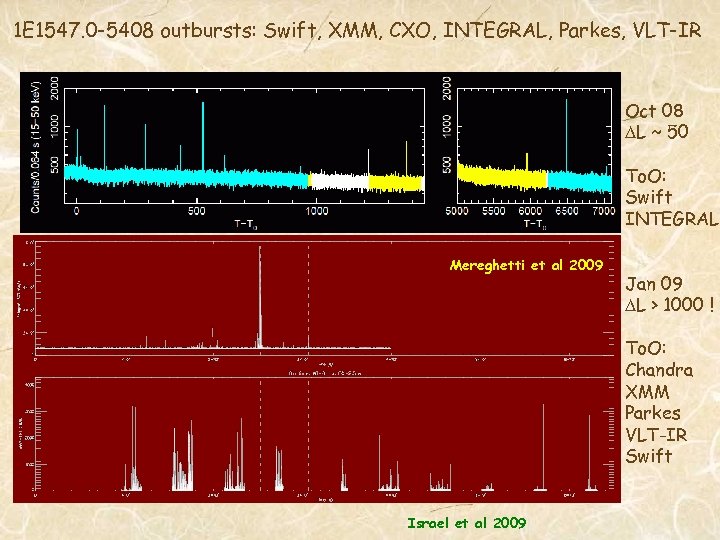
1 E 1547. 0 -5408 outbursts: Swift, XMM, CXO, INTEGRAL, Parkes, VLT-IR Oct 08 L ~ 50 To. O: Swift INTEGRAL Mereghetti et al 2009 Jan 09 L > 1000 ! To. O: Chandra XMM Parkes VLT-IR Swift Israel et al 2009
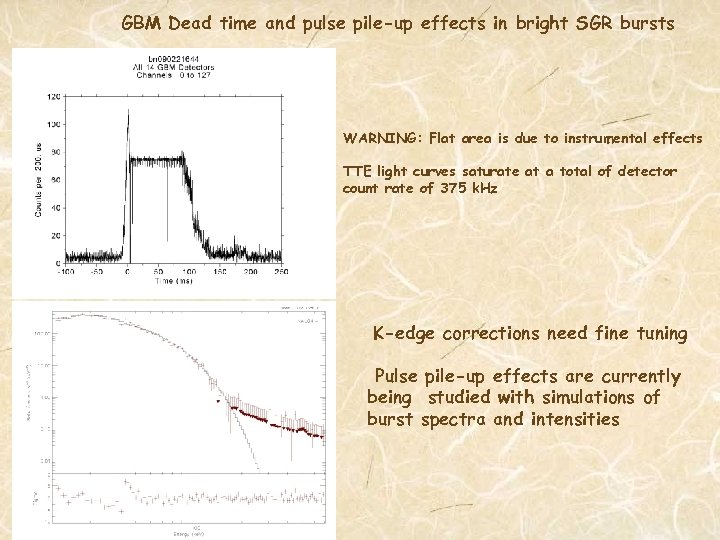
GBM Dead time and pulse pile-up effects in bright SGR bursts WARNING: Flat area is due to instrumental effects TTE light curves saturate at a total of detector count rate of 375 k. Hz K-edge corrections need fine tuning Pulse pile-up effects are currently being studied with simulations of burst spectra and intensities
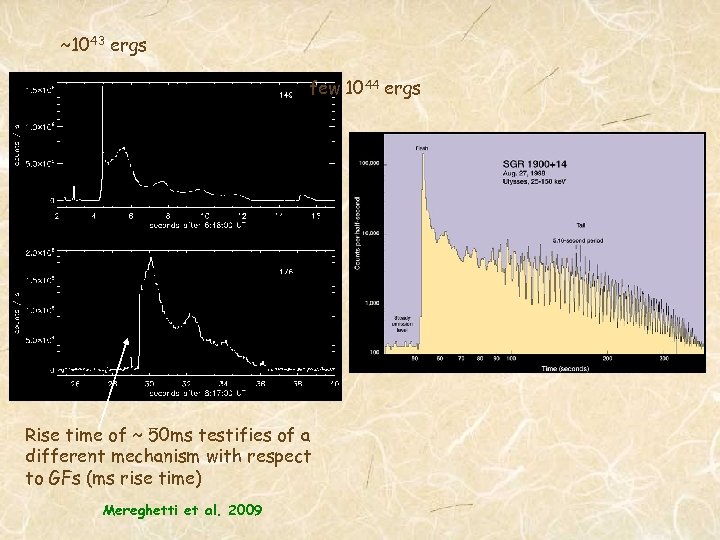
~1043 ergs few 1044 ergs Rise time of ~ 50 ms testifies of a different mechanism with respect to GFs (ms rise time) Mereghetti et al. 2009
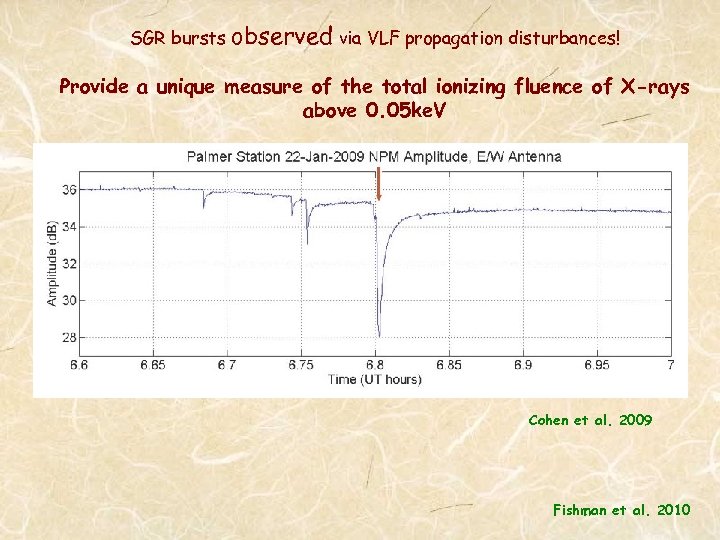
SGR bursts observed via VLF propagation disturbances! Provide a unique measure of the total ionizing fluence of X-rays above 0. 05 ke. V Cohen et al. 2009 Fishman et al. 2010
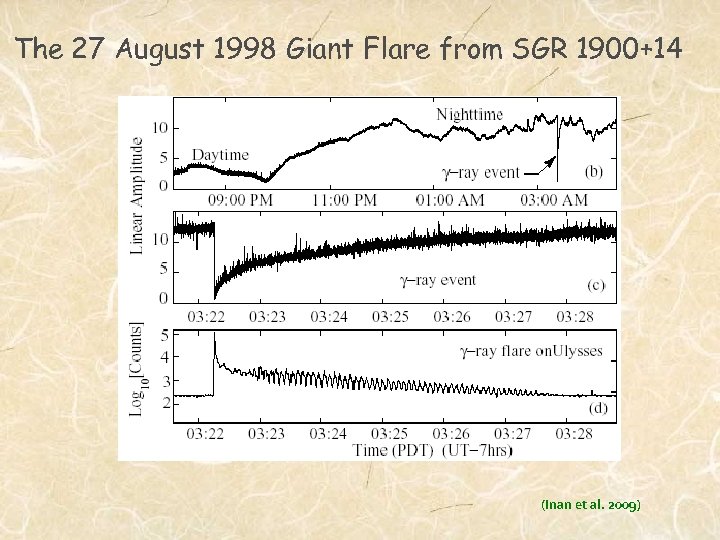
The 27 August 1998 Giant Flare from SGR 1900+14 (Inan et al. 2009)
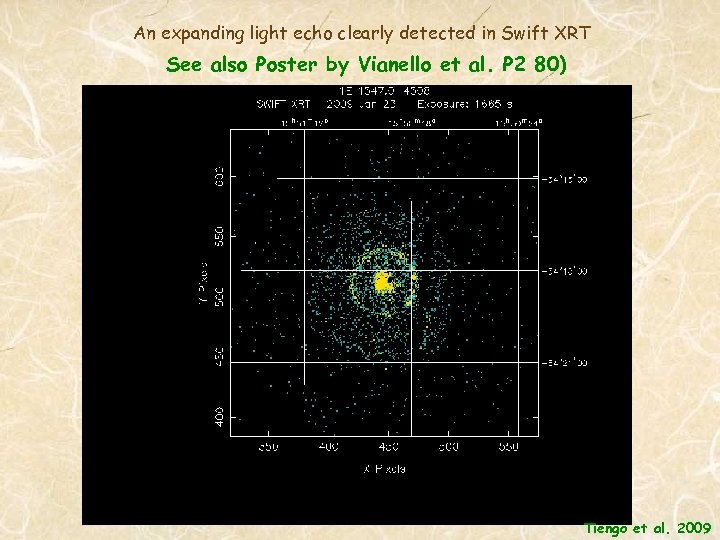
An expanding light echo clearly detected in Swift XRT See also Poster by Vianello et al. P 2 80) Tiengo et al. 2009
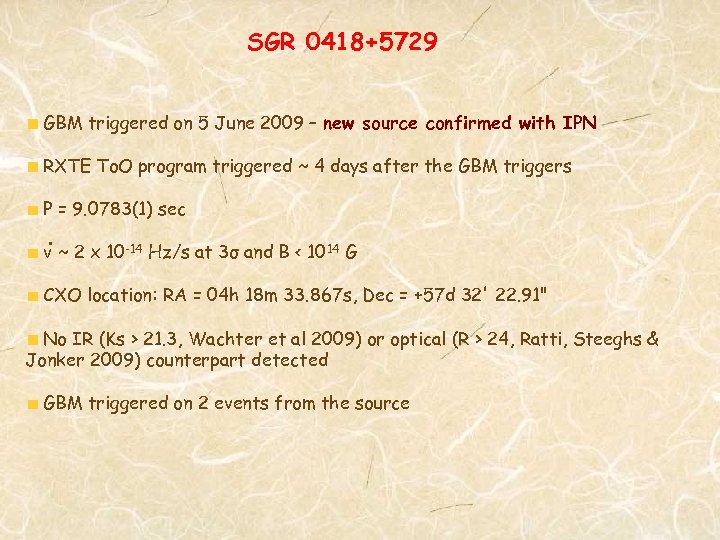
SGR 0418+5729 GBM triggered on 5 June 2009 – new source confirmed with IPN RXTE To. O program triggered ~ 4 days after the GBM triggers P = 9. 0783(1) sec . ν ~ 2 x 10 -14 Hz/s at 3σ and B < 1014 G CXO location: RA = 04 h 18 m 33. 867 s, Dec = +57 d 32' 22. 91" No IR (Ks > 21. 3, Wachter et al 2009) or optical (R > 24, Ratti, Steeghs & Jonker 2009) counterpart detected GBM triggered on 2 events from the source
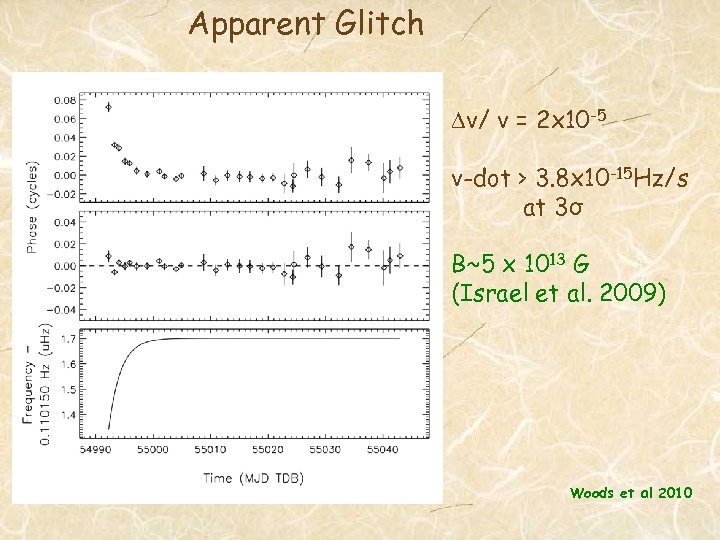
Apparent Glitch ν/ ν = 2 x 10 -5 ν-dot > 3. 8 x 10 -15 Hz/s at 3σ B~5 x 10¹³ G (Israel et al. 2009) Woods et al 2010
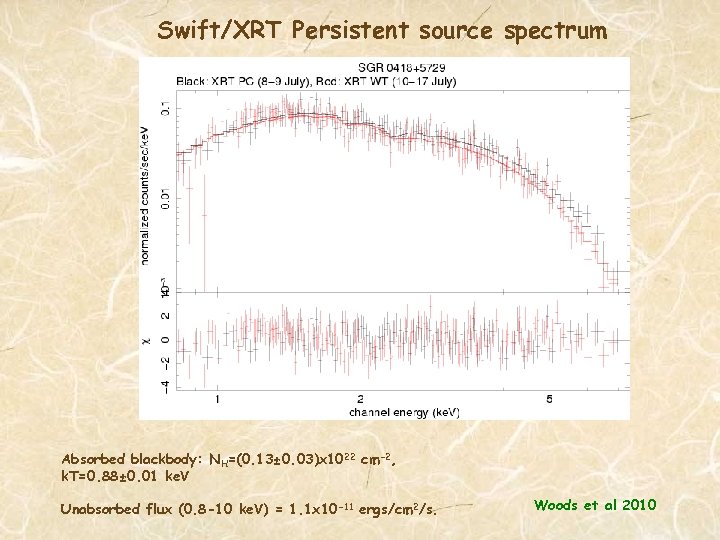
Swift/XRT Persistent source spectrum Absorbed blackbody: NH=(0. 13± 0. 03)x 1022 cm-2, k. T=0. 88± 0. 01 ke. V Unabsorbed flux (0. 8 -10 ke. V) = 1. 1 x 10 -11 ergs/cm 2/s. Woods et al 2010
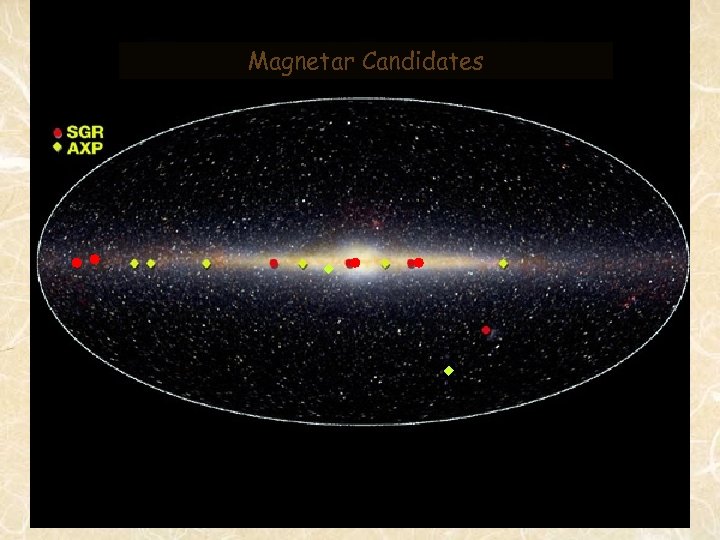
Magnetar Candidates
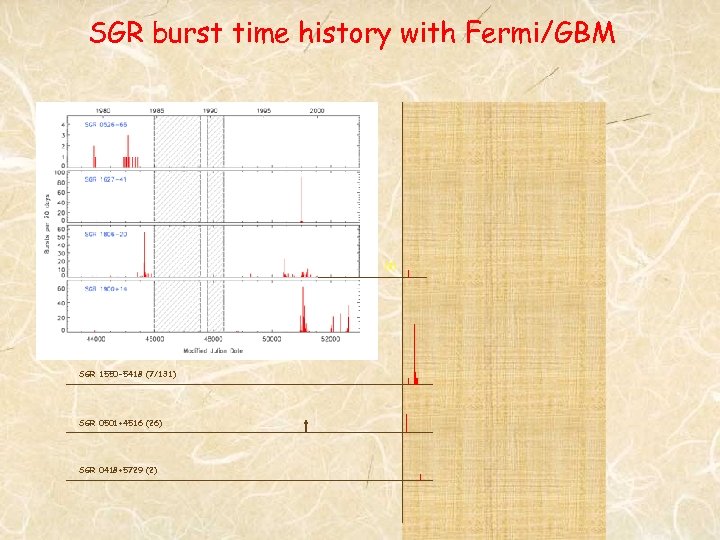
SGR burst time history with Fermi/GBM (2) SGR 1550 -5418 (7/131) SGR 0501+4516 (26) SGR 0418+5729 (2)
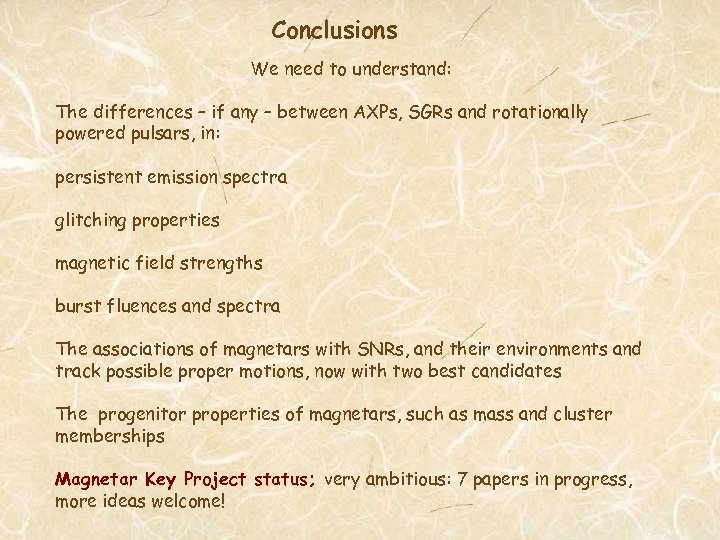
Conclusions We need to understand: The differences – if any – between AXPs, SGRs and rotationally powered pulsars, in: persistent emission spectra glitching properties magnetic field strengths burst fluences and spectra The associations of magnetars with SNRs, and their environments and track possible proper motions, now with two best candidates The progenitor properties of magnetars, such as mass and cluster memberships Magnetar Key Project status; very ambitious: 7 papers in progress, more ideas welcome!

Abstracts due: December 1 st Information, abstract submission and registration: www. confcon. com/head 2010/
Astrophysics of Neutron Stars 2010 ASTRONS 2010 2 – 6 August 2010 Çeşme – Izmir Fermi results are welcome! visit www. astrons 2010. org
Скачать презентацию Magnetars in the Fermi Era On behalf of
2f51365987816a5bea7aa21316d811c6.ppt