 Скачать презентацию Madigan Home Tour and Solar Energy Seminar By
3cbdfa0625f9315400587b7312144d43.ppt
- Количество слайдов: 48



Madigan Home Tour and Solar Energy Seminar By David W. Madigan, P. E.
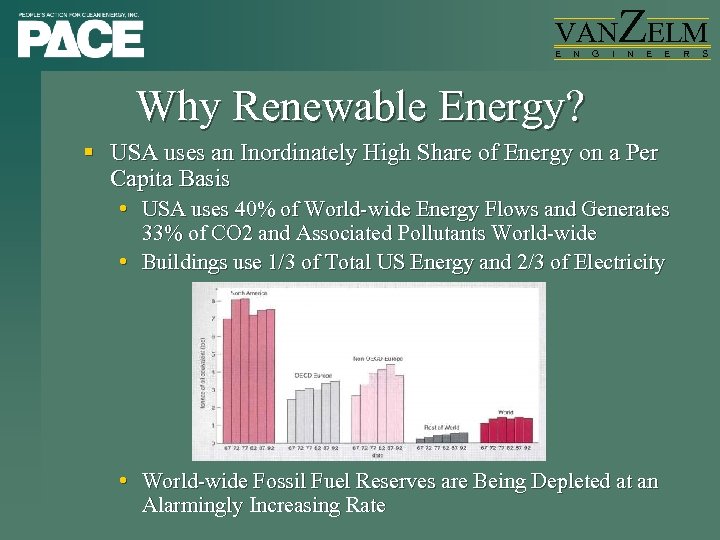
VAN E N G I ZELM N E E Why Renewable Energy? § USA uses an Inordinately High Share of Energy on a Per Capita Basis • USA uses 40% of World-wide Energy Flows and Generates 33% of CO 2 and Associated Pollutants World-wide • Buildings use 1/3 of Total US Energy and 2/3 of Electricity • World-wide Fossil Fuel Reserves are Being Depleted at an Alarmingly Increasing Rate R S
VAN E N G I ZELM N E E R S
VAN E N G I ZELM N E E Conservation vs. Generation § Conservation preferable over Renewable energy • • • Usually Better Economics Even Renewable Energy has Environmental Consequences Conservation Measures Result in Reduction of Usage and Peak Loads § Conservation and Renewable Energy Complement One Another • Renewable Energy Capital Intensive • Conservation Reduces Capital Investment by Limiting Peak Loads § Implement Renewable Energy Systems after Making Maximum use of Conservation Options – Sustainable Design Process R S
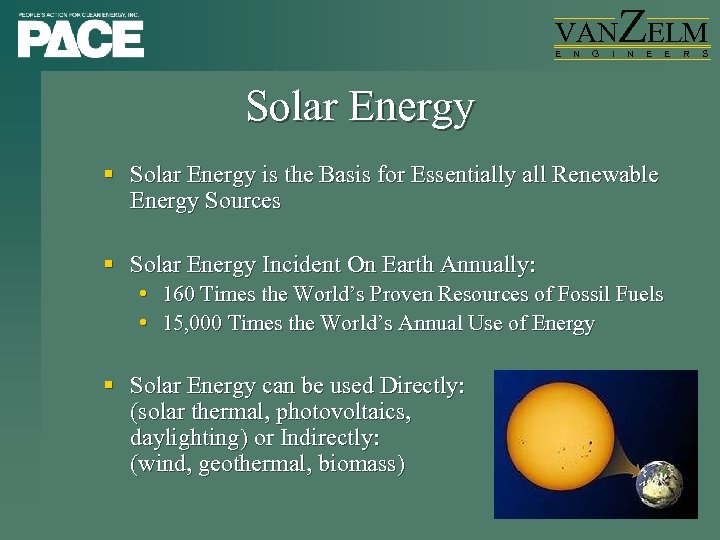
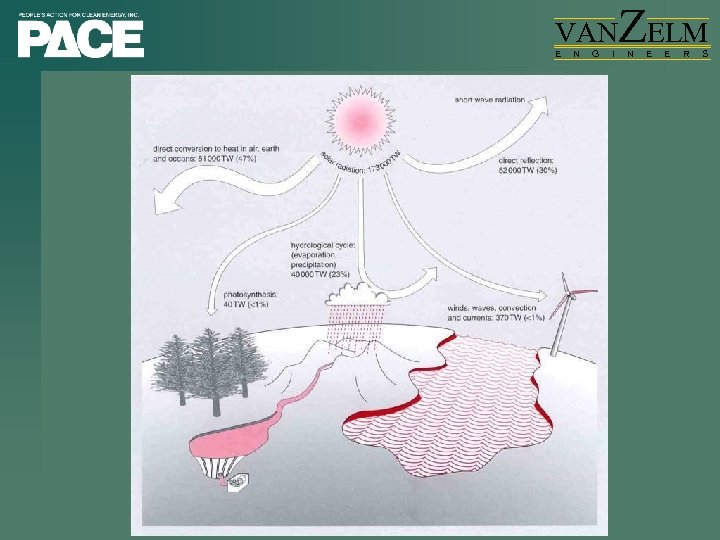
VAN E N G I ZELM N E E Solar Energy § Solar Energy is the Basis for Essentially all Renewable Energy Sources § Solar Energy Incident On Earth Annually: • 160 Times the World’s Proven Resources of Fossil Fuels • 15, 000 Times the World’s Annual Use of Energy § Solar Energy can be used Directly: (solar thermal, photovoltaics, daylighting) or Indirectly: (wind, geothermal, biomass) R S
VAN E N G I ZELM N E E R S
VAN E N G I Solar Energy Basics § Sun is a High Temperature “Radiator” (6000°C) § Earth is a Low Temperature “Receiver” § Solar Energy is Received as Short Wavelength Radiation • 30% Reflected by Atmosphere • 70% Re-radiated As Long Wavelength Radiation § Atmosphere Acts like Glass on a Solar Collector ZELM N E E R S
VAN E N G I ZELM N Solar Energy Basics § Incident Solar Energy Varies Based on: • Length of Travel Through Atmosphere Ø Latitude, Seasons • Atmospheric Clarity Ø Cloud Cover, Pollution • Time of Day • Angle and Orientation of Collector Surface § Sun Angle Highest in Summer (73. 5°) and Lowest in Winter (26. 6°) (at 12: 00 pm, 40° lat. ) E E R S
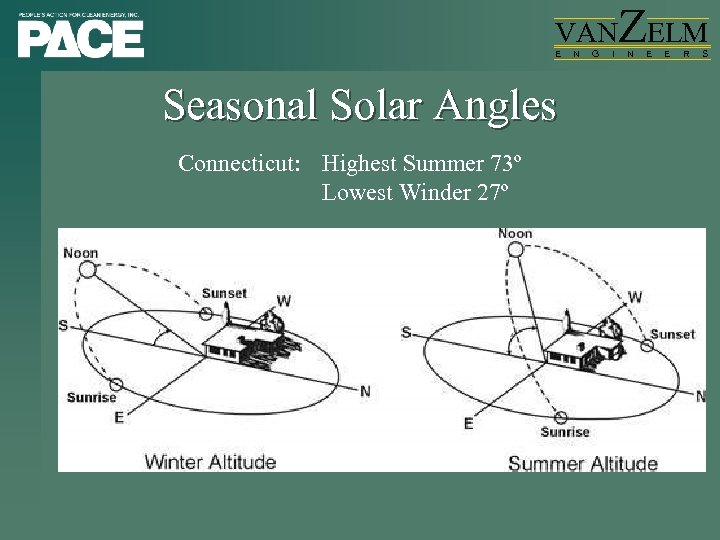
VAN E Seasonal Solar Angles Connecticut: Highest Summer 73º Lowest Winder 27º N G I ZELM N E E R S
VAN E N G I ZELM N E Solar Energy Basics § Direct & Diffuse Radiation • Beam Radiation from Sun Scattered when Penetrating Atmosphere • Flat Plate Collectors, Passive Solar & Daylighting Makes Use of Both Direct & Diffuse Radiation • Concentrating Collectors use Primarily Beam Radiation • Ratio of Beam to Diffuse Varies by Local Climate Ø Cloudier Climates ~ 50% beam / 50% diffuse Ø Clear Climates ~ 80% beam / 20% diffuse E R S
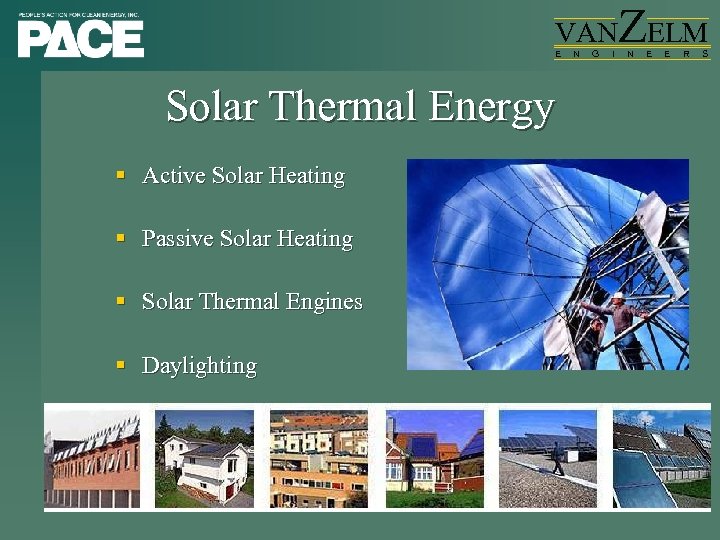
VAN E Solar Thermal Energy § Active Solar Heating § Passive Solar Heating § Solar Thermal Engines § Daylighting N G I ZELM N E E R S
VAN E N G I ZELM N E Solar Thermal Collectors § Dark Surface with High Absorptance Gathers Full Spectrum of Solar Radiation § Heat is Drawn Away by Working Fluid – Usually Glycol / Water § Glass and/or Selective Surface Used to Minimize Conduction and Re-radiation Losses § Efficiency Dependant on Collector Design and Working Temperature • Lower Temperature = Higher Efficiency E R S
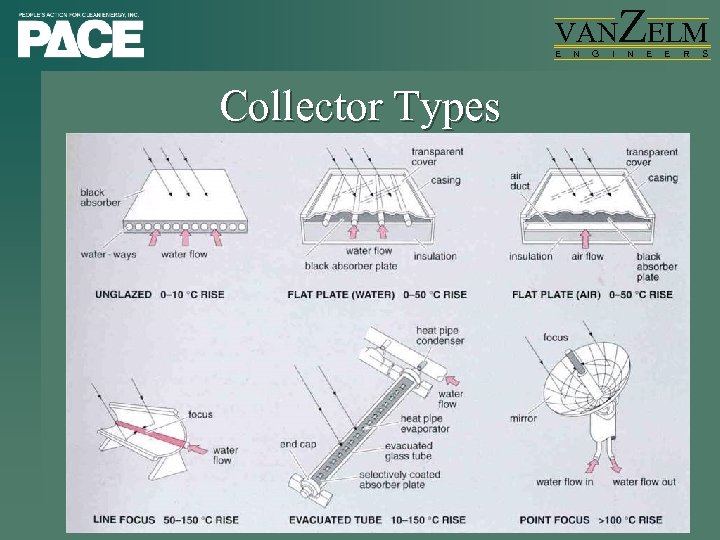
VAN E Collector Types N G I ZELM N E E R S
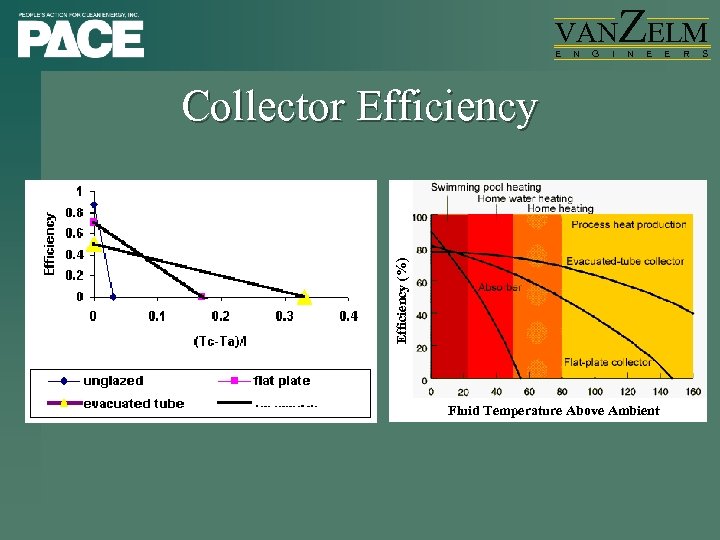
VAN E N G I ZELM N E Efficiency (%) Collector Efficiency Fluid Temperature Above Ambient E R S
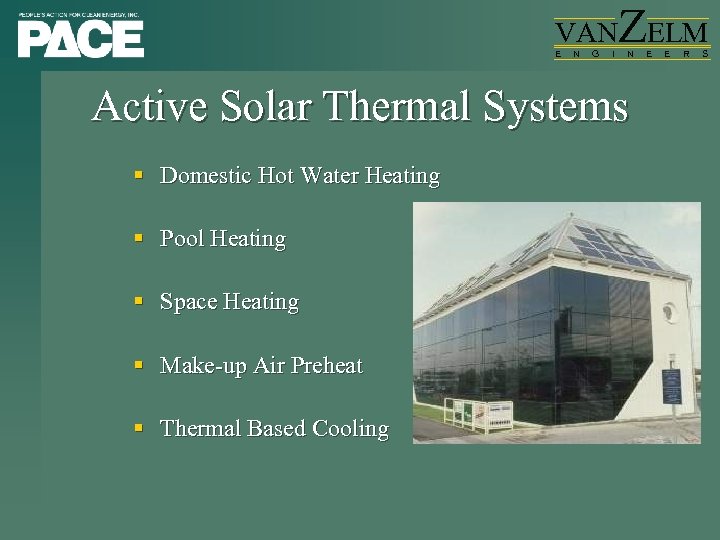
VAN E N G I ZELM N Active Solar Thermal Systems § Domestic Hot Water Heating § Pool Heating § Space Heating § Make-up Air Preheat § Thermal Based Cooling E E R S
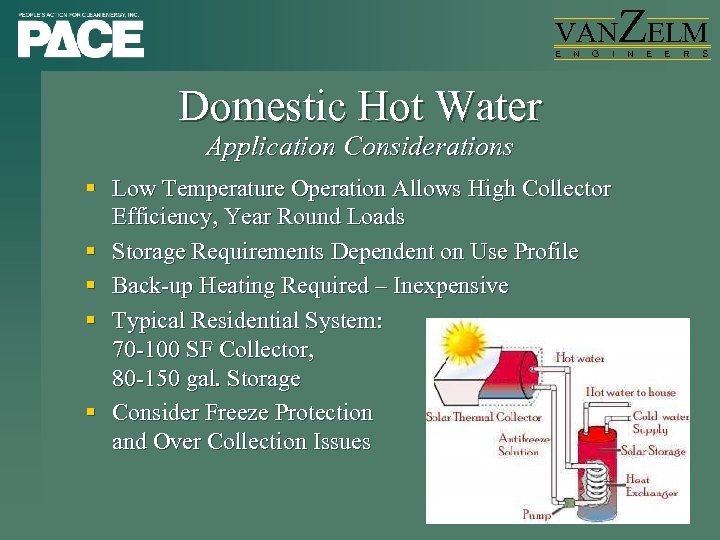
VAN E N G I Domestic Hot Water Application Considerations § Low Temperature Operation Allows High Collector Efficiency, Year Round Loads § Storage Requirements Dependent on Use Profile § Back-up Heating Required – Inexpensive § Typical Residential System: 70 -100 SF Collector, 80 -150 gal. Storage § Consider Freeze Protection and Over Collection Issues ZELM N E E R S
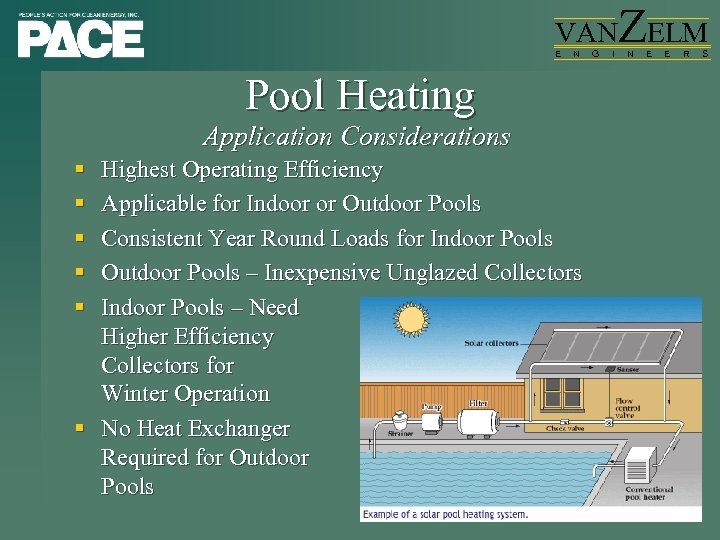
VAN E N Pool Heating Application Considerations § § § Highest Operating Efficiency Applicable for Indoor or Outdoor Pools Consistent Year Round Loads for Indoor Pools Outdoor Pools – Inexpensive Unglazed Collectors Indoor Pools – Need Higher Efficiency Collectors for Winter Operation § No Heat Exchanger Required for Outdoor Pools G I ZELM N E E R S
VAN E N G I ZELM N E E R Space Heating Application Considerations § Lowest Solar Resource and Collector Efficiency at Time of Highest Loads – Daily & Annually § Need High Efficiency Collectors § Good Application with Low Temp Radiant Heating § Couple with Passive Solar § Storage Required to Offset Nighttime Loads § High Efficiency Envelope Design Minimizes Heat Loads / System Sizing § Can be Coupled with Summer Thermal Air Conditioning S
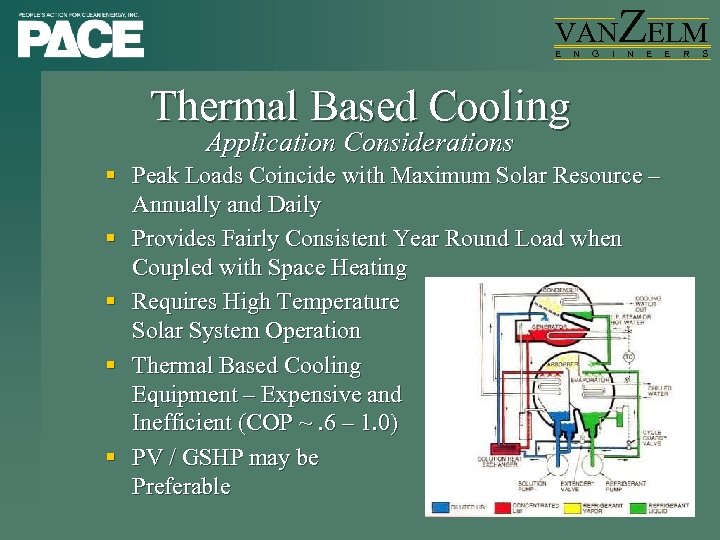
VAN E N G I ZELM N E Thermal Based Cooling Application Considerations § Peak Loads Coincide with Maximum Solar Resource – Annually and Daily § Provides Fairly Consistent Year Round Load when Coupled with Space Heating § Requires High Temperature Solar System Operation § Thermal Based Cooling Equipment – Expensive and Inefficient (COP ~. 6 – 1. 0) § PV / GSHP may be Preferable E R S
VAN E N G I ZELM N E E R S Daylighting Overview § § § § § Solar Resource Used to Offset Highest Cost Electricity Technology Well Developed Allows Reduced Cooling Loads Also Can Help to Downsize HVAC Systems Glazing Optimization by Exposure Need to Control Excess Solar Heat Gain Best Implemented as Part of an Integrated Design Process Can Be Highly Cost Effective Improves Indoor Environment Can Combine with PV Technology & Passive Solar Design
VAN E N G I ZELM N E E R S Photovoltaic (Solar Energy) Systems • Electricity Production Directly From Sunlight • Utilizes Photon Energy in Sunlight to Promote Electrical Current Flow • Relies on Semi-Conductor Effects in Specialized Materials • DC Power Output from Panels • Extensive Development of New Technologies & Products Underway
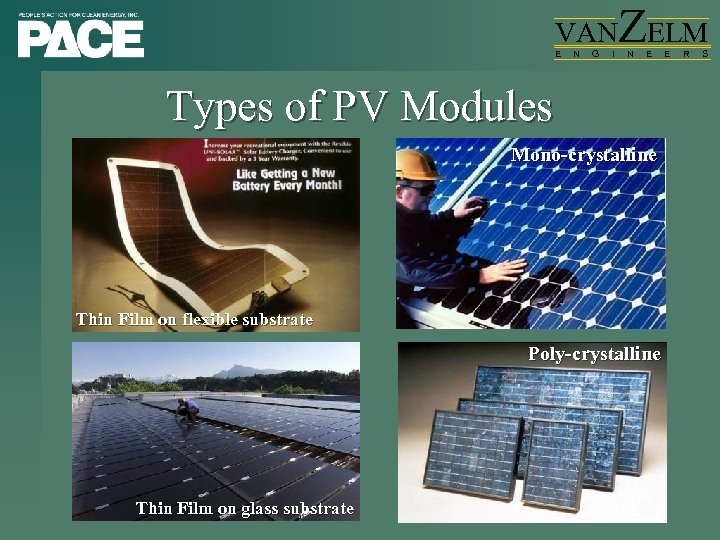
VAN E N G I ZELM N E Types of PV Modules Mono-crystalline Thin Film on flexible substrate Poly-crystalline Thin Film on glass substrate E R S
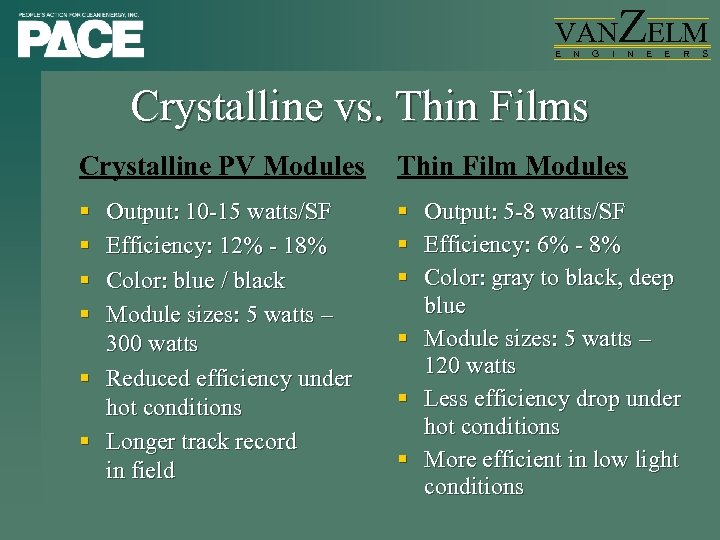
VAN E N G I ZELM N E E Crystalline vs. Thin Films Crystalline PV Modules Thin Film Modules § § § Output: 5 -8 watts/SF § Efficiency: 6% - 8% § Color: gray to black, deep blue § Module sizes: 5 watts – 120 watts § Less efficiency drop under hot conditions § More efficient in low light conditions Output: 10 -15 watts/SF Efficiency: 12% - 18% Color: blue / black Module sizes: 5 watts – 300 watts § Reduced efficiency under hot conditions § Longer track record in field R S
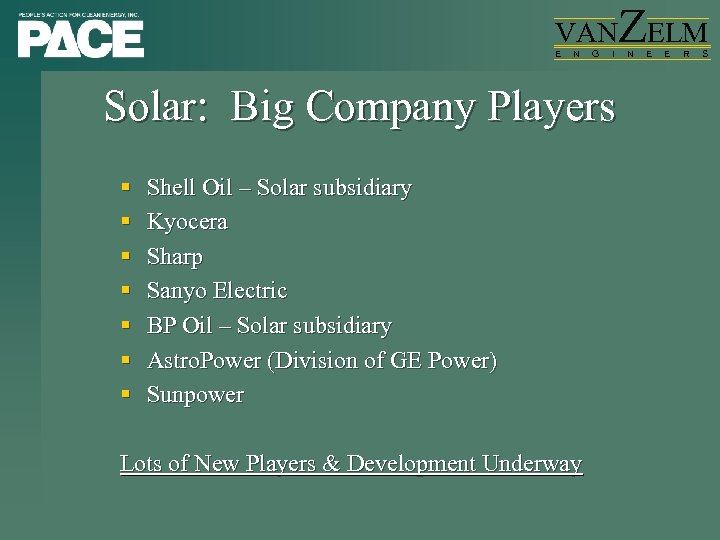
VAN E N G I ZELM Solar: Big Company Players § § § § Shell Oil – Solar subsidiary Kyocera Sharp Sanyo Electric BP Oil – Solar subsidiary Astro. Power (Division of GE Power) Sunpower Lots of New Players & Development Underway N E E R S
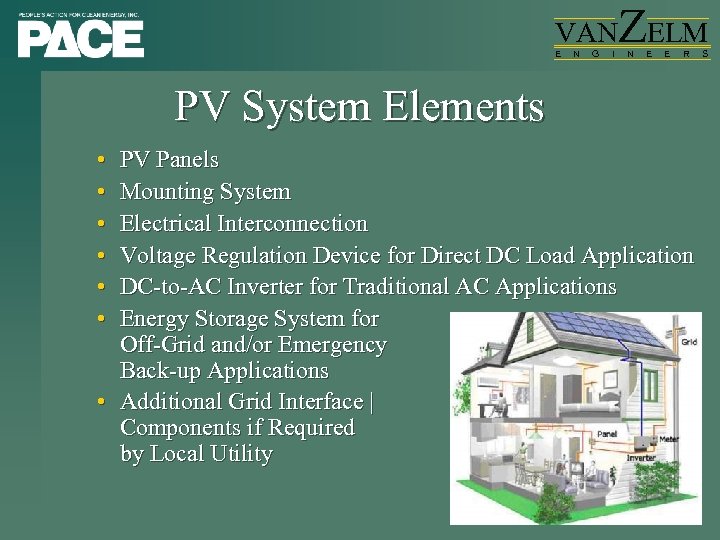
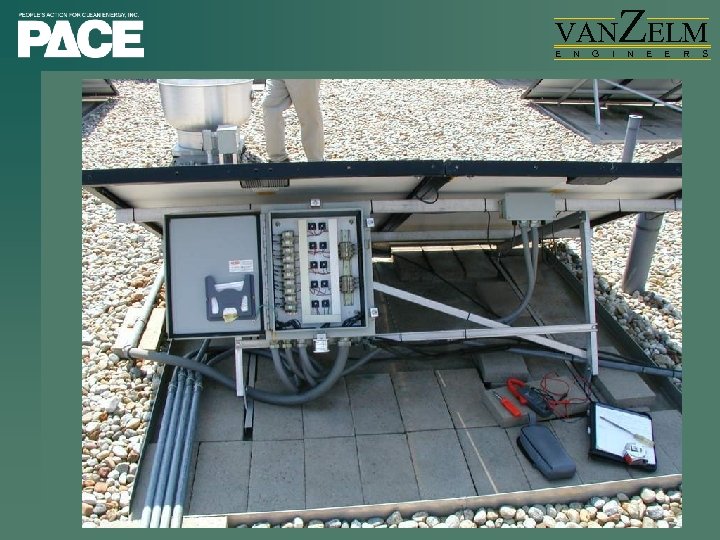
VAN E N G I ZELM N E E R PV System Elements • • • PV Panels Mounting System Electrical Interconnection Voltage Regulation Device for Direct DC Load Application DC-to-AC Inverter for Traditional AC Applications Energy Storage System for Off-Grid and/or Emergency Back-up Applications • Additional Grid Interface | Components if Required by Local Utility S
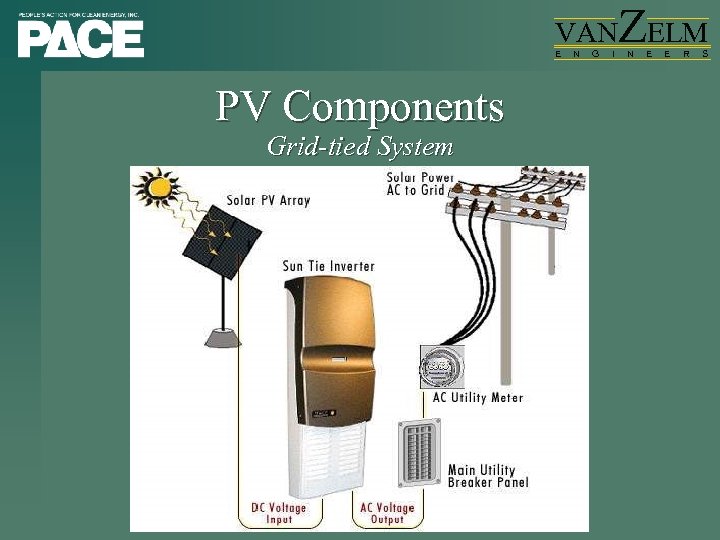
VAN E PV Components Grid-tied System N G I ZELM N E E R S
VAN E N G I ZELM N E E R S
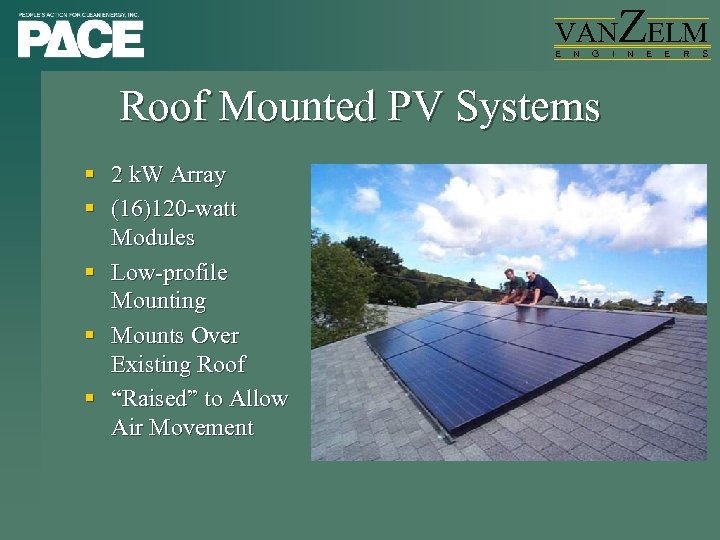
VAN E N G Roof Mounted PV Systems § 2 k. W Array § (16)120 -watt Modules § Low-profile Mounting § Mounts Over Existing Roof § “Raised” to Allow Air Movement I ZELM N E E R S
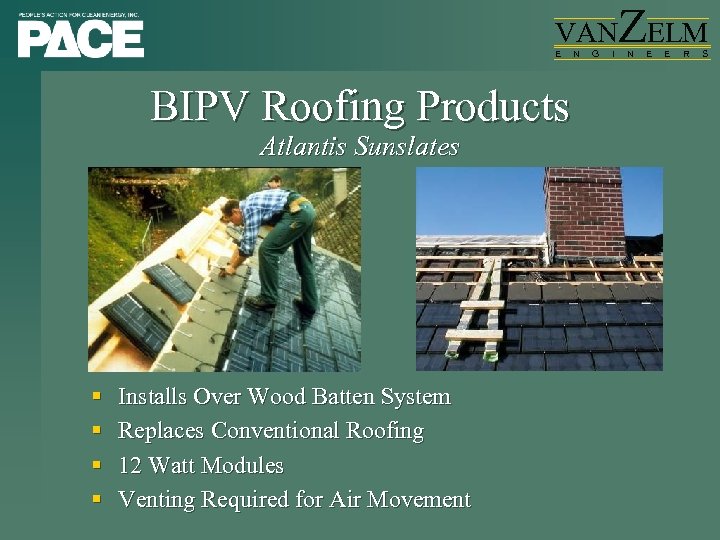
VAN E BIPV Roofing Products Atlantis Sunslates § § Installs Over Wood Batten System Replaces Conventional Roofing 12 Watt Modules Venting Required for Air Movement N G I ZELM N E E R S
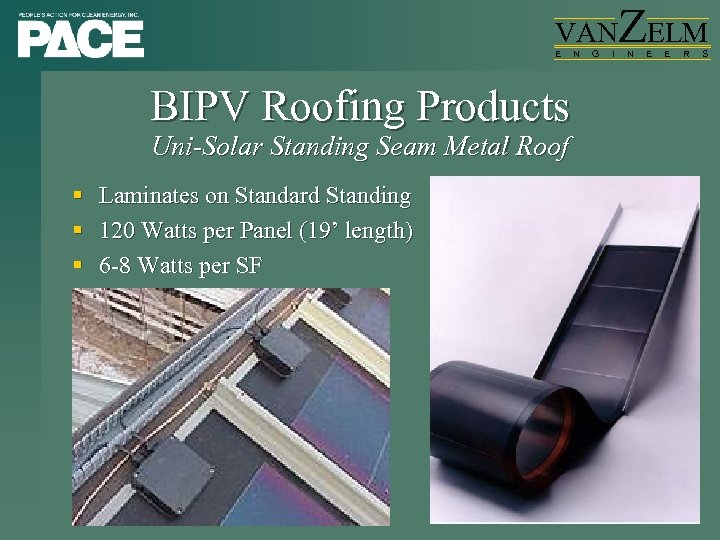
VAN E BIPV Roofing Products Uni-Solar Standing Seam Metal Roof § § § Laminates on Standard Standing 120 Watts per Panel (19’ length) 6 -8 Watts per SF N G I ZELM N E E R S
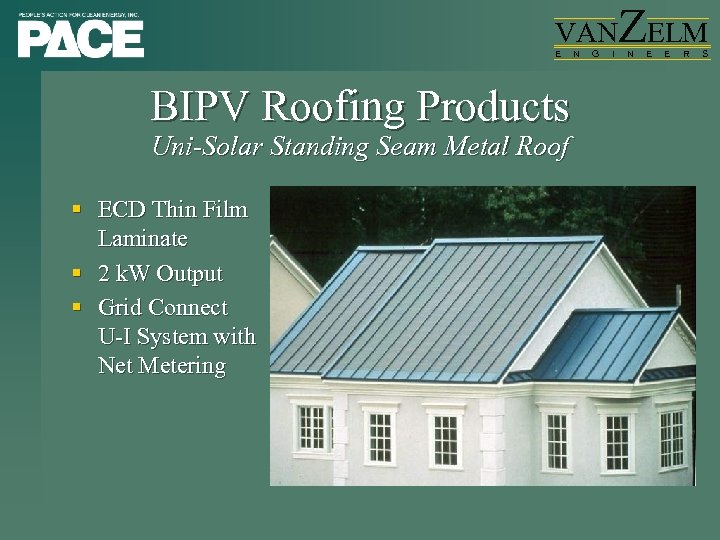
VAN E BIPV Roofing Products Uni-Solar Standing Seam Metal Roof § ECD Thin Film Laminate § 2 k. W Output § Grid Connect U-I System with Net Metering N G I ZELM N E E R S
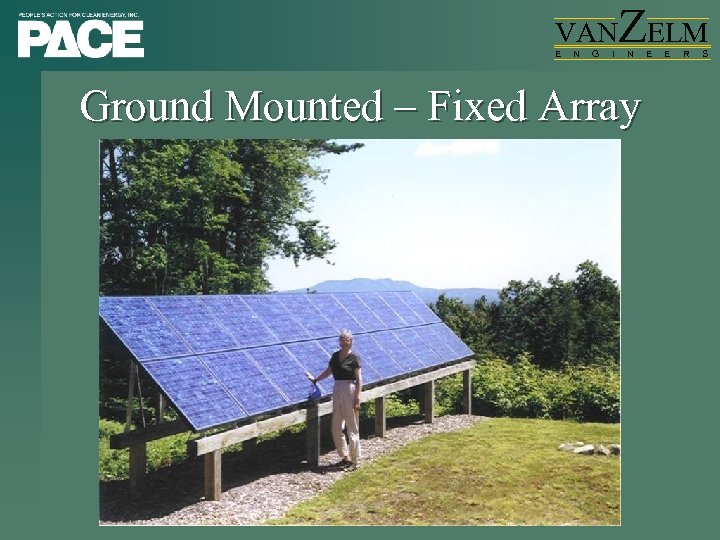
VAN E N G I ZELM N Ground Mounted – Fixed Array E E R S
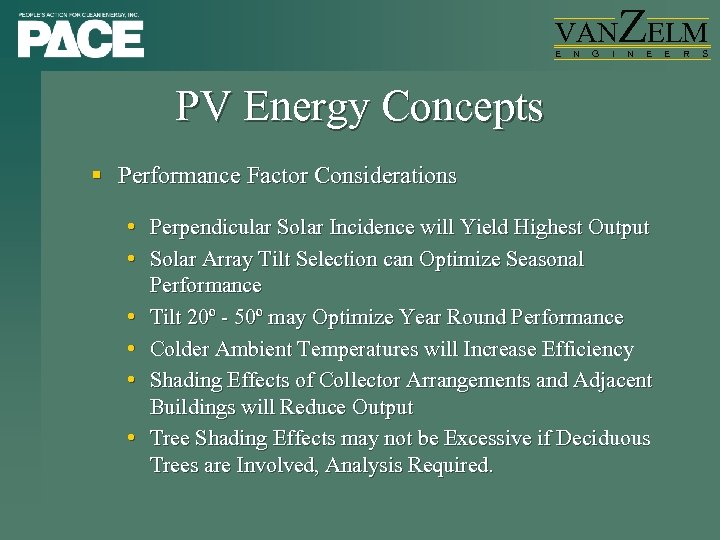
VAN E N G I ZELM N E PV Energy Concepts § Performance Factor Considerations • Perpendicular Solar Incidence will Yield Highest Output • Solar Array Tilt Selection can Optimize Seasonal Performance • Tilt 20º - 50º may Optimize Year Round Performance • Colder Ambient Temperatures will Increase Efficiency • Shading Effects of Collector Arrangements and Adjacent Buildings will Reduce Output • Tree Shading Effects may not be Excessive if Deciduous Trees are Involved, Analysis Required. E R S
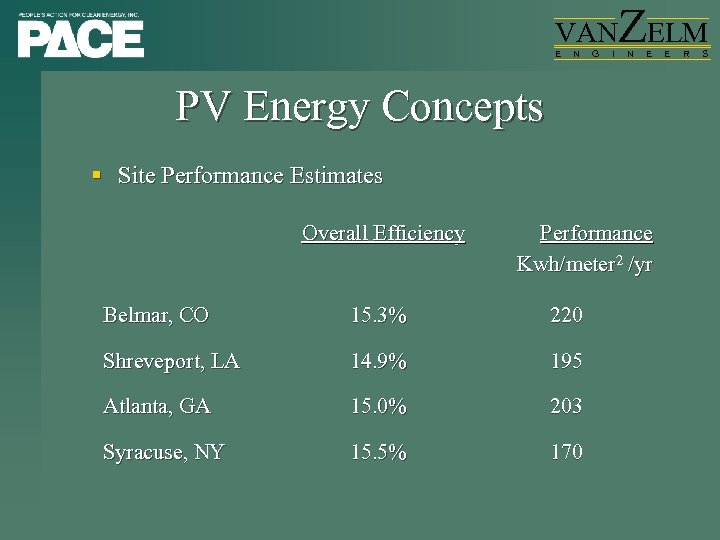
VAN E N G I ZELM N E PV Energy Concepts § Site Performance Estimates Overall Efficiency Performance Kwh/meter 2 /yr Belmar, CO 15. 3% 220 Shreveport, LA 14. 9% 195 Atlanta, GA 15. 0% 203 Syracuse, NY 15. 5% 170 E R S
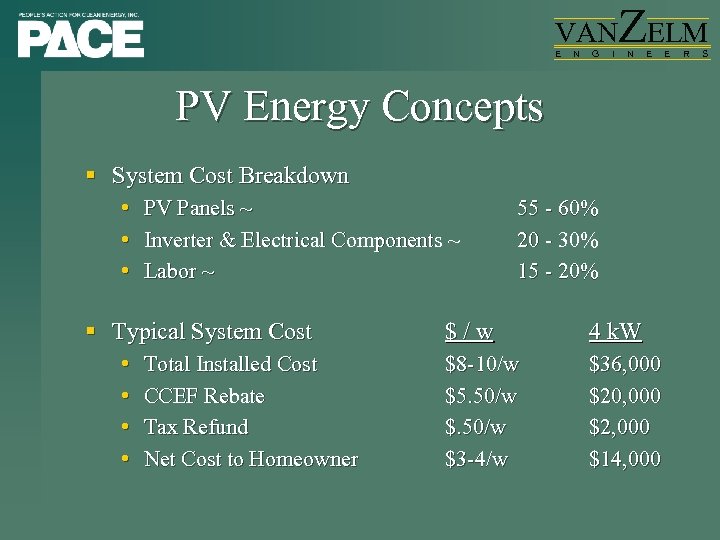
VAN E N G I ZELM N E PV Energy Concepts § System Cost Breakdown • PV Panels ~ • Inverter & Electrical Components ~ • Labor ~ § Typical System Cost • • Total Installed Cost CCEF Rebate Tax Refund Net Cost to Homeowner 55 - 60% 20 - 30% 15 - 20% $/w 4 k. W $8 -10/w $5. 50/w $3 -4/w $36, 000 $20, 000 $2, 000 $14, 000 E R S
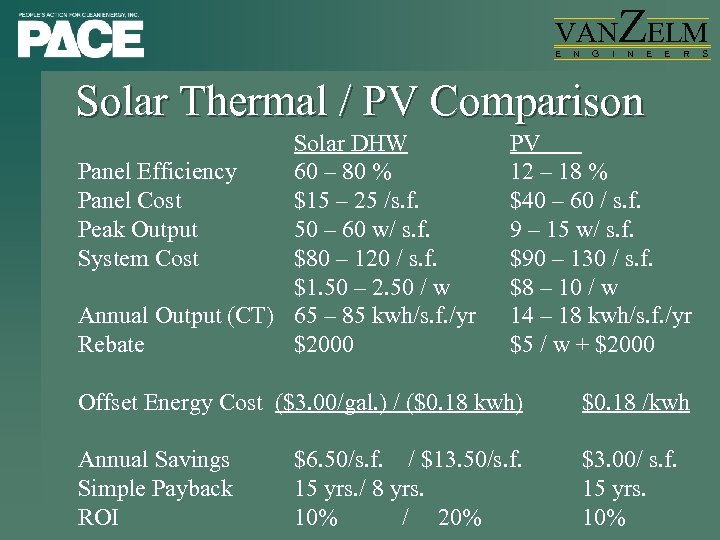
VAN E N G I ZELM N E E R Solar Thermal / PV Comparison Solar DHW Panel Efficiency 60 – 80 % Panel Cost $15 – 25 /s. f. Peak Output 50 – 60 w/ s. f. System Cost $80 – 120 / s. f. $1. 50 – 2. 50 / w Annual Output (CT) 65 – 85 kwh/s. f. /yr Rebate $2000 PV 12 – 18 % $40 – 60 / s. f. 9 – 15 w/ s. f. $90 – 130 / s. f. $8 – 10 / w 14 – 18 kwh/s. f. /yr $5 / w + $2000 Offset Energy Cost ($3. 00/gal. ) / ($0. 18 kwh) $0. 18 /kwh Annual Savings Simple Payback ROI $3. 00/ s. f. 15 yrs. 10% $6. 50/s. f. / $13. 50/s. f. 15 yrs. / 8 yrs. 10% / 20% S
VAN E N G I ZELM N E E Solar Power Information § § § § American Solar Energy Society, ases. org Interstate Renewable Energy Council, irecusa. org Million Solar Roofs, millionsolarroofs. com National Renewable Energy Laboratory, nrel. gov Solar Electric Power Association, solarelectricpower. org Solar Energy Industry Association, seia. org Institute for Sustainable Power, ispq. org US Dept. of Energy Office of Renewable Energy, eren. doe. gov R S
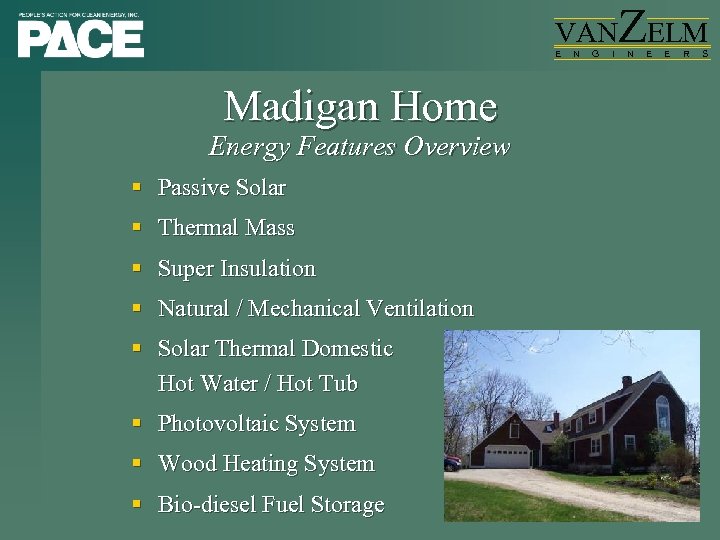
VAN E Madigan Home Energy Features Overview § Passive Solar § Thermal Mass § Super Insulation § Natural / Mechanical Ventilation § Solar Thermal Domestic Hot Water / Hot Tub § Photovoltaic System § Wood Heating System § Bio-diesel Fuel Storage N G I ZELM N E E R S
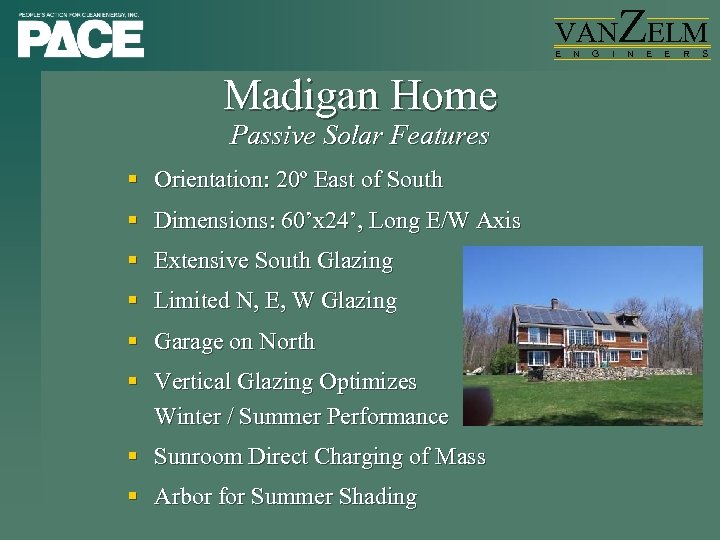
VAN E Madigan Home Passive Solar Features § Orientation: 20º East of South § Dimensions: 60’x 24’, Long E/W Axis § Extensive South Glazing § Limited N, E, W Glazing § Garage on North § Vertical Glazing Optimizes Winter / Summer Performance § Sunroom Direct Charging of Mass § Arbor for Summer Shading N G I ZELM N E E R S
VAN E N G I ZELM N Madigan Home Energy Conservation Features § Stress Skin Walls § 4” Polyurethane - R 30 § Roof and Attic • Attic: 18” Fiberglass – R 60 • Roof: 12” Fiberglass + 1 ½” ISO – R 45 § Foundation / Basement • Floor: 1” Polystyrene – R 6 • Foundation below grade: 2” Polystyrene – R 12 • Foundation above grade: 3” Polystyrene – R 18 § Windows • South Side: Double Glazed, Low-e, Argon – R 3. 5 • Other Sides: Triple Glazed, Low-e, Argon – R 5 E E R S
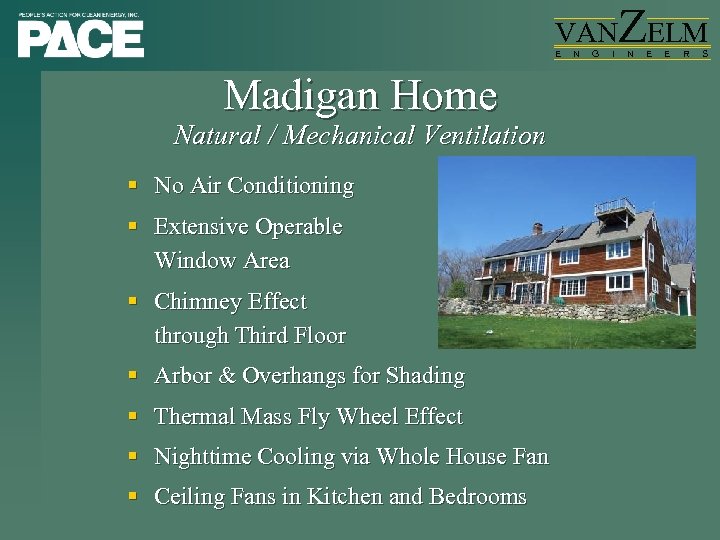
VAN E Madigan Home Natural / Mechanical Ventilation § No Air Conditioning § Extensive Operable Window Area § Chimney Effect through Third Floor § Arbor & Overhangs for Shading § Thermal Mass Fly Wheel Effect § Nighttime Cooling via Whole House Fan § Ceiling Fans in Kitchen and Bedrooms N G I ZELM N E E R S
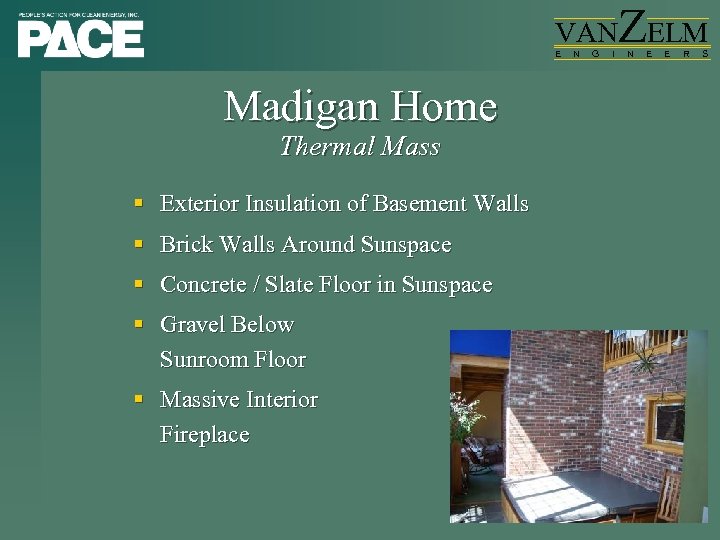
VAN E Madigan Home Thermal Mass § Exterior Insulation of Basement Walls § Brick Walls Around Sunspace § Concrete / Slate Floor in Sunspace § Gravel Below Sunroom Floor § Massive Interior Fireplace N G I ZELM N E E R S
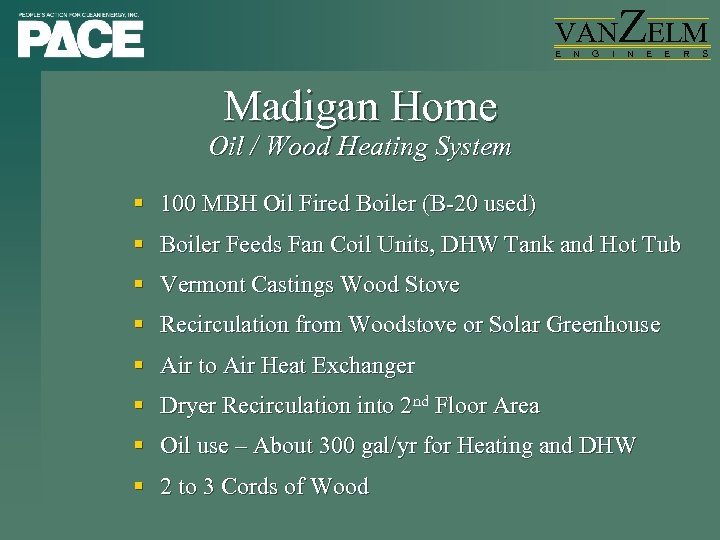
VAN E N G I ZELM N E E Madigan Home Oil / Wood Heating System § 100 MBH Oil Fired Boiler (B-20 used) § Boiler Feeds Fan Coil Units, DHW Tank and Hot Tub § Vermont Castings Wood Stove § Recirculation from Woodstove or Solar Greenhouse § Air to Air Heat Exchanger § Dryer Recirculation into 2 nd Floor Area § Oil use – About 300 gal/yr for Heating and DHW § 2 to 3 Cords of Wood R S
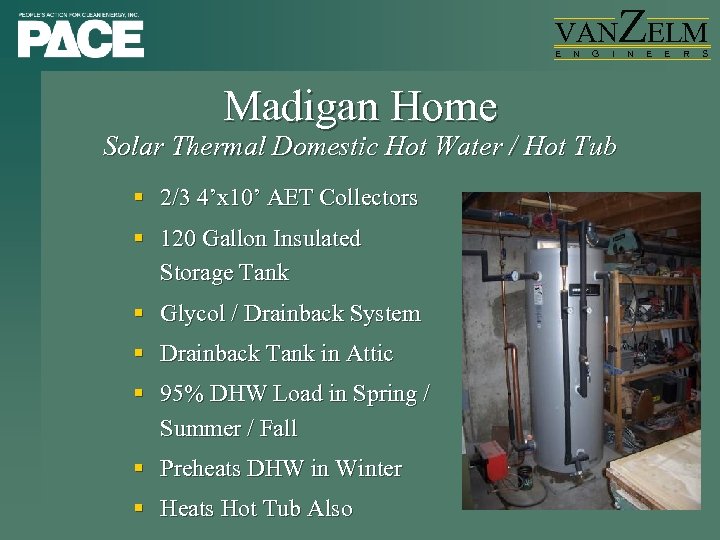
VAN E Madigan Home N G I ZELM Solar Thermal Domestic Hot Water / Hot Tub § 2/3 4’x 10’ AET Collectors § 120 Gallon Insulated Storage Tank § Glycol / Drainback System § Drainback Tank in Attic § 95% DHW Load in Spring / Summer / Fall § Preheats DHW in Winter § Heats Hot Tub Also N E E R S
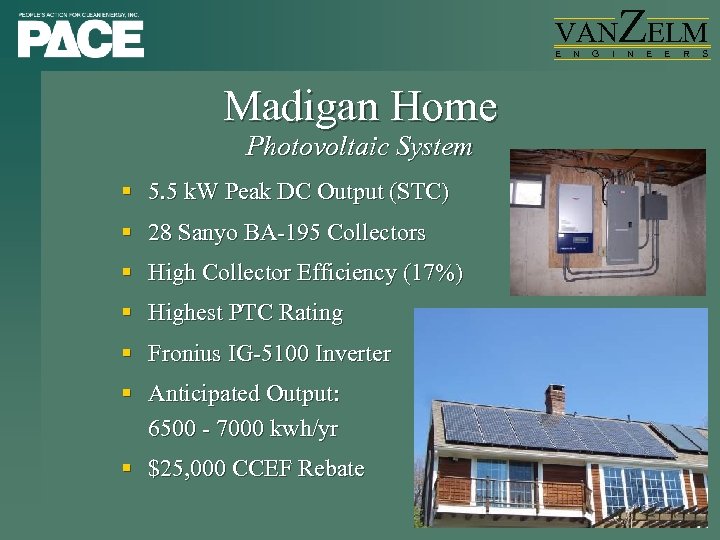
VAN E Madigan Home Photovoltaic System § 5. 5 k. W Peak DC Output (STC) § 28 Sanyo BA-195 Collectors § High Collector Efficiency (17%) § Highest PTC Rating § Fronius IG-5100 Inverter § Anticipated Output: 6500 - 7000 kwh/yr § $25, 000 CCEF Rebate N G I ZELM N E E R S
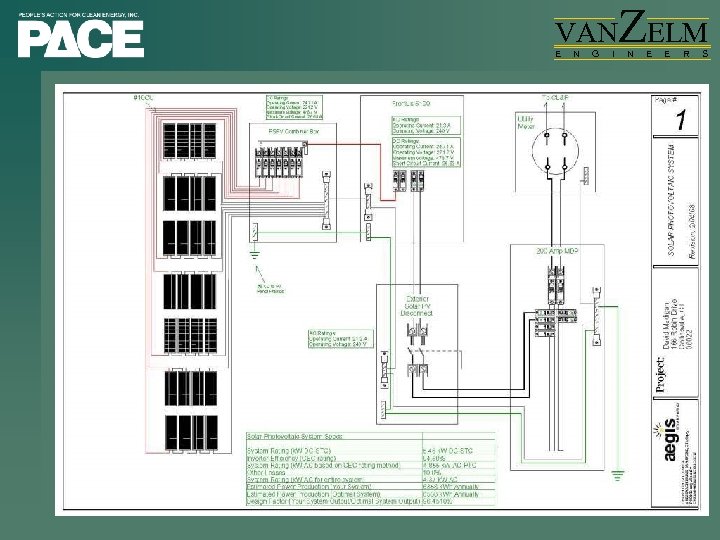
VAN E N G I ZELM N E E R S
VAN E Madigan Home Bio-Diesel Fuel Storage § 330 Gallon Tank w/ Electric Pump § B-100 Used April through November § B-20 Used in Winter § Supplies a 4 person “Co-op” N G I ZELM N E E R S
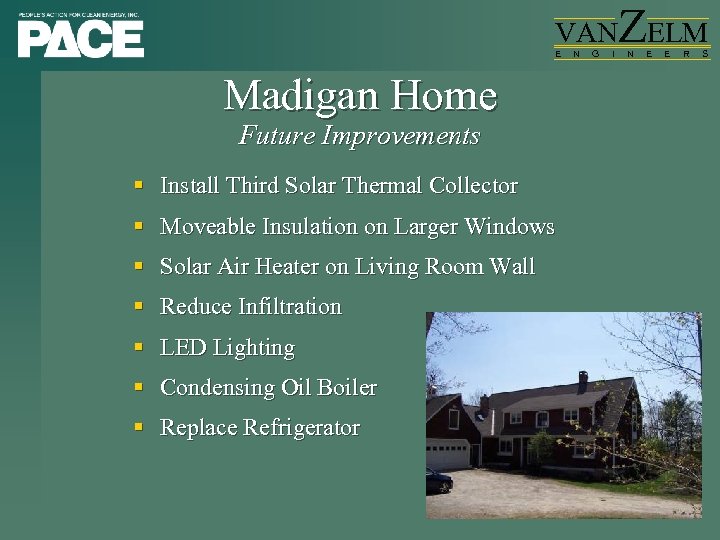
VAN E Madigan Home Future Improvements § Install Third Solar Thermal Collector § Moveable Insulation on Larger Windows § Solar Air Heater on Living Room Wall § Reduce Infiltration § LED Lighting § Condensing Oil Boiler § Replace Refrigerator N G I ZELM N E E R S
Скачать презентацию Madigan Home Tour and Solar Energy Seminar By
3cbdfa0625f9315400587b7312144d43.ppt