



Made by Yegor Karpov, group 443
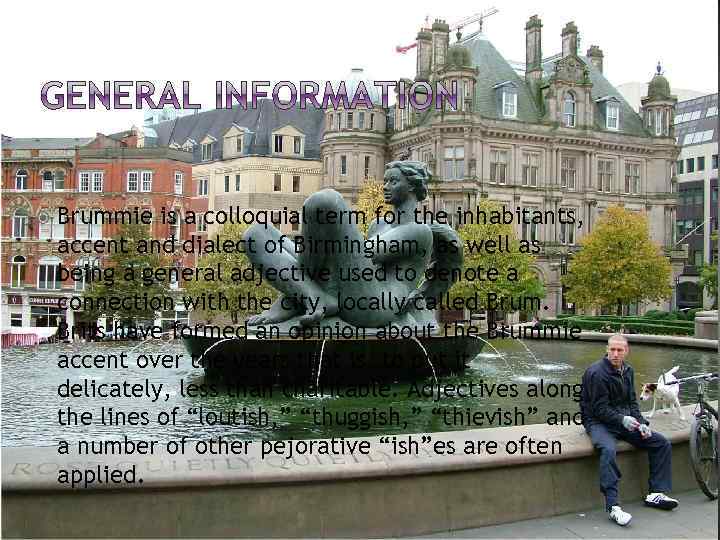
Brummie is a colloquial term for the inhabitants, accent and dialect of Birmingham, as well as being a general adjective used to denote a connection with the city, locally called Brum. Brits have formed an opinion about the Brummie accent over the years that is, to put it delicately, less than charitable. Adjectives along the lines of “loutish, ” “thuggish, ” “thievish” and a number of other pejorative “ish”es are often applied.
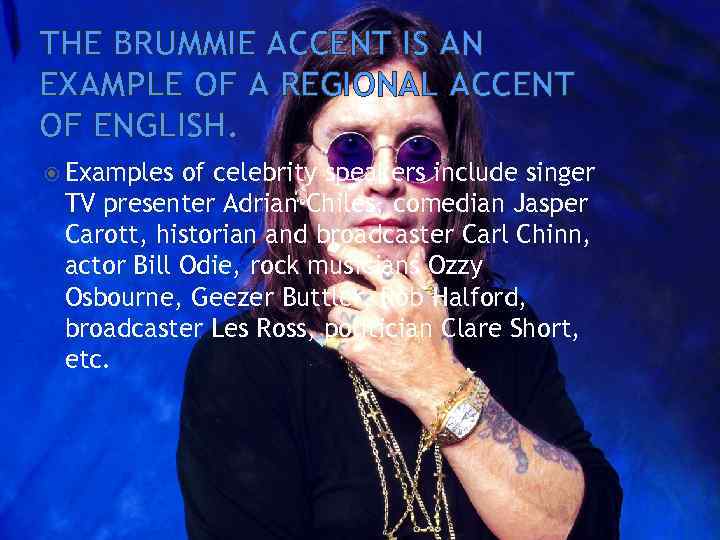
THE BRUMMIE ACCENT IS AN EXAMPLE OF A REGIONAL ACCENT OF ENGLISH. Examples of celebrity speakers include singer TV presenter Adrian Chiles, comedian Jasper Carott, historian and broadcaster Carl Chinn, actor Bill Odie, rock musicians Ozzy Osbourne, Geezer Buttler, Rob Halford, broadcaster Les Ross, politician Clare Short, etc.
It is not the only accent of the West Midlands, although the term Brummie is often erroneously used in referring to all accents of the region. It is markedly distinct from the traditional accent of the adjacent Black Country although modern-day population mobility has tended to blur the distinction. For instance, Dudley -born comedian Lenny Henry, Daniel Taylor, and award winning soap actress Jan Pearson are sometimes mistaken for Brummie-speakers by people outside the West Midlands county.

The Brummie accent and the Coventry accent are also quite distinct in their differences, despite only 17 miles ( 27 km) separating the cities. To the untrained ear, however, all of these accents may sound very similar, just as British English speakers can find it hard to distinguish between different North American accents, or Australian and New Zealand accents. As with all English regional accents, the Brummie accent also grades into RP English. The accent of presenter Cat Deeley is listed by her voiceover agency, Curtis Brown, as "RP/Birmingham".
Brummie varies greatly all across Birmingham. Like most cities, the accent changes relative to the area of the city. A common misconception is that everyone in Birmingham speaks the same accent. There also differences between Brummie and Black Country accents not readily apparent to people from outside the West Midlands. A Black Country accent and a Birmingham accent can be hard to distinguish if neither accent is that broad. The phonetician John Wells has admitted that he cannot tell any difference between the accents. Urszula Clark has proposed the FACE vowel as a difference, with Birmingham speakers' using /ʌɪ/ and Black Country speakers' using /æɪ/She also mentions that Black Country speakers are more likely to use /ɪʊ/ where most other accents use /ju/ (in words such as new, Hugh, stew, etc. ).
Below are some common features of a recognisable Brummie accent (a given speaker may not necessarily use all, or use a feature consistently). The letters enclosed in square brackets – [] – use the International Phonetic alphabet. The corresponding example texts enclosed in double quotes (") are spelt so that a reader using Received Pronunciation (RP) can approximate the sounds.
Stereotypes A study was conducted in 2008 where people were asked to grade the intelligence of a person based on their accent and the Brummie accent was ranked as the least intelligent accent. It even scored lower than being silent, an example of the stereotype attached to the Brummie accent. [ According to Birmingham English: A Sociolinguistic Study (Steve Thorne, 2003), among UK listeners "Birmingham English in previous academic studies and opinion polls consistently fares as the most disfavoured variety of British English, yet with no satisfying account of the dislike". He alleges that, overseas visitors in contrast find it "lilting and melodious", and from this claims that such dislike is driven by various linguistic myths and social factors peculiar to the UK ("social snobbery, negative media stereotyping, the poor public image of the City of Birmingham, and the north/south geographical and linguistic divide"). However, the Brummie accent is the only 'northern' accent to receive such attention. For instance, despite the city's cultural and innovative history, its industrial background (as depicted by the arm-and-hammer in Birmingham`s coat of arms) has led to a muscular and unintelligent stereotype: a "Brummagem screwdriver" or "Brummie screwdriver" is UK slang for a hammer. Steve Thorne also cites the mass media and entertainment industry where actors, usually non-Birmingham, have used inaccurate accents and/or portrayed negative roles.
So let’s take a look at a sample Brummie dialect, and see if there is anything intrinsically grating about it. And who better to use as a dialect sample than Geezer Butler, bassist for Birmingham’s own Black Sabbath. Take a listen:

1. ) He pronounces words like “realize” and “tried” with something like IPA ɒi (so that these words sound a bit like American “realoyze” and “troyed”). This is vaguely reminiscent of how some contemporary Australian English speakers say these words. 2. ) As in Northern English accents, the vowel in “puppies” and “blood” is pronounced higher in the mouth than in Southern English accents, ranging from IPA ʊ to ɔ (i. e. “puppies” sounds a bit like “pooppies” or “pawppies”). 3. ) The diphthong in “about” and “house” is raised, with a prononunciation ranging from IPAæʊ to ɛʉ (“heh-oose”). This is similar to how the diphthong is pronounced in some middle-class Dublin accents. 4. ) Words like “most” and “homes” are pronounced with a very low-starting diphthong, typically IPA ʌʊ although it can start even lower, making “goat” sound like “gout” to outside ears. This pronunciation sounds a bit like exaggerated Cockney.
Brummie tends to sound like it has been patched together from different bits and pieces of other accents. To put it crudely, it sounds a bit like somebody put Cockney, Australian, Northern English and Irish accents through a linguistic blender. And that, perhaps, is one of the reasons why this accent is stigmatized in the UK. In some ways it can seem a bit “muddled” to outside listeners. In some sense, Birmingham isn’t just in the “Midlands” geographically, but linguistically as well.
