


 Скачать презентацию Macroeconomics ECO 110 1 AAU Lecture 11 INTERNATIONAL TRADE
5c750a287301d402681e8406c55cf186.ppt
- Количество слайдов: 50
 Macroeconomics ECO 110/1, AAU Lecture 11 INTERNATIONAL TRADE Eva Hromádková, 3. 5 2010
 Trade Patterns of CR 2 Czech Republic is a small open economy: Imports are goods and services purchased from foreign sources: CR (2009): 1, 981 bil. CZK; 82% of 2008 values Exports are goods and services sold to foreign buyers. CR (2009): 2, 132 bil. CZK; 86% of 2008 values GDP = 3, 627 bil CZK; export ratio = 59%
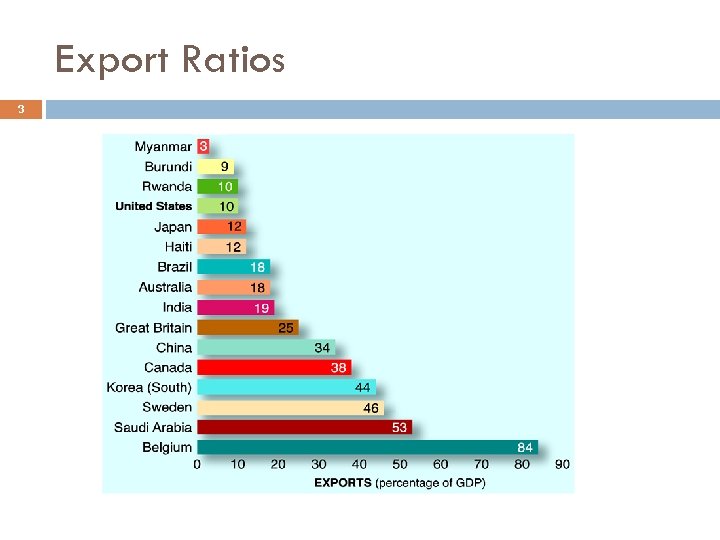 Export Ratios 3
 Trade Balances 4 The trade balance is the difference between the value of exports and imports. Any imbalance in one country’s trade must be offset by reverse imbalances elsewhere. Trade balance = exports – imports
 Trade Balances II 5 Trade deficit is the amount by which the value of imports exceeds the value of exports in a given time period. Trade surplus is the amount by which the value of exports exceeds the value of imports in a given time period. CR is running a trade surplus 151 bil. CZK (2009); 67 bil. CZK (2008)
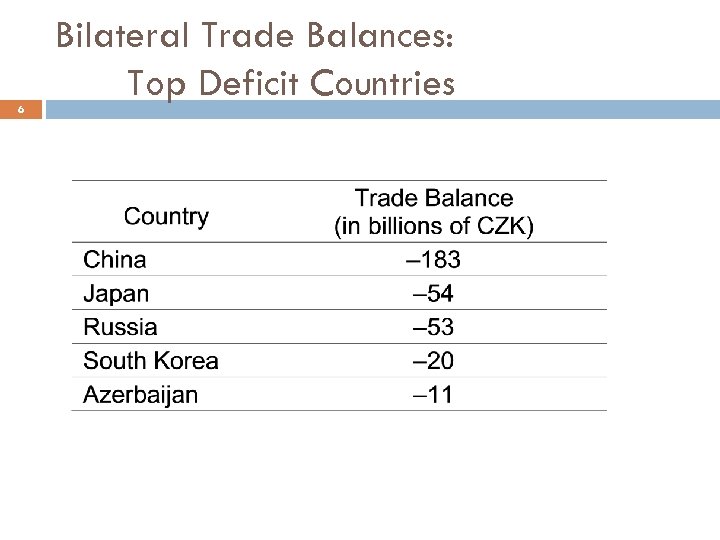 6 Bilateral Trade Balances: Top Deficit Countries
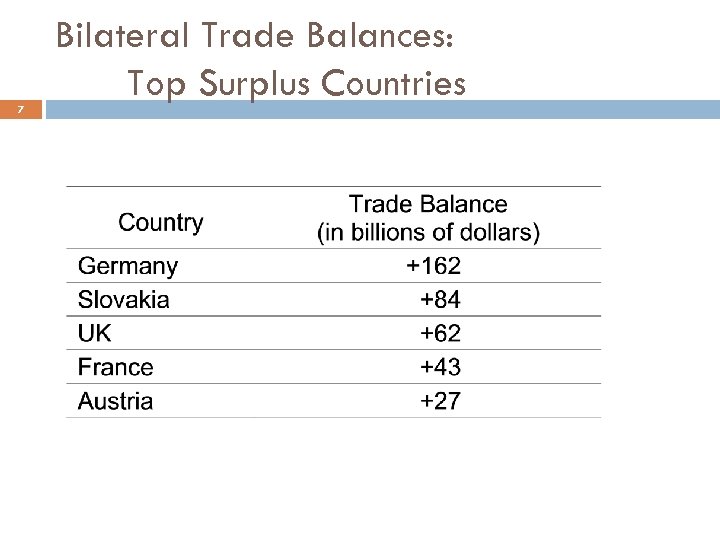 7 Bilateral Trade Balances: Top Surplus Countries
 Motivation to Trade 8 LO 2 Why trade when. . . we import many of the things we also export. . we could produce many of the other things we import. . we seem to worry so much about trade imbalances.
 Specialization 9 Trade allows nations to specialize and specialization increases total output. Example: Would you grow your food and produce all your possessions? Or would you rather work in your field and buy everything else on the market? LO 2 Trade increases world output and the standards of living in all trading countries.
 Production and Consumption Without Trade 10 The gains from trade can be illustrated using production possibilities curves. LO 2 Production possibilities – The alternative combinations of final goods and services that could be produced in a given time period with all available resources and technology. Consumption possibilities - The alternative combinations of goods and services that a country could consume in a given time period. In the absence of trade, a country’s consumption possibilities are identical to its production possibilities.
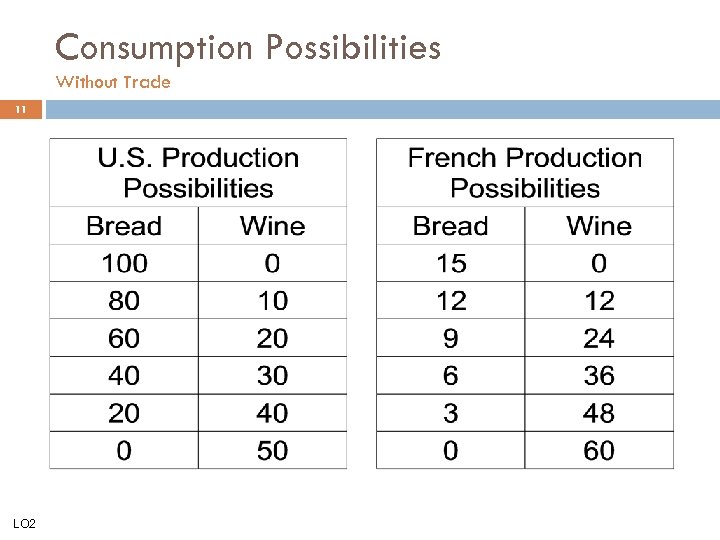 Consumption Possibilities Without Trade 11 LO 2
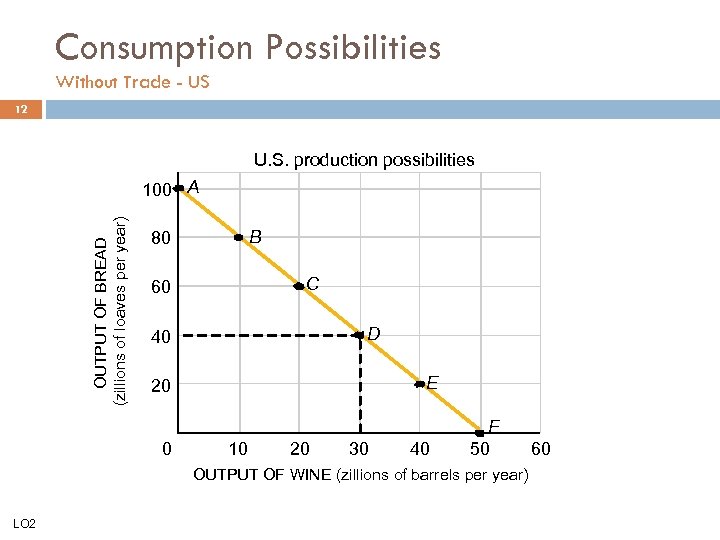 Consumption Possibilities Without Trade - US 12 U. S. production possibilities OUTPUT OF BREAD (zillions of loaves per year) 100 A B 80 C 60 D 40 E 20 0 10 20 30 40 F 50 OUTPUT OF WINE (zillions of barrels per year) LO 2 60
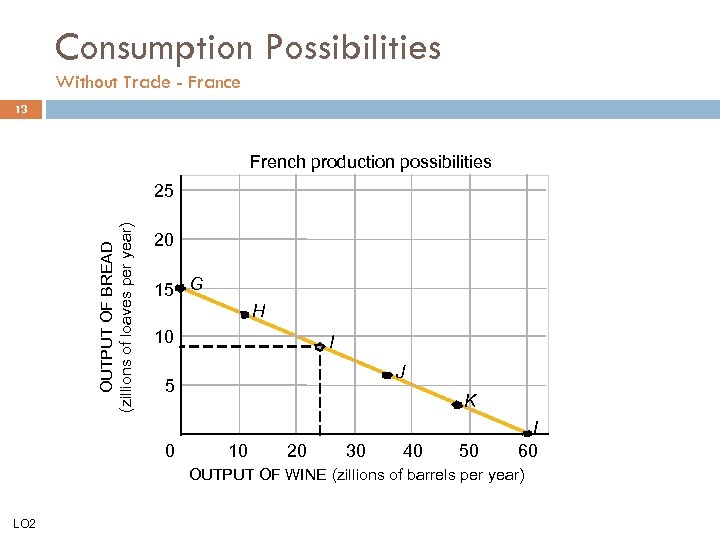 Consumption Possibilities Without Trade - France 13 French production possibilities OUTPUT OF BREAD (zillions of loaves per year) 25 20 15 G H 10 I J 5 0 K 10 20 30 40 50 L 60 OUTPUT OF WINE (zillions of barrels per year) LO 2
 Production and Consumption With Trade 14 To assess the potential gain from trade, we need to consider the combined output of trading nations. By changing the mix of output in each trading country, we can increase total world output. Each country produces those goods it makes best, then trades with other countries to acquire the goods it desires to consume. LO 2 E. g. : US is better in bread and France in wine making When a country engages in international trade, its consumption possibilities always exceed its production possibilities.
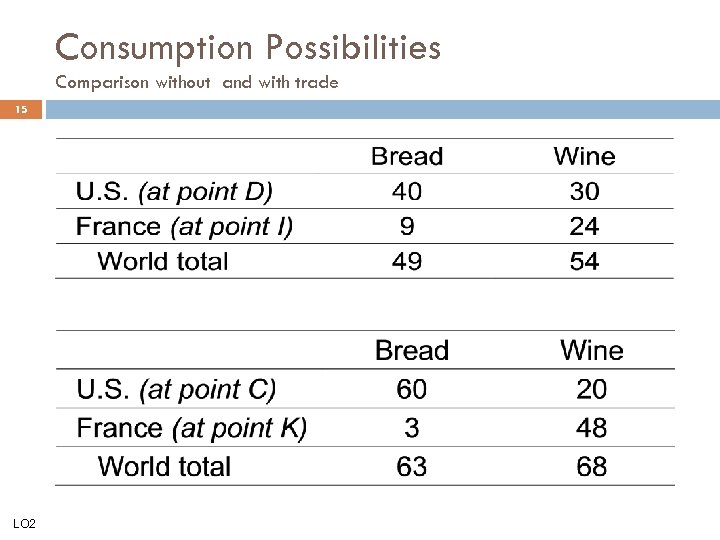 Consumption Possibilities Comparison without and with trade 15 LO 2
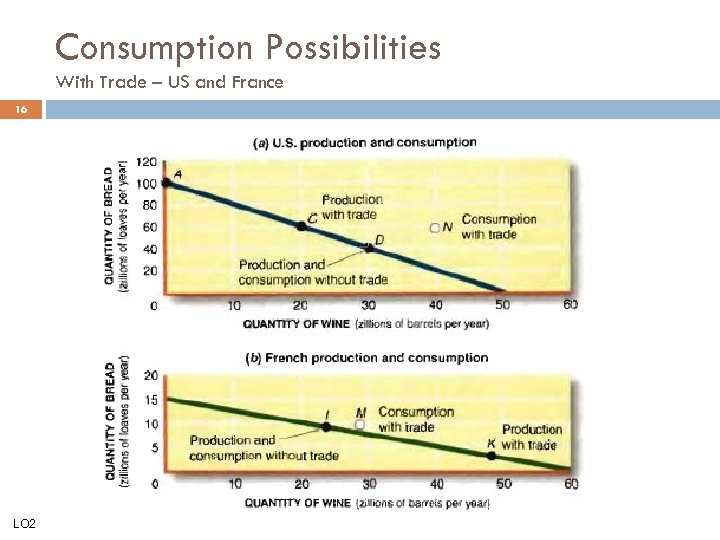 Consumption Possibilities With Trade – US and France 16 LO 2
 Comparative Advantage 17 Although international trade can make everyone better off, it’s not obvious which goods should be traded, or on what terms. The decision to export is based on comparative advantage: The ability of a country to produce a specific good at a lower relative opportunity cost than its trading partners. LO 1 1 wine = 2 breads – USA advantage in bread making 1 wine = 0. 25 breads – France advantage in wine making World output, and thus potential gains from trade, will be maximized when each country pursues its comparative advantage.
 Absolute Advantage 18 The absolute advantages in production do not matter LO 1 Absolute advantage – The ability of a country to produce a specific good with fewer resources (per unit of output) than other countries.
 Terms of Trade 19 The terms of trade establish the trading rate. Terms of trade is the rate at which goods are exchanged – the amount of good A given up for good B in trade. A country will not trade unless the terms of trade are superior to domestic opportunities. The terms of trade between two countries will lie somewhere between their respective opportunity costs in production. Ex: 1 loaf of bread between ½ barrel of wine (US) and 4 barrels of wine (France); in our example 1 loaf of bread = 3. 33 barrel of wine (large gain for US)
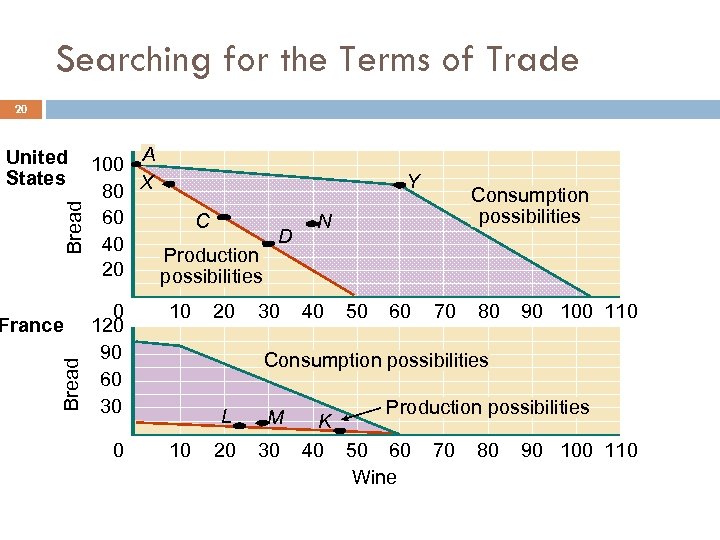 Searching for the Terms of Trade 20 Bread United States Bread France A 100 80 X 60 C D 40 Production 20 possibilities 0 120 90 60 30 10 20 30 Y Consumption possibilities N 40 50 60 70 80 90 100 110 Consumption possibilities L M 20 30 Production possibilities K 40 50 60 Wine 70 80 90 100 110
 The Role of Markets and Prices 21 The decision to import or export a particular good is often left up to the market decisions of individual consumers and producers. The terms of trade, like the price of any good, will depend on the willingness of market participants to buy or sell at various prices. But will stay within the limit terms of trade
 Protectionist Pressures 22 LO 3 Although the potential gains from trade are impressive, not everyone favors free trade. Imports typically compete with a domestic industry.
 Protectionist Pressures Microeconomic Pressures 23 The affected industries will try to restrict imports in order to preserve their own jobs and incomes: Import competing industries E. g. wine producers in California But also a positive pressure: Export industries: import redistributes income from import-competing industries to export industries E. g. wheat producers in Kansas In total, everybody should be better off… LO 3
 Protectionist Pressures Additional Pressures 24 Selfish micro interests are not the only source of trade restrictions. Other arguments are used to restrict trade 1. 2. 3. 4. LO 3 National Security Concerns Dumping Infant Industries Improving the Terms of Trade
 Protectionist pressures 1. National Security Concerns 25 LO 3 Essential defense-related goods are vital during times of war. A war could disrupt this flow leaving us vulnerable. Exporting vital technology to a potential enemy is not wise. E. g: food, steel industry
 Protectionist pressures 2. Dumping 26 Dumping is the sale of goods in export markets at prices below domestic prices (even below production costs) Q: LO 3 What is he main goal of importers then? Import competing industries are placed at risk
 Protectionist pressures 3. Infant Industries 27 LO 3 Even normal export prices might make it difficult or impossible for a new domestic industry to develop. These industries may need temporary protection from imports. Trade restrictions are justified only if there is tangible evidence that the industry can develop a comparative advantage reasonably quickly. (e. g. computer industry in Brazil)
 Protectionist pressures 4. Improving the Terms of Trade 28 LO 3 The distribution of the gains from trade depends on the terms of trade. Putting restrictions on imports can move the terms of trade in our favor We would end up with a larger share of the gains from trade. This strategy can backfire - retaliations
 Barriers to Trade 29 1. 2. 3. 4. 5. LO 3 The microeconomic losses associated with trade give rise to a constant clamor for trade restrictions. Embargoes Tariffs Quotas Voluntary restraint agreements Non-tariff barriers
 Barriers to trade 1. Embargoes 30 The sure-fire way to restrict trade is simply to eliminate it. An embargo is a prohibition against trading particular goods. Ex. 1: on Soviet mink and fur (US) Ex. 2: on Cuban goods (cigars, sugar) Ex. 3: on Georgian wine and mineral water (Russia) LO 3
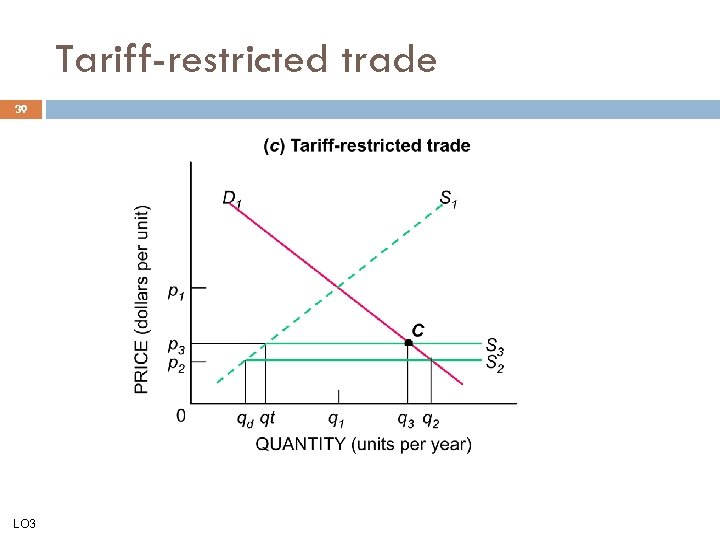
 Barriers to trade 2. Tariffs 31 LO 3 A more frequent trade restriction is a tariff. A tariff is a tax (duty) imposed on imported goods. A tariff makes imported goods more expensive to domestic consumers, and less competitive with domestically priced goods.
 Barriers to trade 3. Quotas 32 The same outcome of a tariff can be attained more directly by imposing an import quota. A quota is a limit on the quantity of a good that may be imported in a given time period. Ex. 1: max 950 gal. of Jamaican ice-cream (US) Ex. 2: lower quotas on the import of US chicken meat (Russia) Russia LO 3 is the biggest export market for US chicken meat
 Comparative Effects 33 LO 3 The effect of quotas on trade is different than the effect of tariffs.
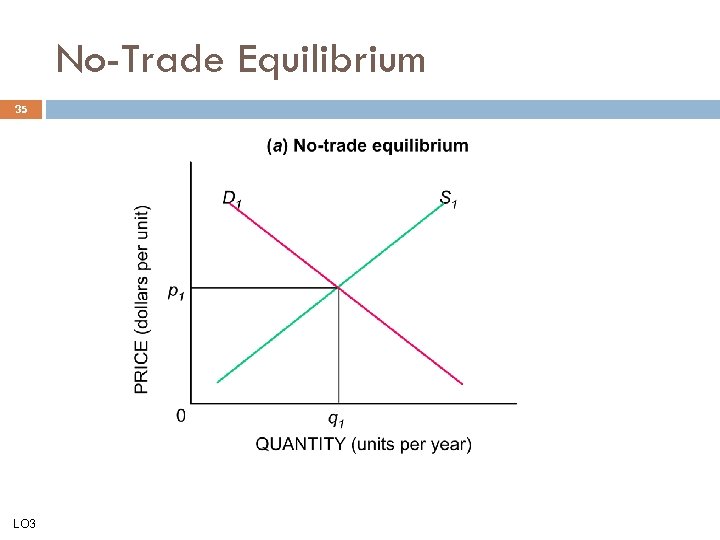
 No-Trade Equilibrium 34 The equilibrium price is completely determined by domestic demand supply curves. Equilibrium price – The price at which the quantity of a good demanded in a given time period equals the quantity supplied. LO 3
 No-Trade Equilibrium 35 LO 3
 Free-Trade Equilibrium 36 LO 3 Free trade allows the import of unlimited quantity of foreign supplies at the world price. Free trade results in reduced prices and increased consumption.
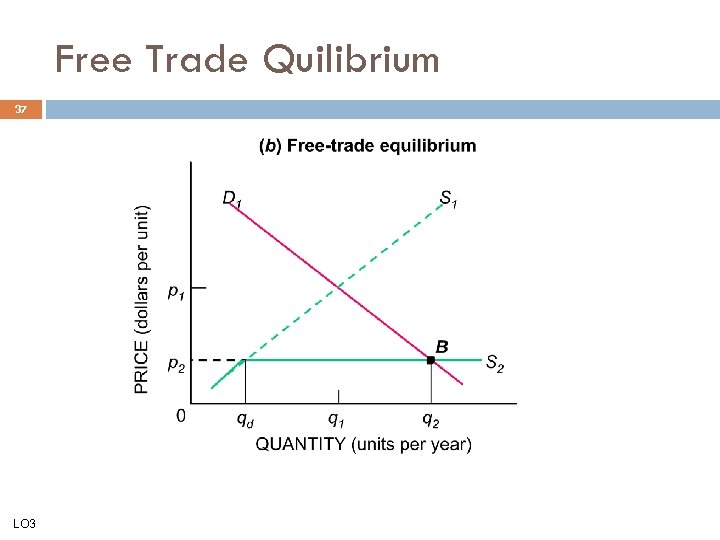 Free Trade Quilibrium 37 LO 3
 Tariff-restricted Trade 38 LO 3 Tariffs raise the price of imports and shifts the import supply curve upward. Domestic prices rise, domestic production rises, and domestic consumption falls.
 Tariff-restricted trade 39 LO 3
 Quota-restricted Trade 40 LO 3 Quotas are a greater threat to competition than tariffs because quotas preclude additional imports at any price.
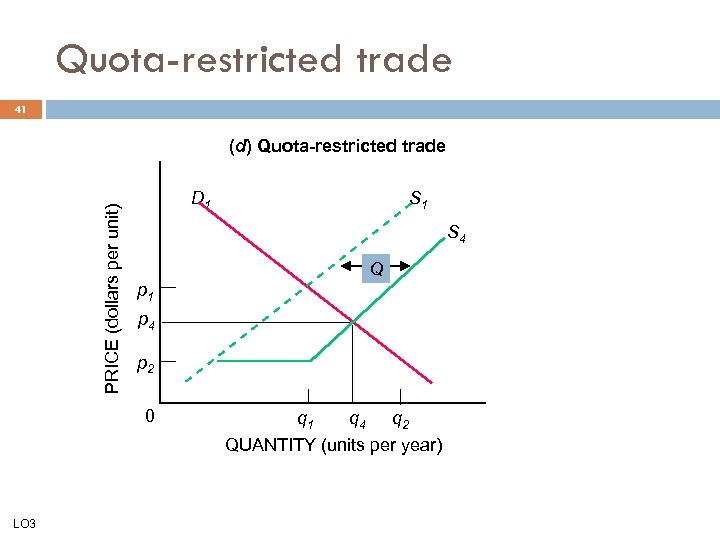 Quota-restricted trade 41 PRICE (dollars per unit) (d) Quota-restricted trade D 1 S 4 Q p 1 p 4 p 2 0 LO 3 S 1 q 4 q 2 QUANTITY (units per year)
 Barriers to trade 4. Voluntary Restraint Agreements 42 A slight variant of quotas has been used in recent years. A voluntary restraint agreement (VRA) is an agreement to reduce the volume of trade in a specific good – a “voluntary” quota. Based on negotiation E. g. Japan’s agreement not to export more than 1. 68 mil cars to US in 1981 LO 3
 Barriers to trade 5. Nontariff Barriers 43 LO 3 Embargoes, export controls, tariffs, and quotas are the most visible barriers to trade, but they are only the tip of the iceberg. e. g: product standards, licensing restrictions, restrictive procurement practices, and other nontariff barriers restrict roughly 15 percent of imports (US).
 Multilateral Trade Pacts 44 Trade policy is a continuing conflict between the proponents of free trade and the special interests that profit from trade protection. The long-term trend is towards lowering trade barriers, thereby increasing global competition. Protectionist forces are being countered by the worldwide recognition of the gains from trade. Exporters and firms that use imported inputs push for free trade.
 Global Pacts: GATT and WTO 45 The granddaddy of the multilateral, multiyear freetrade pacts was the General Agreement on Tariffs and Trade (GATT) in 1947. The 1994 GATT pact created the World Trade Organization (WTO) to enforce free-trade rules. The WTO has become the world’s trade police force. Latest round – Doha (2001) - 141 countries
 WTO Protests 46 Some people see free trade as a mixed blessing. Environmentalists worry about depletion of resources, congestion and pollution. Labor organizations worry about depressed wages and working conditions. Third World countries worry about an unfair trade playing field.
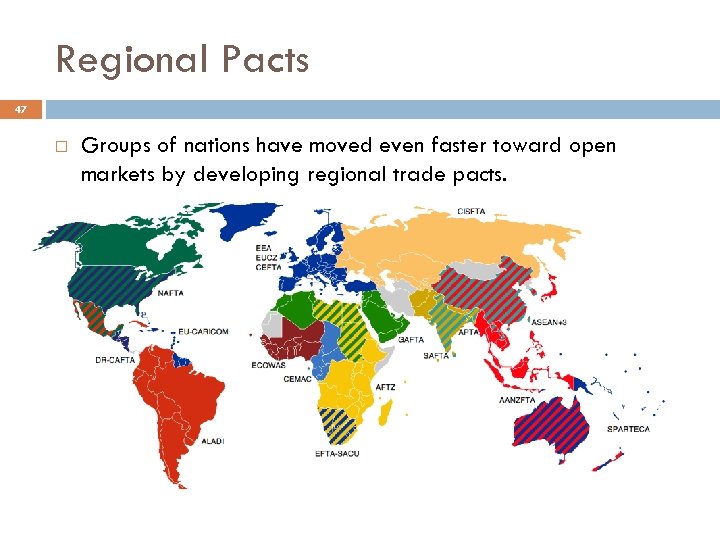 Regional Pacts 47 Groups of nations have moved even faster toward open markets by developing regional trade pacts.
 European Union 48 The European Union (EU) is a regional pact that virtually eliminates national boundaries between 25 countries. The EU eliminated trade barriers and permits full inter-country mobility of workers and capital. In effect, Europe has become one large unified market. EFTA (Iceland, Norway, Swiss, Liechtenstein) + CEFTA
 NAFTA 49 In December 1992, the United States, Canada, and Mexico signed the North American Free Trade Agreement (NAFTA). The ultimate goal of NAFTA is to eliminate all trade barriers between these three countries.
 CAFTA 50 The success of NAFTA prompted a similar 2005 agreement between the U. S. and central American nations. The Central American Free Trade Agreement (CAFTA) aims to eliminate tariffs and standardize trade and investment policies in CAFTA nations.