


 Скачать презентацию Macroeconomic Theory Of Open Economy A MACROECONOMIC THEORY
59d8ddf6849a95a103cf895df8bca89d.ppt
- Количество слайдов: 41
 Macroeconomic Theory Of Open Economy A MACROECONOMIC THEORY OF THE OPEN ECONOMY 0
 Introduction § The previous chapter explained the basic concepts and vocabulary of the open economy: net exports (NX), net capital outflow (NCO), and exchange rates. § This chapter ties these concepts together into a theory of the open economy. § We will use this theory to see how govt policies and various events affect the trade balance, exchange rate, and capital flows. § We start with the loanable funds market… A MACROECONOMIC THEORY OF THE OPEN ECONOMY 1
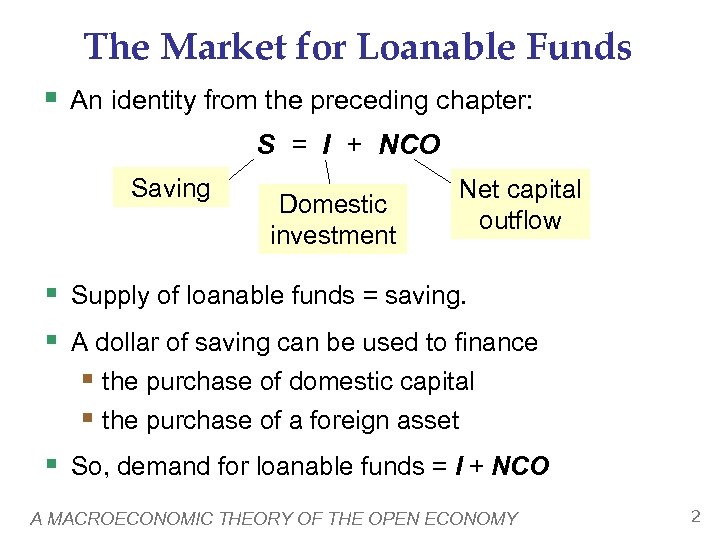 The Market for Loanable Funds § An identity from the preceding chapter: S = I + NCO Saving Domestic investment Net capital outflow § Supply of loanable funds = saving. § A dollar of saving can be used to finance § the purchase of domestic capital § the purchase of a foreign asset § So, demand for loanable funds = I + NCO A MACROECONOMIC THEORY OF THE OPEN ECONOMY 2
 The Market for Loanable Funds § Recall: § S depends positively on the real interest rate, r. § I depends negatively on r. § What about NCO? A MACROECONOMIC THEORY OF THE OPEN ECONOMY 3
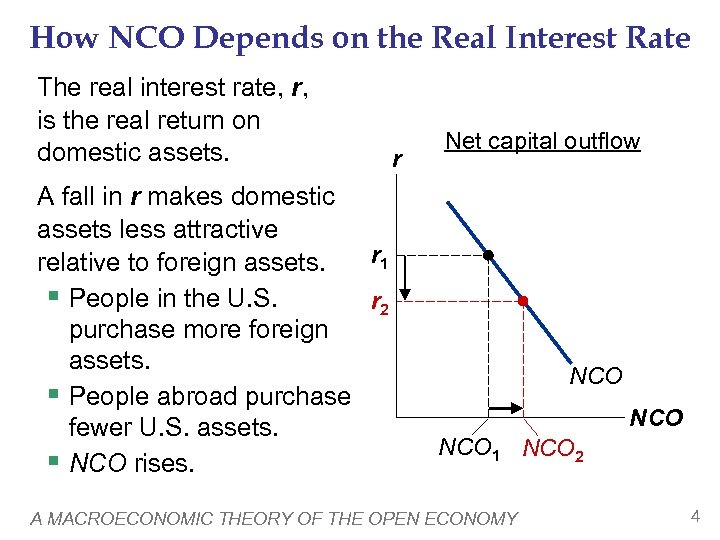 How NCO Depends on the Real Interest Rate The real interest rate, r, is the real return on domestic assets. A fall in r makes domestic assets less attractive r 1 relative to foreign assets. § People in the U. S. r 2 purchase more foreign assets. § People abroad purchase fewer U. S. assets. § NCO rises. r Net capital outflow NCO NCO 1 NCO 2 A MACROECONOMIC THEORY OF THE OPEN ECONOMY 4
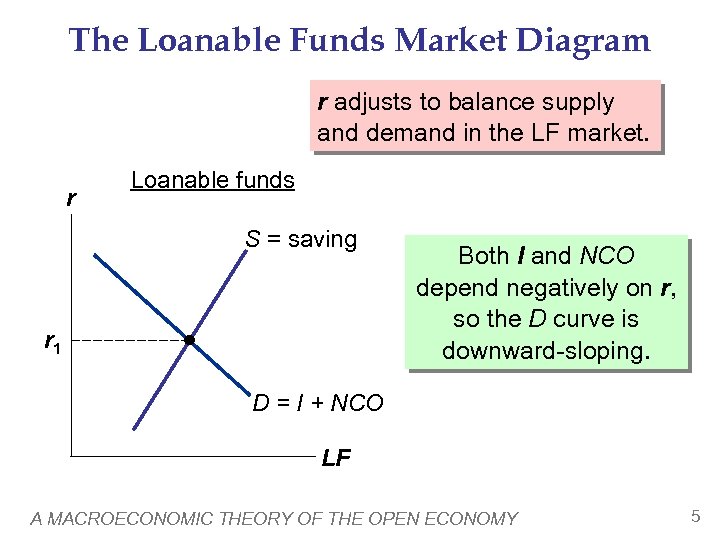 The Loanable Funds Market Diagram r adjusts to balance supply and demand in the LF market. r Loanable funds S = saving r 1 Both I and NCO depend negatively on r, so the D curve is downward-sloping. D = I + NCO LF A MACROECONOMIC THEORY OF THE OPEN ECONOMY 5
 Budget deficits and capital flows § Suppose the government runs a budget deficit (previously, the budget was balanced). § Use the appropriate diagrams to determine the effects on the real interest rate and net capital outflow. 6
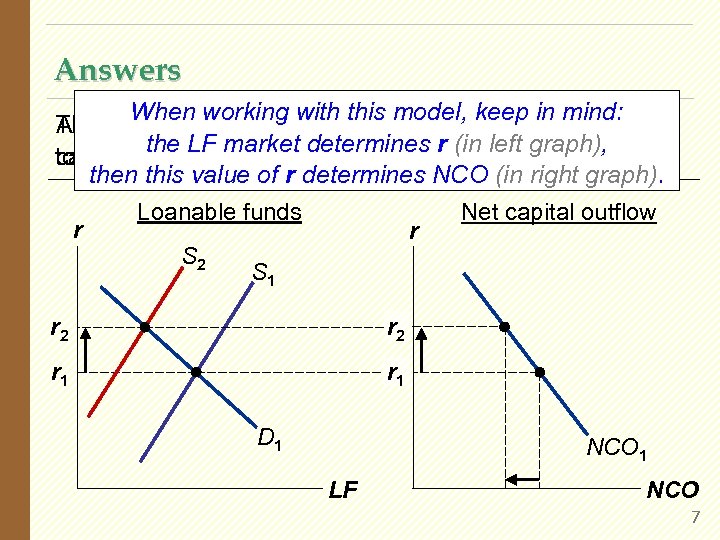 Answers When working with this model, keep in mind: The higher r makes U. S. saving more attractive of LF, A budget deficit reduces bonds and the supply relative the LF market determines r (in left graph), to foreign to rise. reduces NCO. causing r bonds, then this value of r determines NCO (in right graph). Loanable funds Net capital outflow r r S 2 S 1 r 2 r 1 D 1 NCO 1 LF NCO 7
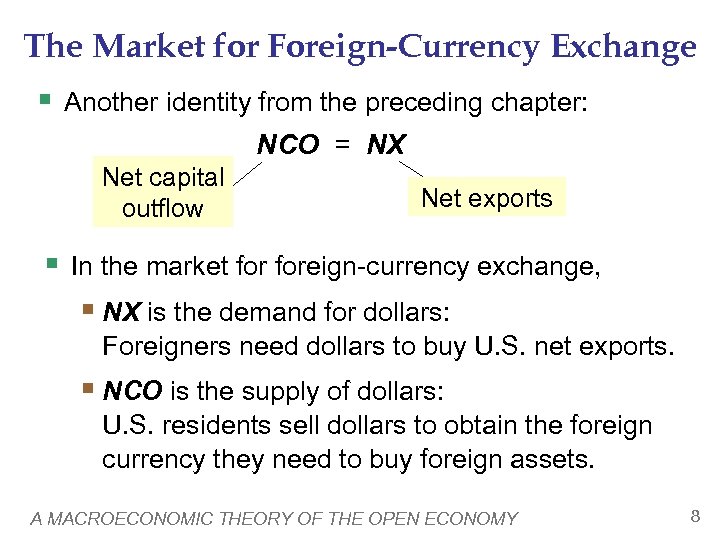 The Market for Foreign-Currency Exchange § Another identity from the preceding chapter: NCO = NX Net capital outflow Net exports § In the market foreign-currency exchange, § NX is the demand for dollars: Foreigners need dollars to buy U. S. net exports. § NCO is the supply of dollars: U. S. residents sell dollars to obtain the foreign currency they need to buy foreign assets. A MACROECONOMIC THEORY OF THE OPEN ECONOMY 8
 The Market for Foreign-Currency Exchange § Recall: The U. S. real exchange rate (E) measures the quantity of foreign goods & services that trade for one unit of U. S. goods & services. § E is the real value of a dollar in the market foreign-currency exchange. A MACROECONOMIC THEORY OF THE OPEN ECONOMY 9
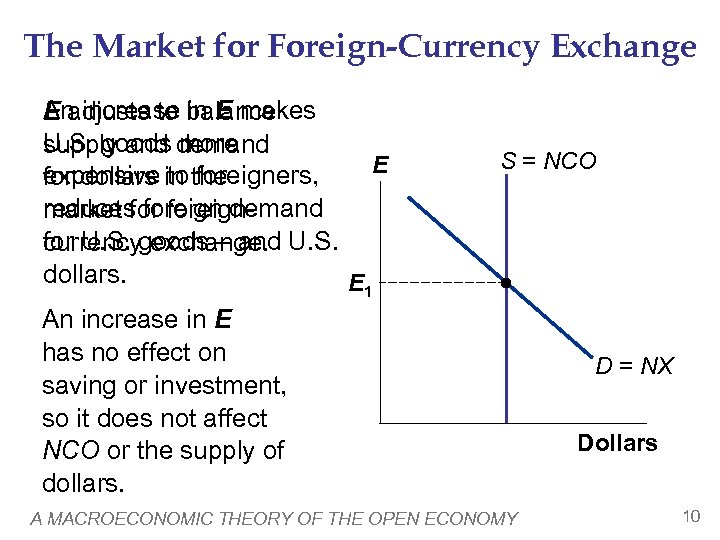 The Market for Foreign-Currency Exchange An increase in E makes E adjusts to balance U. S. goods more supply and demand E expensive to foreigners, for dollars in the reduces foreign demand market foreignfor U. S. exchange. currencygoods – and U. S. dollars. E 1 An increase in E has no effect on saving or investment, so it does not affect NCO or the supply of dollars. S = NCO A MACROECONOMIC THEORY OF THE OPEN ECONOMY D = NX Dollars 10
 FYI: Disentangling Supply and Demand When a U. S. resident buys imported goods, does the transaction affect supply or demand in the foreign exchange market? Two views: 1. The supply of dollars increases. The person needs to sell her dollars to obtain the foreign currency she needs to buy the imports. 2. The demand for dollars decreases. The increase in imports reduces NX, which we think of as the demand for dollars. (So, NX is really the net demand for dollars. ) Both views are equivalent. For our purposes, it’s more convenient to use the second. A MACROECONOMIC THEORY OF THE OPEN ECONOMY 11
 FYI: Disentangling Supply and Demand When a foreigner buys a U. S. asset, does the transaction affect supply or demand in the foreign exchange market? Two views: 1. The demand for dollars increases. The foreigner needs dollars in order to purchase the U. S. asset. 2. The supply of dollars falls. The transaction reduces NCO, which we think of as the supply of dollars. (So, NCO is really the net supply of dollars. ) Again, both views are equivalent. We will use the second. A MACROECONOMIC THEORY OF THE OPEN ECONOMY 12
 The budget deficit, exchange rate, and NX § Initially, the government budget is balanced and trade is balanced (NX = 0). § Suppose the government runs a budget deficit. As we saw earlier, r rises and NCO falls. § How does the budget deficit affect the U. S. real exchange rate? The balance of trade? 13
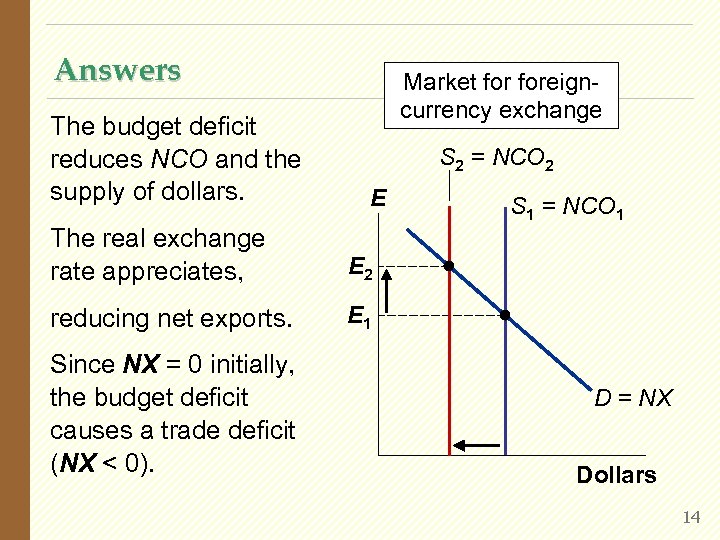 Answers The budget deficit reduces NCO and the supply of dollars. Market foreigncurrency exchange S 2 = NCO 2 E The real exchange rate appreciates, E 2 reducing net exports. S 1 = NCO 1 E 1 Since NX = 0 initially, the budget deficit causes a trade deficit (NX < 0). D = NX Dollars 14
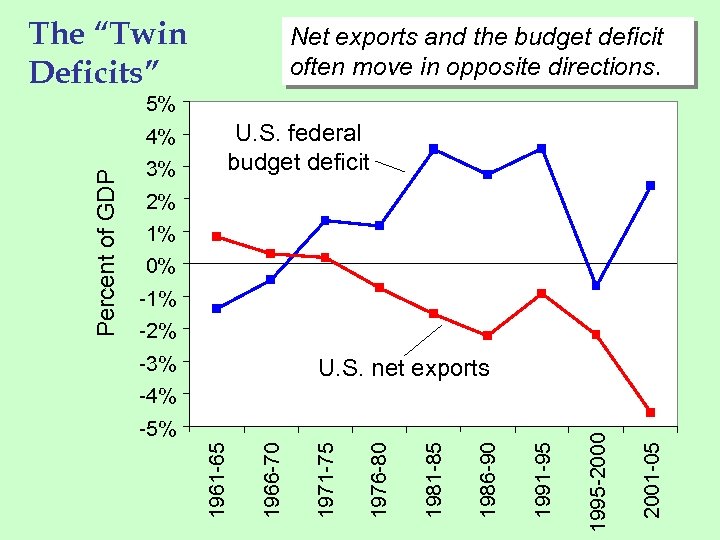 The “Twin Deficits” Net exports and the budget deficit often move in opposite directions. 5% 3% U. S. federal budget deficit 2% 1% 0% -1% -2% -3% U. S. net exports 2001 -05 1991 -95 1986 -90 1981 -85 1976 -80 1971 -75 1966 -70 -5% 1995 -2000 -4% 1961 -65 Percent of GDP 4%
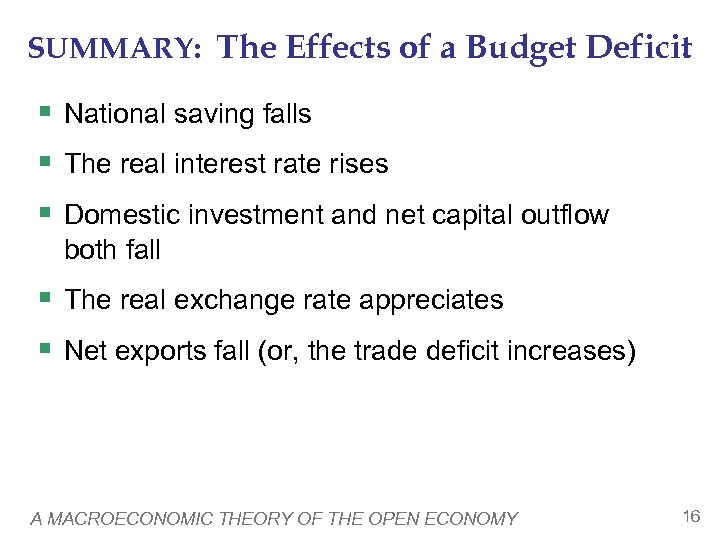 SUMMARY: The Effects of a Budget Deficit § National saving falls § The real interest rate rises § Domestic investment and net capital outflow both fall § The real exchange rate appreciates § Net exports fall (or, the trade deficit increases) A MACROECONOMIC THEORY OF THE OPEN ECONOMY 16
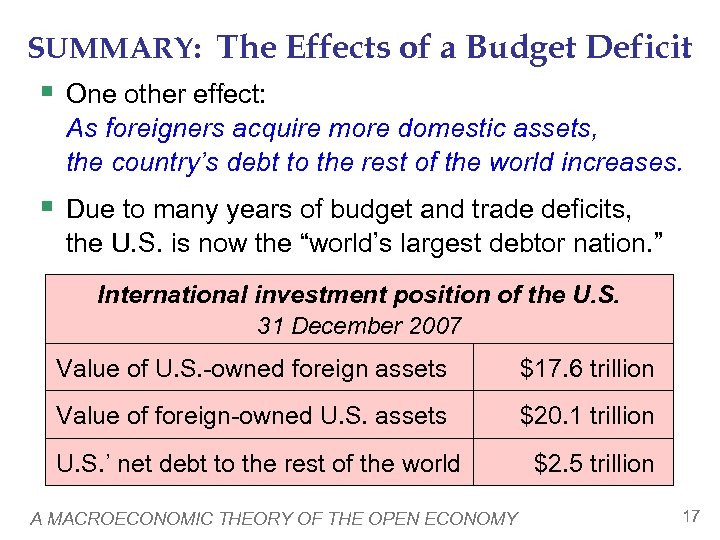 SUMMARY: The Effects of a Budget Deficit § One other effect: As foreigners acquire more domestic assets, the country’s debt to the rest of the world increases. § Due to many years of budget and trade deficits, the U. S. is now the “world’s largest debtor nation. ” International investment position of the U. S. 31 December 2007 Value of U. S. -owned foreign assets $17. 6 trillion Value of foreign-owned U. S. assets $20. 1 trillion U. S. ’ net debt to the rest of the world $2. 5 trillion A MACROECONOMIC THEORY OF THE OPEN ECONOMY 17
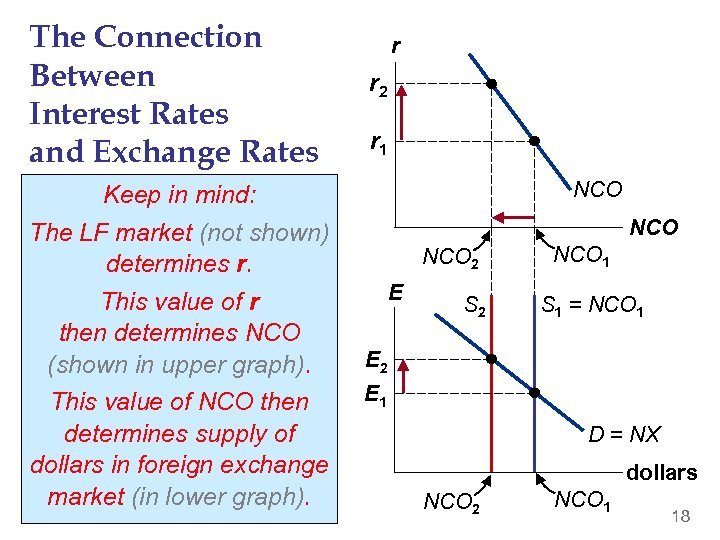 The Connection Between Interest Rates and Exchange Rates Keep in Anything thatmind: increases r The LF market (not shown) determines will reduce NCO r. This value of and the supply of r then determines NCO dollars in the foreign (shown in market. exchange upper graph). This value of NCO then Result: determines supply of The real exchange dollars in foreign exchange rate appreciates. market (in lower graph). r r 2 r 1 NCO NCO 2 E S 2 NCO 1 S 1 = NCO 1 E 2 E 1 D = NX dollars NCO 2 NCO 1 18
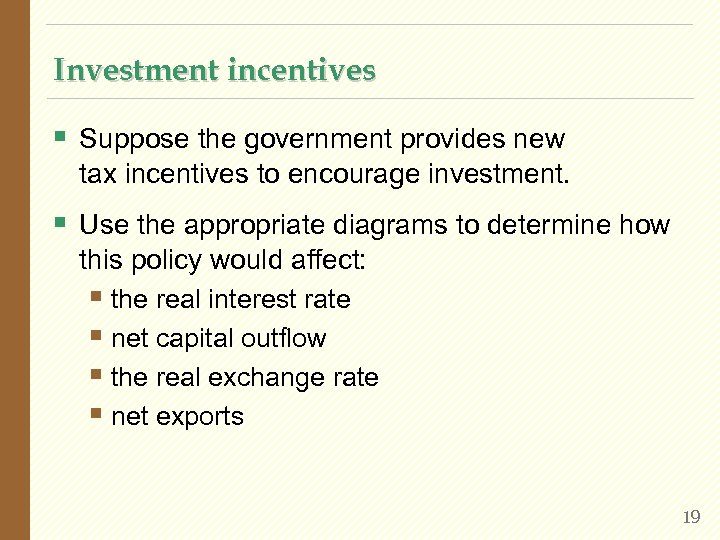 Investment incentives § Suppose the government provides new tax incentives to encourage investment. § Use the appropriate diagrams to determine how this policy would affect: § the real interest rate § net capital outflow § the real exchange rate § net exports 19
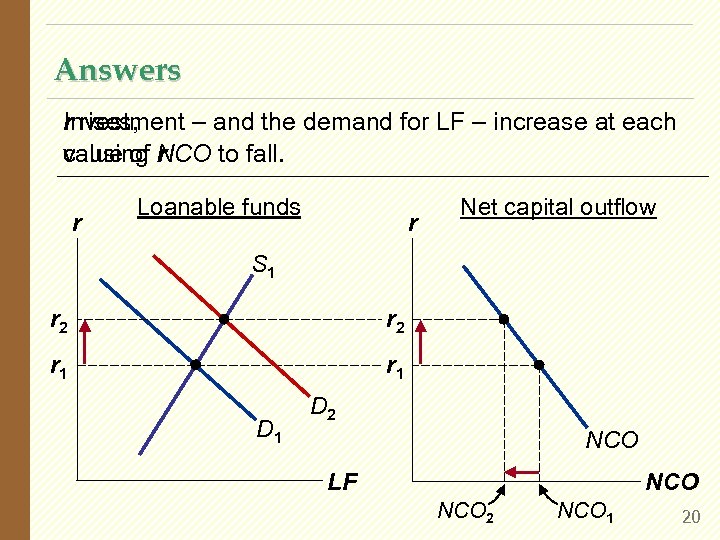 Answers r rises, Investment – and the demand for LF – increase at each causing NCO to fall. value of r. r Loanable funds r Net capital outflow S 1 r 2 r 1 D 1 D 2 NCO LF NCO 2 NCO 1 20
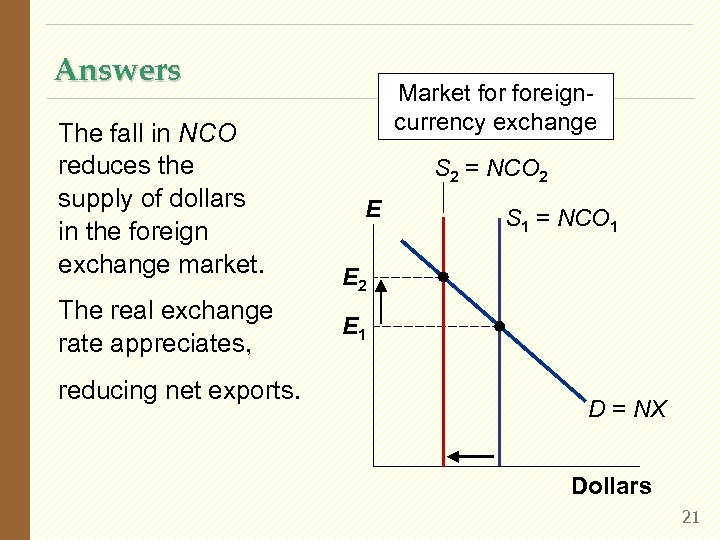 Answers The fall in NCO reduces the supply of dollars in the foreign exchange market. The real exchange rate appreciates, reducing net exports. Market foreigncurrency exchange S 2 = NCO 2 E S 1 = NCO 1 E 2 E 1 D = NX Dollars 21
 Budget Deficit vs. Investment Incentives § A tax incentive for investment has similar effects as a budget deficit: § r rises, NCO falls § E rises, NX falls § But one important difference: § Investment tax incentive increases investment, which increases productivity growth and living standards in the long run. § Budget deficit reduces investment, which reduces productivity growth and living standards. A MACROECONOMIC THEORY OF THE OPEN ECONOMY 22
 Trade Policy § Trade policy: a govt policy that directly influences the quantity of g&s that a country imports or exports § Examples: § Tariff – a tax on imports § Import quota – a limit on the quantity of imports § “Voluntary export restrictions” – the govt pressures another country to restrict its exports; essentially the same as an import quota A MACROECONOMIC THEORY OF THE OPEN ECONOMY 23
 Trade Policy § Common reasons for policies to restrict imports: § Save jobs in a domestic industry that has difficulty competing with imports § Reduce the trade deficit § Do such trade policies accomplish these goals? § Let’s use our model to analyze the effects of an import quota on cars from Japan designed to save jobs in the U. S. auto industry. A MACROECONOMIC THEORY OF THE OPEN ECONOMY 24
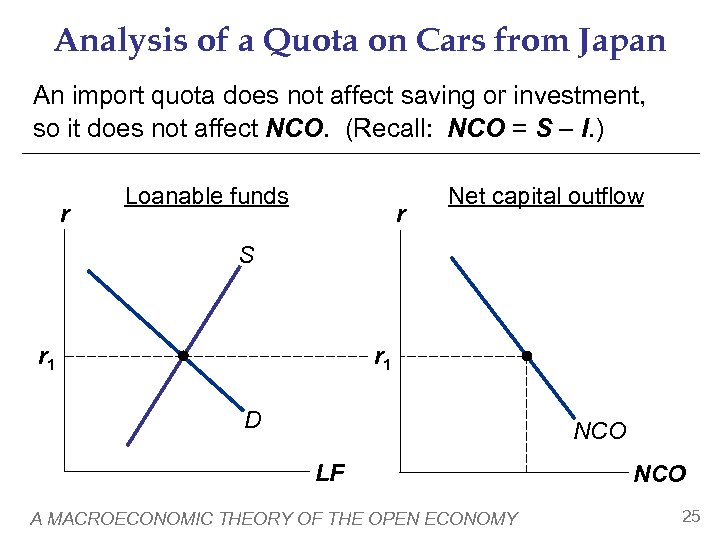 Analysis of a Quota on Cars from Japan An import quota does not affect saving or investment, so it does not affect NCO. (Recall: NCO = S – I. ) r Loanable funds r Net capital outflow S r 1 D NCO LF A MACROECONOMIC THEORY OF THE OPEN ECONOMY NCO 25
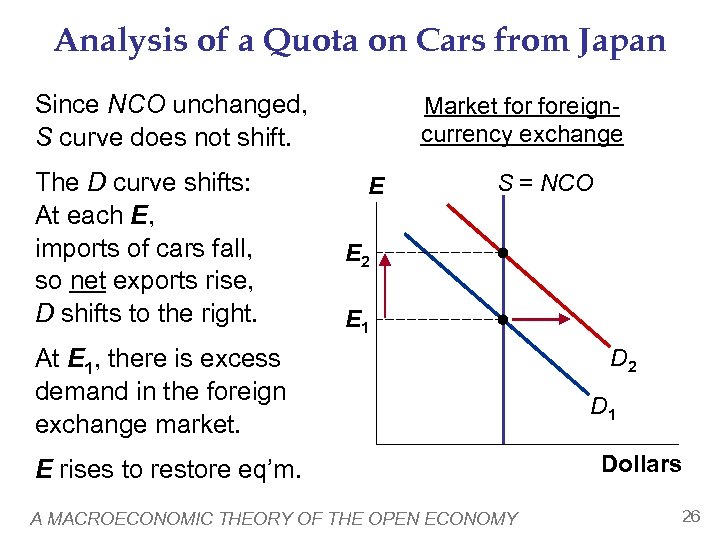 Analysis of a Quota on Cars from Japan Since NCO unchanged, S curve does not shift. The D curve shifts: At each E, imports of cars fall, so net exports rise, D shifts to the right. Market foreigncurrency exchange E S = NCO E 2 E 1 At E 1, there is excess demand in the foreign exchange market. E rises to restore eq’m. A MACROECONOMIC THEORY OF THE OPEN ECONOMY D 2 D 1 Dollars 26
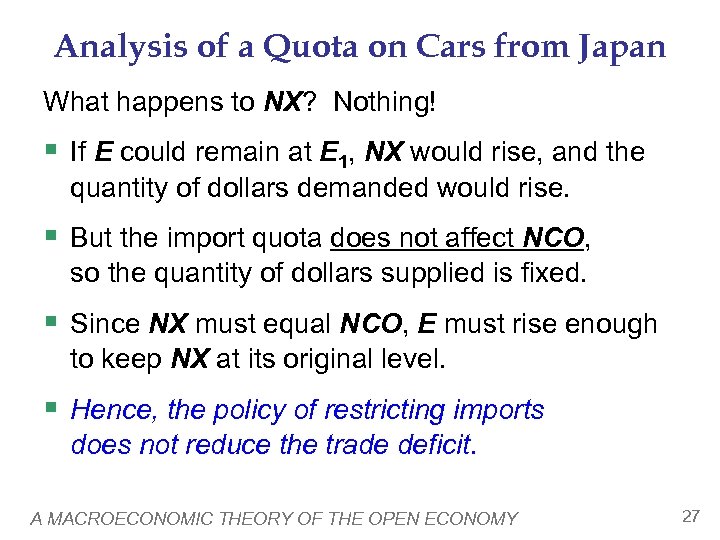 Analysis of a Quota on Cars from Japan What happens to NX? Nothing! § If E could remain at E 1, NX would rise, and the quantity of dollars demanded would rise. § But the import quota does not affect NCO, so the quantity of dollars supplied is fixed. § Since NX must equal NCO, E must rise enough to keep NX at its original level. § Hence, the policy of restricting imports does not reduce the trade deficit. A MACROECONOMIC THEORY OF THE OPEN ECONOMY 27
 Analysis of a Quota on Cars from Japan Does the policy save jobs? The quota reduces imports of Japanese autos. § U. S. consumers buy more U. S. autos. § U. S. automakers hire more workers to produce these extra cars. § So the policy saves jobs in the U. S. auto industry. But E rises, reducing foreign demand for U. S. exports. § Export industries contract, exporting firms lay off workers. The import quota saves jobs in the auto industry but destroys jobs in U. S. export industries!! A MACROECONOMIC THEORY OF THE OPEN ECONOMY 28
 CASE STUDY: Capital Flows from China § In recent years, China has accumulated U. S. assets to reduce its exchange rate and boost its exports. § Results in U. S. : § Appreciation of $ relative to Chinese renminbi § Higher U. S. imports from China § Larger U. S. trade deficit § Some U. S. politicians want China to stop, argue for restricting trade with China to protect some U. S. industries. § Yet, U. S. consumers benefit, and the net effect of China’s currency intervention is probably small. A MACROECONOMIC THEORY OF THE OPEN ECONOMY 29
 Political Instability and Capital Flight § 1994: Political instability in Mexico made world financial markets nervous. § People worried about the safety of Mexican assets they owned. § People sold many of these assets, pulled their capital out of Mexico. § Capital flight: a large and sudden reduction in the demand for assets located in a country § We analyze this using our model, but from the prospective of Mexico, not the U. S. A MACROECONOMIC THEORY OF THE OPEN ECONOMY 30
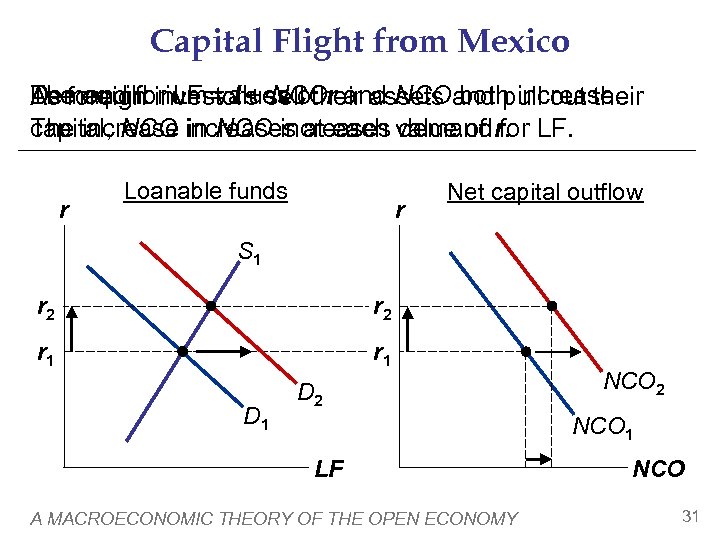 Capital Flight from Mexico Demand for LF values of r and NCO both increase. The equilibrium = I + sell their assets and pull out their As foreign investors NCO. The increases at each value of r. LF. capital, NCO increases demand for r Loanable funds r Net capital outflow S 1 r 2 r 1 D 1 D 2 NCO 1 LF A MACROECONOMIC THEORY OF THE OPEN ECONOMY NCO 31
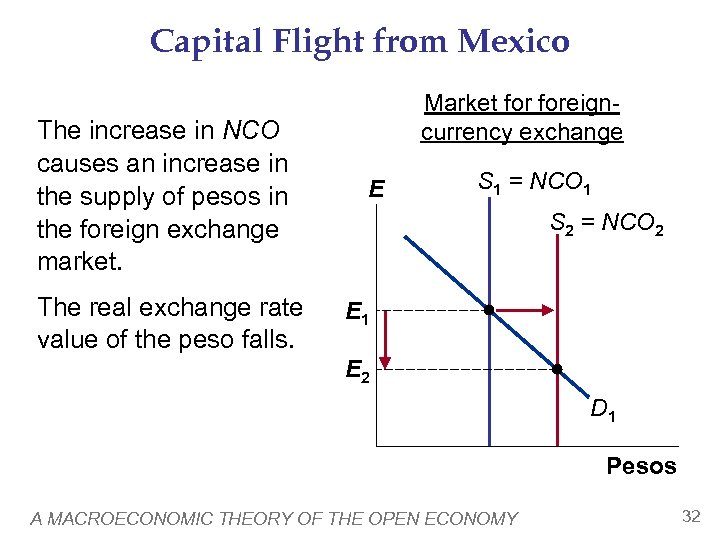 Capital Flight from Mexico The increase in NCO causes an increase in the supply of pesos in the foreign exchange market. The real exchange rate value of the peso falls. Market foreigncurrency exchange E S 1 = NCO 1 S 2 = NCO 2 E 1 E 2 D 1 Pesos A MACROECONOMIC THEORY OF THE OPEN ECONOMY 32
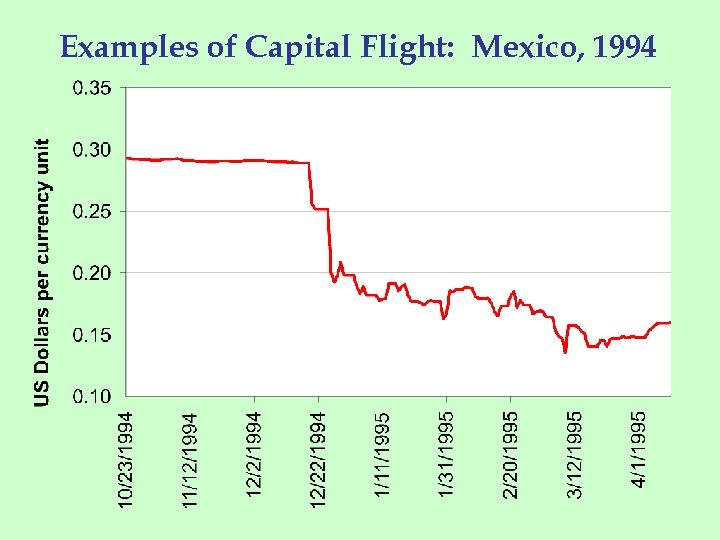 Examples of Capital Flight: Mexico, 1994
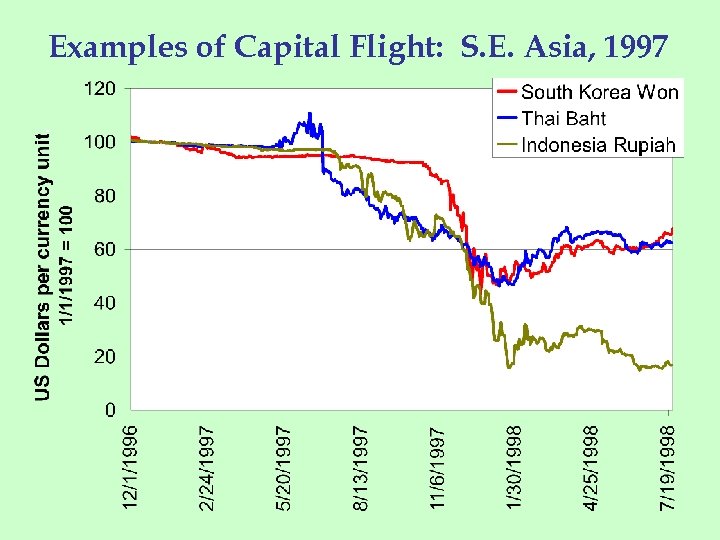 Examples of Capital Flight: S. E. Asia, 1997
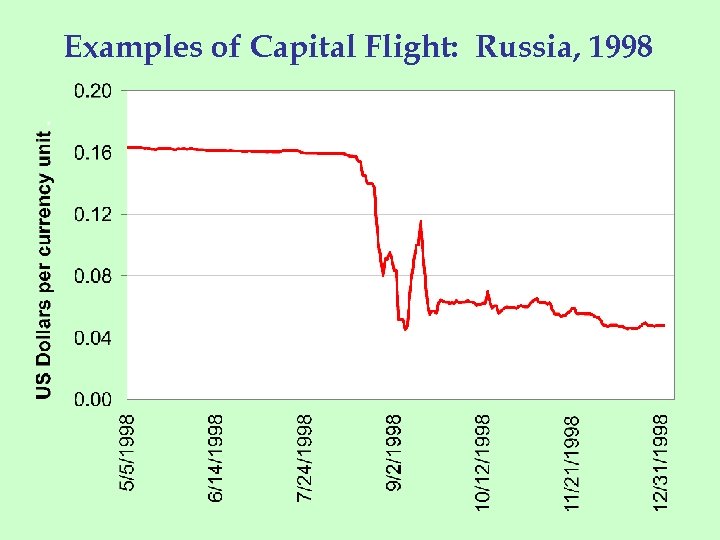 Examples of Capital Flight: Russia, 1998
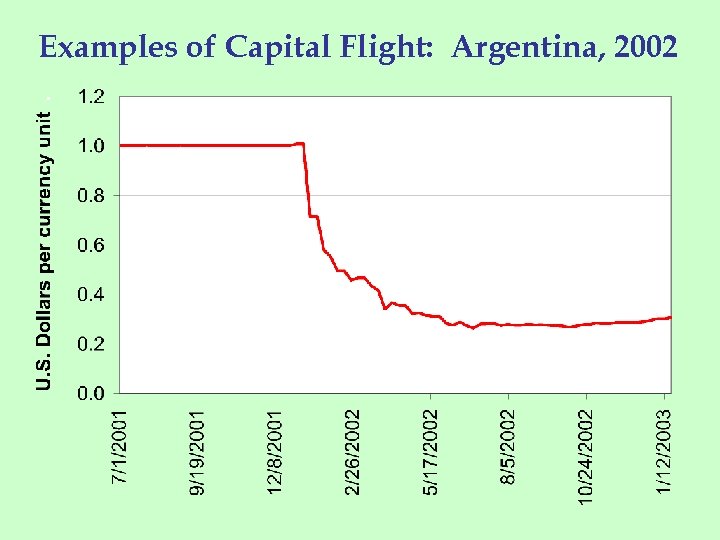 Examples of Capital Flight: Argentina, 2002
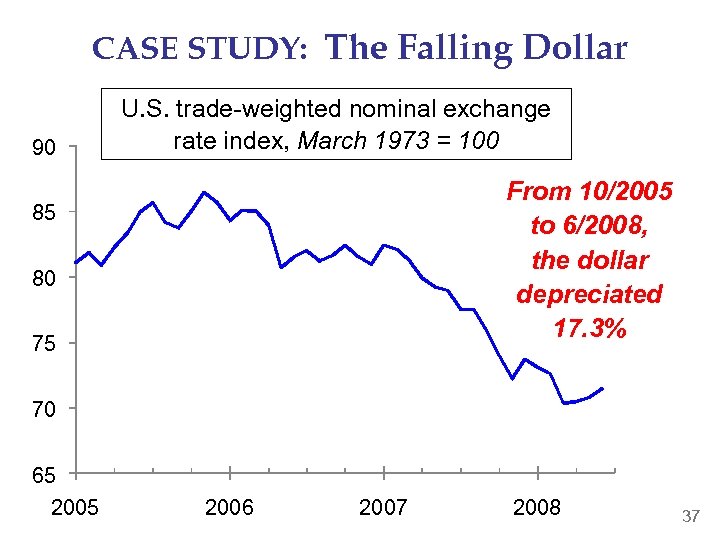 CASE STUDY: The Falling Dollar 90 U. S. trade-weighted nominal exchange rate index, March 1973 = 100 From 10/2005 to 6/2008, the dollar depreciated 17. 3% 85 80 75 70 65 2006 2007 2008 37
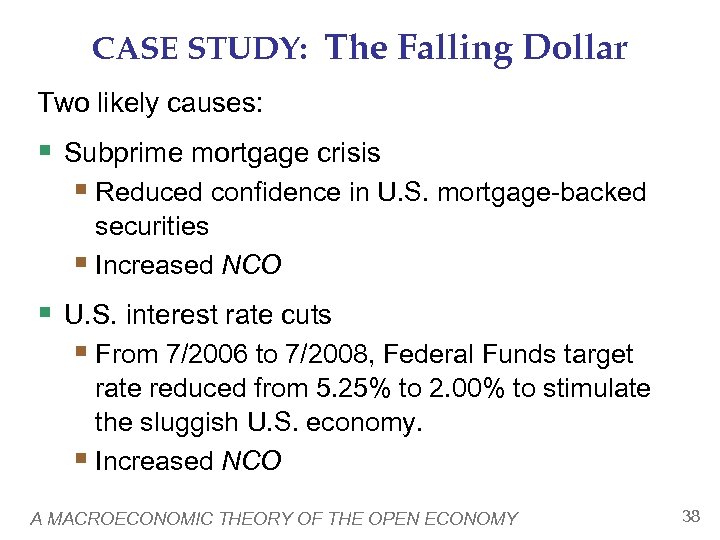 CASE STUDY: The Falling Dollar Two likely causes: § Subprime mortgage crisis § Reduced confidence in U. S. mortgage-backed securities § Increased NCO § U. S. interest rate cuts § From 7/2006 to 7/2008, Federal Funds target rate reduced from 5. 25% to 2. 00% to stimulate the sluggish U. S. economy. § Increased NCO A MACROECONOMIC THEORY OF THE OPEN ECONOMY 38
 CONCLUSION § The U. S. economy is becoming increasingly open: § Trade in g&s is rising relative to GDP. § Increasingly, people hold international assets in their portfolios and firms finance investment with foreign capital. A MACROECONOMIC THEORY OF THE OPEN ECONOMY 39
 CONCLUSION § Yet, we should be careful not to blame our problems on the international economy. § Our trade deficit is not caused by other countries’ “unfair” trade practices, but by our own low saving. § Stagnant living standards are not caused by imports, but by low productivity growth. § When politicians and commentators discuss international trade and finance, the lessons of this and the preceding chapter can help separate myth from reality. A MACROECONOMIC THEORY OF THE OPEN ECONOMY 40