 Скачать презентацию Macroeconomic and Development Policies Branch Division of Globalization
Presentation MAYSTRE_sent.ppt
- Количество слайдов: 21



Macroeconomic and Development Policies Branch Division of Globalization and Development Strategies – UNCTAD Policy challenges in the world economy after the crisis 8 February 2013 Tour for the Belarus State Economic University Faculty of International Economic Relations nicolas. maystre@unctad. org
World Economic Situation and Prospects 2013 Trade and Development Report 2012 Policies for Inclusive and Balance Growth
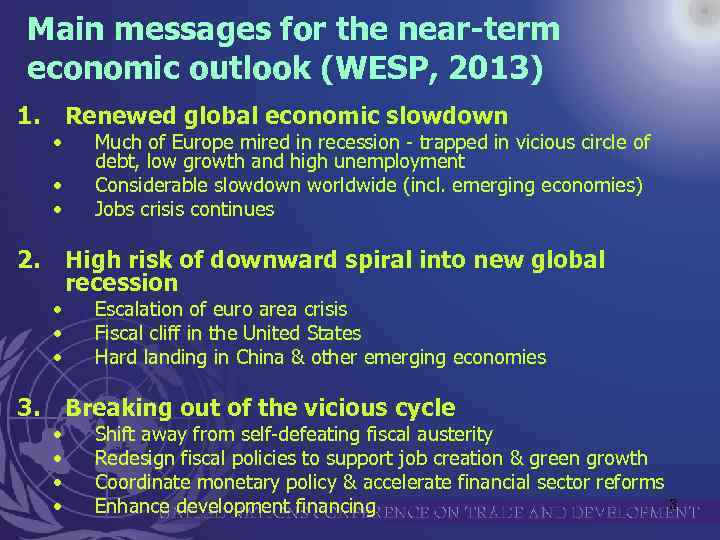
Main messages for the near-term economic outlook (WESP, 2013) 1. • • • 2. • • • 3. • • Renewed global economic slowdown Much of Europe mired in recession - trapped in vicious circle of debt, low growth and high unemployment Considerable slowdown worldwide (incl. emerging economies) Jobs crisis continues High risk of downward spiral into new global recession Escalation of euro area crisis Fiscal cliff in the United States Hard landing in China & other emerging economies Breaking out of the vicious cycle Shift away from self-defeating fiscal austerity Redesign fiscal policies to support job creation & green growth Coordinate monetary policy & accelerate financial sector reforms 3 Enhance development financing
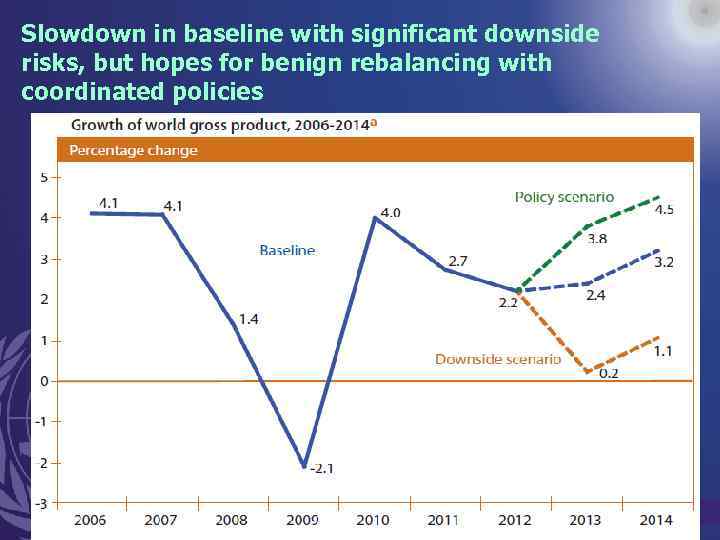
Slowdown in baseline with significant downside risks, but hopes for benign rebalancing with coordinated policies
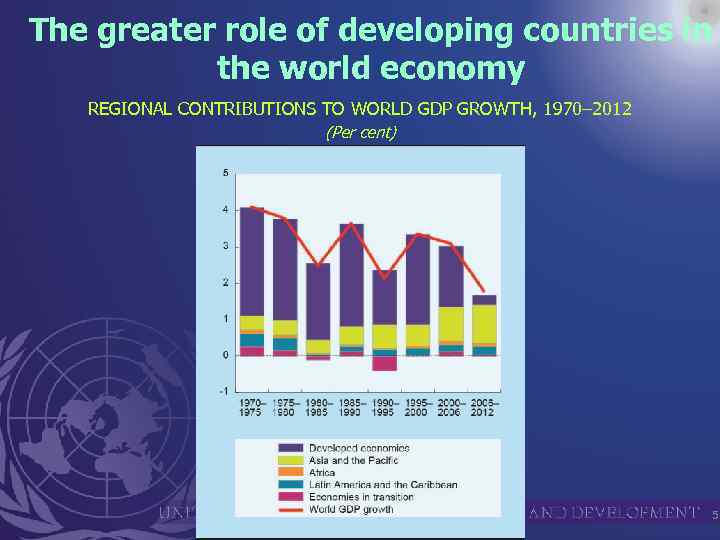
The greater role of developing countries in the world economy REGIONAL CONTRIBUTIONS TO WORLD GDP GROWTH, 1970– 2012 (Per cent) 5
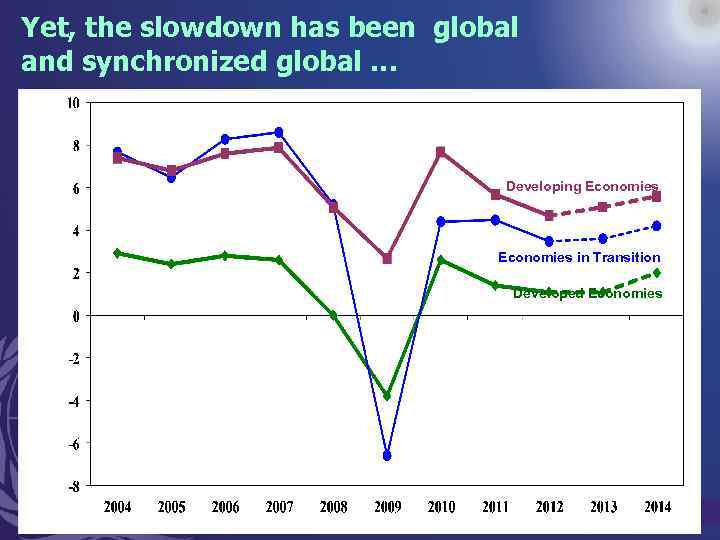
Yet, the slowdown has been global and synchronized global … Developing Economies in Transition Developed Economies 6
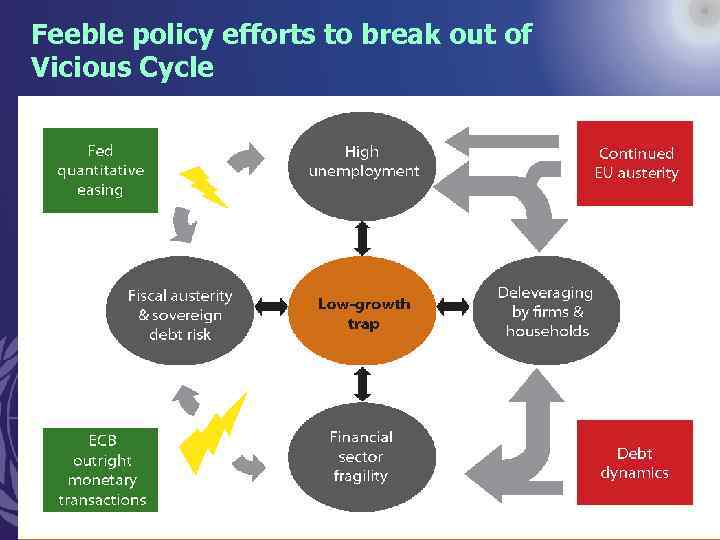
Feeble policy efforts to break out of Vicious Cycle
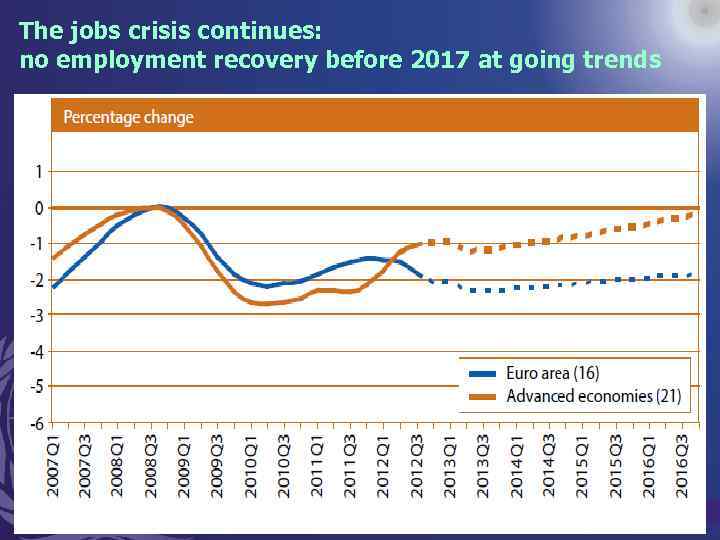
The jobs crisis continues: no employment recovery before 2017 at going trends
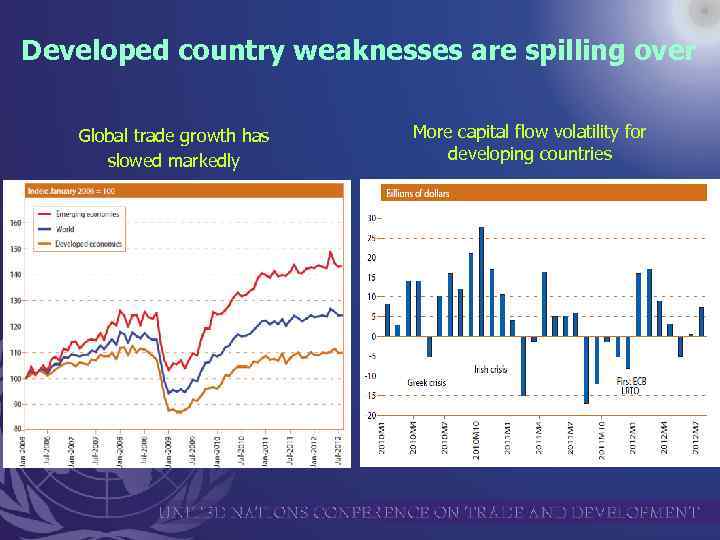
Developed country weaknesses are spilling over Global trade growth has slowed markedly More capital flow volatility for developing countries
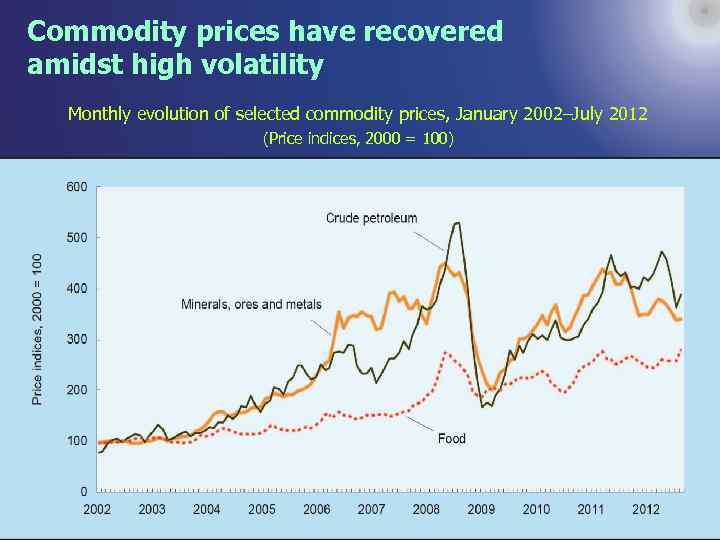
Commodity prices have recovered amidst high volatility Monthly evolution of selected commodity prices, January 2002–July 2012 (Price indices, 2000 = 100) 10
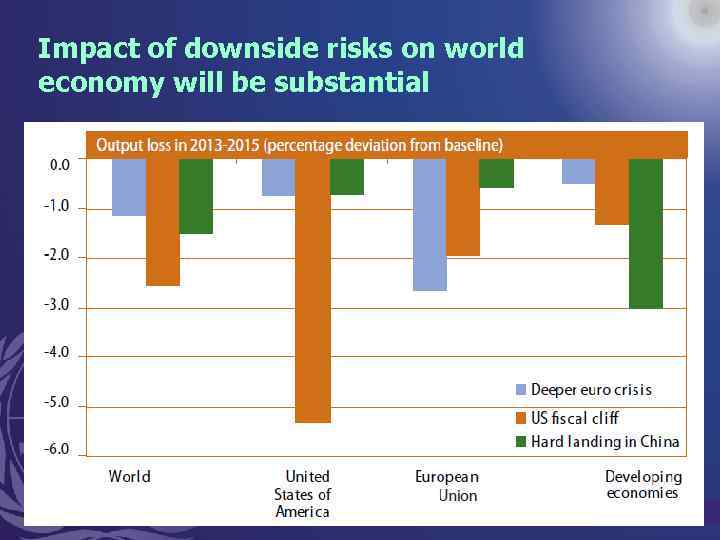
Impact of downside risks on world economy will be substantial 11
Economic policies are not leading to a strong and balanced growth 1. A proper diagnosis of the causes of the crisis and the obstacles to recovery is crucial • High fiscal problems and pubic debt are the consequence, not the cause of the crisis. • The main problem hindering growth in developed economies is faltering demand, due to unemployment, deleveraging and wage compression. Fiscal austerity would only worsen these problems. 2. All macroeconomic effects of fiscal and income policies must be taken into account • By hampering growth, fiscal austerity does not lead to fiscal consolidation nor restores financial markets’ confidence • Further wage compression hits demand, growth and employment • Such measures taken simultaneously by many trading partners does not improve significantly competitiveness in none of them 12 and amplifies their recessionary impact
Economic policies are not leading to a strong and balanced growth (continued…) 3. There is room for counter-cyclical macroeconomic policies, especially in surplus countries • Policymakers should use fiscal, credit and incomes polices for recovering (in developed economies) or sustaining (in developing and transition economies) domestic demand. • The economic stimulus provided by such policies depend on their distribution effect, as they can enhance the purchasing power of agents with a high propensity to consume. 4. The structural reforms are no substitute for supportive macroeconomic policies • As the current problem is one of insufficient demand, reforms aimed at improving the supply side are not the most appropriate, especially if they further weaken demand (e. g. labour market flexibility in some developed countries) • Structural reforms should reinforce social safety nets and expand the role of public policies for supporting investment as is happening in several developing countries • Reforms should also address the root causes of the crisis by reforming the national and international financial systems, and reversing the trend towards increasing income inequality 13
How to get the world economy back on track? Present policy stances insufficient and source of uncertainty Fundamental policy shift is required: • Coordination of fiscal policy new growth impulses • Redesign fiscal and structural policies job creation & green growth • Monetary policy coordination less capital volatility • Accelerate financial regulatory reform reduce financial fragility • Ensure adequate development finance benign rebalancing and achieving MDGs 14
The relationship between income inequality and growth • Ongoing debate: – Income concentration is needed to generate savings and investment. Thus, policies aimed at reducing inequality tend to undermine economic efficiency and growth. vs. – High inequality dampens aggregate demand, deprives many people of access to education and credit, and represents an enormous waste of development potential. Recent theoretical and empirical works find a negative correlation between inequality and growth Rising inequality is neither a necessary condition for sound economic growth, nor its natural result. By contrast, full participation of all citizens in the proceeds of the economy as a whole is indispensible for successful and sustained development. 15
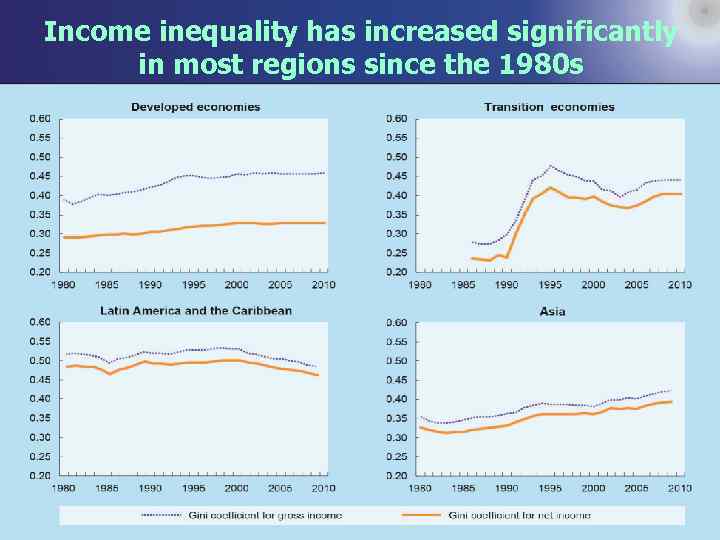
Income inequality has increased significantly in most regions since the 1980 s 16
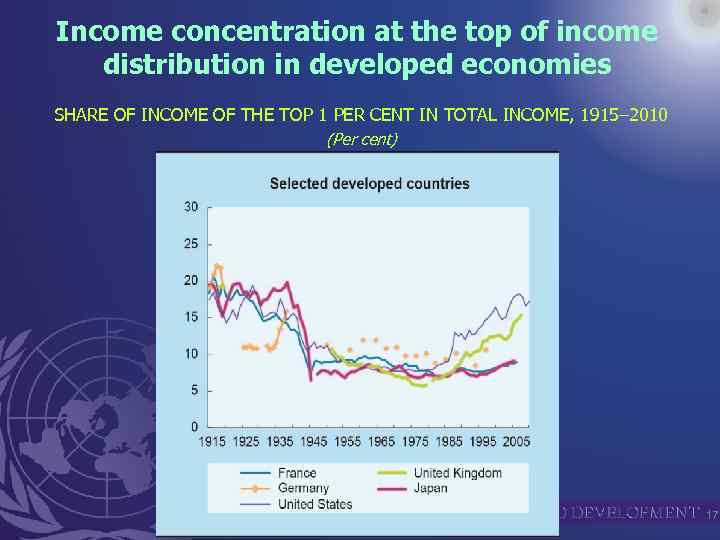
Income concentration at the top of income distribution in developed economies SHARE OF INCOME OF THE TOP 1 PER CENT IN TOTAL INCOME, 1915– 2010 (Per cent) 17
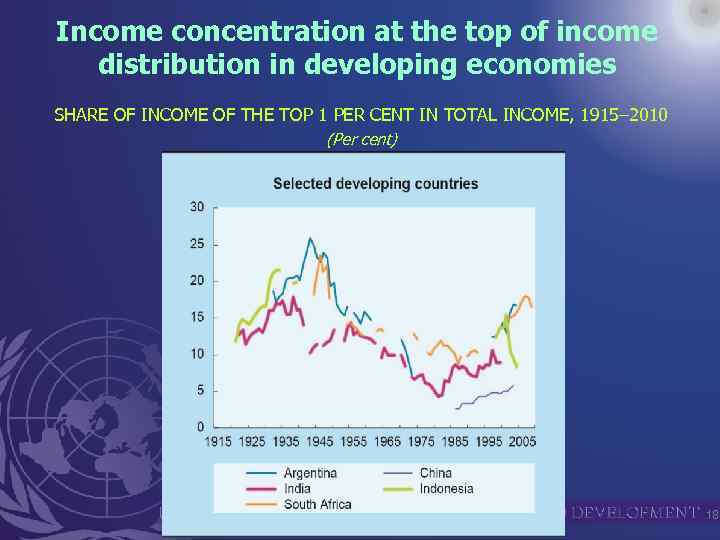
Income concentration at the top of income distribution in developing economies SHARE OF INCOME OF THE TOP 1 PER CENT IN TOTAL INCOME, 1915– 2010 (Per cent) 18
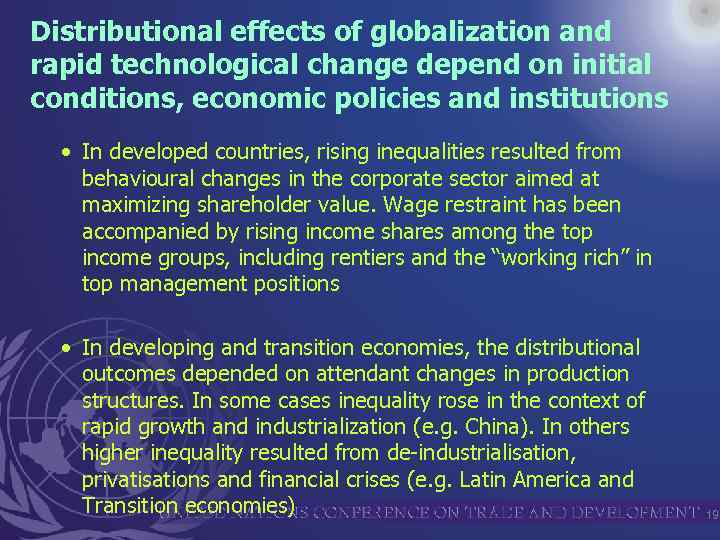
Distributional effects of globalization and rapid technological change depend on initial conditions, economic policies and institutions • In developed countries, rising inequalities resulted from behavioural changes in the corporate sector aimed at maximizing shareholder value. Wage restraint has been accompanied by rising income shares among the top income groups, including rentiers and the “working rich” in top management positions • In developing and transition economies, the distributional outcomes depended on attendant changes in production structures. In some cases inequality rose in the context of rapid growth and industrialization (e. g. China). In others higher inequality resulted from de-industrialisation, privatisations and financial crises (e. g. Latin America and Transition economies) 19
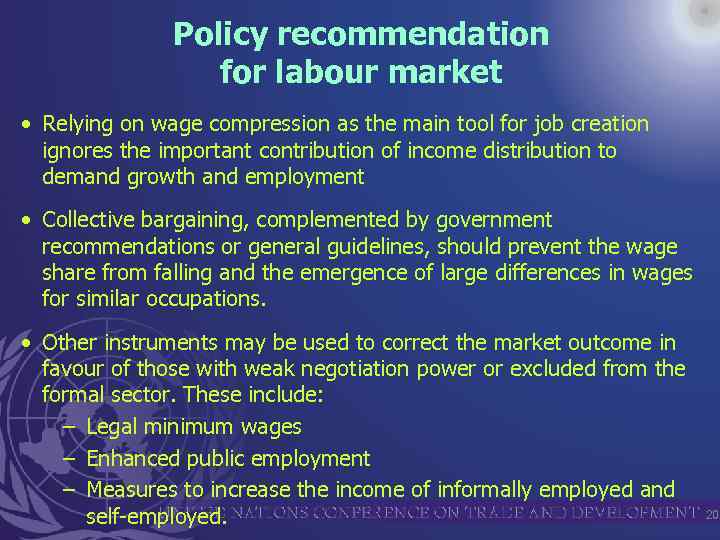
Policy recommendation for labour market • Relying on wage compression as the main tool for job creation ignores the important contribution of income distribution to demand growth and employment • Collective bargaining, complemented by government recommendations or general guidelines, should prevent the wage share from falling and the emergence of large differences in wages for similar occupations. • Other instruments may be used to correct the market outcome in favour of those with weak negotiation power or excluded from the formal sector. These include: – Legal minimum wages – Enhanced public employment – Measures to increase the income of informally employed and self-employed. 20
Policy recommendation for fiscal policy • Progressive taxation and public spending designed to improve the provision of essential goods and services to low-income groups (including monetary transfers) can also contribute to the process of inclusive growth. For example: – Profits from productive entrepreneurial activity may be taxed at a lower rate than profits from purely financial activity and capital gains that provide no benefits for the overall economy. – Taxation could be increased on top incomes resulting from rentseeking activities as compared to productive work. – In resource-rich developing countries, governments should appropriate a fair share of commodity rents and ensure that they benefit the entire population and not just a few domestic and foreign actors. • By enlarging fiscal space, governments can apply counter-cyclical policies, redistribute income and finance investment for a more sustainable and inclusive growth. 21
Скачать презентацию Macroeconomic and Development Policies Branch Division of Globalization
Presentation MAYSTRE_sent.ppt