 Скачать презентацию MACRO Slide 1 Money Banks Money and
e9884fd02013bc8c8a380700e8ff3b68.ppt
- Количество слайдов: 36



MACRO Slide 1 Money & Banks Money and Banking: How Money Is Created (or Money From Nothing) How money is created by fractional reserve banking
MACRO Money & Banks What Is Money? Before asking how money is created, we need to be clear about what is money? You may at first think the answer should be obvious – it’s the coins and paper you have in your pocket that you use to buy things. But when you try to define money, it gets trickier. Basically money is anything accepted and commonly used as a means of exchange. In other words, it’s spending power – the ability to buy goods. Slide 2
MACRO Money & Banks Liquid Money: M 1 The most liquid form of money is what is called M 1 is money that can be immediately spent. It can be used to buy goods without any intermediate steps or transactions necessary. The currency and coins that are in your pocket or wallet (or even down between the cushions of your sofa!), are definitely M 1. They can be spent immediately (and often are in my case, unfortunately)>. But there’s more to M 1, than just currency and coins. The money you put in the bank in your checking account is also M 1. After all, you could go buy something and simply write a check. Traveler’s checks and money orders are also considered M 1. The quantity of M 1 in circulation in an economy is called it’s money supply. Slide 3
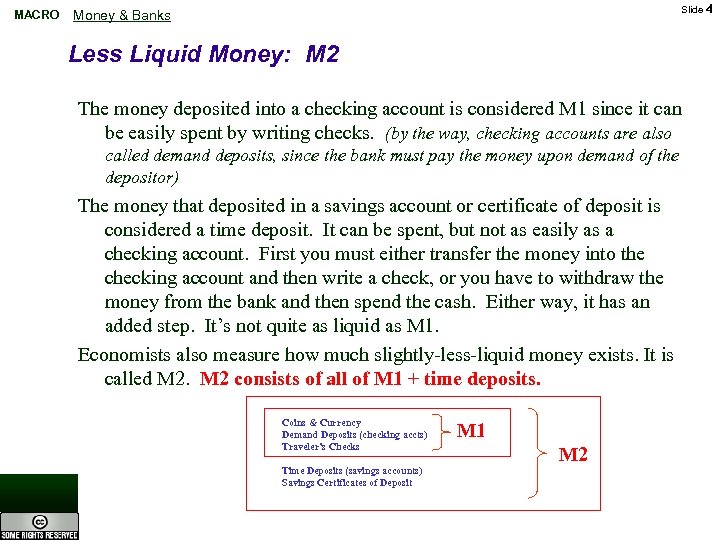
MACRO Slide 4 Money & Banks Less Liquid Money: M 2 The money deposited into a checking account is considered M 1 since it can be easily spent by writing checks. (by the way, checking accounts are also called demand deposits, since the bank must pay the money upon demand of the depositor) The money that deposited in a savings account or certificate of deposit is considered a time deposit. It can be spent, but not as easily as a checking account. First you must either transfer the money into the checking account and then write a check, or you have to withdraw the money from the bank and then spend the cash. Either way, it has an added step. It’s not quite as liquid as M 1. Economists also measure how much slightly-less-liquid money exists. It is called M 2 consists of all of M 1 + time deposits. Coins & Currency Demand Deposits (checking accts) Traveler’s Checks Time Deposits (savings accounts) Savings Certificates of Deposit M 1 M 2
MACRO Slide 5 Money & Banks What about credit cards? Debit cards are just a handy way to write an electronic check. The money you use when you use a debit card is the money in your checking account, so it’s already included in M 1. Credit cards, however, are NOT MONEY. Credit cards are really handy way to electronically take out a loan from the bank. Using a credit card doesn’t really pay for a purchase. It just delays the date when the payment will be made (and adds some interest charges to it). Credit cards are NOT considered part of M 1. NOT money
MACRO Money & Banks Slide 6 Modern Banks are Not Like Your Piggy Bank Some people use a piggy bank to put money away for safe keeping and future use. In the future, when they want the money, they just open the piggy bank and there the money is. In economist-speak, a piggy bank could be described as “ 100% reserve bank”. Looked at from the bank’s perspective, the bank is keeping a reserve of cash to pay back the depositor. If the bank keeps all of the money deposited in it’s reserves, then it is 100% reserve bank. But, a 100% reserve bank cannot afford to pay interest on the deposits. The piggy bank or coin jar you used as child never paid back more than you deposited. But modern banks do pay interest on some deposits. They can afford to pay interest on some deposits because they are fractional-reserve banks.
MACRO Money & Banks Slide 7 Fractional Reserve Banking A fractional reserve bank keeps only a small fraction of it’s deposits as cash in the vault. It takes most of the money depositors have deposited and loans the money out to other customers. The system works because on any given day, customers only want to withdraw a small fraction of the total deposits they have made. As long as the bank has just enough cash on-hand (reserves) to pay these withdrawals, it can use the rest of the deposited money to make loans. So, suppose a bank had a total of $1, 000 in deposits. The bank might only keep $200 thousand on-hand as cash reserves and will have already loaned-out $800 thouand to borrowers. On a typical day, the bank will need to pay out somewhere between $20 -50 thousand in withdrawals and it will take in another $20 -50 thousand in new deposits. As long as each day’s net withdrawals (withdrawals – new deposits) are less than the cash reserves on-hand, the bank is solvent. Meanwhile, it can charge interest to the borrowers and earn profits that way.
MACRO Money & Banks Bank Runs: Trouble for Fractional Reserve Banks What happens if depositors want to withdraw an unusually large (and unexpected by the bank) on a particular day? As long the bank has enough reserves on-hand, nothing. The bank pays the depositors. But, if the amount depositors want to withdraw exceeds the amount the bank has on-hand in reserves, then the bank cannot meet all the demands of the depositors. The bank has failed. It is now bankrupt and closed. When depositors begin demanding an unusually large amount of withdrawals, it is called a bank run. In the old days, depositors would literally run to the bank to withdraw their money before the bank collapsed. Slide 8
MACRO Money & Banks Bank Accounting Banks are businesses. And, like businesses, they track their financial position using a balance sheet statement. In a balance sheet, assets (what is owned) are listed on the left side and liabilities+equity is listed on the right. (liabilities are the amounts owed to others). The statement must always balance. The following must be always be true: Total Assets = Total Liabilities+Equity What makes bank balance sheets appear different at first, is that loans are considered assets and deposits are liabilities. This is, of course different from how customers view it. But the statements are from the bank’s point of view. • A bank deposit is a liability to the bank – the bank is responsible for paying the money back to the customer • A loan is an asset of the bank – the bank owns the right to collect the money from the borrower. Slide 9
MACRO Money & Banks Bank Accounting – An Example Banks essentially have two types of assets: reserves and loans. Reserves are the money the bank keeps on-hand to pay for withdrawals. Reserves may either take the form of cash on-site in the bank vault or a regular bank may make a deposit at another bank, particularly A Federal Reserve Bank. Slide 10
MACRO Money & Banks Fractional Reserve Banking Creates Money When a bank makes a loan to a customer, it creates new purchasing power. It creates new M 1. New loans create new M 1. When a loan is made, all previous depositors still have their spending power (the $ in their checking accounts) but now a new customer, the one receiving the loan, has new spending power. M 1 has been created. Slide 11
MACRO Money & Banks Fractional Reserve Banking Creates Money When a bank accepts a deposit from a customer, no new M 1 is created. The form of M 1 is simply changed. What had been a $100 bill in Ed’s pocket (currency) now becomes a checking account deposit (demand deposit). And vice-versa. If a deposit is withdrawn from a checking account, no new M 1 is created. Only the form is changed. But, if a loan is made, then new M 1 is created. Only new loans create add to M 1. Slide 12
MACRO Money & Banks The Banker’s Dilemma: Safety? or Profits? Bankers constantly face a decision: how much of their deposits should they loan out? In other words, how small should the reserves be as a fraction of the total deposits. If reserves are too small, then the risk increases that an unusual increase in withdrawals will create a bank failure. If reserves are too large, then fewer loans can be made and less interest (profits) can be collected from those loans. Slide 13
MACRO Money & Banks Slide 14 The Federal Reserve Sets a Minimum Reserve Amount To help protect both the public and bankers, The Federal Reserve sets a minimum Required Reserve Ratio. The required reserve ratio, which is oftentimes just called the reserve ratio and abbreviated “rr” calculates the minimum amount of $ a bank must have in reserves given the amount of deposits it has. Reserve ratios are typically in the 15% to 20% range. The Fed will change the ratio depending upon the health of the overall economy and banking system.
MACRO Money & Banks Excess Reserves If a bank actually has more reserves on-hand than required, then it has excess reserves. Excess reserves can be used to create new loans. Thus, excess reserves when loaned out to customers become new M 1. Slide 15
MACRO Money & Banks Too-Little Reserves If a bank actually has less reserves on-hand than required, then it has failed. It is now insolvent. The Fed will close the bank and try to sell it to a healthier, more solvent bank. If the bank cannot be sold, it is liquidated. What reserves are left are used to pay depositors and close accounts. Slide 16
MACRO Slide 17 Money & Banks Let’s Look at An Example In the following simple example, we have a small economy with five people (Larry, Curly, Moe, Shemp, and Monty Burns). There also three businesses (Groucho. Corp, The Harpo Store, and Chico. Mart). Initially there is no bank, but soon Monty Burns (the really rich guy) decides to start his own fractional reserve bank called Acme Bank Each of the following slides will illustrate the effects of a single transaction in the economy. Be sure to pay close attention to how M 1 changes and what the excess reserves of the bank are. These numbers are at the bottom of each slide. The amounts that change as a result of the transaction are shown in red on each slide.
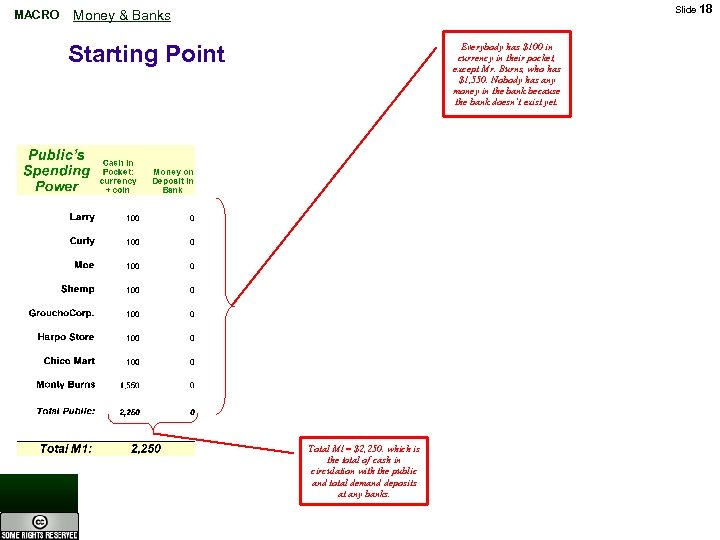
MACRO Slide 18 Money & Banks Starting Point Everybody has $100 in currency in their pocket, except Mr. Burns, who has $1, 550. Nobody has any money in the bank because the bank doesn’t exist yet. Total M 1= $2, 250. which is the total of cash in circulation with the public and total demand deposits at any banks.
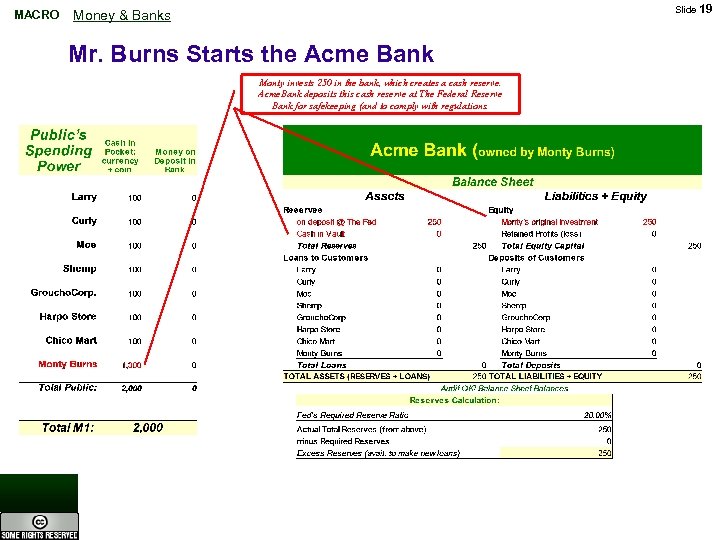
MACRO Slide 19 Money & Banks Mr. Burns Starts the Acme Bank Monty invests 250 in the bank, which creates a cash reserve. Acme. Bank deposits this cash reserve at The Federal Reserve Bank for safekeeping (and to comply with regulations.
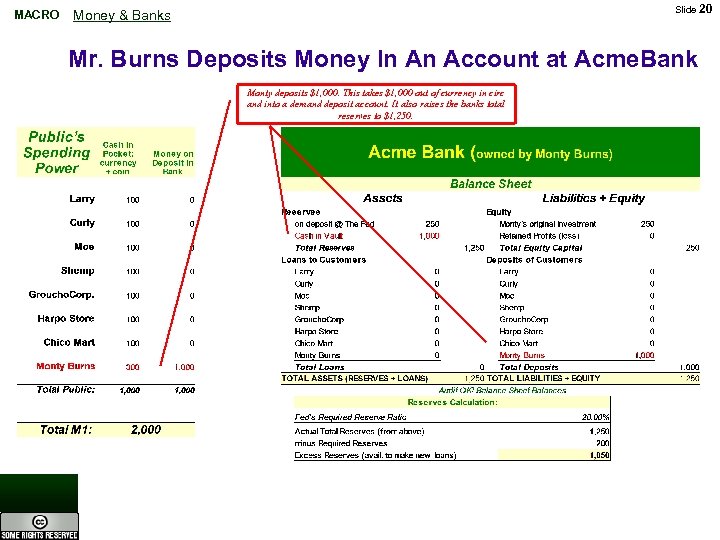
MACRO Slide 20 Money & Banks Mr. Burns Deposits Money In An Account at Acme. Bank Monty deposits $1, 000. This takes $1, 000 out of currency in circ and into a demand deposit account. It also raises the banks total reserves to $1, 250.
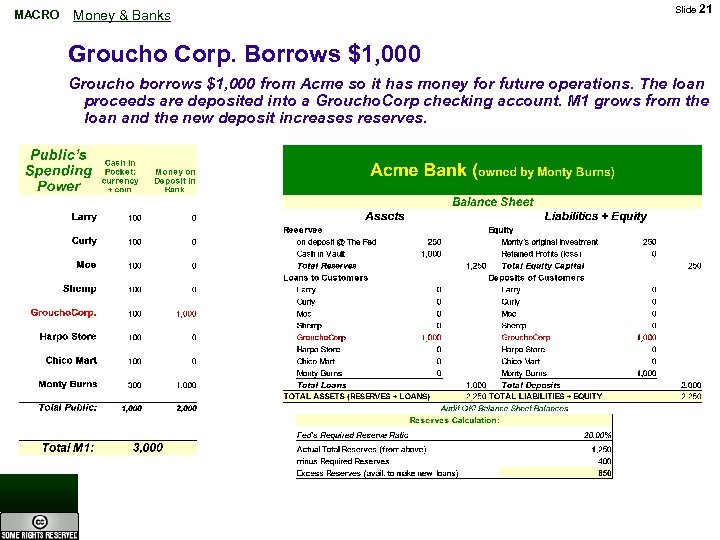
MACRO Money & Banks Slide 21 Groucho Corp. Borrows $1, 000 Groucho borrows $1, 000 from Acme so it has money for future operations. The loan proceeds are deposited into a Groucho. Corp checking account. M 1 grows from the loan and the new deposit increases reserves.
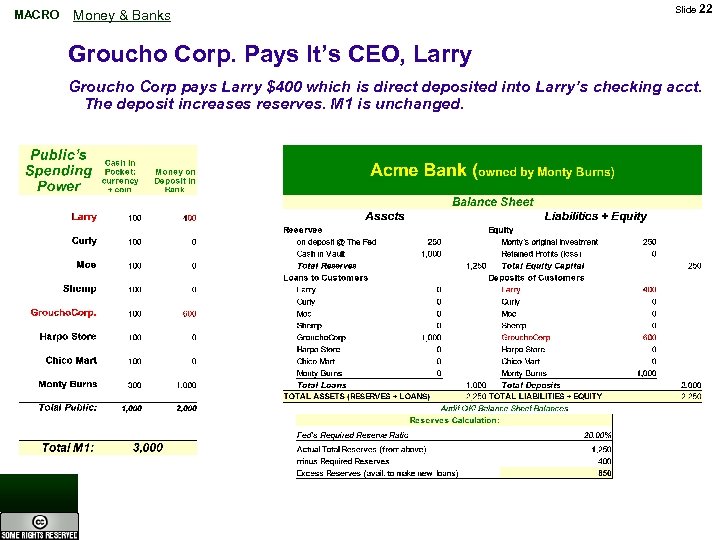
MACRO Money & Banks Slide 22 Groucho Corp. Pays It’s CEO, Larry Groucho Corp pays Larry $400 which is direct deposited into Larry’s checking acct. The deposit increases reserves. M 1 is unchanged.
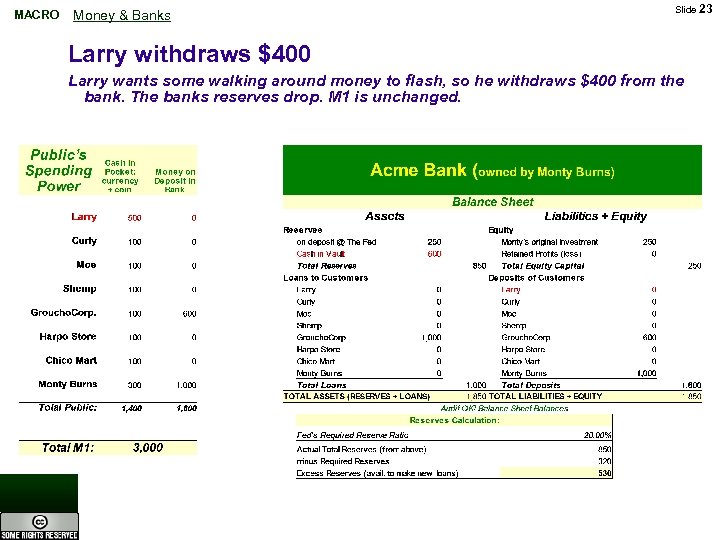
MACRO Money & Banks Slide 23 Larry withdraws $400 Larry wants some walking around money to flash, so he withdraws $400 from the bank. The banks reserves drop. M 1 is unchanged.
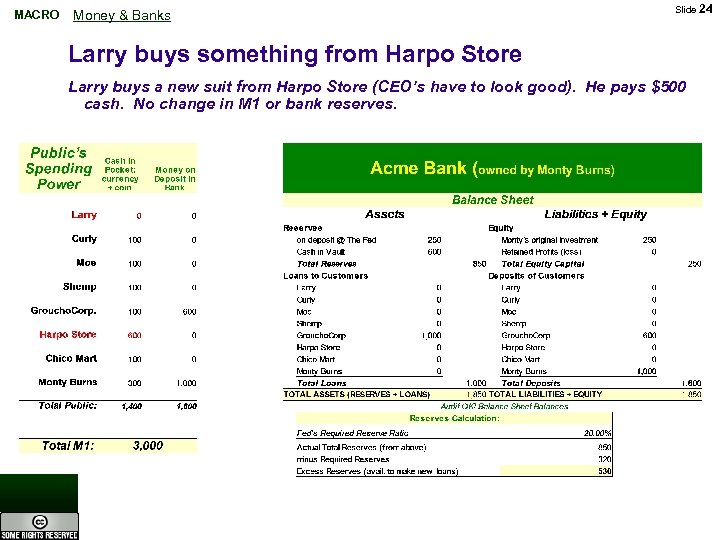
MACRO Money & Banks Slide 24 Larry buys something from Harpo Store Larry buys a new suit from Harpo Store (CEO’s have to look good). He pays $500 cash. No change in M 1 or bank reserves.
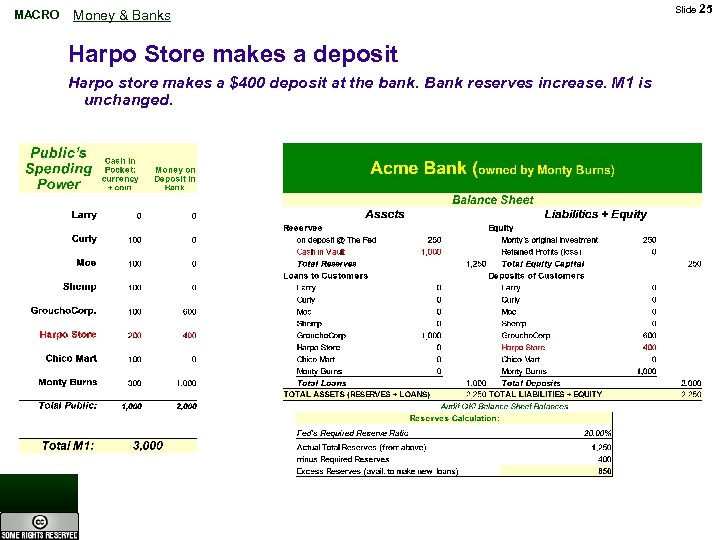
MACRO Money & Banks Harpo Store makes a deposit Harpo store makes a $400 deposit at the bank. Bank reserves increase. M 1 is unchanged. Slide 25
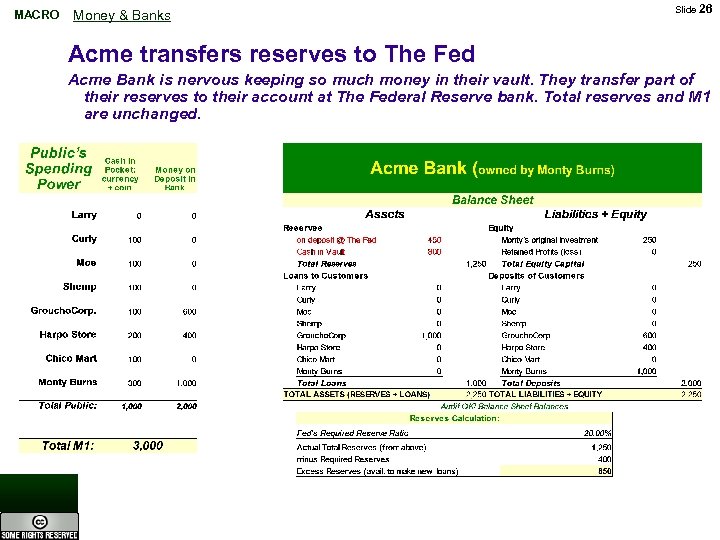
MACRO Money & Banks Slide 26 Acme transfers reserves to The Fed Acme Bank is nervous keeping so much money in their vault. They transfer part of their reserves to their account at The Federal Reserve bank. Total reserves and M 1 are unchanged.
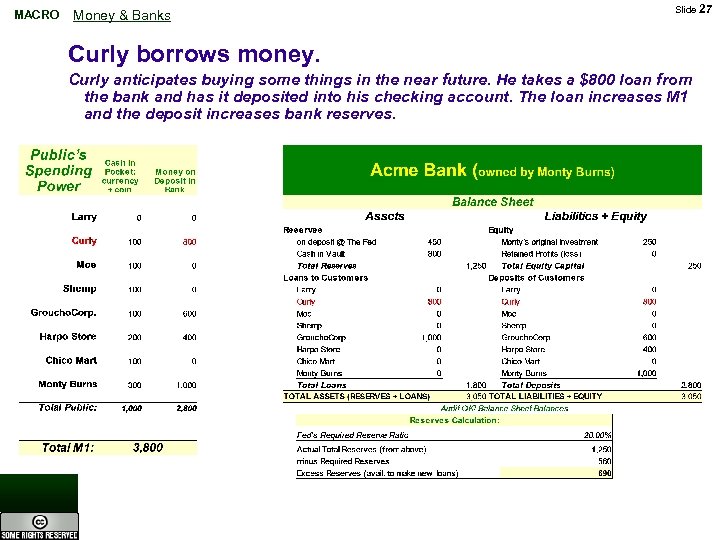
MACRO Money & Banks Slide 27 Curly borrows money. Curly anticipates buying some things in the near future. He takes a $800 loan from the bank and has it deposited into his checking account. The loan increases M 1 and the deposit increases bank reserves.
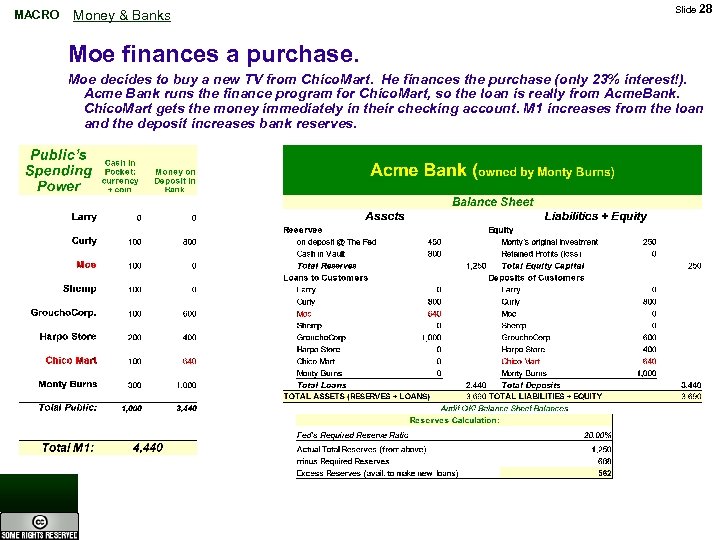
MACRO Money & Banks Slide 28 Moe finances a purchase. Moe decides to buy a new TV from Chico. Mart. He finances the purchase (only 23% interest!). Acme Bank runs the finance program for Chico. Mart, so the loan is really from Acme. Bank. Chico. Mart gets the money immediately in their checking account. M 1 increases from the loan and the deposit increases bank reserves.
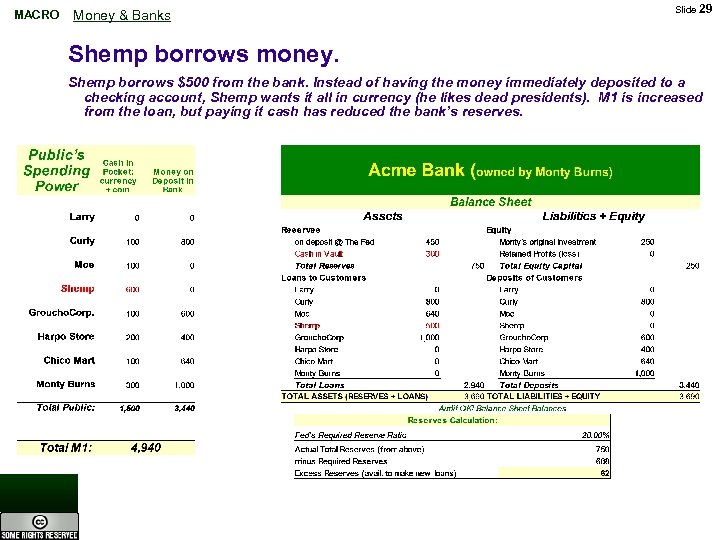
MACRO Money & Banks Slide 29 Shemp borrows money. Shemp borrows $500 from the bank. Instead of having the money immediately deposited to a checking account, Shemp wants it all in currency (he likes dead presidents). M 1 is increased from the loan, but paying it cash has reduced the bank’s reserves.
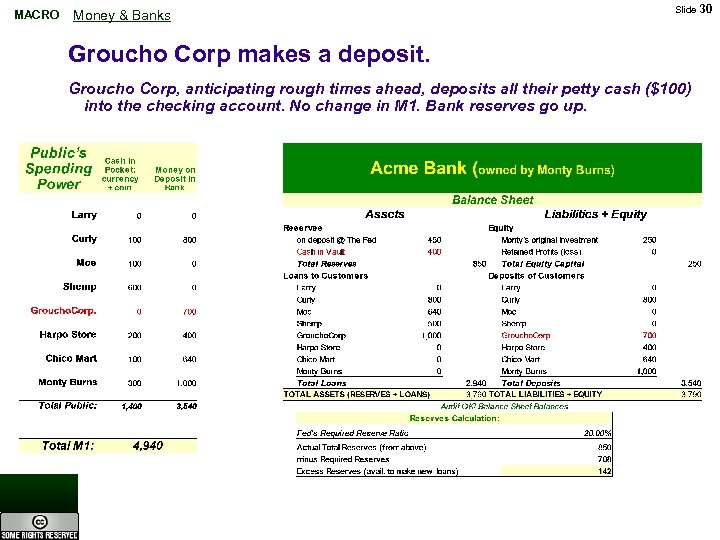
MACRO Money & Banks Slide 30 Groucho Corp makes a deposit. Groucho Corp, anticipating rough times ahead, deposits all their petty cash ($100) into the checking account. No change in M 1. Bank reserves go up.
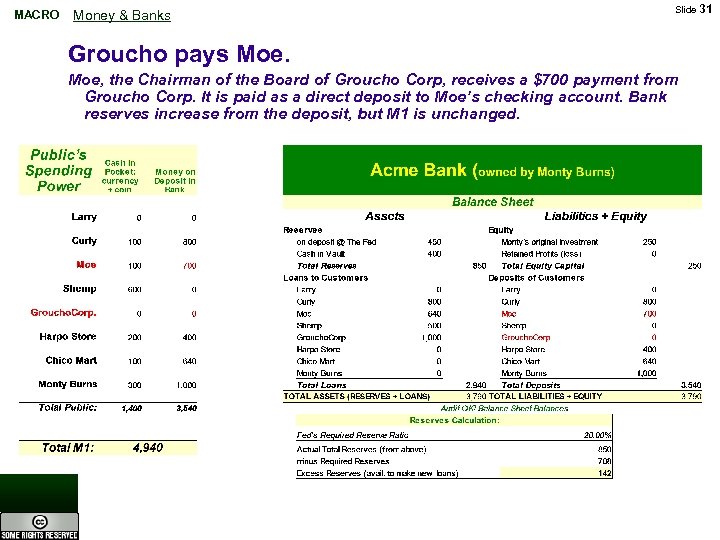
MACRO Money & Banks Slide 31 Groucho pays Moe, the Chairman of the Board of Groucho Corp, receives a $700 payment from Groucho Corp. It is paid as a direct deposit to Moe’s checking account. Bank reserves increase from the deposit, but M 1 is unchanged.
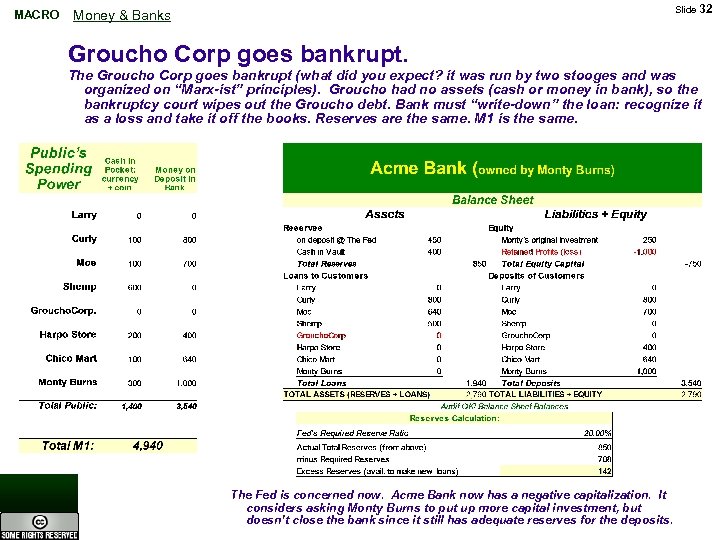
MACRO Slide 32 Money & Banks Groucho Corp goes bankrupt. The Groucho Corp goes bankrupt (what did you expect? it was run by two stooges and was organized on “Marx-ist” principles). Groucho had no assets (cash or money in bank), so the bankruptcy court wipes out the Groucho debt. Bank must “write-down” the loan: recognize it as a loss and take it off the books. Reserves are the same. M 1 is the same. The Fed is concerned now. Acme Bank now has a negative capitalization. It considers asking Monty Burns to put up more capital investment, but doesn’t close the bank since it still has adequate reserves for the deposits.
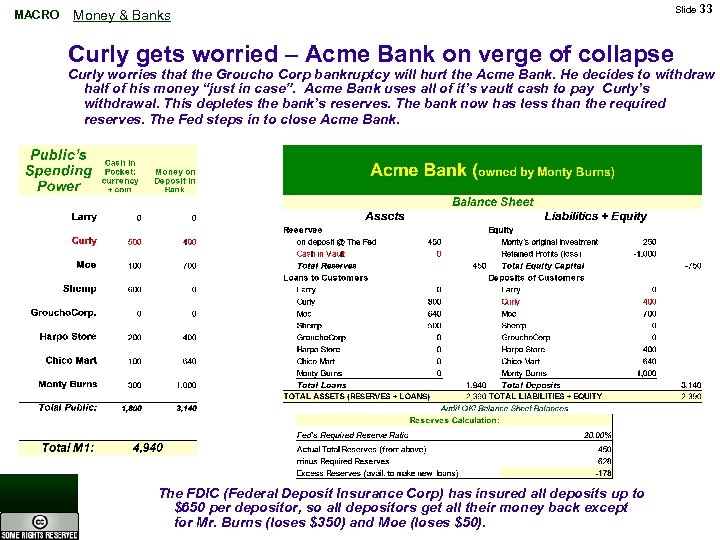
MACRO Money & Banks Curly gets worried – Acme Bank on verge of collapse Slide 33 Curly worries that the Groucho Corp bankruptcy will hurt the Acme Bank. He decides to withdraw half of his money “just in case”. Acme Bank uses all of it’s vault cash to pay Curly’s withdrawal. This depletes the bank’s reserves. The bank now has less than the required reserves. The Fed steps in to close Acme Bank. The FDIC (Federal Deposit Insurance Corp) has insured all deposits up to $650 per depositor, so all depositors get all their money back except for Mr. Burns (loses $350) and Moe (loses $50).
MACRO Slide 34 Money & Banks So Ends the Short Story of Acme Bank Notice that: M 1 only increases if a loan is being made the bank can only loan if it has excess reserves new bank deposits help increase the bank’s reserves withdrawals from the bank deplete the bank’s reserves
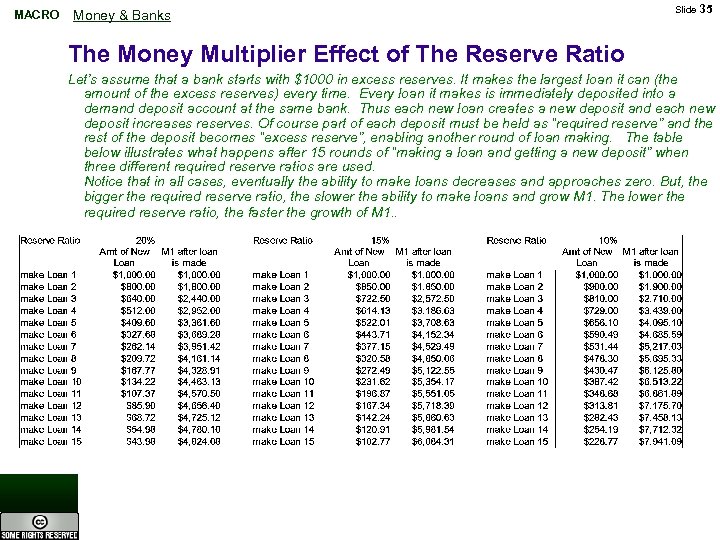
MACRO Money & Banks Slide 35 The Money Multiplier Effect of The Reserve Ratio Let’s assume that a bank starts with $1000 in excess reserves. It makes the largest loan it can (the amount of the excess reserves) every time. Every loan it makes is immediately deposited into a demand deposit account at the same bank. Thus each new loan creates a new deposit and each new deposit increases reserves. Of course part of each deposit must be held as “required reserve” and the rest of the deposit becomes “excess reserve”, enabling another round of loan making. The table below illustrates what happens after 15 rounds of “making a loan and getting a new deposit” when three different required reserve ratios are used. Notice that in all cases, eventually the ability to make loans decreases and approaches zero. But, the bigger the required reserve ratio, the slower the ability to make loans and grow M 1. The lower the required reserve ratio, the faster the growth of M 1. .
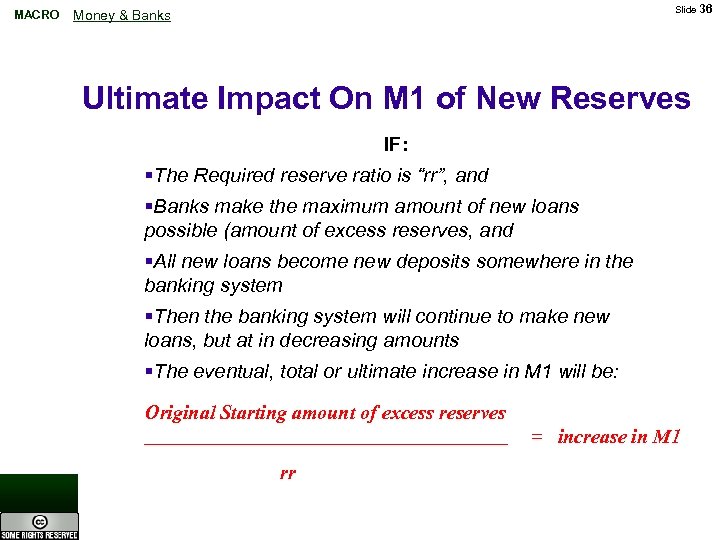
MACRO Slide 36 Money & Banks Ultimate Impact On M 1 of New Reserves IF: The Required reserve ratio is “rr”, and Banks make the maximum amount of new loans possible (amount of excess reserves, and All new loans become new deposits somewhere in the banking system Then the banking system will continue to make new loans, but at in decreasing amounts The eventual, total or ultimate increase in M 1 will be: Original Starting amount of excess reserves ______________________________________________ rr = increase in M 1
Скачать презентацию MACRO Slide 1 Money Banks Money and
e9884fd02013bc8c8a380700e8ff3b68.ppt