


 Скачать презентацию macro CHAPTER FIVE The Open Economy macroeconomics fifth
193b5402846e2dc13cde96ac7c2f3555.ppt
- Количество слайдов: 57
 macro CHAPTER FIVE The Open Economy macroeconomics fifth edition N. Gregory Mankiw Power. Point® Slides by Ron Cronovich © 2002 Worth Publishers, all rights reserved
 Chapter objectives § accounting identities for the open economy § small open economy model § what makes it “small” § how the trade balance and exchange rate are determined § how policies affect trade balance & exchange rate CHAPTER 5 The Open Economy 1
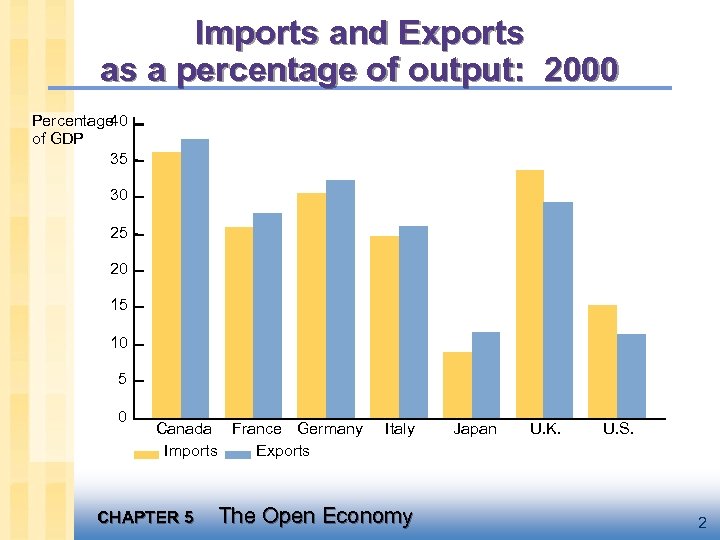 Imports and Exports as a percentage of output: 2000 Percentage 40 of GDP 35 30 25 20 15 10 5 0 Canada France Germany Imports Exports CHAPTER 5 Italy The Open Economy Japan U. K. U. S. 2
 In an open economy, § spending need not equal output § saving need not equal investment CHAPTER 5 The Open Economy 3
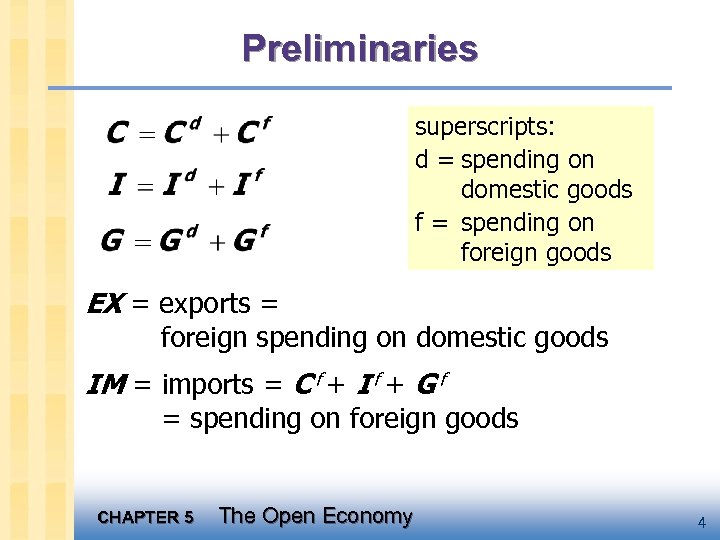 Preliminaries superscripts: d = spending on domestic goods f = spending on foreign goods EX = exports = foreign spending on domestic goods IM = imports = C f + I f + G f = spending on foreign goods CHAPTER 5 The Open Economy 4
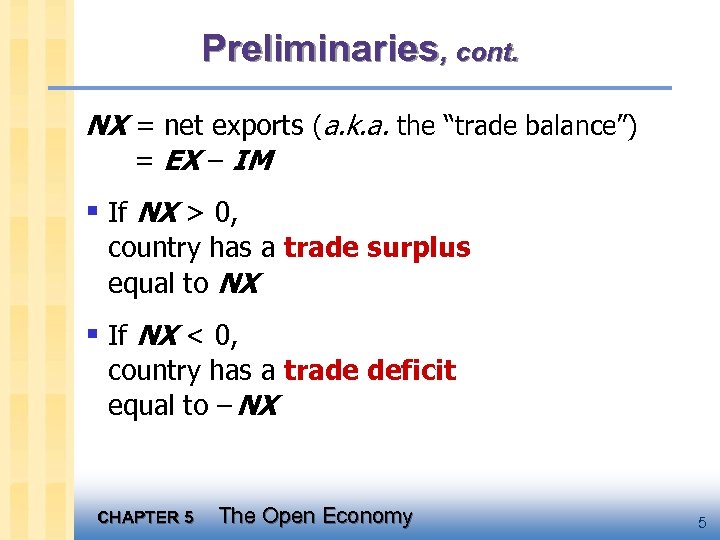 Preliminaries, cont. NX = net exports (a. k. a. the “trade balance”) = EX – IM § If NX > 0, country has a trade surplus equal to NX § If NX < 0, country has a trade deficit equal to – NX CHAPTER 5 The Open Economy 5
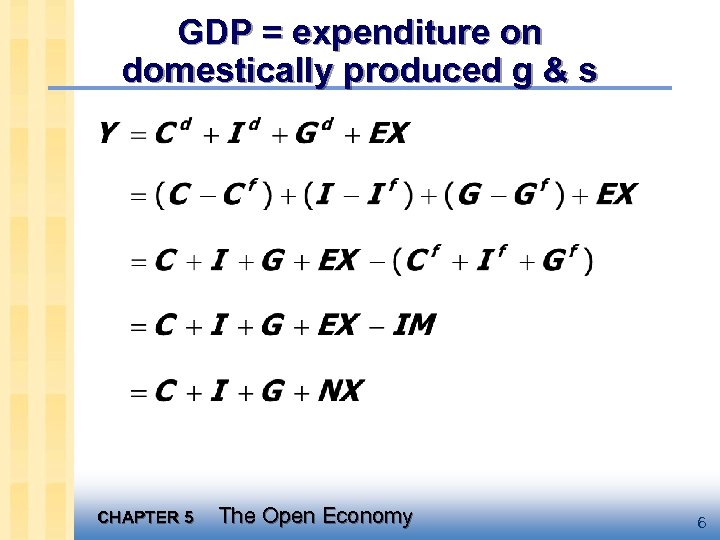 GDP = expenditure on domestically produced g & s CHAPTER 5 The Open Economy 6
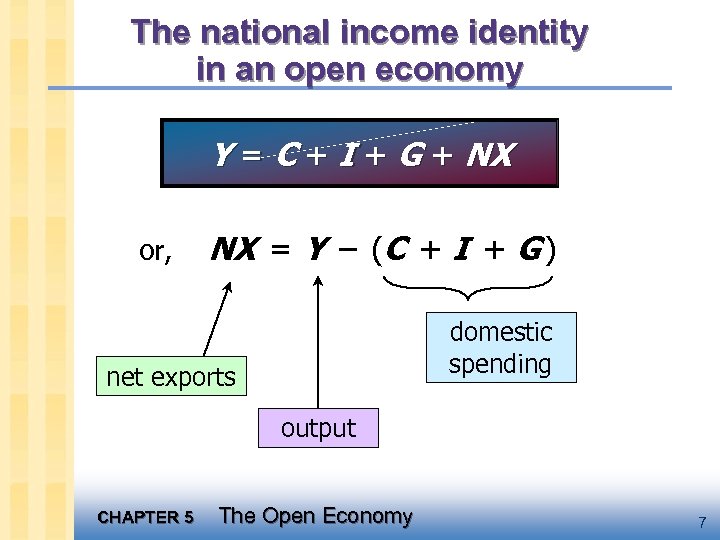 The national income identity in an open economy Y = C + I + G + NX or, NX = Y – (C + I + G ) domestic spending net exports output CHAPTER 5 The Open Economy 7
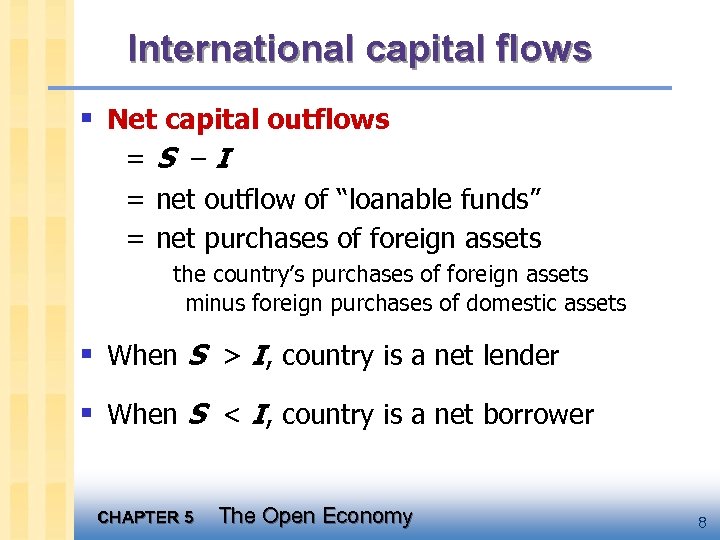 International capital flows § Net capital outflows =S –I = net outflow of “loanable funds” = net purchases of foreign assets the country’s purchases of foreign assets minus foreign purchases of domestic assets § When S > I, country is a net lender § When S < I, country is a net borrower CHAPTER 5 The Open Economy 8
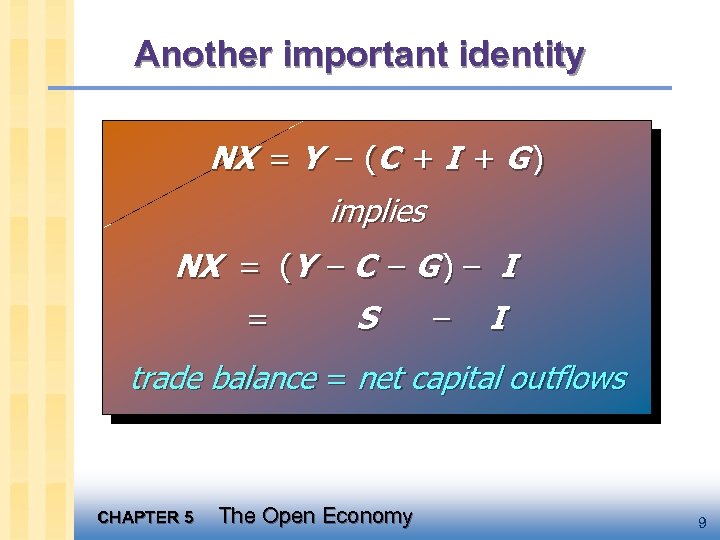 Another important identity NX = Y – (C + I + G ) implies NX = (Y – C – G ) – I = S – I trade balance = net capital outflows CHAPTER 5 The Open Economy 9
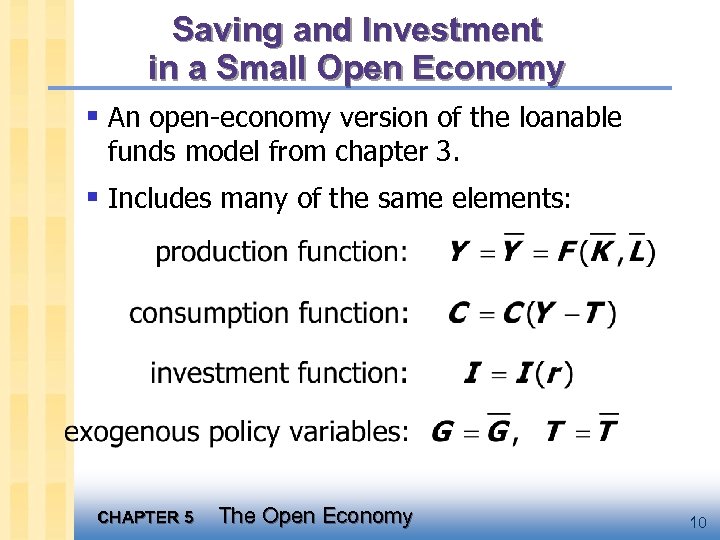 Saving and Investment in a Small Open Economy § An open-economy version of the loanable funds model from chapter 3. § Includes many of the same elements: CHAPTER 5 The Open Economy 10
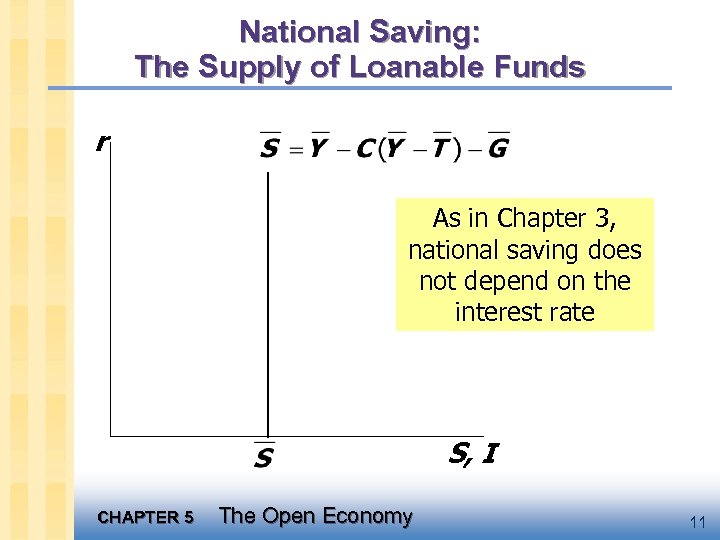 National Saving: The Supply of Loanable Funds r As in Chapter 3, national saving does not depend on the interest rate S, I CHAPTER 5 The Open Economy 11
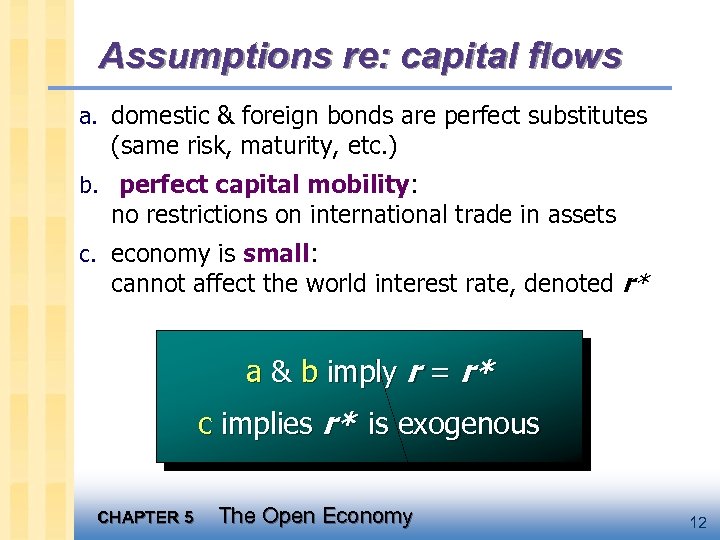 Assumptions re: capital flows a. domestic & foreign bonds are perfect substitutes (same risk, maturity, etc. ) b. perfect capital mobility: no restrictions on international trade in assets c. economy is small: cannot affect the world interest rate, denoted r* a & b imply r = r* c implies r* is exogenous CHAPTER 5 The Open Economy 12
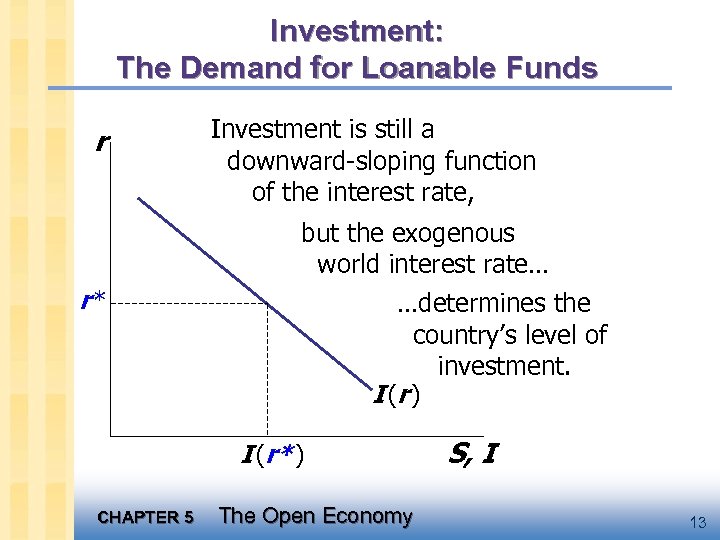 Investment: The Demand for Loanable Funds r Investment is still a downward-sloping function of the interest rate, but the exogenous world interest rate… r* …determines the country’s level of investment. I (r ) I (r* ) CHAPTER 5 The Open Economy S, I 13
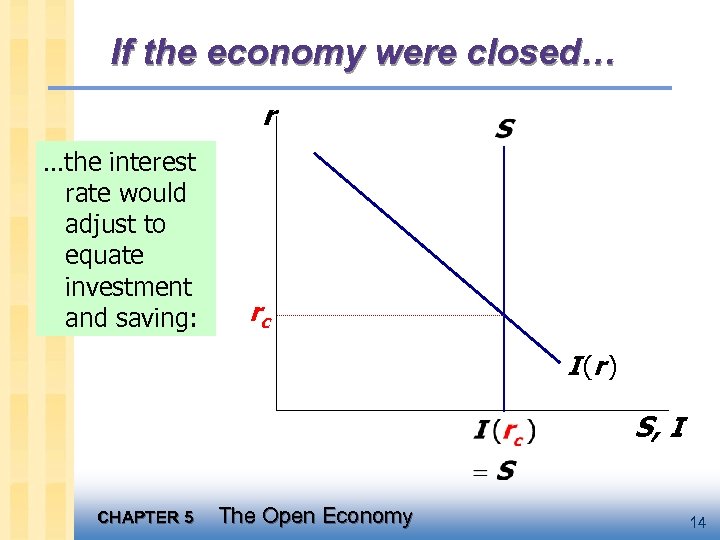 If the economy were closed… r …the interest rate would adjust to equate investment and saving: rc I (r ) S, I CHAPTER 5 The Open Economy 14
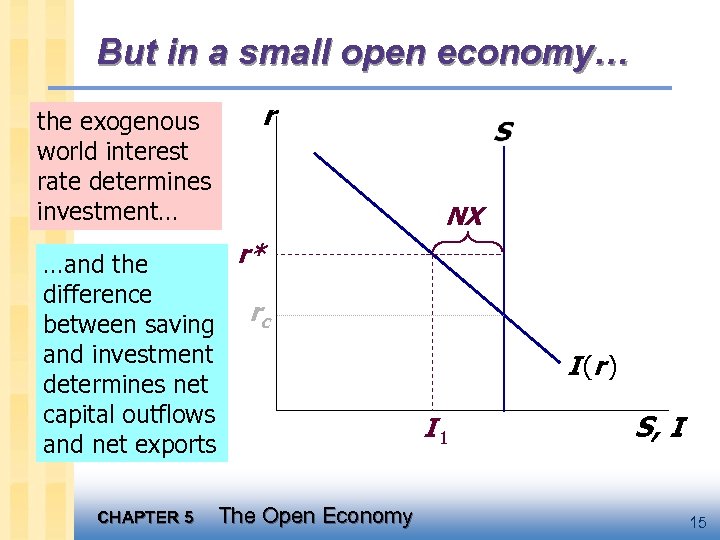 But in a small open economy… the exogenous world interest rate determines investment… r NX r* …and the difference between saving rc and investment determines net capital outflows and net exports CHAPTER 5 The Open Economy I (r ) I 1 S, I 15
 Three experiments 1. Fiscal policy at home 2. Fiscal policy abroad 3. An increase in investment demand CHAPTER 5 The Open Economy 16
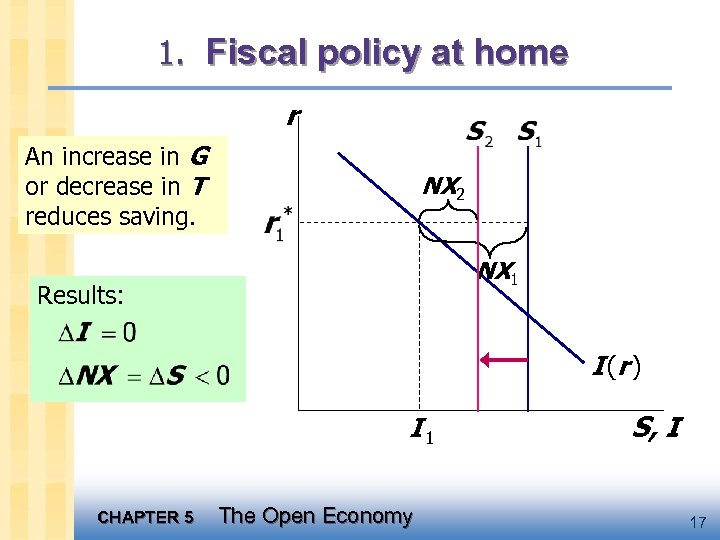 1. Fiscal policy at home r An increase in G or decrease in T reduces saving. NX 2 NX 1 Results: I (r ) I 1 CHAPTER 5 The Open Economy S, I 17
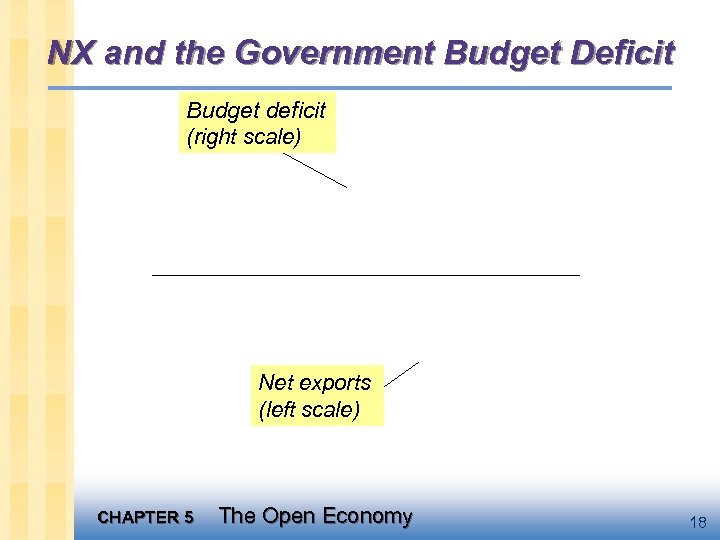 NX and the Government Budget Deficit Budget deficit (right scale) Net exports (left scale) CHAPTER 5 The Open Economy 18
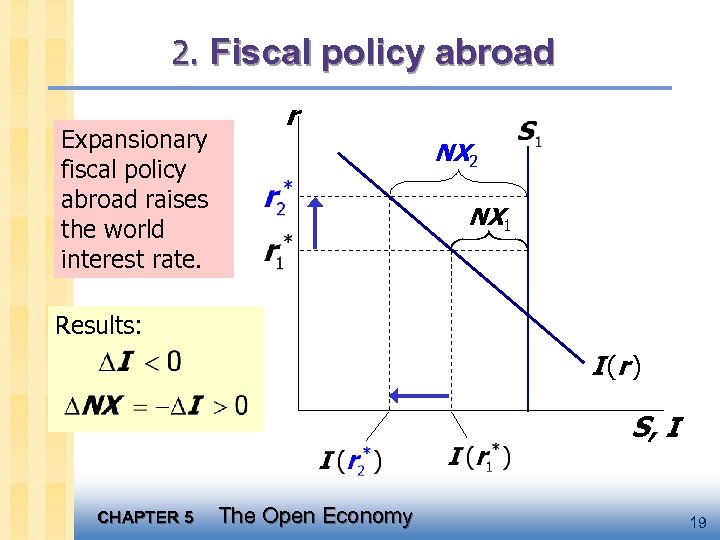 2. Fiscal policy abroad Expansionary fiscal policy abroad raises the world interest rate. r NX 2 NX 1 Results: I (r ) S, I CHAPTER 5 The Open Economy 19
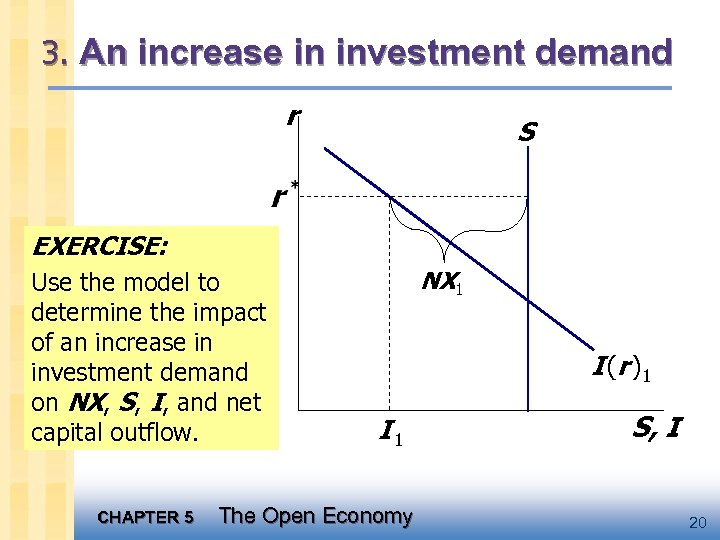 3. An increase in investment demand r S EXERCISE: Use the model to determine the impact of an increase in investment demand on NX, S, I, and net capital outflow. CHAPTER 5 NX 1 I (r )1 I 1 The Open Economy S, I 20
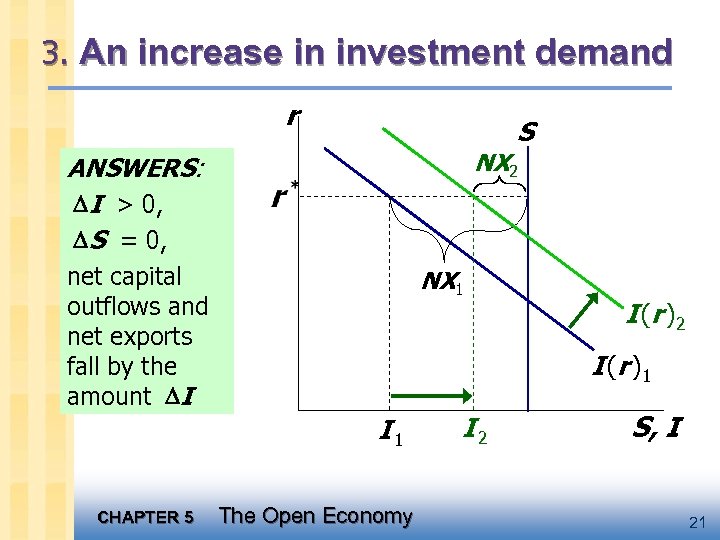 3. An increase in investment demand r S NX 2 ANSWERS: I > 0, S = 0, net capital outflows and net exports fall by the amount I NX 1 I (r )1 I 1 CHAPTER 5 I (r )2 The Open Economy I 2 S, I 21
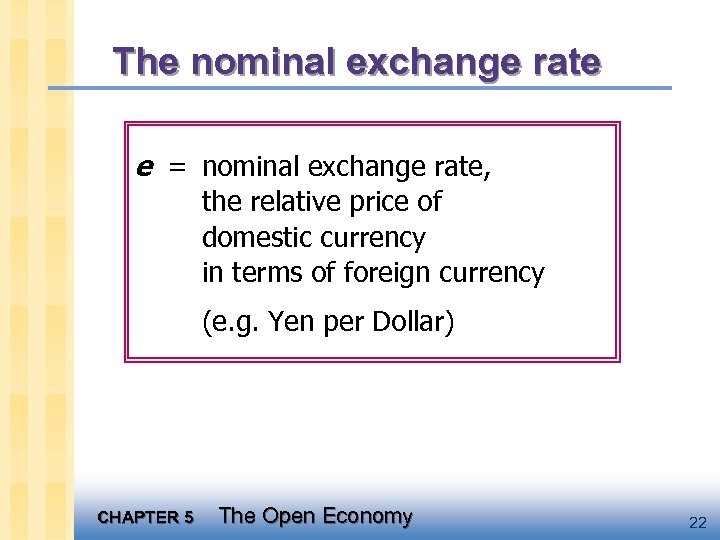 The nominal exchange rate e = nominal exchange rate, the relative price of domestic currency in terms of foreign currency (e. g. Yen per Dollar) CHAPTER 5 The Open Economy 22
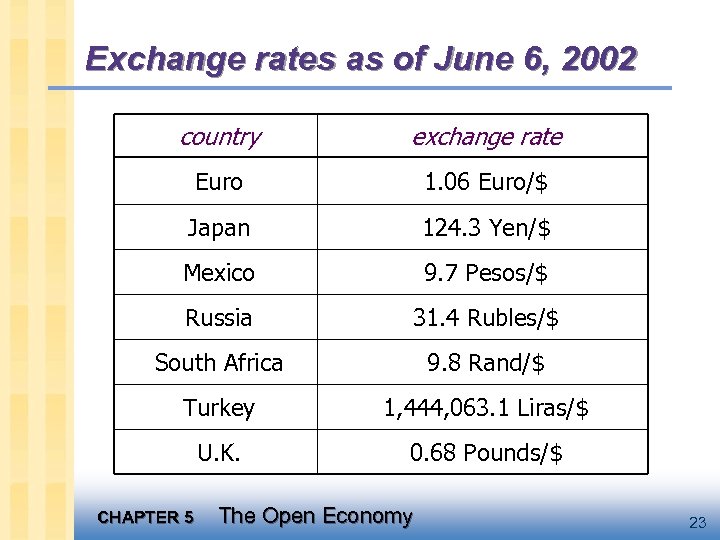 Exchange rates as of June 6, 2002 country exchange rate Euro 1. 06 Euro/$ Japan 124. 3 Yen/$ Mexico 9. 7 Pesos/$ Russia 31. 4 Rubles/$ South Africa 9. 8 Rand/$ Turkey 1, 444, 063. 1 Liras/$ U. K. 0. 68 Pounds/$ CHAPTER 5 The Open Economy 23
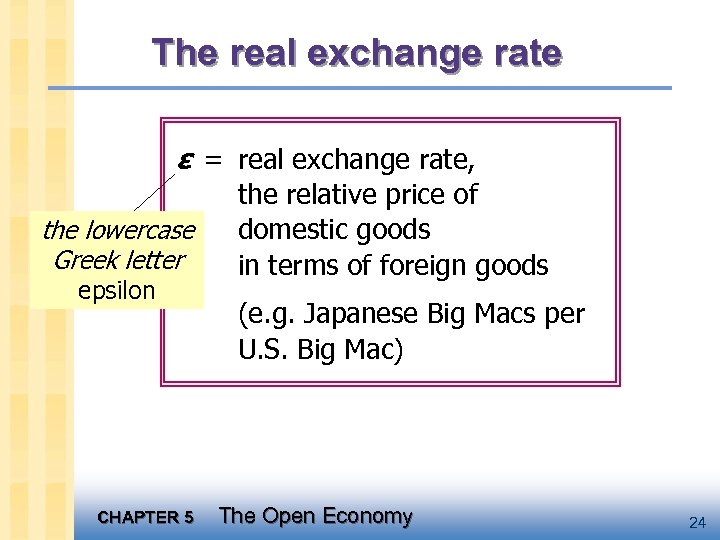 The real exchange rate ε = real exchange rate, the lowercase Greek letter epsilon CHAPTER 5 the relative price of domestic goods in terms of foreign goods (e. g. Japanese Big Macs per U. S. Big Mac) The Open Economy 24
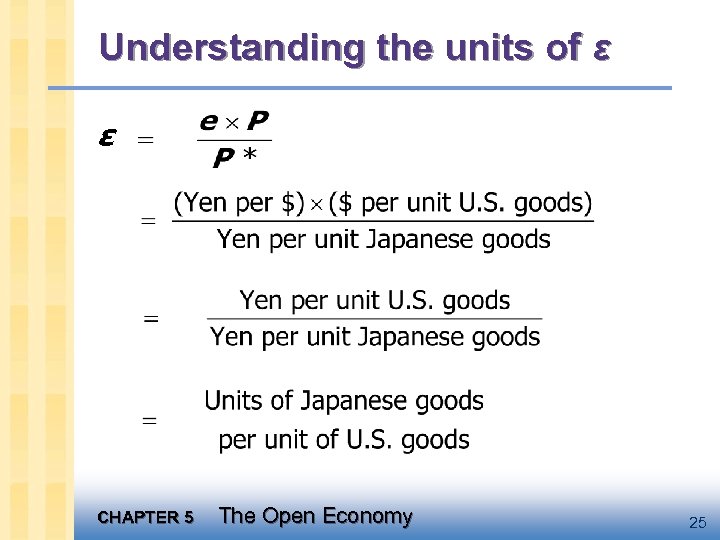 Understanding the units of ε ε CHAPTER 5 The Open Economy 25
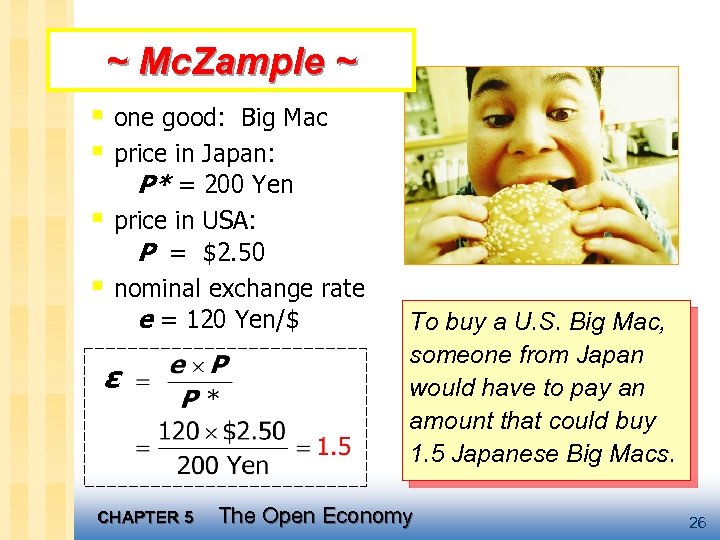 ~ Mc. Zample ~ § one good: Big Mac § price in Japan: P* = 200 Yen § price in USA: P = $2. 50 § nominal exchange rate e = 120 Yen/$ ε CHAPTER 5 To buy a U. S. Big Mac, someone from Japan would have to pay an amount that could buy 1. 5 Japanese Big Macs. The Open Economy 26
 ε in the real world & our model § In the real world: We can think of ε as the relative price of a basket of domestic goods in terms of a basket of foreign goods § In our macro model: There’s just one good, “output. ” So ε is the relative price of one country’s output in terms of the other country’s output CHAPTER 5 The Open Economy 27
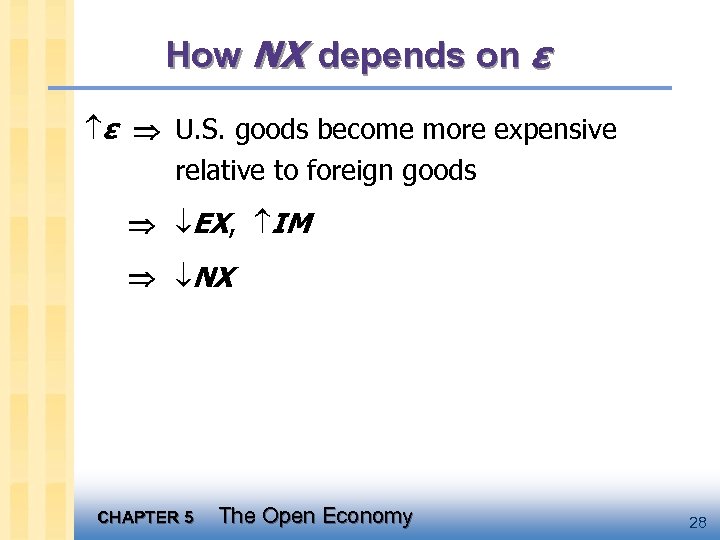 How NX depends on ε ε U. S. goods become more expensive relative to foreign goods EX, IM NX CHAPTER 5 The Open Economy 28
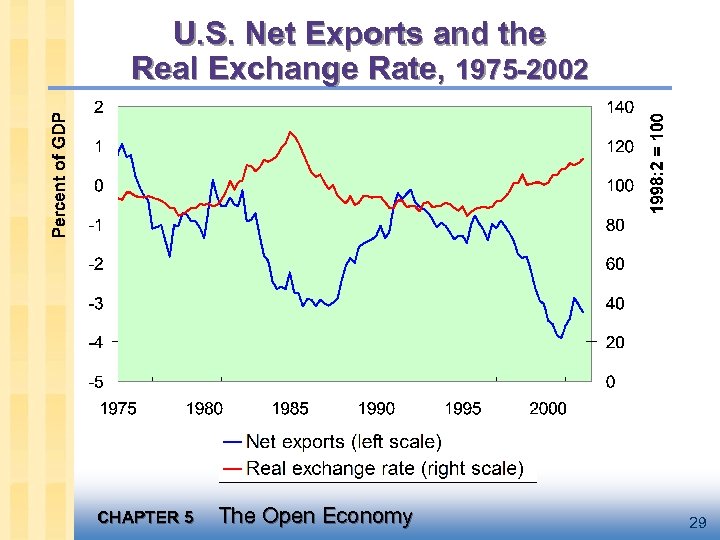 U. S. Net Exports and the Real Exchange Rate, 1975 -2002 CHAPTER 5 The Open Economy 29
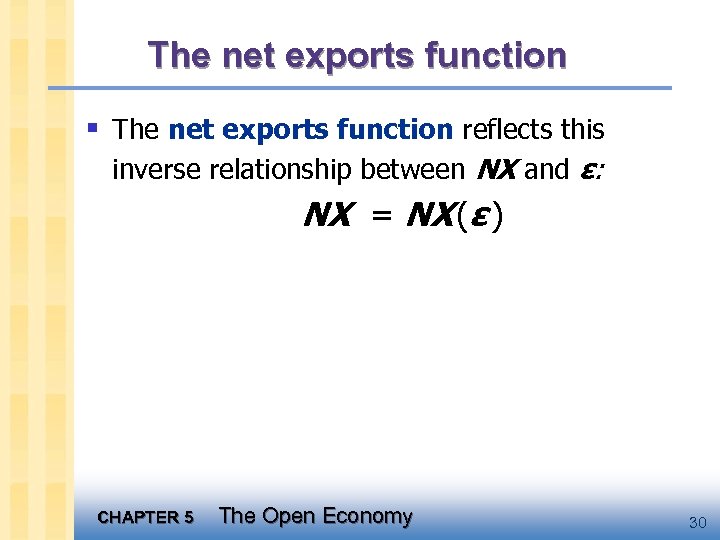 The net exports function § The net exports function reflects this inverse relationship between NX and ε: NX = NX (ε ) CHAPTER 5 The Open Economy 30
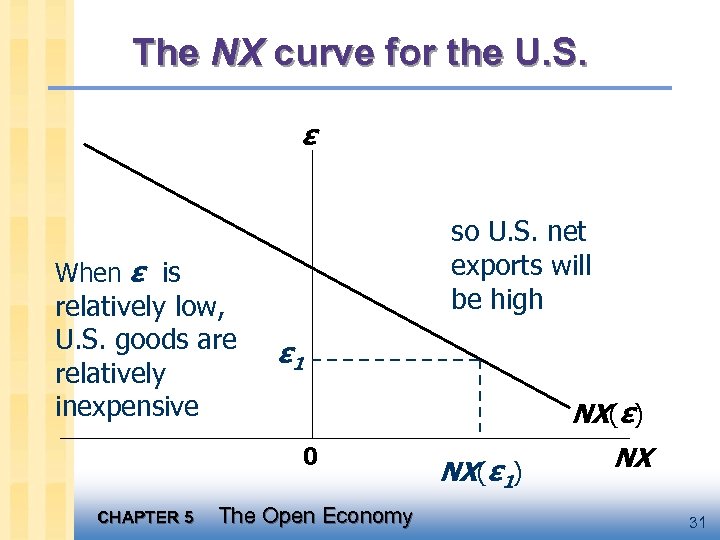 The NX curve for the U. S. ε so U. S. net exports will be high When ε is relatively low, U. S. goods are relatively inexpensive ε 1 NX(ε) 0 CHAPTER 5 The Open Economy NX(ε 1) NX 31
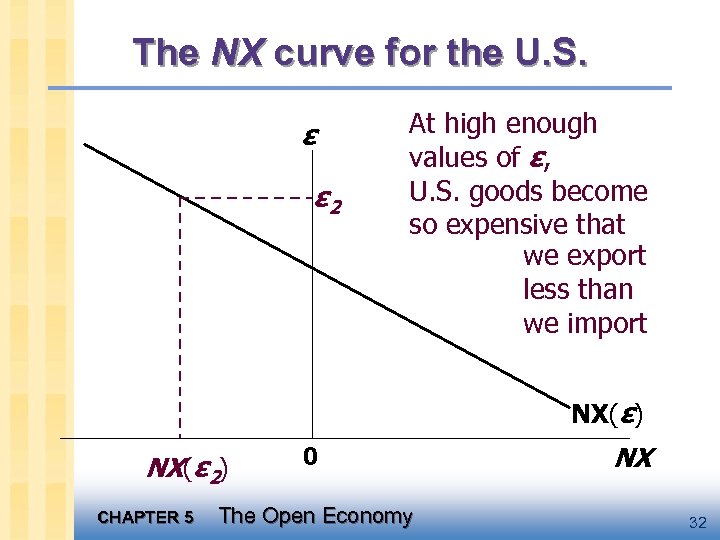 The NX curve for the U. S. ε ε 2 At high enough values of ε, U. S. goods become so expensive that we export less than we import NX(ε) NX(ε 2) CHAPTER 5 0 The Open Economy NX 32
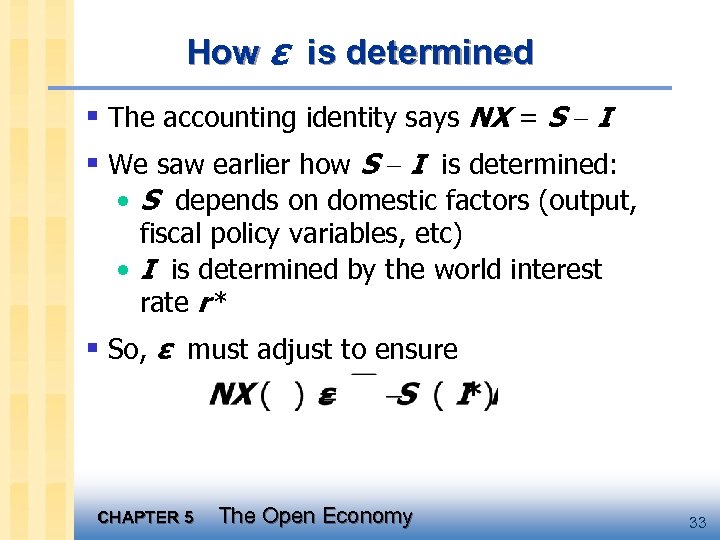 How ε is determined § The accounting identity says NX = S - I § We saw earlier how S - I is determined: • S depends on domestic factors (output, fiscal policy variables, etc) • I is determined by the world interest rate r * § So, ε must adjust to ensure CHAPTER 5 The Open Economy 33
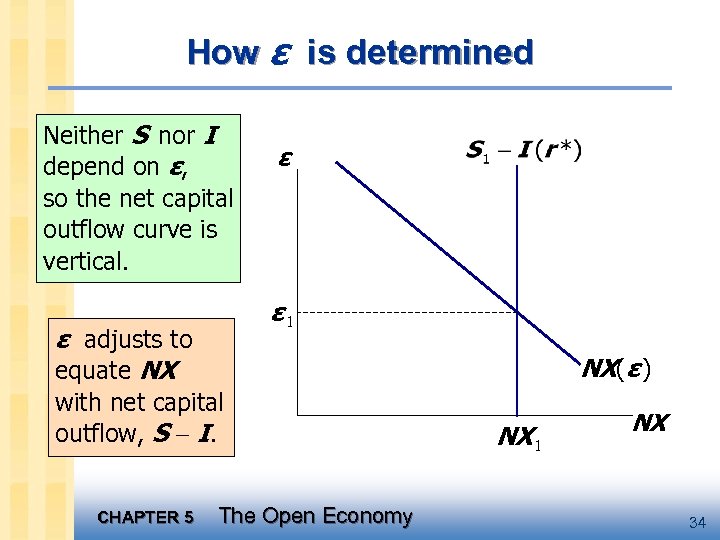 How ε is determined Neither S nor I depend on ε, so the net capital outflow curve is vertical. ε ε 1 ε adjusts to equate NX NX(ε ) with net capital outflow, S - I. CHAPTER 5 The Open Economy NX 1 NX 34
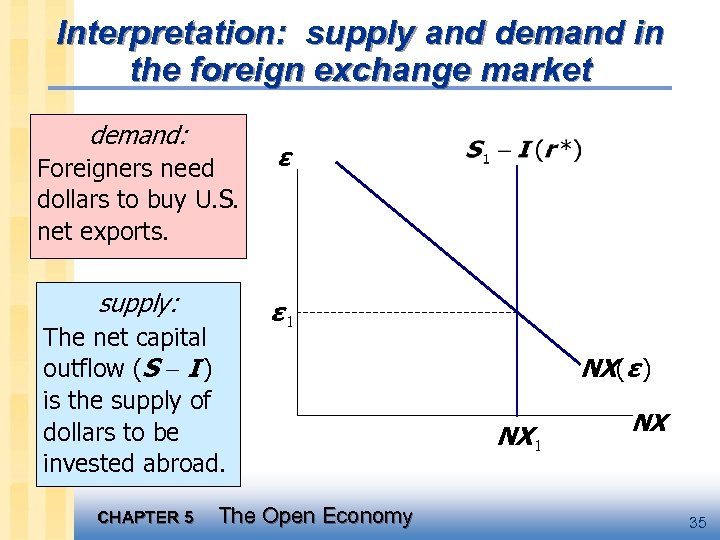 Interpretation: supply and demand in the foreign exchange market demand: Foreigners need dollars to buy U. S. net exports. ε supply: ε 1 The net capital outflow (S - I ) is the supply of dollars to be invested abroad. CHAPTER 5 The Open Economy NX(ε ) NX 1 NX 35
 Four experiments 1. Fiscal policy at home 2. Fiscal policy abroad 3. An increase in investment demand 4. Trade policy to restrict imports CHAPTER 5 The Open Economy 36
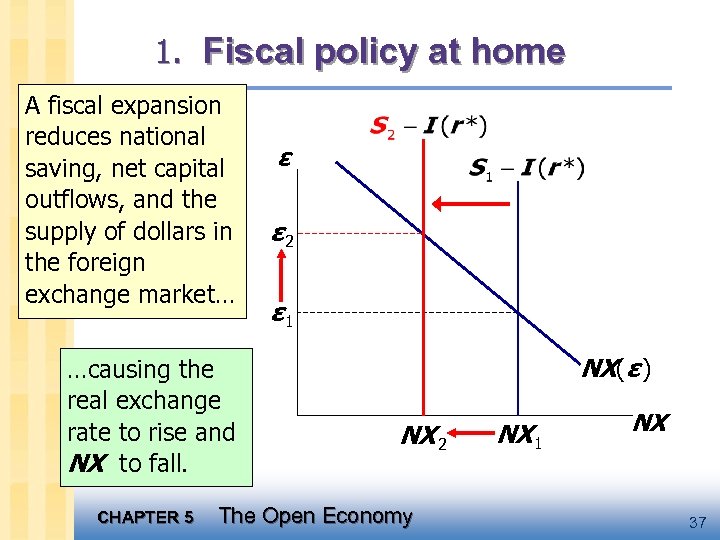 1. Fiscal policy at home A fiscal expansion reduces national saving, net capital outflows, and the supply of dollars in the foreign exchange market… …causing the real exchange rate to rise and NX to fall. CHAPTER 5 ε ε 2 ε 1 NX(ε ) NX 2 The Open Economy NX 1 NX 37
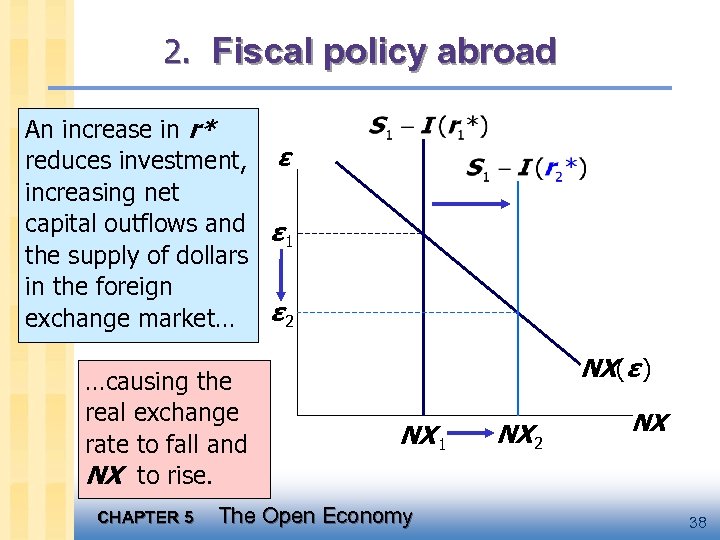 2. Fiscal policy abroad An increase in r* reduces investment, ε increasing net capital outflows and ε 1 the supply of dollars in the foreign exchange market… ε 2 …causing the real exchange rate to fall and NX to rise. CHAPTER 5 NX(ε ) NX 1 The Open Economy NX 2 NX 38
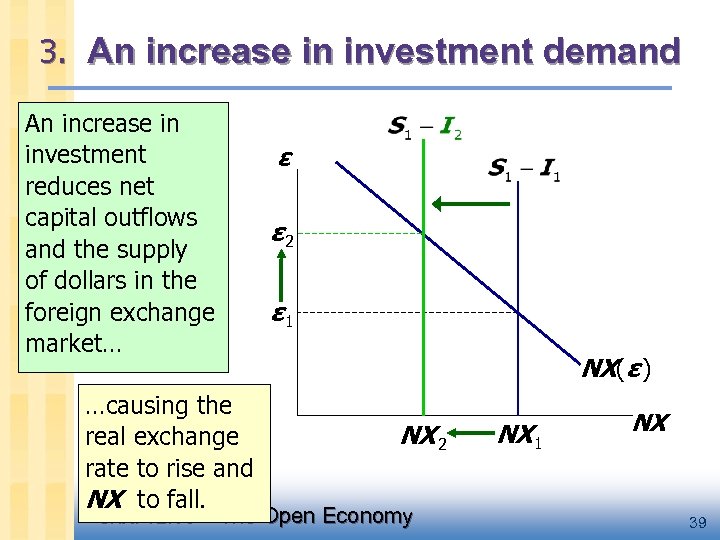 3. An increase in investment demand An increase in investment reduces net capital outflows and the supply of dollars in the foreign exchange market… ε ε 2 ε 1 NX(ε ) …causing the real exchange rate to rise and NX to fall. CHAPTER 5 NX 2 The Open Economy NX 1 NX 39
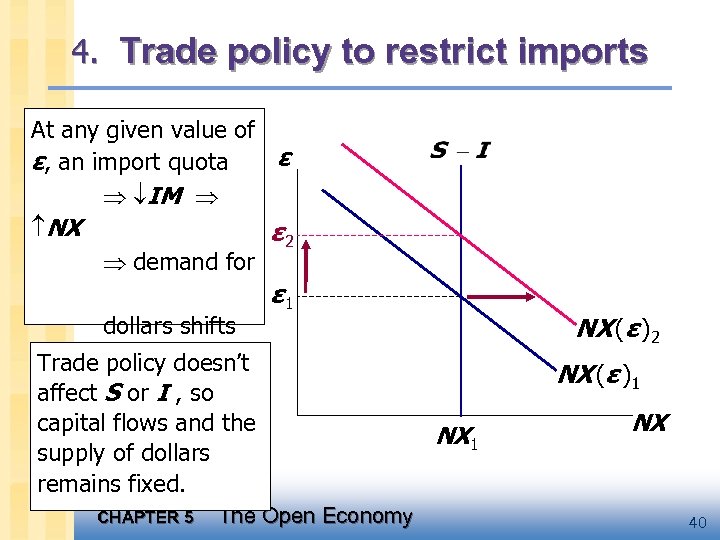 4. Trade policy to restrict imports At any given value of ε ε, an import quota IM NX ε 2 demand for dollars shifts right Trade policy doesn’t affect S or I , so capital flows and the supply of dollars remains fixed. CHAPTER 5 ε 1 The Open Economy NX (ε )2 NX (ε )1 NX 40
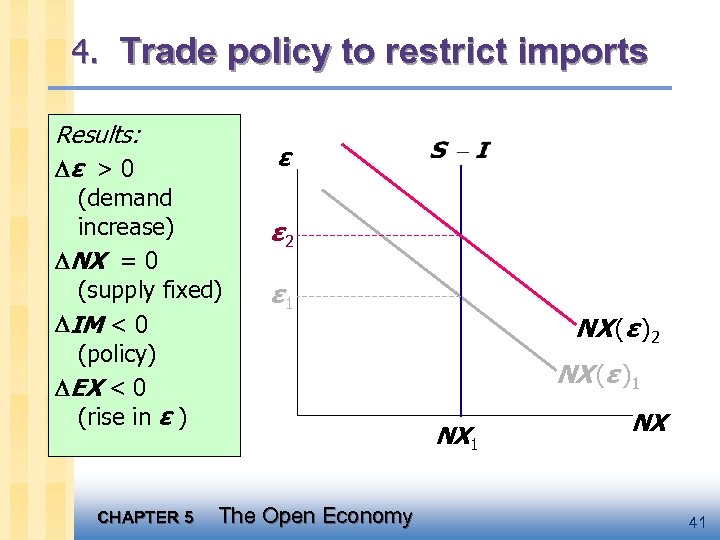 4. Trade policy to restrict imports Results: ε > 0 ε (demand increase) NX = 0 (supply fixed) IM < 0 (policy) EX < 0 (rise in ε ) CHAPTER 5 ε 2 ε 1 The Open Economy NX (ε )2 NX (ε )1 NX 41
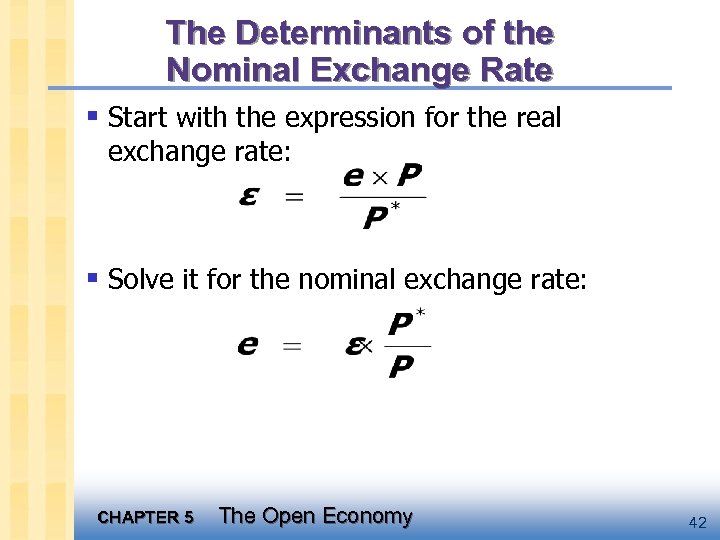 The Determinants of the Nominal Exchange Rate § Start with the expression for the real exchange rate: § Solve it for the nominal exchange rate: CHAPTER 5 The Open Economy 42
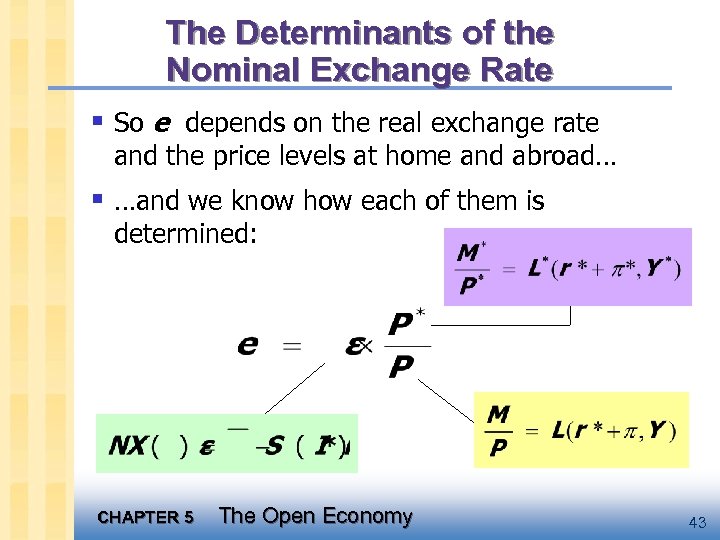 The Determinants of the Nominal Exchange Rate § So e depends on the real exchange rate and the price levels at home and abroad… § …and we know how each of them is determined: CHAPTER 5 The Open Economy 43
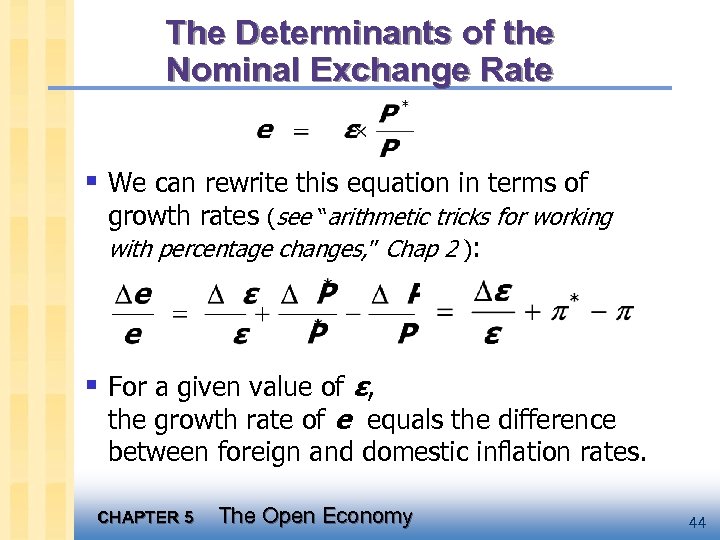 The Determinants of the Nominal Exchange Rate § We can rewrite this equation in terms of growth rates (see “arithmetic tricks for working with percentage changes, ” Chap 2 ): § For a given value of ε, the growth rate of e equals the difference between foreign and domestic inflation rates. CHAPTER 5 The Open Economy 44
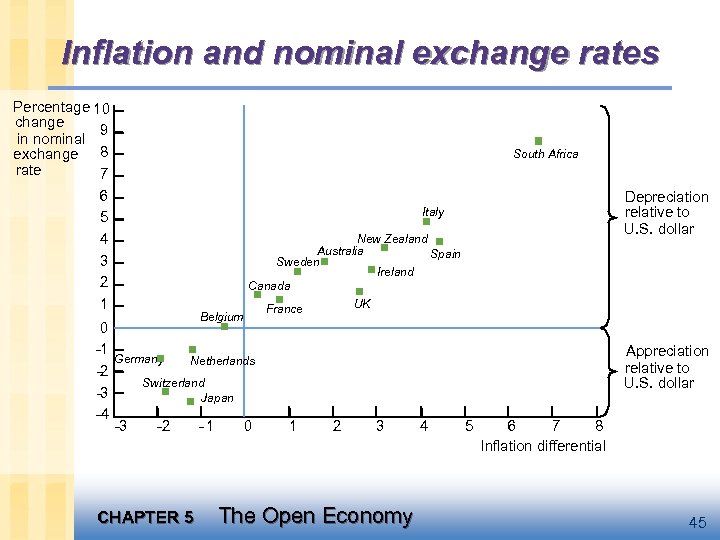 Inflation and nominal exchange rates Percentage 10 change 9 in nominal exchange 8 rate 7 6 5 4 3 2 1 0 -1 -2 -3 -4 South Africa Depreciation relative to U. S. dollar Italy New Zealand Australia Spain Sweden Ireland Canada Belgium Germany UK France Appreciation relative to U. S. dollar Netherlands Switzerland Japan -3 -2 CHAPTER 5 -1 0 1 2 3 The Open Economy 4 5 6 7 8 Inflation differential 45
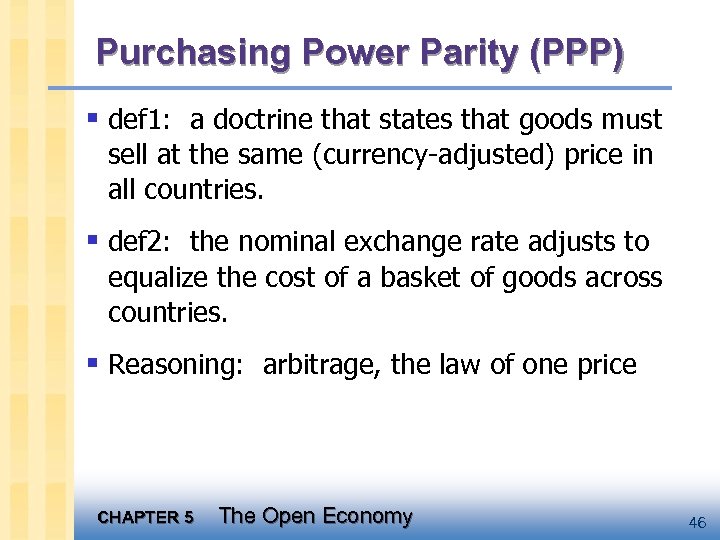 Purchasing Power Parity (PPP) § def 1: a doctrine that states that goods must sell at the same (currency-adjusted) price in all countries. § def 2: the nominal exchange rate adjusts to equalize the cost of a basket of goods across countries. § Reasoning: arbitrage, the law of one price CHAPTER 5 The Open Economy 46
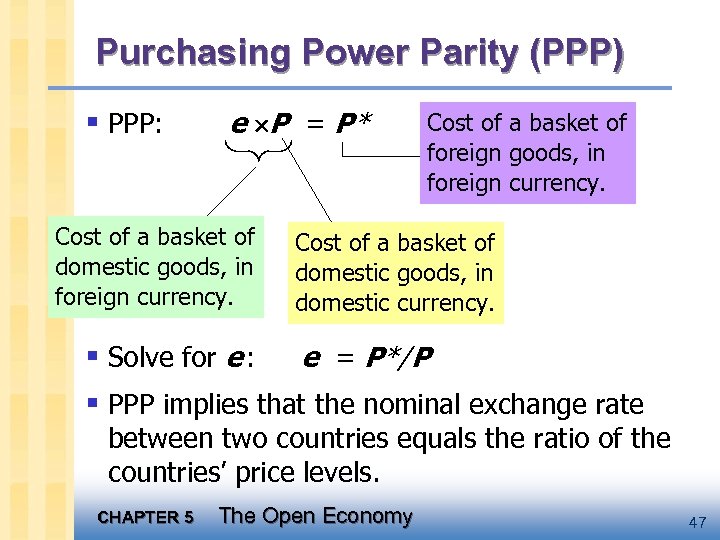 Purchasing Power Parity (PPP) § PPP: e P = P* Cost of a basket of domestic goods, in foreign currency. § Solve for e : Cost of a basket of foreign goods, in foreign currency. Cost of a basket of domestic goods, in domestic currency. e = P*/ P § PPP implies that the nominal exchange rate between two countries equals the ratio of the countries’ price levels. CHAPTER 5 The Open Economy 47
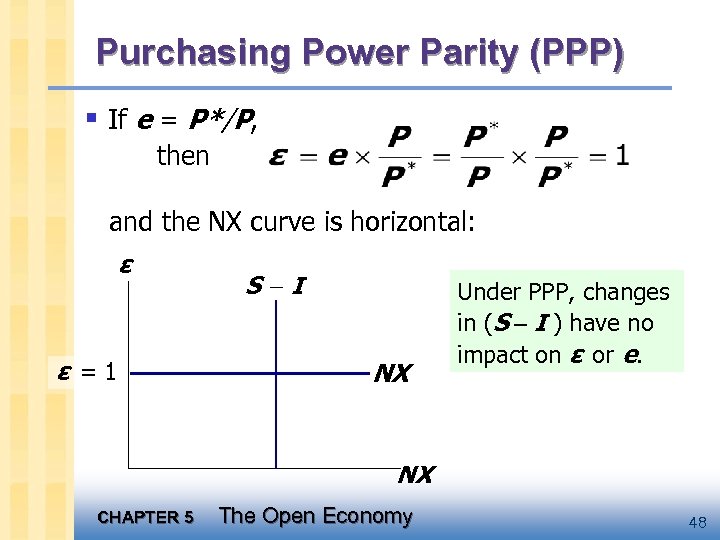 Purchasing Power Parity (PPP) § If e = P*/P, then and the NX curve is horizontal: ε ε =1 S -I NX Under PPP, changes in (S - I ) have no impact on ε or e. NX CHAPTER 5 The Open Economy 48
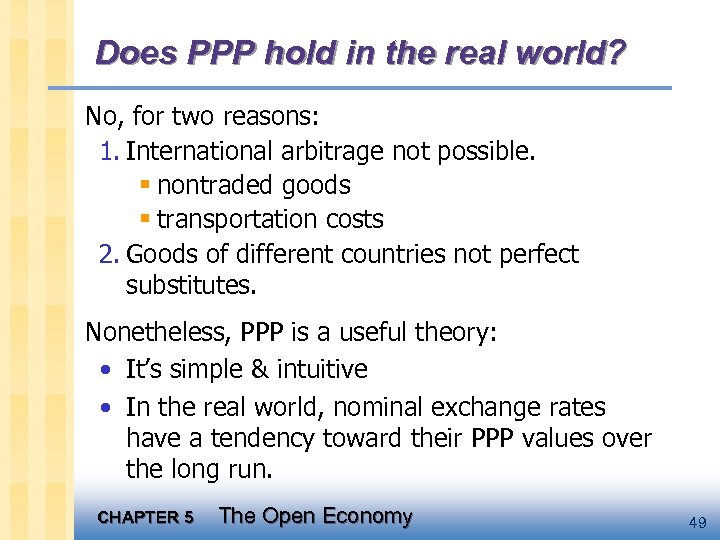 Does PPP hold in the real world? No, for two reasons: 1. International arbitrage not possible. § nontraded goods § transportation costs 2. Goods of different countries not perfect substitutes. Nonetheless, PPP is a useful theory: • It’s simple & intuitive • In the real world, nominal exchange rates have a tendency toward their PPP values over the long run. CHAPTER 5 The Open Economy 49
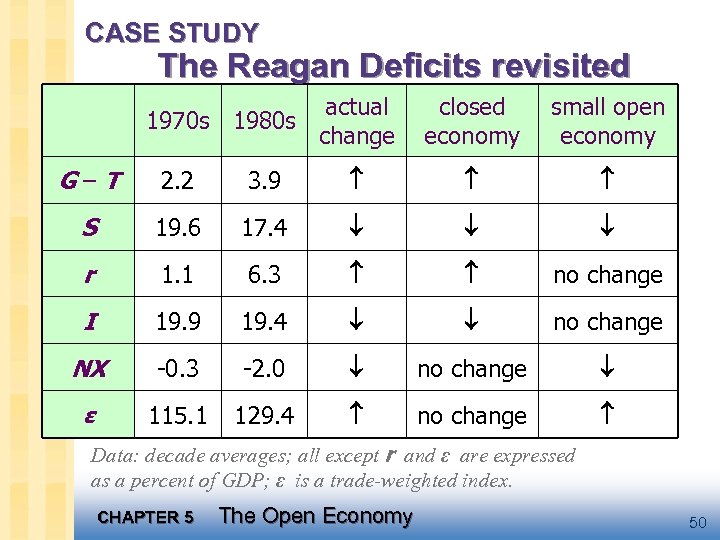 CASE STUDY The Reagan Deficits revisited actual 1970 s 1980 s change closed economy small open economy G–T 2. 2 3. 9 S 19. 6 17. 4 r 1. 1 6. 3 no change I 19. 9 19. 4 no change NX -0. 3 -2. 0 no change ε 115. 1 129. 4 no change Data: decade averages; all except r and ε are expressed as a percent of GDP; ε is a trade-weighted index. CHAPTER 5 The Open Economy 50
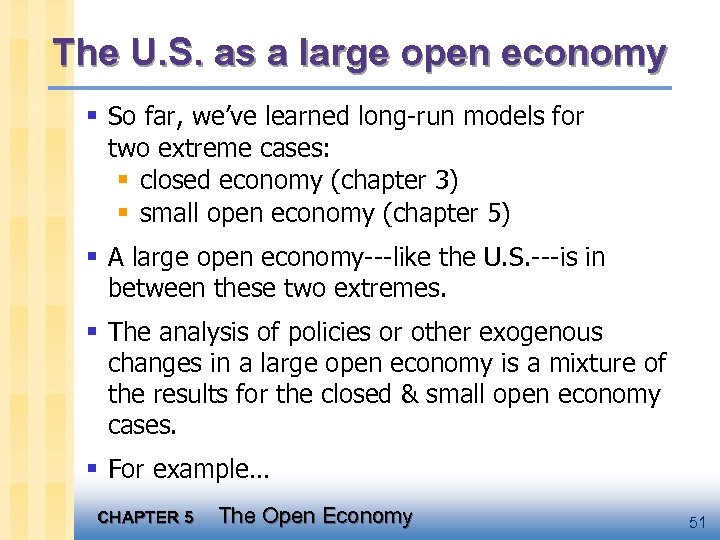 The U. S. as a large open economy § So far, we’ve learned long-run models for two extreme cases: § closed economy (chapter 3) § small open economy (chapter 5) § A large open economy---like the U. S. ---is in between these two extremes. § The analysis of policies or other exogenous changes in a large open economy is a mixture of the results for the closed & small open economy cases. § For example… CHAPTER 5 The Open Economy 51
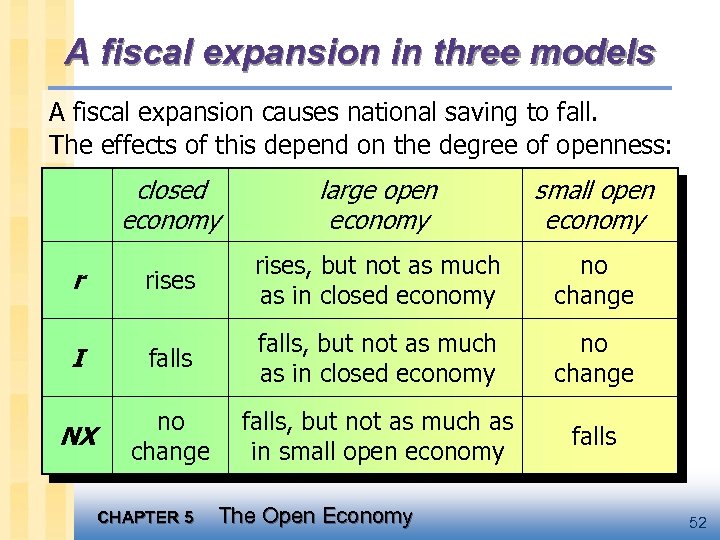 A fiscal expansion in three models A fiscal expansion causes national saving to fall. The effects of this depend on the degree of openness: closed economy large open economy small open economy rises, but not as much as in closed economy no change I falls, but not as much as in closed economy no change NX no change falls, but not as much as in small open economy falls r CHAPTER 5 The Open Economy 52
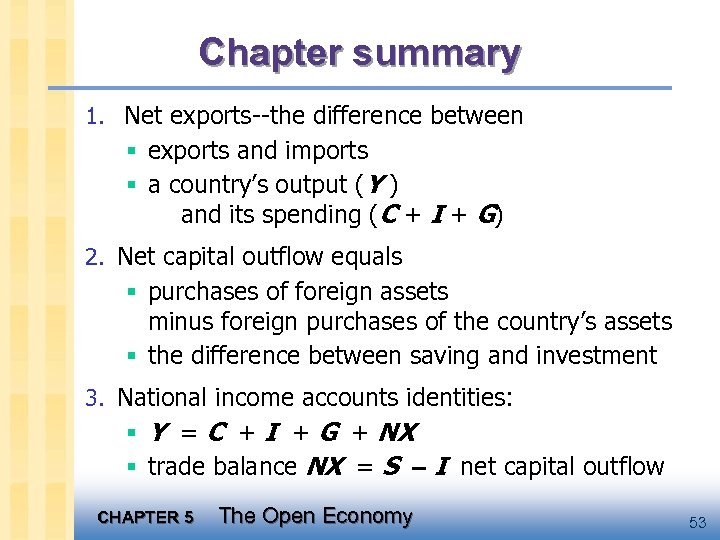 Chapter summary 1. Net exports--the difference between § exports and imports § a country’s output (Y ) and its spending (C + I + G) 2. Net capital outflow equals § purchases of foreign assets minus foreign purchases of the country’s assets § the difference between saving and investment 3. National income accounts identities: § Y = C + I + G + NX § trade balance NX = S - I net capital outflow CHAPTER 5 The Open Economy 53
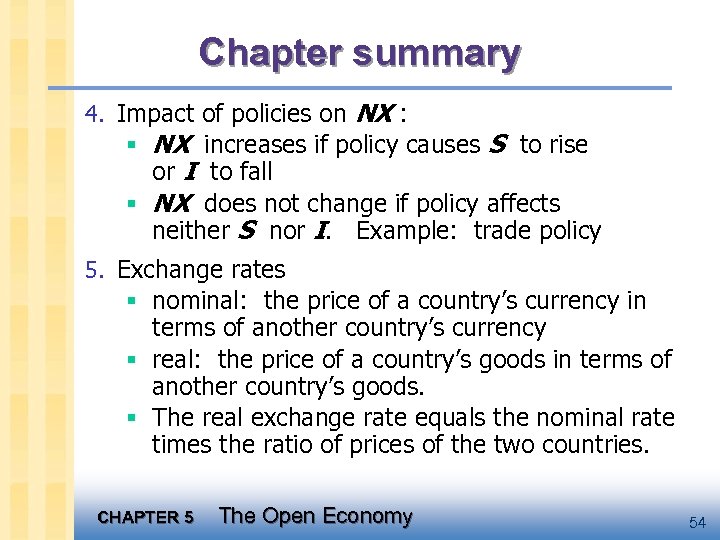 Chapter summary 4. Impact of policies on NX : § NX increases if policy causes S to rise or I to fall § NX does not change if policy affects neither S nor I. Example: trade policy 5. Exchange rates § nominal: the price of a country’s currency in terms of another country’s currency § real: the price of a country’s goods in terms of another country’s goods. § The real exchange rate equals the nominal rate times the ratio of prices of the two countries. CHAPTER 5 The Open Economy 54
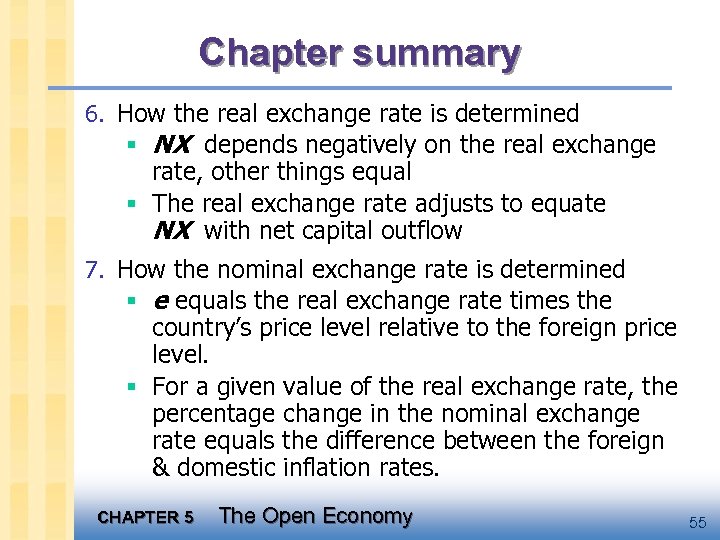 Chapter summary 6. How the real exchange rate is determined § NX depends negatively on the real exchange rate, other things equal § The real exchange rate adjusts to equate NX with net capital outflow 7. How the nominal exchange rate is determined § e equals the real exchange rate times the country’s price level relative to the foreign price level. § For a given value of the real exchange rate, the percentage change in the nominal exchange rate equals the difference between the foreign & domestic inflation rates. CHAPTER 5 The Open Economy 55
 CHAPTER 5 The Open Economy 56