 Скачать презентацию Machines that Think Presented by Lucas Mellinger
0590140e59136c8eb0199cea35913d63.ppt
- Количество слайдов: 27



Machines that Think? Presented by Lucas Mellinger
The Oriental Abacus n Circa 3000 BC n Used a combination of beads and rods to perform calculations. n ABACUS
The Antikythera Mechanism n 150 -100 BC n Discovered in 1902 by a diver off the coast of Antikythera Island off the coast of Greece. n Origins are unclear. Speculation: – Constructed at an academy founded by the philosopher Posidonius, on the Greek island of Rhodes. – Carrying to Rome with other looted treasure.
The Antikythera Mechanism A similar machine was built by Archimedes and brought to Rome after Archimedes’ death at the siege of Syracuse in 212 BC. n Device Functions: n – 365 -day calendar that factored in leap year every four years – Reconciles the solar year with the lunar calendar – A star almanac, showing the times when the major stars and constellations of the Greek zodiac would rise or set – (speculatively) may also have shown the positions of the planets – Includes the main lunar anomaly (the Moon appears to move across the heavens at different speeds at different times)
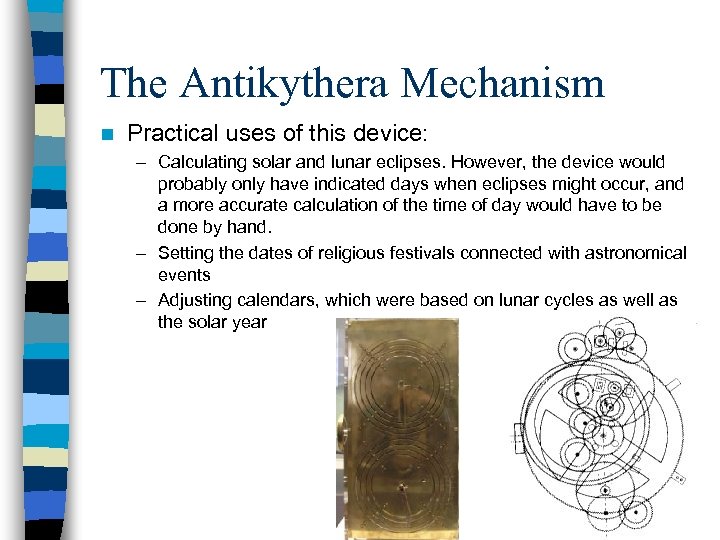
The Antikythera Mechanism n Practical uses of this device: – Calculating solar and lunar eclipses. However, the device would probably only have indicated days when eclipses might occur, and a more accurate calculation of the time of day would have to be done by hand. – Setting the dates of religious festivals connected with astronomical events – Adjusting calendars, which were based on lunar cycles as well as the solar year
Napier’s Bones n 1617 - John Napier implemented new system of logarithms with a set of movable sticks, often made of ivory. n Used for multiplication n 1630 - William Oughtred improved Napier’s design to invent the Slide Rule
Slide Rule Used to perform multiplication, division, squares, square roots, logs, sine, cosine, and tangent calculations. n There also many variants that include things like specialized scales for cubes and cube roots, and for making multiplication and division a bit easier. n More complicated slide rules can also include various log-log scales for calculating exponential powers in general, or natural logs, or various mathematical relationships. n n SLIDE RULE
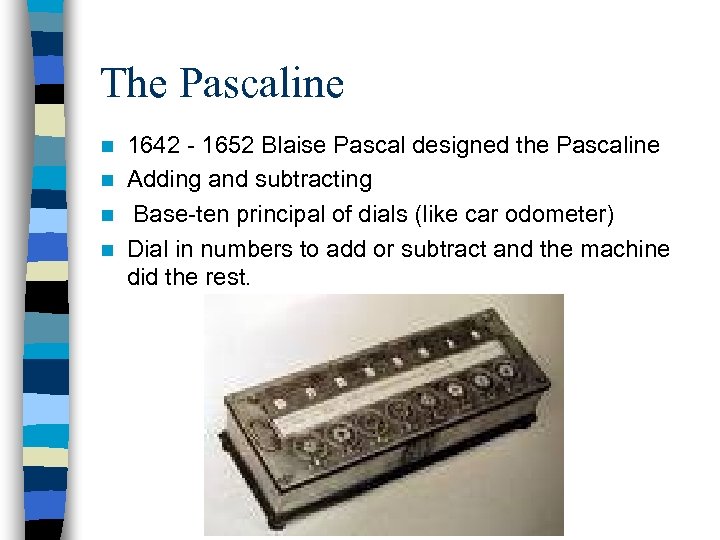
The Pascaline 1642 - 1652 Blaise Pascal designed the Pascaline n Adding and subtracting n Base-ten principal of dials (like car odometer) n Dial in numbers to add or subtract and the machine did the rest. n
The Epitome of Monotony n Mechanical devices in the 17 th century had to be crafted one-by-one. n Each individual precision part had to be fashioned by hand. n “The genius of the inventor was often held hostage to the skill of the metalworker. ”
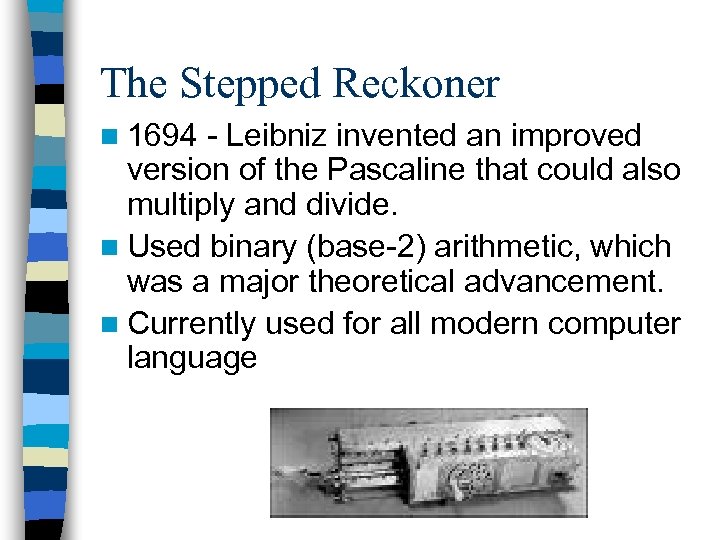
The Stepped Reckoner n 1694 - Leibniz invented an improved version of the Pascaline that could also multiply and divide. n Used binary (base-2) arithmetic, which was a major theoretical advancement. n Currently used for all modern computer language
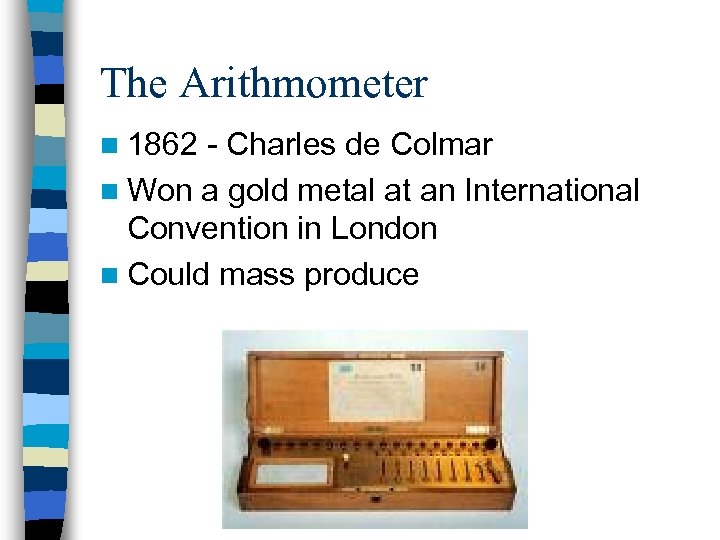
The Arithmometer n 1862 - Charles de Colmar n Won a gold metal at an International Convention in London n Could mass produce
The Arithmometer n Promotional Claims: – Multiply two eight-digit numbers in 18 seconds – Divide a sixteen-digit number by an eightdigit number in 24 seconds – Find the square root of a sixteen-digit number in one minute n Manufactured 20 th century and sold well into the
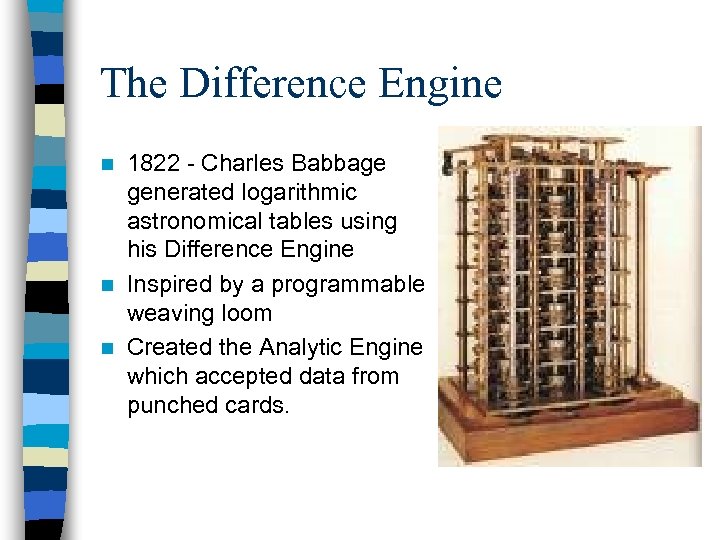
The Difference Engine 1822 - Charles Babbage generated logarithmic astronomical tables using his Difference Engine n Inspired by a programmable weaving loom n Created the Analytic Engine which accepted data from punched cards. n
Analytic Engine n Babbage and assistant Lovelace wrote what is considered the first significant computer program n Designed to be steam powered n Metalworking technology could not match precision of the Analytic Engine n The design and programs were rediscovered in 20 th century by computer designers
Technological Advances n Industrial Revolution of the 19 th century n Mid-1800’s - George Boole develops foundation for Boolean Algebra – Expressing logical processes in terms of 1’s and 0’s – Published two works: • The Mathematical Analysis of Logic • The Laws of Thought – Theoretical key to thinking circuitry in today’s computers
Technological Advances n 1880’s - Herman Hollerith devised a machine that ran on electricity to tabulate census data using punch cards. – Reduced processing time by 5 1/2 years – Hollerith founded the Tabulating Machine Company which later became IBM n 1937 - Claude Shannon combined Boolean algebra with electrical relays and switching circuits
Technological Advances n World War II: – Allan Turing invented machine to break German Uboat “Enigma code” – Max Newman devised logic to bread the code, but was too slow and tedious – In 1944 Tommy Flowers a huge machine, “Colossus, ” that used 1500 vacuum tubes to run Newman’s decoding process • Decoded German messages in hours vs. . weeks or months by hand – Konrad Zuse created a functional electromechanical machine • Some claim that he was the first inventor of electronic computers
Technological Advances 1941 - John Atanasoff and grad student Clifford Berry built a programmable computer that solved systems of linear equations n 1944 - First American general-purpose computer, “Mark I, ” was built by IBM n – – – Used mechanical and electromagnetic relays Got instructions from punched paper tape More than 50 ft long Contained 800, 000 parts Used more than 500 miles of wire
ENIAC n 1946 - Electronic Numerical Integrator and Calculator n Constructed of forty-two 9 x 2 x 1 panels with 18, 000 vacuum tubes, 1500 electrical relays, and weighed more than 30 tons n Vacuum tubes made it 500 times faster than the Mark I n Not reliable: vacuum tubes burn out and had not data storage capacity
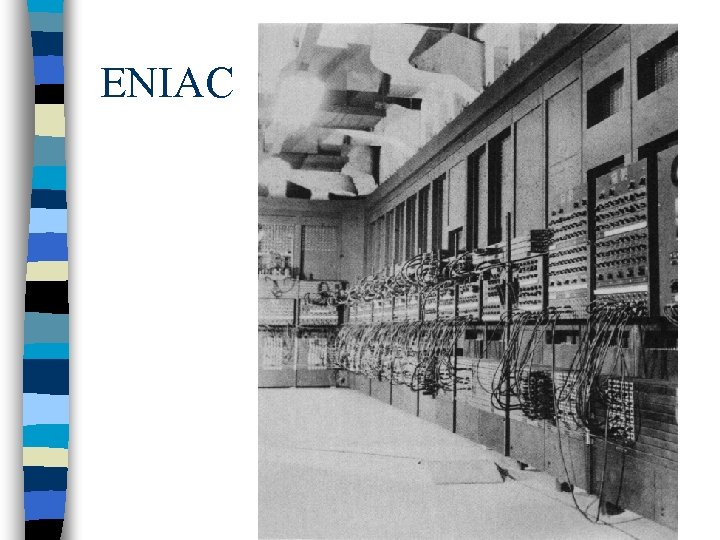
ENIAC
Get with the Program… n 1949 - John von Neumann devised a way to store programs inside a computer n EDSAC - Electronic Delayed Storage Automatic Computer n UNIVAC I - UNIVersal Automatic Computer – First commercial computer
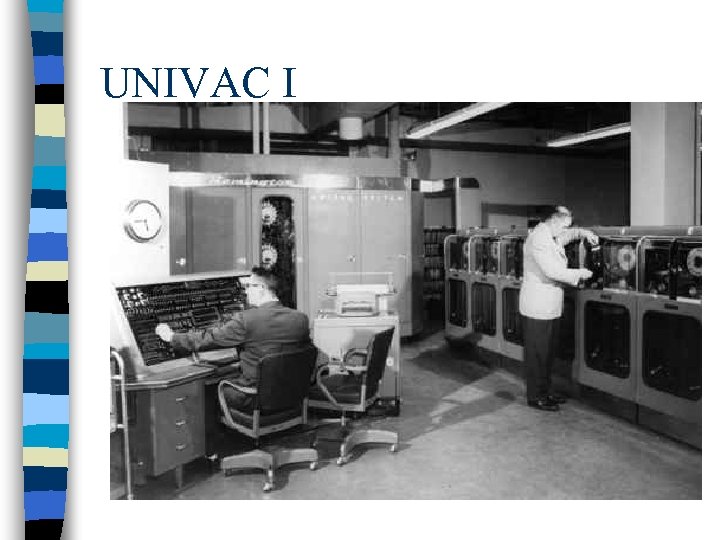
UNIVAC I
Modern-Day Technology 1950’s - vacuum tube replaced by the transistor invented by Bell Labs – Rivaled vacuum tubs by being smaller, more powerful and more dependable n Mid-1960’s - integrated circuitry making personal computers more affordable n 1967 - Texas Instruments officially recognized for inventing the first pocket electronic calculator n
“There has never been a technology in the history of the world that has progressed as fast as computer technology. ”
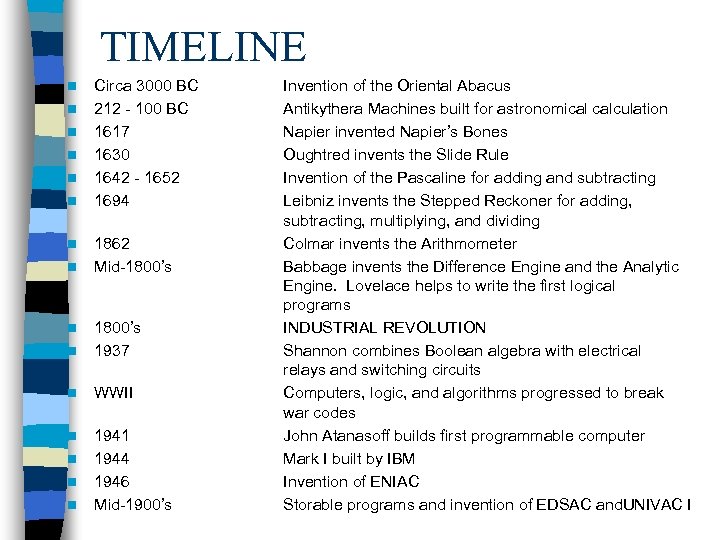
TIMELINE n n n n Circa 3000 BC 212 - 100 BC 1617 1630 1642 - 1652 1694 1862 Mid-1800’s n 1800’s 1937 n WWII n 1941 1944 1946 Mid-1900’s n n Invention of the Oriental Abacus Antikythera Machines built for astronomical calculation Napier invented Napier’s Bones Oughtred invents the Slide Rule Invention of the Pascaline for adding and subtracting Leibniz invents the Stepped Reckoner for adding, subtracting, multiplying, and dividing Colmar invents the Arithmometer Babbage invents the Difference Engine and the Analytic Engine. Lovelace helps to write the first logical programs INDUSTRIAL REVOLUTION Shannon combines Boolean algebra with electrical relays and switching circuits Computers, logic, and algorithms progressed to break war codes John Atanasoff builds first programmable computer Mark I built by IBM Invention of ENIAC Storable programs and invention of EDSAC and. UNIVAC I
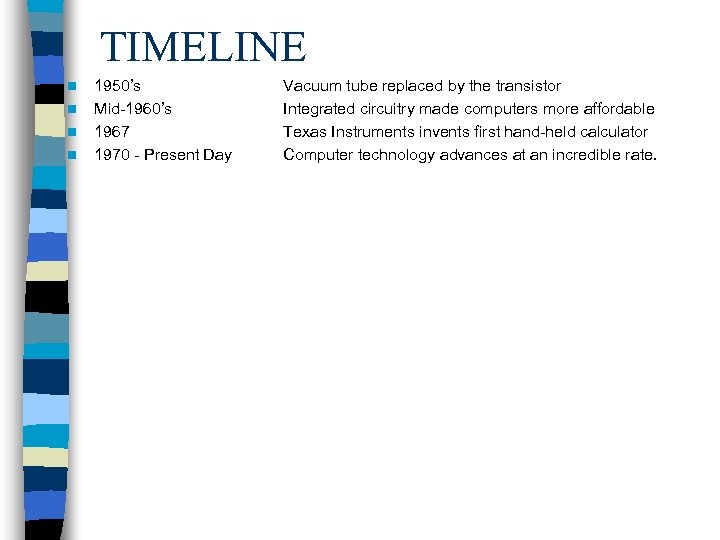
TIMELINE n n 1950’s Mid-1960’s 1967 1970 - Present Day Vacuum tube replaced by the transistor Integrated circuitry made computers more affordable Texas Instruments invents first hand-held calculator Computer technology advances at an incredible rate.
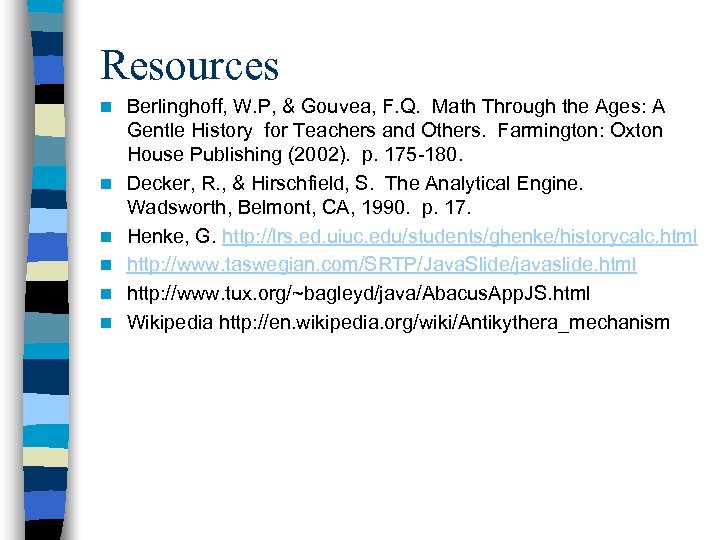
Resources n n n Berlinghoff, W. P, & Gouvea, F. Q. Math Through the Ages: A Gentle History for Teachers and Others. Farmington: Oxton House Publishing (2002). p. 175 -180. Decker, R. , & Hirschfield, S. The Analytical Engine. Wadsworth, Belmont, CA, 1990. p. 17. Henke, G. http: //lrs. ed. uiuc. edu/students/ghenke/historycalc. html http: //www. taswegian. com/SRTP/Java. Slide/javaslide. html http: //www. tux. org/~bagleyd/java/Abacus. App. JS. html Wikipedia http: //en. wikipedia. org/wiki/Antikythera_mechanism
Скачать презентацию Machines that Think Presented by Lucas Mellinger
0590140e59136c8eb0199cea35913d63.ppt