


 Скачать презентацию Machine Learning Decision Trees Chapter 18 1 -18
40abe6a320bbc6e240aa0622b7bee954.ppt
- Количество слайдов: 55
 Machine Learning: Decision Trees Chapter 18. 1 -18. 3 Some material adopted from notes by Chuck Dyer
 What is learning? • “Learning denotes changes in a system that. . . enable a system to do the same task more efficiently the next time. ” –Herbert Simon • “Learning is constructing or modifying representations of what is being experienced. ” –Ryszard Michalski • “Learning is making useful changes in our minds. ” –Marvin Minsky
 Why study learning? • Understand improve efficiency of human learning – Use to improve methods for teaching and tutoring people (e. g. , better computer-aided instruction) • Discover new things or structure previously unknown – Examples: data mining, scientific discovery • Fill in skeletal or incomplete specifications about a domain – Large, complex AI systems can’t be completely built by hand require dynamic updating to incorporate new information – Learning new characteristics expands the domain or expertise and lessens the “brittleness” of the system • Build agents that can adapt to users, other agents, and their environment
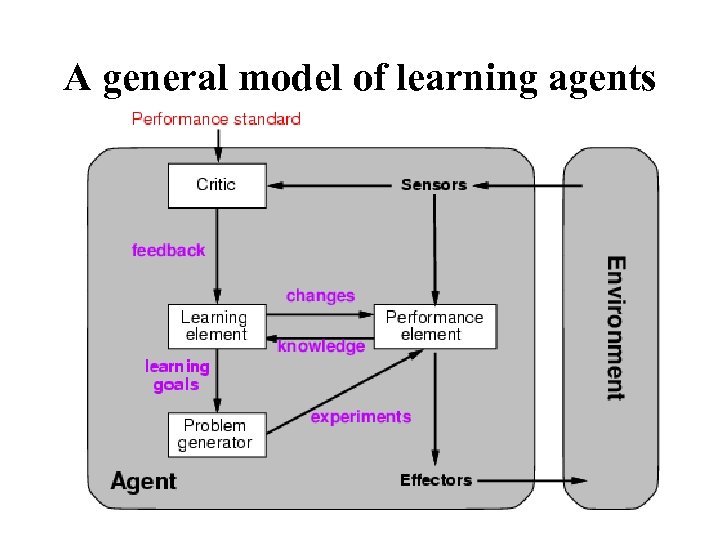 A general model of learning agents
 Major paradigms of machine learning • Rote learning – One-to-one mapping from inputs to stored representation. “Learning by memorization. ” Association-based storage and retrieval. • Induction – Use specific examples to reach general conclusions • Clustering – Unsupervised identification of natural groups in data • Analogy – Determine correspondence between two different representations • Discovery – Unsupervised, specific goal not given • Genetic algorithms – “Evolutionary” search techniques, based on an analogy to “survival of the fittest” • Reinforcement – Feedback (positive or negative reward) given at the end of a sequence of steps
 The inductive learning problem • Extrapolate from a given set of examples to make accurate predictions about future examples • Supervised versus unsupervised learning – Learn an unknown function f(X) = Y, where X is an input example and Y is the desired output. – Supervised learning implies we are given a training set of (X, Y) pairs by a “teacher” – Unsupervised learning means we are only given the Xs and some (ultimate) feedback function on our performance. • Concept learning or classification – Given a set of examples of some concept/class/category, determine if a new one is an instance of the concept or not – Instances are positive examples, non-instances negative examples – Or we can make a probabilistic prediction (e. g. , using a Bayes net)
 Supervised concept learning • Given a training set of positive and negative examples of a concept • Construct a description that will accurately classify whether future examples are positive or negative • That is, learn some good estimate of function f given a training set {(x 1, y 1), (x 2, y 2), . . . , (xn, yn)} where each yi is either + (positive) or - (negative), or a probability distribution over +/-
 Inductive learning framework • Raw input data from sensors are typically preprocessed to obtain a feature vector, X, that adequately describes all of the relevant features for classifying examples • Each x is a list of (attribute, value) pairs. For example, X = [Person: Sue, Eye. Color: Brown, Age: Young, Sex: Female] • The number of attributes (a. k. a. features) is fixed (positive, finite) • Each attribute has a fixed, finite number of possible values (or could be continuous) • Each example is interpreted as a point in an n-dimensional feature space, where n is the number of attributes
 Inductive learning as search • Instance space I defines the language for the training and test instances – Typically, but not always, each instance i I is a feature vector – Features are sometimes called attributes or variables – I: V 1 x V 2 x … x Vk, i = (v 1, v 2, …, vk) • Class variable C gives an instance’s class (to be predicted) • Model space M defines the possible classifiers – M: I → C, M = {m 1, … mn} (possibly infinite) – Model space is sometimes, but not always, defined in terms of the same features as the instance space • Training data can be used to direct the search for a good (consistent, complete, simple) hypothesis in the model space
 Model spaces • Decision trees – Partition the instance space into axis-parallel regions, labeled with class value • Version spaces – Search for necessary (lower-bound) and sufficient (upper-bound) partial instance descriptions for an instance to be in the class • Nearest-neighbor classifiers – Partition the instance space into regions defined by the centroid instances (or cluster of k instances) • Associative rules (feature values → class) • First-order logical rules • Bayesian networks (probabilistic dependencies of class on attributes) • Neural networks
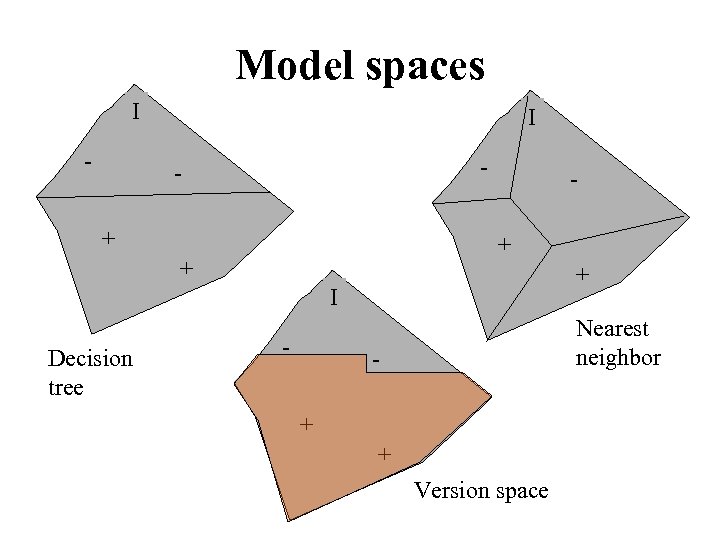 Model spaces I - + + I Decision tree - Nearest neighbor + + Version space
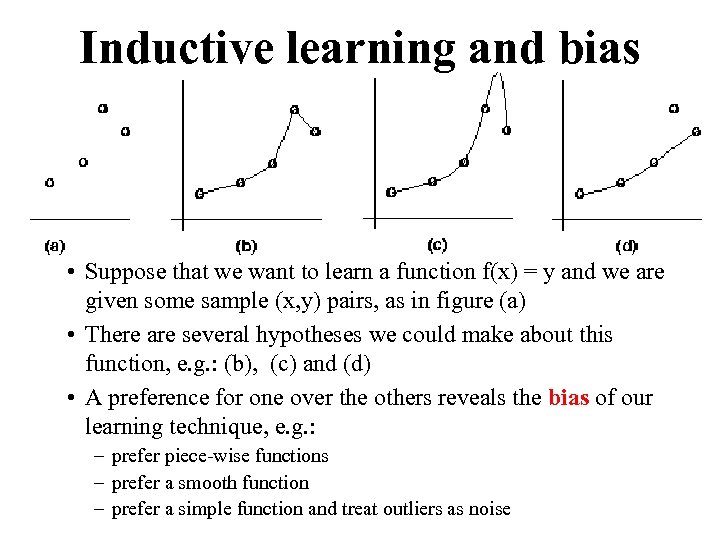 Inductive learning and bias • Suppose that we want to learn a function f(x) = y and we are given some sample (x, y) pairs, as in figure (a) • There are several hypotheses we could make about this function, e. g. : (b), (c) and (d) • A preference for one over the others reveals the bias of our learning technique, e. g. : – prefer piece-wise functions – prefer a smooth function – prefer a simple function and treat outliers as noise
 Preference bias: Ockham’s Razor • A. k. a. Occam’s Razor, Law of Economy, or Law of Parsimony • Principle stated by William of Ockham (1285 -1347/49), a scholastic, that – “non sunt multiplicanda entia praeter necessitatem” – or, entities are not to be multiplied beyond necessity • The simplest consistent explanation is the best • Therefore, the smallest decision tree that correctly classifies all of the training examples is best. • Finding the provably smallest decision tree is NP-hard, so instead of constructing the absolute smallest tree consistent with the training examples, construct one that is pretty small
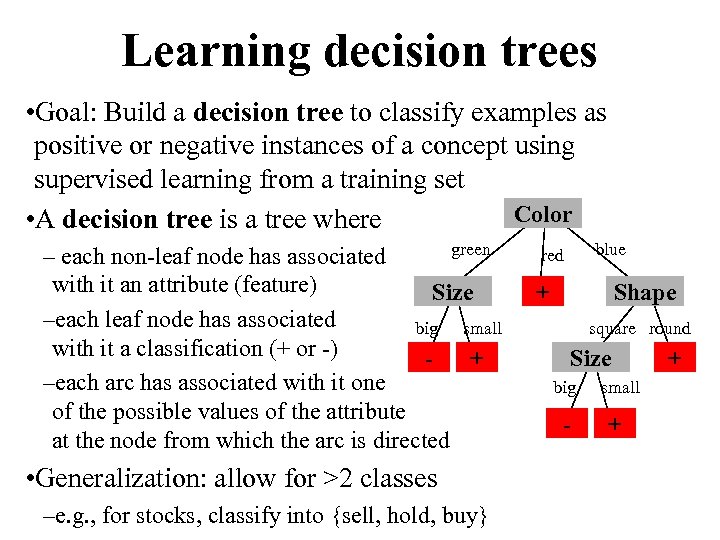 Learning decision trees • Goal: Build a decision tree to classify examples as positive or negative instances of a concept using supervised learning from a training set Color • A decision tree is a tree where green – each non-leaf node has associated with it an attribute (feature) Size –each leaf node has associated big small with it a classification (+ or -) + –each arc has associated with it one of the possible values of the attribute at the node from which the arc is directed • Generalization: allow for >2 classes –e. g. , for stocks, classify into {sell, hold, buy} blue red + Shape square round Size big - small + +
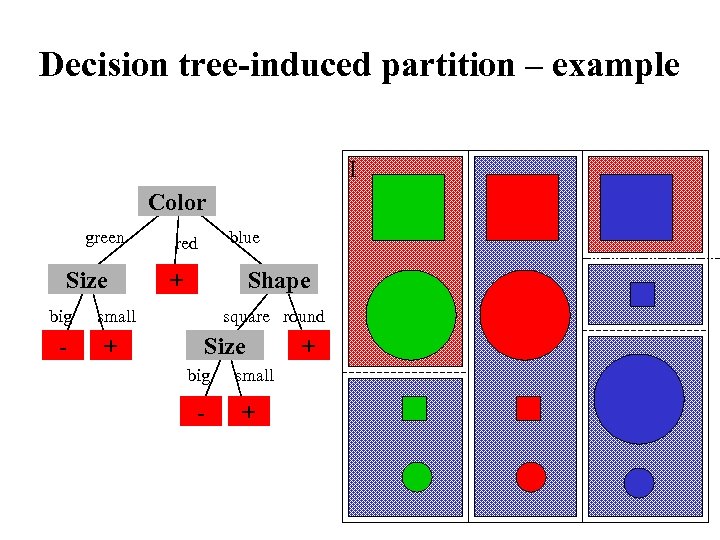 Decision tree-induced partition – example I Color green Size big - blue red + Shape small + square round Size big - small + +
 R&N’s restaurant domain • Develop a decision tree to model decision a patron makes when deciding whether or not to wait for a table at a restaurant • Two classes: wait, leave • Ten attributes: Alternative available? Bar in restaurant? Is it Friday? Are we hungry? How full is the restaurant? How expensive? Is it raining? Do we have a reservation? What type of restaurant is it? What’s the purported waiting time? • Training set of 12 examples • ~ 7000 possible cases
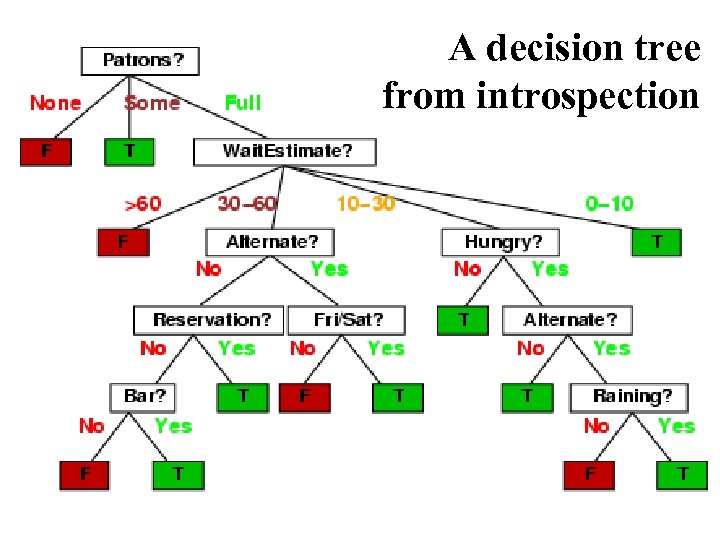 A decision tree from introspection
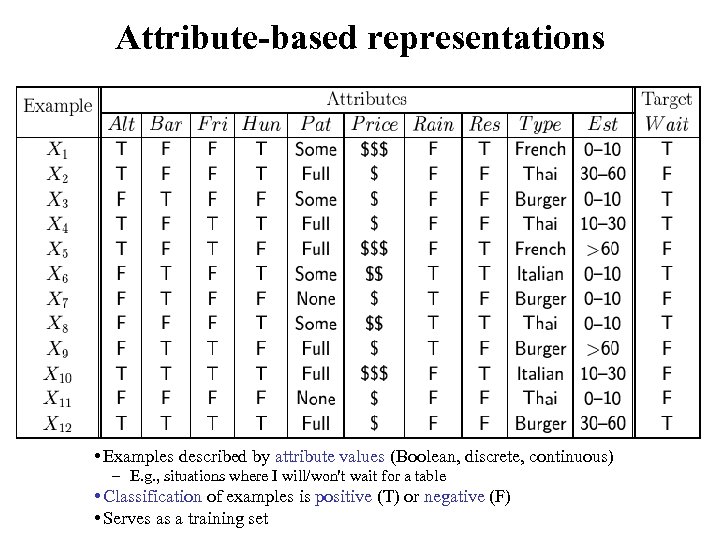 Attribute-based representations • Examples described by attribute values (Boolean, discrete, continuous) – E. g. , situations where I will/won't wait for a table • Classification of examples is positive (T) or negative (F) • Serves as a training set
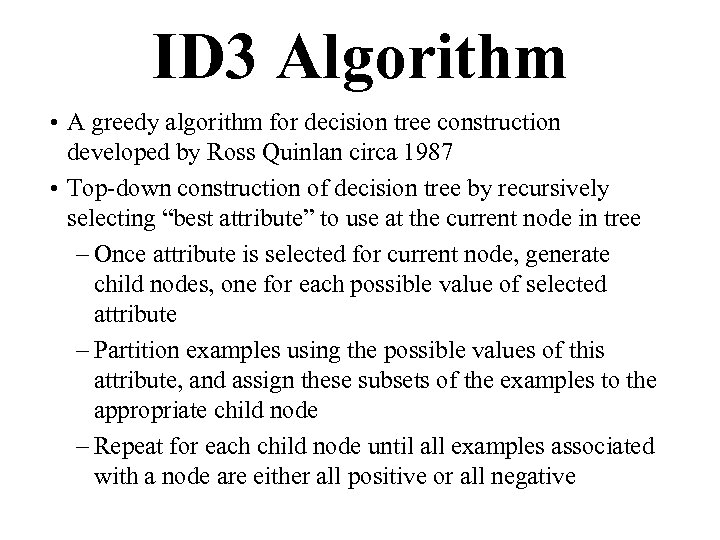 ID 3 Algorithm • A greedy algorithm for decision tree construction developed by Ross Quinlan circa 1987 • Top-down construction of decision tree by recursively selecting “best attribute” to use at the current node in tree – Once attribute is selected for current node, generate child nodes, one for each possible value of selected attribute – Partition examples using the possible values of this attribute, and assign these subsets of the examples to the appropriate child node – Repeat for each child node until all examples associated with a node are either all positive or all negative
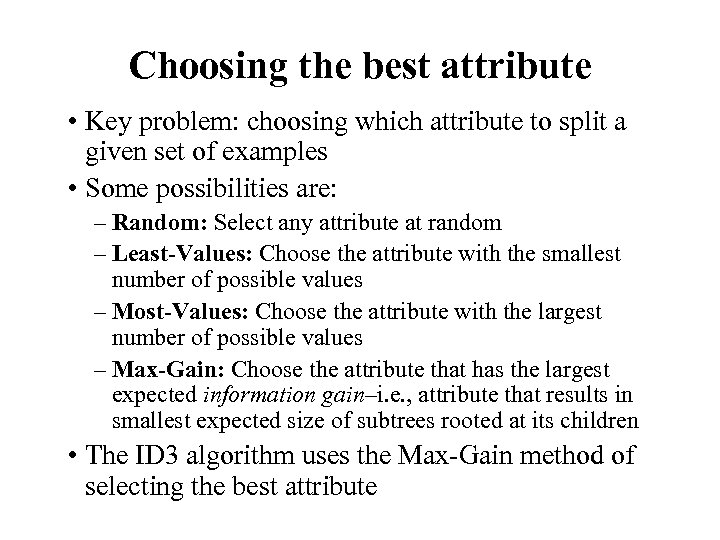 Choosing the best attribute • Key problem: choosing which attribute to split a given set of examples • Some possibilities are: – Random: Select any attribute at random – Least-Values: Choose the attribute with the smallest number of possible values – Most-Values: Choose the attribute with the largest number of possible values – Max-Gain: Choose the attribute that has the largest expected information gain–i. e. , attribute that results in smallest expected size of subtrees rooted at its children • The ID 3 algorithm uses the Max-Gain method of selecting the best attribute
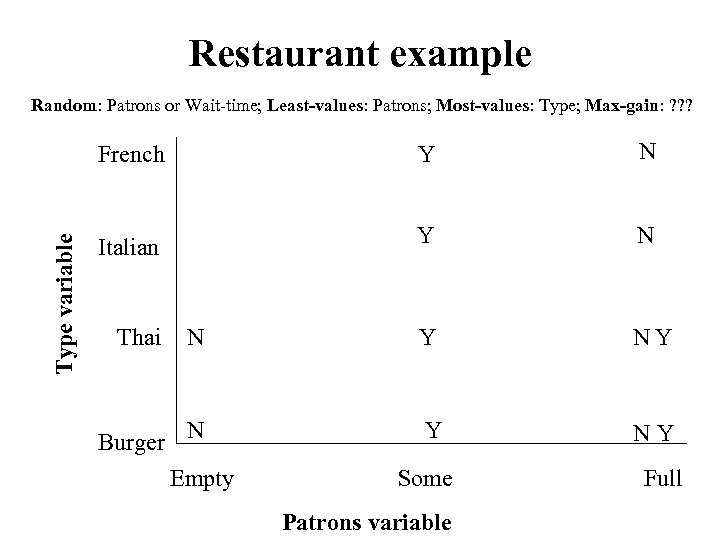 Restaurant example Random: Patrons or Wait-time; Least-values: Patrons; Most-values: Type; Max-gain: ? ? ? Type variable French Y N Italian Y NY Thai N Burger N Empty Some Patrons variable Full
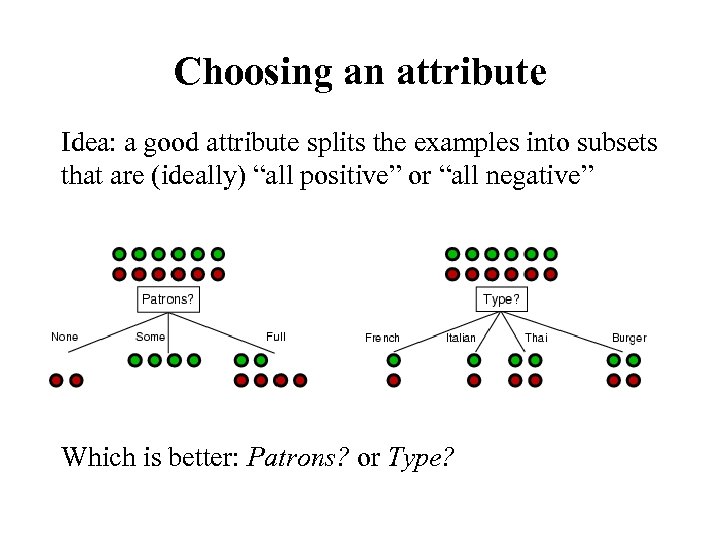 Choosing an attribute Idea: a good attribute splits the examples into subsets that are (ideally) “all positive” or “all negative” Which is better: Patrons? or Type?
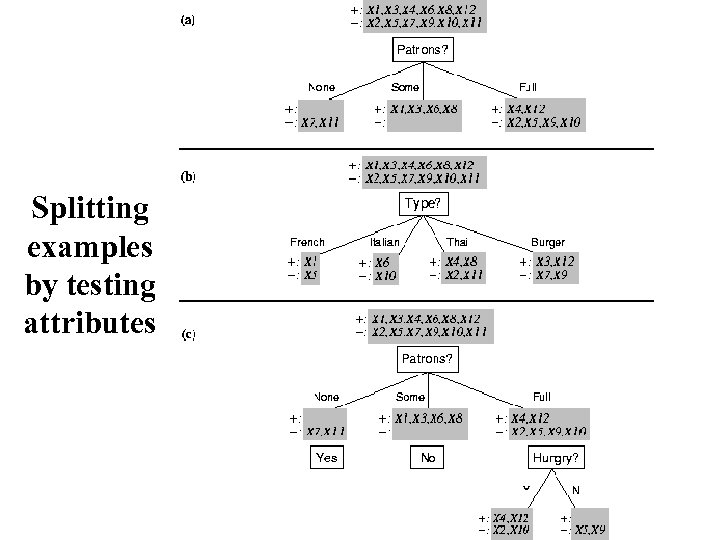 Splitting examples by testing attributes
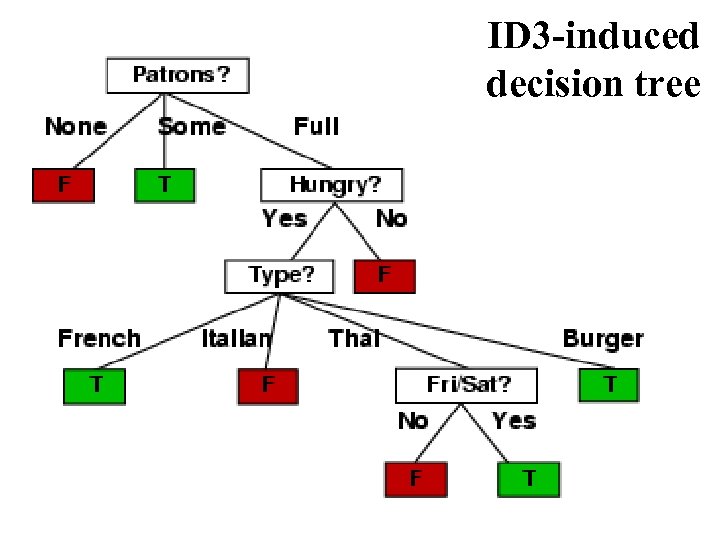 ID 3 -induced decision tree
 Information theory 101 • Information theory sprang almost fully formed from the seminal work of Claude E. Shannon at Bell Labs – A Mathematical Theory of Communication, Bell System Technical Journal, 1948. • Intuitions – Common words (a, the, dog) are shorter than less common ones (parlimentarian, foreshadowing) – In Morse code, common (probable) letters have shorter encodings • Information is measured in minimum number of bits needed to store or send some information • Wikipedia: The measure of data, known as information entropy, is usually expressed by the average number of bits needed for storage or communication.
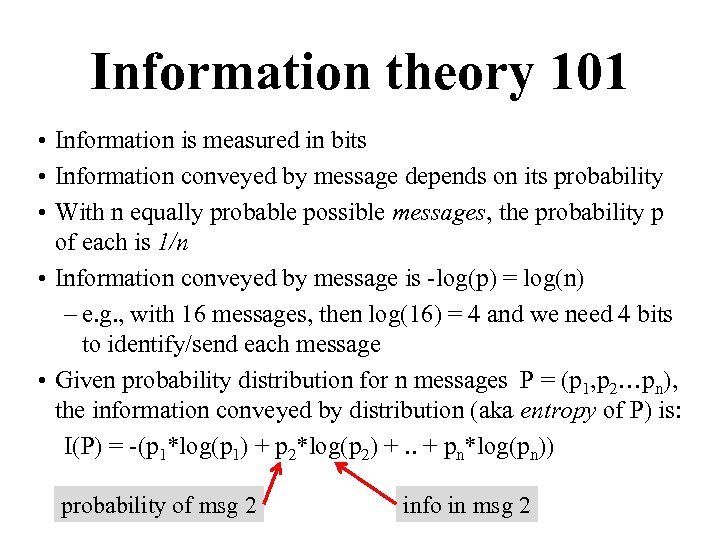 Information theory 101 • Information is measured in bits • Information conveyed by message depends on its probability • With n equally probable possible messages, the probability p of each is 1/n • Information conveyed by message is -log(p) = log(n) – e. g. , with 16 messages, then log(16) = 4 and we need 4 bits to identify/send each message • Given probability distribution for n messages P = (p 1, p 2…pn), the information conveyed by distribution (aka entropy of P) is: I(P) = -(p 1*log(p 1) + p 2*log(p 2) +. . + pn*log(pn)) probability of msg 2 info in msg 2
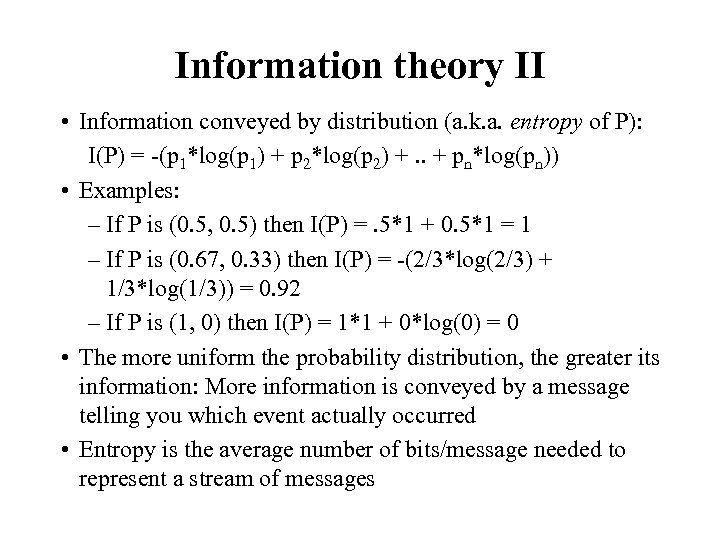 Information theory II • Information conveyed by distribution (a. k. a. entropy of P): I(P) = -(p 1*log(p 1) + p 2*log(p 2) +. . + pn*log(pn)) • Examples: – If P is (0. 5, 0. 5) then I(P) =. 5*1 + 0. 5*1 = 1 – If P is (0. 67, 0. 33) then I(P) = -(2/3*log(2/3) + 1/3*log(1/3)) = 0. 92 – If P is (1, 0) then I(P) = 1*1 + 0*log(0) = 0 • The more uniform the probability distribution, the greater its information: More information is conveyed by a message telling you which event actually occurred • Entropy is the average number of bits/message needed to represent a stream of messages
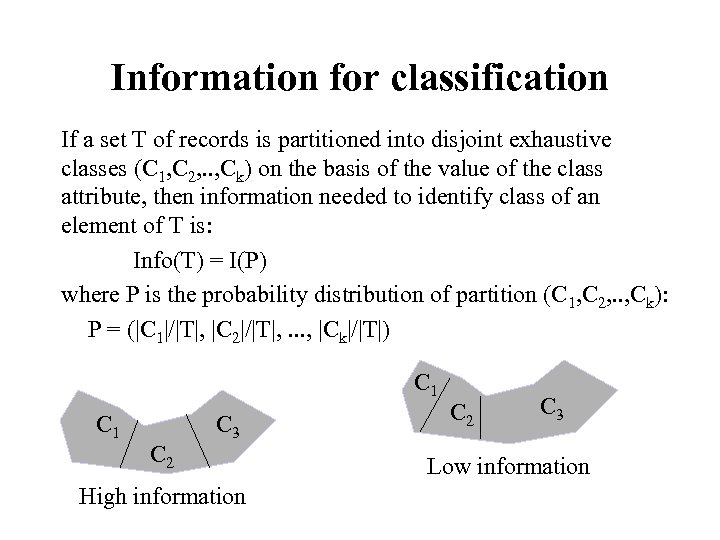 Information for classification If a set T of records is partitioned into disjoint exhaustive classes (C 1, C 2, . . , Ck) on the basis of the value of the class attribute, then information needed to identify class of an element of T is: Info(T) = I(P) where P is the probability distribution of partition (C 1, C 2, . . , Ck): P = (|C 1|/|T|, |C 2|/|T|, . . . , |Ck|/|T|) C 1 C 2 C 3 High information C 2 C 3 Low information
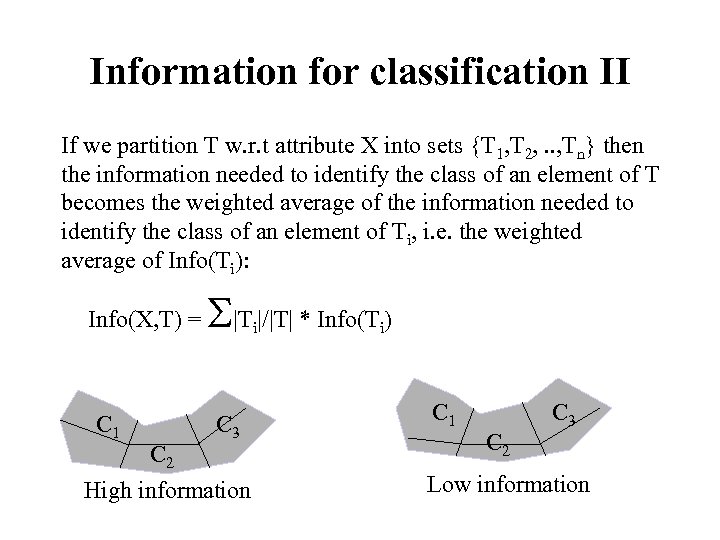 Information for classification II If we partition T w. r. t attribute X into sets {T 1, T 2, . . , Tn} then the information needed to identify the class of an element of T becomes the weighted average of the information needed to identify the class of an element of Ti, i. e. the weighted average of Info(Ti): Info(X, T) = C 1 S|T |/|T| * Info(T ) i C 3 C 2 High information i C 1 C 2 C 3 Low information
 Information gain • Consider the quantity Gain(X, T) defined as Gain(X, T) = Info(T) - Info(X, T) • This represents the difference between – info needed to identify element of T and – info needed to identify element of T after value of attribute X known • This is the gain in information due to attribute X • Use to rank attributes and build DT where each node uses attribute with greatest gain of those not yet considered (in path from root) • The intent of this ordering is to: – Create small DTs so records can be identified with few questions – Match a hoped-for minimality of the process represented by the records being considered (Occam’s Razor)
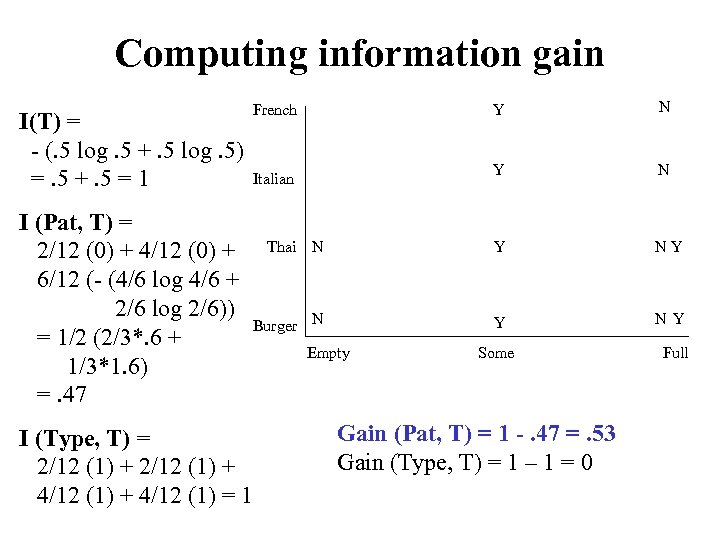 Computing information gain I(T) = - (. 5 log. 5 +. 5 log. 5) =. 5 +. 5 = 1 I (Pat, T) = 2/12 (0) + 4/12 (0) + 6/12 (- (4/6 log 4/6 + 2/6 log 2/6)) = 1/2 (2/3*. 6 + 1/3*1. 6) =. 47 Y N Thai N Y NY Burger N Y French Italian I (Type, T) = 2/12 (1) + 4/12 (1) = 1 Empty Some Gain (Pat, T) = 1 -. 47 =. 53 Gain (Type, T) = 1 – 1 = 0 Full
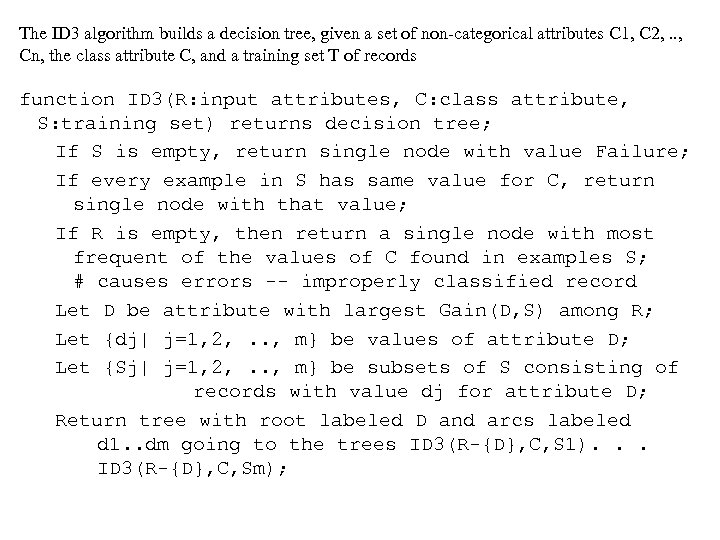 The ID 3 algorithm builds a decision tree, given a set of non-categorical attributes C 1, C 2, . . , Cn, the class attribute C, and a training set T of records function ID 3(R: input attributes, C: class attribute, S: training set) returns decision tree; If S is empty, return single node with value Failure; If every example in S has same value for C, return single node with that value; If R is empty, then return a single node with most frequent of the values of C found in examples S; # causes errors -- improperly classified record Let D be attribute with largest Gain(D, S) among R; Let {dj| j=1, 2, . . , m} be values of attribute D; Let {Sj| j=1, 2, . . , m} be subsets of S consisting of records with value dj for attribute D; Return tree with root labeled D and arcs labeled d 1. . dm going to the trees ID 3(R-{D}, C, S 1). . . ID 3(R-{D}, C, Sm);
 How well does it work? Many case studies have shown that decision trees are at least as accurate as human experts. – A study for diagnosing breast cancer had humans correctly classifying the examples 65% of the time; the decision tree classified 72% correct – British Petroleum designed a decision tree for gasoil separation for offshore oil platforms that replaced an earlier rule-based expert system – Cessna designed an airplane flight controller using 90, 000 examples and 20 attributes per example
 Extensions of ID 3 • • Using gain ratios Real-valued data Noisy data and overfitting Generation of rules Setting parameters Cross-validation for experimental validation of performance C 4. 5 is an extension of ID 3 that accounts for unavailable values, continuous attribute value ranges, pruning of decision trees, rule derivation, and so on
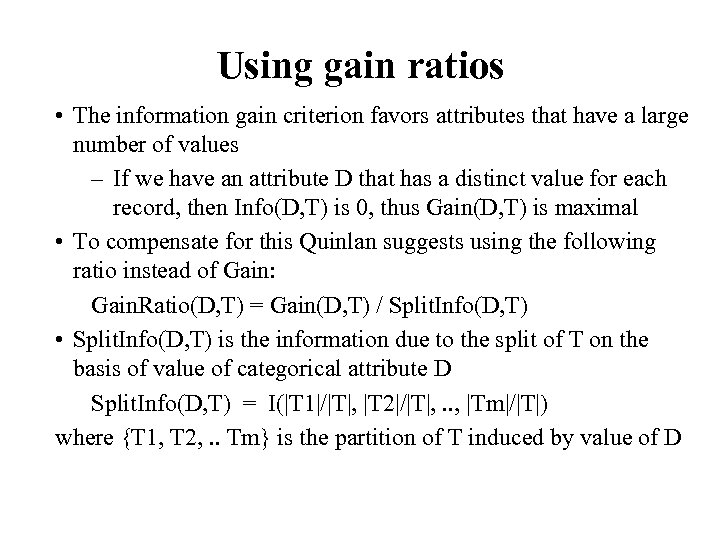 Using gain ratios • The information gain criterion favors attributes that have a large number of values – If we have an attribute D that has a distinct value for each record, then Info(D, T) is 0, thus Gain(D, T) is maximal • To compensate for this Quinlan suggests using the following ratio instead of Gain: Gain. Ratio(D, T) = Gain(D, T) / Split. Info(D, T) • Split. Info(D, T) is the information due to the split of T on the basis of value of categorical attribute D Split. Info(D, T) = I(|T 1|/|T|, |T 2|/|T|, . . , |Tm|/|T|) where {T 1, T 2, . . Tm} is the partition of T induced by value of D
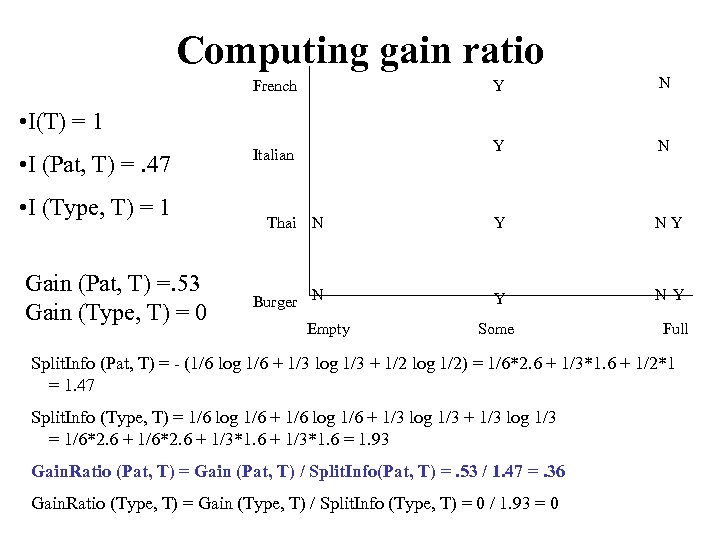 Computing gain ratio Y N Thai N Y NY Burger N Y French • I(T) = 1 • I (Pat, T) =. 47 • I (Type, T) = 1 Gain (Pat, T) =. 53 Gain (Type, T) = 0 Italian Empty Some Full Split. Info (Pat, T) = - (1/6 log 1/6 + 1/3 log 1/3 + 1/2 log 1/2) = 1/6*2. 6 + 1/3*1. 6 + 1/2*1 = 1. 47 Split. Info (Type, T) = 1/6 log 1/6 + 1/3 log 1/3 = 1/6*2. 6 + 1/3*1. 6 = 1. 93 Gain. Ratio (Pat, T) = Gain (Pat, T) / Split. Info(Pat, T) =. 53 / 1. 47 =. 36 Gain. Ratio (Type, T) = Gain (Type, T) / Split. Info (Type, T) = 0 / 1. 93 = 0
 Real-valued data • Select a set of thresholds defining intervals • Each interval becomes a discrete value of the attribute • Use some simple heuristics… – always divide into quartiles • Use domain knowledge… – divide age into infant (0 -2), toddler (3 - 5), school-aged (5 -8) • Or treat this as another learning problem – Try a range of ways to discretize the continuous variable and see which yield “better results” w. r. t. some metric – E. g. , try midpoint between every pair of values
 Noisy data • Many kinds of “noise” can occur in the examples: • Two examples have same attribute/value pairs, but different classifications • Some values of attributes are incorrect because of errors in the data acquisition process or the preprocessing phase • The classification is wrong (e. g. , + instead of -) because of some error • Some attributes are irrelevant to the decision-making process, e. g. , color of a die is irrelevant to its outcome
 Overfitting • Irrelevant attributes, can result in overfitting the training example data • If hypothesis space has many dimensions (large number of attributes), we may find meaningless regularity in the data that is irrelevant to the true, important, distinguishing features • If we have too little training data, even a reasonable hypothesis space will ‘overfit’
 Overfitting • Fix by by removing irrelevant features – E. g. , remove ‘year observed’, ‘month observed’, ‘day observed’, ‘observer name’ from feature vector • Fix by getting more training data • Fix by pruning lower nodes in the decision tree – E. g. , if gain of the best attribute at a node is below a threshold, stop and make this node a leaf rather than generating children nodes
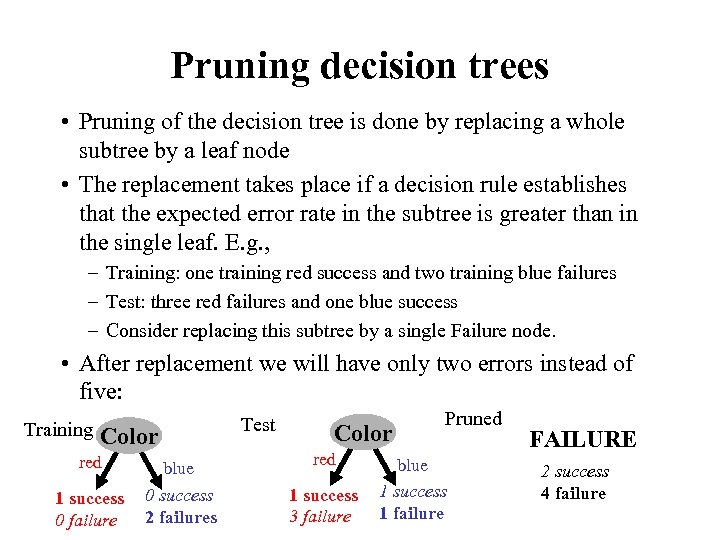 Pruning decision trees • Pruning of the decision tree is done by replacing a whole subtree by a leaf node • The replacement takes place if a decision rule establishes that the expected error rate in the subtree is greater than in the single leaf. E. g. , – Training: one training red success and two training blue failures – Test: three red failures and one blue success – Consider replacing this subtree by a single Failure node. • After replacement we will have only two errors instead of five: Training Color red 1 success 0 failure blue 0 success 2 failures Test Color red 1 success 3 failure Pruned blue 1 success 1 failure FAILURE 2 success 4 failure
 Converting decision trees to rules • It is easy to derive rules from a decision tree: write a rule for each path from the root to a leaf • In that rule the left-hand side is built from the label of the nodes and the labels of the arcs • The resulting rules set can be simplified: – Let LHS be the left hand side of a rule – LHS’ obtained from LHS by eliminating some conditions – Replace LHS by LHS' in this rule if the subsets of the training set satisfying LHS and LHS' are equal – A rule may be eliminated by using meta-conditions such as “if no other rule applies”
 http: //archive. ics. uci. edu/ml
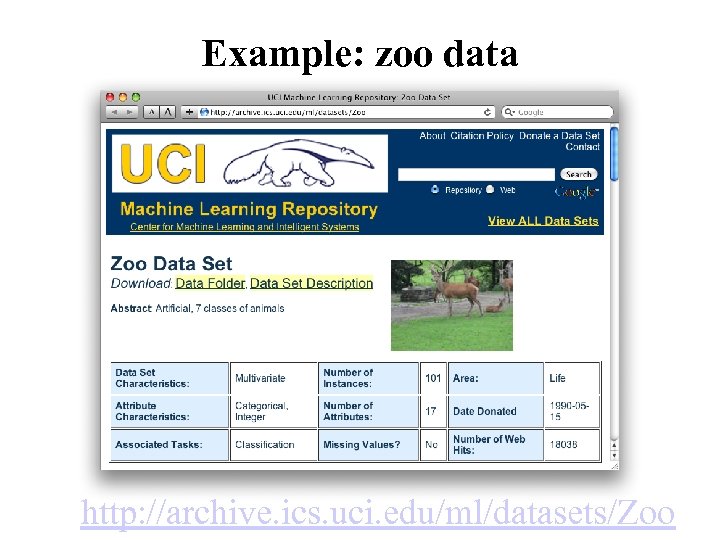 Example: zoo data http: //archive. ics. uci. edu/ml/datasets/Zoo
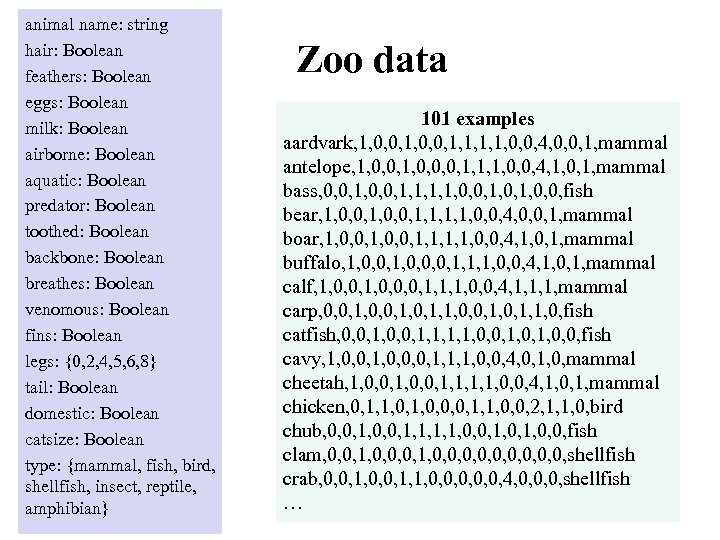 animal name: string hair: Boolean feathers: Boolean eggs: Boolean milk: Boolean airborne: Boolean aquatic: Boolean predator: Boolean toothed: Boolean backbone: Boolean breathes: Boolean venomous: Boolean fins: Boolean legs: {0, 2, 4, 5, 6, 8} tail: Boolean domestic: Boolean catsize: Boolean type: {mammal, fish, bird, shellfish, insect, reptile, amphibian} Zoo data 101 examples aardvark, 1, 0, 0, 1, 1, 0, 0, 4, 0, 0, 1, mammal antelope, 1, 0, 0, 0, 1, 1, 1, 0, 0, 4, 1, 0, 1, mammal bass, 0, 0, 1, 1, 0, 0, 1, 0, 0, fish bear, 1, 0, 0, 1, 1, 0, 0, 4, 0, 0, 1, mammal boar, 1, 0, 0, 1, 1, 0, 0, 4, 1, 0, 1, mammal buffalo, 1, 0, 0, 0, 1, 1, 1, 0, 0, 4, 1, 0, 1, mammal calf, 1, 0, 0, 0, 1, 1, 1, 0, 0, 4, 1, 1, 1, mammal carp, 0, 0, 1, 1, 0, 0, 1, 1, 0, fish catfish, 0, 0, 1, 1, 0, 0, 1, 0, 0, fish cavy, 1, 0, 0, 0, 1, 1, 1, 0, 0, 4, 0, 1, 0, mammal cheetah, 1, 0, 0, 1, 1, 0, 0, 4, 1, 0, 1, mammal chicken, 0, 1, 1, 0, 0, 2, 1, 1, 0, bird chub, 0, 0, 1, 1, 0, 0, 1, 0, 0, fish clam, 0, 0, 1, 0, 0, 0, shellfish crab, 0, 0, 1, 1, 0, 0, 0, 4, 0, 0, 0, shellfish …
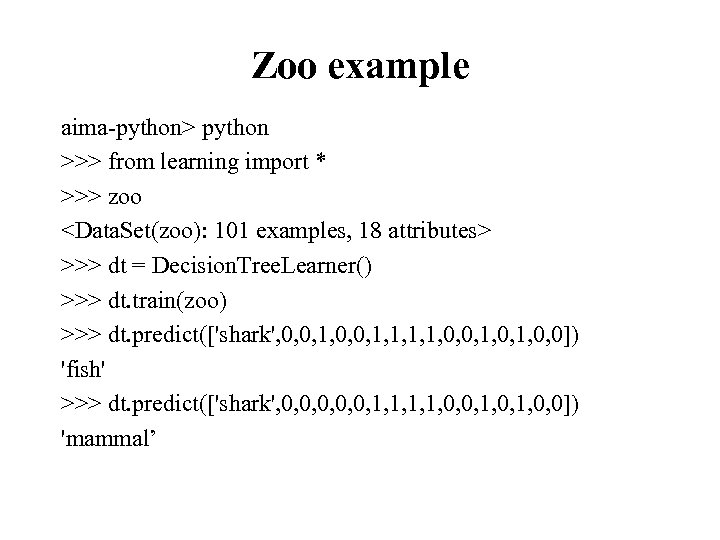 Zoo example aima-python> python >>> from learning import * >>> zoo
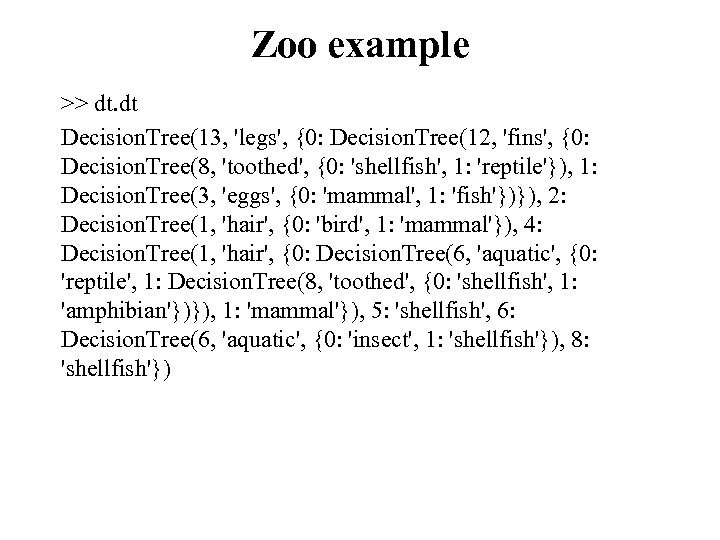 Zoo example >> dt. dt Decision. Tree(13, 'legs', {0: Decision. Tree(12, 'fins', {0: Decision. Tree(8, 'toothed', {0: 'shellfish', 1: 'reptile'}), 1: Decision. Tree(3, 'eggs', {0: 'mammal', 1: 'fish'})}), 2: Decision. Tree(1, 'hair', {0: 'bird', 1: 'mammal'}), 4: Decision. Tree(1, 'hair', {0: Decision. Tree(6, 'aquatic', {0: 'reptile', 1: Decision. Tree(8, 'toothed', {0: 'shellfish', 1: 'amphibian'})}), 1: 'mammal'}), 5: 'shellfish', 6: Decision. Tree(6, 'aquatic', {0: 'insect', 1: 'shellfish'}), 8: 'shellfish'})
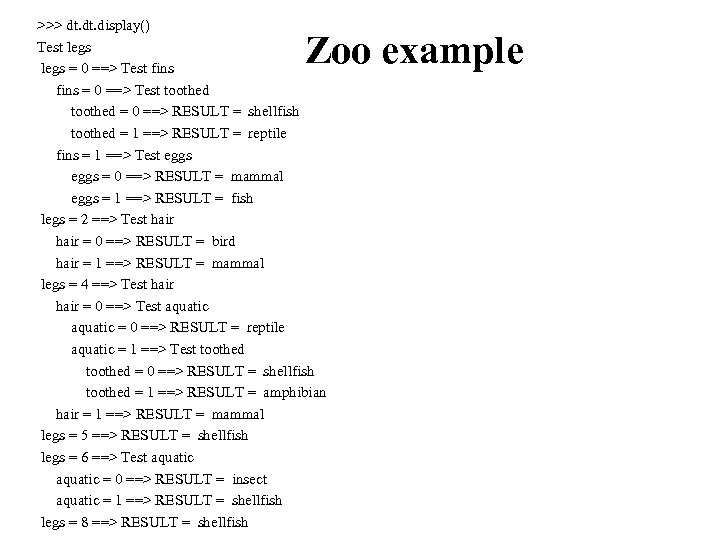 >>> dt. display() Test legs = 0 ==> Test fins = 0 ==> Test toothed = 0 ==> RESULT = shellfish toothed = 1 ==> RESULT = reptile fins = 1 ==> Test eggs = 0 ==> RESULT = mammal eggs = 1 ==> RESULT = fish legs = 2 ==> Test hair = 0 ==> RESULT = bird hair = 1 ==> RESULT = mammal legs = 4 ==> Test hair = 0 ==> Test aquatic = 0 ==> RESULT = reptile aquatic = 1 ==> Test toothed = 0 ==> RESULT = shellfish toothed = 1 ==> RESULT = amphibian hair = 1 ==> RESULT = mammal legs = 5 ==> RESULT = shellfish legs = 6 ==> Test aquatic = 0 ==> RESULT = insect aquatic = 1 ==> RESULT = shellfish legs = 8 ==> RESULT = shellfish Zoo example
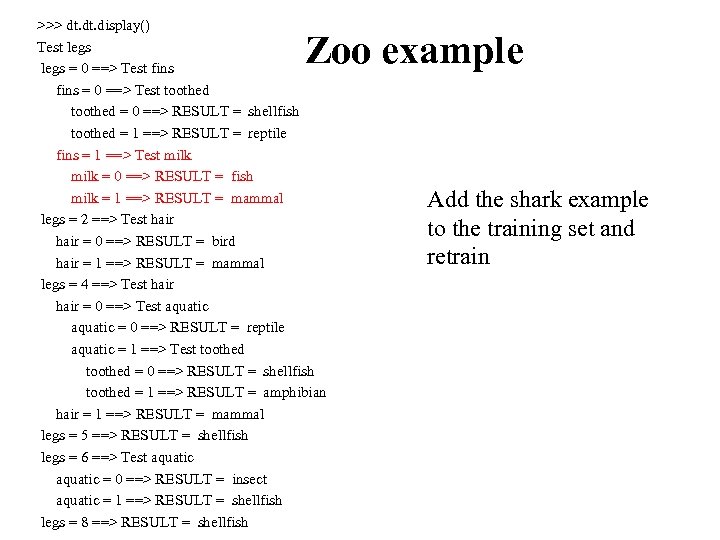 >>> dt. display() Test legs = 0 ==> Test fins = 0 ==> Test toothed = 0 ==> RESULT = shellfish toothed = 1 ==> RESULT = reptile fins = 1 ==> Test milk = 0 ==> RESULT = fish milk = 1 ==> RESULT = mammal legs = 2 ==> Test hair = 0 ==> RESULT = bird hair = 1 ==> RESULT = mammal legs = 4 ==> Test hair = 0 ==> Test aquatic = 0 ==> RESULT = reptile aquatic = 1 ==> Test toothed = 0 ==> RESULT = shellfish toothed = 1 ==> RESULT = amphibian hair = 1 ==> RESULT = mammal legs = 5 ==> RESULT = shellfish legs = 6 ==> Test aquatic = 0 ==> RESULT = insect aquatic = 1 ==> RESULT = shellfish legs = 8 ==> RESULT = shellfish Zoo example Add the shark example to the training set and retrain
 Evaluation methodology • Standard methodology: 1. Collect large set of examples with correct classifications 2. Randomly divide collection into two disjoint sets: training and test 3. Apply learning algorithm to training set giving hypothesis H 4. Measure performance of H w. r. t. test set • Important: keep the training and test sets disjoint! • Study efficiency and robustness of algorithm: repeat steps 2 -4 for different training sets and sizes of training sets • On modifying algorithm, restart with step 1 to avoid evolving algorithm to work well on just this collection
 K-fold Cross Validation • Problem: getting “ground truth” data can be expensive • Problem: ideally need different test data each time we test • Problem: experimentation is needed to find right “feature space” and parameters for ML algorithm • Goal: minimize amount of training+test data needed • Idea: split training data into K subsets, use K-1 for training, and one for development testing • Common K values are 5 and 10
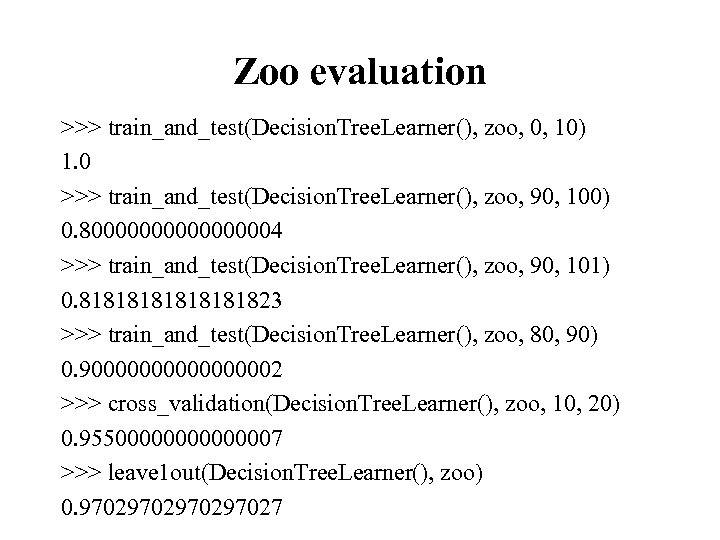 Zoo evaluation >>> train_and_test(Decision. Tree. Learner(), zoo, 0, 10) 1. 0 >>> train_and_test(Decision. Tree. Learner(), zoo, 90, 100) 0. 8000000004 >>> train_and_test(Decision. Tree. Learner(), zoo, 90, 101) 0. 81818181823 >>> train_and_test(Decision. Tree. Learner(), zoo, 80, 90) 0. 9000000002 >>> cross_validation(Decision. Tree. Learner(), zoo, 10, 20) 0. 95500000007 >>> leave 1 out(Decision. Tree. Learner(), zoo) 0. 970297027
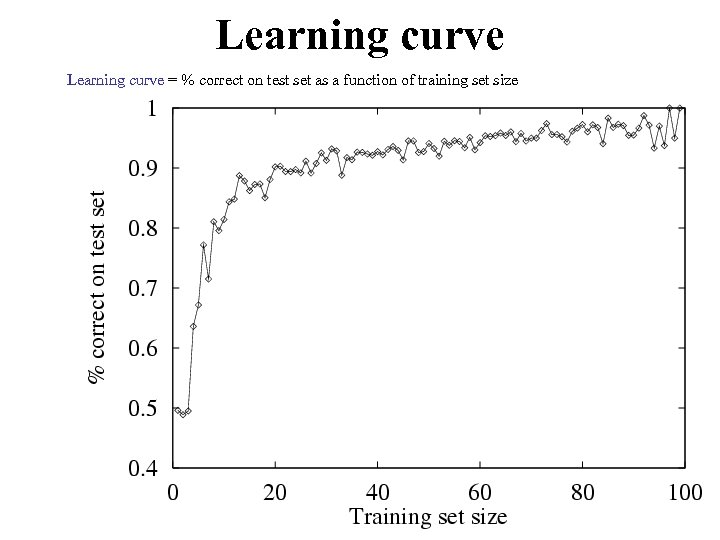 Learning curve = % correct on test set as a function of training set size
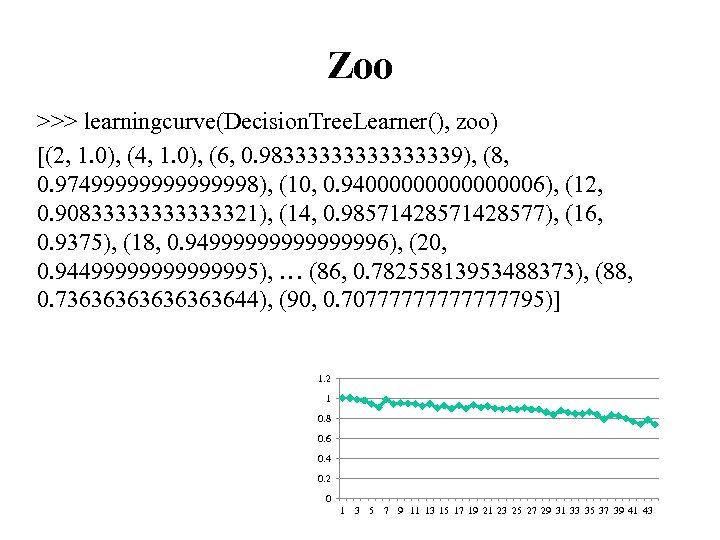 Zoo >>> learningcurve(Decision. Tree. Learner(), zoo) [(2, 1. 0), (4, 1. 0), (6, 0. 9833333339), (8, 0. 97499999998), (10, 0. 9400000006), (12, 0. 90833333321), (14, 0. 98571428577), (16, 0. 9375), (18, 0. 9499999996), (20, 0. 94499999995), … (86, 0. 78255813953488373), (88, 0. 73636363644), (90, 0. 70777777795)] 1. 2 1 0. 8 0. 6 0. 4 0. 2 0 1 3 5 7 9 11 13 15 17 19 21 23 25 27 29 31 33 35 37 39 41 43
 Summary: Decision tree learning • Inducing decision trees is one of the most widely used learning methods in practice • Can out-perform human experts in many problems • Strengths include – – – Fast Simple to implement Can convert result to a set of easily interpretable rules Empirically valid in many commercial products Handles noisy data • Weaknesses include: – Univariate splits/partitioning using only one attribute at a time so limits types of possible trees – Large decision trees may be hard to understand – Requires fixed-length feature vectors – Non-incremental (i. e. , batch method)