


 Скачать презентацию Machine Learning CSE 473 Daniel S Weld
5f03f1e754e07e782c8af90439982b0b.ppt
- Количество слайдов: 27
 Machine Learning CSE 473 © Daniel S. Weld
 Machine Learning Outline • Machine learning: What & why? Bias • Supervised learning Classifiers A supervised learning technique in depth Induction of Decision Trees • Ensembles of classifiers • Overfitting © Daniel S. Weld 2
 Why Machine Learning • Flood of data Wal. Mart – 25 Terabytes WWW – 1, 000 Terabytes • Speed of computer vs. %#@! of programming Highly complex systems (telephone switching systems) Productivity = 1 line code @ day @ programmer • Desire for customization A browser that browses by itself? • Hallmark of Intelligence How do children learn language? © Daniel S. Weld 3
 Applications of ML • • Credit card fraud Product placement / consumer behavior Recommender systems Speech recognition Most mature & successful area of AI © Daniel S. Weld 4
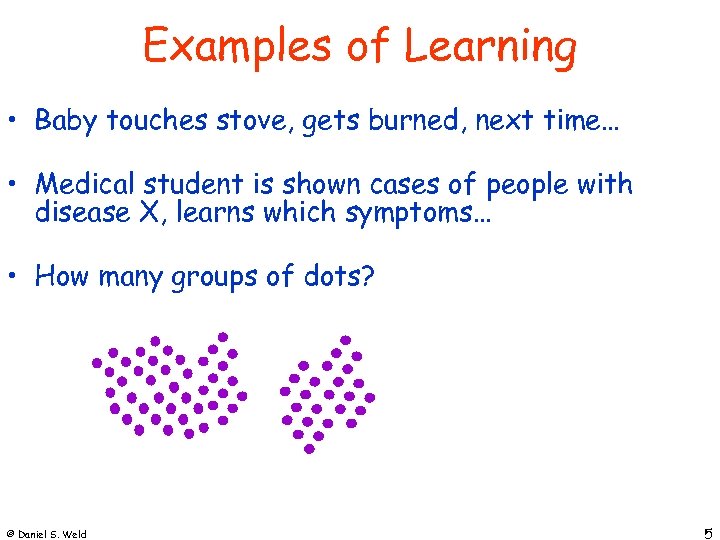 Examples of Learning • Baby touches stove, gets burned, next time… • Medical student is shown cases of people with disease X, learns which symptoms… • How many groups of dots? © Daniel S. Weld 5
 What is Machine Learning? ? © Daniel S. Weld 6
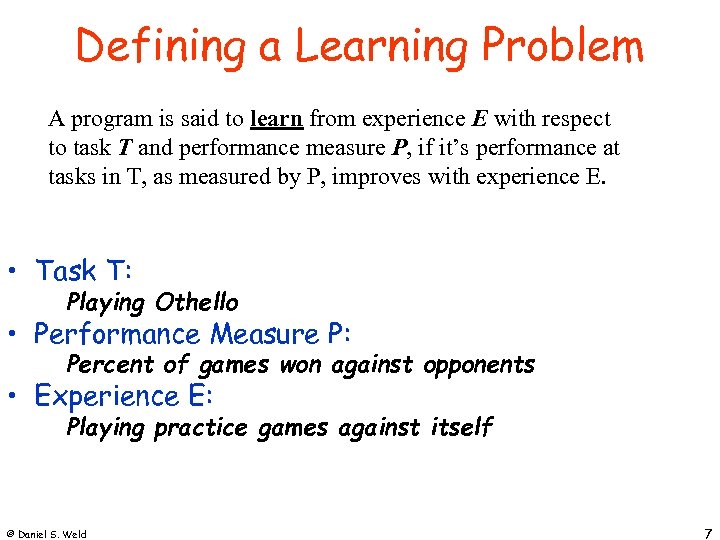 Defining a Learning Problem A program is said to learn from experience E with respect to task T and performance measure P, if it’s performance at tasks in T, as measured by P, improves with experience E. • Task T: Playing Othello • Performance Measure P: Percent of games won against opponents • Experience E: Playing practice games against itself © Daniel S. Weld 7
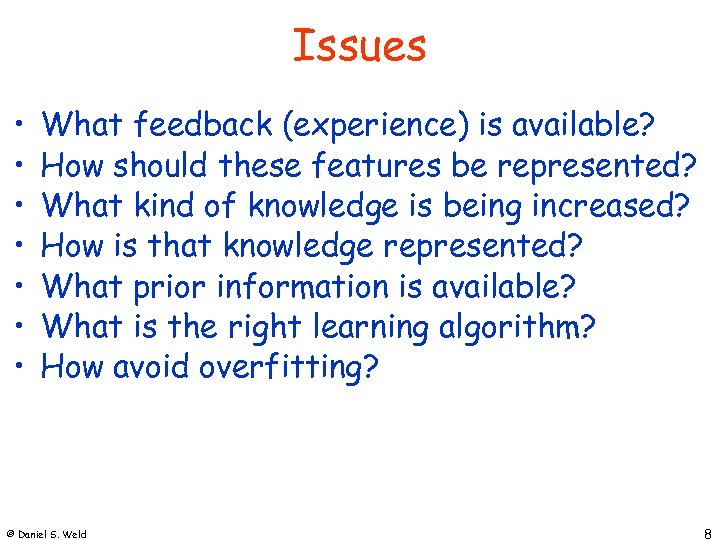 Issues • • What feedback (experience) is available? How should these features be represented? What kind of knowledge is being increased? How is that knowledge represented? What prior information is available? What is the right learning algorithm? How avoid overfitting? © Daniel S. Weld 8
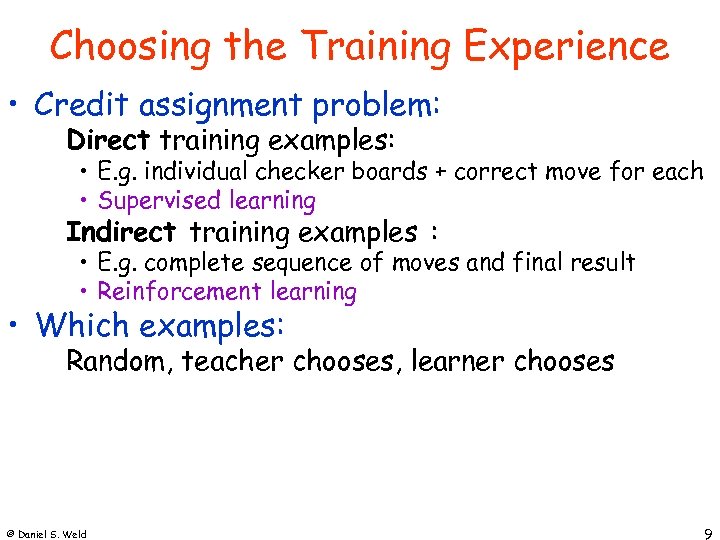 Choosing the Training Experience • Credit assignment problem: Direct training examples: • E. g. individual checker boards + correct move for each • Supervised learning Indirect training examples : • E. g. complete sequence of moves and final result • Reinforcement learning • Which examples: Random, teacher chooses, learner chooses © Daniel S. Weld 9
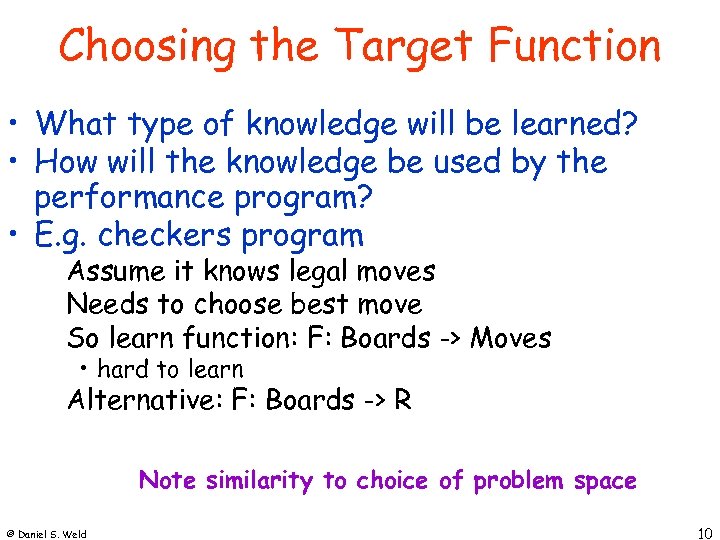 Choosing the Target Function • What type of knowledge will be learned? • How will the knowledge be used by the performance program? • E. g. checkers program Assume it knows legal moves Needs to choose best move So learn function: F: Boards -> Moves • hard to learn Alternative: F: Boards -> R Note similarity to choice of problem space © Daniel S. Weld 10
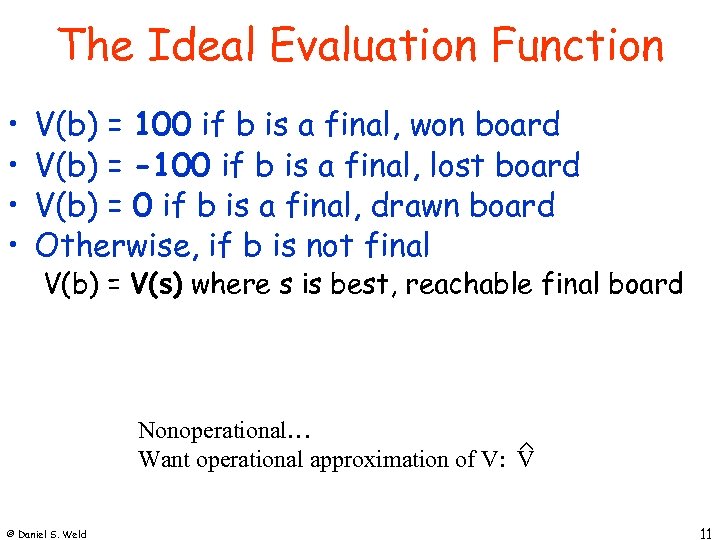 The Ideal Evaluation Function • • V(b) = 100 if b is a final, won board V(b) = -100 if b is a final, lost board V(b) = 0 if b is a final, drawn board Otherwise, if b is not final V(b) = V(s) where s is best, reachable final board Nonoperational… Want operational approximation of V: V © Daniel S. Weld 11
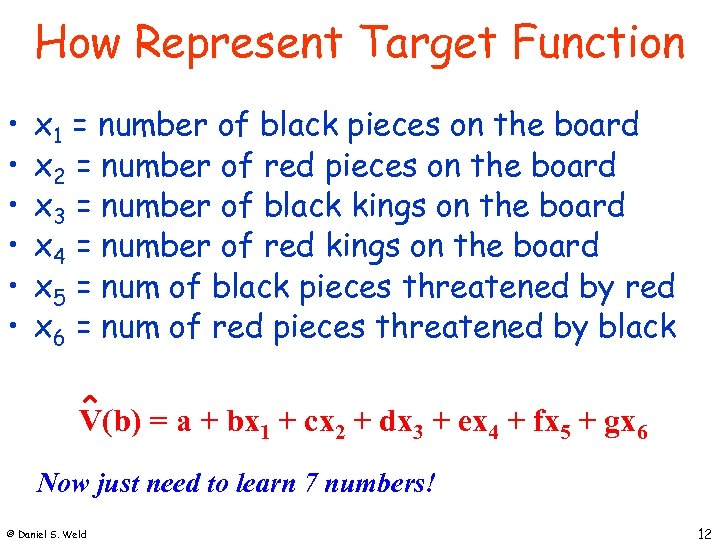 How Represent Target Function • • • x 1 = number of black pieces on the board x 2 = number of red pieces on the board x 3 = number of black kings on the board x 4 = number of red kings on the board x 5 = num of black pieces threatened by red x 6 = num of red pieces threatened by black V(b) = a + bx 1 + cx 2 + dx 3 + ex 4 + fx 5 + gx 6 Now just need to learn 7 numbers! © Daniel S. Weld 12
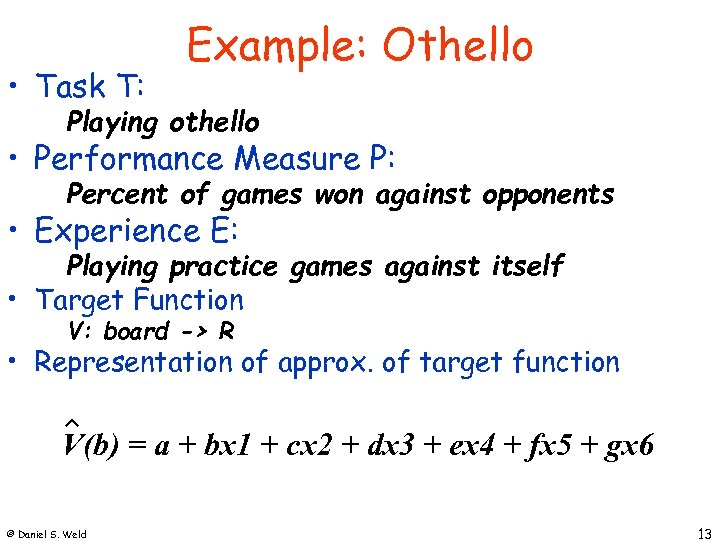 • Task T: Example: Othello Playing othello • Performance Measure P: Percent of games won against opponents • Experience E: Playing practice games against itself • Target Function V: board -> R • Representation of approx. of target function V(b) = a + bx 1 + cx 2 + dx 3 + ex 4 + fx 5 + gx 6 © Daniel S. Weld 13
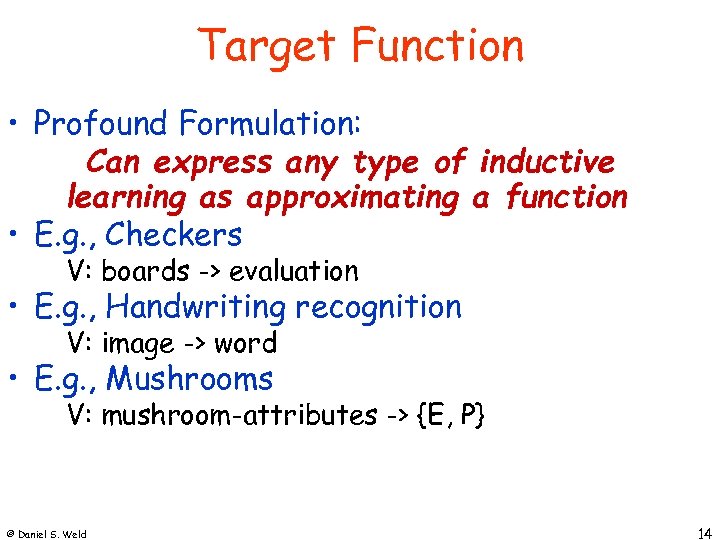 Target Function • Profound Formulation: Can express any type of inductive learning as approximating a function • E. g. , Checkers V: boards -> evaluation • E. g. , Handwriting recognition V: image -> word • E. g. , Mushrooms V: mushroom-attributes -> {E, P} © Daniel S. Weld 14
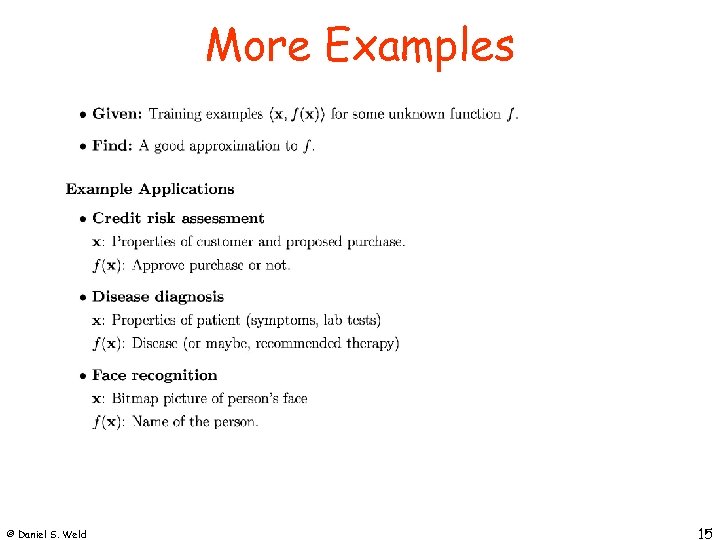 More Examples © Daniel S. Weld 15
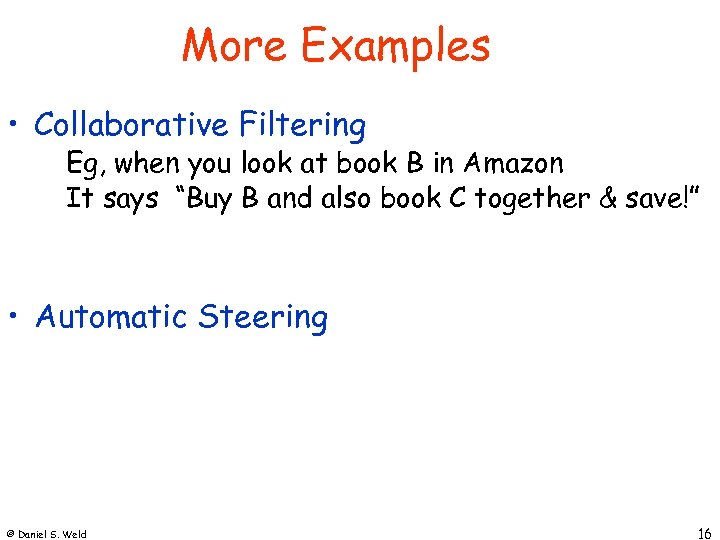 More Examples • Collaborative Filtering Eg, when you look at book B in Amazon It says “Buy B and also book C together & save!” • Automatic Steering © Daniel S. Weld 16
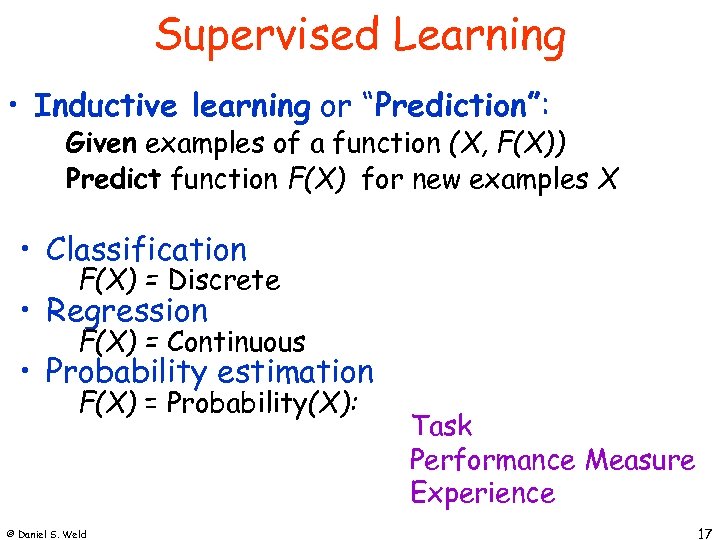 Supervised Learning • Inductive learning or “Prediction”: Given examples of a function (X, F(X)) Predict function F(X) for new examples X • Classification F(X) = Discrete • Regression F(X) = Continuous • Probability estimation F(X) = Probability(X): © Daniel S. Weld Task Performance Measure Experience 17
 Why is Learning Possible? Experience alone never justifies any conclusion about any unseen instance. Learning occurs when PREJUDICE meets DATA! © Daniel S. Weld 18
 Bias • The nice word for prejudice is “bias”. • What kind of hypotheses will you consider? What is allowable range of functions you use when approximating? • What kind of hypotheses do you prefer? © Daniel S. Weld 19
 Some Typical Bias The world is simple Occam’s razor “It is needless to do more when less will suffice” – William of Occam, died 1349 of the Black plague MDL – Minimum description length Concepts can be approximated by . . . conjunctions of predicates. . . by linear functions. . . by short decision trees © Daniel S. Weld 20
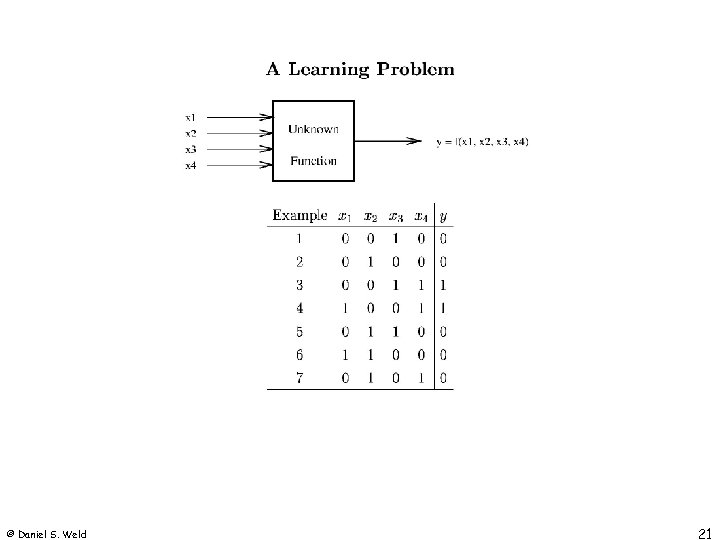 © Daniel S. Weld 21
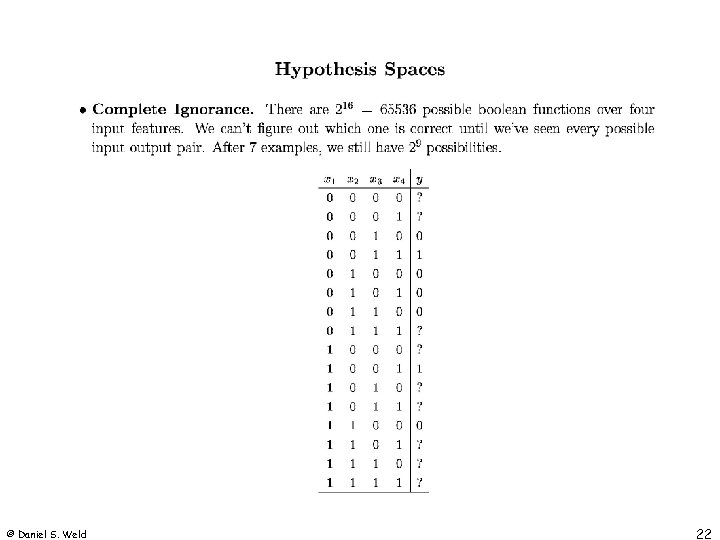 © Daniel S. Weld 22
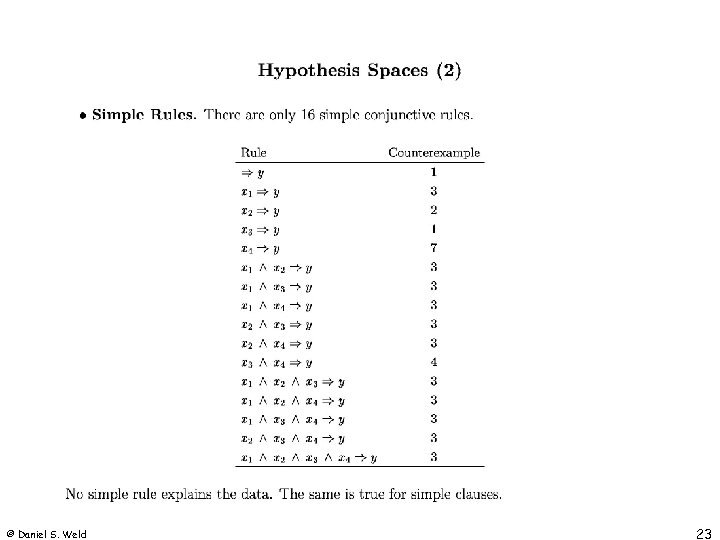 © Daniel S. Weld 23
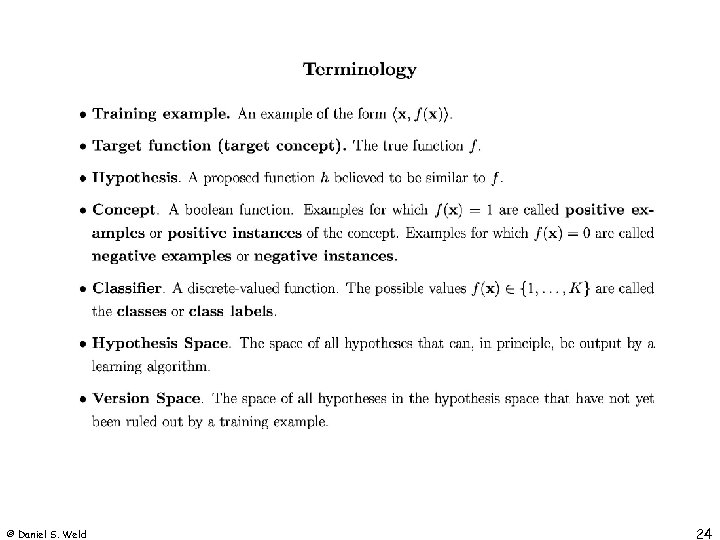 © Daniel S. Weld 24
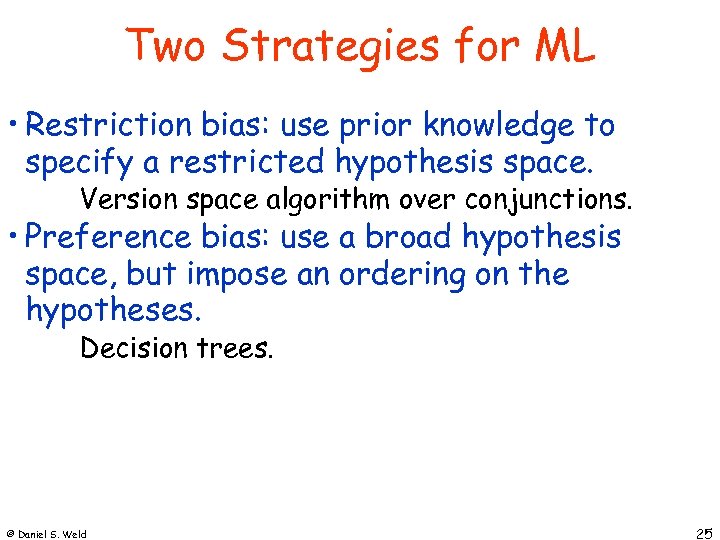 Two Strategies for ML • Restriction bias: use prior knowledge to specify a restricted hypothesis space. Version space algorithm over conjunctions. • Preference bias: use a broad hypothesis space, but impose an ordering on the hypotheses. Decision trees. © Daniel S. Weld 25
 © Daniel S. Weld 26
 © Daniel S. Weld 27