 Скачать презентацию MACD and Technical Analysis Basic Building Blocks of
46fc05a58fa4c40cbb9d6f7d07bfaa74.ppt
- Количество слайдов: 20



MACD and Technical Analysis: Basic Building Blocks of Technical Analysis by Richard D. Marcus • Investors want to see into the future. • Technical analysis employs past patterns in stock prices to forecast the future. Liberation by M. C. Escher Thursday, October 13, 2005 Student Investment Club

Beliefs About the Future The Future • Forecasting rests on an implicit belief that past relationships will continue into the future. • Natura non facit saltum – Nature never moves in leaps. • If the world changes too quickly, no model will be useful. MACD and Technical Analysis The Present 2
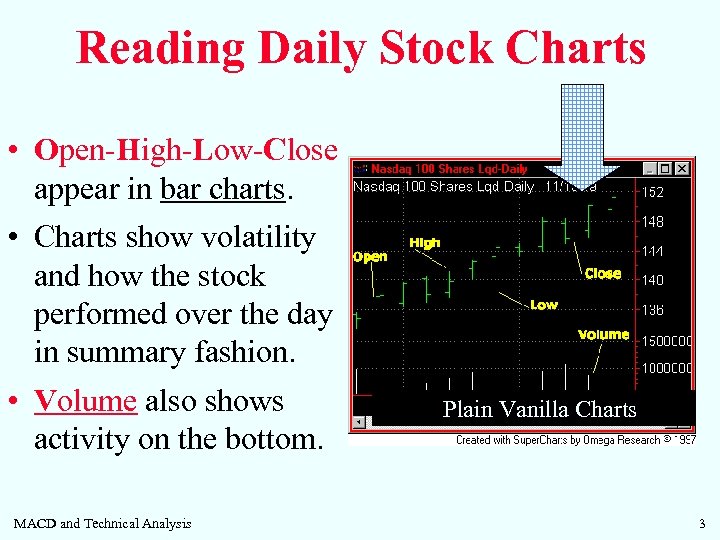
Reading Daily Stock Charts • Open-High-Low-Close appear in bar charts. • Charts show volatility and how the stock performed over the day in summary fashion. • Volume also shows activity on the bottom. MACD and Technical Analysis Plain Vanilla Charts 3
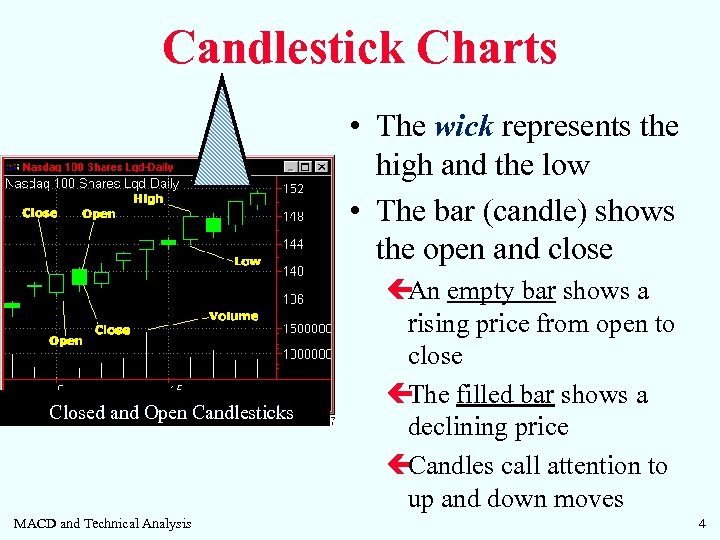
Candlestick Charts • The wick represents the high and the low • The bar (candle) shows the open and close Closed and Open Candlesticks MACD and Technical Analysis ç empty bar shows a An rising price from open to close ç The filled bar shows a declining price ç Candles call attention to up and down moves 4
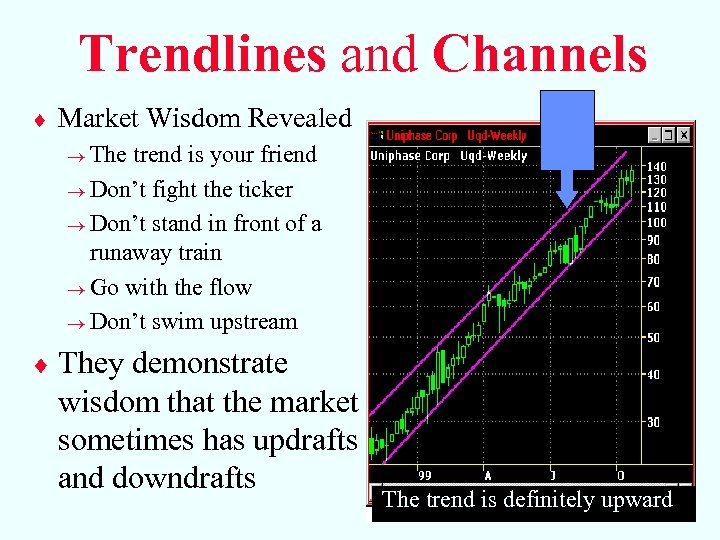
Trendlines and Channels ¨ Market Wisdom Revealed ® The trend is your friend ® Don’t fight the ticker ® Don’t stand in front of a runaway train ® Go with the flow ® Don’t swim upstream ¨ They demonstrate wisdom that the market sometimes has updrafts and downdrafts The trend is definitely upward
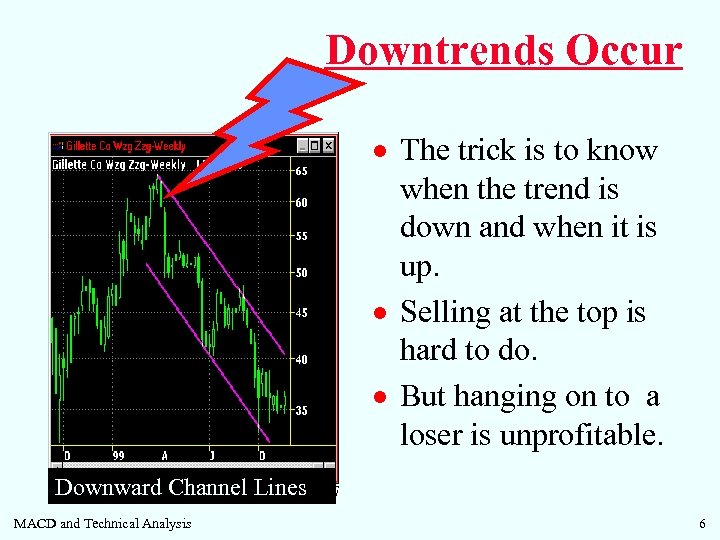
Downtrends Occur · The trick is to know when the trend is down and when it is up. · Selling at the top is hard to do. · But hanging on to a loser is unprofitable. Downward Channel Lines MACD and Technical Analysis 6
Ten Top Technical Tools 1. Trends, Channels, Bollinger Bands 2. Moving Averages 3. Relative Strength Indicators 4. Advance/Decline Ratio 5. Elliott Waves MACD and Technical Analysis 6. Head and Shoulders Reversal Patterns (DOW) 7. Cumulative Volume Indices 8. Short Ratio 9. Number of New Highs or New Lows 10. Moving Average Convergence-Divergence Analysis (MACD) 7
Brief Technical Tool Methods 1. Use charts, std. dev. bands, regressions & go with the flow 2. Chart prices and multiple day moving averages & the trend is your friend 3. A stock relative to S&P 500 or industry 4. Healthy markets have positive A/D ratios 5. 3 impulse waves up, and 2 corrective waves down MACD and Technical Analysis 6. 3 trend phases, confirmation with other indices, and support levels 7. Add the difference between advancing and declining stocks to a running total. 8. Divide short interest by total daily volume & buy when there’s high short interest 9. Ratio of the lesser of new highs or new lows to total number of trades as the High Low Logic = buy when ratio is low 10. Moving Average Convergence. Divergence Analysis (MACD) 8
4 Traps of Technical Analysis 1. Most technical buy & sell indicators occur too late – Often the first few days of a market move includes 2/3 rd of the total upward or downward correction. If missed, there is much less to be had. 2. Many technical indicators switch on and off too often, leading to excessive trading costs – Stop loss orders can leave you out of the stock, then buy it back, eating up profits. 3. Some technical indicators keep you out of the market for years – Hard to explain to clients if you keep them out of stocks for long, long periods. 4. Communists view of the failure of the USSR – “The Soviets just didn’t do it correctly. ” All test failures are blamed on inexact methods. MACD and Technical Analysis 9
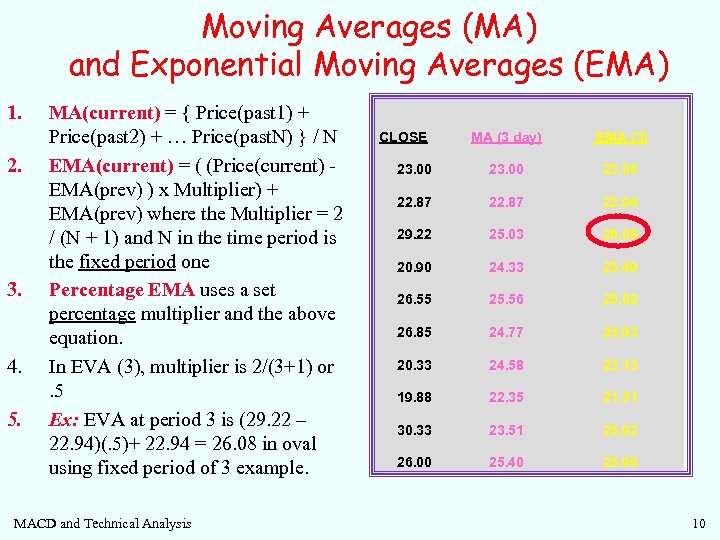
Moving Averages (MA) and Exponential Moving Averages (EMA) 1. 2. 3. 4. 5. MA(current) = { Price(past 1) + Price(past 2) + … Price(past. N) } / N EMA(current) = ( (Price(current) EMA(prev) ) x Multiplier) + EMA(prev) where the Multiplier = 2 / (N + 1) and N in the time period is the fixed period one Percentage EMA uses a set percentage multiplier and the above equation. In EVA (3), multiplier is 2/(3+1) or. 5 Ex: EVA at period 3 is (29. 22 – 22. 94)(. 5)+ 22. 94 = 26. 08 in oval using fixed period of 3 example. MACD and Technical Analysis CLOSE MA (3 day) EMA (3) 23. 00 22. 87 22. 94 29. 22 25. 03 26. 08 20. 90 24. 33 23. 49 26. 55 25. 56 25. 02 26. 85 24. 77 25. 93 20. 33 24. 58 23. 13 19. 88 22. 35 21. 51 30. 33 23. 51 25. 92 26. 00 25. 40 25. 96 10
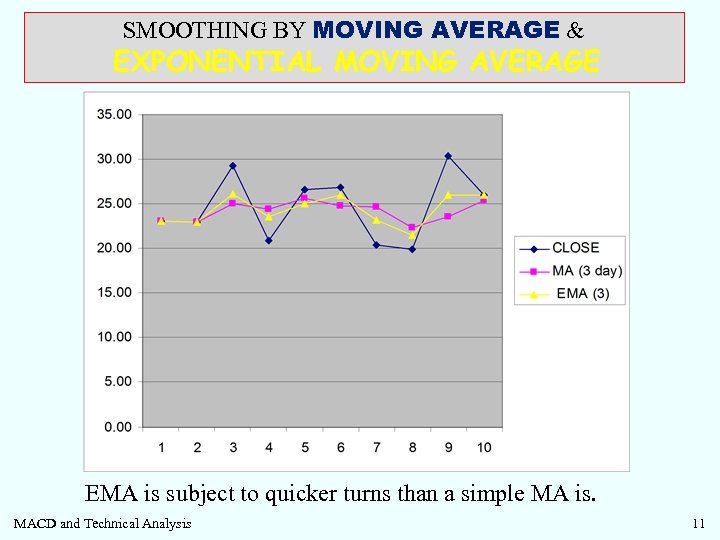
SMOOTHING BY MOVING AVERAGE & EXPONENTIAL MOVING AVERAGE EMA is subject to quicker turns than a simple MA is. MACD and Technical Analysis 11
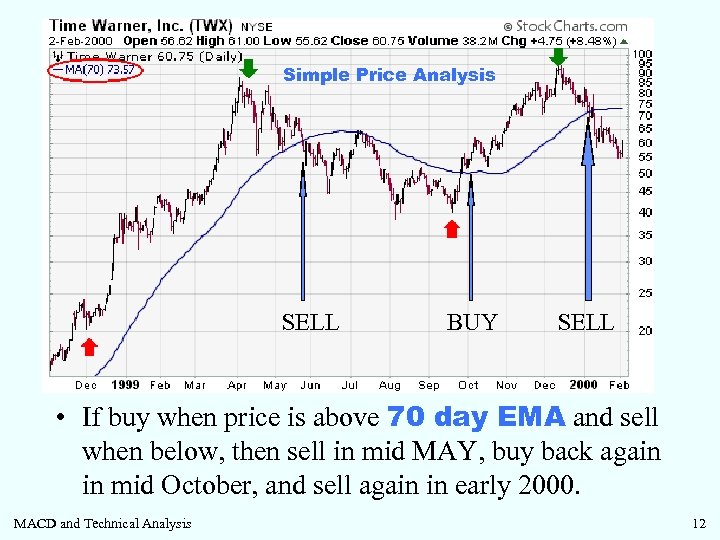
Simple Price Analysis SELL BUY SELL • If buy when price is above 70 day EMA and sell when below, then sell in mid MAY, buy back again in mid October, and sell again in early 2000. MACD and Technical Analysis 12
Two Moving Averages (for momentum price oscillators) • Short run moving average emphasizes what is currently occurring – Someone could be accumulating shares and bidding the price up – Someone could be dumping shares to bring it down • A long run moving average is the base line against what is happening generally • When the short run crosses the long run, we see momentum in the price (BUY). MACD and Technical Analysis 13
Momentum Price Oscillator • A Price oscillator is the difference between a short and long exponential moving average as a percent or as an amount Ø For British pounds, I used 9 -day and 25 -day periods. Ø The oscillator is positive when the 9 -day is above the 25 day line • When line goes above zero, buy as the 9 day is above the 25 day • It is good in a trending market, but it whipsaws with too many trades in sideways markets MACD and Technical Analysis 14
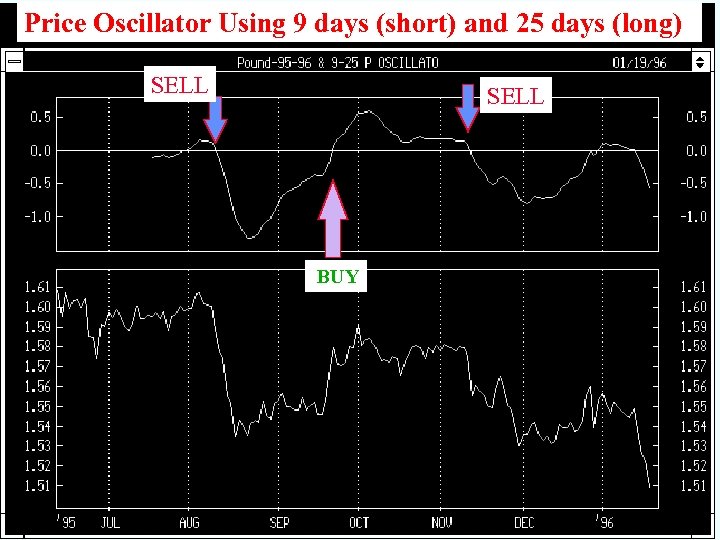
Price Oscillator Using 9 days (short) and 25 days (long) SELL BUY MACD and Technical Analysis 15
Moving Average Covergence. Divergence (MACD) • MACD is an updated price momentum indicator (Gerald Appel) which sometimes includes a signal or trigger line. • It is a smoothed oscillator based on the point spread difference between two exponential moving averages, constructed as a (Short – Long) oscillators. ØA 26 week EMA (long) & a 12 week EMA (short) Ø The difference (short - long) is MACD line Ø 9 week EMA to form the SIGNAL or TRIGGER line Ø Buy Ø when MACD crosses Trigger Line “You don’t have to understand the concept behind a technical indicator to use it; you just need to know what to ask the computer to do with it” -- Cyber-Investing, Brown & Bentley, 1995, p. 62 MACD and Technical Analysis 16
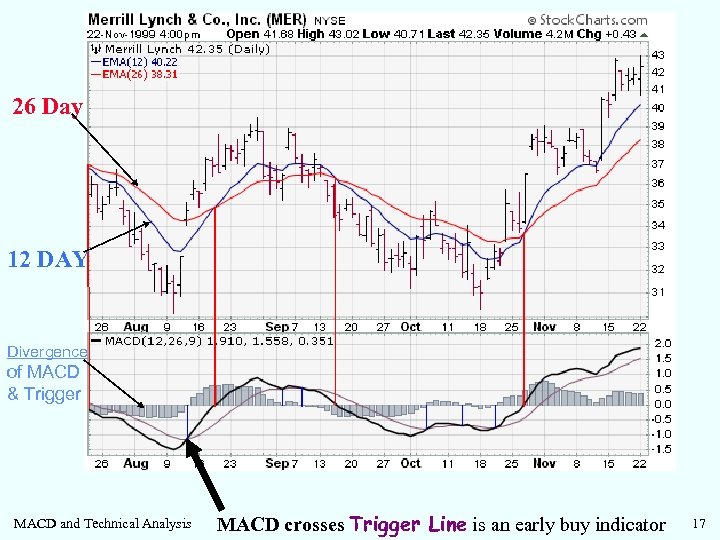
26 Day 12 DAY Divergence of MACD & Trigger MACD and Technical Analysis MACD crosses Trigger Line is an early buy indicator 17
• Moving Average Convergent Divergent (MACD) is a trend deviation oscillator that measures the difference between two exponential moving averages of different lengths. 1. MACD line = subtract a 26 period exponential moving average from a 12 period (a price oscillator) 2. The SIGNAL line - dotted line is a 9 period exponential moving average of the MACD line as an early trigger. – Buy when MACD crosses above Trigger line. – Sell when MACD crosses below he Trigger line • MACD tends to “beat” price oscillators in back testing • Research by Colby & Meyers “The Encyclopedia of Technical Market Indictors” suggest shorter EMA’s. • Brown & Bentley in Cyber Investing suggest 17 days (long) and 8 days (short), and signal line 9 days • But I used 26, 12, and 9 days as is suggested in Meta. Stock SE by Equis for the British pound. MACD and Technical Analysis 18
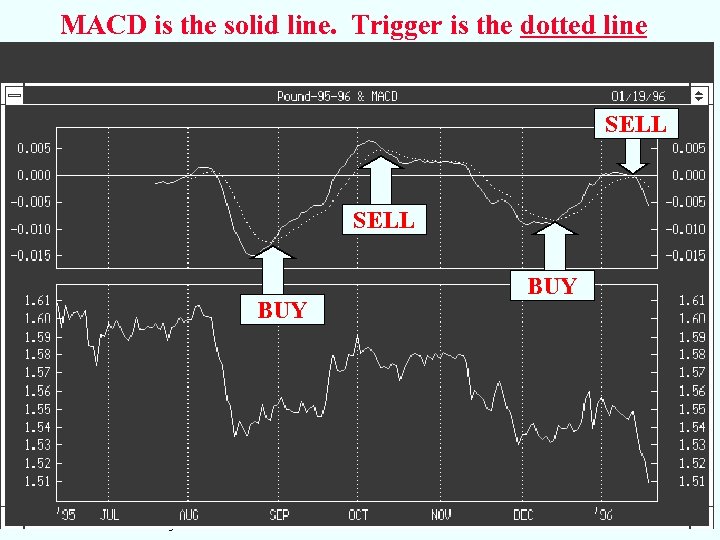
MACD is the solid line. Trigger is the dotted line SELL BUY MACD and Technical Analysis BUY 19
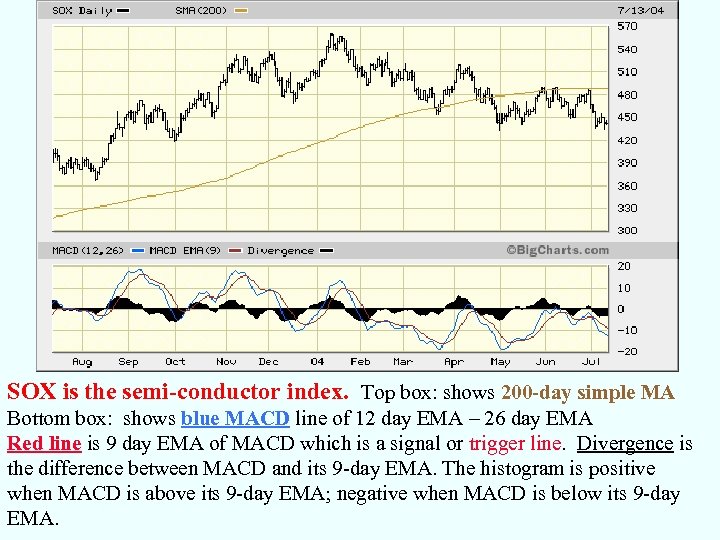
SOX is the semi-conductor index. Top box: shows 200 -day simple MA Bottom box: shows blue MACD line of 12 day EMA – 26 day EMA Red line is 9 day EMA of MACD which is a signal or trigger line. Divergence is the difference between MACD and its 9 -day EMA. The histogram is positive when MACD is above its 9 -day EMA; negative when MACD is below its 9 -day EMA.
Скачать презентацию MACD and Technical Analysis Basic Building Blocks of
46fc05a58fa4c40cbb9d6f7d07bfaa74.ppt