


 Скачать презентацию Ma sas hi Ka ne ta Event anisotropy
0cb2352c0078c39705c1746b9e9ad9c5.ppt
- Количество слайдов: 21
 Ma sas hi Ka ne ta Event anisotropy of identified p 0, g and e compared to charged p, K, p, and d in s. NN = 200 Ge. V Au+Au at PHENIX Masashi Kaneta y for the PHENIX collaboration z x Masashi Kaneta, RBRC, BNL
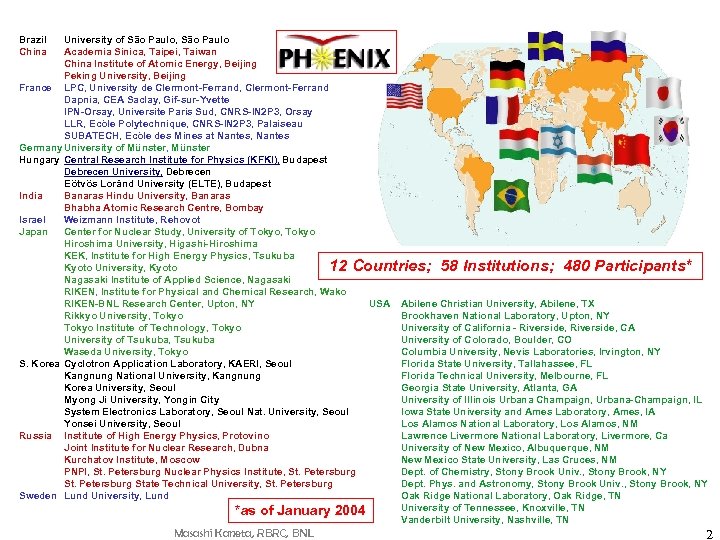 Brazil China University of São Paulo, São Paulo Academia Sinica, Taipei, Taiwan China Institute of Atomic Energy, Beijing Peking University, Beijing France LPC, University de Clermont-Ferrand, Clermont-Ferrand Dapnia, CEA Saclay, Gif-sur-Yvette IPN-Orsay, Universite Paris Sud, CNRS-IN 2 P 3, Orsay LLR, Ecòle Polytechnique, CNRS-IN 2 P 3, Palaiseau SUBATECH, Ecòle des Mines at Nantes, Nantes Germany University of Münster, Münster Hungary Central Research Institute for Physics (KFKI), Budapest Debrecen University, Debrecen Eötvös Loránd University (ELTE), Budapest India Banaras Hindu University, Banaras Bhabha Atomic Research Centre, Bombay Israel Weizmann Institute, Rehovot Japan Center for Nuclear Study, University of Tokyo, Tokyo Hiroshima University, Higashi-Hiroshima KEK, Institute for High Energy Physics, Tsukuba Kyoto University, Kyoto Nagasaki Institute of Applied Science, Nagasaki RIKEN, Institute for Physical and Chemical Research, Wako RIKEN-BNL Research Center, Upton, NY Rikkyo University, Tokyo Institute of Technology, Tokyo University of Tsukuba, Tsukuba Waseda University, Tokyo S. Korea Cyclotron Application Laboratory, KAERI, Seoul Kangnung National University, Kangnung Korea University, Seoul Myong Ji University, Yongin City System Electronics Laboratory, Seoul Nat. University, Seoul Yonsei University, Seoul Russia Institute of High Energy Physics, Protovino Joint Institute for Nuclear Research, Dubna Kurchatov Institute, Moscow PNPI, St. Petersburg Nuclear Physics Institute, St. Petersburg State Technical University, St. Petersburg Sweden Lund University, Lund 12 Countries; 58 Institutions; 480 Participants* *as of January 2004 Masashi Kaneta, RBRC, BNL USA Abilene Christian University, Abilene, TX Brookhaven National Laboratory, Upton, NY University of California - Riverside, CA University of Colorado, Boulder, CO Columbia University, Nevis Laboratories, Irvington, NY Florida State University, Tallahassee, FL Florida Technical University, Melbourne, FL Georgia State University, Atlanta, GA University of Illinois Urbana Champaign, Urbana-Champaign, IL Iowa State University and Ames Laboratory, Ames, IA Los Alamos National Laboratory, Los Alamos, NM Lawrence Livermore National Laboratory, Livermore, Ca University of New Mexico, Albuquerque, NM New Mexico State University, Las Cruces, NM Dept. of Chemistry, Stony Brook Univ. , Stony Brook, NY Dept. Phys. and Astronomy, Stony Brook Univ. , Stony Brook, NY Oak Ridge National Laboratory, Oak Ridge, TN University of Tennessee, Knoxville, TN Vanderbilt University, Nashville, TN 2
 Announcement • The flow and event anisotropy from the PHENIX collaborators in the poster session – Shingo Sakai* • Azimuthal anisotropy of electrons/positrons in 200 Ge. V Au+Au collisions at RHIC-PHENIX – Andrey Kazantsev* • Elliptic flow of inclusive photons in Au+Au collisions at s. NN=200 Ge. V from the PHENIX experiment at RHIC – Hiroshi Masui* • Measurement of directed flow in s. NN=200 Ge. V Au+Au, d+Au, p+p collisions at RHIC-PHENIX – Akio Kiyomichi • Radial flow study from identified hadron spectra in Au+Au collisions at s. NN=200 Ge. V (at PHENIX) – Michael Issah* • Azimuthal anisotropy measurements in PHENIX via cummulants of Multiparticle azimuthal correlations – Debsankar Mukhopadhyay • Elliptic flow of f mesons in Au+Au collisions at s. NN=200 Ge. V (at PHENIX) – Shin. Ichi Esumi • Analysis of event anisotropy and azimuthal pair correlation Masashi Kaneta, RBRC, BNL * Students 3
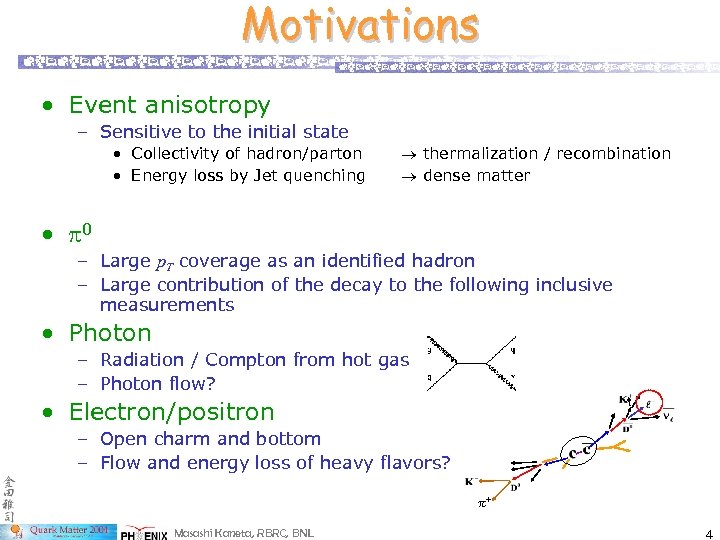 Motivations • Event anisotropy – Sensitive to the initial state • Collectivity of hadron/parton • Energy loss by Jet quenching thermalization / recombination dense matter • p 0 – Large p. T coverage as an identified hadron – Large contribution of the decay to the following inclusive measurements • Photon – Radiation / Compton from hot gas – Photon flow? • Electron/positron – Open charm and bottom – Flow and energy loss of heavy flavors? p+ Masashi Kaneta, RBRC, BNL 4
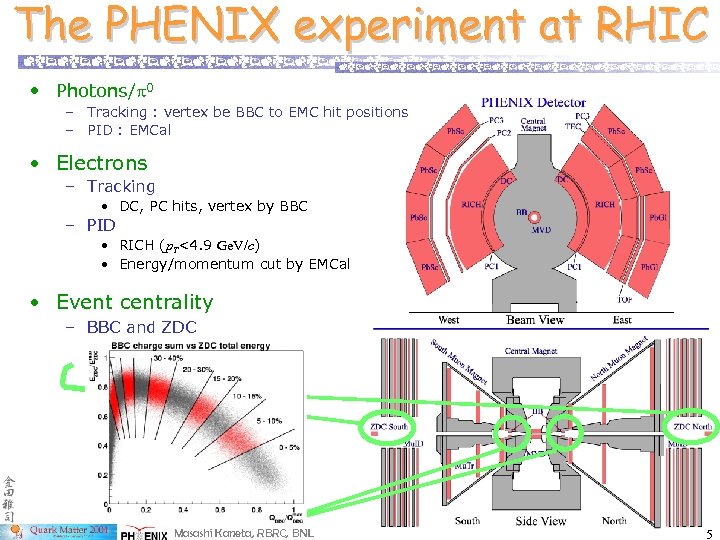 The PHENIX experiment at RHIC • Photons/p 0 – Tracking : vertex be BBC to EMC hit positions – PID : EMCal PHOENIX • Electrons – Tracking • DC, PC hits, vertex by BBC – PID • RICH (p. T<4. 9 Ge. V/c) • Energy/momentum cut by EMCal • Event centrality – BBC and ZDC Masashi Kaneta, RBRC, BNL 5
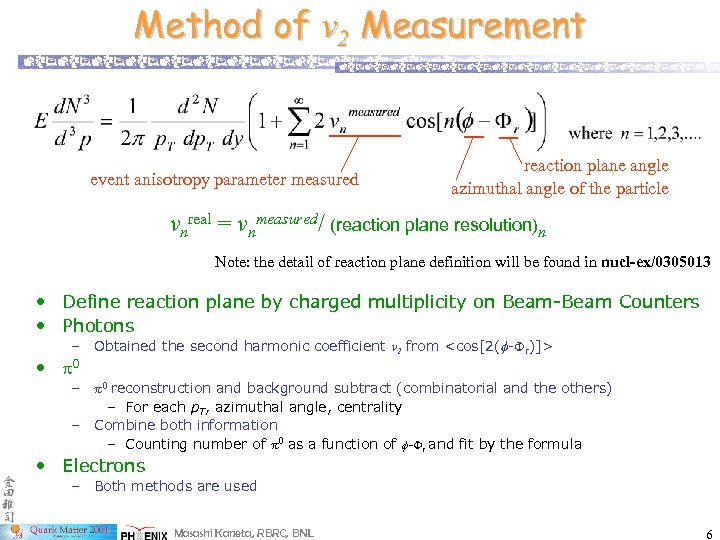 Method of v 2 Measurement event anisotropy parameter measured reaction plane angle azimuthal angle of the particle vnreal = vnmeasured/ (reaction plane resolution)n Note: the detail of reaction plane definition will be found in nucl-ex/0305013 • Define reaction plane by charged multiplicity on Beam-Beam Counters • Photons – Obtained the second harmonic coefficient v 2 from
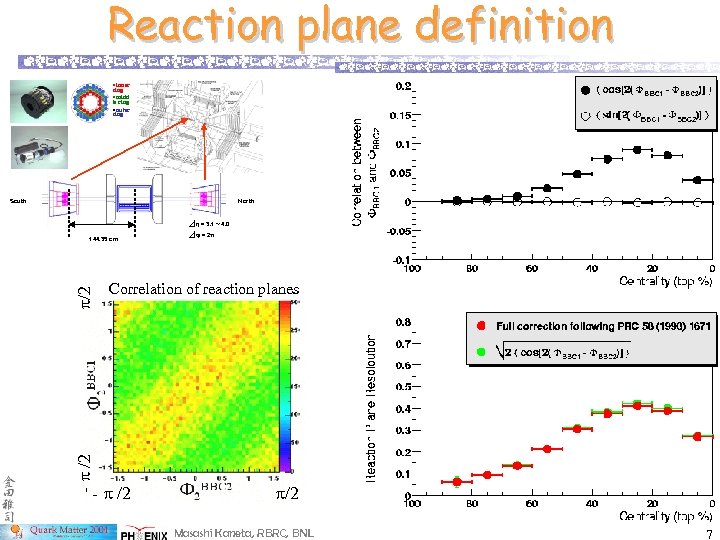 Reaction plane definition • inner ring • middle ring • outer ring • inner ring • midd le ring • outer ring BBC South 64 elements Quartz Cherenkov radiator p/2 144. 35 cm North ⊿η = 3. 1 ~ 4. 0 ⊿φ = 2π meshed dynode PMT Correlation of reaction planes North - p /2 South - p /2 p/2 144. 35 cm Masashi Kaneta, RBRC, BNL ⊿η = 3. 1 ~ 4. 0 ⊿φ = 2π 7
 g & Masashi Kaneta, RBRC, BNL p v 2 0
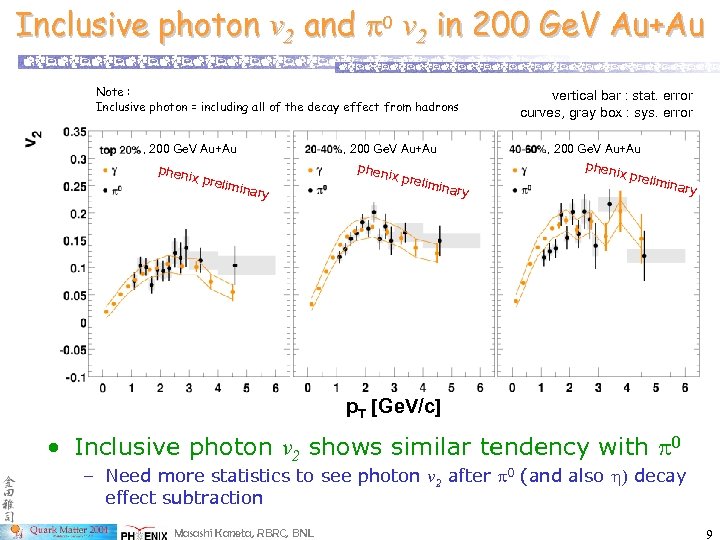 Inclusive photon v 2 and p 0 v 2 in 200 Ge. V Au+Au Note : Inclusive photon = including all of the decay effect from hadrons , 200 Ge. V Au+Au phen ix pre l imina phen ry ix pre limina vertical bar : stat. error curves, gray box : sys. error , 200 Ge. V Au+Au phen ry ix pre limina ry p. T [Ge. V/c] • Inclusive photon v 2 shows similar tendency with p 0 – Need more statistics to see photon v 2 after p 0 (and also h) decay effect subtraction Masashi Kaneta, RBRC, BNL 9
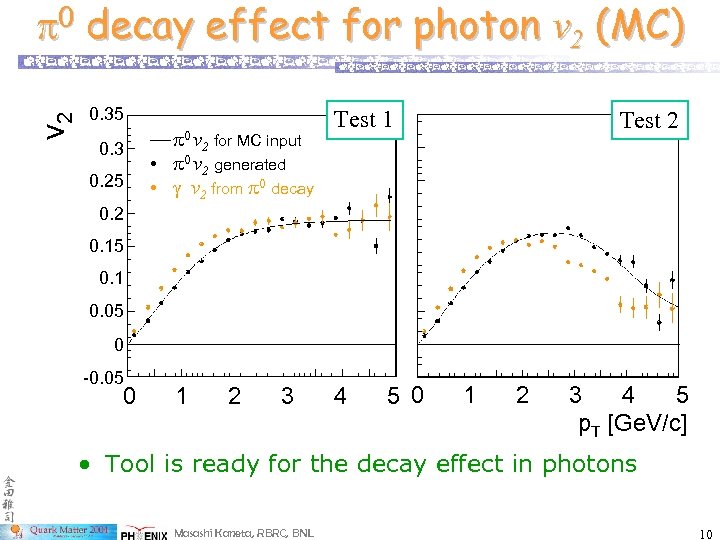 v 2 p 0 decay effect for photon v 2 (MC) 0. 35 0. 3 0. 25 — p 0 v 2 for MC input • p 0 v 2 generated • g v 2 from p 0 decay Test 1 Test 2 0. 15 0. 1 0. 05 0 -0. 05 0 1 2 3 4 5 p. T [Ge. V/c] • Tool is ready for the decay effect in photons Masashi Kaneta, RBRC, BNL 10
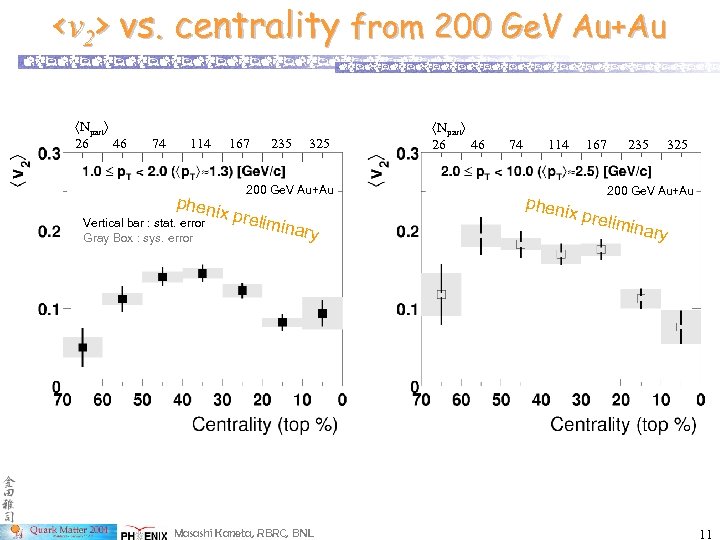
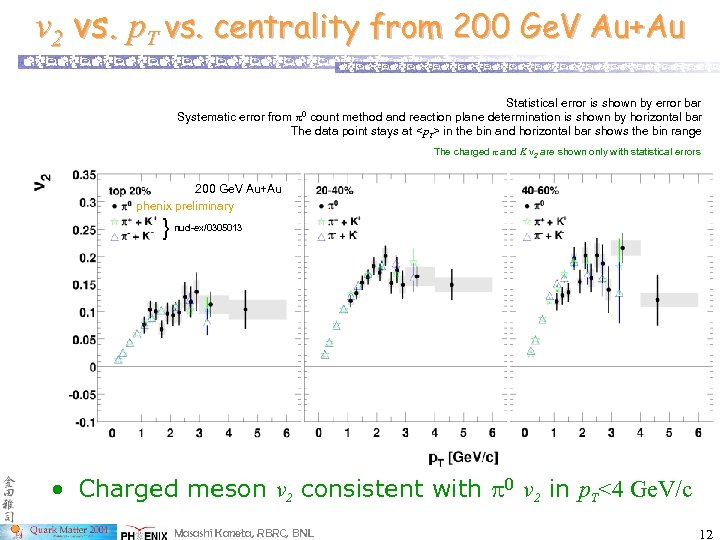 v 2 vs. p. T vs. centrality from 200 Ge. V Au+Au Statistical error is shown by error bar Systematic error from count method and reaction plane determination is shown by horizontal bar The data point stays at
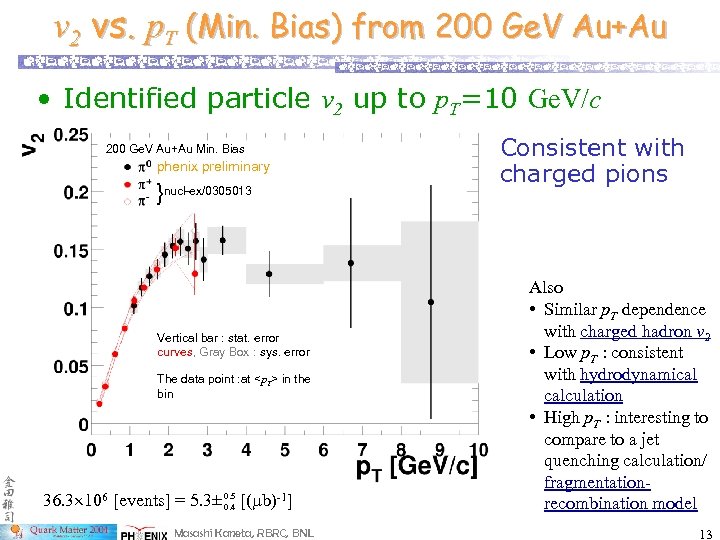 v 2 vs. p. T (Min. Bias) from 200 Ge. V Au+Au • Identified particle v 2 up to p. T=10 Ge. V/c 200 Ge. V Au+Au Min. Bias phenix preliminary }nucl-ex/0305013 Vertical bar : stat. error curves, Gray Box : sys. error The data point : at
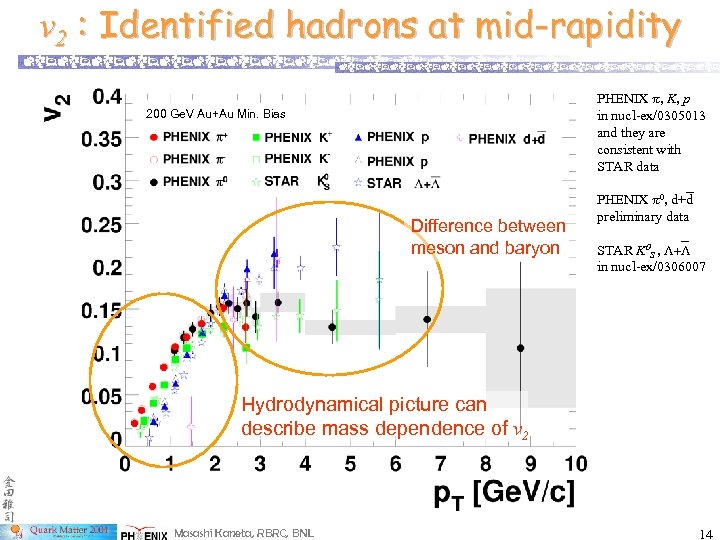 v 2 : Identified hadrons at mid-rapidity PHENIX p, K, p in nucl-ex/0305013 and they are consistent with STAR data 200 Ge. V Au+Au Min. Bias Difference between meson and baryon PHENIX p 0, d+d preliminary data STAR K 0 S , L+L in nucl-ex/0306007 Hydrodynamical picture can describe mass dependence of v 2 Masashi Kaneta, RBRC, BNL 14
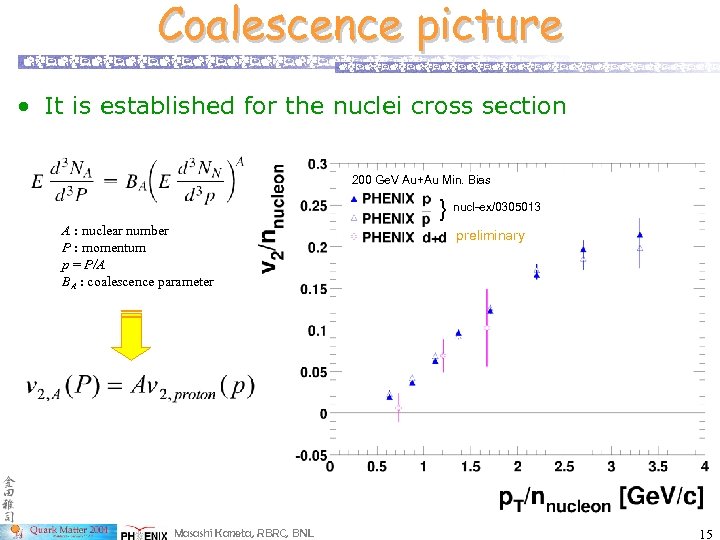 Coalescence picture • It is established for the nuclei cross section 200 Ge. V Au+Au Min. Bias } nucl-ex/0305013 A : nuclear number P : momentum p = P/A BA : coalescence parameter Masashi Kaneta, RBRC, BNL preliminary 15
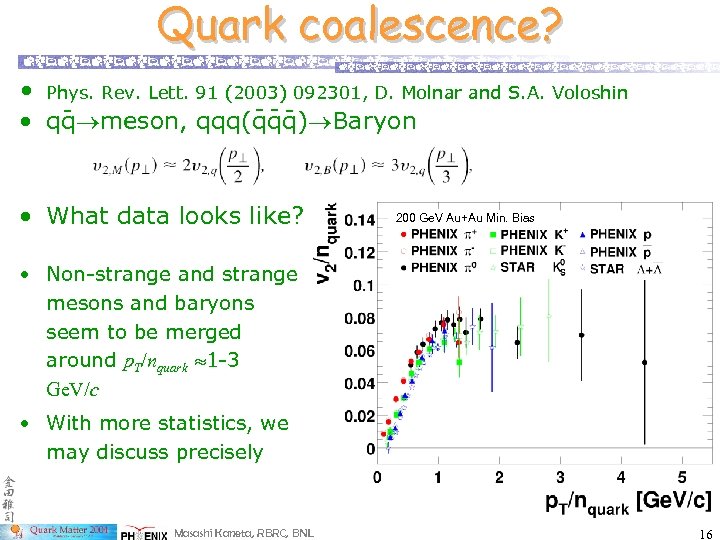 Quark coalescence? • Phys. Rev. Lett. 91 (2003) 092301, D. Molnar and S. A. Voloshin -- • qq meson, qqq(qqq) Baryon • What data looks like? 200 Ge. V Au+Au Min. Bias • Non-strange and strange mesons and baryons seem to be merged around p. T/nquark 1 -3 Ge. V/c • With more statistics, we may discuss precisely Masashi Kaneta, RBRC, BNL 16
 ± e Masashi Kaneta, RBRC, BNL v 2
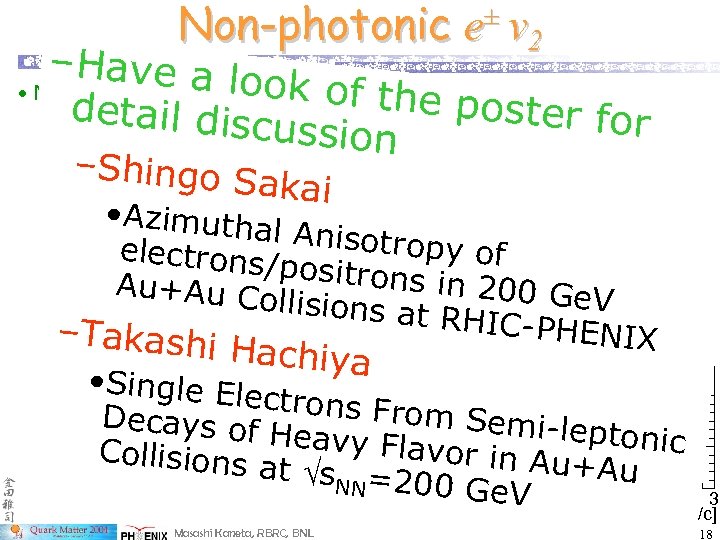 Non-photonic e± v 2 – Have a lo ok for the • Non-photonic electron (sorry of jargon) means poster for – detail discussion 0. 3 Measured electron minus background: • hadron decay • g conversion non-photonic electron v 2 –Shingo S akai 0. 25 – that is, charmed (+bottomed) electron we think The data point : on
 Summary Masashi Kaneta, RBRC, BNL
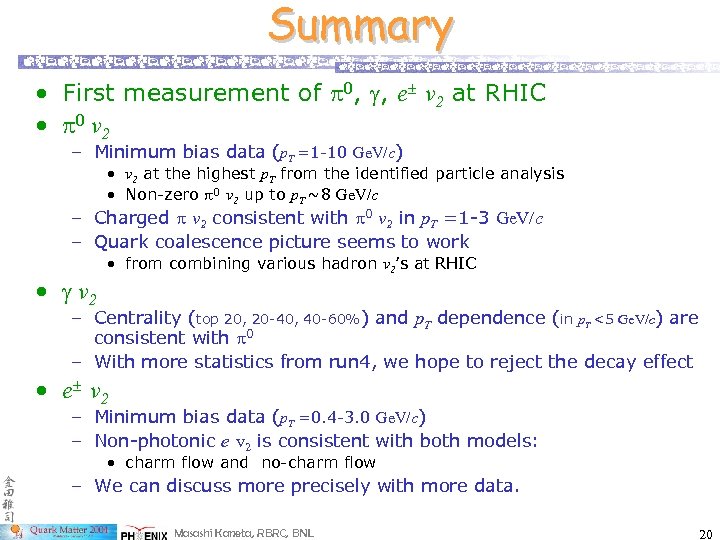 Summary • First measurement of p 0, g, e v 2 at RHIC • p 0 v 2 – Minimum bias data (p. T =1 -10 Ge. V/c) • v 2 at the highest p. T from the identified particle analysis • Non-zero p 0 v 2 up to p. T ~8 Ge. V/c – Charged p v 2 consistent with p 0 v 2 in p. T =1 -3 Ge. V/c – Quark coalescence picture seems to work • g v 2 • from combining various hadron v 2’s at RHIC – Centrality (top 20, 20 -40, 40 -60%) and p. T dependence (in p. T <5 Ge. V/c) are consistent with p 0 – With more statistics from run 4, we hope to reject the decay effect • e v 2 – Minimum bias data (p. T =0. 4 -3. 0 Ge. V/c) – Non-photonic e v 2 is consistent with both models: • charm flow and no-charm flow – We can discuss more precisely with more data. Masashi Kaneta, RBRC, BNL 20
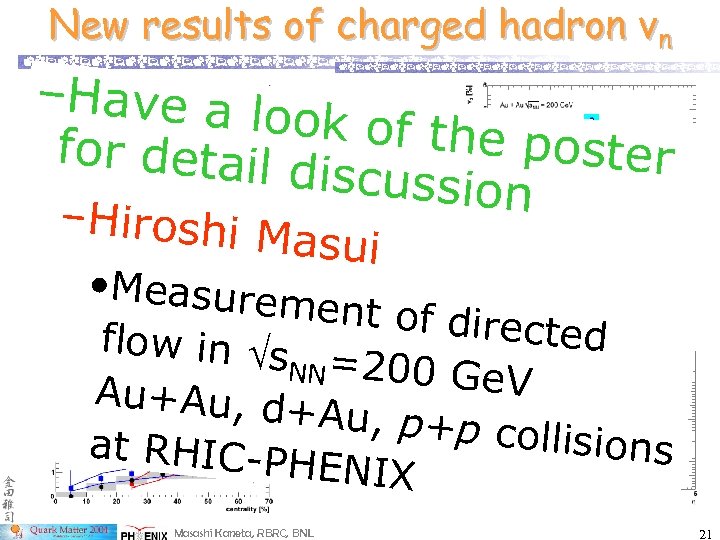 New results of charged hadron vn –Have a lo o. Elliotfc the k pi poster for detail F discussion low –Hiroshi M asui • Measurem ent of dire cted flow in s NN =200 Ge. V Au+Au, d Directe +Au, p+p d collisions at RHIC-P Flow HENIX Masashi Kaneta, RBRC, BNL 21