


 Скачать презентацию M Tech Industrial Visit Presentation phase II R
8dec1584bd81318fc934c2834a7920d3.ppt
- Количество слайдов: 26
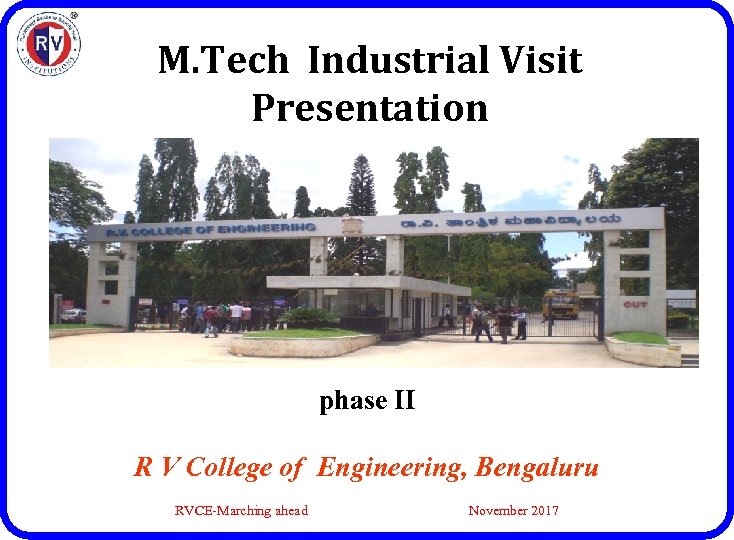 M. Tech Industrial Visit Presentation phase II R V College of Engineering, Bengaluru RVCE-Marching ahead November 2017
 R V College of Engineering Bengaluru. Industrial visit “Profile of NGO and Profile of C-DAC” By Chaitra D M 1 RV 16 SSE 05 Under the guidance of Dr. Mamatha G S RVCE-Marching ahead November 2017
 . Profile of NGO-Akshaya Patra RVCE-Marching ahead November 2017
 Introduction • In recent years, NGOs have become increasingly involved in supplying meals to schools as a part of government’s midday meal scheme. • Akshaya Patra is the largest of these, serving wholesome food to over 1. 6 million children from 13, 839 schools across 12 states in India. • The Akshaya Patra Foundation is a not-for-profit organisation headquartered in Bengaluru, India started in 2000. • This organisation strives to fight issues like hunger and malnutrition in India, by implementing the Mid-Day Meal Scheme in the government schools and government-aided schools. RVCE-Marching ahead November 2017
 Kitchen - AKSHAYA PATRA • Akshaya Patra kitchen run mainly on two methods of food preparation that is centralized and decentralized method of kitchen. • Centralised kitchens – Are large kitchen units that have the capacity to typically cook up to 100, 000 meals. – These kitchens serve a set of schools located around the unit. – They are automated and thus ensure hygiene during the cooking processes. Decentralised kitchen – On the other hand, in locations where factors like difficult geographical terrain and improper road connectivity do not support the construction of large infrastructure, the decentralised kitchen format is the ideal solution. – The kitchens are run by the women Self-Help Groups (SHGs) under the guidance and supervision of Akshaya Patra’s kitchen process and operations module. • RVCE-Marching ahead November 2017
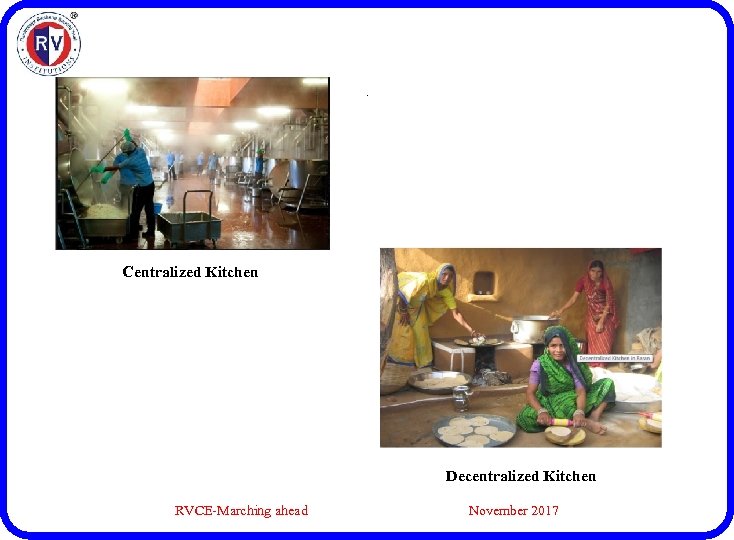 . Centralized Kitchen Decentralized Kitchen RVCE-Marching ahead November 2017
 Service – MID-DAY MEAL • To improve primary education and counter classroom hunger the Government of India has developed two of the most significant programmes 1. Sarva Shiksha Abhiyan (SSA) 2. Mid-Day Meal Scheme (MDMS) • The Mid-Day Meal Scheme focuses on providing free lunch at all Government schools in order to enhance enrolment, retention and attendance among children and also simultaneously to improve their nutritional levels. • Akshaya Patra implements the Mid- Day Meal programme in 32 locations of 12 states of India. Each day the Foundation feeds 1. 6 million children covering more than 13, 839 Government schools. • The Akshaya Patra Kitchen Infrastructure will give an overview of its compliance to Food Safety and Quality Standards while preparing the meals. 12 centralised kitchens of the Foundation are ISO 22000: 2005 certified and the remaining are in the process of getting certification. RVCE-Marching ahead November 2017
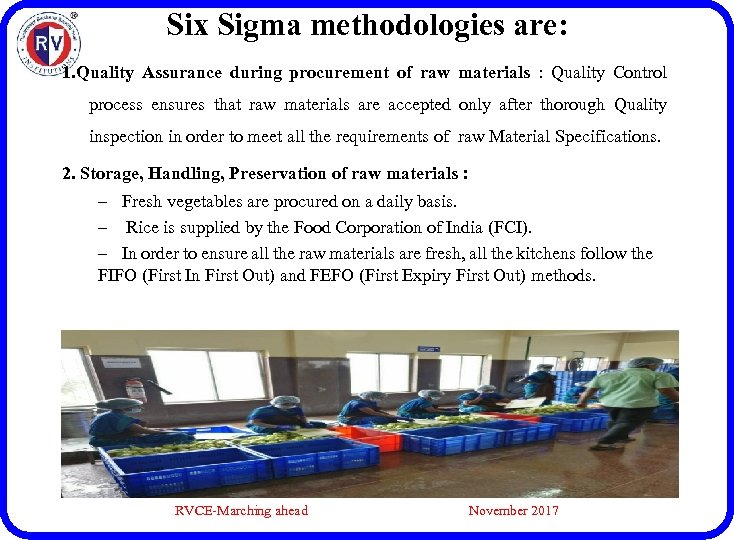 Six Sigma methodologies are: 1. Quality Assurance during procurement of raw materials : Quality Control process ensures that raw materials are accepted only after thorough Quality inspection in order to meet all the requirements of raw Material Specifications. 2. Storage, Handling, Preservation of raw materials : – Fresh vegetables are procured on a daily basis. – Rice is supplied by the Food Corporation of India (FCI). – In order to ensure all the raw materials are fresh, all the kitchens follow the FIFO (First In First Out) and FEFO (First Expiry First Out) methods. RVCE-Marching ahead November 2017
 3. Quality and Safety during cooking : . ØAll the cooking equipment are sterilised using steam before the cooking process begins. ØThe vessels used in the kitchens are made of stainless steel of 304 grade and is best for cooking and handling food. 4. Food Packing and Transportation : ØThe cooked food is packed in steam sterilized vessels and vehicles to deliver food. ØThese vehicles use a puffed body to reduce the temperature loss and a honeycomb structure to hold the vessels upright and keep the freshness of the cooked meal intact till it is served to the children. RVCE-Marching ahead November 2017
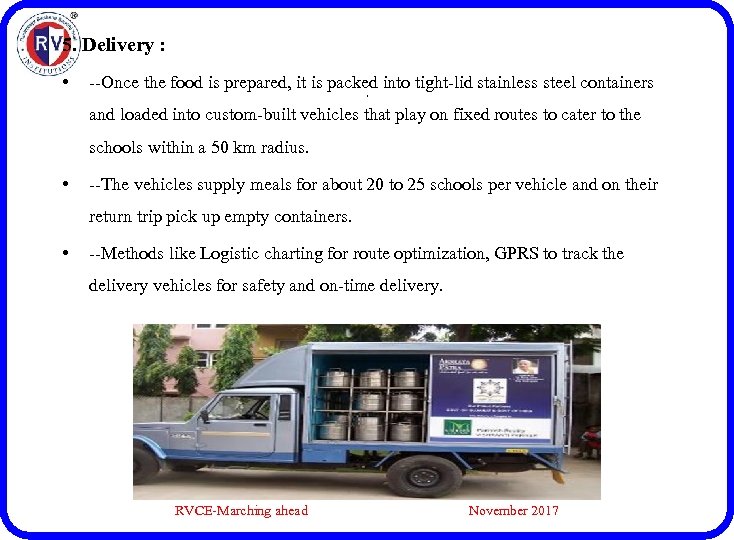 5. Delivery : • --Once the food is prepared, it is packed into tight-lid stainless steel containers , and loaded into custom-built vehicles that play on fixed routes to cater to the schools within a 50 km radius. • --The vehicles supply meals for about 20 to 25 schools per vehicle and on their return trip pick up empty containers. • --Methods like Logistic charting for route optimization, GPRS to track the delivery vehicles for safety and on-time delivery. RVCE-Marching ahead November 2017
 6. Post Delivery Process . Ø In order to consistently maintain the quality of the meal, we take feedbacks from schools on a daily basis while delivering the meal. Ø They also circulate ‘Do’s and Don’ts’ pamphlets to all schools on a regular basis for creating awareness on food safety and hygiene while serving the mid-day meals. RVCE-Marching ahead November 2017
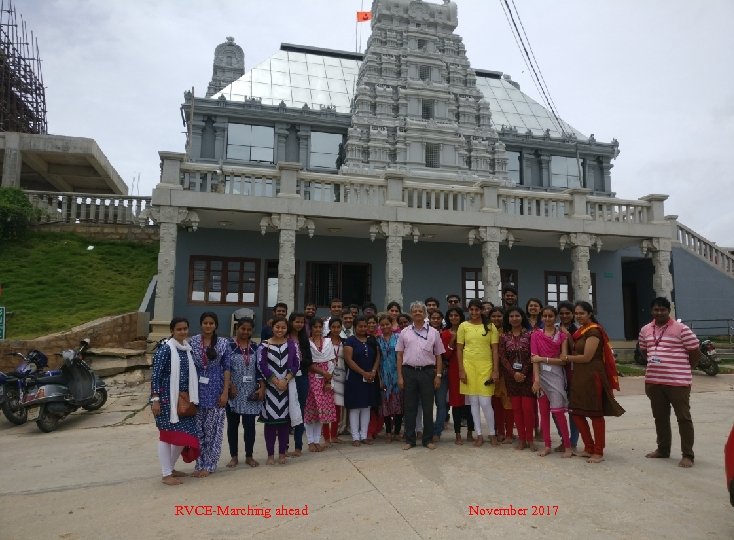
 learnings • We learnt about the new large production of cooking techniques. • About the technology used for large production of food. RVCE-Marching ahead November 2017
 Conclusion • The visit provided in depth understanding in various processes undertaken at Akshaya Patra in preparing various items. • The unique aspect of this intervention is that the program has been able to take a massive initiative to scale, while keeping its high quality and delivery standards integral. RVCE-Marching ahead November 2017
 , RVCE-Marching ahead November 2017
 , Profile of C-DAC RVCE-Marching ahead November 2017
 Introduction • Centre for Development of Advanced Computing (C-DAC) is the R&D organization of the Ministry of Electronics and Information Technology. • The setting up of C-DAC in 1988 itself was to built Supercomputers in context of denial of import of Supercomputers by USA. • Since then C-DAC has been undertaking building of multiple generations of Supercomputer starting from PARAM with 1 GF in 1988. • C-DAC started building Indian Language Computing Solutions with setting up of GIST group (Graphics and Intelligence based Script Technology) RVCE-Marching ahead November 2017
 , • C-DAC started its education & training activities in 1994. • C-DAC has today emerged as a premier R&D organization in IT&E (Information Technologies and Electronics) in the country. • As an institution for high-end Research and Development (R&D), CDAC has been at the forefront of the Information Technology revolution. • constantly building capacities in emerging/enabling technologies and innovating and leveraging its expertise, caliber, skill sets to develop and deploy IT products and solutions for different sectors of the economy RVCE-Marching ahead November 2017
 VISION • To emerge as the premier R&D institution for the design, development and deployment of world class electronic and IT solutions for economic and human advancement. MISSION The Mission Statement as defined below, reflects the fabric and character of C-DAC and integrates in the fulfillment of C-DAC's Vision. . • Evolve technology solutions - architectures, systems and standards for nationally important problems. • Achieve rapid and effective spread of knowledge by overcoming language barriers through application of technologies. • Share experience and know how to help build advanced competence in the areas of Electronics and Information Technology. • Bring benefits of Electronics and Information Technology to society. RVCE-Marching ahead November 2017
 TECHNICAL AREAS. High Performance Computing Systems and Facilities PARAM Yuva II: • In 2013 at C-DAC’s National PARAM Supercomputing Facility in Pune, PARAM Yuva II has been extensively used by many scientists and engineers. • The resources on PARAM Yuva II are grouped into homogeneous groups known as partitions. • Various queues ensure a spectrum of quality of service according to the resource requirement of the users for different computing exercises and queue wait time has been reduced with effective use of partitioning. RVCE-Marching ahead November 2017
 . PARAM PADMA • Introduced in 2003 • Its a next generation high performance scalable computing cluster • External Storage array 5 Tera. Bytes • It provides a high flexible software environment for the cluster. RVCE-Marching ahead November 2017
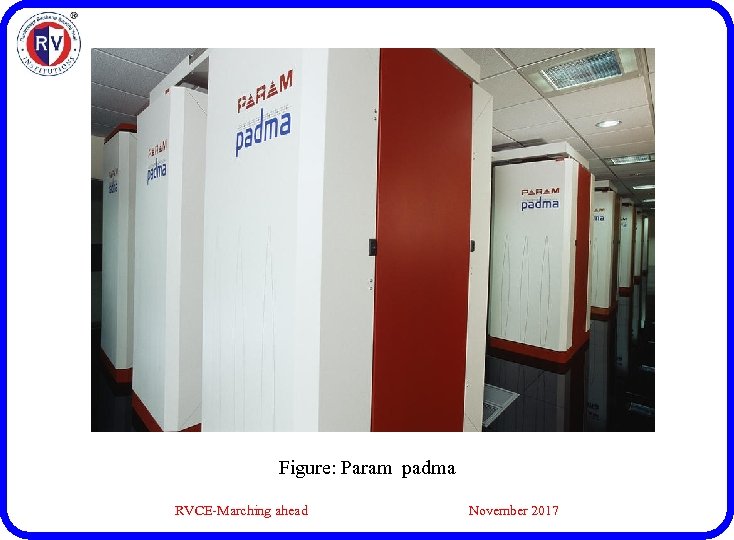 . Figure: Param padma RVCE-Marching ahead November 2017
 Applications : . • Bioinformatics - stimulations of large bio molecules - analysis of large databases for studying functions of genes • Computational Structural Mechanics - fracture analysis - stress analysis - visualization for structural and fluid mechanics - study of thin walled structures RVCE-Marching ahead November 2017
 High Speed Interconnect and Accelerator Technologies Trinetra: C-DAC is carrying out development of next generation indigenous HPC interconnect called “Trinetra” for efficient inter-node communication between compute nodes under National Supercomputing Mission. Reconfigurable Computing System RCS is a FPGA (Field Programmable Gate Array) based high performance application accelerator card for accelerating applications. This energy efficient card supports Linux and Windows Operating Systems. RVCE-Marching ahead November 2017
 learnings • We got to know about one of the super computer which is Param Padma. • We learnt about the features of param padma • configurations of Param Padma contains compute nodes, storage. RVCE-Marching ahead November 2017
 Conclusion • The industrial visit to C-DAC was a very informative visit. The visit provided in depth understanding of various technologies undertaken at C -DAC. • The program provides an insight of the various technologies that CDAC works on and also gave the students an overview of the company RVCE-Marching ahead November 2017 .
 , THANK YOU RVCE-Marching ahead November 2017