 Скачать презентацию M 8120 Data for Evidence-based Practice Fall 2001
475457654a19508a3076f839ea5ca59a.ppt
- Количество слайдов: 90




M 8120 Data for Evidence-based Practice Fall 2001
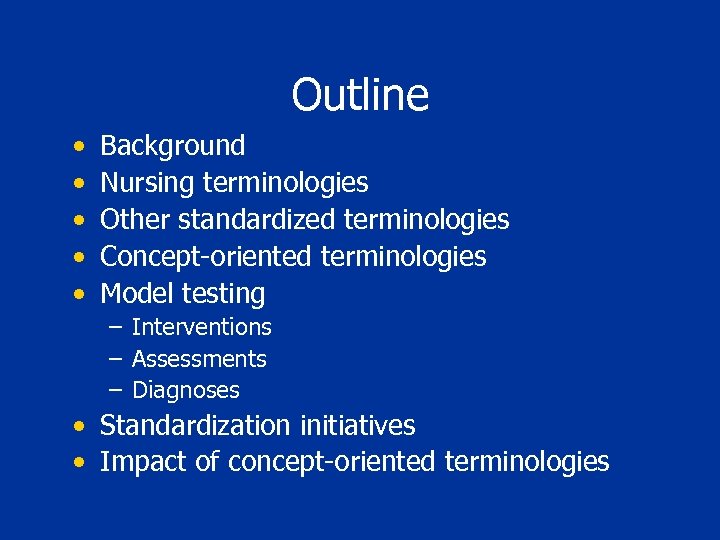
Outline • • • Background Nursing terminologies Other standardized terminologies Concept-oriented terminologies Model testing – Interventions – Assessments – Diagnoses • Standardization initiatives • Impact of concept-oriented terminologies

Foundation for Evidence-based Practice ü Standardized terminologies • Digital sources of evidence • Standards that facilitate health care data exchange • Informatics competencies • Informatics processes that support the acquisition and application of evidence to a specific clinical situation

What Data Do We Need for Evidence-Based Practice? • Data and information about the patient • Data and information about the context of care • Domain information and knowledge (“the evidence”) from systematic inquiry and other sources
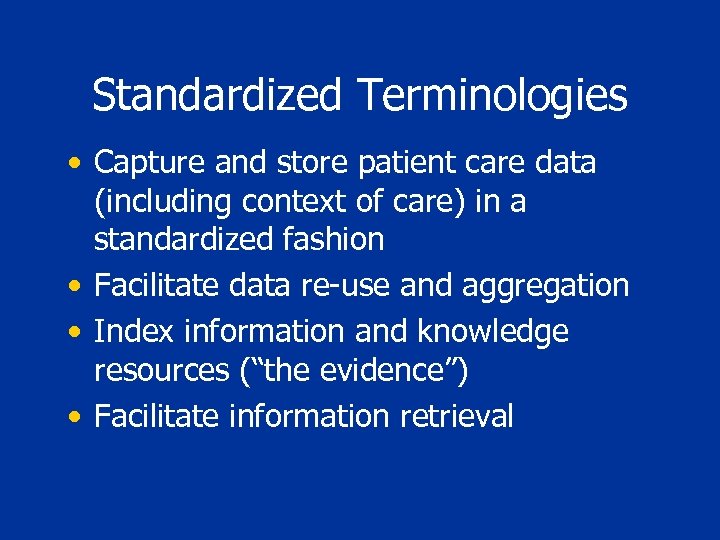
Standardized Terminologies • Capture and store patient care data (including context of care) in a standardized fashion • Facilitate data re-use and aggregation • Index information and knowledge resources (“the evidence”) • Facilitate information retrieval
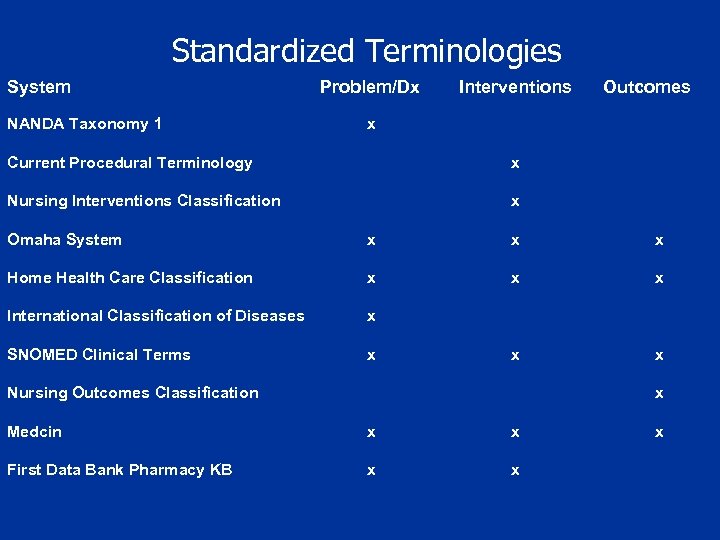
Standardized Terminologies System NANDA Taxonomy 1 Problem/Dx Interventions Outcomes x Current Procedural Terminology x Nursing Interventions Classification x Omaha System x x x Home Health Care Classification x x x International Classification of Diseases x SNOMED Clinical Terms x x x Nursing Outcomes Classification x Medcin x x First Data Bank Pharmacy KB x x x
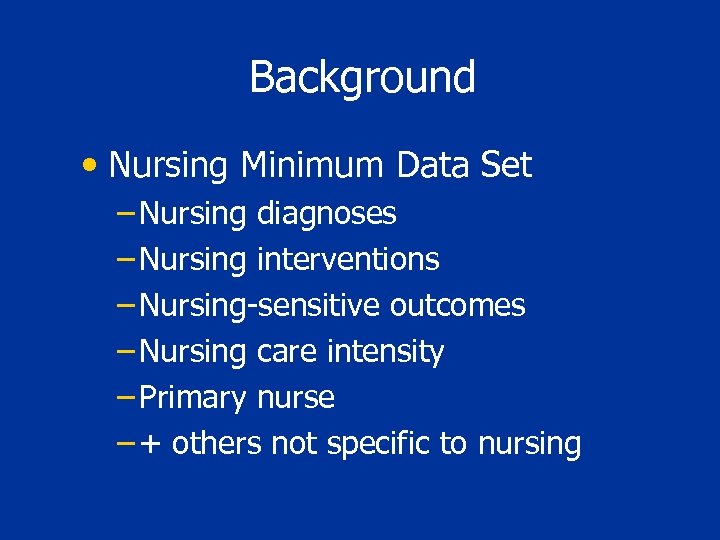
Background • Nursing Minimum Data Set – Nursing diagnoses – Nursing interventions – Nursing-sensitive outcomes – Nursing care intensity – Primary nurse – + others not specific to nursing
Nursing Systems • Diagnoses/judgments – NANDA Taxonomy I – Georgetown Home Health Care Classification – Patient Care Data Set – Omaha System – International Classification of Nursing Practice
Nursing Systems • Interventions – Nursing Interventions Classification – Georgetown Home Health Care Classification – Patient Care Data Set – Omaha System – International Classification of Nursing Practice
Nursing Systems • Outcomes – Nursing Outcomes Classification – Georgetown Home Health Care Classification – Omaha System – International Classification of Nursing Practice • Goals – Patient Care Data Set
Nursing Interventions Classification • Three-tiered taxonomy – 7 domains (e. g. , Health System) – 30 classes (e. g. , Health System Management) – 486 interventions (e. g. , Critical Path Development) – Plus related activities (e. g. , Review current standards of practice related to patient population)
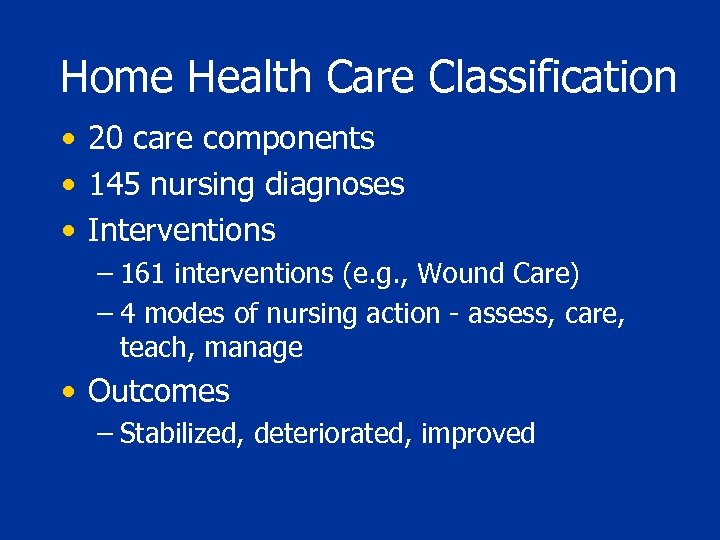
Home Health Care Classification • 20 care components • 145 nursing diagnoses • Interventions – 161 interventions (e. g. , Wound Care) – 4 modes of nursing action - assess, care, teach, manage • Outcomes – Stabilized, deteriorated, improved
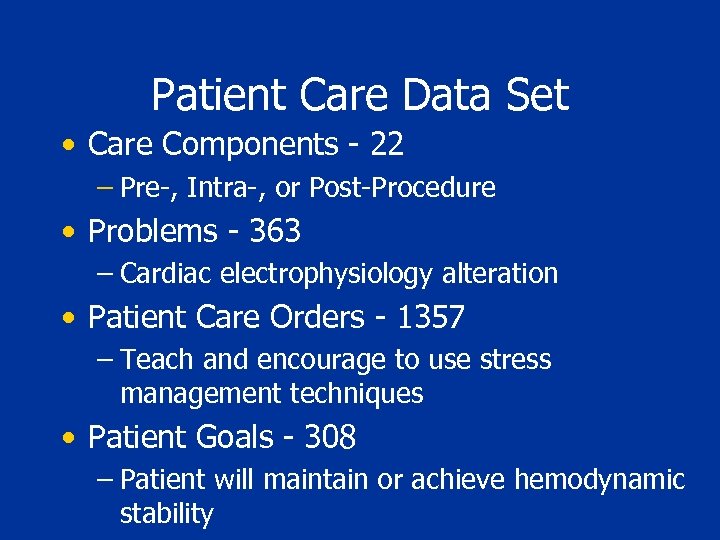
Patient Care Data Set • Care Components - 22 – Pre-, Intra-, or Post-Procedure • Problems - 363 – Cardiac electrophysiology alteration • Patient Care Orders - 1357 – Teach and encourage to use stress management techniques • Patient Goals - 308 – Patient will maintain or achieve hemodynamic stability
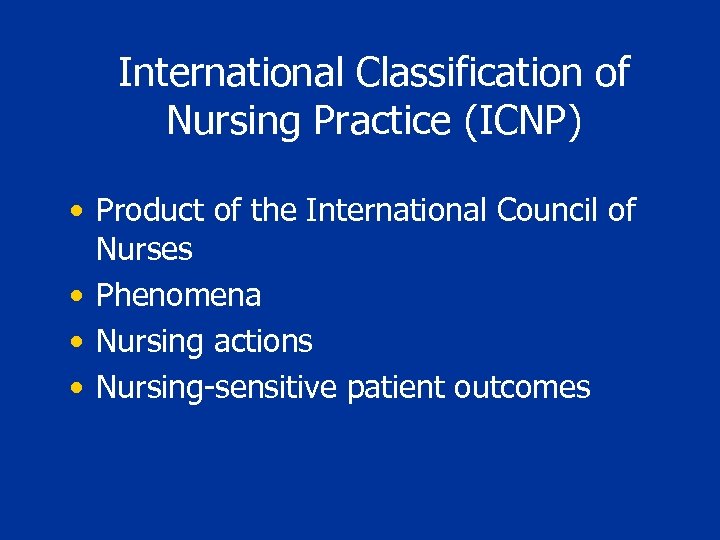
International Classification of Nursing Practice (ICNP) • Product of the International Council of Nurses • Phenomena • Nursing actions • Nursing-sensitive patient outcomes
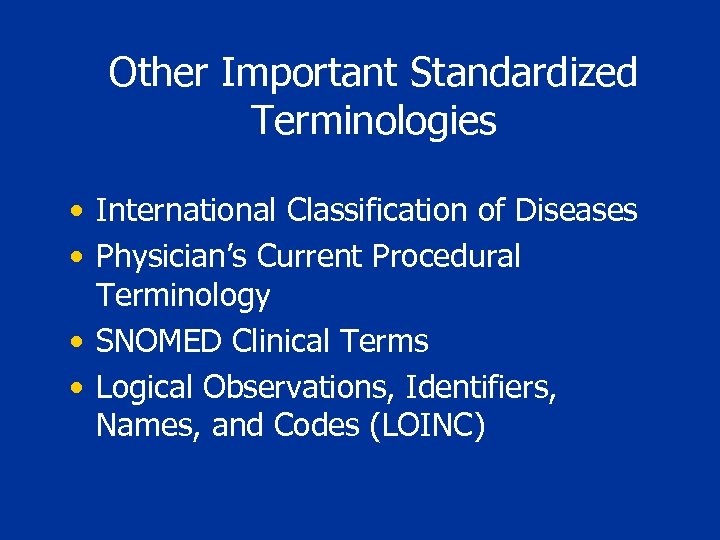
Other Important Standardized Terminologies • International Classification of Diseases • Physician’s Current Procedural Terminology • SNOMED Clinical Terms • Logical Observations, Identifiers, Names, and Codes (LOINC)

Issues Related to Standardized Terminologies • • • Multiple terminologies exist Large number of terms Terms vary in level of abstraction Areas of overlap Areas of gap “Computability”
Potential Solutions • Uniform language • Unified Medical Language System • Concept-oriented “reference” terminologies
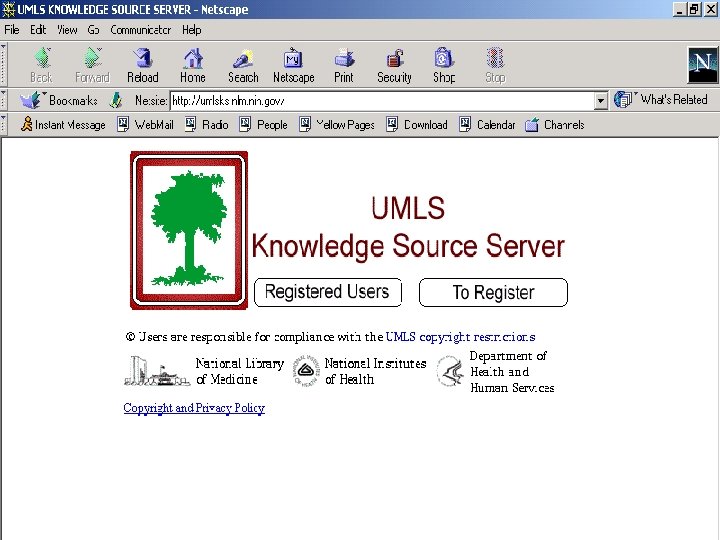
What is the UMLS? • Long-term NLM research and development effort designed to facilitate the retrieval and integration of information from multiple machine-readable biomedical information sources • Includes development of machine-readable “knowledge sources” that can be used by a wide variety of application programs to compensate for differences in the way concepts are expressed in different machine-readable sources and by different users
Contents • Metathesaurus • Specialist Lexicon • Semantic Network • Information Sources Map
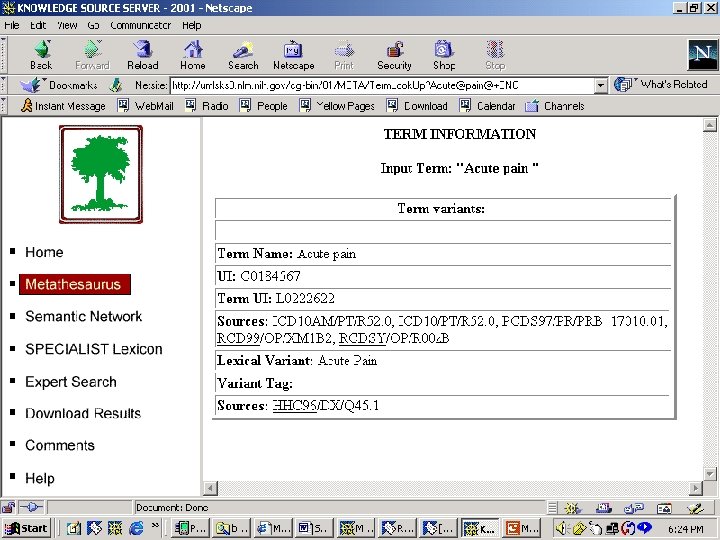
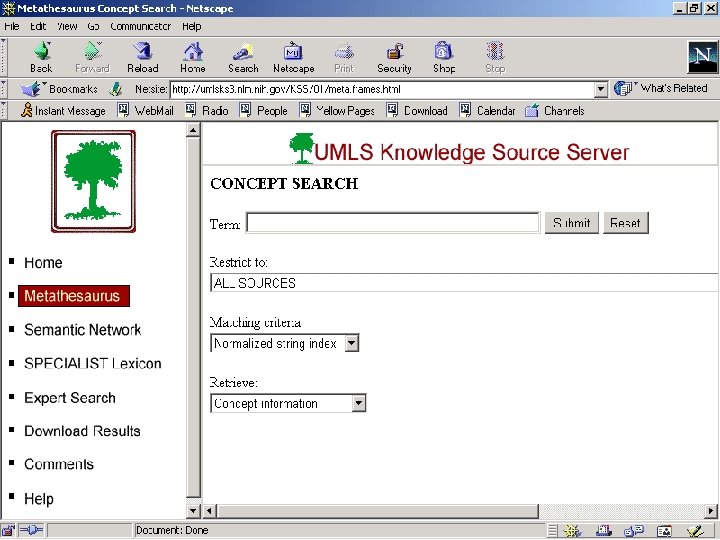
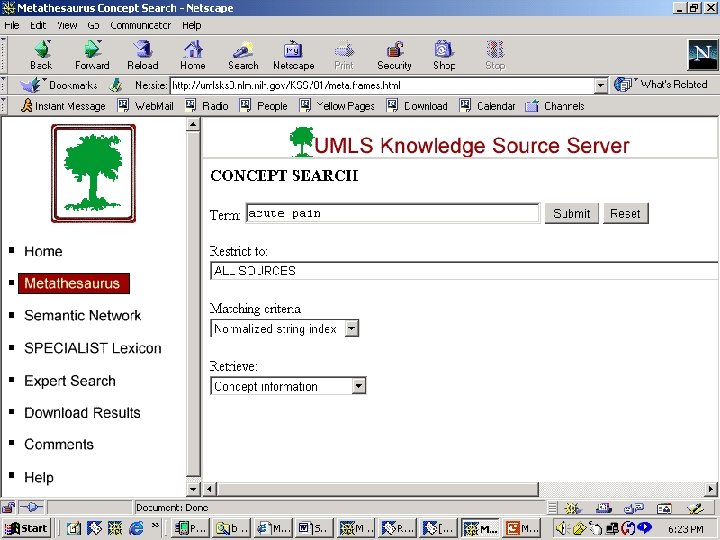
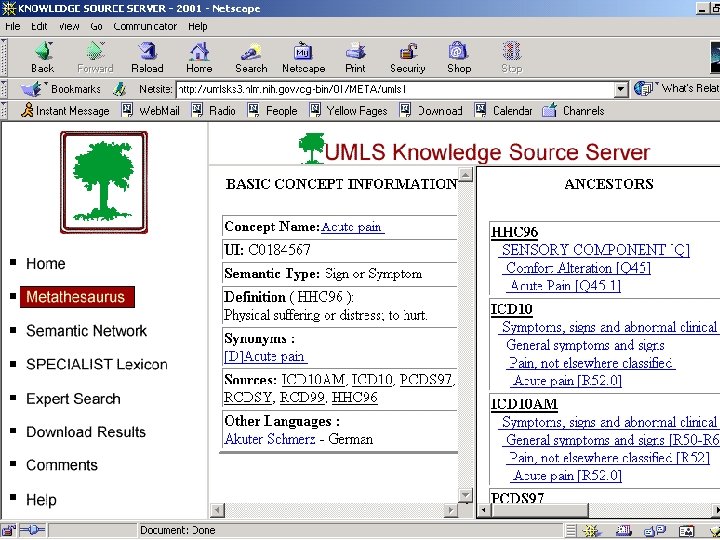
Metathesaurus • Semantic information about biomedical concepts, their various names, and the relationships among them • Built from source vocabularies, i. e. , thesauri, classifications, coding systems, and lists of controlled terms that are developed and maintained by different organizations • 476, 313 concepts and 1, 051, 901 different concept names from >40 source vocabularies
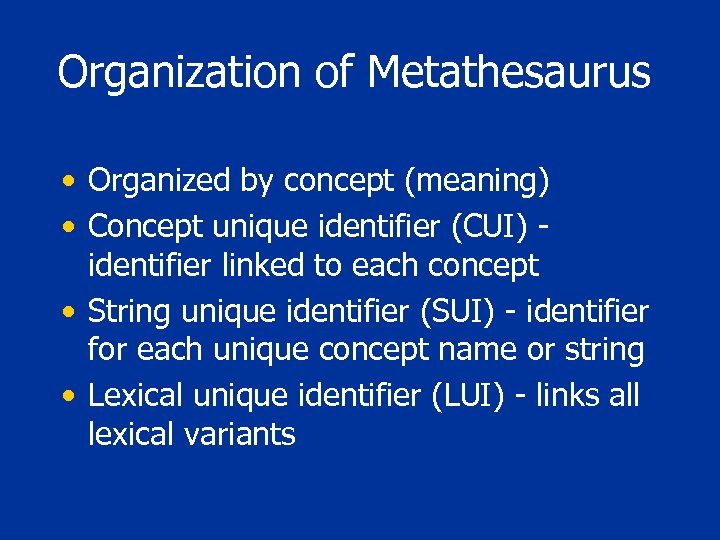
Organization of Metathesaurus • Organized by concept (meaning) • Concept unique identifier (CUI) identifier linked to each concept • String unique identifier (SUI) - identifier for each unique concept name or string • Lexical unique identifier (LUI) - links all lexical variants
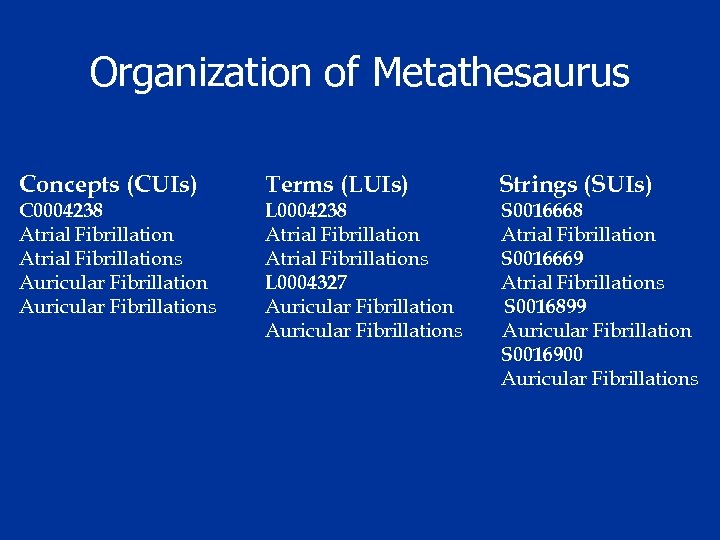
Organization of Metathesaurus Concepts (CUIs) Terms (LUIs) Strings (SUIs) C 0004238 Atrial Fibrillations Auricular Fibrillations L 0004238 Atrial Fibrillations L 0004327 Auricular Fibrillations S 0016668 Atrial Fibrillation S 0016669 Atrial Fibrillations S 0016899 Auricular Fibrillation S 0016900 Auricular Fibrillations
Major Use • Interface - optimized for user data entry • Administrative - optimized for statistical classification • Reference - optimized for nonambiguous concept definition, information retrieval, and analysis
What is a Concept-Oriented Terminology? • Focus on concept (unit of thought) rather than on term (linguistic expression) • Terminology in which the concepts are formally represented in a manner that renders them suitable for computer processing • Optimized for computer vs. human processing (understanding) • Reference terminology as compared to an interface or administrative terminology
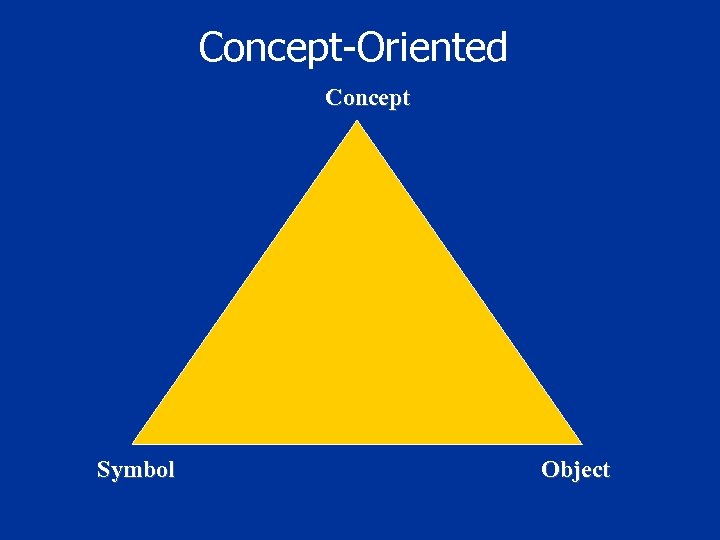
Concept-Oriented Concept Symbol Object
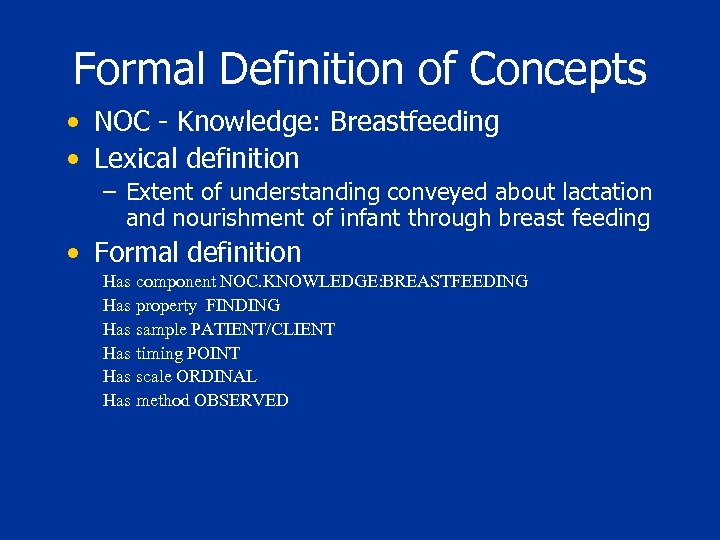
Formal Definition of Concepts • NOC - Knowledge: Breastfeeding • Lexical definition – Extent of understanding conveyed about lactation and nourishment of infant through breast feeding • Formal definition Has component NOC. KNOWLEDGE: BREASTFEEDING Has property FINDING Has sample PATIENT/CLIENT Has timing POINT Has scale ORDINAL Has method OBSERVED
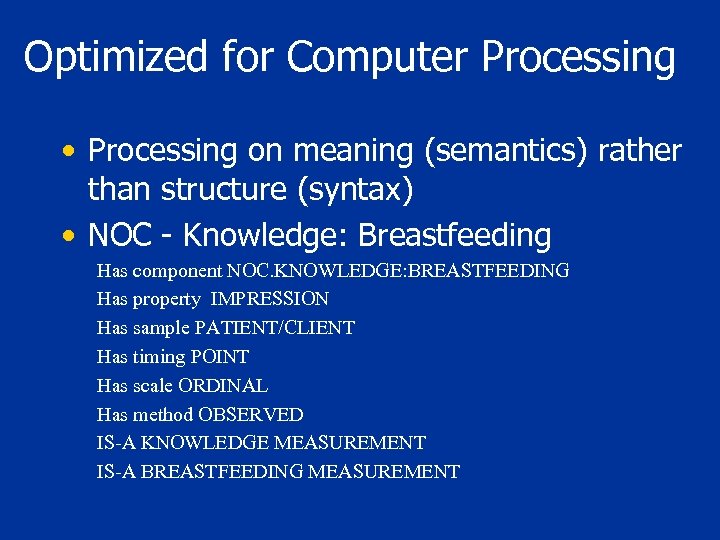
Optimized for Computer Processing • Processing on meaning (semantics) rather than structure (syntax) • NOC - Knowledge: Breastfeeding Has component NOC. KNOWLEDGE: BREASTFEEDING Has property IMPRESSION Has sample PATIENT/CLIENT Has timing POINT Has scale ORDINAL Has method OBSERVED IS-A KNOWLEDGE MEASUREMENT IS-A BREASTFEEDING MEASUREMENT
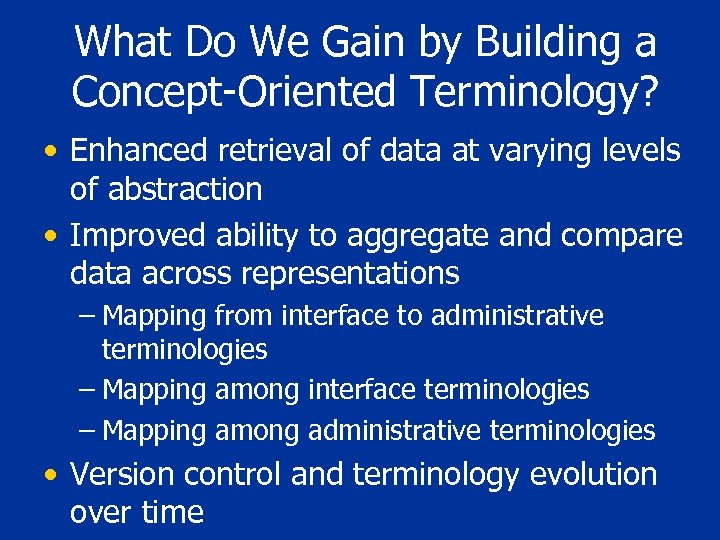
What Do We Gain by Building a Concept-Oriented Terminology? • Enhanced retrieval of data at varying levels of abstraction • Improved ability to aggregate and compare data across representations – Mapping from interface to administrative terminologies – Mapping among interface terminologies – Mapping among administrative terminologies • Version control and terminology evolution over time
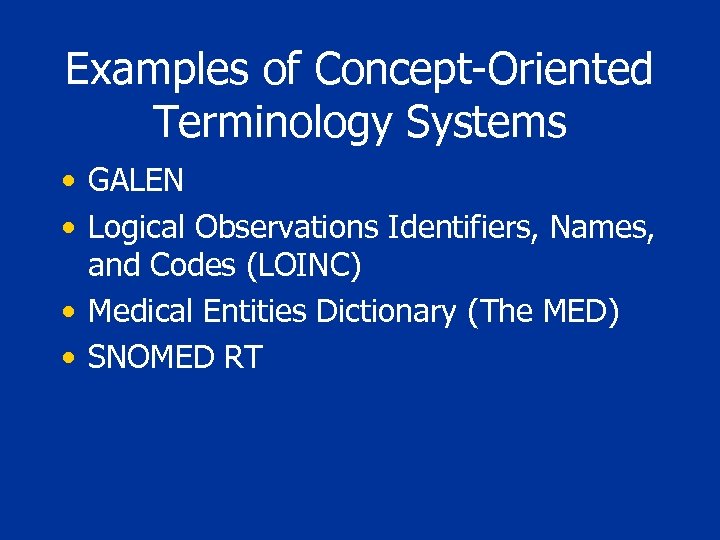
Examples of Concept-Oriented Terminology Systems • GALEN • Logical Observations Identifiers, Names, and Codes (LOINC) • Medical Entities Dictionary (The MED) • SNOMED RT
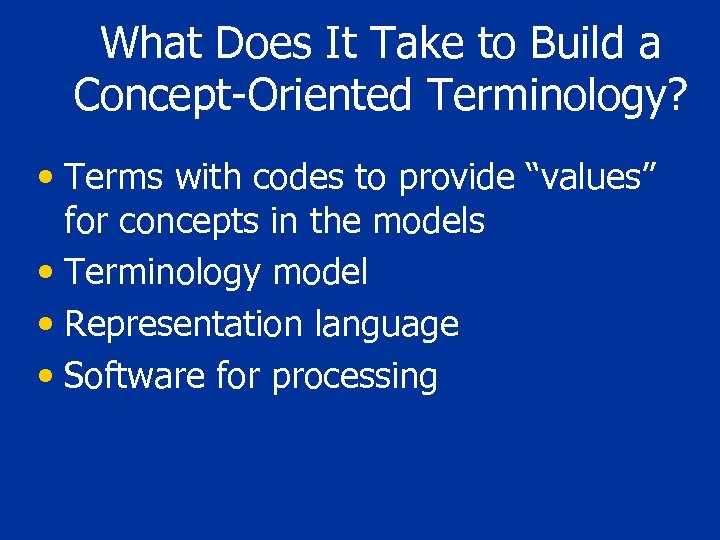
What Does It Take to Build a Concept-Oriented Terminology? • Terms with codes to provide “values” for concepts in the models • Terminology model • Representation language • Software for processing
Status of Components in Nursing • Terms with codes to provide “values” for concepts in the models - many • Terminology model - evolving • Representation language - generic • Software for processing - generic
Terminology Model • Explicit representation of a system of concepts that is optimized for terminology management and that supports the intensional definition of concepts and the mapping among terminologies • A terminology model depicts the associative relationships between an aggregate (molecular) expression and more primitive (atomic) concepts • Type definition - attributes (properties, roles) necessary and sufficient for non-ambiguously defining a concept of a particular type (fully specified name)
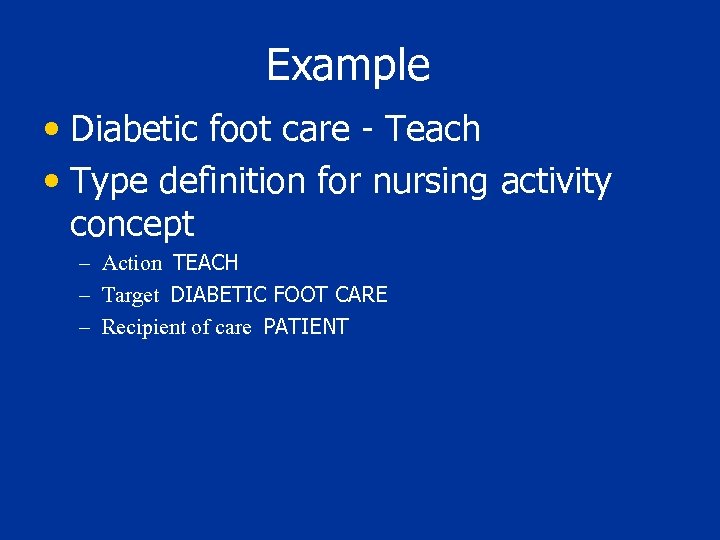
Example • Diabetic foot care - Teach • Type definition for nursing activity concept – Action TEACH – Target DIABETIC FOOT CARE – Recipient of care PATIENT
Representation Language • Description logics based on predicate calculus represented in different formalisms – Predicate calculus – Conceptual graphs (e. g. , KRSS) – GRAIL • Vary in expressibility and parsimony
Software for Processing • Formal and automated classification (IS-A relationships) of new concepts • Inheritance of attributes of parent concepts to facilitate formal definition of child concepts • Rules (grammar) for generation of composite concepts • Natural language generation (GALEN) • Conflict resolution management for distributed development (SNOMED RT)
Examples GALEN l SNOMED RT l

GALEN

What Does the Box Need to ‘Know’? • • How to classify things Sensible combinations Redundant information etc. . .
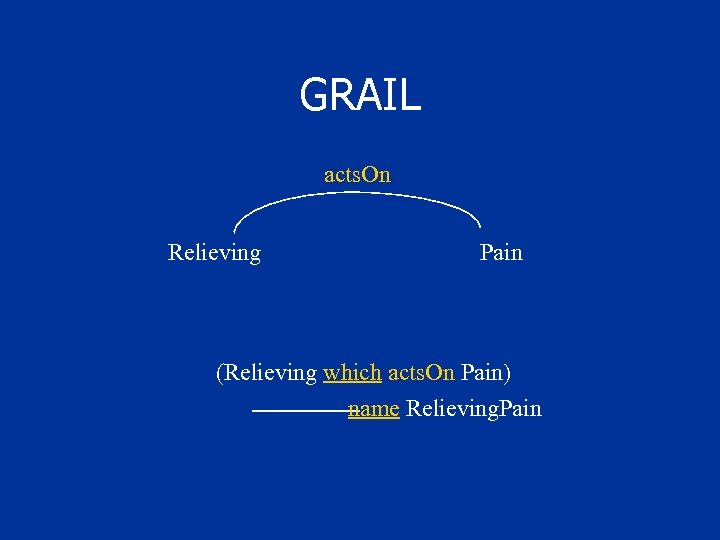
GRAIL acts. On Relieving Pain (Relieving which acts. On Pain) name Relieving. Pain
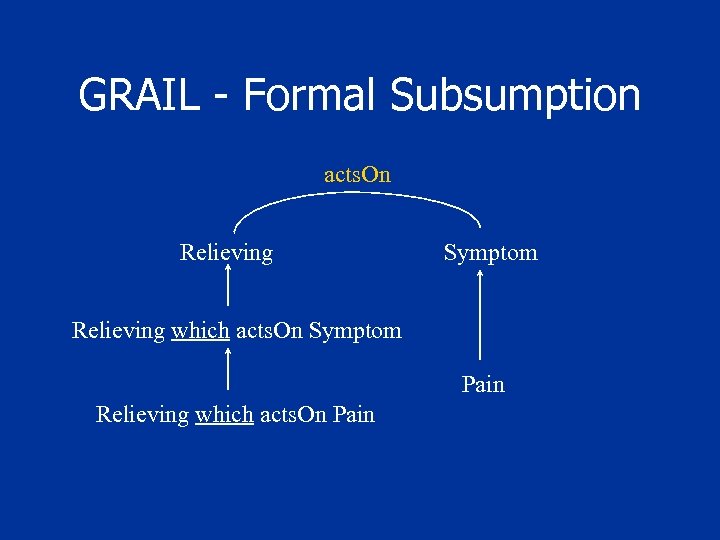
GRAIL - Formal Subsumption acts. On Relieving Symptom Relieving which acts. On Symptom Pain Relieving which acts. On Pain
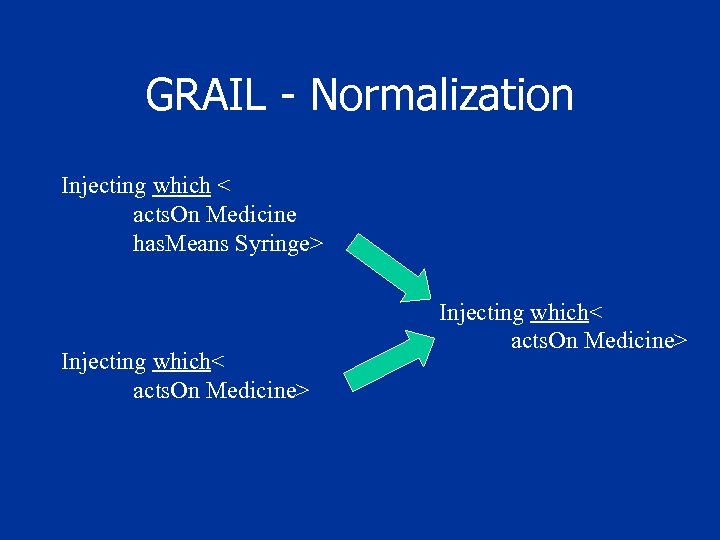
GRAIL - Normalization Injecting which < acts. On Medicine has. Means Syringe> Injecting which< acts. On Medicine>
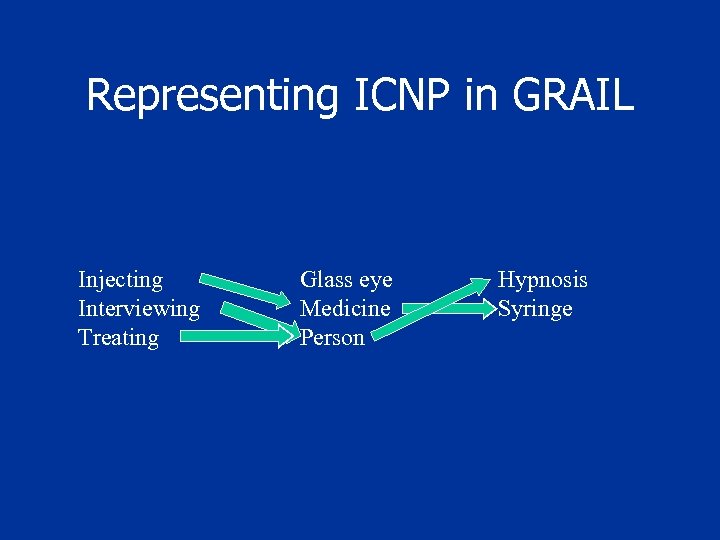
Representing ICNP in GRAIL Injecting Interviewing Treating Glass eye Medicine Person Hypnosis Syringe
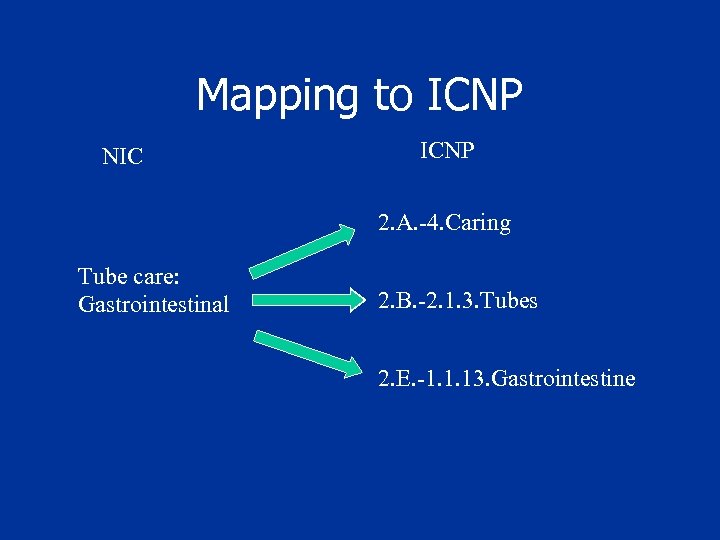
Mapping to ICNP NIC ICNP 2. A. -4. Caring Tube care: Gastrointestinal 2. B. -2. 1. 3. Tubes 2. E. -1. 1. 13. Gastrointestine
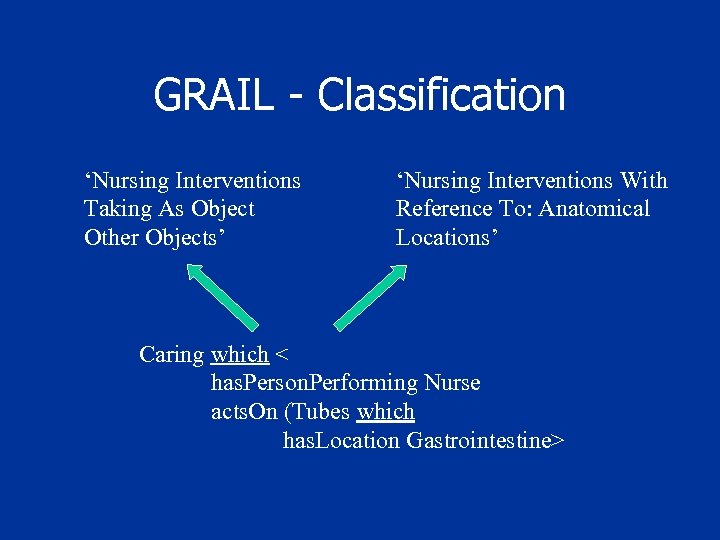
GRAIL - Classification ‘Nursing Interventions Taking As Object Other Objects’ ‘Nursing Interventions With Reference To: Anatomical Locations’ Caring which < has. Person. Performing Nurse acts. On (Tubes which has. Location Gastrointestine>
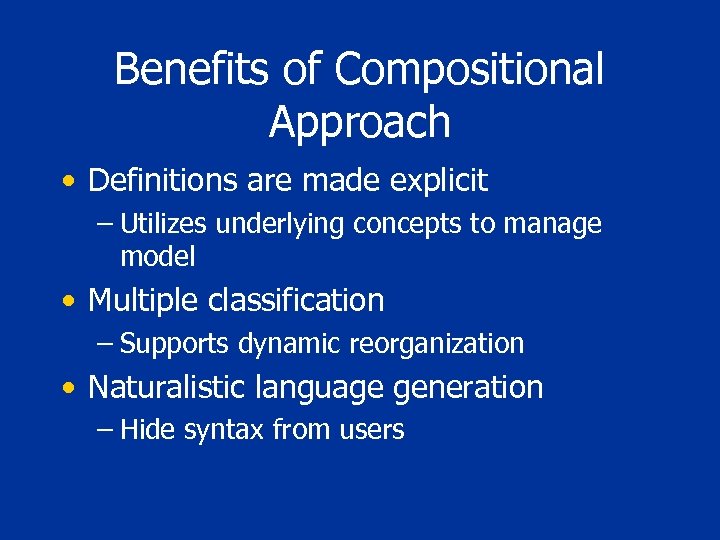
Benefits of Compositional Approach • Definitions are made explicit – Utilizes underlying concepts to manage model • Multiple classification – Supports dynamic reorganization • Naturalistic language generation – Hide syntax from users
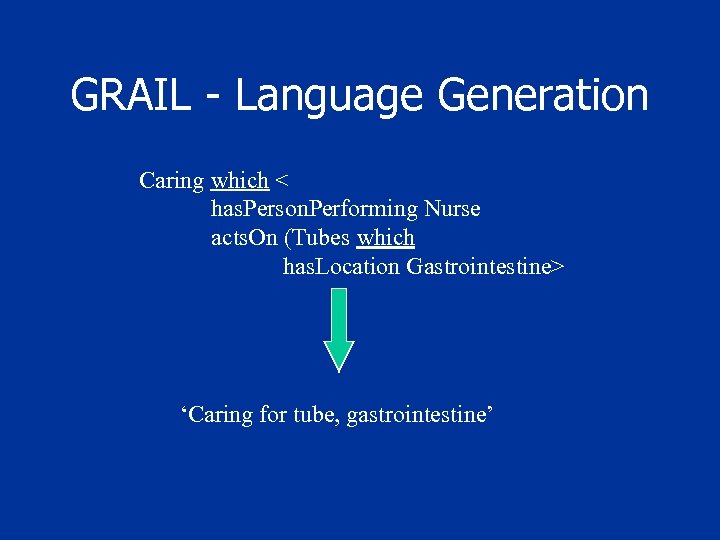
GRAIL - Language Generation Caring which < has. Person. Performing Nurse acts. On (Tubes which has. Location Gastrointestine> ‘Caring for tube, gastrointestine’
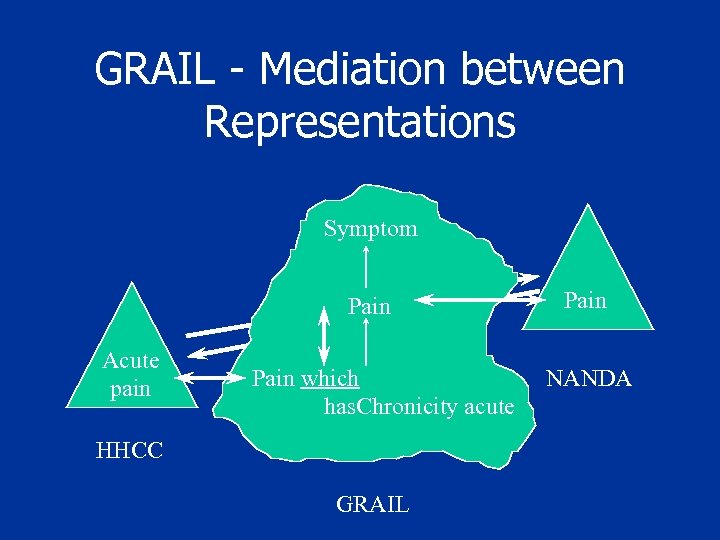
GRAIL - Mediation between Representations Symptom Pain Acute pain Pain which has. Chronicity acute HHCC GRAIL Pain NANDA
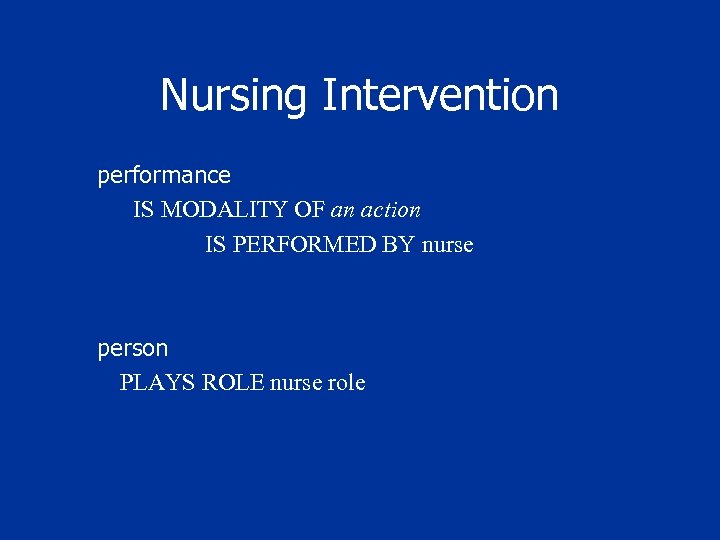
Nursing Intervention performance IS MODALITY OF an action IS PERFORMED BY nurse person PLAYS ROLE nurse role
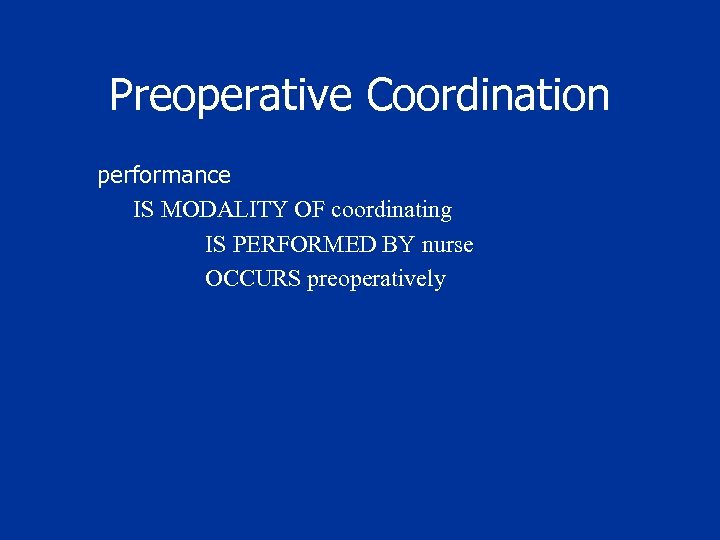
Preoperative Coordination performance IS MODALITY OF coordinating IS PERFORMED BY nurse OCCURS preoperatively
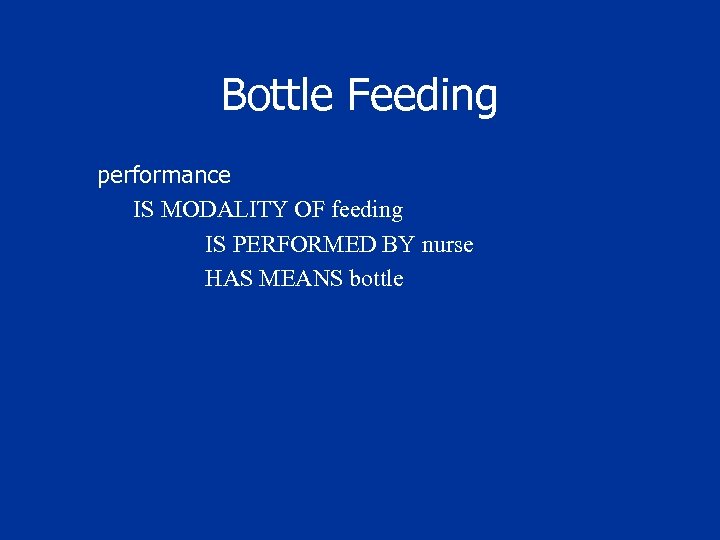
Bottle Feeding performance IS MODALITY OF feeding IS PERFORMED BY nurse HAS MEANS bottle
SNOMED RT • Optimized for retrieval and analysis of data relating to the causes of disease, treatments of patients, and outcomes of the overall health care process • Based on SNOMED International • Provider-neutral representations • Evolving toward SNOMED Clinical Terms
SNOMED RT • Includes: – Representation language - modified KRSS – Computer-based tools (Galapagos, Ontylog, Metaphrase) • Missing for nursing: – Terms with codes to provide “values” for concepts in the models – Categorical structures
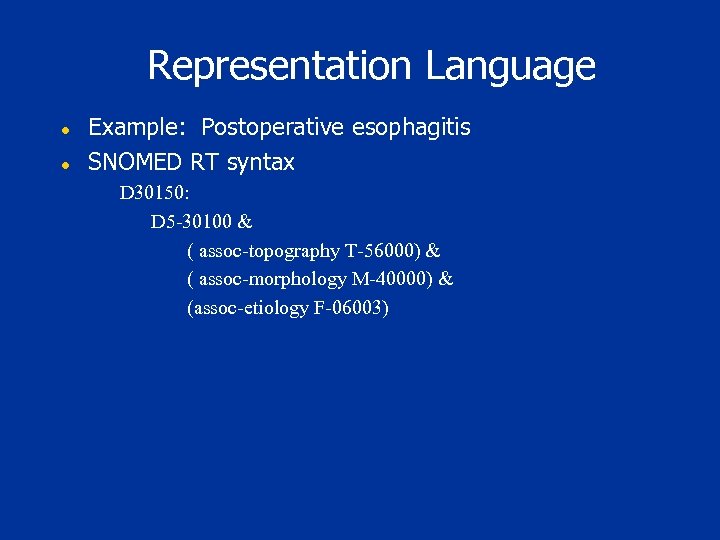
Representation Language l l Example: Postoperative esophagitis SNOMED RT syntax D 30150: D 5 -30100 & ( assoc-topography T-56000) & ( assoc-morphology M-40000) & (assoc-etiology F-06003)
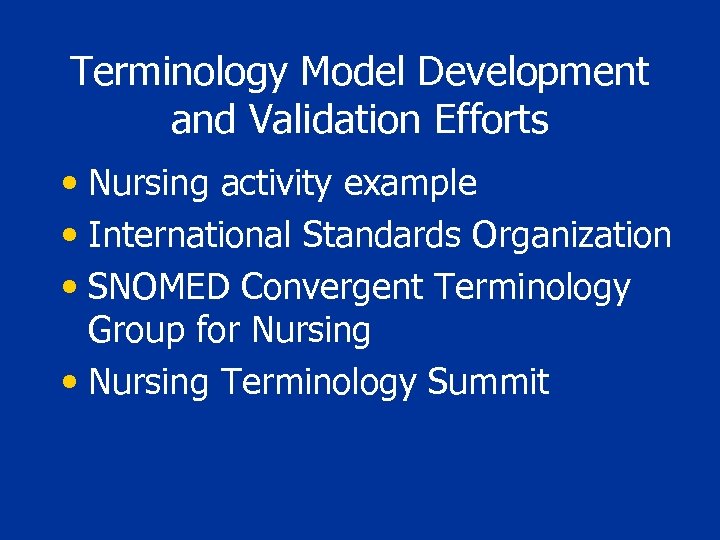
Terminology Model Development and Validation Efforts • Nursing activity example • International Standards Organization • SNOMED Convergent Terminology Group for Nursing • Nursing Terminology Summit
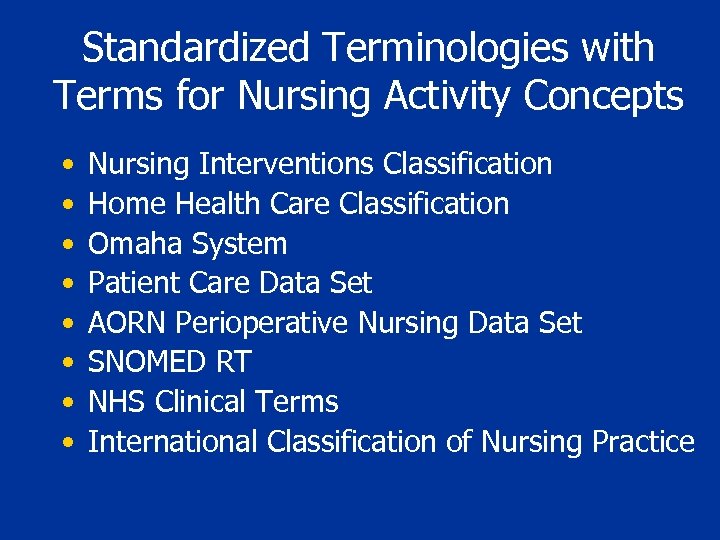
Standardized Terminologies with Terms for Nursing Activity Concepts • • Nursing Interventions Classification Home Health Care Classification Omaha System Patient Care Data Set AORN Perioperative Nursing Data Set SNOMED RT NHS Clinical Terms International Classification of Nursing Practice

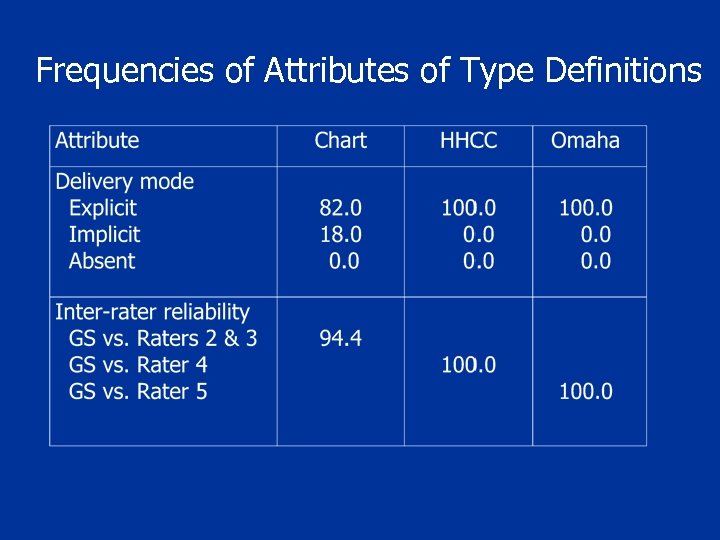
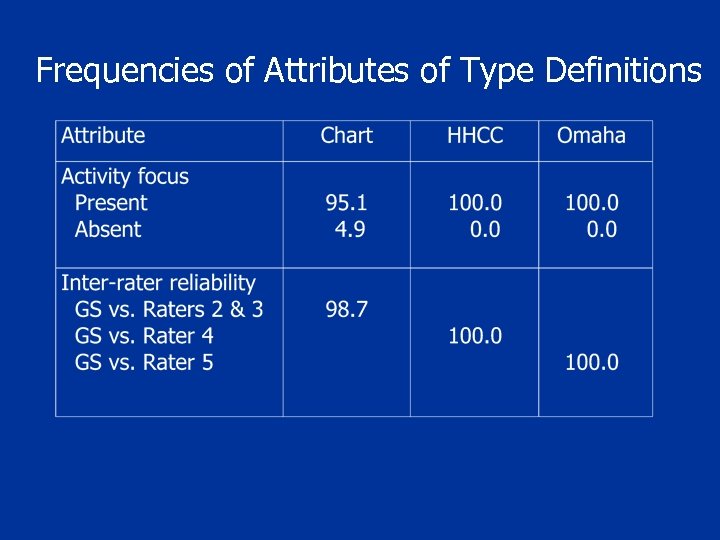
Study Purpose • Evaluate the adequacy and utility of a type definition (required parts of a terminology model) for nursing activities • Research Questions – What percentage of nursing activity terms includes the attributes of the type definition (Delivery Mode, Activity Focus, and Recipient)? – Can the nursing activity terms be reliably decomposed into the three attributes of the type definition?
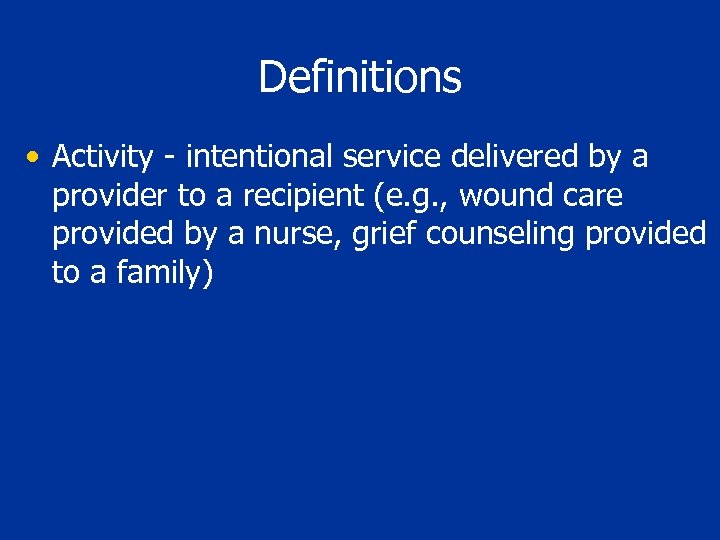
Definitions • Activity - intentional service delivered by a provider to a recipient (e. g. , wound care provided by a nurse, grief counseling provided to a family)
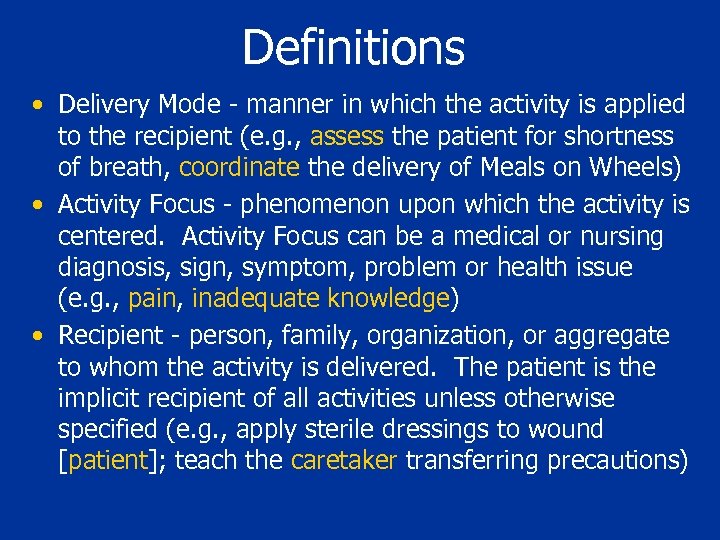
Definitions • Delivery Mode - manner in which the activity is applied to the recipient (e. g. , assess the patient for shortness of breath, coordinate the delivery of Meals on Wheels) • Activity Focus - phenomenon upon which the activity is centered. Activity Focus can be a medical or nursing diagnosis, sign, symptom, problem or health issue (e. g. , pain, inadequate knowledge) • Recipient - person, family, organization, or aggregate to whom the activity is delivered. The patient is the implicit recipient of all activities unless otherwise specified (e. g. , apply sterile dressings to wound [patient]; teach the caretaker transferring precautions)
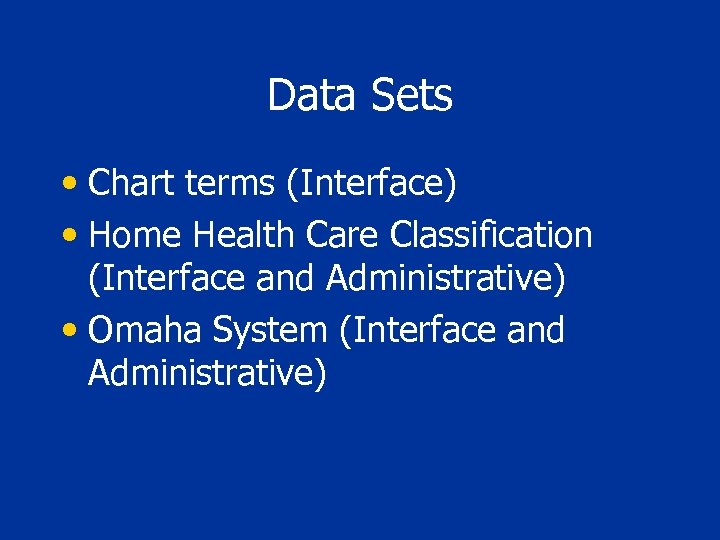
Data Sets • Chart terms (Interface) • Home Health Care Classification (Interface and Administrative) • Omaha System (Interface and Administrative)
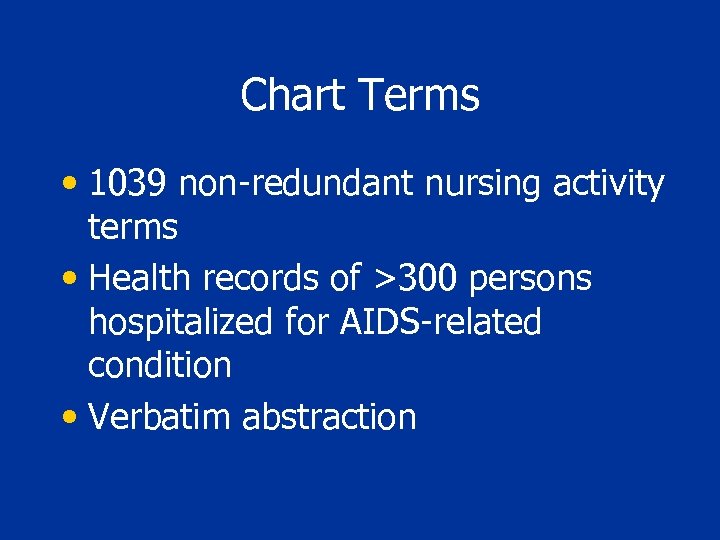
Chart Terms • 1039 non-redundant nursing activity terms • Health records of >300 persons hospitalized for AIDS-related condition • Verbatim abstraction
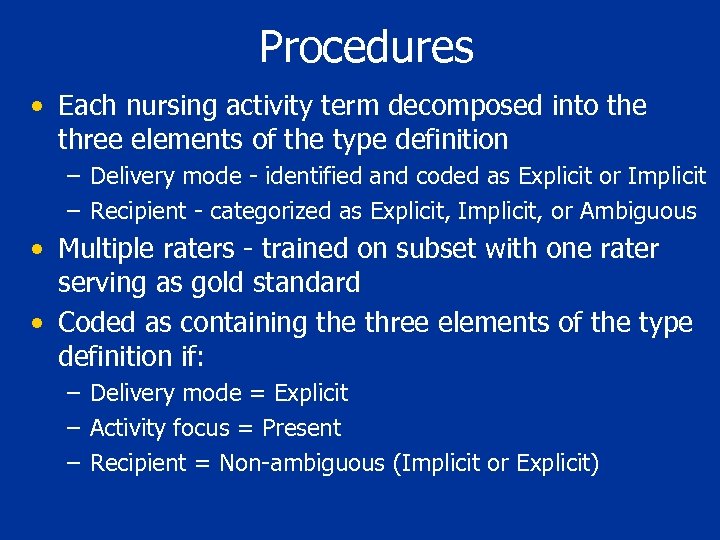
Procedures • Each nursing activity term decomposed into the three elements of the type definition – Delivery mode - identified and coded as Explicit or Implicit – Recipient - categorized as Explicit, Implicit, or Ambiguous • Multiple raters - trained on subset with one rater serving as gold standard • Coded as containing the three elements of the type definition if: – Delivery mode = Explicit – Activity focus = Present – Recipient = Non-ambiguous (Implicit or Explicit)
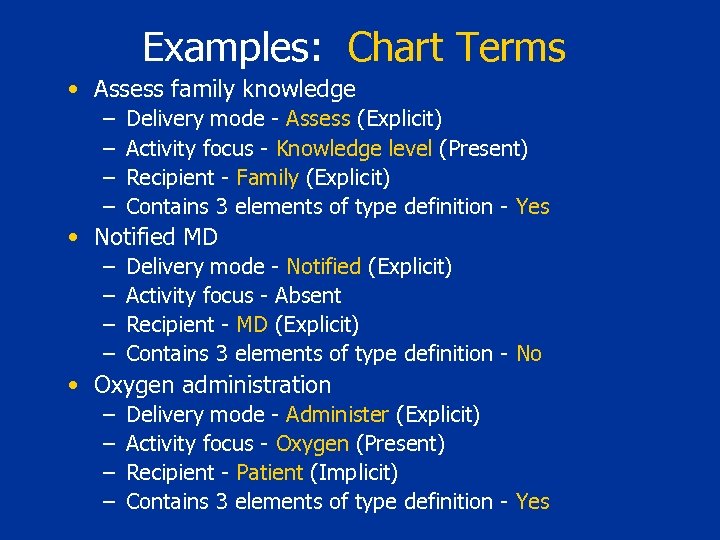
Examples: Chart Terms • Assess family knowledge – – Delivery mode - Assess (Explicit) Activity focus - Knowledge level (Present) Recipient - Family (Explicit) Contains 3 elements of type definition - Yes • Notified MD – – Delivery mode - Notified (Explicit) Activity focus - Absent Recipient - MD (Explicit) Contains 3 elements of type definition - No • Oxygen administration – – Delivery mode - Administer (Explicit) Activity focus - Oxygen (Present) Recipient - Patient (Implicit) Contains 3 elements of type definition - Yes
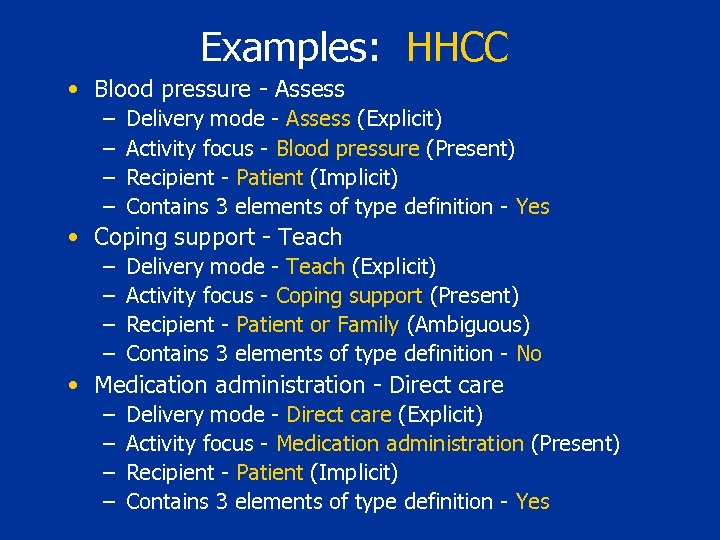
Examples: HHCC • Blood pressure - Assess – – Delivery mode - Assess (Explicit) Activity focus - Blood pressure (Present) Recipient - Patient (Implicit) Contains 3 elements of type definition - Yes • Coping support - Teach – – Delivery mode - Teach (Explicit) Activity focus - Coping support (Present) Recipient - Patient or Family (Ambiguous) Contains 3 elements of type definition - No • Medication administration - Direct care – – Delivery mode - Direct care (Explicit) Activity focus - Medication administration (Present) Recipient - Patient (Implicit) Contains 3 elements of type definition - Yes
Frequencies of Attributes of Type Definitions
Frequencies of Attributes of Type Definitions
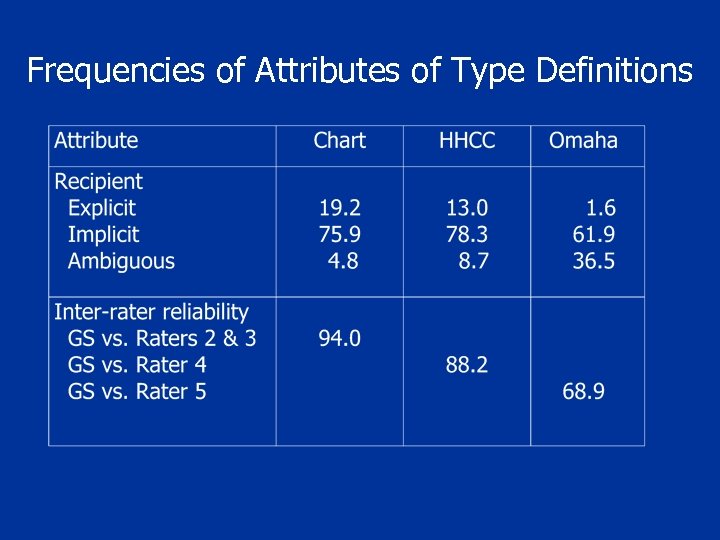
Frequencies of Attributes of Type Definitions

Discussion • Majority of chart terms contained elements of the type definition – Reliably decomposed • Type definition had utility as a model for decomposing HHCC and Omaha – Activity focus and Delivery mode decomposition straightforward and easily reproducible – Recipient more frequently ambiguous than in chart terms – Inter-rater reliability lower for recipient
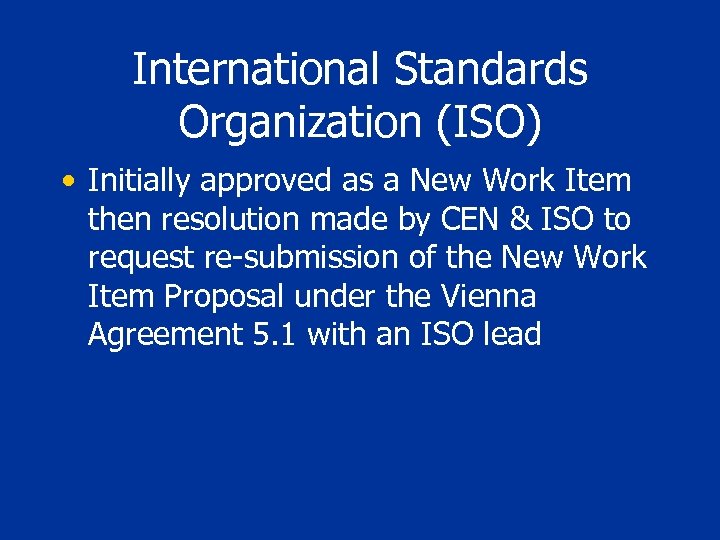
International Standards Organization (ISO) • Initially approved as a New Work Item then resolution made by CEN & ISO to request re-submission of the New Work Item Proposal under the Vienna Agreement 5. 1 with an ISO lead
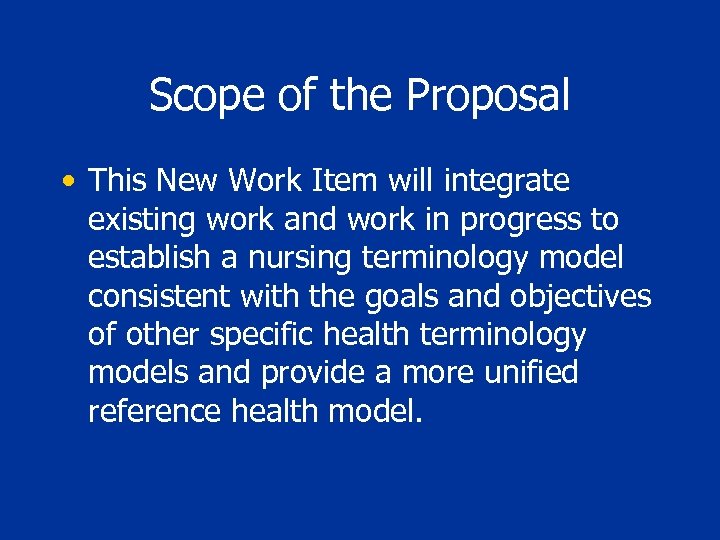
Scope of the Proposal • This New Work Item will integrate existing work and work in progress to establish a nursing terminology model consistent with the goals and objectives of other specific health terminology models and provide a more unified reference health model.

Structure • Steering Committee • Technical Committee • Expert Committee

Steering Committee • The Steering Committee is responsible for project management including the development and monitoring work processes and timelines. • Members – Virginia Saba, Ed. D, RN, FAAN (Chair of IMIA/NI-SIG & Chair of the IMIA/NI-SIG Concept Representation Group) – Evelyn Hovenga, Ph. D, RN (Outgoing Chair of the IMIA/NISIG) – Kathleen Mc. Cormick, Ph. D, RN, FAAN (Chair of the Data Standards Working Group, IMIA/NI-SIG) – Amy Coenen, Ph. D, RN, CS (Representative from the ICN and Director of the ICNP®)
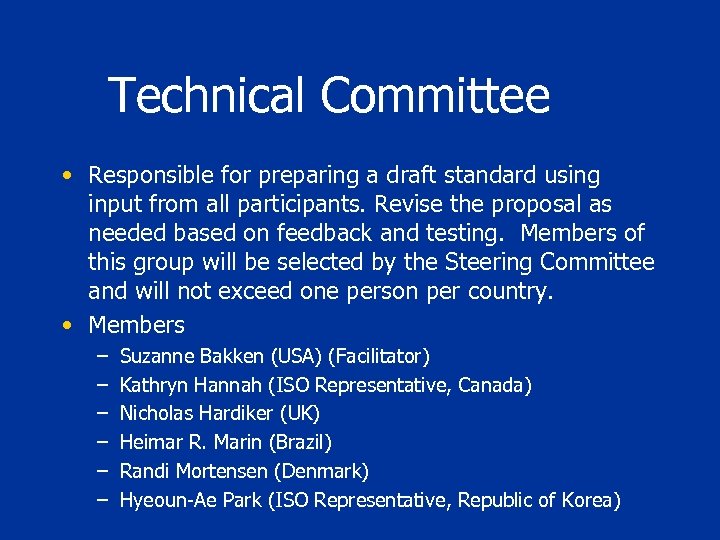
Technical Committee • Responsible for preparing a draft standard using input from all participants. Revise the proposal as needed based on feedback and testing. Members of this group will be selected by the Steering Committee and will not exceed one person per country. • Members – – – Suzanne Bakken (USA) (Facilitator) Kathryn Hannah (ISO Representative, Canada) Nicholas Hardiker (UK) Heimar R. Marin (Brazil) Randi Mortensen (Denmark) Hyeoun-Ae Park (ISO Representative, Republic of Korea)

Expert Committee • Responsible for providing input on standard development and review of draft proposals. • This group will include expert volunteers from ISO and others willing and interested in participating in the process.
Terminology Model • Explicit representation of a system of concepts that is optimized for terminology management and that supports the intensional definition of concepts and the mapping among terminologies • A terminology model depicts the associative relationships between an aggregate (molecular) expression and more primitive (atomic) concepts
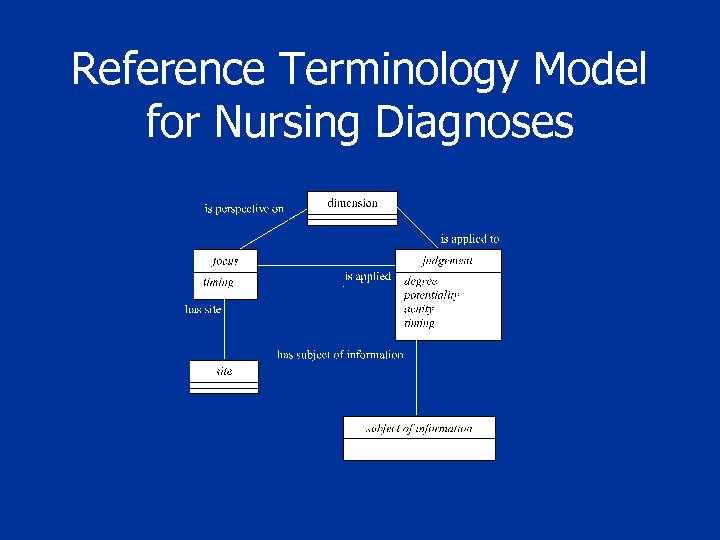
Reference Terminology Model for Nursing Diagnoses
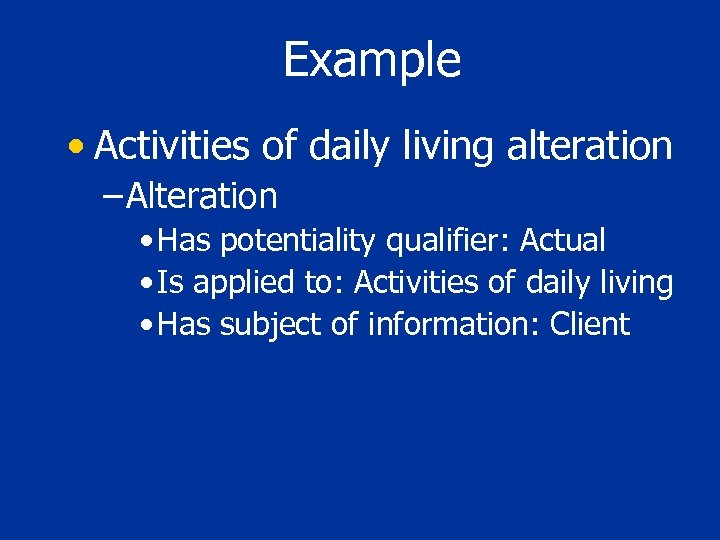
Example • Activities of daily living alteration – Alteration • Has potentiality qualifier: Actual • Is applied to: Activities of daily living • Has subject of information: Client
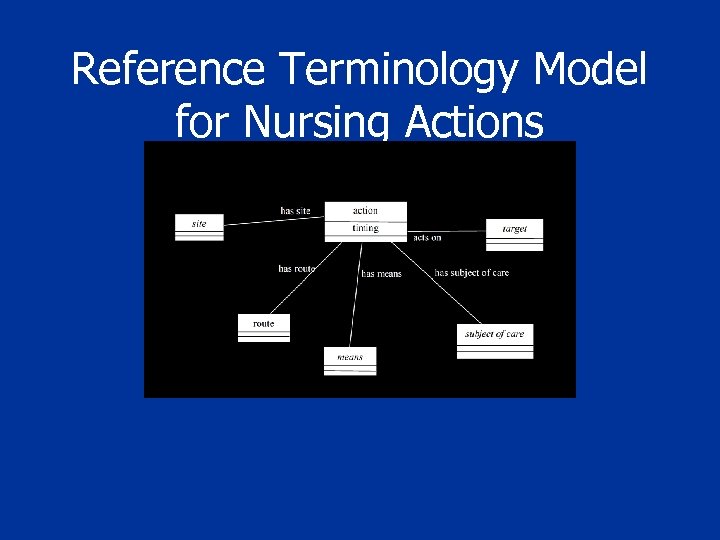
Reference Terminology Model for Nursing Actions

Example • Pressure ulcer assessment –Assessing • Acts on: pressure ulcer (target) • Has subject of information: client (implied)
Conclusions • ISO standard for a reference terminology model for nursing will support the mapping among nursing terminologies • Must be integrated within a broader health care terminology model
SNOMED Convergent Terminology Group for Nursing • Members – – – SNOMED International Editorial Board Member SNOMED staff ANA liaison CMT nurse modelers Nurse consultant • Activities – Developing and testing models – Outreach and education – Collaboration agreements with ANA-recognized terminology developers – Participation in standards efforts
Nursing Terminology Summit • Consensus development • Think tank • Constituencies – Terminology developers – System implementers – Standards experts • Focus – Reference terminology model – CEN/ISO – Clinical templates
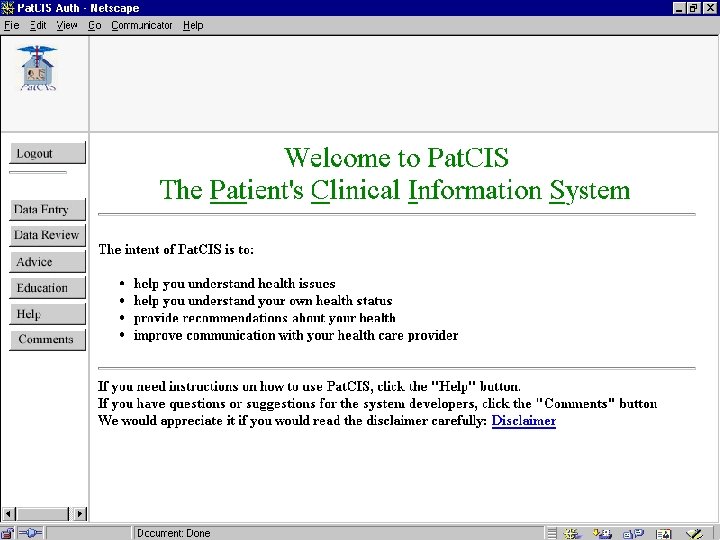
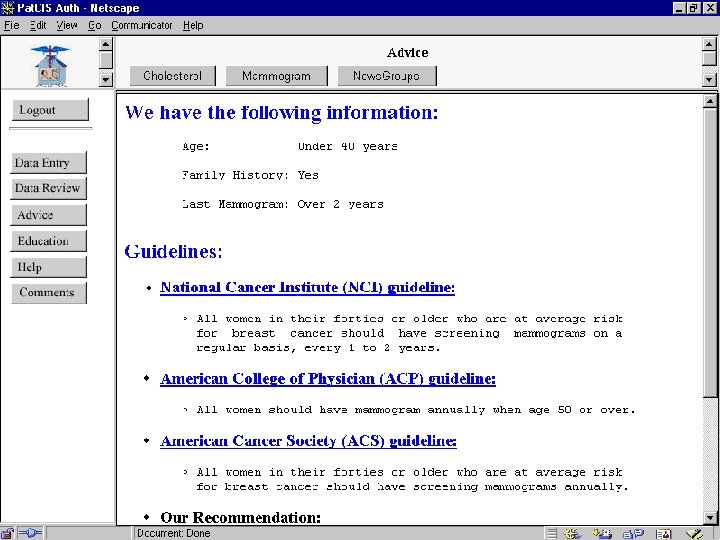
Impact of Concept-Oriented Terminologies • Medical Entities Dictionary – Concept-oriented terminology – Meta-data dictionary for applications at New York Presbyterian Hospital
 Скачать презентацию M 8120 Data for Evidence-based Practice Fall 2001
475457654a19508a3076f839ea5ca59a.ppt