 Скачать презентацию M 33 -2 Cyber-attacks M 33 -2
d11b9186f35d640a6c68bbffdf739968.ppt
- Количество слайдов: 87



M 33 -2. Cyber-attacks
M 33 -2. Cyber-attaques • Introduction – Considérations juridiques – Pourquoi les pirates s’intéressent-ils aux S. I. des organisations ou au PC d’individus ? – La nouvelle économie de la cybercriminalité – Notions de vulnérabilité, menace, attaque Cours de Sécurité – Grenoble – CB – Chapitre M 33 -2 « Cyber-attaques» - Année 2017 -2018 2
Considérations juridiques • Rappel réglementaire : – le seul fait de collecter des données à caractère personnel par un moyen frauduleux est puni de cinq ans d’emprisonnement et de 300 000 euros d’amende (article 226 -18 du Code pénal) – le seul fait de s’introduire frauduleusement dans tout ou partie d’un système de traitement automatisé de données est puni de deux ans de prison et de 30 000 euros d’amende (article 321 -1 du même code). Cours de Sécurité – Grenoble – CB – Chapitre M 33 -2 « Cyber-attaques» - Année 2017 -2018 3
Considérations juridiques • Article 323 -3 -1 du code pénal – Le fait, sans motif légitime, d'importer, de détenir, d'offrir, de céder ou de mettre à disposition un équipement, un instrument, un programme informatique ou toute donnée conçus ou spécialement adaptés pour commettre une ou plusieurs des infractions prévues par les articles 323 -1 à 323 -3 est puni des peines prévues respectivement pour l'infraction elle-même ou pour l'infraction la plus sévèrement réprimée. Cours de Sécurité – Grenoble – CB – Chapitre M 33 -2 « Cyber-attaques» - Année 2017 -2018 4
Considérations juridiques The use of methods described in this course involves the responsibility of users in case of use! Cours de Sécurité – Grenoble – CB – Chapitre M 33 -2 « Cyber-attaques» - Année 2017 -2018 5
Why do pirates take an interest in organizations IT or individuals computers ? Cours de Sécurité – Grenoble – CB – Chapitre M 33 -2 « Cyber-attaques» - Année 2017 -2018 6
Why do pirates take an interest in organizations IT or individuals computers ? Cours de Sécurité – Grenoble – CB – Chapitre M 33 -2 « Cyber-attaques» - Année 2017 -2018 7
Why do pirates take an interest in organizations IT or individuals computers ? Cours de Sécurité – Grenoble – CB – Chapitre M 33 -2 « Cyber-attaques» - Année 2017 -2018 8
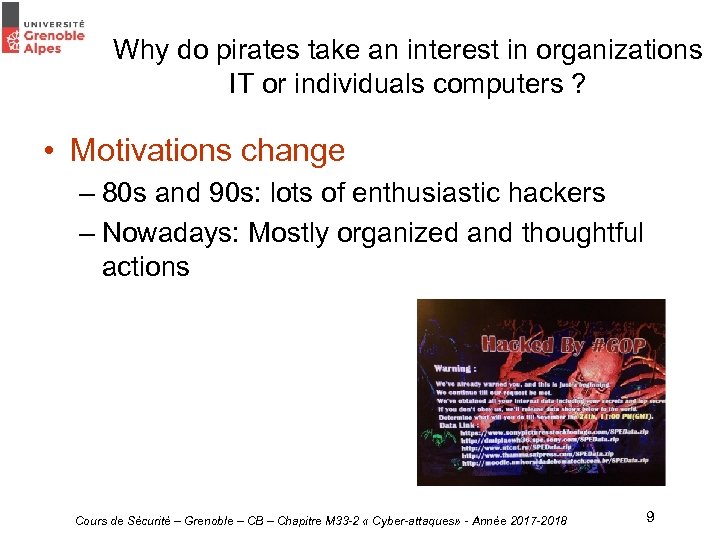
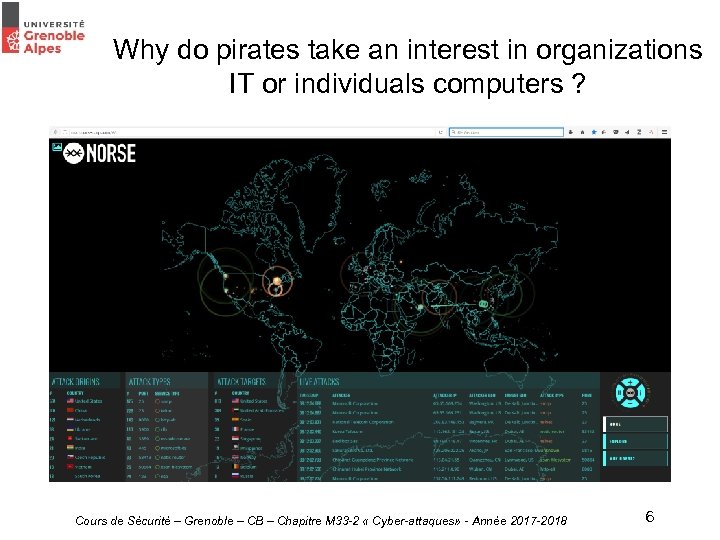
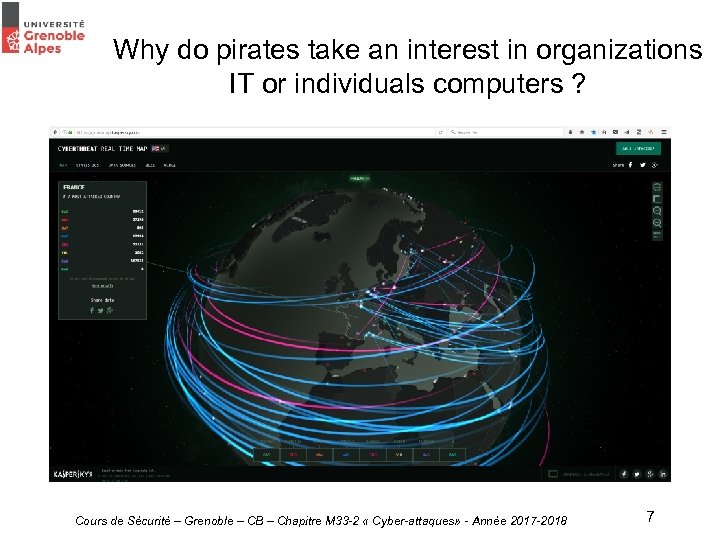
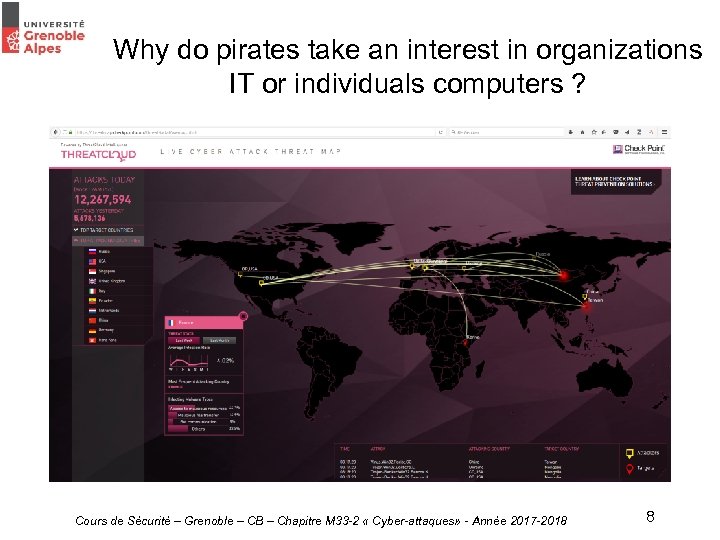
Why do pirates take an interest in organizations IT or individuals computers ? • Motivations change – 80 s and 90 s: lots of enthusiastic hackers – Nowadays: Mostly organized and thoughtful actions Cours de Sécurité – Grenoble – CB – Chapitre M 33 -2 « Cyber-attaques» - Année 2017 -2018 9
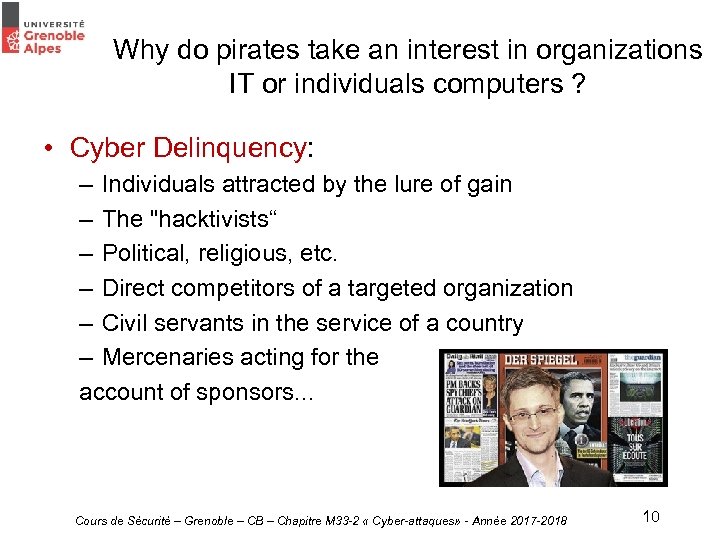
Why do pirates take an interest in organizations IT or individuals computers ? • Cyber Delinquency: – Individuals attracted by the lure of gain – The "hacktivists“ – Political, religious, etc. – Direct competitors of a targeted organization – Civil servants in the service of a country – Mercenaries acting for the account of sponsors… Cours de Sécurité – Grenoble – CB – Chapitre M 33 -2 « Cyber-attaques» - Année 2017 -2018 10
Why do pirates take an interest in organizations IT or individuals computers ? • Financial gains (access to information, then monetization and resale)Users, emails – – – • Use of resources (then reselling or making available as "service") – – • Bandwidth & storage space ( hosting music, movies et others contents ) Zombies (botnets) Shakedown – – • Internal organization of the company Customer Files Passwords, bank account numbers, credit cards Deny of service Data modifications Spying – – Industrial / Competitors From states Cours de Sécurité – Grenoble – CB – Chapitre M 33 -2 « Cyber-attaques» - Année 2017 -2018 11
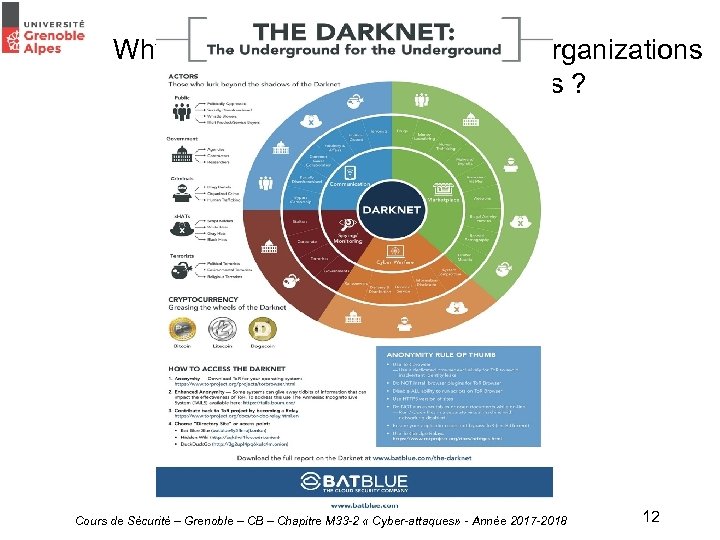
Why do pirates take an interest in organizations IT or individuals computers ? Cours de Sécurité – Grenoble – CB – Chapitre M 33 -2 « Cyber-attaques» - Année 2017 -2018 12
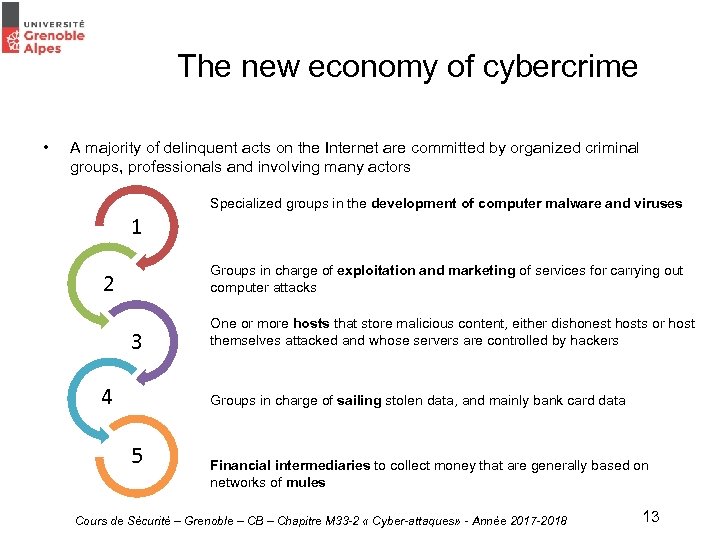
The new economy of cybercrime • A majority of delinquent acts on the Internet are committed by organized criminal groups, professionals and involving many actors Specialized groups in the development of computer malware and viruses 1 Groups in charge of exploitation and marketing of services for carrying out computer attacks 2 3 4 One or more hosts that store malicious content, either dishonest hosts or host themselves attacked and whose servers are controlled by hackers Groups in charge of sailing stolen data, and mainly bank card data 5 Financial intermediaries to collect money that are generally based on networks of mules Cours de Sécurité – Grenoble – CB – Chapitre M 33 -2 « Cyber-attaques» - Année 2017 -2018 13
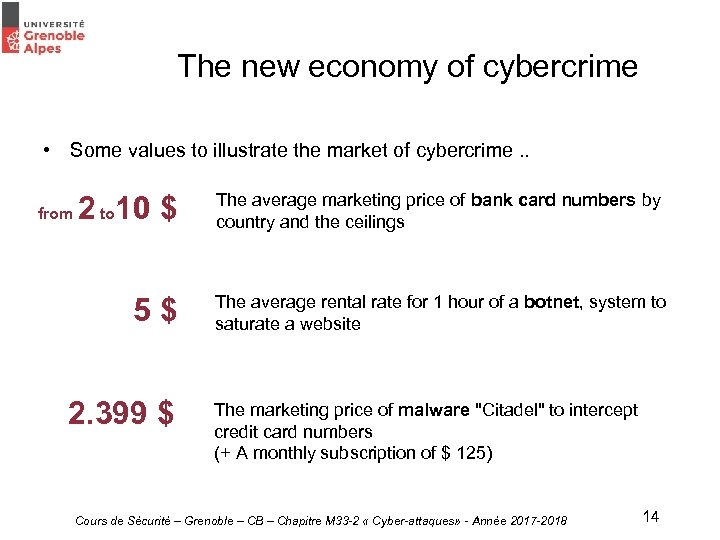
The new economy of cybercrime • Some values to illustrate the market of cybercrime. . from 2 to 10 $ 5$ 2. 399 $ The average marketing price of bank card numbers by country and the ceilings The average rental rate for 1 hour of a botnet, system to saturate a website The marketing price of malware "Citadel" to intercept credit card numbers (+ A monthly subscription of $ 125) Cours de Sécurité – Grenoble – CB – Chapitre M 33 -2 « Cyber-attaques» - Année 2017 -2018 14
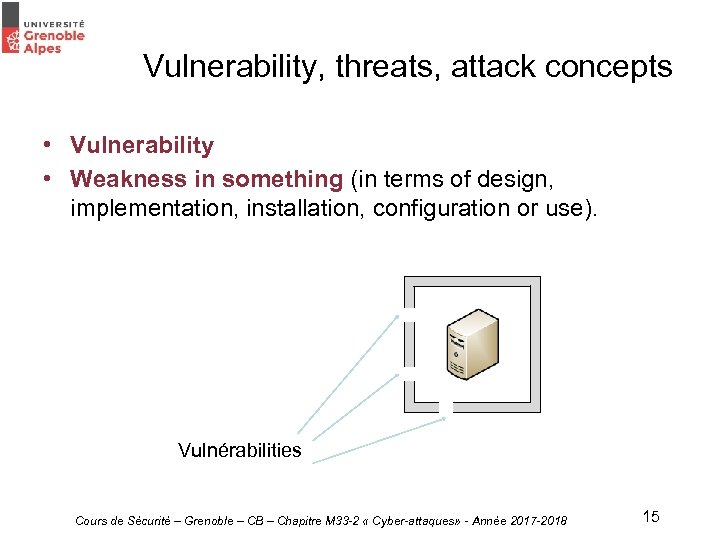
Vulnerability, threats, attack concepts • Vulnerability • Weakness in something (in terms of design, implementation, installation, configuration or use). Vulnérabilities Cours de Sécurité – Grenoble – CB – Chapitre M 33 -2 « Cyber-attaques» - Année 2017 -2018 15
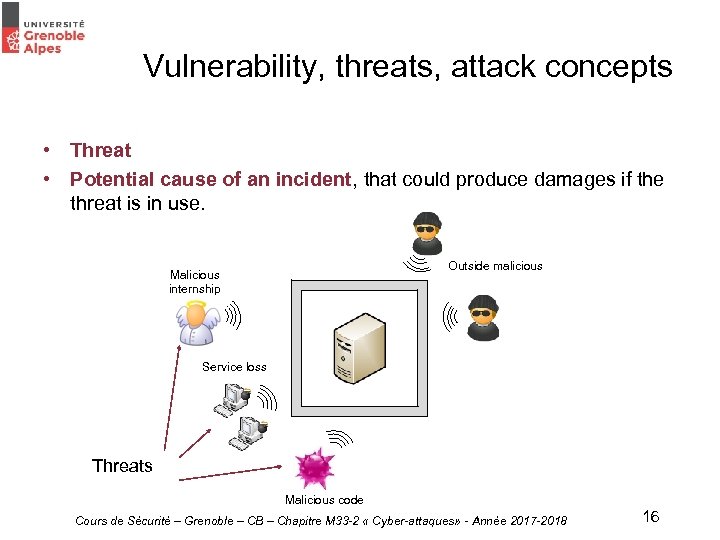
Vulnerability, threats, attack concepts • Threat • Potential cause of an incident, that could produce damages if the threat is in use. Outside malicious Malicious internship Service loss Threats Malicious code Cours de Sécurité – Grenoble – CB – Chapitre M 33 -2 « Cyber-attaques» - Année 2017 -2018 16
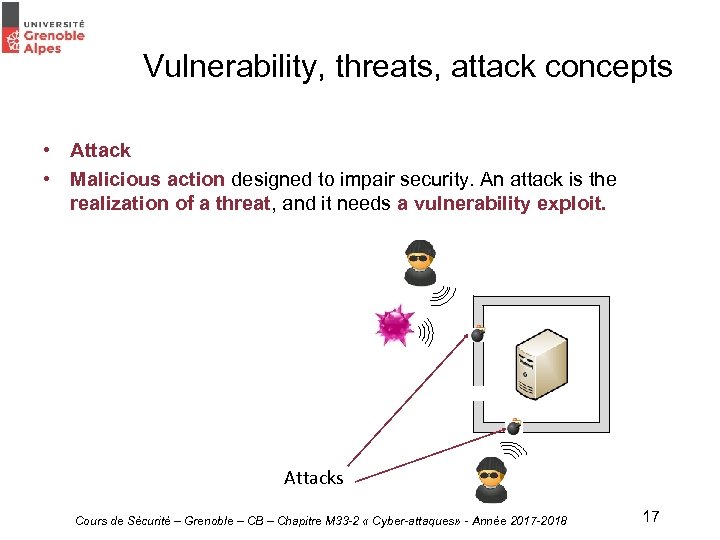
Vulnerability, threats, attack concepts • Attack • Malicious action designed to impair security. An attack is the realization of a threat, and it needs a vulnerability exploit. Attacks Cours de Sécurité – Grenoble – CB – Chapitre M 33 -2 « Cyber-attaques» - Année 2017 -2018 17
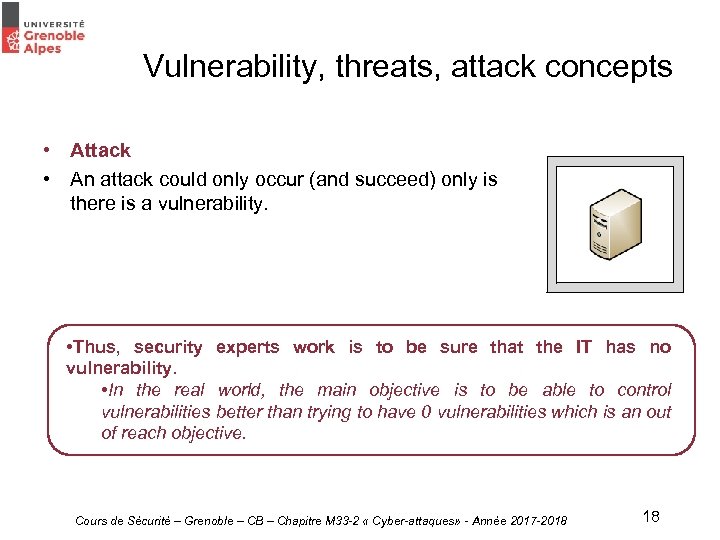
Vulnerability, threats, attack concepts • Attack • An attack could only occur (and succeed) only is there is a vulnerability. • Thus, security experts work is to be sure that the IT has no vulnerability. • In the real world, the main objective is to be able to control vulnerabilities better than trying to have 0 vulnerabilities which is an out of reach objective. Cours de Sécurité – Grenoble – CB – Chapitre M 33 -2 « Cyber-attaques» - Année 2017 -2018 18
M 33 -2. Cyber-attaques • Les ingrédients – Ressources informatiques vulnérables aux attaques – Types de cibles – Sources potentielles de menaces – Types d'attaquants Cours de Sécurité – Grenoble – CB – Chapitre M 33 -2 « Cyber-attaques» - Année 2017 -2018 19
2. 1 Type of computer resources vulnerable to the attacks • Servers - Obtaining a slave machine to tackle other targets • Clients hardware – Machine potentially less protected – Vulnerable via a wireless connection • Other terminals (wireless) – Cellular phones – PDA, … • Disk space - Backup of illegal files • Bandwidth - Use of a pirated network to reach/attack other networks • Personal and confidential information Cours de Sécurité – Grenoble – CB – Chapitre M 33 -2 « Cyber-attaques» - Année 2017 -2018 20
2. 1 Types of targets • Convenient target (cible opportune) - By “chance”: detected by the pirates in the search of least protected machines or servers - What to do? : update the systems - To test the system (try to find faults) • Chosen target (cible de choix) - Precise Target: strategic interest of the company … Cours de Sécurité – Grenoble – CB – Chapitre M 33 -2 « Cyber-attaques» - Année 2017 -2018 21
capacity Sources potentielles de menaces Others Etat States tiers Capacity Threat source knowledge and ressources Cybercriminals Groupe de cybercriminels groups Competitors Cyberdélinquant criminals Personnel Internal interne staff Exposure Threat source opportunities and interest exposure Map example of main threat sources applying to IT Attention : this map must be adapted to each organization because threats depends on sectors. Example : State administration IT don’t face threats as a e-shop website or a university Cours de Sécurité – Grenoble – CB – Chapitre M 33 -2 « Cyber-attaques» - Année 2017 -2018 22
Types d'attaquants • Hackers (skilled computer expert who seeks and exploits weaknesses in a computer system or computer network) – – – A white hat hacker breaks security for non-malicious reasons, either to test their own security system, perform penetration tests or vulnerability assessments for a client - or while working for a security company which makes security software. The term is generally synonymous with ethical hacker. A blue hat hacker is someone outside computer security consulting firms who is used to bug-test a system prior to its launch, looking for exploits so they can be closed. A "black hat" hacker is a hacker who "violates computer security for little reason beyond maliciousness or for personal gain" (Moore, 2005). Black hat hackers form the stereotypical, illegal hacking groups often portrayed in popular culture, and are "the epitome of all that the public fears in a computer criminal". A grey hat hacker lies between a black hat and a white hat hacker. A grey hat hacker may surf the Internet and hack into a computer system for the sole purpose of notifying the administrator that their system has a security defect, for example. They may then offer to correct the defect for a fee. A script kiddie (also known as a skid or skiddie) is an unskilled hacker who breaks into computer systems by using automated tools written by others (usually by other black hat hackers), hence the term script (i. e. a prearranged plan or set of activities) kiddie (i. e. kid, child—an individual lacking knowledge and experience, immature), usually with little understanding of the underlying concept. A hacktivist is a hacker who utilizes technology to publicize a social, ideological, religious or political message. Cours de Sécurité – Grenoble – CB – Chapitre M 33 -2 « Cyber-attaques» - Année 2017 -2018 23
Types d'attaquants • Pirates organizations – Sharing of finds – Motivations through challenges (challenges) – Mercenaries – State Actors Cours de Sécurité – Grenoble – CB – Chapitre M 33 -2 « Cyber-attaques» - Année 2017 -2018 24
M 33 -2. Cyber-attaques • Recipe : – – – – Attacks categorization Attack strategy Information recognition and collection Scan services and ports Obtaining Access Extension of acquired privileges Trace Coverage Risk Analysis: Nature of Harm Cours de Sécurité – Grenoble – CB – Chapitre M 33 -2 « Cyber-attaques» - Année 2017 -2018 25
2. 3 Types of attacks (4/4) The types of attacks are classified in two categories: • Passive attacks - Interception, listening • Active attacks - Modification - Interruption - Denial of service Cours de Sécurité – Grenoble – CB – Chapitre M 33 -2 « Cyber-attaques» - Année 2017 -2018 26
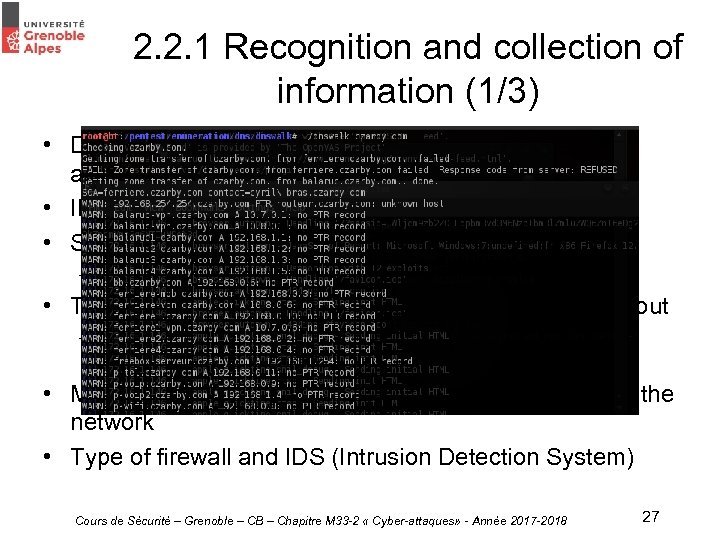
2. 2. 1 Recognition and collection of information (1/3) • Domain names, DNS servers, blocks of assigned IP addresses • IP addresses accessible from outside • Services presenting a valid target – www, ftp, e-mail… • Types of machines on which the services are carried out – Operating systems and number of version => use of the exploitable known faults • Mechanisms available for the control of the access to the network • Type of firewall and IDS (Intrusion Detection System) Cours de Sécurité – Grenoble – CB – Chapitre M 33 -2 « Cyber-attaques» - Année 2017 -2018 27
2. 2. 1 Recognition and collection of information (2/3) • User names, groups, routing tables, SNMP information (techniques of enumeration of the sources of the system) • Physical location of the equipment and systems • Used network protocols (IP, IPv 6, IPSec, SSL) • Cartography of the network • Type of access connections – Traditional access (frame relay, broad band) – Access by classical telephone (modem) – Wi-Fi Access • Approach by “social engineering” (consists in questioning people and recovering information by trapping them) – Information on the people, their names, telephone numbers, situation in the company, addresses… Cours de Sécurité – Grenoble – CB – Chapitre M 33 -2 « Cyber-attaques» - Année 2017 -2018 28
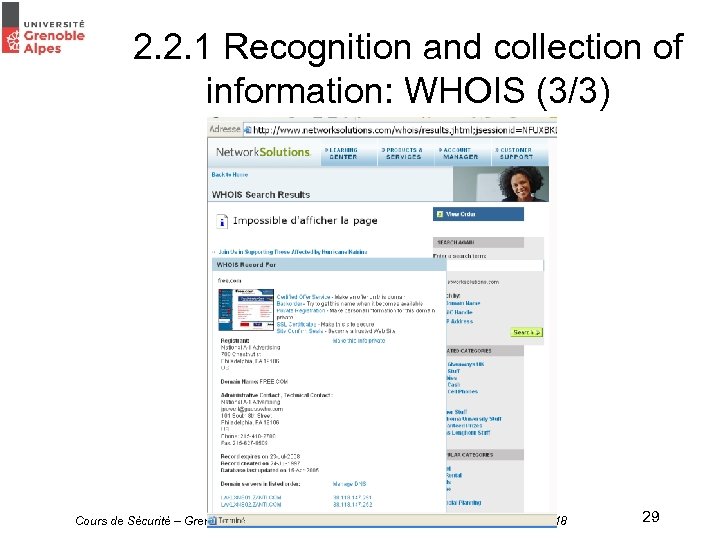
2. 2. 1 Recognition and collection of information: WHOIS (3/3) Cours de Sécurité – Grenoble – CB – Chapitre M 33 -2 « Cyber-attaques» - Année 2017 -2018 29
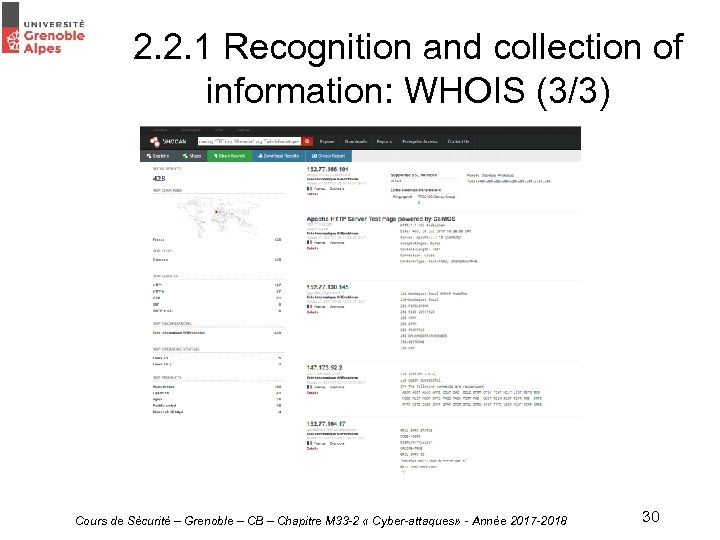
2. 2. 1 Recognition and collection of information: WHOIS (3/3) Cours de Sécurité – Grenoble – CB – Chapitre M 33 -2 « Cyber-attaques» - Année 2017 -2018 30
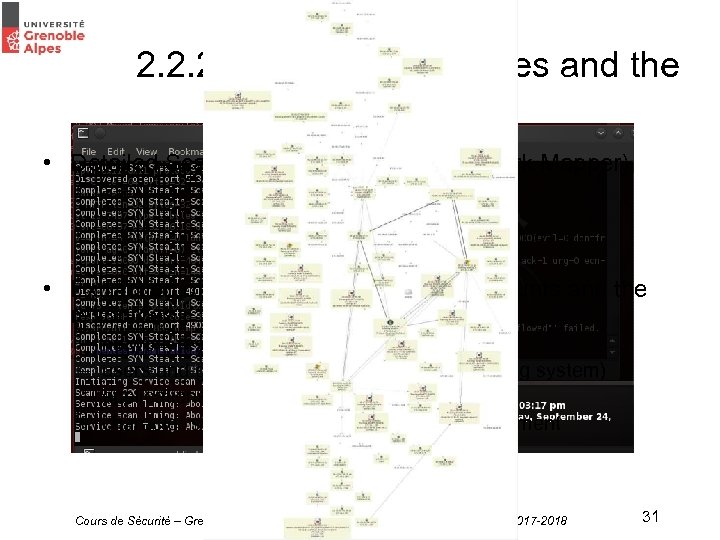
2. 2. 2 Scan of the services and the ports • Detailed Scan of a target (NMAP = Network Mapper) 3. 2. 3 Enumeration • Extraction of information on the valid accounts and the resources – – network resources and shared resources users and groups (as a function of the Operating system) applications character strings sent in response by the equipment Cours de Sécurité – Grenoble – CB – Chapitre M 33 -2 « Cyber-attaques» - Année 2017 -2018 31
2. 2. 4 Obtaining an access • Tackle at the operating system level – Use of the functionalities of the O. S. • Tackle at the application level – Use of the functionalities of the application • Attack benefiting from a bad configuration – “Opened” system, default configuration (administrator name and password!), many activated functionalities • Attack using lodged scripts – Scripts available on the system and sometimes activated by default (Unix/Linux) – Détournement de requêtes SQL lors de l’interrogation d’une base de données via interface web • Automated Attack (ex: scan of port 80 of a whole C-class block of addresses in order to seek a fault) • Targeted Attack : much rarer but difficult to detect (experienced pirates) Cours de Sécurité – Grenoble – CB – Chapitre M 33 -2 « Cyber-attaques» - Année 2017 -2018 32
2. 2. 5 Extension of the acquired privileges • If the pirate succeeded in entering on the system with a “weak” password => extension of the rights (authorizations) – To carry out code to obtain privilege – To seek to decipher other passwords – To scan for non ciphered passwords – To seek possible inter-network relations – To identify badly configured files or shared resources permissions Cours de Sécurité – Grenoble – CB – Chapitre M 33 -2 « Cyber-attaques» - Année 2017 -2018 33
2. 2. 6 Cover the traces • To dissimulate to the administrator the fact that one penetrated the system - Windows: To eliminate the entries (inputs) in the event logs and the registers - Unix: to empty the file of history (execution of the program log wiper) - ! The attacker cleans the log files but does not remove them! Cours de Sécurité – Grenoble – CB – Chapitre M 33 -2 « Cyber-attaques» - Année 2017 -2018 34
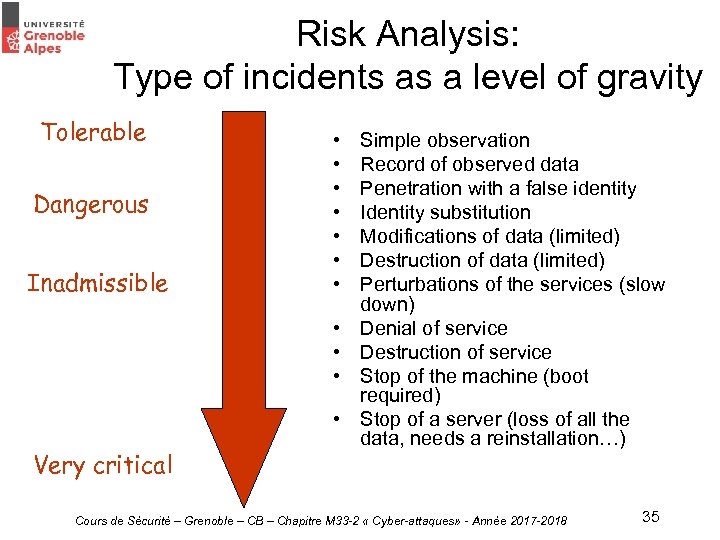
Risk Analysis: Type of incidents as a level of gravity Tolerable Dangerous Inadmissible • • • Very critical Simple observation Record of observed data Penetration with a false identity Identity substitution Modifications of data (limited) Destruction of data (limited) Perturbations of the services (slow down) Denial of service Destruction of service Stop of the machine (boot required) Stop of a server (loss of all the data, needs a reinstallation…) Cours de Sécurité – Grenoble – CB – Chapitre M 33 -2 « Cyber-attaques» - Année 2017 -2018 35
M 33 -2. Cyber-attaques • Définitions : – Les types d’attaques – Attaques TOIP – Les attaques APT – Détection des attaques – Étude de cas Cours de Sécurité – Grenoble – CB – Chapitre M 33 -2 « Cyber-attaques» - Année 2017 -2018 36
Attacks types and solutions • • • Deny Of Service DOS Sniffing Scanning Social engineering Cracking Spoofing Man in the middle Hijacking Buffer overflow Cours de Sécurité – Grenoble – CB – Chapitre M 33 -2 « Cyber-attaques» - Année 2017 -2018 37
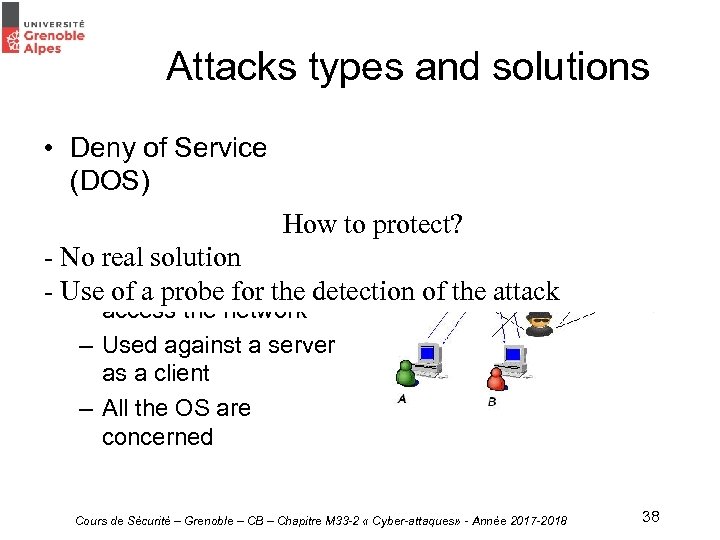
Attacks types and solutions • Deny of Service (DOS) – Getting out of order the protect? How to targeted system - No real solution – of a probe for the - Use. Victim unable to detection of the attack access the network – Used against a server as a client – All the OS are concerned Cours de Sécurité – Grenoble – CB – Chapitre M 33 -2 « Cyber-attaques» - Année 2017 -2018 38
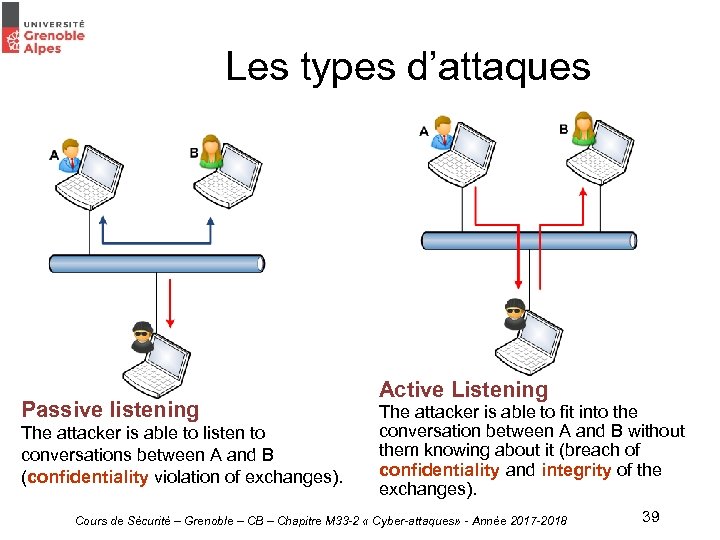
Les types d’attaques Passive listening The attacker is able to listen to conversations between A and B (confidentiality violation of exchanges). Active Listening The attacker is able to fit into the conversation between A and B without them knowing about it (breach of confidentiality and integrity of the exchanges). Cours de Sécurité – Grenoble – CB – Chapitre M 33 -2 « Cyber-attaques» - Année 2017 -2018 39
Attacks types and solutions • Sniffing – Network analys How to protect yourself? – Collect information Preferably use a switch rather than a hub. exchange in order to Use encrypted protocols for sensitive information find sensitive data. such as passwords. – Simple to implement if Use a sniffer detector. they have access to Taken not to leave equipment connected without the network Cours de Sécurité – Grenoble – CB – Chapitre M 33 -2 « Cyber-attaques» - Année 2017 -2018 40
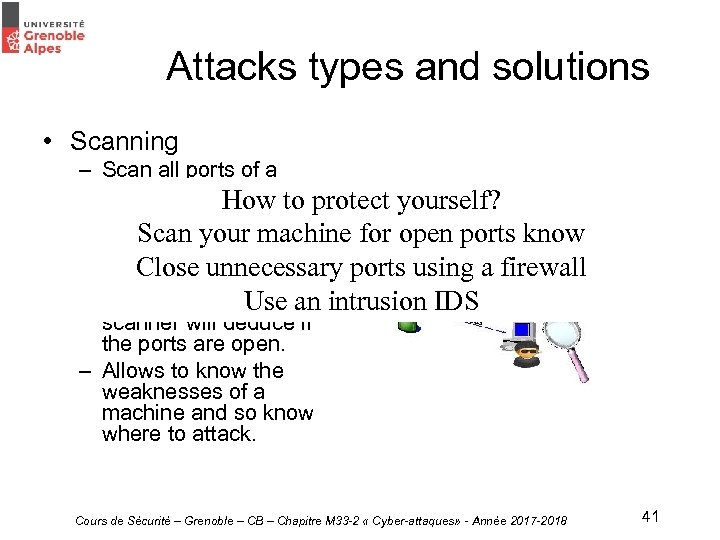
Attacks types and solutions • Scanning – Scan all ports of a machine using a tool protect yourself? How called a scanner. to Scan your machine for open ports know – The scanner sends packets to many ports of ports using a firewall Close unnecessary the machine. Based on their responses, the intrusion IDS Use an scanner will deduce if the ports are open. – Allows to know the weaknesses of a machine and so know where to attack. Cours de Sécurité – Grenoble – CB – Chapitre M 33 -2 « Cyber-attaques» - Année 2017 -2018 41
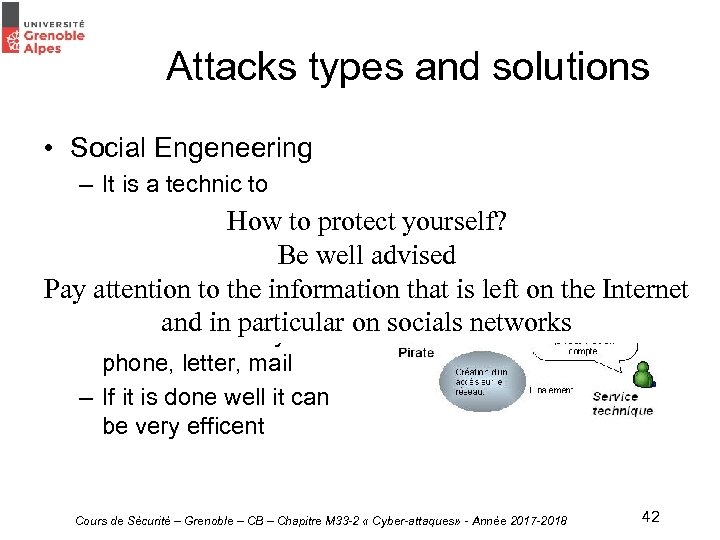
Attacks types and solutions • Social Engeneering – It is a technic to manipulate people to How to protect yourself? get them information Be well advised they would not give Pay attention to the information that is left on the Internet normally and in particular on socials networks – It can be done by phone, letter, mail – If it is done well it can be very efficent Cours de Sécurité – Grenoble – CB – Chapitre M 33 -2 « Cyber-attaques» - Année 2017 -2018 42
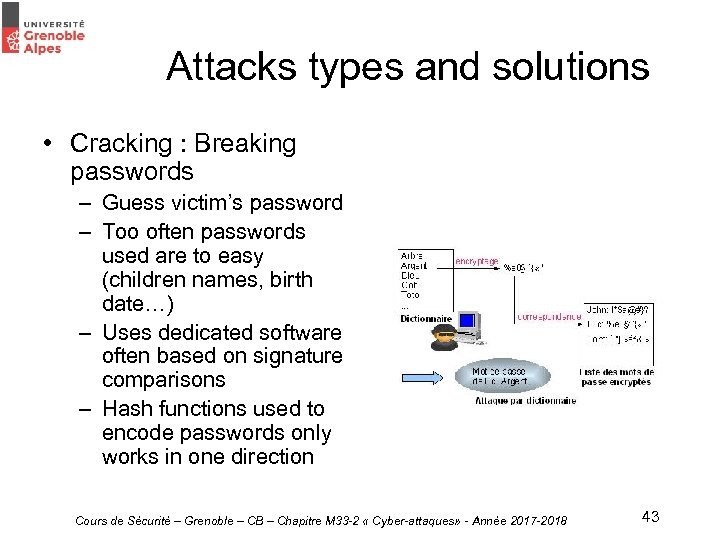
Attacks types and solutions • Cracking : Breaking passwords – Guess victim’s password – Too often passwords used are to easy (children names, birth date…) – Uses dedicated software often based on signature comparisons – Hash functions used to encode passwords only works in one direction Cours de Sécurité – Grenoble – CB – Chapitre M 33 -2 « Cyber-attaques» - Année 2017 -2018 43
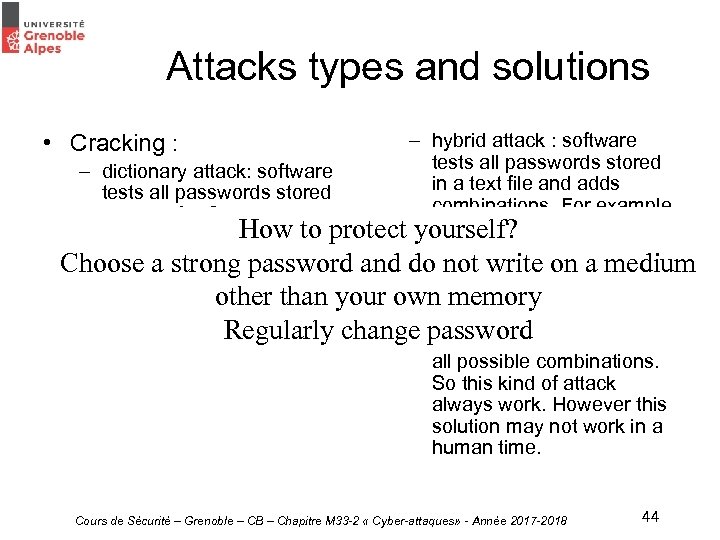
Attacks types and solutions • Cracking : – hybrid attack : software tests all passwords stored – dictionary attack: software in a text file and adds tests all passwords stored combinations. For example, in a text file. ? This method thomas 01. This method is How to is really efficent because protect yourself? also well working because lambda users often use Choose a strong password and domany people put digits at not write on a medium existing words as the password end to passwords. other than your own memory increase security. Regularly change password – brute-force : software tests all possible combinations. So this kind of attack always work. However this solution may not work in a human time. Cours de Sécurité – Grenoble – CB – Chapitre M 33 -2 « Cyber-attaques» - Année 2017 -2018 44
Attacks types and solutions • Spoofing How – Of IP address to protect yourself? No solution to prevent – Of MAC address Use mechanisms to determine the trust (electronic – Of e-mail address secure protocols. . . ) signature mail, – Of website = Phishing Cours de Sécurité – Grenoble – CB – Chapitre M 33 -2 « Cyber-attaques» - Année 2017 -2018 45
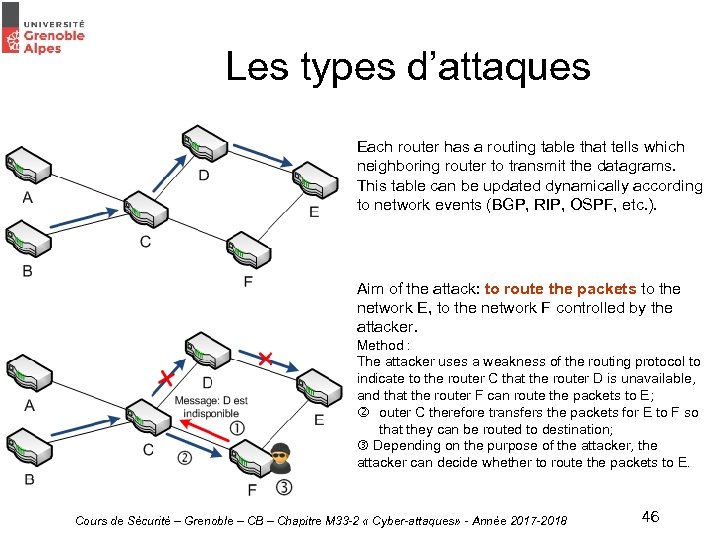
Les types d’attaques Each router has a routing table that tells which neighboring router to transmit the datagrams. This table can be updated dynamically according to network events (BGP, RIP, OSPF, etc. ). Aim of the attack: to route the packets to the network E, to the network F controlled by the attacker. Method : The attacker uses a weakness of the routing protocol to indicate to the router C that the router D is unavailable, and that the router F can route the packets to E; outer C therefore transfers the packets for E to F so that they can be routed to destination; Depending on the purpose of the attacker, the attacker can decide whether to route the packets to E. Cours de Sécurité – Grenoble – CB – Chapitre M 33 -2 « Cyber-attaques» - Année 2017 -2018 46
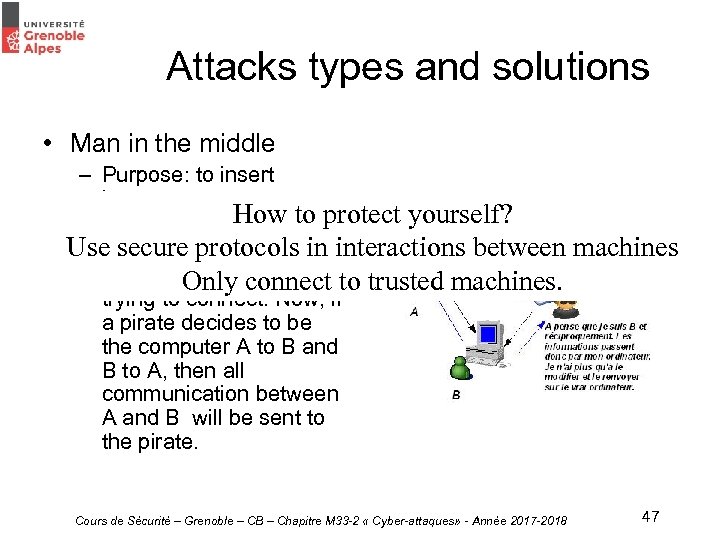
Attacks types and solutions • Man in the middle – Purpose: to insert between two How to protect yourself? communicating computers. Use secure protocols in interactions between – Two computers A and B to trusted machines. Only connect trying to connect. Now, if a pirate decides to be the computer A to B and B to A, then all communication between A and B will be sent to the pirate. Cours de Sécurité – Grenoble – CB – Chapitre M 33 -2 « Cyber-attaques» - Année 2017 -2018 machines 47
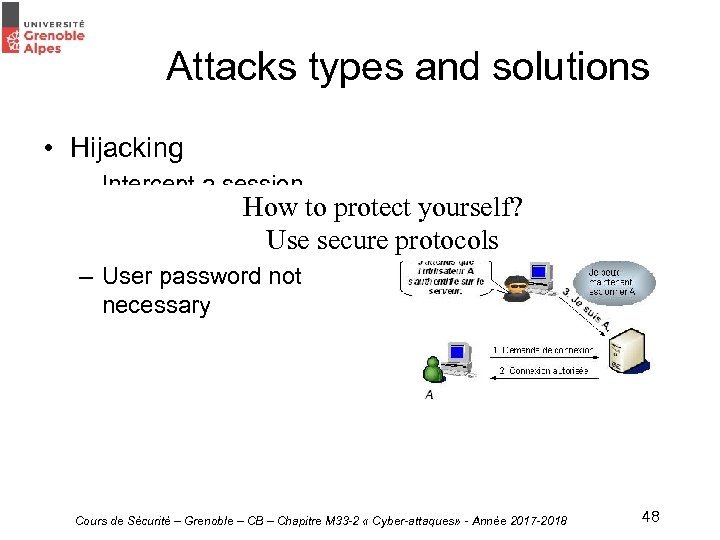
Attacks types and solutions • Hijacking – Intercept a session How to protect yourself? during its opening by a legitimate user Use secure protocols – User password not necessary Cours de Sécurité – Grenoble – CB – Chapitre M 33 -2 « Cyber-attaques» - Année 2017 -2018 48
Attacks types and solutions • Buffer over flow – a program residing on your machine by How to protect yourself? sending more data than it is supposed to No direct solution since it is based on errors or receive so that it executes arbitrary code. weaknesses in programming – It is not uncommon for a program to accept Be sure to apply patches and updates to programs you use. data parameters. Thus, if the program does not check the length of the string passed as a parameter, an attacker can compromise the machine by entering something to long. Cours de Sécurité – Grenoble – CB – Chapitre M 33 -2 « Cyber-attaques» - Année 2017 -2018 49
VOIP attacks • 3 Types of attacks – Over IP – Voicemail – Administrator VOIP attacks – C. Bras Cours de Sécurité – Grenoble – CB – Chapitre M 33 -2 « Cyber-attaques» - Année 2017 -2018 50 50
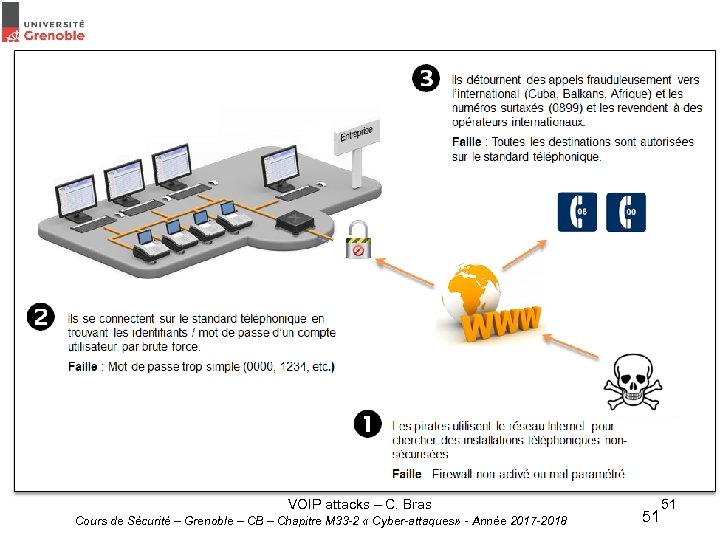
TOIP attacks • Over IP New telephonic systems are based on IP protocol (TOIP) and use computer network company. However, a misconfigured firewall won’t protect the telephony system. Pirates can get on the phone network and use it as international phone gateway. VOIP attacks – C. Bras Cours de Sécurité – Grenoble – CB – Chapitre M 33 -2 « Cyber-attaques» - Année 2017 -2018 51 51
VOIP attacks • Voicemail Most of the time, users within companies do not customize access code to their voicemail. Some PBXs then give the possibility to make calls. This fault is used by hackers to turn the phone user's gateway to send to premium rate numbers, numbers of servers games, recharge account numbers (such as Paypal). VOIP attacks – C. Bras Cours de Sécurité – Grenoble – CB – Chapitre M 33 -2 « Cyber-attaques» - Année 2017 -2018 52 52
VOIP attacks • Example of pirates methodology On the voicemail – Allowing to be returned before or after filing message. – Allows remote configuration Pirates procedure – Try to call company phone numbers – If they come on a voicemail? Menu navigation (browsing, configuration)? Entering the password? Phone number for tranfer… – Call to the user, transferred to voicemail which itself refers to a distant destination. . . ! – How to avoid being identified immediately, disable forwarding after use. VOIP attacks – C. Bras Cours de Sécurité – Grenoble – CB – Chapitre M 33 -2 « Cyber-attaques» - Année 2017 -2018 53 53
VOIP attacks • Administrator Phone systems had a management interface that can be hacked if the personal identifiers are not so complex. The risks are the following: Transfer call authorization to outside Programming transfer - User, - Messaging - IVR (Interactive Voice Server) Managing passwords (reset) Trace log management VOIP attacks – C. Bras Cours de Sécurité – Grenoble – CB – Chapitre M 33 -2 « Cyber-attaques» - Année 2017 -2018 54 54
VOIP attacks • Example of pirates methodology 1 - Access to the PBX administration - Find IP Address - Follow configuration documentation - Trying default constructor passwords 2 - Changing the configuration - Configure transfers 3 - After use - Restore Configuration - Delete the server log 4 - Provide the following - Explorer configuration - Possibly other open access to government VOIP attacks – C. Bras Cours de Sécurité – Grenoble – CB – Chapitre M 33 -2 « Cyber-attaques» - Année 2017 -2018 55 55
VOIP attacks • Piracy consequences Companies face enormous financial consequences. Many hacks are reported every day in France and several tens of million euros pirated each year. Piracy Telecom fraud represents ten thousand euros to hundred thousand euros. The largest recorded case in France is 600. 000 euros. Most of the time, piracy takes place during closed business days periods, especially during weekends, holidays. The company can not detect the problem because nobody controls it. Just few hours of hacking could cost ten thousand euros. VOIP attacks – C. Bras Cours de Sécurité – Grenoble – CB – Chapitre M 33 -2 « Cyber-attaques» - Année 2017 -2018 56 56
VOIP attacks • Piracy consequences For example the case of a french company : Between Christmas and New Year's Day, it was closed. Hackers have penetrated easily the system information using email. Conclusion: 70. 000 euros lost. The main destinations pirated nowaday are the following : Taiwan, Somalia, Cuba, Cayman Islands, Estonia, North Korea, Azerbaibjan, Slovenia, Afghanistan, Global Satellite, Globastar, Egypt, Nigeria, Togo, Sri Lanka, Benin, Ethiopia. VOIP attacks – C. Bras Cours de Sécurité – Grenoble – CB – Chapitre M 33 -2 « Cyber-attaques» - Année 2017 -2018 57 57
Web attacks a. Identity theft via cookies Like all applications, web applications are vulnerable. We will see two of them: • Weakness based on cookies; – This allows - for example - an attacker to bypass an authentication mechanism. • Weakness based on poorly developed source code. – This allows, for example, an attacker to bypass an authentication mechanism, access data to disclose or corrupt it. Cours de Sécurité – Grenoble – CB – Chapitre M 33 -2 « Cyber-attaques» - Année 2017 -2018 58
Web attacks a. Identity theft via cookies Cookies are files managed by web browsers to store (and reuse) user information, for example : • Its identifier; • Its preferences for display and layout of the web page Cookies are required for all dynamic web pages that require to identify or authenticate the user, including allowing the implementation of sessions : • The merchant sites (in order to display the basket of the user logged in) ; • The banking sites (to display the account balance of the logged in user and not the account of another customer) ; • The sites "in general" (in order to display ads targeted on our navigation). It is possible - under certain conditions - to usurp the identity of a user on a website if one gets to retrieve its cookie of identification. Cours de Sécurité – Grenoble – CB – Chapitre M 33 -2 « Cyber-attaques» - Année 2017 -2018 59
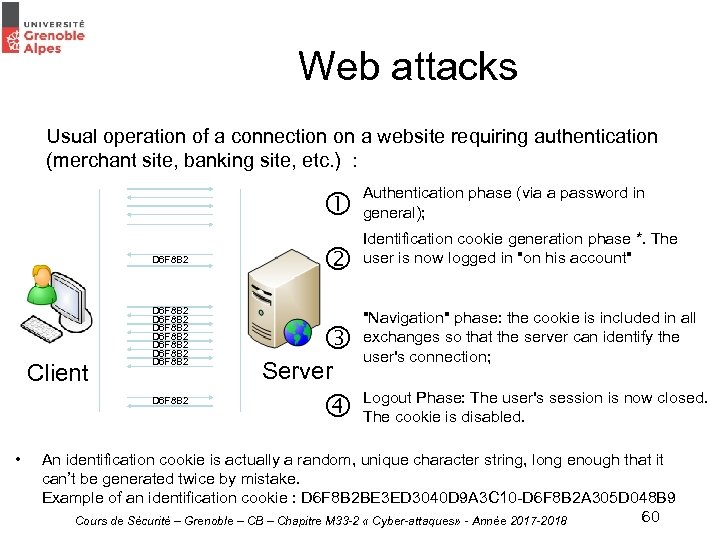
Web attacks Usual operation of a connection on a website requiring authentication (merchant site, banking site, etc. ) : D 6 F 8 B 2 Client D 6 F 8 B 2 D 6 F 8 B 2 • Server Authentication phase (via a password in general); Identification cookie generation phase *. The user is now logged in "on his account" "Navigation" phase: the cookie is included in all exchanges so that the server can identify the user's connection; Logout Phase: The user's session is now closed. The cookie is disabled. An identification cookie is actually a random, unique character string, long enough that it can’t be generated twice by mistake. Example of an identification cookie : D 6 F 8 B 2 BE 3 ED 3040 D 9 A 3 C 10 -D 6 F 8 B 2 A 305 D 048 B 9 60 Cours de Sécurité – Grenoble – CB – Chapitre M 33 -2 « Cyber-attaques» - Année 2017 -2018
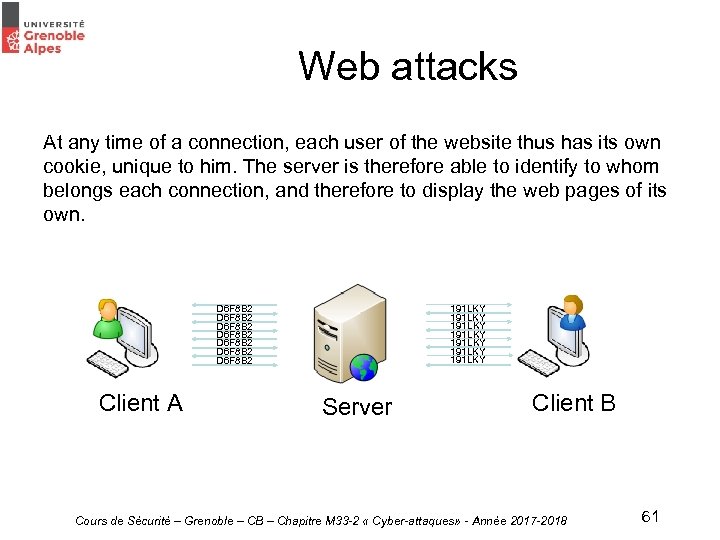
Web attacks At any time of a connection, each user of the website thus has its own cookie, unique to him. The server is therefore able to identify to whom belongs each connection, and therefore to display the web pages of its own. D 6 F 8 B 2 D 6 F 8 B 2 Client A 191 LKY 191 LKY Server Client B Cours de Sécurité – Grenoble – CB – Chapitre M 33 -2 « Cyber-attaques» - Année 2017 -2018 61
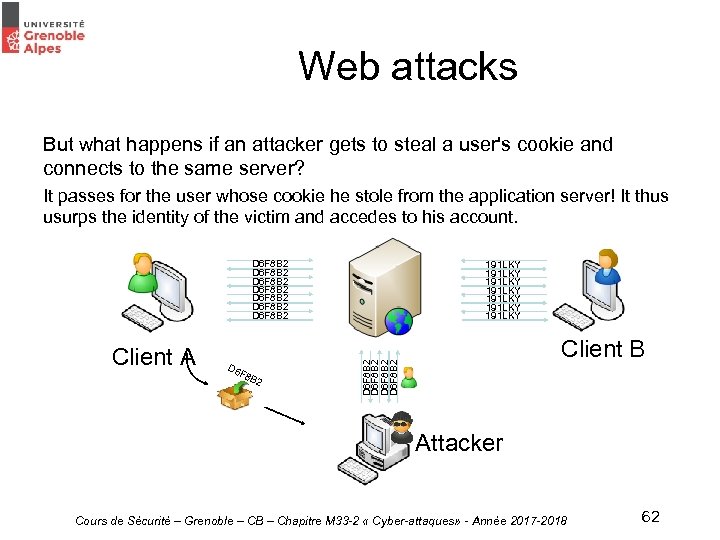
Web attacks But what happens if an attacker gets to steal a user's cookie and connects to the same server? It passes for the user whose cookie he stole from the application server! It thus usurps the identity of the victim and accedes to his account. D 6 F 8 B 2 D 6 F 8 B 2 D 6 F 8 B 2 Client B D 6 F 8 B 2 Client A 191 LKY 191 LKY Attacker Cours de Sécurité – Grenoble – CB – Chapitre M 33 -2 « Cyber-attaques» - Année 2017 -2018 62
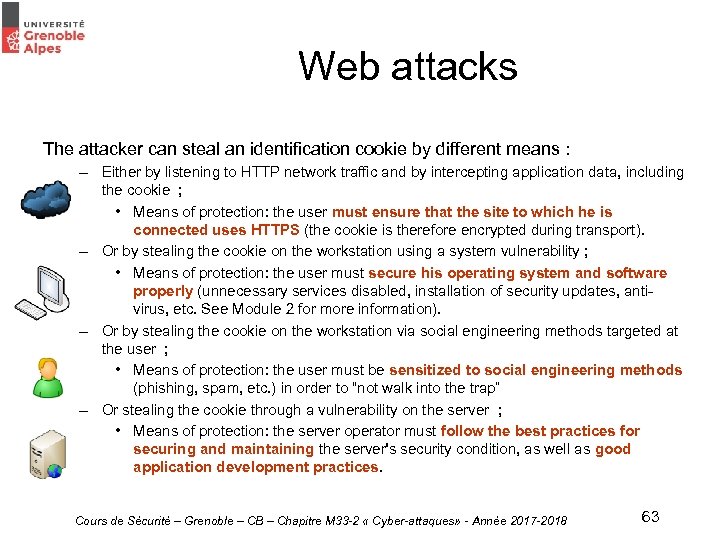
Web attacks The attacker can steal an identification cookie by different means : – Either by listening to HTTP network traffic and by intercepting application data, including the cookie ; • Means of protection: the user must ensure that the site to which he is connected uses HTTPS (the cookie is therefore encrypted during transport). – Or by stealing the cookie on the workstation using a system vulnerability ; • Means of protection: the user must secure his operating system and software properly (unnecessary services disabled, installation of security updates, antivirus, etc. See Module 2 for more information). – Or by stealing the cookie on the workstation via social engineering methods targeted at the user ; • Means of protection: the user must be sensitized to social engineering methods (phishing, spam, etc. ) in order to “not walk into the trap” – Or stealing the cookie through a vulnerability on the server ; • Means of protection: the server operator must follow the best practices for securing and maintaining the server's security condition, as well as good application development practices. Cours de Sécurité – Grenoble – CB – Chapitre M 33 -2 « Cyber-attaques» - Année 2017 -2018 63
b. SQL Injection Web attacks • An SQL injection attack allows an attacker to interact directly with the database of a website (although access to this database is of course prohibited); • The purpose of this type of attack is generally to circumvent the authentication mechanism, to access or to modify fraudulently the confidential data of the database (passwords, telephones, credit card number, etc. ) ; • There are multiple possible variations, the next slide shows an example of bypassing a web page. Cours de Sécurité – Grenoble – CB – Chapitre M 33 -2 « Cyber-attaques» - Année 2017 -2018 64
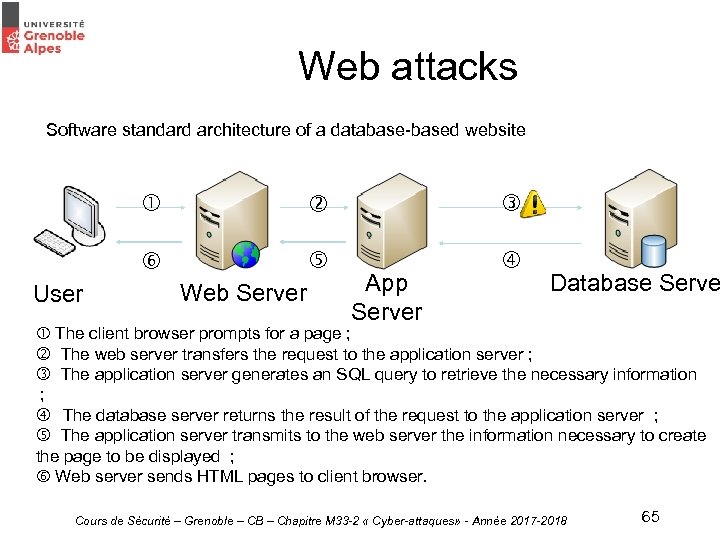
Web attacks Software standard architecture of a database-based website User Web Server App Server Database Serve The client browser prompts for a page ; The web server transfers the request to the application server ; The application server generates an SQL query to retrieve the necessary information ; The database server returns the result of the request to the application server ; The application server transmits to the web server the information necessary to create the page to be displayed ; Web server sends HTML pages to client browser. Cours de Sécurité – Grenoble – CB – Chapitre M 33 -2 « Cyber-attaques» - Année 2017 -2018 65
Web attacks • The purpose of an SQL injection attack is to divert the SQL query from step 3 (previous slide), and - depending on the context - create its own malicious SQL query ; • The following slide illustrates how such an attack can be conducted from a client browser. Cours de Sécurité – Grenoble – CB – Chapitre M 33 -2 « Cyber-attaques» - Année 2017 -2018 66
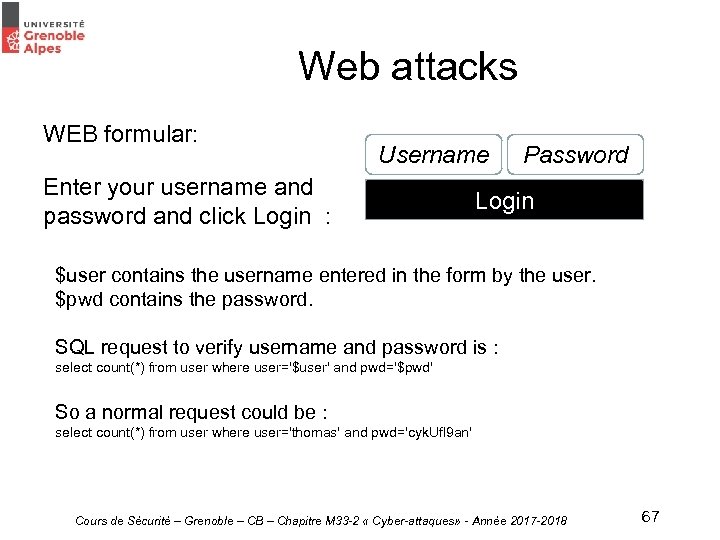
Web attacks WEB formular: Username Enter your username and password and click Login : Password Login $user contains the username entered in the form by the user. $pwd contains the password. SQL request to verify username and password is : select count(*) from user where user='$user' and pwd='$pwd' So a normal request could be : select count(*) from user where user='thomas' and pwd='cyk. Ufl 9 an' Cours de Sécurité – Grenoble – CB – Chapitre M 33 -2 « Cyber-attaques» - Année 2017 -2018 67
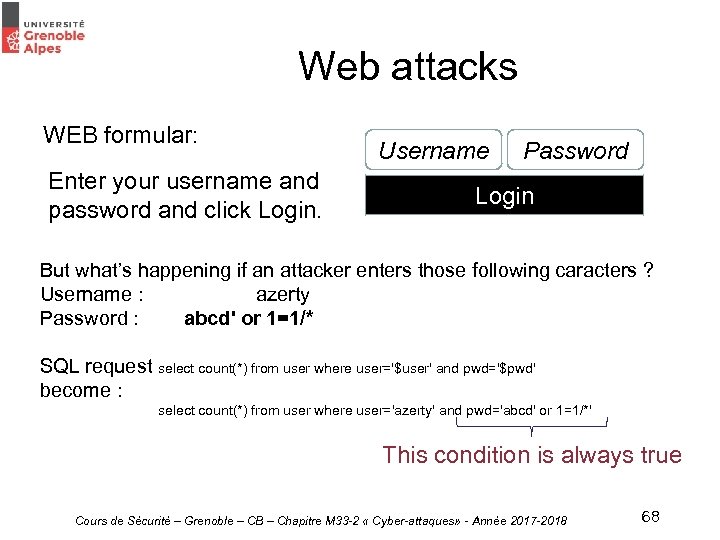
Web attacks WEB formular: Enter your username and password and click Login. Username Password Login But what’s happening if an attacker enters those following caracters ? Username : azerty Password : abcd' or 1=1/* SQL request select count(*) from user where user='$user' and pwd='$pwd' become : select count(*) from user where user='azerty' and pwd='abcd' or 1=1/*' This condition is always true Cours de Sécurité – Grenoble – CB – Chapitre M 33 -2 « Cyber-attaques» - Année 2017 -2018 68
Web attacks • The condition being always true, the request is always valid, whatever the password given by the attacker ! – The / * characters are used to ignore the end of the legitimate query. • The weakness lies here in the application code: the data entered by the user (i. e. an attacker in our scenario) are not verified / validated; On the contrary, they are used as they are without any prior verification that they are "harmless“ • How to protect ? – Systematically validate each external data before using it ; – Use prepared statements, which have the advantage of being more resistant to injections ; – In general, follow industry-recommended good development practices regarding PHP code, Java, etc. . 15/03/2018 Sensibilisation et initiation à la Cours de Sécurité – Grenoble – CB – Chapitre cybersécurité M 33 -2 « Cyber-attaques» - Année 2017 -2018 69
APT attacks • Une Advanced Persistent Threat (APT) Is a type of stealth and ongoing computer piracy, often orchestrated by humans targeting a specific entity. Cours de Sécurité – Grenoble – CB – Chapitre M 33 -2 « Cyber-attaques» - Année 2017 -2018 70
APT attacks • A APT typically targets an organization for business reasons or a state for political reasons. • An APT requires a high degree of concealment over a long period of time. The purpose of such an attack is to place personalized malicious code on one or more computers to perform specific tasks and remain unnoticed for as long as possible. Cours de Sécurité – Grenoble – CB – Chapitre M 33 -2 « Cyber-attaques» - Année 2017 -2018 71
APT attacks • The term Advanced Persistent Threat is also used to refer to a group, as a government, with both the ability and the intention to persistently and effectively target a specific entity. • An individual, such as a hacker, is usually not referred to as an Advanced Persistent Threat because it does not have the resources to be both advanced and persistent. Cours de Sécurité – Grenoble – CB – Chapitre M 33 -2 « Cyber-attaques» - Année 2017 -2018 72
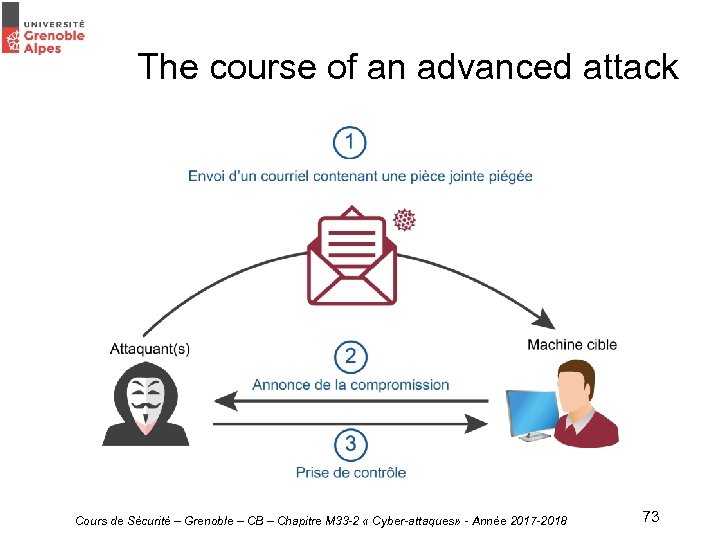
The course of an advanced attack Cours de Sécurité – Grenoble – CB – Chapitre M 33 -2 « Cyber-attaques» - Année 2017 -2018 73
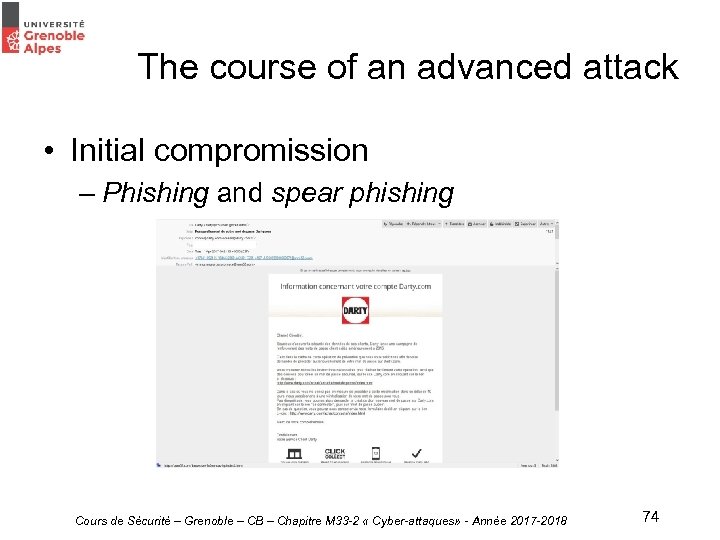
The course of an advanced attack • Initial compromission – Phishing and spear phishing Cours de Sécurité – Grenoble – CB – Chapitre M 33 -2 « Cyber-attaques» - Année 2017 -2018 74
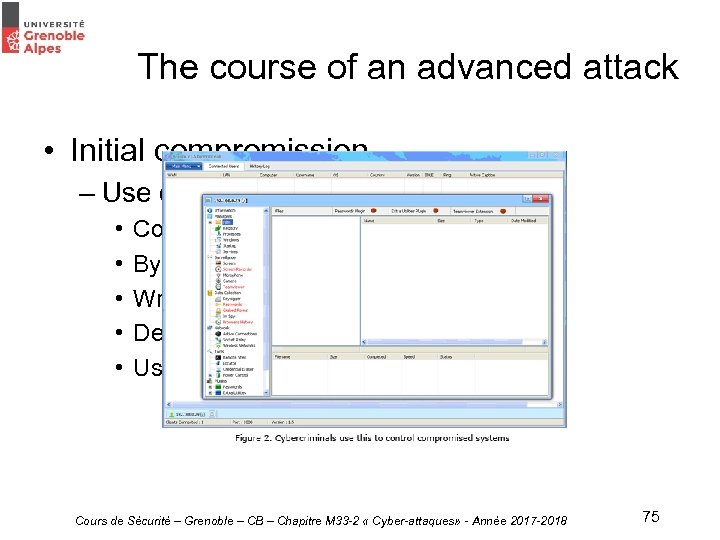
The course of an advanced attack • Initial compromission – Use of malwares (Ex : Plug. X) • • • Complex and well developped Bypass antivirus Writtent specifically for the attack Detects test environnement and VM Uses 0 day exploits Cours de Sécurité – Grenoble – CB – Chapitre M 33 -2 « Cyber-attaques» - Année 2017 -2018 75
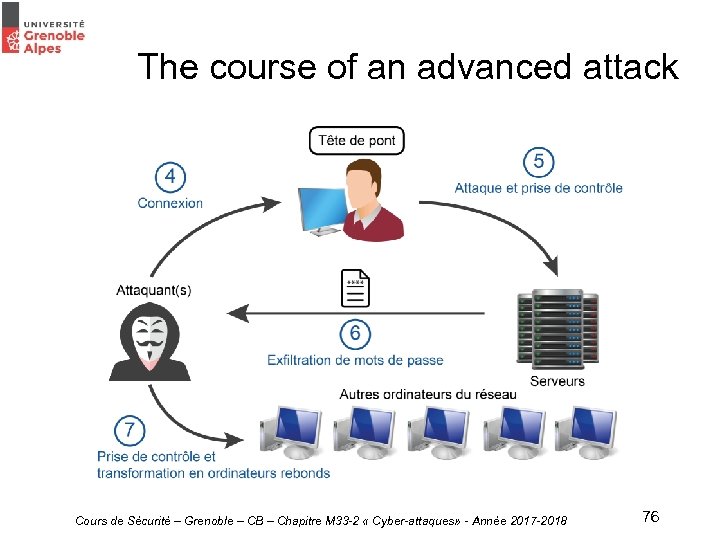
The course of an advanced attack Cours de Sécurité – Grenoble – CB – Chapitre M 33 -2 « Cyber-attaques» - Année 2017 -2018 76
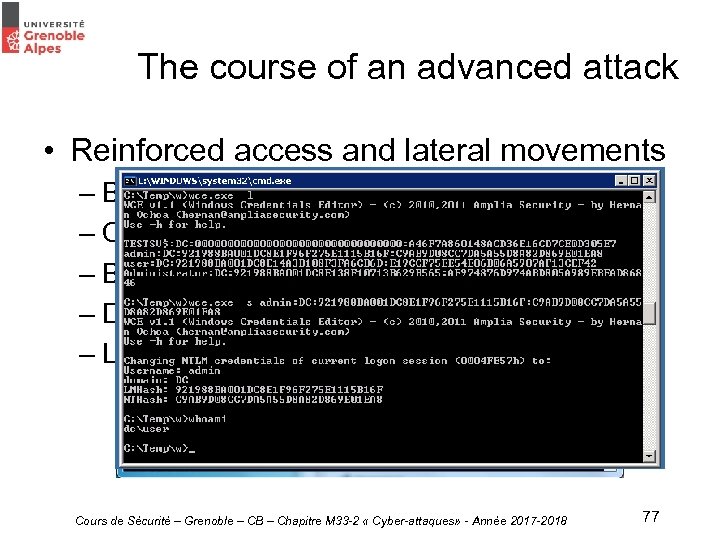
The course of an advanced attack • Reinforced access and lateral movements – Become a local administrator – Collecting passwords and hashes – Become a domaine administrator – Dump the AD – Lateral movements Cours de Sécurité – Grenoble – CB – Chapitre M 33 -2 « Cyber-attaques» - Année 2017 -2018 77
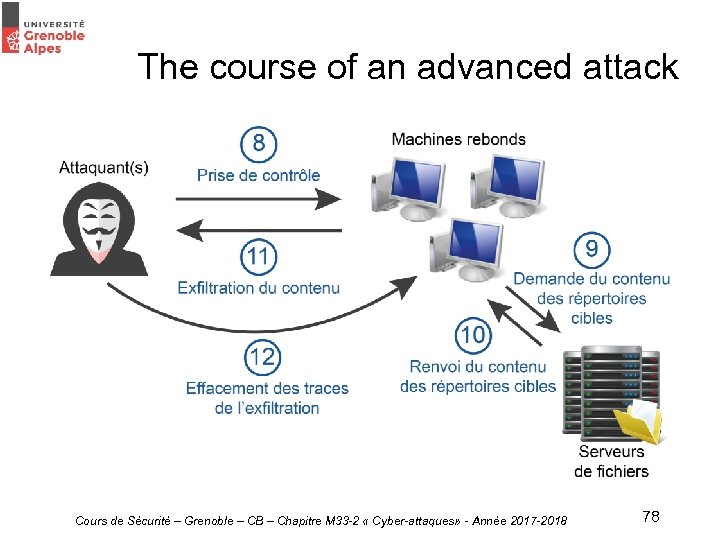
The course of an advanced attack Cours de Sécurité – Grenoble – CB – Chapitre M 33 -2 « Cyber-attaques» - Année 2017 -2018 78
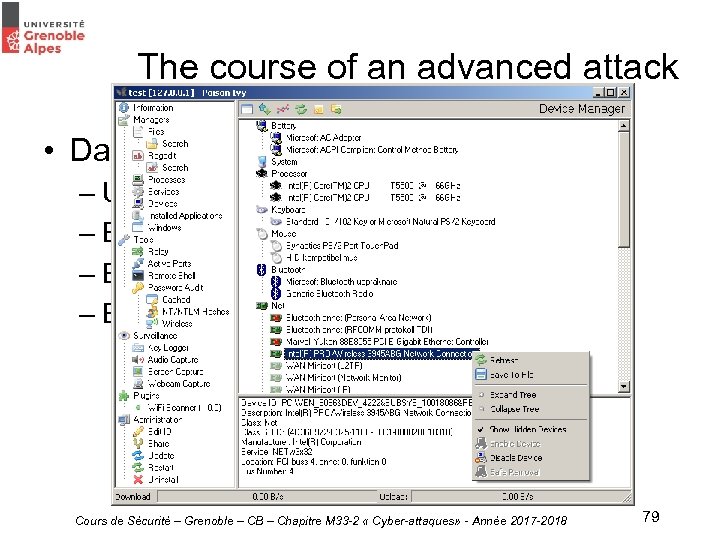
The course of an advanced attack • Data exfiltration : – Use of a. RAT (Remote Administration Tool) – Exfiltration with FTP /SFTP – Exfiltration by e-mail – Exfiltration by DNS tunnel Cours de Sécurité – Grenoble – CB – Chapitre M 33 -2 « Cyber-attaques» - Année 2017 -2018 79
Detection of attacks • • By human beings (culture) By specialised software or hardware (anti-virus, firewalls) By ports normally non open (alert scans) By abnormal reactions – During connections, when you are absent – Of the applications (slow, double validation) • By abnormal overloads – Network resources – Processor, disk, memory resources • By invalid data • By data losses Every abnormal event should incitate to remain very “attentive” ! Cours de Sécurité – Grenoble – CB – Chapitre M 33 -2 « Cyber-attaques» - Année 2017 -2018 80
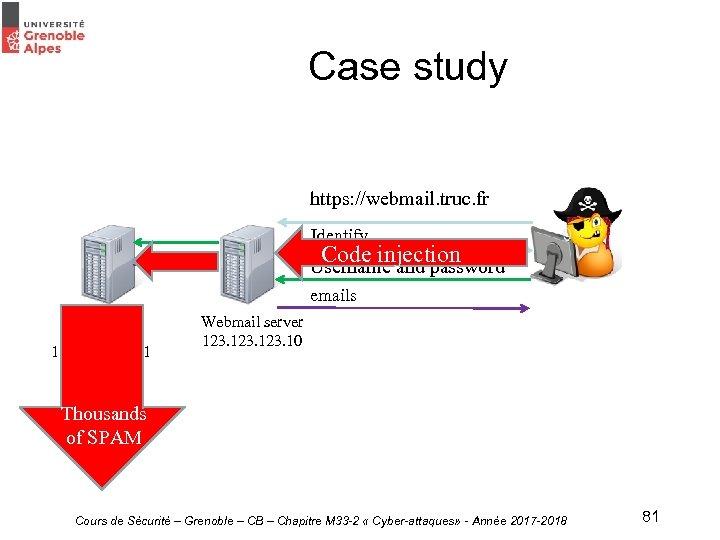
Case study https: //webmail. truc. fr Identify Code injection Username and password emails Mail server 123. 11 Webmail server 123. 10 Thousands of SPAM Cours de Sécurité – Grenoble – CB – Chapitre M 33 -2 « Cyber-attaques» - Année 2017 -2018 81
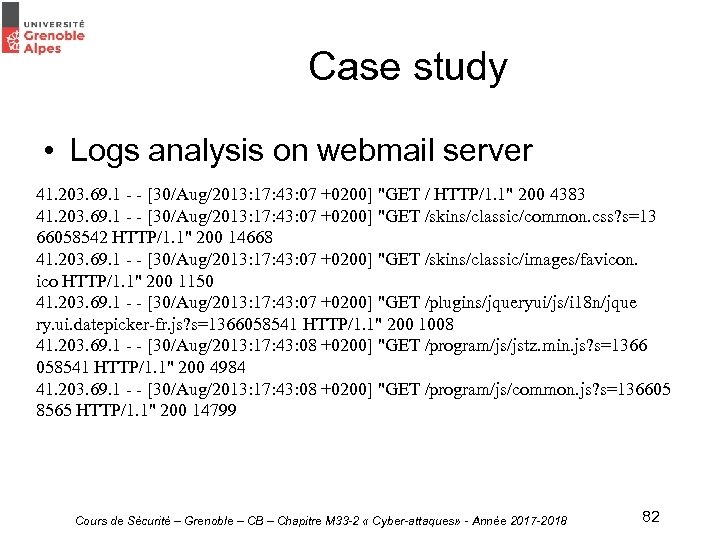
Case study • Logs analysis on webmail server 41. 203. 69. 1 - - [30/Aug/2013: 17: 43: 07 +0200] "GET / HTTP/1. 1" 200 4383 41. 203. 69. 1 - - [30/Aug/2013: 17: 43: 07 +0200] "GET /skins/classic/common. css? s=13 66058542 HTTP/1. 1" 200 14668 41. 203. 69. 1 - - [30/Aug/2013: 17: 43: 07 +0200] "GET /skins/classic/images/favicon. ico HTTP/1. 1" 200 1150 41. 203. 69. 1 - - [30/Aug/2013: 17: 43: 07 +0200] "GET /plugins/jqueryui/js/i 18 n/jque ry. ui. datepicker-fr. js? s=1366058541 HTTP/1. 1" 200 1008 41. 203. 69. 1 - - [30/Aug/2013: 17: 43: 08 +0200] "GET /program/js/jstz. min. js? s=1366 058541 HTTP/1. 1" 200 4984 41. 203. 69. 1 - - [30/Aug/2013: 17: 43: 08 +0200] "GET /program/js/common. js? s=136605 8565 HTTP/1. 1" 200 14799 Cours de Sécurité – Grenoble – CB – Chapitre M 33 -2 « Cyber-attaques» - Année 2017 -2018 82
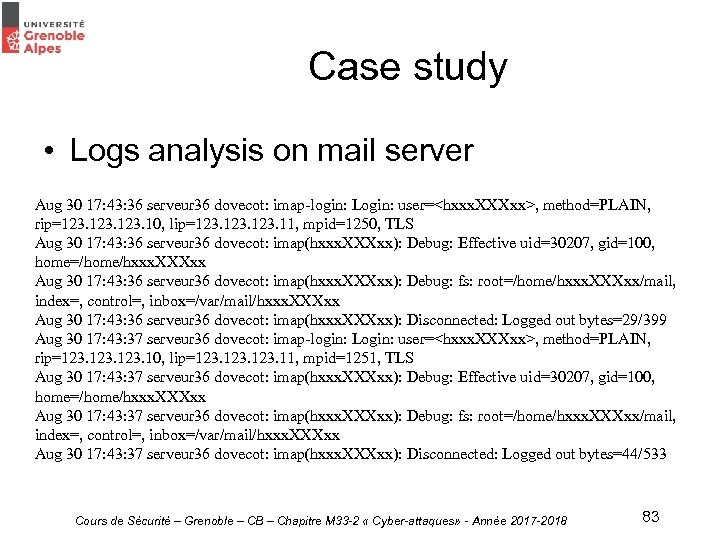
Case study • Logs analysis on mail server Aug 30 17: 43: 36 serveur 36 dovecot: imap-login: Login: user=<hxxx. XXXxx>, method=PLAIN, rip=123. 10, lip=123. 11, mpid=1250, TLS Aug 30 17: 43: 36 serveur 36 dovecot: imap(hxxx. XXXxx): Debug: Effective uid=30207, gid=100, home=/home/hxxx. XXXxx Aug 30 17: 43: 36 serveur 36 dovecot: imap(hxxx. XXXxx): Debug: fs: root=/home/hxxx. XXXxx/mail, index=, control=, inbox=/var/mail/hxxx. XXXxx Aug 30 17: 43: 36 serveur 36 dovecot: imap(hxxx. XXXxx): Disconnected: Logged out bytes=29/399 Aug 30 17: 43: 37 serveur 36 dovecot: imap-login: Login: user=<hxxx. XXXxx>, method=PLAIN, rip=123. 10, lip=123. 11, mpid=1251, TLS Aug 30 17: 43: 37 serveur 36 dovecot: imap(hxxx. XXXxx): Debug: Effective uid=30207, gid=100, home=/home/hxxx. XXXxx Aug 30 17: 43: 37 serveur 36 dovecot: imap(hxxx. XXXxx): Debug: fs: root=/home/hxxx. XXXxx/mail, index=, control=, inbox=/var/mail/hxxx. XXXxx Aug 30 17: 43: 37 serveur 36 dovecot: imap(hxxx. XXXxx): Disconnected: Logged out bytes=44/533 Cours de Sécurité – Grenoble – CB – Chapitre M 33 -2 « Cyber-attaques» - Année 2017 -2018 83
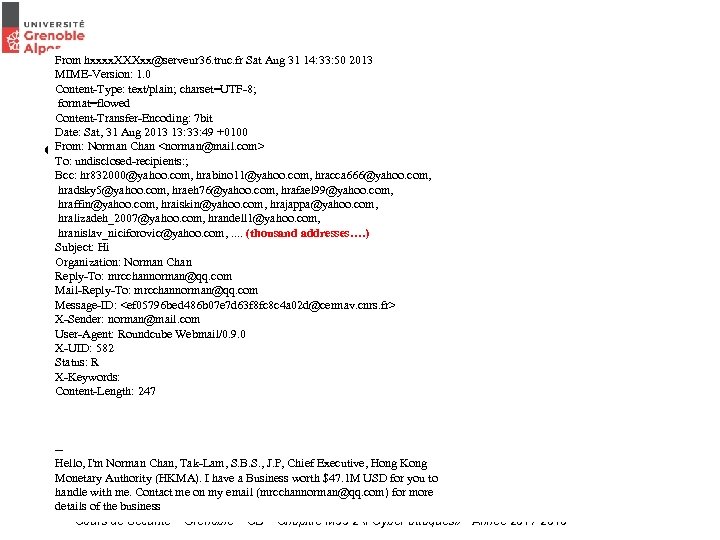
Case study From hxxxx. XXXxx@serveur 36. truc. fr Sat Aug 31 14: 33: 50 2013 MIME-Version: 1. 0 Content-Type: text/plain; charset=UTF-8; format=flowed Content-Transfer-Encoding: 7 bit Date: Sat, 31 Aug 2013 13: 33: 49 +0100 From: Norman Chan <norman@mail. com> To: undisclosed-recipients: ; Bcc: hr 832000@yahoo. com, hrabino 11@yahoo. com, hracca 666@yahoo. com, hradsky 5@yahoo. com, hraeh 76@yahoo. com, hrafael 99@yahoo. com, hraffin@yahoo. com, hraiskin@yahoo. com, hrajappa@yahoo. com, hralizadeh_2007@yahoo. com, hrandell 1@yahoo. com, hranislav_niciforovic@yahoo. com, . . (thousand addresses…. ) Subject: Hi Organization: Norman Chan Reply-To: mrcchannorman@qq. com Mail-Reply-To: mrcchannorman@qq. com Message-ID: <ef 05796 bed 486 b 07 e 7 d 63 f 8 fc 8 c 4 a 02 d@cermav. cnrs. fr> X-Sender: norman@mail. com User-Agent: Roundcube Webmail/0. 9. 0 X-UID: 582 Status: R X-Keywords: Content-Length: 247 • Type of mails sent by user -Hello, I'm Norman Chan, Tak-Lam, S. B. S. , J. P, Chief Executive, Hong Kong Monetary Authority (HKMA). I have a Business worth $47. 1 M USD for you to handle with me. Contact me on my email (mrcchannorman@qq. com) for more details of the business Cours de Sécurité – Grenoble – CB – Chapitre M 33 -2 « Cyber-attaques» - Année 2017 -2018 84
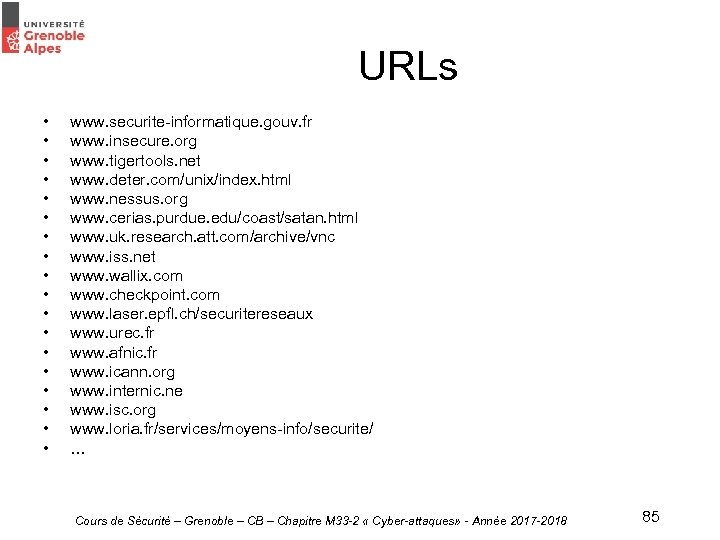
URLs • • • • • www. securite-informatique. gouv. fr www. insecure. org www. tigertools. net www. deter. com/unix/index. html www. nessus. org www. cerias. purdue. edu/coast/satan. html www. uk. research. att. com/archive/vnc www. iss. net www. wallix. com www. checkpoint. com www. laser. epfl. ch/securitereseaux www. urec. fr www. afnic. fr www. icann. org www. internic. ne www. isc. org www. loria. fr/services/moyens-info/securite/ … Cours de Sécurité – Grenoble – CB – Chapitre M 33 -2 « Cyber-attaques» - Année 2017 -2018 85
References • Sécurité et espionnage informatique : connaissance de la menace APT, Cédric Pernet, Eyrolles • Guide d’autodéfense numérique, éditions Tahin Party • Cybertactique : Conduire la guerre numérique, Bertrand Boyer, Nuvis Cours de Sécurité – Grenoble – CB – Chapitre M 33 -2 « Cyber-attaques» - Année 2017 -2018 86
Exercises • 1. What are the differences between an active attack and a passive attack? • 2. What are the conditions of success of an attack? • 3. Analysis of a Web site (preceding list, to be completed…), contents, interesting or uninteresting parts • 4. 2 nd step to the memoir on security: propose a classification of attacks, with the corresponding strategy to avoid these classes of attacks • 5. Try to identify some tools (software) which can be used for attacks Cours de Sécurité – Grenoble – CB – Chapitre M 33 -2 « Cyber-attaques» - Année 2017 -2018 87
Скачать презентацию M 33 -2 Cyber-attacks M 33 -2
d11b9186f35d640a6c68bbffdf739968.ppt