 Скачать презентацию LWG Assessment of DOE s Energy Portfolio George Crabtree
4d60a633d3fc056c16ea6ae41b3beb73.ppt
- Количество слайдов: 25



LWG Assessment of DOE’s Energy Portfolio George Crabtree Argonne National Laboratory Basic Energy Sciences Advisory Committee Aug 3, 2006
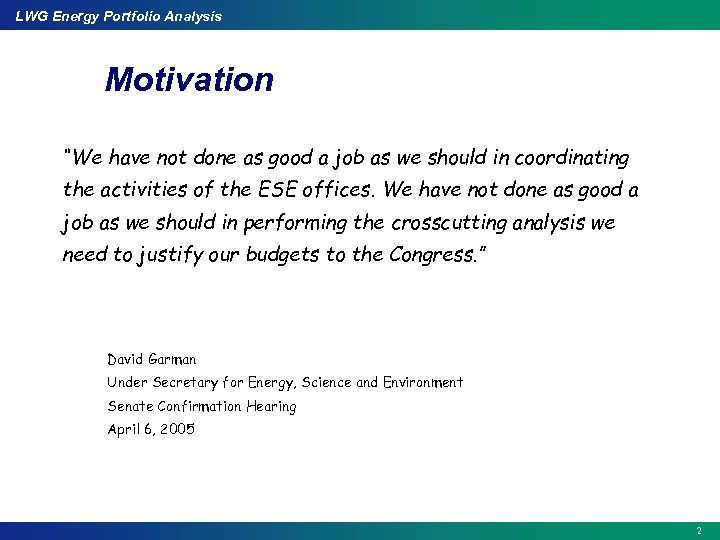
LWG Energy Portfolio Analysis Motivation “We have not done as good a job as we should in coordinating the activities of the ESE offices. We have not done as good a job as we should in performing the crosscutting analysis we need to justify our budgets to the Congress. ” David Garman Under Secretary for Energy, Science and Environment Senate Confirmation Hearing April 6, 2005 2
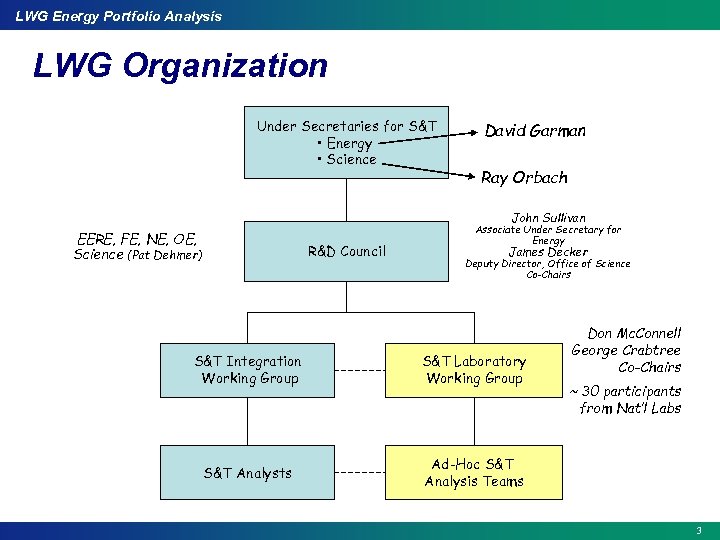
LWG Energy Portfolio Analysis LWG Organization Under Secretaries for S&T • Energy • Science David Garman Ray Orbach John Sullivan EERE, FE, NE, OE, Science (Pat Dehmer) R&D Council Associate Under Secretary for Energy James Decker Deputy Director, Office of Science Co-Chairs S&T Integration Working Group S&T Laboratory Working Group S&T Analysts Don Mc. Connell George Crabtree Co-Chairs Ad-Hoc S&T Analysis Teams ~ 30 participants from Nat’l Labs 3
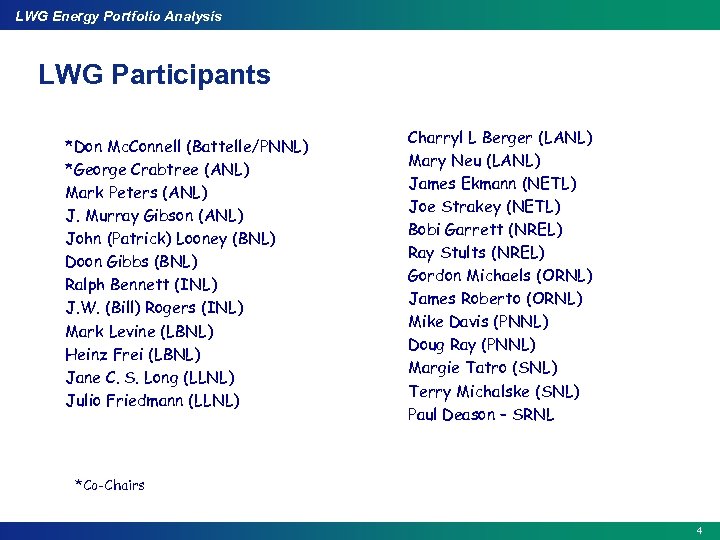
LWG Energy Portfolio Analysis Part I: Context LWG Participants *Don Mc. Connell (Battelle/PNNL) *George Crabtree (ANL) Mark Peters (ANL) J. Murray Gibson (ANL) John (Patrick) Looney (BNL) Doon Gibbs (BNL) Ralph Bennett (INL) J. W. (Bill) Rogers (INL) Mark Levine (LBNL) Heinz Frei (LBNL) Jane C. S. Long (LLNL) Julio Friedmann (LLNL) Charryl L Berger (LANL) Mary Neu (LANL) James Ekmann (NETL) Joe Strakey (NETL) Bobi Garrett (NREL) Ray Stults (NREL) Gordon Michaels (ORNL) James Roberto (ORNL) Mike Davis (PNNL) Doug Ray (PNNL) Margie Tatro (SNL) Terry Michalske (SNL) Paul Deason – SRNL *Co-Chairs 4
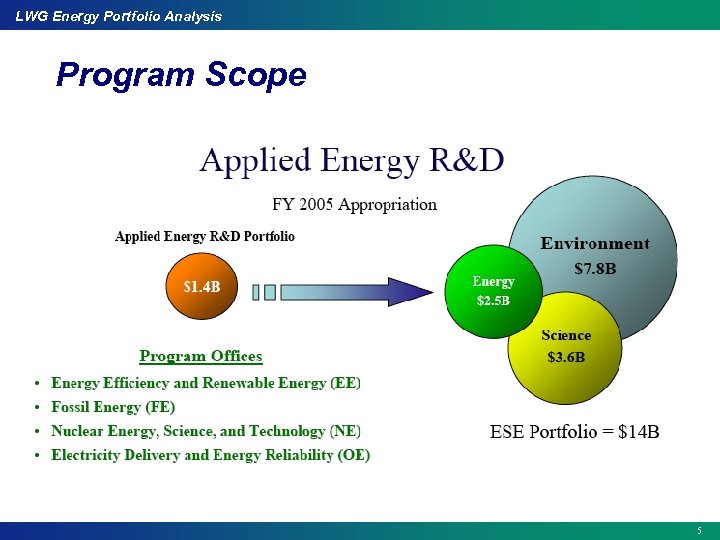
LWG Energy Portfolio Analysis Program Scope 5
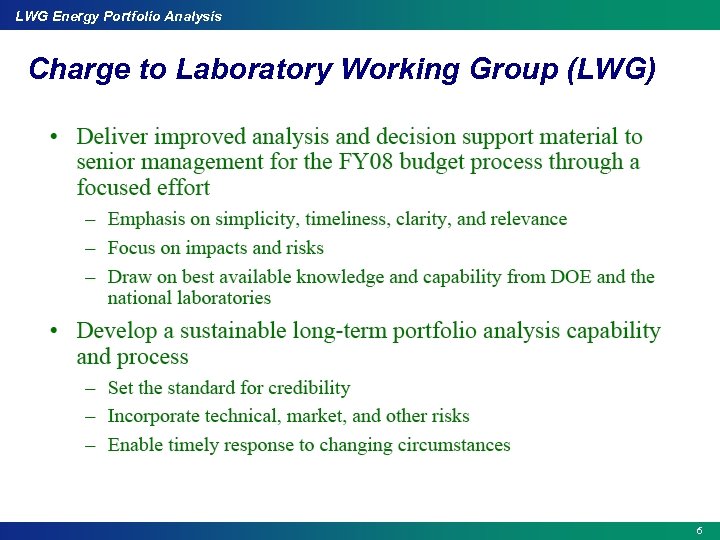
LWG Energy Portfolio Analysis Charge to Laboratory Working Group (LWG) 6
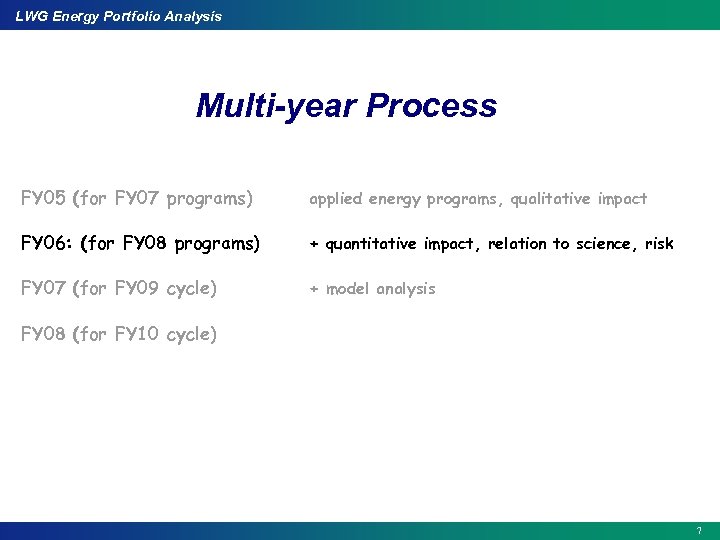
LWG Energy Portfolio Analysis Multi-year Process FY 05 (for FY 07 programs) applied energy programs, qualitative impact FY 06: (for FY 08 programs) + quantitative impact, relation to science, risk FY 07 (for FY 09 cycle) + model analysis FY 08 (for FY 10 cycle) 7
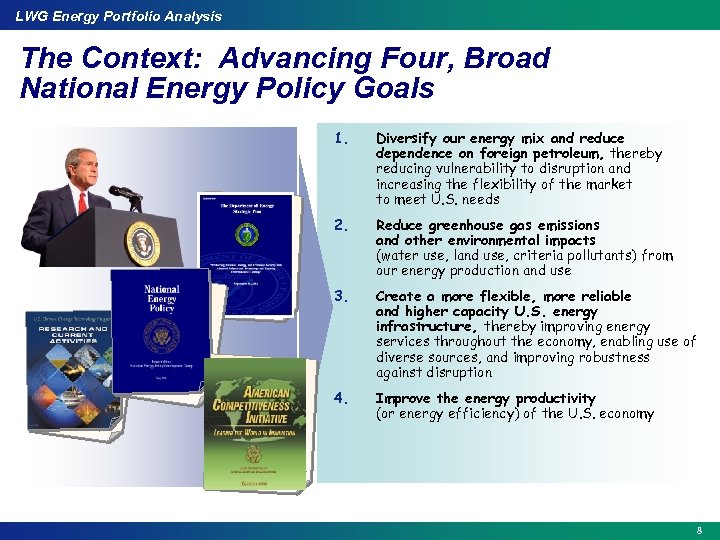
LWG Energy Portfolio Analysis The Context: Advancing Four, Broad National Energy Policy Goals 1. Diversify our energy mix and reduce dependence on foreign petroleum, thereby reducing vulnerability to disruption and increasing the flexibility of the market to meet U. S. needs 2. Reduce greenhouse gas emissions and other environmental impacts (water use, land use, criteria pollutants) from our energy production and use 3. Create a more flexible, more reliable and higher capacity U. S. energy infrastructure, thereby improving energy services throughout the economy, enabling use of diverse sources, and improving robustness against disruption 4. Improve the energy productivity (or energy efficiency) of the U. S. economy 8
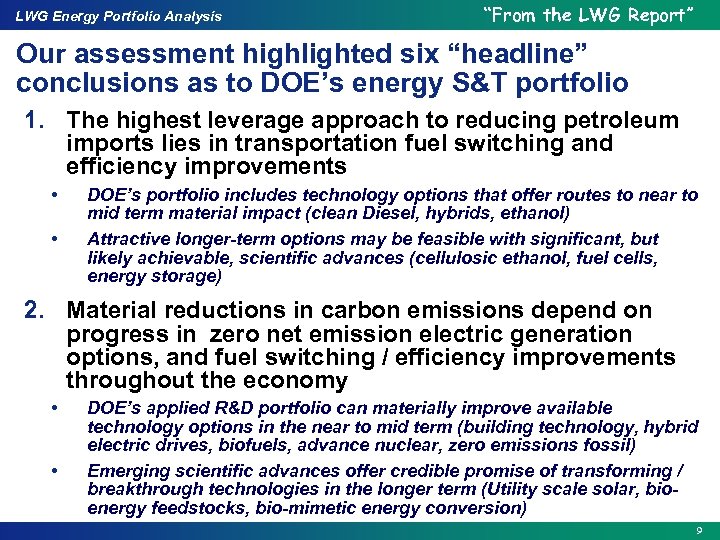
LWG Energy Portfolio Analysis “From the LWG Report” Our assessment highlighted six “headline” conclusions as to DOE’s energy S&T portfolio 1. The highest leverage approach to reducing petroleum imports lies in transportation fuel switching and efficiency improvements • • DOE’s portfolio includes technology options that offer routes to near to mid term material impact (clean Diesel, hybrids, ethanol) Attractive longer-term options may be feasible with significant, but likely achievable, scientific advances (cellulosic ethanol, fuel cells, energy storage) 2. Material reductions in carbon emissions depend on progress in zero net emission electric generation options, and fuel switching / efficiency improvements throughout the economy • • DOE’s applied R&D portfolio can materially improve available technology options in the near to mid term (building technology, hybrid electric drives, biofuels, advance nuclear, zero emissions fossil) Emerging scientific advances offer credible promise of transforming / breakthrough technologies in the longer term (Utility scale solar, bioenergy feedstocks, bio-mimetic energy conversion) 9
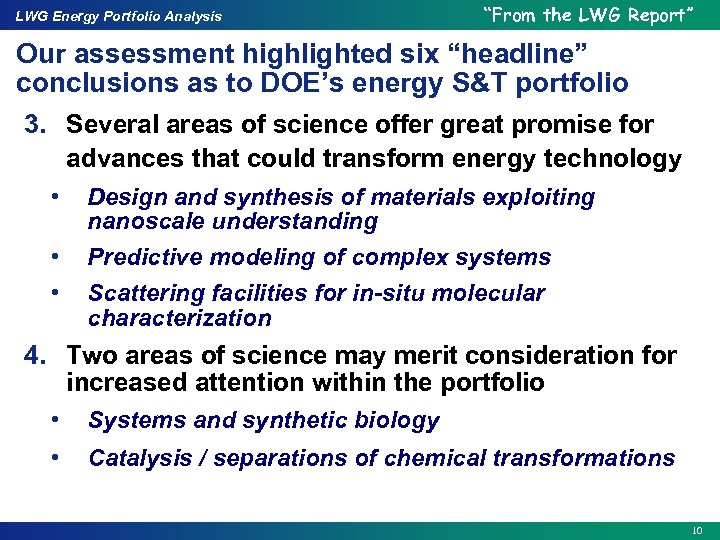
LWG Energy Portfolio Analysis “From the LWG Report” Our assessment highlighted six “headline” conclusions as to DOE’s energy S&T portfolio 3. Several areas of science offer great promise for advances that could transform energy technology • • • Design and synthesis of materials exploiting nanoscale understanding Predictive modeling of complex systems Scattering facilities for in-situ molecular characterization 4. Two areas of science may merit consideration for increased attention within the portfolio • Systems and synthetic biology • Catalysis / separations of chemical transformations 10
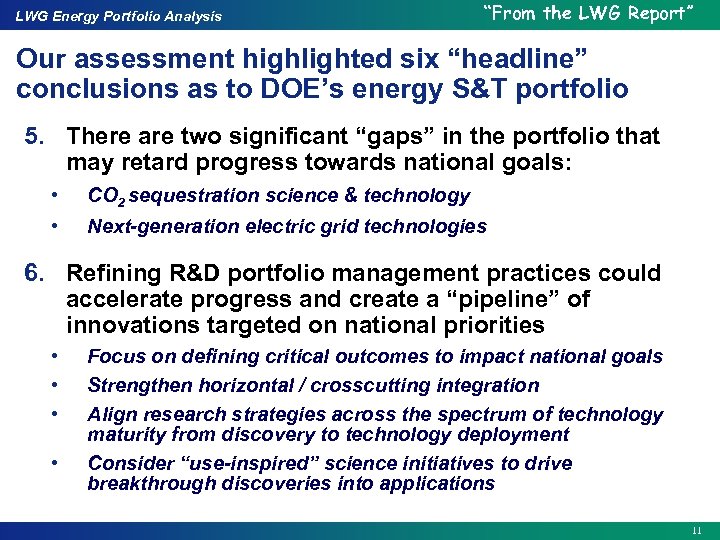
LWG Energy Portfolio Analysis “From the LWG Report” Our assessment highlighted six “headline” conclusions as to DOE’s energy S&T portfolio 5. There are two significant “gaps” in the portfolio that may retard progress towards national goals: • CO 2 sequestration science & technology • Next-generation electric grid technologies 6. Refining R&D portfolio management practices could accelerate progress and create a “pipeline” of innovations targeted on national priorities • • Focus on defining critical outcomes to impact national goals Strengthen horizontal / crosscutting integration Align research strategies across the spectrum of technology maturity from discovery to technology deployment Consider “use-inspired” science initiatives to drive breakthrough discoveries into applications 11
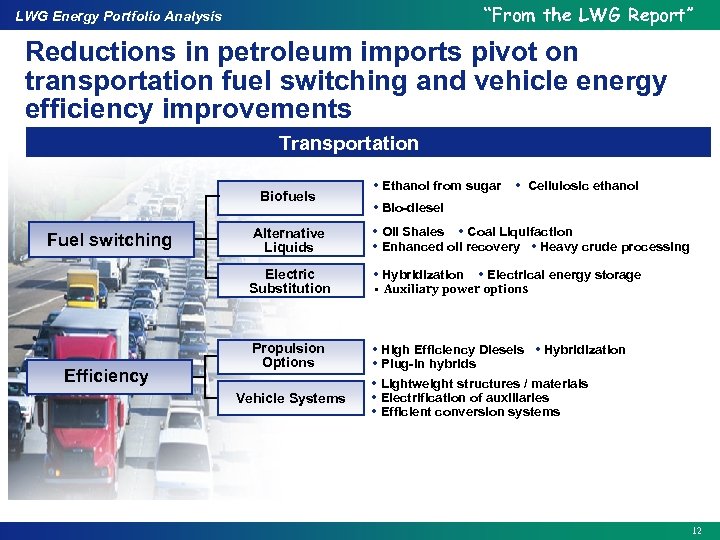
“From the LWG Report” LWG Energy Portfolio Analysis Reductions in petroleum imports pivot on transportation fuel switching and vehicle energy efficiency improvements Transportation Biofuels • Ethanol from sugar • Cellulosic ethanol • Bio-diesel Efficiency Alternative Liquids • Oil Shales • Coal Liquifaction • Enhanced oil recovery • Heavy crude processing Electric Substitution Fuel switching • Hybridization • Electrical energy storage • Auxiliary power options Propulsion Options • High Efficiency Diesels • Hybridization • Plug-in hybrids Vehicle Systems • Lightweight structures / materials • Electrification of auxiliaries • Efficient conversion systems 12
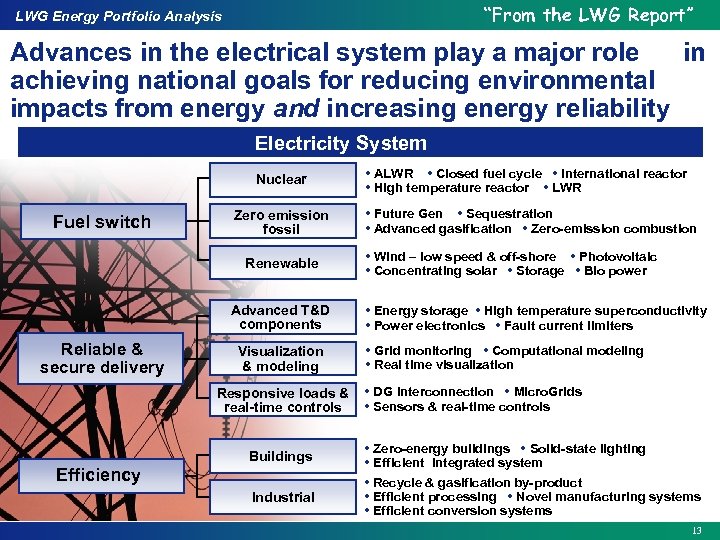
“From the LWG Report” LWG Energy Portfolio Analysis Advances in the electrical system play a major role in achieving national goals for reducing environmental impacts from energy and increasing energy reliability Electricity System Nuclear Fuel switch Zero emission fossil Renewable Advanced T&D components Reliable & secure delivery Visualization & modeling Responsive loads & real-time controls • ALWR • Closed fuel cycle • International reactor • High temperature reactor • LWR • Future Gen • Sequestration • Advanced gasification • Zero-emission combustion • Wind – low speed & off-shore • Photovoltaic • Concentrating solar • Storage • Bio power • Energy storage • High temperature superconductivity • Power electronics • Fault current limiters • Grid monitoring • Computational modeling • Real time visualization • DG interconnection • Micro. Grids • Sensors & real-time controls Buildings • Zero-energy buildings • Solid-state lighting • Efficient integrated system Industrial • Recycle & gasification by-product • Efficient processing • Novel manufacturing systems • Efficient conversion systems Efficiency 13
LWG Energy Portfolio Analysis “From the LWG Report” Mission impact requires translation from discovery to innovation to the market • DOE R&D faces two broadly recognized gaps: – Translation of new concepts arising out of basic research to conceptual stage but targeted R&D – Translation of near-mature technologies from working prototypes to commercial deployment • Both of these are “bi-directional” issues – Basic science creates entirely new technology possibilities – Technology efforts identify key issues requiring improved scientific understanding or new approaches – Improving technology performance suggests new deployment opportunities – Market feedback helps set technology performance requirements 14
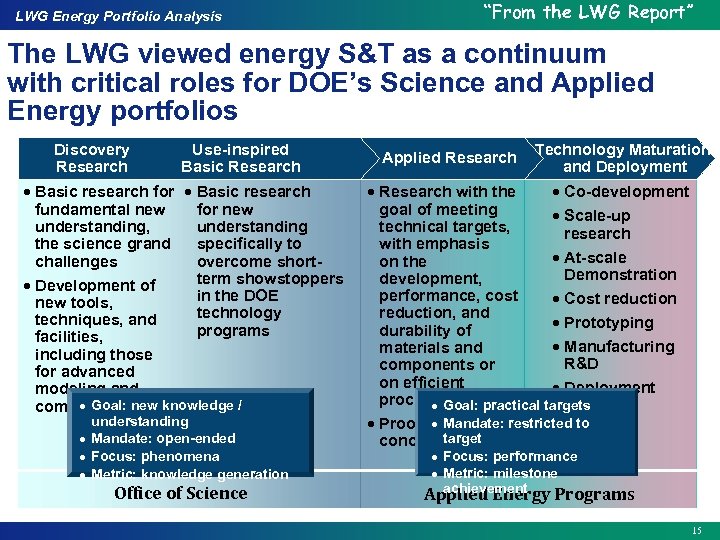
LWG Energy Portfolio Analysis “From the LWG Report” The LWG viewed energy S&T as a continuum with critical roles for DOE’s Science and Applied Energy portfolios Discovery Research Use-inspired Basic Research · Basic research for · Basic research fundamental new for new understanding, understanding the science grand specifically to challenges overcome shortterm showstoppers · Development of in the DOE new tools, technology techniques, and programs facilities, including those for advanced modeling and · Goal: computationnew knowledge / understanding · Mandate: open-ended · Focus: phenomena · Metric: knowledge generation Office of Science Applied Research Technology Maturation and Deployment · Research with the · Co-development goal of meeting · Scale-up technical targets, research with emphasis · At-scale on the Demonstration development, performance, cost · Cost reduction, and · Prototyping durability of · Manufacturing materials and R&D components or on efficient · Deployment processes · Goal: practical targets support · technology · Proof of Mandate: restricted to concept target · Focus: performance · Metric: milestone achievement Applied Energy Programs 15
LWG Energy Portfolio Analysis Issues for Next Cycle: Technology • Interaction of energy sources: “fuel switching” – Coal-gas-nuclear-renewable for electricity – Petroleum-biofuel for transportation – Alternative transportation energy options • Interaction of energy chains – Electricity-petroleum-natural gas-biofuel-hydrogen • Quantitative analysis of energy system – Market inertia, ripple effect across sources and chains 16
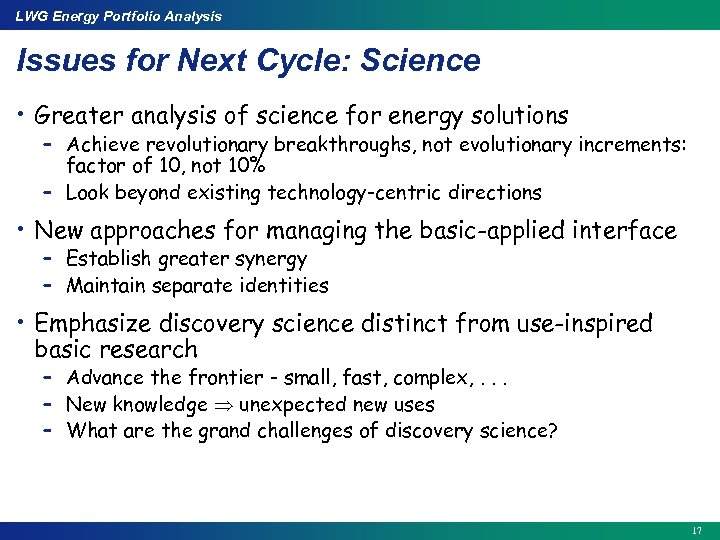
LWG Energy Portfolio Analysis Issues for Next Cycle: Science • Greater analysis of science for energy solutions – Achieve revolutionary breakthroughs, not evolutionary increments: factor of 10, not 10% – Look beyond existing technology-centric directions • New approaches for managing the basic-applied interface – Establish greater synergy – Maintain separate identities • Emphasize discovery science distinct from use-inspired basic research – Advance the frontier - small, fast, complex, . . . – New knowledge unexpected new uses – What are the grand challenges of discovery science? 17
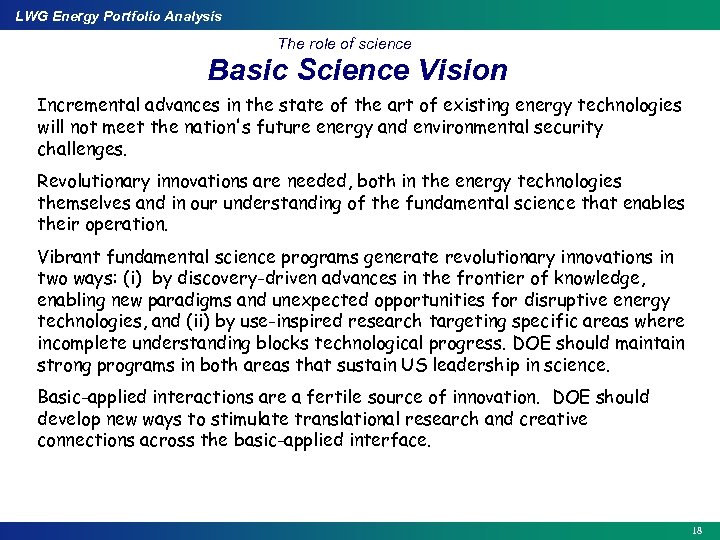
LWG Energy Portfolio Analysis The role of science Basic Science Vision Incremental advances in the state of the art of existing energy technologies will not meet the nation's future energy and environmental security challenges. Revolutionary innovations are needed, both in the energy technologies themselves and in our understanding of the fundamental science that enables their operation. Vibrant fundamental science programs generate revolutionary innovations in two ways: (i) by discovery-driven advances in the frontier of knowledge, enabling new paradigms and unexpected opportunities for disruptive energy technologies, and (ii) by use-inspired research targeting specific areas where incomplete understanding blocks technological progress. DOE should maintain strong programs in both areas that sustain US leadership in science. Basic-applied interactions are a fertile source of innovation. DOE should develop new ways to stimulate translational research and creative connections across the basic-applied interface. 18
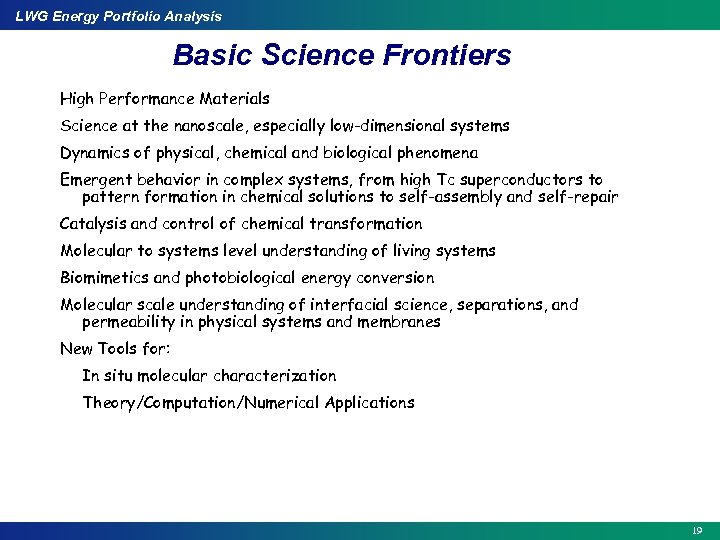
LWG Energy Portfolio Analysis Basic Science Frontiers High Performance Materials Science at the nanoscale, especially low-dimensional systems Dynamics of physical, chemical and biological phenomena Emergent behavior in complex systems, from high Tc superconductors to pattern formation in chemical solutions to self-assembly and self-repair Catalysis and control of chemical transformation Molecular to systems level understanding of living systems Biomimetics and photobiological energy conversion Molecular scale understanding of interfacial science, separations, and permeability in physical systems and membranes New Tools for: In situ molecular characterization Theory/Computation/Numerical Applications 19
LWG Energy Portfolio Analysis Back up slides 20
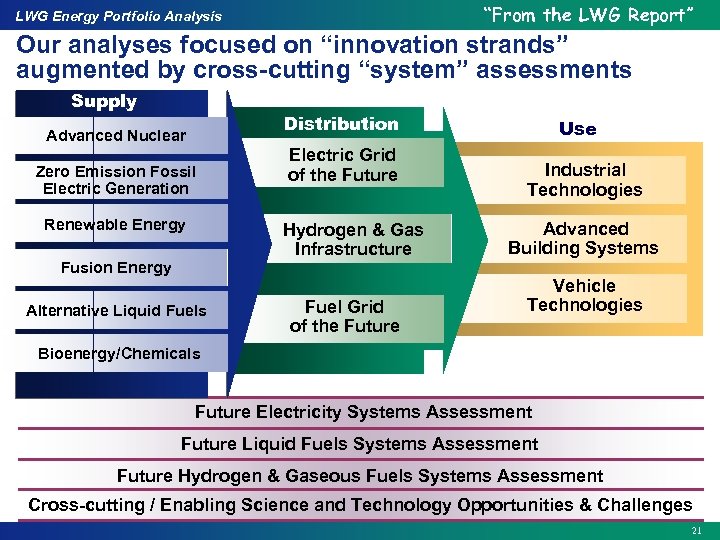
“From the LWG Report” LWG Energy Portfolio Analysis Our analyses focused on “innovation strands” augmented by cross-cutting “system” assessments Supply Distribution Advanced Nuclear Zero Emission Fossil Electric Generation Renewable Energy Electric Grid of the Future Hydrogen & Gas Infrastructure Fusion Energy Alternative Liquid Fuels Fuel Grid of the Future Use Industrial Technologies Advanced Building Systems Vehicle Technologies Bioenergy/Chemicals Future Electricity Systems Assessment Future Liquid Fuels Systems Assessment Future Hydrogen & Gaseous Fuels Systems Assessment Cross-cutting / Enabling Science and Technology Opportunities & Challenges 21
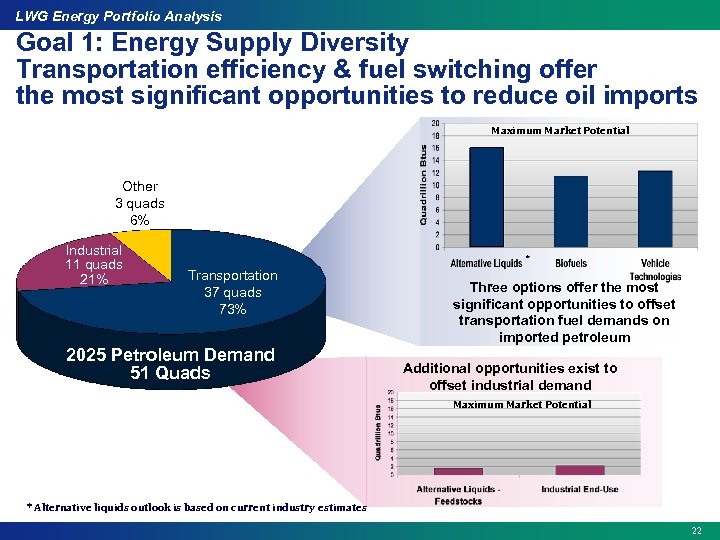
LWG Energy Portfolio Analysis Goal 1: Energy Supply Diversity Transportation efficiency & fuel switching offer the most significant opportunities to reduce oil imports Maximum Market Potential Other 3 quads 6% Industrial 11 quads 21% * Transportation 37 quads 73% 2025 Petroleum Demand 51 Quads Three options offer the most significant opportunities to offset transportation fuel demands on imported petroleum Additional opportunities exist to offset industrial demand Maximum Market Potential * Alternative liquids outlook is based on current industry estimates 22
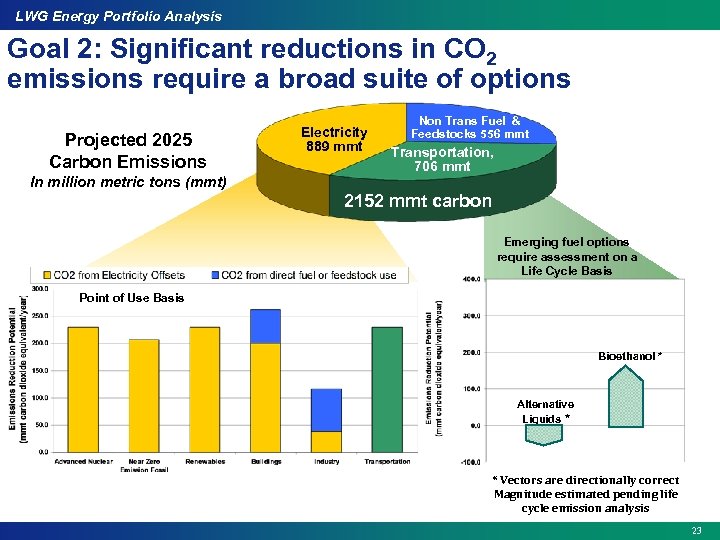
LWG Energy Portfolio Analysis Goal 2: Significant reductions in CO 2 emissions require a broad suite of options Projected 2025 Carbon Emissions In million metric tons (mmt) Electricity 889 mmt Non Trans Fuel & Feedstocks 556 mmt Transportation, 706 mmt 2152 mmt carbon Emerging fuel options require assessment on a Life Cycle Basis Point of Use Basis Bioethanol * Alternative Liquids * * Vectors are directionally correct Magnitude estimated pending life cycle emission analysis 23
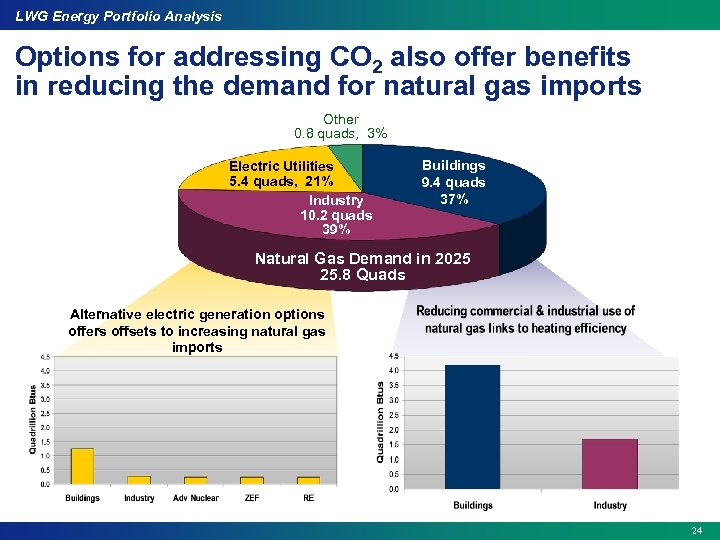
LWG Energy Portfolio Analysis Options for addressing CO 2 also offer benefits in reducing the demand for natural gas imports Other 0. 8 quads, 3% Electric Utilities 5. 4 quads, 21% Industry 10. 2 quads 39% Buildings 9. 4 quads 37% Natural Gas Demand in 2025 25. 8 Quads Alternative electric generation options offers offsets to increasing natural gas imports 24
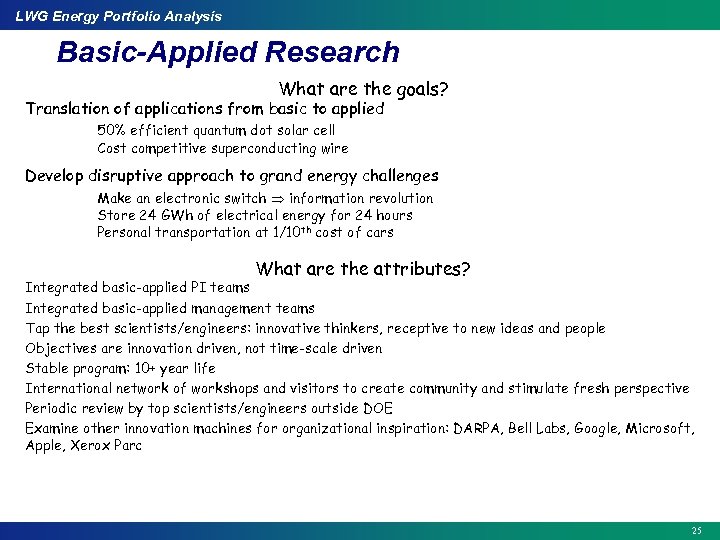
LWG Energy Portfolio Analysis Basic-Applied Research What are the goals? Translation of applications from basic to applied 50% efficient quantum dot solar cell Cost competitive superconducting wire Develop disruptive approach to grand energy challenges Make an electronic switch information revolution Store 24 GWh of electrical energy for 24 hours Personal transportation at 1/10 th cost of cars What are the attributes? Integrated basic-applied PI teams Integrated basic-applied management teams Tap the best scientists/engineers: innovative thinkers, receptive to new ideas and people Objectives are innovation driven, not time-scale driven Stable program: 10+ year life International network of workshops and visitors to create community and stimulate fresh perspective Periodic review by top scientists/engineers outside DOE Examine other innovation machines for organizational inspiration: DARPA, Bell Labs, Google, Microsoft, Apple, Xerox Parc 25
Скачать презентацию LWG Assessment of DOE s Energy Portfolio George Crabtree
4d60a633d3fc056c16ea6ae41b3beb73.ppt