


 Скачать презентацию LWE Research to Operations Dr Roy Rasmussen
3d68ed32cc2841bb185a7c2f4f6f5afe.ppt
- Количество слайдов: 19
 LWE – Research to Operations Dr. Roy Rasmussen (NCAR) Steve Howe (Vaisala)
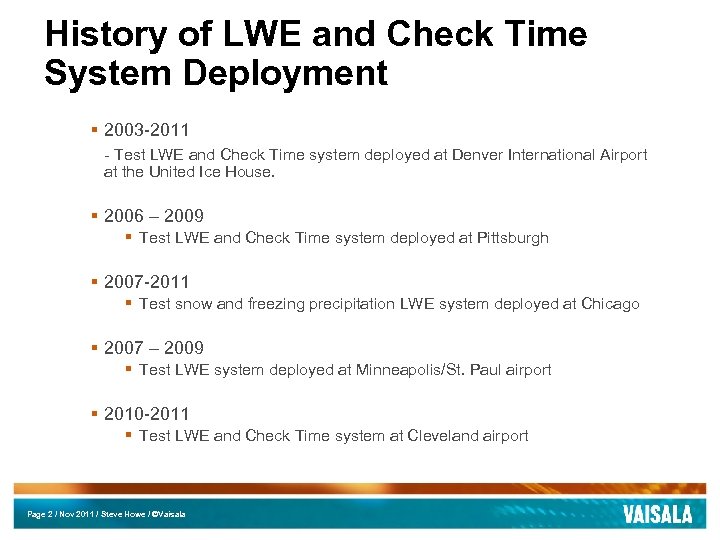 History of LWE and Check Time System Deployment § 2003 -2011 - Test LWE and Check Time system deployed at Denver International Airport at the United Ice House. § 2006 – 2009 § Test LWE and Check Time system deployed at Pittsburgh § 2007 -2011 § Test snow and freezing precipitation LWE system deployed at Chicago § 2007 – 2009 § Test LWE system deployed at Minneapolis/St. Paul airport § 2010 -2011 § Test LWE and Check Time system at Cleveland airport Page 2 / Nov 2011 / Steve Howe / ©Vaisala
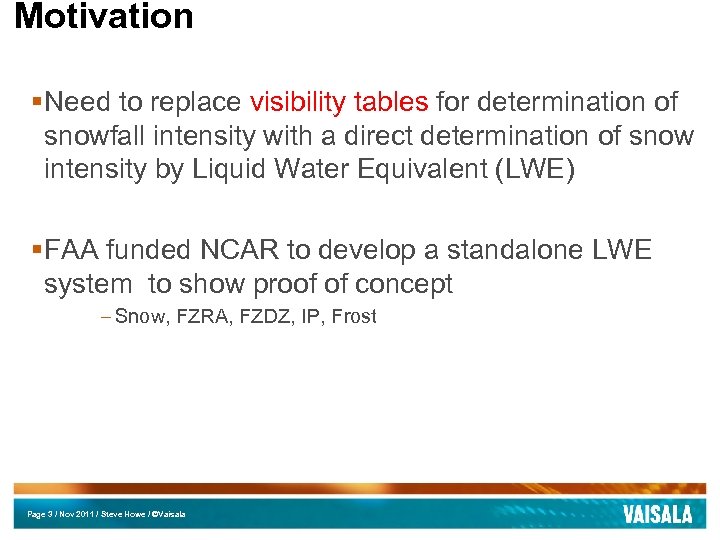 Motivation § Need to replace visibility tables for determination of snowfall intensity with a direct determination of snow intensity by Liquid Water Equivalent (LWE) § FAA funded NCAR to develop a standalone LWE system to show proof of concept – Snow, FZRA, FZDZ, IP, Frost Page 3 / Nov 2011 / Steve Howe / ©Vaisala
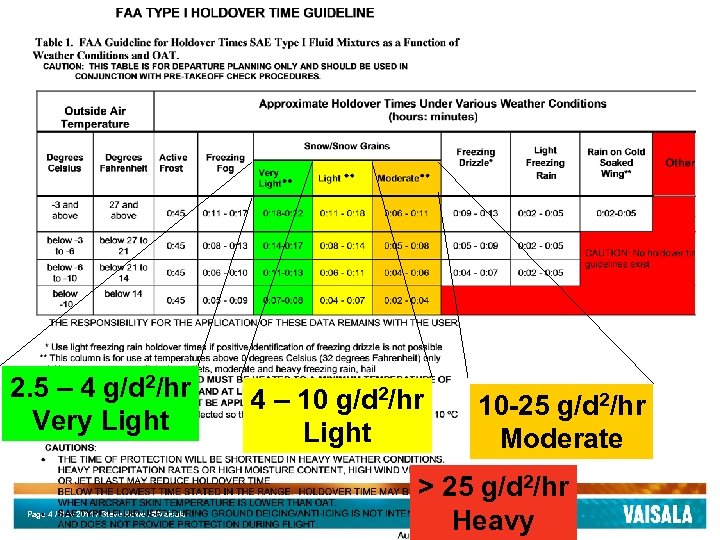 2. 5 – 4 g/d 2/hr Very Light Page 4 / Nov 2011 / Steve Howe / ©Vaisala 4 – 10 g/d 2/hr Light 10 -25 g/d 2/hr Moderate > 25 g/d 2/hr Heavy
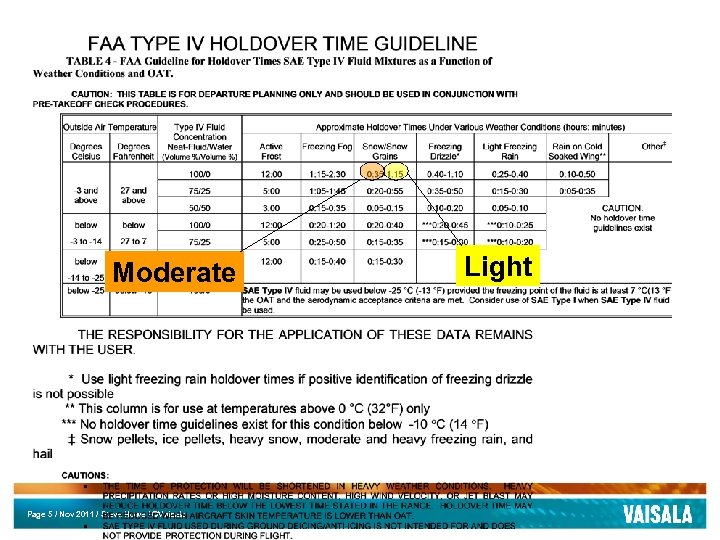 Moderate Page 5 / Nov 2011 / Steve Howe / ©Vaisala Light
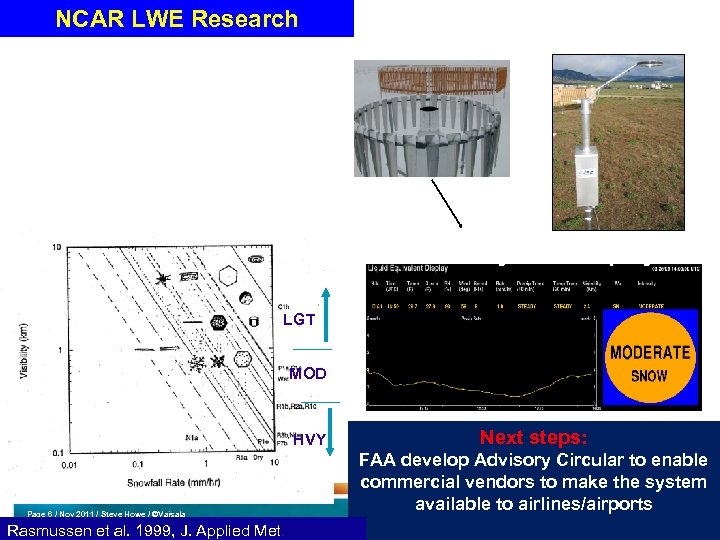 NCAR LWE Research The poor relationship between visibility and snowfall intensity motivated the FAA to request NCAR to develop a Liquid Water Equivalent (LWE) system and Check Time system using real-time snowgauges GEONOR snowgauge Hotplate snowgauge LWE System display LGT MOD HVY Page 6 / Nov 2011 / Steve Howe / ©Vaisala Rasmussen et al. 1999, J. Applied Met. Next steps: FAA develop Advisory Circular to enable commercial vendors to make the system available to airlines/airports
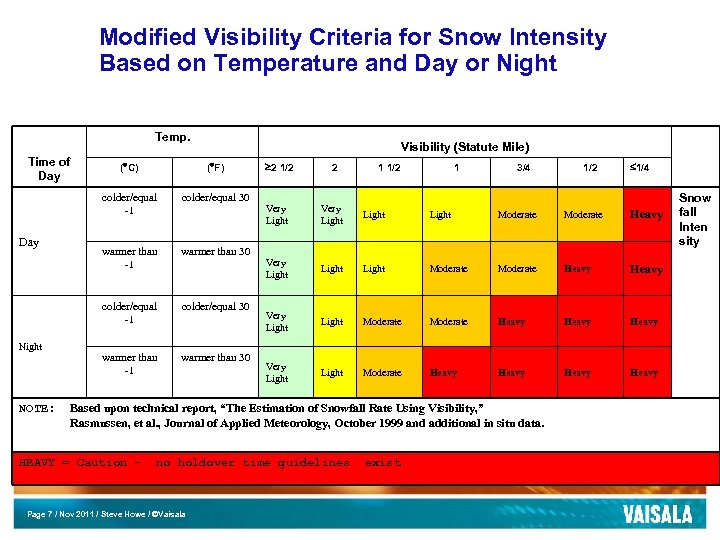 Modified Visibility Criteria for Snow Intensity Based on Temperature and Day or Night Temp. Time of Day Visibility (Statute Mile) colder/equal 30 warmer than -1 warmer than 30 colder/equal -1 Night ( F) colder/equal -1 Day ( C) colder/equal 30 warmer than -1 warmer than 30 2 1/2 2 1 1/2 1 3/4 Very Light Light Moderate Heavy Heavy Very Light Moderate Heavy no holdover time guidelines Page 7 / Nov 2011 / Steve Howe / ©Vaisala 1/4 Very Light NOTE: Based upon technical report, “The Estimation of Snowfall Rate Using Visibility, ” Rasmussen, et al. , Journal of Applied Meteorology, October 1999 and additional in situ data. HEAVY = Caution - 1/2 exist Snow fall Inten sity
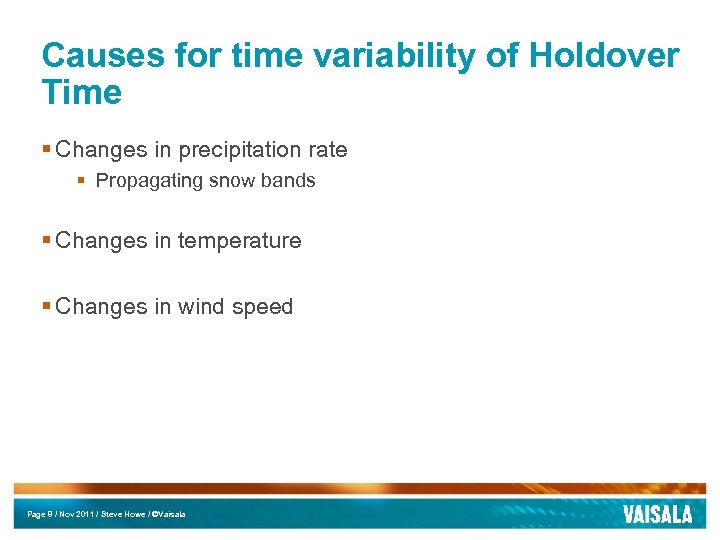 Causes for time variability of Holdover Time § Changes in precipitation rate § Propagating snow bands § Changes in temperature § Changes in wind speed Page 8 / Nov 2011 / Steve Howe / ©Vaisala
 Impact of Time Variation of Precipitation Rate, Temperature, and Wind Speed on Holdover Time § Data from Denver, Chicago and Pittsburgh all showed that time variation of precipitation has a significant effect on Holdover Time § On average, 50% of the Instantaneous HOTs longer than Check Time HOTs. § 15% of the Instantaneous HOTs a factor of 1. 25 longer than Check Time HOTs (a potential safety issue). § 5% of the Instantaneous HOTs a factor of 1. 5 long than Check Time HOTs Page 9 / Nov 2011 / Steve Howe / ©Vaisala
 Liquid Water Equivalent (LWE) § Why now? § Pressure from Airline industry to FAA to utilize LWE technology § FAA produced a draft Advisory Circular for LWES (Liquid Water Equivalent Systems) earlier this year § Provide LWE information for a Holdover Time Determination System (HOTDS) or Check. Time Determination System (CTDS) § Remove the uncertainty of using Visibility tables to estimate current precipitation conditions § HOTDS or CTDS reports one time (not a range like the current FAA/TC HOT) Page 10 / Nov 2011 / Steve Howe / ©Vaisala
 Vaisala LWE § Vaisala and NCAR worked closely together to transfer knowledge of WSDDM/LWE/Check. Time technology § Vaisala currently has licensed WSDDM and Check. Time technology § Vaisala WSDDM system is called Avi. Cast – Web Based – Uses LWE technology – Check. Time uses the same hardware/LWE station – Based on NCAR WSDDM technology – Example Vaisala LWE station - Page 11 / Nov 2011 / Steve Howe / ©Vaisala
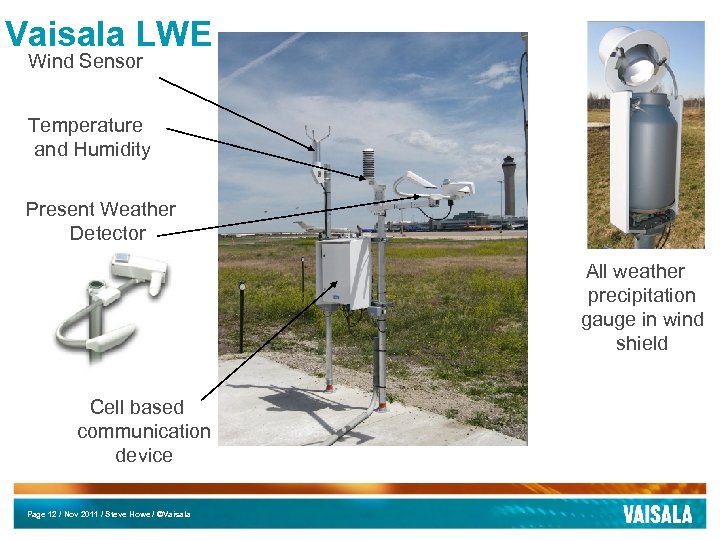 Vaisala LWE Wind Sensor Temperature and Humidity Present Weather Detector All weather precipitation gauge in wind shield Cell based communication device Page 12 / Nov 2011 / Steve Howe / ©Vaisala
 What is AVICAST? § Airports Decision Support System § Vaisala Service offering which provides short term forecasts for winter operations § Based on NCAR WSDDM – Winter Weather Support to Deicing Decision Making § Uses a combination of Vaisala ground stations and NOAA port information (Radars, METARS, winter weather warnings) § Includes Lightning data for year round operations § Web based – uses Adobe Flash Player § § Each user requires unique login and password details Multiple logins for each customer Only supports one login credentials to be logged in at any time IE and Firefox are supported browsers § Hosted out of Vaisala data center Page 13 / Nov 2011 / Steve Howe / ©Vaisala
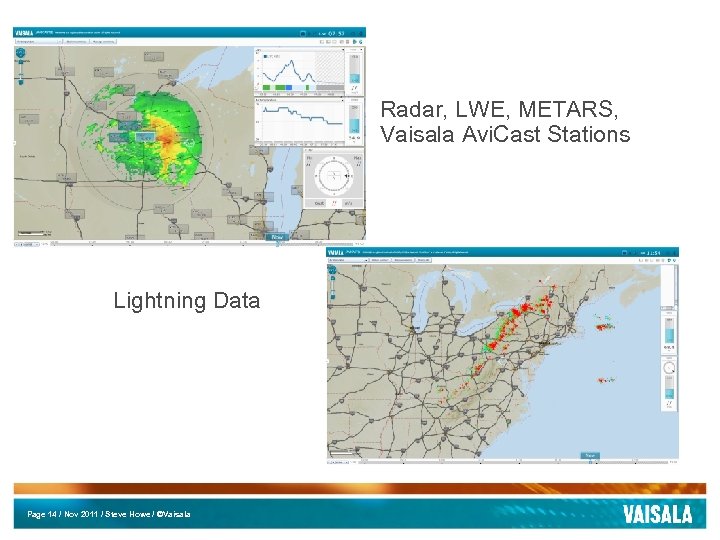 Radar, LWE, METARS, Vaisala Avi. Cast Stations Lightning Data Page 14 / Nov 2011 / Steve Howe / ©Vaisala
 Check. Time § Check. Time is an NCAR algorithm developed to replace current snow visibility tables used for generating a Hold. Over Time § Check. Time uses actual/reported Liquid Water Equivalent (LWE) information from the past 3 hours § Check. Time also uses temperature, wind speed and present weather conditions § Check. Time gives a time in the past which estimates how much of the fluid has failed by current and past conditions. § Advantages over Hold. Over Time § How much liquid water has been absorbed by the deicing fluid over the past 3 hours? § Has the precipitation intensity changed? (Light – Moderate - Heavy) § Has the temperature changed? Page 15 / Nov 2011 / Steve Howe / ©Vaisala
 Winter 2013/2014 Status § Vaisala is in Operational Demo for winter 2013/2014 § UPS is primary operator working with Vaisala § As per FAA agreement up to 4 additional airlines to UPS will also participate in operational demo § Airports supported for Operational Demo § DEN - Denver International Airport § ORD - Chicago O’Hare International Airport § MSP - Minneapolis St. Paul International Airport Planned to be added before snow season: § SDF - Louisville Regional Airport § ANC – Anchorage International Airport § BOS – Logan International Airport Page 16 / Nov 2011 / Steve Howe / ©Vaisala
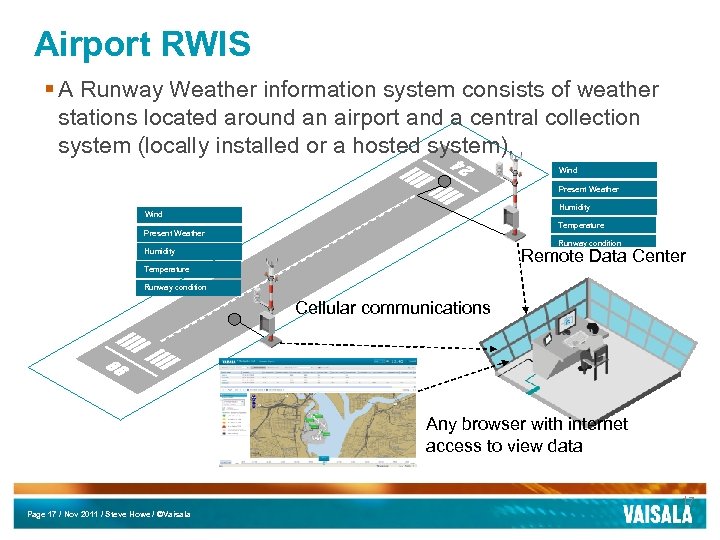 Airport RWIS § A Runway Weather information system consists of weather stations located around an airport and a central collection system (locally installed or a hosted system). Wind Present Weather Humidity Wind Temperature Present Weather Runway condition Remote Data Center Humidity Temperature Runway condition Cellular communications Any browser with internet access to view data 17 Page 17 / Nov 2011 / Steve Howe / ©Vaisala
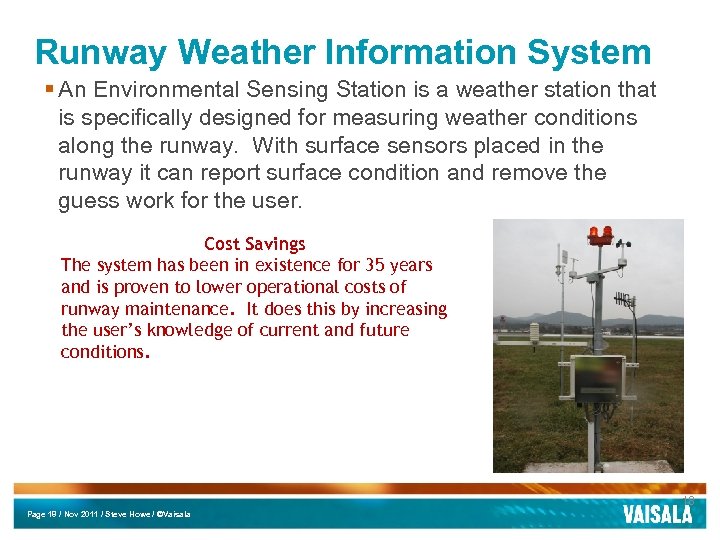 Runway Weather Information System § An Environmental Sensing Station is a weather station that is specifically designed for measuring weather conditions along the runway. With surface sensors placed in the runway it can report surface condition and remove the guess work for the user. Cost Savings The system has been in existence for 35 years and is proven to lower operational costs of runway maintenance. It does this by increasing the user’s knowledge of current and future conditions. 18 Page 18 / Nov 2011 / Steve Howe / ©Vaisala
 Dr. Roy Rasmussen rasmus@ucar. edu Steve Howe – steve. howe@vaisala. com Thank you! www. vaisala. com Page 19 / Nov 2011 / Steve Howe / ©Vaisala