


 Скачать презентацию LUNA at LNGS Alessandra Guglielmetti Universita degli Studi
2750cf54ae8c27479bb98c7175d6fcf0.ppt
- Количество слайдов: 18
 LUNA at LNGS Alessandra Guglielmetti Universita’ degli Studi di Milano and INFN, Milano, ITALY Outline: -Nuclear Fusion reactions in stars -Why going underground -The Luna Experiment -Future perspective Laboratory Underground Nuclear Astrophysics
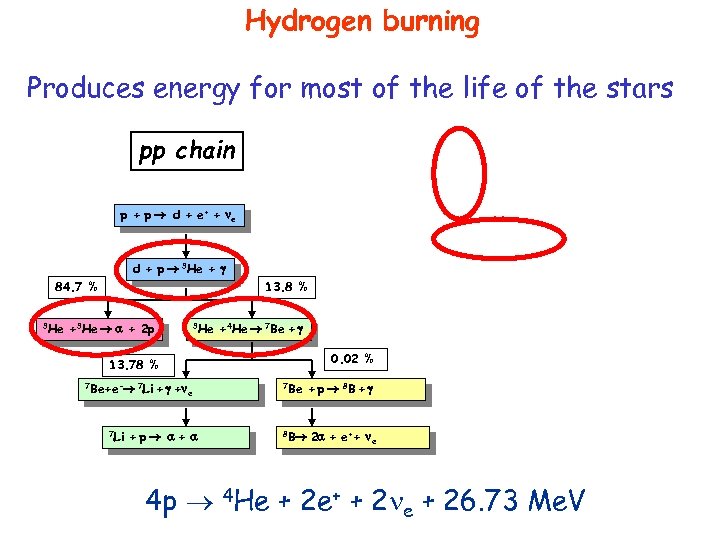 Hydrogen burning Produces energy for most of the life of the stars pp chain p + p d + e + + ne d + p 3 He + 84. 7 % 3 He 13. 8 % +3 He + 2 p 3 He +4 He 7 Be + 0. 02 % 13. 78 % 7 Be+e- 7 Li + +ne +p + 7 Be 8 B + p 8 B + 2 + e++ ne 4 p 4 He + 2 e+ + 2 e + 26. 73 Me. V
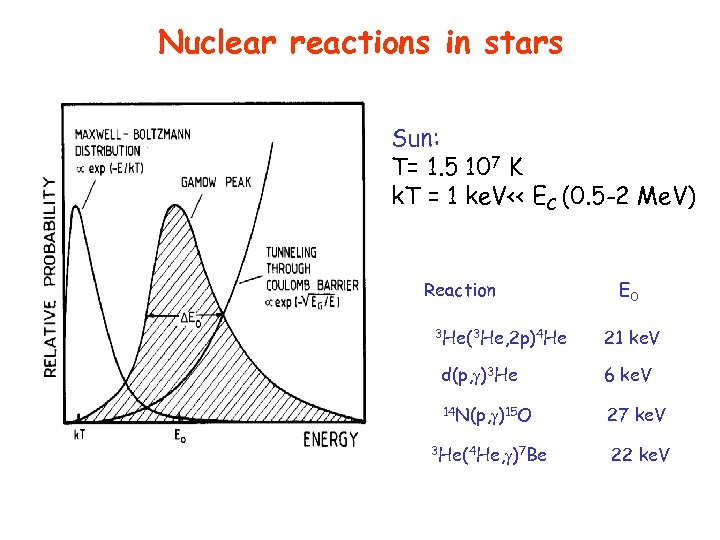 Nuclear reactions in stars Sun: T= 1. 5 107 K k. T = 1 ke. V<< EC (0. 5 -2 Me. V) Reaction 3 He(3 He, 2 p)4 He E 0 21 ke. V d(p, )3 He 6 ke. V 14 N(p, )15 O 27 ke. V 3 He(4 He, )7 Be 22 ke. V
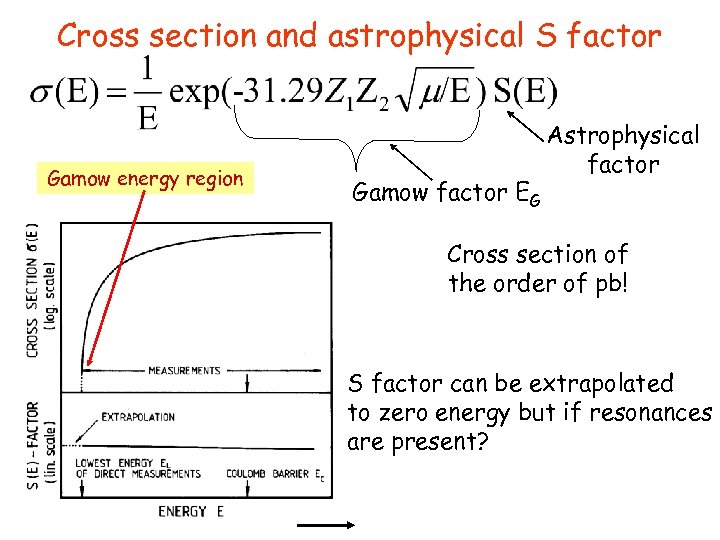 Cross section and astrophysical S factor Gamow energy region Gamow factor EG Astrophysical factor Cross section of the order of pb! S factor can be extrapolated to zero energy but if resonances are present?
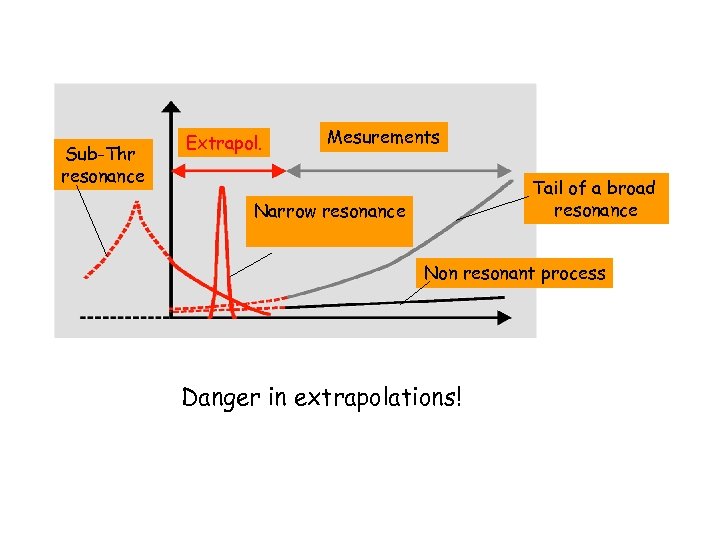 Sub-Thr resonance Extrapol. Mesurements Tail of a broad resonance Narrow resonance Non resonant process Danger in extrapolations!
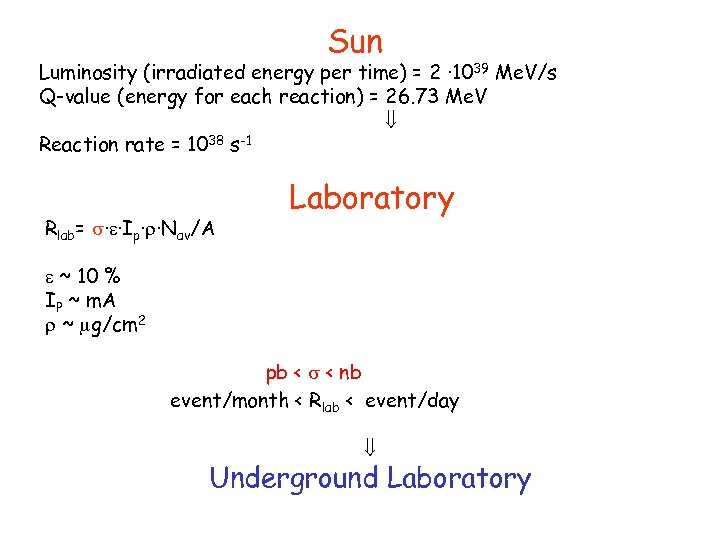 Sun Luminosity (irradiated energy per time) = 2 · 1039 Me. V/s Q-value (energy for each reaction) = 26. 73 Me. V Reaction rate = 1038 s-1 Rlab= · ·Ip· ·Nav/A Laboratory ~ 10 % IP ~ m. A ~ g/cm 2 pb < < nb event/month < Rlab < event/day Underground Laboratory
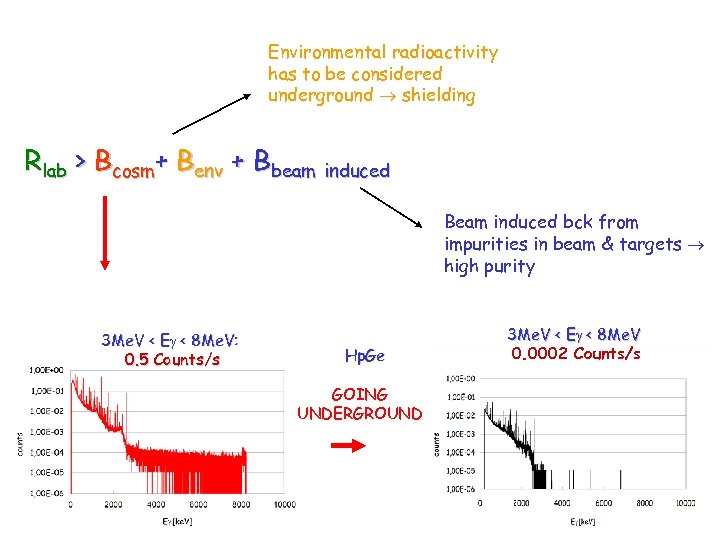 Cross section measurement requirements Environmental radioactivity has to be considered underground shielding Rlab > Bcosm+ Benv + Bbeam induced Beam induced bck from impurities in beam & targets high purity 3 Me. V < E < 8 Me. V: 0. 5 Counts/s Hp. Ge GOING UNDERGROUND 3 Me. V < E < 8 Me. V 0. 0002 Counts/s
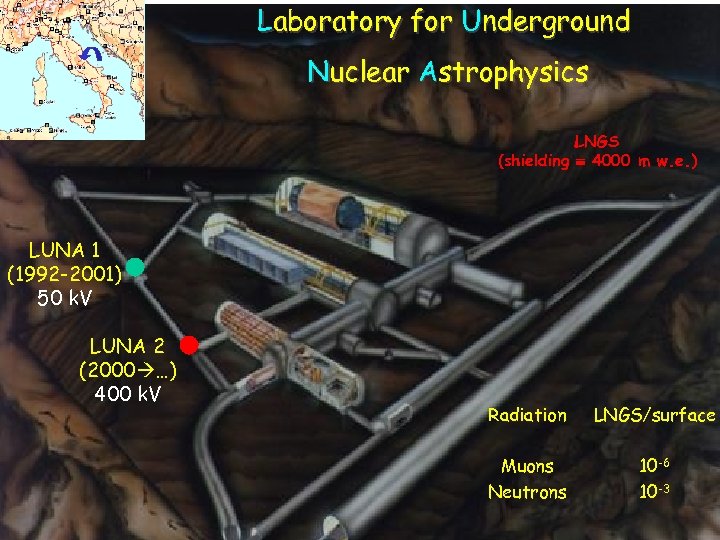 Laboratory for Underground Nuclear Astrophysics LUNA site LNGS (shielding 4000 m w. e. ) LUNA 1 (1992 -2001) 50 k. V LUNA 2 (2000 …) 400 k. V Radiation LNGS/surface Muons Neutrons 10 -6 10 -3
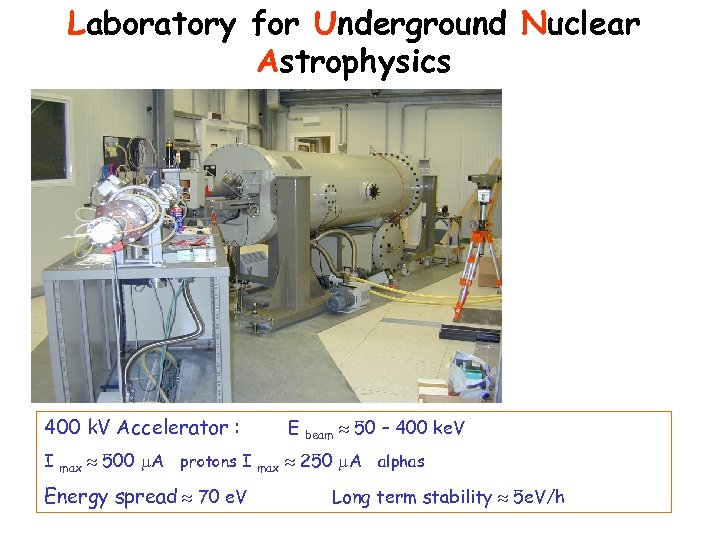 Laboratory for Underground Nuclear Astrophysics 400 k. V Accelerator : E beam 50 – 400 ke. V I max 500 A protons I max 250 A alphas Energy spread 70 e. V Long term stability 5 e. V/h
 LUNA "non solar phase" 2006 -ongoing (p, ) reactions on : Nitrogen, Oxygen, Neon, Sodium and Magnesium isotopes belonging to: CNO, Ne. Na and Mg. Al cycles of Hydrogen burning Important for second generation stars with temperature and mass higher than those of our Sun Seeds of the reactions already present Higher Coulomb barrier: these cycles are unimportant for energy generation but essential for nucleosynthesis of elements with A>20
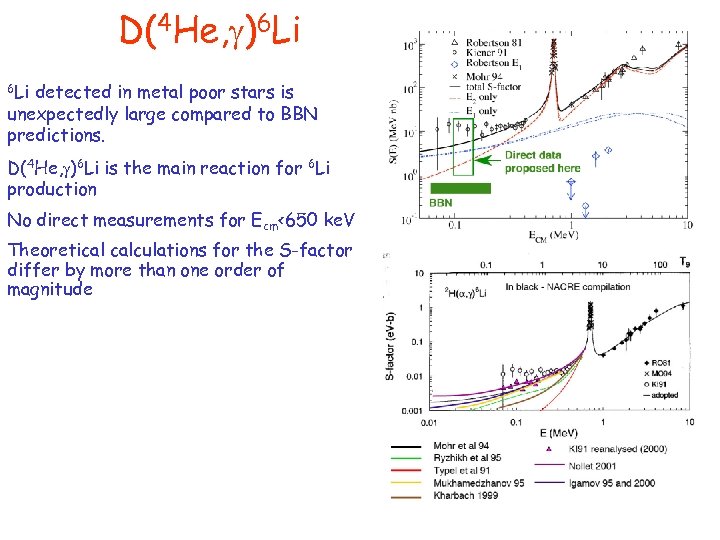 D(4 He, )6 Li detected in metal poor stars is unexpectedly large compared to BBN predictions. D(4 He, )6 Li is the main reaction for 6 Li production No direct measurements for Ecm<650 ke. V Theoretical calculations for the S-factor differ by more than one order of magnitude
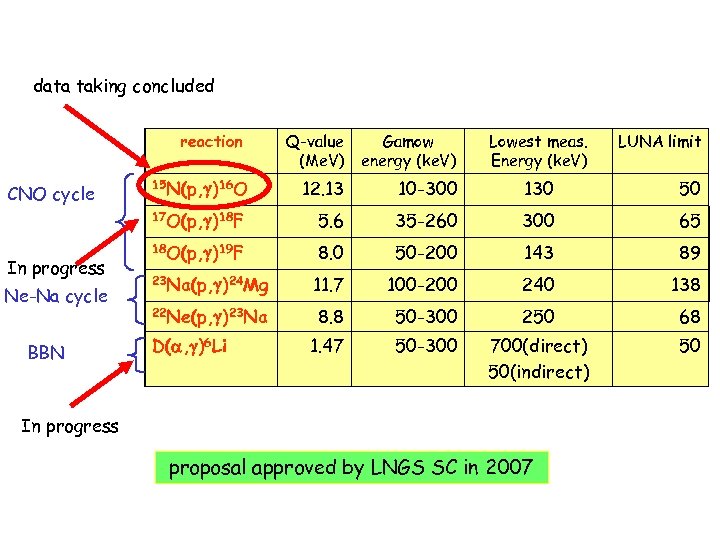 data taking concluded reaction In progress Ne-Na cycle BBN Gamow energy (ke. V) 12. 13 10 -300 130 50 17 O(p, )18 F CNO cycle Q-value (Me. V) 5. 6 35 -260 300 65 18 O(p, )19 F 8. 0 50 -200 143 89 23 Na(p, )24 Mg 11. 7 100 -200 240 138 22 Ne(p, )23 Na 8. 8 50 -300 250 68 1. 47 50 -300 700(direct) 50(indirect) 50 15 N(p, )16 O D( , )6 Li Lowest meas. Energy (ke. V) In progress proposal approved by LNGS SC in 2007 LUNA limit
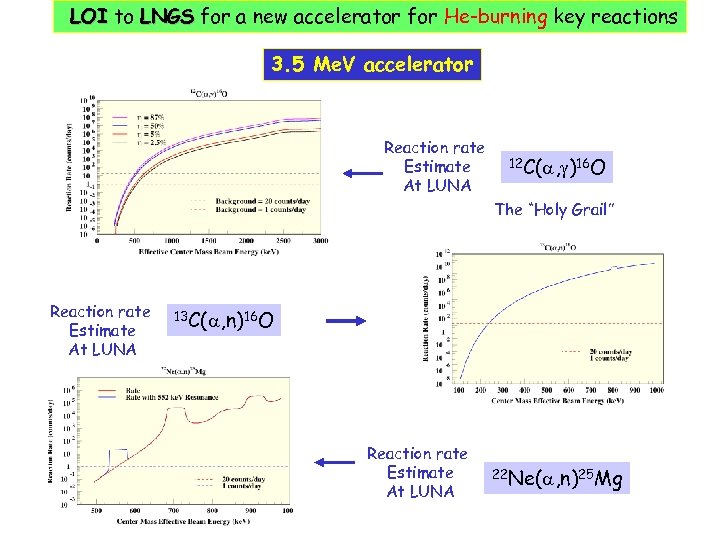 LOI to LNGS for a new accelerator for He-burning key reactions 3. 5 Me. V accelerator Reaction rate Estimate At LUNA 12 C( , )16 O The “Holy Grail” Reaction rate Estimate At LUNA 13 C( , n)16 O Reaction rate Estimate At LUNA 22 Ne( , n)25 Mg
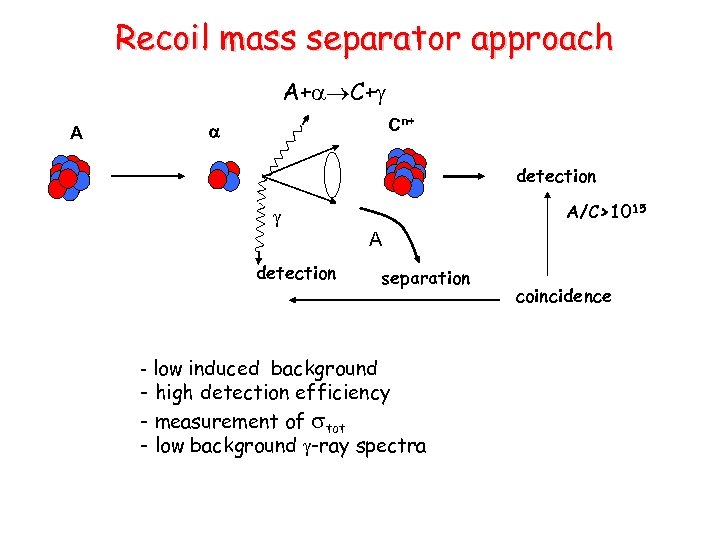 Recoil mass separator approach A+ C+ A Cn+ detection A/C>1015 A detection separation - low induced background - high detection efficiency - measurement of tot - low background -ray spectra coincidence
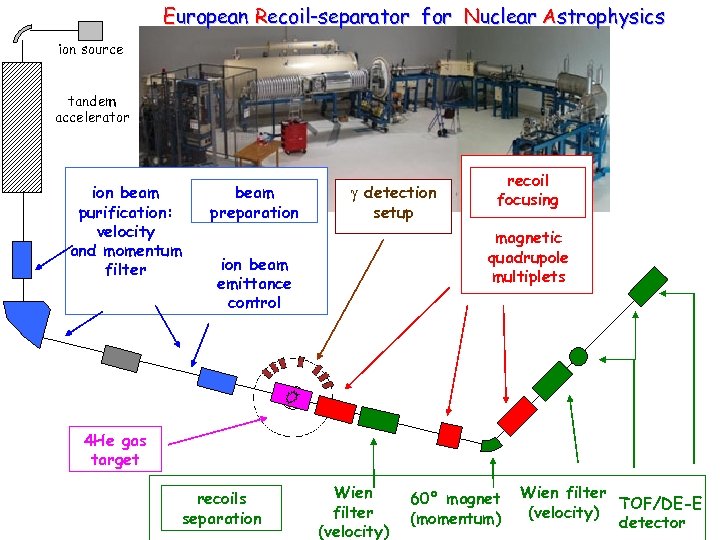 European Recoil-separator for Nuclear Astrophysics ion source tandem accelerator ion beam purification: velocity and momentum filter beam preparation detection setup recoil focusing magnetic quadrupole multiplets ion beam emittance control 4 He gas target recoils separation Wien filter (velocity) 60° magnet (momentum) Wien filter TOF/DE-E (velocity) detector
 ERNA experimental program Hydrogen burning and neutrino flux from 8 B 3 He( , )7 Be measured in Bochum 7 Be(p, )8 B Helium burning and synthesis of Oxygen and Fluorine 12 C( , )16 O measured in Bochum down to ~2 Me. V CM 14 N( , )18 F(b+)18 O 15 N( , )19 F
 LUNA COLLABORATION Laboratori Nazionali del Gran Sasso, INFN, ASSERGI: A. Formicola, C. Gustavino, M. Junker Forschungszentrum Dresden-Rossendorf, Germany D. Bemmerer, M. Marta INFN, Padova, Italy C. Broggini, A. Caciolli, M. Erhard, R. Menegazzo, C. Rossi Alvarez Institute of Nuclear Research (ATOMKI), Debrecen, Hungary Z. Elekes, Zs. Fülöp, Gy. Gyurky, E. Somorjai Osservatorio Astronomico di Collurania, Teramo, and INFN, Napoli, Italy O. Straniero Ruhr-Universität Bochum, Germany C. Rolfs, F. Strieder, H. P. Trautvetter Seconda Università di Napoli, Caserta, and INFN, Napoli, Italy F. Terrasi Università di Genova and INFN, Genova, Italy F. Confortola, P. Corvisiero, H. Costantini, A. Lemut, P. Prati Università di Milano and INFN, Milano, Italy V. Capogrosso, A. Guglielmetti, C. Mazzocchi Università di Napoli ''Federico II'', and INFN, Napoli, Italy G. Imbriani, B. Limata, V. Roca Università di Torino and INFN, Torino, Italy G. Gervino
 ERNA COLLABORATION INFN, Napoli, Italy M. De Cesare, N. De Cesare, A. Di Leva, A. D'Onofrio, L. Gialanella, G. Imbriani, B. Limata, M. Romano, D. Schuermann, F. Terrasi, S. Cristallo, L. Piersanti INFN, Napoli, Italy M. Busso, R. Guandalini, M. Nucci, S. Palmerini. A. Salterelli Ruhr-Universität Bochum, Germany D. Rogalla, C. Rolfs, F. Strieder Institute of Nuclear Research (ATOMKI), Debrecen, Hungary University of Connecticut, USA CNRS Orsay, France University of Jerusalem, Israel